How the Three Client Mindsets Reveal the Biggest Revenue Opportunity You’re Missing
You know that AI is transforming your agency world, and clients hire you for what goes on between your ears—not just pretty pictures and clever taglines.
But you’re feeling that AI fatigue. Ten new tools launch every single day, and you’re not sure how to wrap your arms around something so slippery.
Therefore, what if I told you the agencies mastering AI transparency today become the indispensable partners clients can’t imagine moving forward without tomorrow?
Welcome to the Business of Story. I’m Park Howell.
Today’s guest is Drew McLellan, CEO of Agency Management Institute, who just dropped groundbreaking research revealing what agency clients really think about AI. And honestly? The findings flipped conventional wisdom on its head.
The Three Mindsets Your Clients Are Living In
Screenshot
Drew’s research revealed three distinct groups among agency clients:
AI Embracers see AI as a way to get deeper, better, faster results from their agencies. Not cheaper. Better. These clients are inviting agencies into R&D teams, sales teams, and customer service—opening massive new revenue streams.
AI Skeptics aren’t dismissing AI. They’re nervous about legal implications and data privacy. They need transparency about how you’re using AI safely. Education and guardrails make them comfortable.
AI Opportunists think they can save money and pull work in-house using ChatGPT. They often need to fail first before understanding the “garbage in, garbage out” reality.
Here’s what shocked me: very few clients think about AI in terms of paying you less.
The iPad Moment That Changed Everything
I’ll never forget walking into my largest client’s office in 2010 with the first iPad.
Forever Living Products International. Two billion in annual revenue.
The first 15 minutes? Handing that iPad around while they ooh-ed and ahh-ed over this magical device.
We are a leading-edge industry. Clients pay us for what goes on between our ears first and foremost. Everything else is secondary.
But here’s the thing: I had a copywriter on that project who still used a flip phone. Refused to upgrade. And you know what happened?
He couldn’t keep up. The world passed him by.
The Transparency Crisis Nobody’s Talking About
Here’s what clients told Drew: agencies are using AI but not telling them how, when, or why.
That feels like hiding something.
You need a clear AI policy explaining your tools, benefits, and usage. Not because clients demand cheaper work (they don’t). But because transparency transforms you from vendor to partner.
Botification vs. Beautification
I call it “botification” versus “beautification.”
Generic AI outputs create forgettable, commodity content. That’s botification—the junk ChatGPT spits out when people don’t know what they’re doing.
Beautification happens when you know what you’re doing. When AI advances your messaging, your cause, your strategy because you’ve got the human expertise guiding the technology.
AI can’t ask innovative questions like you can. Can’t connect dots the way human intelligence does. Can’t understand buyer psychology the way experienced marketers do.
But man, can it crunch data and help you ask better questions.
The Teaching Transformation
Fifteen years ago, clients asked me to teach them the Story Cycle System.
My first reaction? “Hell no, that’s my IP.”
But here’s what happened when I said yes: campaigns became more successful because internal teams understood the strategy. Clients increased their budgets instead of leaving. The relationship transformed from vendor to indispensable partner.
You’re no longer a vendor when you’re co-creating and leveling people up as professionals.
They never forget it.
My Dad’s Question That Haunts Me Still
Six months into starting Park & Co., my dad asked me: “You seem really busy, when do you take time to think?”
He was a civil engineer. Practical. Direct.
“You can’t just be busy all the time. Otherwise, you’re going to busy yourself with so many problems, lose so much money by being busy. You have to take time away from your work and just go and think.”
That wisdom matters more now than ever.
The Math Most Agency Owners Don’t Do
Drew laid it out: invest an hour a day in AI learning. By month’s end, you’ll save 20 hours per week.
But agency owners stuck doing things the old way don’t make that calculation.
And what’s going to happen? They’re going to be irrelevant.
Like the copywriter with the flip phone.
The Real Question Isn’t “Which Tool?”
It’s too soon to know which tool will win. ChatGPT might not be the leader in five years.
The question is: How do you use AI to think deeper, better, and faster?
How do you add even more value to client work and help them advance their goals faster?
That’s what you need to be honing right now.
The Democratization Nobody Expected
COVID democratized agency location. Clients stopped caring where you’re physically located.
Now, AI is democratizing capability.
A five-person agency using AI strategically can compete with 100-person shops. You can turn a three-hour proposal customization into a three-minute task while maintaining quality.
The playing field just leveled. Hard.
What You’ll Learn About AI and Your Agency in This Episode:
- Investing an hour a day can save 20 hours a week.
- Agencies must innovate to meet client needs.
- Relying solely on tools like Grammarly and Canva isn’t enough.
- Time management is crucial for agency success.
- Stagnation can lead to being outpaced by competitors.
- Understanding client expectations is key to agency growth.
- Innovation should be meaningful and client-focused.
- Agencies need to carve out time for strategic thinking.
- Failing to adapt can result in losing clients.
- Proactive time investment leads to long-term benefits.
Three Things You Need to Do This Week
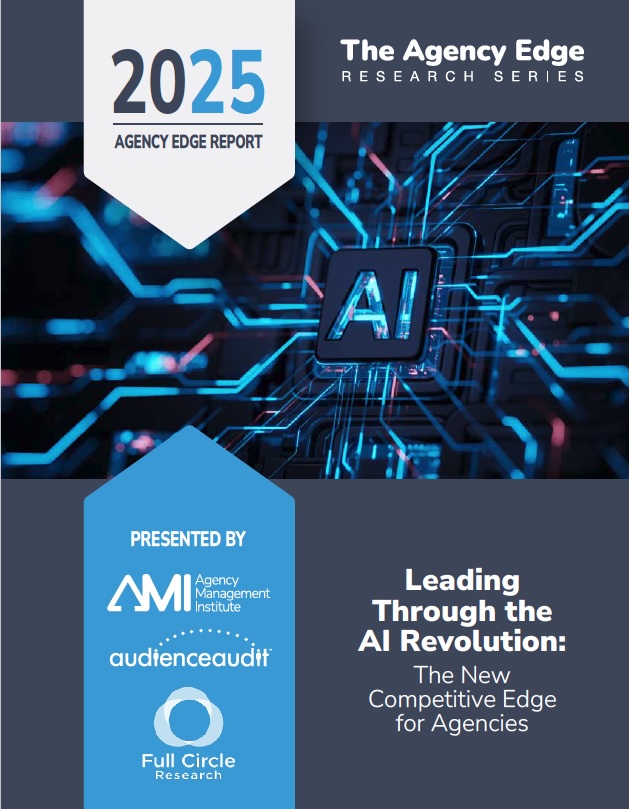
Download the Research – Get Drew’s 2025 Agency Edge Research Report. Understand exactly what your clients think about AI and what they expect from you.
Create Your AI Policy – Document which tools you use, why you use them, and how they benefit clients. Share it transparently.
Invest One Hour Daily – Carve out time for AI experimentation. Do the math. Calculate the 20 hours per week you’ll save.
Because here’s the truth, Drew and I both know:
Clients expect you to be the first one walking into the meeting with the iPad.
Not the one still holding a flip phone.
Story on, my friend.
Episode Chapters
- The Accidental Agency Owner Reality
- The AI Upheaval: Bigger Than Anything We’ve Seen
- The iPad Story: Why Clients Pay for What’s Between Your Ears
- The Agency Edge Research: What Clients Really Think About AI
- The Three AI Mindsets: Embracers, Skeptics, and Opportunists
- The Transparency Gap: Why Clients Think You’re Hiding Something
- The Teaching Moment: From Vendor to Partner • Botification vs. Beautification: AI Done Right vs AI Done Wrong
- When Do You Take Time to Think? (Dad’s Wisdom)
- The Democratization Effect: Leveling the Playing Field
Links & Resources
- Download the 2025 Agency Edge Report: Leading Through the AI Revolution: The New Competitive Edge for Agencies
- Agency Management Institute
- Drew McLellan on LinkedIn
- Drew on Instagram
- Drew on Facebook
- StoryCycle Genie™
About Drew McLellan
Drew McLellan is CEO of Agency Management Institute (AMI), serving 500 paying members and 30,000 agencies worldwide. Former agency owner who purchased AMI in 2010, he teaches agency owners how to run the business of their business better. His 15-year research partnership with Susan Baer produces the annual Agency Edge Research Report series.
Related Episodes You’ll Love
• Why Agency Owners Are Burning Out (And How AI Automation Fixes It) – Alane Boyd reveals how strategic AI automation creates seven-year employee tenure versus the industry’s 18-month average.
• Why “AI First” Is Wrong: The Narrative-First Case – Joeri Billast explains why CMOs must establish narrative foundations before AI implementation to prove measurable ROI to the C-suite.
• The Chief Sales Energizer Reveals Her 3-Step Framework for Strategic AI Implementation – Alice Heiman exposes why “random acts of AI” kill sales results and shares her systematic approach for Return on Intelligence.
Transcript
Why AI Won’t Make You Cheaper (And Why That’s Great News for Your Agency) with Drew McLellan
Introduction: The Accidental Agency Owner
PARK HOWELL: Hello, Drew. Welcome back to the Business of Story.
DREW MCLELLAN: Thanks for having me back. I’m looking forward to the conversation.
PARK: It’s good to see you again. For those of our listeners who don’t know who you are and what the Agency Management Institute is and does, could you give us a bit of a back story?
DREW: Sure. So Agency Management Institute, which is much easier just to say AMI, is an organization—think of it as a for-profit education association. We know that most agency owners are accidental business owners, and it’s our job to help them run the business of their business better.
And so we focus on teaching around what is the owner supposed to do? And that’s everything from what are they supposed to do day in and day out? But also, how do they build a business that they could sell someday? What does that whole process look like?
We talk a lot about staff. How do you staff today? How do you get the work done? How do you recruit and retain great talent, whether they’re FTEs or they’re contractors and whether they’re in your country of origin or they’re somewhere else in the world today—all of that’s possible.
We spend a lot of time on biz dev as you might imagine, talking about how do you define your right fit clients and get them to actually come knocking on your door rather than you going and chasing them.
And then of course, we have to talk about how do you actually get the work done, the systems and processes of an agency. And last but not least, we spend a lot of time talking about money, everything from pricing and proposals, but hopefully, how do you make more money and how do you keep more of the money you make?
And so that’s really the focus of AMI and my wife and I own that business together and run that business together. Both she and I have owned agencies for many years. And anybody who works for AMI, in a coach capacity or something like that, is either a former agency owner or a current agency owner. So we are very close to the work because we all did the work.
PARK: And when you characterize a lot of your membership as accidental owners, and me being a former ad agency owner too, I was very explicit about what I wanted to do so there was no accident. Of course, I created lots of accidents in it, but are you talking about these people that are like great writers or designers, good advertising minds, and they have a client and then they get another client and then, my God, they got three clients and now I got to hire somebody. And next thing you know, they got a staff of 10 people working for them. They’re like, how in the hell did I arrive here?
DREW: That’s exactly right. Most agencies are born out of a layoff or some other situation where you hang up a shingle for a while till you get a job at your next agency. And next thing you know, you’ve been so successful at networking and connecting with people and solving problems that you look around and you’re like, wait a minute, I have five employees and I don’t know anything about employment law or am I filing my taxes in the right way? Or how do I know if I can afford another employee?
There’s just all kinds of aspects, as you know, to running an agency that aren’t taught in a traditional four-year education or MBA program. They’re very specific to our industry and it’s hard to find those KPIs and guideposts. And that’s really what we provide is just sort of the shortcuts to how to do this well and profitably and, hopefully a little less stressfully.
PARK: How long have you been running AMI and how many members do you have?
DREW: Yeah, so I sound like one of those hair club commercial guys. So I was actually a client of the company that was the precursor to AMI and the gentleman who started it, who was also an agency owner, was in his seventies and wanted to retire. And he said, Drew, I think you’re the guy. And it’s a long story, but eventually I acquiesced and decided I was the guy. So I bought it in 2010. So I’ve had it for 16 years now, something like that.
And we serve, it kind of depends on how you define members. So we have about 500 paying members. But when you talk about people who come to workshops or listen to the podcast, our mailing list, people who are hearing from us on a regular basis—so a lot of people get taught for free, which is part of our model for sure—we probably serve about 30,000 agencies worldwide every year. And we have a close relationship with about 500.
The AI Upheaval: Bigger Than Anything We’ve Seen
PARK: So in the time that you’ve had it, the 16 years, I imagine it’s safe to say that you probably haven’t had to deal with such an upheaval in the agency world as AI is creating right now.
DREW: Well, you know, it’s interesting when you go back and you sort of look at it. We had the great recession and then we had COVID and then we had the great resignation and now we have AI. It just sort of seems like life is always throwing agency owners and leaders a curve ball, but AI is a big one.
And I believe it is probably in terms of the long range impact on our business, bigger than anything any of us have seen in our professional tenure for sure.
The iPad Story: Why Clients Pay for What’s Between Your Ears
PARK: Yeah, you know, I’ve been in the advertising world, agency world for over 40 years and I’ve never seen anything quite like it. When I was reading through your report, it reminded me of a funny technology thing that happened to me back in 2010. It was right after Steve Jobs launched his iPad, right? So I bought one immediately because I’m an early adopter in tech, especially in the ad world. I’m just kind of curious what it was.
And I was driving out to our largest client, Forever Living Products International at the time. And I had my copywriter with me. He was coming out and he was very much of a Luddite when it came to technology. He’s like, nope, I’m going to let everybody else adopt it. And then once it blows up and they fix it, I’m going to take it.
So we’re driving out there and he looked at me sort of suspiciously and he goes, why did you buy that gadget? You know, this iPad. Yeah, I mean, what’s the deal with that? And remember, this is a guy that still had a flip phone when we all had iPhones.
And one time I had a hard time getting a hold of Dan and I said, something wrong? I couldn’t reach you. And he said to me, well, my phone’s down. And I said, what, did the hinge break? And I’ve known Dan a long time, so I could get away with that jab.
Anyways, I said to him, I go, our clients hire us to always be one, two, three steps ahead of the trends in everything creative and communication and marketing and planning and especially technology.
DREW: That’s right. Social change. I mean, think about it. We are a leading edge industry. We are always changing the world out ahead of us.
PARK: Yeah. And that’s what they hire us for. And Dan said, well, I thought they pay us for our creative. I go, well, they do, but that’s not first. They pay us for what goes on between our ears first and foremost, then everything is secondary.
And I said, you watch what happens when I walk into the conference room with the very first iPad that this company has ever seen. Drew, the first 15 minutes of that meeting was handing my iPad around and them ooh-ing and ahh-ing over it. When I walked out, I said, see Dan, we are just modeling that we are ahead of our clients and that’s what they want us to be.
So AI, I’m so surprised at the reluctancy of so many people, not just agencies, but clients and others that are like, I’ve got AI fatigue, I don’t really want to deal with it right now.
Ten New AI Tools Launch Every Single Day
DREW: Well, when you think about it, I equate this to when computers came to agencies. But computers were a thing and they had a handful of software. So it was really manageable. It didn’t seem manageable at the time. It seemed like a crazy change.
But with AI, 10 new tools are launched every single day. And so I get the fatigue and I get the nervousness around this is so big and this is so evolutionary and I don’t want to get it wrong. And there are so many choices, so many paths.
And I think what people are missing is we’re going to change tools. The tools are going to evolve. They’re going to sort out. ChatGPT may not be the leader that it is today in a year or five years, but how we use the tools and the ways that we use AI to think deeper and better and faster, that’s what we have to be sort of honing right now.
The tools are gonna be the tools. But just thinking about what can I do that adds even more value to the work that we do on behalf of clients? How do I get smarter? How do I help them advance their goals faster with these tools? Those are the questions we need to be asking ourselves, not which tool. It’s too soon to know which tool and a lot of the tools do the same thing, right?
The Agency Edge Research: What Clients Really Think About AI
PARK: Well, you asked a lot of these same questions in your most recent report, the Agency Edge Research Report series that you do with the amazing Susan Baer of Audience Audit. And as I mentioned before we started recording, I’ve been through that thing three different times, and I was really blown away. You presented it to your group of member agencies earlier this year. What was the single most enlightening finding for you that came out of that report?
DREW: Yeah. So Audience Audit and AMI have been partners for about 15 years. And every year we go out into the field and we talk to people who hire agencies and we pick a topic and then we just drill really deep into that topic.
So we’ve talked about everything from what makes you hire an agency. A couple of years ago, we said, how, where, and when do you give your current agency more money? And this year we knew that it had to be about AI.
And so the focus of the research for 2025 was, hey, clients, how are you feeling about AI? How are you using it? How is your agency currently using it? What do you wish your agency was doing with it? And sort of how do you envision the future of it?
And no surprise, the clients are further behind. They have legal departments that won’t let them do things. They have constraints around corporate rules. One of the reasons why I think agencies are always on the leading edge is because we don’t have the same level of rules that a lot of our clients do.
We’re able, especially small independent agencies, we’re able to move so much more nimbly and do things that feel riskier because we’re kind of in charge of our own destiny.
So a couple of things that came out of it that really surprised me were, one, most of them said they’re using AI inside their organization. But when we ask them how or what tools they were using—you and I were laughing before we hit the record button—the two most common tools they’re using are, well, ChatGPT, which everyone on the planet is using. And then Grammarly and Canva were their two big go-tos.
So when you think about sort of AI evolution and adoption, Grammarly and Canva are not really cutting edge. So they’re behind. So that’s one thing.
The Massive Opportunity: Clients Expect Agencies to Be AI Experts
DREW: But the big one that I think is the huge opportunity for agencies is that what they said loud and clear was, we expect our agencies to be experts in this. And we want them to bring that expertise into our organizations, not just to the marketing department, but we want them telling our entire organization how we can leverage AI to our advantage.
So you think about the revenue opportunities and the new revenue streams that that opens up for agencies, it’s pretty staggering.
PARK: It really is. I was speaking with a junior in the Edward R. Murrow College of Communication at Washington State University where I went to school. And she was in the PR sequence. And I asked her, I go, how much are they teaching you about AI there? And she goes, some are and some aren’t. A little here, a little there.
And I said, well, personally, how much are you investing in learning about AI? Well, I’m doing a little bit here, a little bit there.
And I said to her, and I don’t know if it’s right, but I think it’s right, Drew, for having done this for over four decades, is I go, I don’t know that you are going to get hired as an entry-level writer coming out of school, but if you really knew how to use AI in public relations and publicity and so forth, then you will probably be swept up in a heartbeat because whoever is hiring you probably doesn’t know that much about it.
It’s Not Age—It’s Curiosity and Exploration
DREW: Right. It’s really been interesting. So as I’ve watched how our agencies are approaching AI, it isn’t always the air quote “kids” who are jumping on. It’s really not age-dependent. It’s curiosity and exploration-dependent.
So if you are an agency owner or leader who is curious, who likes to be, as you said, the first kid on the block with the iPad, who wants to play with the new technology, who’s wondering how can these tools help me evolve my agency to be different from everybody else, then regardless of if you’re 30 or you’re 60, you’re in it to win it.
So I do think we don’t see very many agencies that are like, we don’t do anything with AI, but I will say the depth and variance of how agencies are leaning into it is pretty dramatic.
PARK: Yeah. You know, I was thinking when I was going through your report again too, because my brain’s always a branding brain. It’s like, if I was running Park & Co. today, my old agency, I would reframe it instead of being an advertising agency, I would be an “aid-vertising agency.” And I would throw an I in there, AID-vertising agency, as corny as that may sound, but I would be all in.
Now in your report, you found three distinct AI mindsets among agency clients. Could you introduce us to those three and what are the significant characteristics of them?
The Three AI Mindsets: Embracers, Skeptics, and Opportunists
DREW: Yeah, so it was interesting. As you know, Agency Edge and Susan’s work is often looking at an audience and saying, these people all look the same on the outside. If we were in a room with all of them, they’re all CMOs, they’re a variety of ages. If we’re going to put them in categories, how do we put them in categories based on their attitudes and beliefs, which are impossible to see from the outside, but are really telling from the inside.
And so this study revealed three different sort of attitudinal groups. The first one, no surprise, are the AI Embracers. These are the CMOs and business owners who are all in and are trying to figure out how can they really leverage AI? They’re the ones experimenting. They’re the ones that are investing in different tools and really starting to apply them.
And then there were the AI Skeptics. And so these are people who are nervous about it. And they’re not nervous about it because they think it’s a flash in the pan and it’s going to go away. I think they’re smarter than that. But they just don’t know how to wrap their arms around it.
And they see all of the legal implications. They read about how if you put something into ChatGPT, the whole world’s going to be able to see it. And they just don’t understand how to use it in a safe way yet. And so it makes them anxious.
And then of course, there are the AI Opportunists, which are, this is going to be a way that I’m going to save a buck, that I’m going to figure out a way to squeeze a little more juice out. And I am thinking that this is going to augment or replace things I’m doing now.
So the embracers are the ones who are like, hey agency, this isn’t—this is not gonna replace you, but I want you to use these tools to help me get further faster.
The Surprising Finding: It’s Not About Cheaper, It’s About Better
DREW: One of the big surprises in this study was very few of the respondents thought about AI in terms of this is, I’m going to be able to pay the agency less. It wasn’t a lot of that. It was really, I think this will make my agency better. I’m going to pay them the same amount of money, but I’m going to get better and faster from them, deeper, better, faster.
It wasn’t really about cheaper, which I think is something a lot of agencies worry about. Like I know what AI is going to do. It’s going to make everybody say that I have to be cheaper. And we’re not seeing that yet. Maybe we’ll see it down the road, but we’re not seeing that yet.
PARK: And so how would you recommend agencies speak to all three of these different mindsets?
How to Speak to Each AI Mindset
DREW: Yeah. So for the AI Embracers, obviously—and you know, it’s interesting, you have to ask a few questions to sort of figure out who is what, right? Because again, it’s not based on age, it’s not based on budget, it’s not based on part of the country they’re from. It really is more about sort of just their belief set and their attitudes.
So for the AI Embracers, this is a huge opportunity for agencies to really be able to go in as kind of the sherpa that is guiding that client through the evolution that AI can bring to their business. So this is the client that is going to invite you into the R&D team or the sales team or the customer service team.
And so lots of new revenue streams and opportunities for you to show up as a teacher, for you to help them with their tech stack, for you to help them think about how to use these tools to be better than their competitors, lots of opportunity there.
The Transparency Gap: Why Clients Think You’re Hiding Something
DREW: On the skeptic side, it’s really about assuaging their fears, right? So it’s talking about how you have guardrails in place to make sure that their data stays private. It’s about you being really clear about what tools you’re using and why you’re using them.
That was one of the other big takeaways from this study. We said, are your agencies using it and how do you feel about it? And overwhelmingly, all three groups said, we’re pretty sure my agency’s using it, but they’re not telling us that they’re using it, and they’re not telling us how, when, and why, which feels like hiding something.
So one of the big takeaways when we presented this data at the Build a Better Agency Summit in May was we were saying to agency owners, look, you have to have a policy in place that says, hey, here’s how we as an agency use AI. Here’s why we use it. Here’s the benefits of using it.
You just need to be more open about what you’re using and what the results are and why it makes sense. And it’s a benefit to the client. So the AI skeptics, it’s really about more transparency and helping them understand that there absolutely are ways to use it without the world having access to your most secret and private data.
The Teaching Moment: From Vendor to Partner
PARK: You know, I’m just going to jump in real quick there because you said something that completely sparked an aha moment in me. And it was about 15 years ago when I was really adopting storytelling in our Story Cycle System into the Park & Co. agency. And we were having some success with our clients—a lot of success. And some of our old clients would say they’d never seen this approach before I came to them.
And we started going through it and they loved it. And they asked me, they said, would you teach my team how to do this? And I was not prepared for that. My first reaction was, well, hell no, that’s my IP. You won’t need me anymore.
And then I immediately go, of course I will. Because it occurred to me that was a linchpin. That was a differentiator in our industry that Park not only builds these for these clients, he teaches them how to use it.
And I also then found that our campaigns were more successful when their internal team knew what the magic was behind it. And I can’t tell you how many agency principals I had when I would tell them what I was doing, they said, why would you give that away to them? Aren’t you afraid that they are going to leave you and do it on their own?
Frequently Asked Questions: AI Adoption for Marketing Agencies
Business of Story Podcast Episode with Drew McLellan
1. What are the three AI mindsets among agency clients?
Agency clients fall into three distinct attitudinal groups: AI Embracers who are all-in and experimenting with AI tools to get deeper, better, faster results; AI Skeptics who are nervous about legal implications and data privacy but recognize AI isn’t going away; and AI Opportunists who think AI will help them save money and potentially replace agency work.
The good news? Embracers want agencies to use AI to deliver better results at the same price point—not cheaper work.
2. Do agency clients expect their agencies to be AI experts?
Yes, overwhelmingly. The 2025 Agency Edge Research revealed that clients expect agencies to be AI experts and want that expertise brought into their entire organization—not just the marketing department.
This creates massive new revenue opportunities for agencies to serve as AI sherpas, helping clients with R&D teams, sales teams, customer service, and tech stack optimization.
3. Why do clients think agencies are hiding their AI usage?
All three client mindset groups reported feeling like agencies are using AI but not telling them how, when, or why—which feels like hiding something.
Agencies need clear AI policies explaining which tools they use, why they use them, and how AI benefits client work. Transparency builds trust and positions agencies as partners rather than vendors.
4. How should agencies speak to AI-skeptical clients?
Focus on assuaging fears by demonstrating guardrails that keep client data private. Be transparent about which tools you’re using and why.
Help skeptical clients understand there are absolutely ways to use AI safely without the world having access to their confidential information. Education and transparency are key.
5. What is the “wet wiggly baby” metaphor for AI adoption?
Drew McLellan describes AI as feeling like holding a wet, wiggly baby fresh from the bathtub—it’s constantly moving, slippery, and changing, making it hard to wrap your arms around and hold safely.
This discomfort comes from AI not being defined or finite, with everyone knowing this is just the beginning. The depth of being behind will only grow longer if agencies don’t decide how to get caught up now.
6. What AI tools are most clients currently using?
Most clients reported using ChatGPT (which everyone uses), Grammarly, and Canva as their primary AI tools.
These aren’t exactly cutting-edge applications, revealing that clients are significantly behind agencies in AI adoption—creating a huge opportunity for agencies to lead and educate.
7. Will AI make agency services cheaper?
No. The research showed very few clients thinking about AI in terms of paying agencies less. Instead, clients believe AI will make their agencies better—delivering deeper, better, faster results at the same price point.
This contradicts the common agency fear that AI will force price reductions. Clients value enhanced quality over cost savings.
8. What is “botification” versus “beautification” in AI content?
“Botification” is the generic, forgettable junk created when people use AI tools like ChatGPT without strategic knowledge—just cranking out commodity content.
“Beautification” happens when you know what you’re doing with AI, using it to advance your messaging, cause, and strategy in meaningful ways. Strategic AI use requires human expertise to guide the technology.
9. How does teaching clients your methodology increase agency revenue?
When agencies teach clients their proprietary methodologies (like the Story Cycle System), several things happen: campaigns become more successful because internal teams understand the strategy, clients increase budgets rather than leaving, and the relationship transforms from vendor to partner.
Clients who understand what you do and how hard it is value it more and spend more money on it while providing better input for better outputs.
10. Should small agencies fear being left behind by AI?
Both yes and no. Agencies of all sizes (5 to 60+ people) are struggling to figure out AI ownership and adoption. However, AI democratizes capability the same way COVID democratized location.
A five-person agency using AI strategically can level up deliverables and compete with larger shops—turning a three-hour proposal customization into a three-minute task while maintaining quality.
11. Who should own AI strategy at an agency?
Most agencies don’t yet have a technology officer or innovation officer, so AI ownership is falling inconsistently on creative or strategy departments. Drew McLellan predicts agencies will evolve to have some sort of technology officer who drives innovation, ensures proper training, and establishes rules protecting both agency and clients.
Currently, agencies are in the infancy stage of institutionalizing AI learning and experimentation.
12. What’s the real AI question agencies should be asking?
It’s not “which tool should I use?” Tools will evolve and change—ChatGPT may not be the leader in a year or five years.
The real question is: How do we use AI to think deeper, better, and faster? How do we add even more value to client work and help them advance their goals faster? Focus on the application and thinking process, not the specific tools.
13. How can AI validate, reveal, and inspire for brand development?
AI does three critical things for brand story development: First, it validates what you’re already doing well with honest assessment. Second, it reveals gaps—where you’re leaving money on the table or not positioned correctly—by raising questions that make you think differently. Third, it inspires new ways to think about your marketing when you’re too busy in the fog of war to think strategically.
AI opens doors to possibilities that would take days of thinking to discover, revealing paths in five minutes that your experience can then explore.
14. What can’t AI do that agencies must provide?
AI can’t ask innovative questions the way humans can, can’t connect dots like human intelligence, and can’t understand buyer psychology the way experienced marketers do.
But AI excels at crunching data and helping agencies ask better questions to refine their work. It’s a thinking partner, but independent of humans, it’s just a machine spitting out generic content. In a world requiring differentiation, you need the human part of the equation.
15. What happens if agencies don’t make time for AI adoption?
Agencies that don’t figure out how to make time for meaningful AI adoption will become irrelevant—like being an agency that doesn’t use computers or still uses flip phones.
When clients bring three agencies in for review, the one far behind doing it the old way will be left in the dust. The relevance risk is real: invest an hour a day to save 20 hours a week by month’s end, or risk obsolescence.
16. How should agency leaders think about their role with AI?
Agency leaders need to sit above the work as innovation officers, looking for new ways to bring value to clients and teams rather than staying entrenched in daily execution.
The job is looking out ahead and thinking about what’s coming next, becoming the indispensable partner clients can’t imagine moving forward without. This requires taking time away from being busy to actually think strategically.
17. What did Park Howell’s dad teach him about being busy?
Park’s father, a civil engineer, asked him six months into starting his agency: “When do you take time to think?” His wisdom: You can’t just be busy all the time or you’ll busy yourself into problems and lose money.
Agency leaders must take time away from work to think strategically—a principle more critical than ever in the AI era when rushing to adopt tools without strategic thinking creates expensive mistakes.
18. How does the Agency Management Institute help agency owners?
AMI (Agency Management Institute) is a for-profit education association helping “accidental agency owners” run the business of their business better. They teach what owners should do daily, how to build sellable businesses, staffing and talent management, business development, systems and processes, and financial management including pricing, proposals, and profitability.
With 500 paying members and 30,000 agencies served annually worldwide, AMI provides shortcuts to running agencies well, profitably, and less stressfully.
19. What free resources does AMI provide?
AMI offers a podcast, free weekly newsletter focused on teaching, and 14 years of Agency Edge Research executive summaries available under the resource tab at AgencyManagementInstitute.com.
The 2025 Agency Edge Research Report on AI adoption among agency clients is available in full, revealing what clients think about AI and what they expect from their agencies.
20. How is AI similar to when computers came to agencies?
When computers came to agencies, they were “a thing” with a handful of software—manageable and finite. AI launches 10 new tools every single day, creating overwhelming choices and paths.
The parallel: Just as agencies had to learn how to use computers (not which specific computer to buy), agencies must now focus on how to use AI to think deeper, better, and faster—not which specific tool to adopt, since tools will constantly evolve.
 Listen To More Episodes