
Why “AI First” Is Wrong: The Narrative-First Case
Most CMOs Are Amplifying the Wrong Thing With AI in Their Brand Storytelling
Eighteen months.
That’s how long the average CMO lasts before getting fired, replaced, or burning out.
Not because they lack talent.
Because they can’t prove to the CEO and CFO that marketing actually works.
Now add the AI pressure: “We need to be AI-first. Create more content faster. Get it to market faster.”
And I honestly think that’s wrong.
The Universal Challenge Every Modern CMO Faces
You want to leverage AI for marketing efficiency and scale AND prove measurable ROI to secure your boardroom credibility.
But you feel overwhelmed because most “AI-first” approaches amplify noise without a narrative foundation, creating scattered experiments that fail to demonstrate real business value.
Therefore, you can achieve smart visibility and sustained results by implementing a narrative-first approach: establish a clear brand story, then use AI to amplify authentic messaging and measure meaningful KPIs that executives understand.
Meet Joeri: 260 Episodes, One Book, and the CMO Wisdom You Need
Joeri hosts the Web3 CMO Stories podcast with 260 episodes, interviewing marketing leaders about emerging technology and brand strategy.
He was one of my first podcast guests years ago when we met at Social Media Marketing World in San Diego.
Now he’s living in Lisbon, Portugal, where people say “bom dia” on the streets, and the sunshine gives him energy.
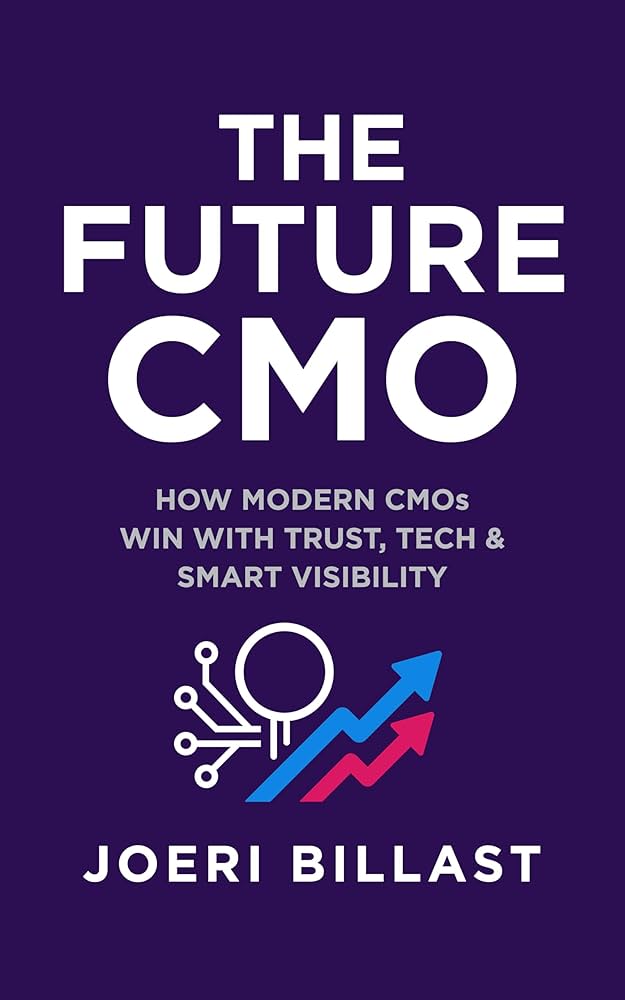
He just published “The Future CMO: How Modern CMOs Can Win with Trust, Tech, and Smart Visibility.”
And in April 2025, he’s hosting an AI Marketing Retreat in Sintra, Portugal with Mark Schaefer.
Why Narrative First Beats AI First Every Time
Here’s what I shared with Joeri:
“Companies should be narrative first. Get your story down, then understand how AI can help activate, accentuate, and amplify your story. But until you get that brand narrative clear, the rest doesn’t matter. Because if you’re using AI to amplify it and you don’t have your story dialed in, you’re just putting more noise and confusion in the marketplace.”
Joeri absolutely agreed.
He gave a talk in Lisbon about using AI to amplify trust, amplify your voice, and amplify your story. Because over 50% of online content is now AI-generated.
But for him, use AI not to generate, but to assist you.
Use your story, your brand voice, to amplify and generate trust.
That’s how he wrote his book and does his keynotes.
Based on 260 podcast episodes of personal experiences, his own voice and stories.
AI helped organize things and make sense of it all.
But he kept his own voice.
The Scattershot AI Problem: Experiments Instead of Systems
CMOs I talk to are building custom ChatGPTs and different tools.
But it’s not one ecosystem.
One person doing this, another doing that, the CMO doing a third thing.
Scattershot approach that doesn’t work.
Joeri sees the same thing: experiments on the side, trying things.
What should happen: a team from different departments coming together, sharing what they’ve done, defining best practices for the whole company.
Step by step.
Talking to each other.
He had a conversation with Johnson & Johnson. They said, “That’s a good idea. We haven’t thought about coming together and just sharing stuff.”
Sometimes it can be easy.
How to Own Your Place in the Boardroom
Joeri’s major aha from writing the book:
CMOs need to come up with ideas and strategies, then prove to the CEO and CFO that what they’re doing works.
It’s not always easy to show marketing works. So you need to define the right KPIs.
Show the CEO what you’re doing is working.
Own your place in the boardroom.
The Smart Visibility Shift: From Google to ChatGPT
Joeri believes that Google ranking isn’t as important anymore because AI will answer for you.
What’s important now: you don’t rank on Google, you rank in ChatGPT.
If someone asks, “What is the best storytelling podcast?” your podcast should show up.
This is what people do these days.
They’re looking right there.
Making sure you’re standing out and visible where people are actually looking.
Joeri’s Daily AI Workflow That Actually Works
Joeri uses AI every day.
For his podcast, he loves to talk, but episodes need repurposing into blog articles, LinkedIn newsletters and infographics.
That helps people find him in ChatGPT because those blog articles are out there.
He uses AI to prepare interview questions.
People say, “Wow, those were great questions.”
He researches backgrounds, feeds into AI with specific prompts.
Those questions are backup because he prefers conversation.
Then AI helps him edit.
It’s better that he does it, not an editor, because it goes faster.
He works on episodes and sees what’s in there.
Feels it.
Makes sure it makes sense.
Opus Pro takes the best moments from video.
He uses audio tools, video tools, and content creation tools, but makes sure he’s not using too many tools.
Joeri even suggests that using different, competing AI tools helps, like Claude discussing with ChatGPT.
You get the best of both worlds.
What You’ll Master in This Episode
- Learn the difference between narrative-first and AI-first marketing.
- Understand how to build boardroom credibility through AI workflows.
- Discover how ChatGPT shifts marketing visibility.
- Step-by-step guide to systematizing AI-driven storytelling.
- How to implement team-based AI adoption instead of scattered experiments by bringing departments together to share learnings and establish company-wide best practices.
Join Joeri at the AI Marketing Retreat in Sintra, Portugal this April 2025 with special guest Mark Schaefer. Learn systematic AI integration strategies while experiencing Portuguese hospitality. Visit SintraSynergies.com for details.
Chapters:
- 00:00 Welcome and Lisbon Life
- 02:15 The AI Marketing Retreat with Mark Schaefer
04:30 The Future CMO: Trust, Tech, and Smart Visibility - 07:45 The CMO Challenge: Technology Strategist on Everything
- 12:20 The Scattershot AI Problem: Silos Instead of Systems
- 16:40 Why “AI First” Is Wrong: The Case for Narrative First
- 22:15 Real-World Examples: Companies Doing It Right
- 26:30 The Ledger Case Study: Thoughtful Alignment
- 31:10 The Major Aha: Owning Your Boardroom Place
- 35:45 Joeri’s Daily AI Workflow: Research to Repurposing
Links:
- Joeri on LinkedIn
- Web3 CMO Stories Podcast
- The Future CMO Book
- Sintra Synergies AI Marketing Retreat
- Craft your vibrant brand story with the StoryCycle Genie™
- What users are saying about the StoryCycle Genie™
Deepen Your Communication Mastery: Three Essential Episodes
To amplify your transformation from today’s conversation, these carefully selected past episodes provide complementary classical wisdom:
How AI Changes Your Customers: The Marketing Guide to Humanity’s Next Chapter with Mark Schaefer – Explores how AI is fundamentally reshaping customer behavior and decision-making, providing the strategic context for why narrative-first approaches matter even more in an AI-driven world.
The CMO+ Framework That’s Liberating Small Business Owners from the Vendor Vortex with Sara Nay – Demonstrates how CMOs can own their marketing strategy and prove ROI through systematic frameworks that combine classical wisdom with modern execution.
Why Most Branded Podcasts Fail: The JAR Framework That Fixes Everything with Jen Moss – Reveals how strategic focus and narrative clarity prevent the “ramblecast” problem, perfectly complementing Joeri’s narrative-first approach to AI implementation.
Each recommendation selected to deepen your mastery through The Business of Story’s archive of classical storytelling wisdom enhanced by modern application.
Transcript:
How CMOs are Using AI in the Web3 World
Park Howell: Good morning, Joeri. Welcome to the show! But I guess it’s evening your time there in Portugal.
Joeri Billast: It’s 5 PM on my side, Park.
Park: Ah, so you’ve already got a full Monday behind you and I’m just firing mine up. You moved to Portugal what, 18 months ago you said?
Joeri: Yeah, 18 months ago. You know, time flies.
It’s great to see you again, Park, because I was checking—you were one of the first guests when I started podcasting. I met you in San Diego at Social Media Marketing World a few years ago, and you’re just top of mind.
So I’m here now in Lisbon. When we last spoke, I was still in Belgium.
Park: Yeah, boy, everybody is moving to Lisbon. You must love it out there, huh?
Joeri: It depends on what you like, but I like good weather, good food, and people who say “bom dia” on the streets.
Belgians are a bit colder—they’re not likely to say hi, you know, they’re more reserved.
But I like people who smile and greet you. Everything’s a little slower here, a little less stressful, which is also good.
Park: And the weather’s pretty nice.
Joeri: It is, it is. Way less rain than Belgium and more sunshine, which gives me energy, Park.
The AI Marketing Retreat and Mark Schaefer Collaboration
Park: Well, it’s great to see you again. It’s been a couple years since we last chatted, but I’ve been watching your progress online and the work you’ve been doing with Mark Schaefer.
I understand you two have something coming up pretty soon. What’s that about?
Joeri: Yeah, we have something coming up. I met Mark at Social Media Marketing World, and he advised me to write this new book, which we’ll be talking about later.
But also, because I live here in Sintra, Portugal, I’ll be doing an AI marketing retreat in April next year, and Mark will be my main guest. I’m really looking forward to that.
Park: That’s great. When is that and how can people learn about it?
Joeri: It’s in April. I have a website called Sintra Synergies—Sintra from the place in Portugal and Synergies like you say it in English.
So SintraSynergies.com. I’m updating the website now. All the information will be there, and people can send me a message if they want to know more.
The Future CMO: Trust, Tech, and Smart Visibility
Park: That’s great. Well, you’re here today because you’ve got this new book out, “The Future CMO.” I’ve had a chance to go through it. There it is, folks—there’s a picture of it.
If you’re listening to this, you’ll have to pull it up online and take a look. But it’s great. I’ve been through it.
First, what is the main premise of the book?
Joeri: Well, like it says in the subtitle: “How Modern CMOs Can Win with Trust, Tech, and Smart Visibility.”
When I speak to other marketers—typical CMOs—they do traditional marketing as it has always worked. But times are changing. You have AI, you have Web3, you have all these emerging technologies.
People want to use them, but they’re struggling with the question: Is it really right? Is it fake? How can we keep the trust? That’s a problem.
I want to address this in the book—that a future CMO should be looking at that and also should be looking at the KPIs they can show to the CEO that what they’re doing really pays off.
The CMO Challenge: Technology Strategist on Top of Everything Else
Park: Well, CMOs have a really tough job. I think the average tenure of a CMO is about two years tops at a company before they get fired, replaced, leave, or burn out.
Marketing in and of itself—and I’ve been doing it for over 40 years now—is hard. It’s tough, and it leads to tremendous burnout even with the best CMOs out there.
How big of a lift is it now to make these CMOs technology strategists and experts on top of everything else they have to do?
Joeri: Yeah, it’s a big lift. I would say it depends on how big the company is where the CMO is working. That makes a difference.
I’ve been giving training to executives in Belgium from bigger companies—even Microsoft was there in my session, as well as Randstad, ING, and big pharma companies.
They want to move forward, but they also have limitations within the company. They’re a bit afraid: What can we do and what is happening with our data?
So they want to move forward, but they have boundaries. This keeps them from moving as fast as they want.
CMOs need to know everything about the business and about technology. It’s quite a stretch because in AI, something happens every day.
I would say the basics of marketing are still there—you still need to understand your customer, understand your business, and come up with the right stories.
Then I would say they need to pick one thing. If you start as a CMO adopting AI, pick one thing, focus on that, then go to the next thing. Step by step, try to improve and use AI.
The Scattershot AI Problem: Silos Instead of Systems
Park: A number of the CMOs I’ve been talking to are definitely dabbling in or fully embracing AI. They’ve got teams that are all in, building their own custom ChatGPTs and different tools like that.
But none of them are like one ecosystem. It’s like one person is doing this, another’s doing that, the CMO is doing a third thing.
While they may be talking together as human beings, what they’re creating online using AI isn’t necessarily working because it’s such a scattershot approach.
What do you recommend people do to overcome that?
Joeri: Yeah, that’s what I’m seeing too. They’re doing experiments, as I call it—doing stuff on the side and trying things.
Actually, they should have a team that can be a team in the company with people from different departments coming together, sharing what they’ve been doing, and getting the best practices from there. Try to define best practices for the whole company so it can work.
But again, that’s step by step, and they need to talk to each other to show what they’re doing.
I’ve seen this in bigger companies. I had a conversation with Johnson & Johnson, and they said, “That’s a good idea. We haven’t thought about coming together and just sharing stuff.” So sometimes it can be easy.
Then, of course, you need to see what you’re allowed to do. You talked about their own GPTs on their own data—yeah, that’s also the sensitivity that’s there.
Why “AI First” Is Wrong: The Case for Narrative First
Park: You hear a lot now—this trend with marketing departments of all sizes saying “We are AI first. We are pulling this together to help become more efficient, create more content faster, get it to market faster. We are AI first.”
And I honestly think that’s wrong.
I think companies should be narrative first. Get your story down, and then understand how AI can help activate, accentuate, amplify your story.
But until you get that brand narrative down, the rest of it doesn’t matter. Because if you’re using AI to amplify it and you don’t have your story dialed in, well, you’re just putting way more noise and confusion out in the marketplace.
Joeri: Absolutely. Actually, I gave a talk about that in Lisbon—how to use AI to amplify trust, amplify your own voice, amplify your story, your narrative.
Because there’s so much noise out there. I saw somewhere—I think a statistic that now more than 50% of the content that’s generated online is AI-generated.
But for me, it’s more like: use AI not to generate, but to assist you. Use your story, your brand voice to amplify and generate trust.
That’s actually what I’ve been using to write my own book and do my keynotes. This is based on my personal experiences and my own voice and stories.
Of course, AI helped me a bit because I’m not a native English speaker—to make sense of it all. Imagine 260 podcast episodes. That’s a lot of stories, Park.
Putting them together and asking AI to make sense of it and organize things helps me go faster while still keeping my own voice.
So yeah, that’s really important. I would not say AI first, but use AI in a sensible way.
Real-World Examples: Companies Doing It Right
Park: Can you give us an example of a company that’s following this advice and putting narrative first to build trust using AI?
Joeri: Yeah, there are a couple of examples in the book. I don’t know them all by heart, but the companies that do it—they put together their story first.
They upload it or feed it into their AI systems and prepare everything. They do the exercises first. They think about their brand story, think about their customer, put that together, and then they start creating content based on that.
But there are a couple… sorry.
Park: Yeah, in the book you talked about the Ledger/Tottenham Spurs campaign.
Joeri: Yeah, that one was really good, and GOAT Gaming too. I was just thinking of those two examples.
They’ve been using AI in a sensible way. Certainly GOAT Gaming—which is actually from the Web3 world—how they used AI to get the best practices out of that, to get the most results.
Also the story with Ledger is interesting—how Ledger, which is a Web3 wallet, something that sounds very technical, but they linked it to sports. That’s a really good approach for me.
The Ledger Case Study: Thoughtful Alignment Over Logo Placement
Park: Can you take us on a bit of a deep dive into that one so our listeners can really understand the specifics of how they did it?
Joeri: I would have to look again at the details. But I would say they approached the Spurs and worked together in a way that was benefiting both parties.
If you want, I need to check again how it was and then explain it, Park. I don’t know the details because I did a whole podcast episode on that, but I worked so hard on it. I wasn’t knowing which questions you would exactly ask me.
There’s also the Liquid Death case study, but that wasn’t on the AI side. Let me quickly pull it up here.
Park: Sure.
Joeri: So the story about the San Antonio Spurs was actually about thoughtful alignment. It wasn’t just about the logo on the jersey, but the alignment between a French tech company and an NBA team with strong French connections focused on youth, STEM education, and financial literacy.
Ariel explained that NBA fans have twice the purchase intent for crypto compared to average customers. This is something they found out through data and AI.
This made the partnership both culturally relevant and strategically sound. They were thinking more long-term rather than short-term.
It’s a really specific case. I didn’t get all the details, but if people want to know more, I have it on my podcast episode with Ledger, which is episode S5E27 on the Web3 CMO Stories podcast.
The Major Aha: Owning Your Place in the Boardroom
Park: Okay, fair enough. So in writing your book, you know I’ve written a couple myself, and I realize as the author you learn so much in the process. The book almost writes you when you’re all said and done.
What was the major takeaway, the major aha moment in writing your new book?
Joeri: One of the takeaways—and it’s actually one of the titles in the book—when I talked to those people you mentioned, the CMO doesn’t stay long in the job. I think it’s 18 months on average, but it can also be two years.
But what’s the reason? They need to come with ideas and strategies, and then they need to prove to the CEO, to the CFO, that what they’re doing is working. It’s not always easy to show that marketing is working.
So to make it work, you need to define the right KPIs and be able to show the CEO that what you’re doing is working. You need to own your place in the boardroom.
The CEO and CFO are there, but the CMO isn’t always there—but needs to be there and needs to own that place. That was one of the things that came back.
Also the trust aspect—they want to use AI and they want to use it in a smart way. That was one thing.
The other thing—and I think Mark has talked about this recently too—people say to me that Google isn’t so important anymore to be in the top places on Google because AI answers for you.
So what’s important now is that you don’t rank on Google, but you rank in ChatGPT.
If someone asks “What is the best storytelling podcast?” or “What is the best Web3 podcast?” then in my case, my podcast should show up. Or when you have a business, your business should show up.
This is what people do these days—they’re looking right there. So this AI aspect and thinking about how we can make sure we’re standing out and visible where people are looking—this was also a recurring fact.
Joeri’s Daily AI Workflow: From Research to Repurposing
Park: Yeah. And are you using a lot of AI in your own work?
Joeri: Every day I use it a lot. I was already using GenAI before ChatGPT—if we talk about AI, because AI has been there for so many years. I did it before with my former company in business intelligence. We also used AI.
Now I use a lot of GenAI. I already used Jasper and so on before the ChatGPT moment.
But now, today, for my own podcast—I love to talk, but then episodes need to be repurposed. They’re repurposed into blog articles, LinkedIn newsletters, infographics, and so on.
I’ve been doing this since when we first met. That helps people find me and know that I exist, and also find me now in ChatGPT because these blog articles are out there. People find the podcast through the blog.
I use AI to prepare for podcast interviews to ask the right questions, because people say, “Wow, those were great questions. How did you come up with them?”
I do research on people’s backgrounds, feed it into AI with specific prompts so I get the right questions. Those questions are actually a backup to fall back on because I prefer to have a conversation.
Then I have the podcast recording, and AI helps me edit it. It’s even better that I do it and not an editor because it goes faster.
I work on the podcast episodes and I see for myself what’s in there. I feel it. I make sure it makes sense. I use AI to publish it, to get a hook out of that. All of that I’m doing myself.
Then there are tools that take the best moments from a video podcast. Opus Pro, for instance, takes out the best parts, and then I can repurpose it.
So I use a lot of audio tools, video tools, content creation tools, putting them all together. Making sure I’m not using too many tools, and making sure I’m still thinking and not letting AI do everything.
Sometimes having different AIs in competition helps—having Claude discuss with ChatGPT and making sure I get the best of both worlds.
Park: And how many different AI tools do you use?
Joeri: On a daily basis, I would say a handful of tools. But on a monthly basis, depending on the need I have, I’ll use different tools to get to the result. Those are tools I’ve tested and compared.
Sometimes it’s a tool that has AI baked in—like Metricool, which is a social media management tool but has AI baked in. Buzzsprout, which I use for podcast hosting, has AI baked in.
 Listen To More Episodes