
How AI Changes Your Customers: The Marketing Guide to Humanity’s Next Chapter
As a marketing professional, you understand that staying ahead of technological shifts determines your competitive advantage, and mastering how AI is fundamentally reshaping customer behavior matters because your entire marketing strategy depends on understanding decision-making processes.
But you feel uncertain because AI’s evolution is happening faster than anyone can predict or prepare for, leaving you wondering whether your current approach will even be relevant in twelve months.
Therefore you can gain strategic clarity about marketing’s AI-transformed future through Mark Schaefer’s latest research with 300 global futurists who reached a remarkable consensus on how AI will change humanity by 2035, revealing the specific strategies that will separate thriving brands from those left behind.
Meet Mark Schaefer
Mark Schaefer is a globally recognized keynote speaker, futurist, business consultant, and author of twelve books, including Marketing Rebellion, KNOWN, and Belonging to the Brand.
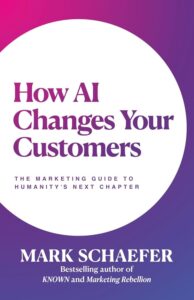 His newest release, How AI Changes Your Customers: The Marketing Guide to Humanity’s Next Chapter, synthesizes groundbreaking research from 300 global futurists to reveal how artificial intelligence is fundamentally rewiring human psychology and customer behavior.
Mark’s work has been featured in The New York Times, The Wall Street Journal, and Wired magazine.
He teaches graduate marketing courses at Rutgers University and helps organizations worldwide navigate the intersection of technology, marketing, and human connection.
What’s In It For You: Key Takeaways
Listening to this episode will equip you with:
1. The AI-as-Customer Framework: Understanding why AI is becoming the actual decision-maker in customer purchases (not just a tool), fundamentally changing how you need to position your brand and content.
2. The Dual Content Strategy: How to optimize for both “bots and bros” by feeding AI the data it needs while preserving the beautiful, creative content that builds human connection and brand loyalty.
3. The Curiosity Differentiator: Why curiosity is the single human trait that will determine success in the AI age, and how brands can cultivate it in their teams and communities to avoid the de-skilling trap.
The Core Revelation: AI Is Now the Customer
Here’s the profound shift Mark discovered through research with 300 global futurists.
We’re experiencing cognitive offloading at a scale humanity has never seen.
As we trust AI more, as we develop emotional relationships with algorithms, as we offload complex decision-making to chatbots, AI is becoming the actual customer.
Not just for simple choices like which airline to book.
For life-changing decisions like where to attend college, which job to accept, even who to marry.
Mark frames it perfectly with the diaper analogy: his grandson is the end user, but he’s not the decision-maker.
Someone else controls what gets purchased.
That’s exactly what’s happening with AI.
Your prospects might be the end users, but AI is increasingly the decision-maker recommending (or not recommending) your brand.
This changes everything about how we market.
The Dual Strategy: Honoring Bots While Building Human Connection
Andy Crestodina, founder of Orbit Media Studios, articulates the tactical approach brilliantly: our job is to train AI to become a sales rep for our brands.
That means creating content with excruciating detail and FAQs.
AI doesn’t get bored, doesn’t appreciate creativity, just wants data.
But here’s where Mark adds the critical second layer: the AI override.
The override is brand.
The override is what you mean to people.
The override is the human recommendation that trumps algorithmic suggestions every single time.
When Mark’s friend in France recommended a specific gluten-free bakery in Paris, he ignored ChatGPT’s itinerary and went there instead.
Human connection still wins.
So the strategy becomes clear: give the bots their data in one space on your website, but never compromise the beautiful, creative content that builds human connection.
Your blog, your podcast, your books remain for your readers, your fans, the people who love your work.
Never compromise that for algorithmic optimization.
Curiosity: The Single Trait That Determines AI-Era Success
Mark identifies curiosity as the fundamental differentiator.
Curious people will drive AI to create more knowledge and value.
Non-curious people will simply accept answers and de-skill themselves.
The data already shows this divide: entry-level jobs are disappearing while demand for experienced professionals over 50 remains strong.
We need wisdom to oversee the bots.
Mark’s parenting advice to his daughter captures it perfectly: drive curiosity into this child because that trait will determine success in an unknowable future.
For brands, this means creating content and experiences that cultivate curiosity rather than just delivering quick answers.
Level up your audience.
Increase their capabilities.
Make them more curious, not more dependent.
The Four Pillars of Humanity That AI Cannot Replace
Mark closes his book with four powerful truths:
Empathy is still a choice: AI can pattern-match empathy, but it’s an illusion. Real empathy remains distinctly human.
Creativity is still a practice: The years of practice, the bosses with red pens, the disciplined craft development, that’s what creates real creative ability.
Resilience is still a muscle: You build it through struggle, not by having AI do the hard work for you.
Connection is still a risk: People can hurt you, betray you, disappoint you, but you have to keep taking that risk because real connection creates real business.
Joy as Rebellion: The Emotional Promise That Changes Everything
Perhaps the most powerful moment in our conversation came when Mark shared his transformation from anxiety to joy.
In corporate charm school, when asked what emotion he felt most of the time, Mark answered: anxiety.
His mentor answered: joy.
That moment changed Mark’s life.
He realized he was doing things wrong, prioritizing money over meaning, hustle over happiness.
Joy became his rebellion against societal pressure.
And here’s the branding insight: every brand needs to identify that singular emotional promise they deliver.
For StoryCycle Genie™: enthrallment.
For Mark Schaefer: belonging.
What’s yours?
The Simplest Path Forward: Tell True Stories
Here’s how to overcome the AI content paranoia:
Tell true stories about the people you’ve helped.
Include the outcomes.
That’s it.
AI can’t write those stories because AI doesn’t know them.
Only you do.
And guess what? Writing those stories is actually fun.
It reconnects you with why you do this work in the first place.
It builds the human connection that creates the AI override.
And it cultivates the curiosity, creativity, empathy, resilience, and connection that will always separate remarkable brands from algorithmic commodities.
The most human company wins.
Story on, my friend.
About Mark Schaefer
Mark Schaefer is a globally recognized keynote speaker, futurist, business consultant, and author of twelve books including Marketing Rebellion, KNOWN, and Belonging to the Brand.
His newest release, How AI Changes Your Customers: The Marketing Guide to Humanity’s Next Chapter, synthesizes groundbreaking research from 300 global futurists.
Mark’s work has been featured in The New York Times, The Wall Street Journal, and Wired magazine. He teaches graduate marketing courses at Rutgers University and helps organizations worldwide navigate the intersection of technology, marketing, and human connection.
Get Mark’s book: How AI Changes Your Customers: The Marketing Guide to Humanity’s Next Chapter
Connect with Mark: businessesgrow.com
Chapters:
- 00:00 Introduction and Context of AI in Communication
- 02:53 Insights from the Futurist Group
- 05:58 Cognitive Offloading and Writing Skills
- 08:56 The Impact of AI on Writing and Creativity
- 11:37 AI as a Decision Maker
- 14:36 Strategies for Influencing AI Algorithms
- 17:49 Balancing Bots and Human Connection
- 20:44 Ethics in AI Content Creation
- 23:28 The Future of Entry-Level Jobs in Marketing
- 26:47 Positive Aspects of AI in Brand Development
- 27:24 Assessing Brand Communication
- 29:55 AI as a Tool for Creativity
- 33:40 Curiosity: The Key to Future Success
- 39:12 The Human Element in AI
- 41:37 Joy as a Rebellion
- 48:16 Emotional Connection in Branding
Links:
- How AI Changes Your Customers: The Marketing Guide to Humanity’s Next Chapter
- Mark Schaefer’s website
- The acclaimed marketing blog, {grow}
- Mark Schaefer’s books
- The Marketing Companion Podcast
- Mark Schaefer’s speaking highlight reel
- Mark Schaefer on LinkedIn
- Craft your vibrant brand story with the StoryCycle Genie™
- What users are saying about the StoryCycle Genie™
Deepen Your Mastery: Three Complementary Episodes
To amplify your transformation from today’s conversation, these carefully selected past episodes provide complementary classical wisdom:
Michael Schaefer Asks, “How Audacious of a Brand Storyteller Are You?” – Mark’s earlier appearance exploring his book Audacious: How Humans Win in an AI Marketing World, revealing how creativity and bold marketing moves create the human connection and brand meaning that generates the AI override Mark discusses in today’s episode.
How to Position Your Brand Against a Clear-Cut Enemy With Laura Ries – Reveals Laura Ries’ Strategic Enemy Framework that transforms the brand meaning Mark discusses into powerful market differentiation, showing how to own something meaningful in customers’ minds that AI will recognize and recommend.
Why Your Corporate Brand Videos Fail (And How to Fix Them) With Nick Francis – Explores Nick’s “get close enough” principle that embodies Mark’s call to tell true stories about people you’ve helped, revealing how proximity to customers creates the authentic content that generates both human loyalty and AI override.
Each recommendation selected to deepen your mastery through The Business of Story’s archive of classical storytelling wisdom enhanced by modern application.
Transcript:
How AI Changes Your Customers with Mark Schaefer
The Return of a Trusted Voice
Park: Hey, Mark, welcome back to the show.
Mark: I’m delighted to be here. Always, always makes me so happy to see you.
Park: That’s nice. And you just got back from a pretty cool trip in Paris, I think, right?
Mark: I was in Paris on business and then a couple of weeks later I went on vacation to southern France for a couple of weeks.
Park: Ah, that’s good living. So you’re all refreshed. You’re back, ready to take on the AI bots and roll your sleeves up. The terminators of communication. People are believing, but really enjoyed your book. And I mentioned on LinkedIn that I had ordered it before I went on vacation. I first was doing some work in Chicago and then was up at the Pacific Northwest. And a couple of weeks later I returned and there it was sitting on my doorstep. No one stole it, so that was nice. And that next morning I got a cup of coffee. I thought, well, I’ll read a chapter two and see where Mark’s going with this. Well, it was so great. I read the whole thing in about two hours and I made note after note and reached out to you immediately. I thought this would be perfect timing to get your insights on what you learned. And first, could you give our listeners an idea of this group of 300 futurists you were a part of, how that came together and what was the one core finding that blew you away in all of this?
When 300 Futurists Reach Consensus on AI’s Impact
Mark: Well, so I had been a part of some research studies sponsored by Pew Research. And some of the researchers at Pew now are working together at Elon University, and they’ve created the Center for the Future. And so they called on some of their old Pew Research associates and they brought 300 futures from around the world and some really big names like Gerd Leonard and Ray Wang. And they had this impossible question: How will AI change humanity by 2035? And I loved it. Cause I mean, I just love thinking about that. It was a little intimidating at first.
And then they created this research report. And what made this so fascinating part is that nobody knows what’s going to happen next with AI. Even the Silicon Valley insiders, they don’t really know like when is AGI coming? Could be this year, could be 20 years. I mean, nobody really knows. But these 300 experts, these futurists, they came to consensus on a couple key ideas. And I found that so valuable and so unique. And I went to the sponsors of the research and I said, could I turn this into a book? And they said, not only yes, but we’re jealous we didn’t have that idea. And so I had intended to take the summer off, but I spent my summer vacation writing this book right before I went to Europe. And I just knew that if I didn’t take these ideas and put them into the world, I would regret it. I had to do it. I had to do it now. And that’s why I wrote the book.
Park: And with these 300 futurists, they’re coming from all different kinds of disciplines. You came from the marketing branding discipline.
Mark: Yeah. One of the few. Yeah. There are people that are there. There are philosophers. There are technologists. There are business leaders. There are people like Ray who are, you know, AI insiders. And I think at the end of the day, there were I think there were 12 big buckets. I chose to explore six of them, which I thought were most relevant to business and marketing. And I started the book really with this idea of de-skilling, of cognitive offloading, where we begin to rely on AI so much that we kind of become lazy and we lose our ability to integrate knowledge into our beings. And so, that was one of a few ideas I explored.
The De-Skilling Dilemma: What Happens When AI Does the Thinking?
Park: So was that like in our world, in the branding, marketing, communications world, if we are offloading to AI, then say writing, do we become weaker writers, do you think?
Mark: Well, absolutely. I mean, it’s like, it’s like it’ll do to many human skills and human psychology what the calculator did to doing long math or what Google Maps did to fumbling with a map in your car. We just don’t do it. We just don’t do it anymore. And so I, and I don’t want to come across as being anti AI or anti technology or or, you know, anti de-skilling in some ways. I mean, I I never want to do long math again. I never want to use a map again. But I think, I think it’s it is interesting that, you know, I was in a rental car recently and I was in a foreign country and I got out of the airport and the Google map didn’t work. And I literally had to pull over to figure out what do I do next. And so I think that’s a small example of if we have cognitive offloading. Well, there’s a positive to that, that maybe it’ll let us do higher level thinking and do more creative thinking. If AI goes down, what happens? That literally happened about, what was it, like two months ago? And the reaction was like, went on TikTok, people were literally sobbing and crying. And we kind of have this young generation now that they’re offloading so much of what they do to AI. They literally can’t, I mean, I just thought of this, it’s like, chat GPT has almost become like the operating system for human psychology today. Isn’t that a weird thing to think about? I kind of got to chill down my spine as I said those words.
Park: Yeah, it is. So let me ask you, you and I are well along in our careers. We’ve been doing this for a couple, three, four decades, right? And we have written and written and written and I don’t know, how many books do you have? 24, 25?
Mark: 12, 12.
Park: 12? Well, the brilliance in them seems like 24 or 25. I’ll give you that. And so we’ve trained ourselves, and I’m setting something up here that I just experienced recently. And that is that, you know, we’ve got our StoryCycle Genie™ out there now that is helping with brand development and so forth. And I have been using it a lot. In fact, I wrote five blog posts last weekend while one eye on the writer cup, watching the Europeans trounce us. And the first blog post took me about four hours by the time it got in. It was kind of the operating instructions for the genie and so forth. And it had a lot of really good stuff, but I had to go back as a chief copy editor and change a whole lot of stuff and get it back in my voice and that kind of thing. And then it learned about that and it wrote the next one. And the next one I spent probably two hours cleaning up. And then three, four, and five came out in each one of those were progressively less time that it really got to know my voice and the content was really good. It even came up with content I had not considered. And it had superfluous stuff that as the chief copy editor, I took out. And then when I shared the pieces with my partners, they were like, this is amazing, how much did you have to work on this stuff? I mean, it was reading really well. And so then fast forward a couple days where I jump on and I needed to write a post very quickly and I didn’t want to mess around with AI or the story cycle genie and I just wrote it. And Mark, I found my ability to write that post was even better than it was two months ago. And it caught me by surprise and I thought, just being this chief copy editor and really thinking critically about what the genie was giving me, did that all of a sudden make me a better writer? Because that next post, I wrote in about 20 minutes, go, damn, yeah, that’s really good. I can just run with this. And I’ve heard from some other users of the Genie saying, surprisingly, in the last couple of weeks, the same thing. They said, it’s making me think differently and it’s actually making me better in my communications. Now the proviso to that is almost every single person that has told me that are in our age range. We’ve been at this a long time. We’ve written a lot of stuff. So now let’s go back to millennials, you know, gen Z’s, throwing no one under the bus. They just don’t have the experience or the proficiency because they haven’t been writing as long. And therefore is there a fear in your mind that AI will take over for them because they’re like, well, I don’t need to become a great writer. I’m just going to let it do it and crank it out.
The Generational Divide: Experience vs. AI Dependency
Mark: Oh my gosh, I mean, you fired so many synaptic connections for me there. Wow. First of all, I want to say, I mean, you gave me the opportunity to try your genie and it is brilliant. I mean, you just did a wonderful job with that. And I’m not surprised it sort of had that, that impact. You know, I, I went through something last night where I’m preparing for a big meeting in New York with one of the biggest CPG companies in the world. And quite frankly, it’s a little intimidating because I’m going to be, I am because I’m speaking to brand managers of beauty products and I’m way out of my league. So this forced me to do a tremendous amount of research and update my thinking on some things. And then last night I thought, you know what? The things I learned would make a great blog post. So I didn’t use AI at all. I just used all this research that I did and all these new insights and I created this blog post. Then I had the idea, let’s put this in a chat GPT and see what I missed. And maybe there’s even something new I could bring into this meeting. And it really was crap. I mean, it just didn’t work. And it wasn’t your refined system of your genie, it was just GPT. So it just makes me wonder if sometimes if it’s situational, you know, it depends on the subject. It depends on the importance of you and your stories, your messiness, your awkwardness, your dad jokes, whatever you put it in there to make it more like you. But it’s interesting. I mean, it is, the technology is getting better and better as your genie technology proves. So, you know, I don’t know. You know, is it making me a better writer? It’s making me a more thorough writer for sure, because I will take a blog post and put it in there and say, take the opposite view. What would a critic say about this? You know, I have five points I’m making in this post. Did I miss something? And sometimes it’ll come up with something really good. So it’s definitely making me a more thorough writer, but I think my best writing, at least for me right now, it’s still coming out of me.
Park: Mm hmm. Yeah, totally makes sense. And so let’s go back to that first question I asked about out of everything that you learned from this report, what was like the one thing and maybe it’s it’s a thread throughout. And of course, your your book title is How AI Changes Your Customers, I guess. Was that your biggest finding?
AI as Decision Maker: The Fundamental Shift in Customer Behavior
Mark: I think the biggest, you know, in the book, I talk about a number of ways that we’re really being rewired, but I think it all gets down to this: As we offload our cognitive processes, as we trust AI more, as we really actually develop an emotional relationship where an AI becomes a friend and a trusted advisor, the end result is that AI is becoming the decision maker in much of our life. Even complicated decisions like where do I go to college? What job should I take? Who should I marry? It’s not just little decisions like, you know, should I buy this product or that product or should I visit, you know, should I take this airline or that airline to go on my trip? It’s big, complex decisions. And so AI is the decision maker. That means AI is the customer. So you and I, before we pushed record here, we were both cheering each other on as new grandfathers. And, you know, my little grandson goes through a lot of diapers. He’s the end user, but he’s not the decision maker. And it’s an interesting analogy, right? Because it’s like selling diapers today. We have to find a way to influence this algorithm like we never had before. And that, boy, I mean, that is profound. And that is coming out as like a freight train. And so I think that’s the biggest takeaway from the book. It all kind of leads to that. And then I also look at this through the filter of sales and marketing to give some ideas about what we might do. And you know, it’s emerging. We’re all still trying to figure this out, but I did have a lot of good input into the book. A lot of good experts helped me. And so I think that’s the big takeaway.
Training AI to Become Your Brand’s Sales Rep
Park: Yeah. Let me pull up one of your experts who I really admire, Andy Crestadena. One of the most brilliant minds out there when it comes to search and content and so forth. And he wrote in here something that really struck me, Mark. And he said, he’s the founder of Orbit Studios. And I’m just going to read right from your book. He’s on the strategic strategy, on the cutting edge of strategies to influence the AI algorithms. He contends that traditional content marketing works, but with a twist. Andy put it succinctly: our job is to train AI to become a sales rep for our brands by feeding it all of the important sales and marketing messages. So he articulates three strategies, and one of them is really you’ve got to be very straightforward in your content that AI does not reward you for cleverness or creativity. So right there, isn’t that saying something about our writing that we need to now write towards what AI wants to recognize as an authoritative source and therefore will recommend you to a buyer and take out some of our best content, some of our funniest lines, some of our best subheads because AI won’t get them?
The Dual Strategy: Feeding Bots While Preserving Humanity
Mark: Yes and no, because that’s only half the story. So there is a technical, tactical approach. And then the second approach that I talk about is the AI override. So let’s talk about the technical, tactical approach first. And that’s what Andy is referring to. AI doesn’t get bored. AI doesn’t get tired. It just wants the data. It doesn’t care if you’re a beautiful writer. It doesn’t care if you’re telling great stories. It just wants the data. So I think one of the terms used, Andy used was something like excruciating detail or extreme detail, FAQs. And so there does have to be a side of our websites and our web presence that is honoring the AI bots, right? Now, let’s get into the override. The override, and this is, I think, just as important as this data piece, the override is the brand. The override is what we mean to people. I’ll give you a little example from, you know, we talked about, I went to this trip to Paris and I went to ChatGPT, I said, plan my trip. It gave me a great itinerary. I was not influenced by advertising. I was not influenced by content or any brand marketing whatsoever. I literally took what it gave me and I did it. Except I have a friend who lives in France. She said, I know that you have to eat gluten-free. There’s this great bakery in Paris that you need to go to. When AI gives me an itinerary, I will consider it. When a human being tells me something, I’m going to do it. I’m going to act on it. So there’s this thing that I think is really important, which is the override, the brand preference. Wouldn’t it be great if I go in and I say, chat GPT, plan this trip for me, but you have to use Delta Airlines because that’s my brand or I have to stay at Marriott hotels because that’s my brand. Wouldn’t it be great to say, include this? Because one of my people that read my content and they know me, or people in my community, they say, hey, you’ve got to include this on your trip. So there’s this whole other idea of content that does mean something to people. The brands that do mean something to people. The emotion, the connection, the story, which creates meaning, that is more important than ever. The story that earns attention, that earns validation. And this is the other thing that AI is picking up on. Backlinks don’t matter anymore, but references do, right? Now, one of the things you were so kind to do is when my book came out, you posted something on LinkedIn. You are a person with great authority and you posted something on LinkedIn, said, hey, I started reading this book and I couldn’t stop. Now that means everything to AI. Might not mean anything to SEO unless, you know, maybe there’s a link in there or something somewhere, but the validation from you in that content, that is a vote to AI saying this book means something. That is something we need to consider in our referrals.
Optimizing for Bots AND Bros: The New Content Reality
Park: It’s interesting in that post too, I made the note and I’m curious to have your take on it is what I took away from what Andy mentioned here, another part of your book is that now as brand storytellers, we need to optimize for both the bots and the bros. And I say that jokingly for humans. So we’ve got to write and they got to be, sometimes a thought leadership piece and we have to optimize for search engine for GEO and AEO with the FAQs and whatever. And FAQs can get kind of sterile, stale at the end of an article, but they’re very important. And yet we still have to infuse that humanity in it. So whoever is reading from the human point, we’re optimizing for them as well to build that community, to build that feeling.
Mark: Here’s where I get down to on this. And I’m not sure I’m right, but I think it’s two different things. I’m not going to compromise. And this goes back to my earliest days in the digital marketing field. And you remember the days of black hat marketing, right? And people were doing all these tricks. And I remember going to a conference one time and this, this young guy and he created this SEO company and he was doing absolutely the most unethical things. And I was aghast. And it came time for the Q&A. I said, just how do you live with yourself? He said, well, first of all, if I don’t do it, somebody else will. And number two, companies are paying me millions of dollars to do this. Now, I made a decision then and there. I would never do this. I would never compromise my ethics. I would never compromise my values. And by the way, I think in the long term, Google and AI, they’re not going to reward people who compromise their ethics and values, right? So let’s just stay clear on that. That no matter what the latest tricks are, if it crosses the line in terms of legality or ethics or values, long term it’s not going to work. And so to me, I’m not going to compromise. I’m going to write things that are beautiful. I’m going to write things like you. You picked up the book and you couldn’t put it down. I’m not going to compromise that ever. Now, somehow I’ve got to find a way to create content that AI is going to like. Maybe that’s a separate thing. Maybe that’s a separate space. You know, maybe I give the bots their own little place on my website. But in terms of the blog that I send out, in terms of the books that I create, in terms of the podcasts that I do, I’m never going to compromise. It’s going to be for my readers, for my fans, for the people that love my work. I’m just not going to compromise. Somehow, you know, if I need to do something for the bots, that’s in another place that’s not going to bother my readers.
The Entry-Level Job Crisis and the Curiosity Advantage
Park: Do you have any concern seeing a trend? And maybe it’s a concern we share because I do see this. I think it’s going to happen is, you know, the, large, large agency holding companies, Omnicom and so forth. They typically will hire, you know, 20 somethings and early 30 somethings because they’re less expensive than people like you and I coming in and work. And they have them cranking out all kinds of content. And of course they do that for shareholder value. When they look at this in AI and they go, you know, it used to take that 25 year old copywriter two days to write a decent ad. Now they can do it in an hour. And I don’t really care if it’s perfect or not. We just need to get it out there and hopefully it converts stuff where we will then offload our creative capabilities, especially in our industries to essentially venture capitalists that are like, you know, young part stop wasting so much time in that ad, crank it out, move on to the next thing. And then we will lose that creative spirit, the creative ability, and everything is going to come across as bot mayonnaise.
Mark: I’ve never heard that one before. I’ll probably steal that one. Yeah, wow. I mean, this is such a big question and it’s already happening. We see in the data that entry-level jobs are drying up, that the unemployment rate for new college graduates is at maybe the highest level ever. Curiously, the unemployment rate and the job listings for people like over 50 are very good. They’re very healthy. And it’s like we need wisdom, right? To kind of oversee the bots is maybe the way to interpret that. And I think you’re hinting at really a long-term existential problem is that why am I such a good writer? I’m a good writer because it took years and years of practice and I had bosses with a big red pen that forced me to do better, do better, do better, do better, and thank God for them. Thank God for that red pen. So what’s the solution? I don’t know. The only thing I can say is that there is a repeating pattern throughout history that when a new technology comes along, businesses tend to overcompensate and over index. And so they may get overboard. The entry level jobs may dry up and then hopefully at some point they’ll say, whoa, we went too far. We’ve got to bring young people into this company. That’s our future. So that’s my only hope. But who knows? It is a bad situation right now. I’m concerned about it. There’s no way to sugarcoat it.
Curiosity: The Human Differentiator in the AI Age
Park: And I guess we say it’s a bad situation right now just because we don’t know. We have a lot of confusion. We’re not sure where it’s going to lead. Yeah. Since you and I spoke last, I want to move to the positive side of AI of what we have been seeing again with the use of our StoryCycle Genie™. And we’ve got a free tool in there now that any of your people can use if they go and just click on the free brand assessment. And it will look at your website. And in under a minute, it’ll give you a grade from F minus to B plus of how you are doing. And then a 14 point assessment of, you know, are you using proper story structure? Are you placing your audience at the center of the story? Are you actually building community in your communication and so forth? And so this is an assessment that, you know, if you were to do it yourself would take weeks and it can come back and look at it. And then of course, it can also give you competitive analysis. You go and put in your three top competitors, we are going to look at their website and tell you what they’re doing better than you, where the white spots are, where you could go in and own it and so forth and give you insights there. So it’s giving you competitive research and it’s kind of like mirror mirror on the wall, how is my brand showing up for all as I have currently produced it? And then it gives you insights on how to change it. Then you bring your humanity in to changing it, to updating your homepage, making it less about you as the brand and more about the audience, using the and but therefore framework so that you know when you’re communicating to them, you are speaking to that problem solving decision making, buying limbic brain in the way it wants to receive information. Provides all that to you and then you can either write it yourself or be the copy editor in chief. It is offloading those hours and hours of hours of mind numbing research and giving it to you. And then you can agree with how accurate you think it is. Most people are saying, wow, this is pretty accurate. You know, the funny thing about that, Mark, I’ll say most people say, wow, this is pretty accurate because I know my website sucks. And I’m thinking to myself, if you know your website sucks, why haven’t you already fixed it? And I think it’s that cognitive load of noise where they haven’t taken the time to find the signal. And that’s what, you know, an app like the StoryCycle Genie™ can do for you. And now frees you to be the human creator where you’ve got more time and energy to actually write those stories.
Mark: I think that’s the tone of hope that I end the book with is that, and it’s funny how our conversation has sort of gone this way where a lot of people are grieving right now because they see entry-level jobs disappearing. They see AI nipping at the heels of our skillsets, perhaps our careers, like where do I belong? Where am I going to go? And there’s also an opportunity though, just to look at AI and reimagine yourself as something bigger and bolder and greater and more creative and having a bigger impact. And that’s exactly what you’re saying. You know, if AI can do the jobs that take hours and hours and hours of your time and you can focus on something that’s going to create even more value for the world, well, that’s a beautiful thing. And the example I used in the book is that at this point in my life, I’m a teacher and I’m a mentor. And I think about this, I’ve thought about this for years. How do you scale mentorship? How could I, I would love to figure out a way to do that. And I haven’t totally cracked the code, but I created a mark bot on my website. I uploaded everything, my books and my speeches and my workshops and all my blog posts and my podcasts and my strategic frameworks and my values and the ethical framework, the boundaries. And I created a chatbot, a mark bot, and it’s on my website. And it works pretty well and I’m getting good feedback from it. And are people going to use it? I mean, I guess at the end, I don’t really care. I don’t really have a metric to say, I’m only successful if more people are using it. I don’t really care. But it’s my attempt to put it out there to say, look, maybe I’m not available or maybe I’m doing something else or maybe I’m not even here anymore. But you’ve got this thing and people seem to like it. So it’s a way to scale me in a way that never could have been possible without AI.
Leveling Up Your Audience: The Hidden Gem of Brand Building
Park: Well, it kind of speaks to something in your book as well, that you talk about one of the hidden gems in brand storytelling and building brand community is to level up your audiences, level up your customers and provide them greater capabilities for themselves with whatever they’re doing. And you’re talking about that right there. How can you scale through the MarkBot and now a lot more people can access you because you only have so many hours in the day, but they get all that wisdom. So you are increasing their capability. And anyways, I took that note to heart and I was again thinking about our StoryCycle Genie™ and what it does is it 10Xs your branding capabilities because it can take away all of this research in the minutia, you know, the detritus of marketing that can drive you crazy, provide that papers, so you’re not looking at a blank page with a blank stare, with some initial thought starters to get you going. And I keep coming back to AI and then there’s so much doom and gloom out there, but there is so many things and ways to use it to advance and enhance your capabilities in any industry.
Mark: Yeah, and here’s, I think this is the difference. And I mentioned this in a blog post recently and I’m working on a new blog post completely devoted to this idea. I think the human capability, the trait, the soft skill that will make the difference is curiosity. If you’re a curious person, you will drive this technology to create more knowledge and value. If you’re not a curious person and you approach the world in a bit of a lazy way, then you’re just gonna get the answer and forget about it. You’re not creating any new knowledge, you’re not creating any new wisdom. And so, you know, this is, it’s I’ve got this new grandchild, that’s the third time I’ve mentioned him now. And my daughter and her husband came to visit last week. And I said, I want to give you some parenting advice. And of course, you could just see them clench. And I said, you know, I just finished writing this new book. And the biggest lesson for me in writing this book is this point of differentiation that’s going to make successful people in the future is curiosity. And we have just got to drive curiosity, this trait of curiosity into this child. And then you could see them unclench because they knew that was pretty good advice. And luckily, both my daughter and her husband are very, very curious people. And I’m 100% assured that this is going to be a curious child. So we don’t know where AI is going to go. And we don’t know what the future is going to hold for our children. But that’s one thing I’m pretty sure of. That’s going to be a big success factor. Are you a curious person that’s going to go down these rabbit holes with AI and learn, learn, learn? Or are you just going to take the easy way out and really sort of de-skill yourself?
Park: Do you think that AI might have an impact on diminishing the curiosity of the Homo sapiens storytelling monkey?
Mark: Oh boy. You know, I don’t know. What do you think? Is that, is that something we’re, we’re, we’re born with or, or is it something that we grow into? I mean, I don’t, I don’t know. I think if you’re a naturally lazy person, you’re, you’re certainly going to become more lazy because AI will do so much for you. You’ll continue this, the, the de-skilling process. You know, I don’t know.
Park: Yeah. I would say it is innate. Curiosity is innate in us, but it takes a nature and a nurture to probably trigger it in different ways. You know? And yes, if you are a lazy person and don’t want to really understand AI and how it can work for you and let AI just take over your life. Well, lazy people don’t contribute a whole lot to society and productivity. So I asked myself, well, is that just a market I’m not interested in working in? You know, and I say that as a ubiquitous eye, you know, as a brand, unless you’re selling to the lazy individual and then that’s, you know, you’re going to play off of that. So I don’t know. I think by nature, we are lazy. I mean, our survival mechanism is park, burn as few calories as possible. It believes still that status quo is the safest place to be. And we all know that status quo is the scariest place to remain.
Mark: Yeah, you know, it’s so interesting because I remember even, I come from a family that never really put a lot of weight on education or reading or anything like that. But as a child, I mean, the favorite thing I ever had as a child was a microscope. And at one point I had like a chemistry set. And like I was a voracious reader from the earliest earliest days. And so I do think there was something innate there. I’ve always exhibited that through my entire career. I was always pushing the edges and trying things that people hadn’t tried yet, creating things that were new, breakthrough ideas in our field. I think that maybe I’m built to succeed in the world of AI because I’ve always been curious.
The Four Pillars of Humanity in the AI Era
Park: Yeah. Well, let’s round up this interview because I know you’ve got to run here, but I want to go to the point you made at the very end of the book. And you said, here’s the truth: Empathy is still a choice. Meaning bots don’t empathize. They can act like they’re empathizing with you, but they’re not. Yeah, that’s pattern empathy. They figured the pattern of empathy down, but it doesn’t really work. Creativity is still a practice. Okay. Resilience is still a muscle and some might argue, I might argue that, you know, AI takes resilience out of the picture in a lot of cases, because you don’t gotta muscle your way through research or writing a book or whatever. You don’t have to be resilient when it’ll just crank it out. Connection is still a risk. Can you talk about that just a little bit? What do you mean by that? Connection is still a risk.
Mark: Well, speaking as the poster child for someone who is an introvert.
Park: You an introvert?
Mark: I am, yeah, I’m an introvert. I don’t really like people all that much.
Park: Hahaha!
Mark: I think you connect, well, maybe connection isn’t always a risk if you’re just a big extrovert. And connection is sort of just second nature. But basically, people are a risk. People are always a risk. I had a recent example where I had someone in my community, I poured everything into them and things didn’t work out and I kind of was betrayed by this person and it hurts even today. So, but that doesn’t mean you don’t do it. You have to do it. And even if you’re hurt in your life and everybody gets hurt, everybody gets disappointed, you have to keep taking that risk over and over again.
Park: So it’s just that human connection you’re talking about with this risk. And as a brand, it might be, how are my connecting with my customers? And boy, sales have been great, but now they’ve plummeted. I’ve lost them. Viewership is down on my podcast. I’ve lost them. It’s that kind of ego-driven connection that you set yourself up to try to be helpful, but it doesn’t always work out. And then it becomes very hurtful for you, the connector. Interesting. You also, and I put the note out on LinkedIn because I didn’t know what you meant by this and you were kind enough to answer, but let’s let our listeners know. You said joy is still a rebellion.
Joy as Rebellion: Choosing Meaning Over Money
Mark: Yeah. Because I don’t think our society rewards joy. And especially I think this is apparent when we’ve just gone through this whole cycle and hopefully it’s dying down of the hustle culture, right? You’re almost, people make fun of you if you’re not working all the time, if you’re not making money all the time. And it got to a point in my life where I was very motivated by money because I grew up poor and I had to pay my way through college and basically was living in poverty for years and years and years. And I just was sick of it. I just wanted to buy a new shirt. I just wanted to buy food that tasted good. And so I was very motivated by money. And I was afraid of not having money. And there was this life-changing moment, really. I was going up the corporate ladder and I was in this corporate training program. They called it charm school. Like I was being groomed for the top executive positions at this Fortune 100 company. And we were in this meeting with this facilitator and trainer and we’re supposed to talk about our emotions. And I didn’t want to talk about my emotions. And this kind guy, he ended up being a good friend of mine and a great mentor of mine. He could see that I was struggling. And he said, Mark, what’s the emotion you feel most of the time? And it was really easy for me to answer because I was in this stupid training program when I had dumpster fires, you know, all over the, all over my life at the time. And I said, anxiety. And I thought I was being a smart ass. And I said to him, well, what’s the feeling you have most of the time? And he said, joy. And that moment changed my life because I thought, because he was right. This was a man. I could see how joyful he was. I thought, what am I doing to my life where the emotion I feel most of time is anxiety, not joy. I am doing things wrong. And really beginning in that moment, it went through a period of introspection and really reimagining in a way. And I started stepping off the hamster wheel. You know, I started stepping out of, you know, the hustle culture and started making decisions that would lead toward more joy instead of more money and more anxiety. So I think, I think joy is not rewarded in many parts of our society. And, and, so I think it is, it is a rebellion. It’s a rebellion against a lot of societal pressures.
The Power of Your Emotional Promise
Park: That’s interesting. I had never thought about it that way before. And you were talking about your upbringing. My name is Park, which is a strange name, especially when you figure out that I’m one of seven kids: Dan, Meldy, Tom, Steve, Chris, and Mike, then Park. And I asked my mom and dad, why did you name me Park? What’s the deal with that? I was born in 1961. My dad told me that his first job out of college was working as a civil engineer for the city of Fargo, North Dakota. And the lead city engineer, his first boss was a Norwegian by the name of Park Tarbell. Park Tarbell died about the time I was born. And so, and I says, okay, but why would you give your old boss’s namesake to me? And he said, because what he taught me was: He always got things done happily and easily.
Mark: Wow.
Park: Yes, it’s the joy thing, right? Happily, and that’s the way my dad went through life. He built large things, dams and tunnels and bridges. And yeah, he had a lot of stress in his life, but he was always a joyful, crazy Viking. And so it speaks to that, to joy. And it’s kind of…
Mark: That’s not where I thought you’re going to go. I had this moment where you see, my dad’s first job was parking cars.
Park: There’s no joy in that unless you’re making a lot of money.
Mark: Goodness, it was a better story than that.
Park: Park Tarbell, yeah. So it goes back to that thing that you learned, you know, and he said, you’re, you’re feeling anxiety. He goes, but I’m feeling joy. So that’s the story he’s telling himself and living into and making happen. Your story was anxiety and you were living into that. And then you had a bit of an awakening there. And I’ve met you a couple of times in person and had you on the shows. And I don’t ever, I always feel joy in your writing and what you communicate, an openness. Yeah.
Mark: Yeah. I’m still a work in progress. You know, really, I’m still, I’m still, I’m still a work in progress because, you know, part of, you know, now that I’ve sort of become known, you know, there’s, there’s also this rebellion that’s like, um, am I, am I, am I showing up in a way because people expect something, because they expect. So there’s a little rebellion in that as well. It’s like, I’m a work in progress. It’s a constant, it’s a state of constant rebellion, I think, to just think about, you know, what’s the expectation and what’s the framework and what’s politically correct versus like, where do I really want to be? What’s going to lower the anxiety and bring me joy? But that’s a great question. I’m probably going to turn that question into a blog post. The rebellion of joy.
Park: I love it. Now, I think brands would do themselves well, and we’ve had great success with this, is to find that one emotional word that you are going to live into and deliver for anyone that comes in contact with your brand. And that is colleagues, people you recruit and retain. It is the customers and it is the communities that you serve. And it’s a part of our story cycle genie process is to find that one emotional promise. And ours for the genie, Mark, is enthrallment, to be enthralled. And we’ve seen it happen. And we’ve seen it because people go in there and I’ll watch their eyes just become saucers when the genie reveals their brand story, like what I had sent to you. It revealed it in three minutes and they are enthralled by it. And then they get excited or enthralled by the ability to work one-on-one with the genius. I call it your emotional intelligence plus AI intelligence equals a new kind of ROI. And that is return on intelligence, not reducing yours, but actually making you smarter in the process as you work with this tool. And then the bottom line, aren’t, isn’t that really the goal of every brand is to enthrall a customer to get them to buy and then to keep enthralling them to tell your story as an active participant in your story. So our goal is to try to deliver enthrallment at every juncture in the use and the output of the genie. But it also begs the question, and I’ll ask it of you, what would be your emotional promise for the Marc Schaefer brand if you were to boil it down to one word?
Mark: Most, well, it’s not a word, but it’s a phrase: the most human company wins. And I think that’s particularly relevant and essential in the AI era. And this is my fear. You’ve been around, you’ve seen this happen too, where companies and organizations, they become enthralled with cost savings or technology. They become obsessed with it. And then they over, they, they, they over index and then they look up and it’s like, well, you know, what have we done? And we, we can’t forget that, you know, our businesses are built on people. They’re built on our customers. They’re built on real needs and desires and our comp, our customers are suffering and they’re crying out to belong and to connect. And, you know, it’s easy to forget that it is really easy to forget that. And I think the company that shows their face, shows their heart, shows their passion and their compassion in every meeting, in every note, in every response, in every negotiation, those are the companies we’re going to remember. Those are the companies that we’re going to want to do business with forever. Not the ones that abdicate to AI, but the ones that are willing to open up and show us that smile, their heart, that, you know, even love. It’s not a word we use in business very much, but it might be the most important word in business.
Park: So through my branding brain, which I can never turn off after 40 years, everything you just told me, if I was to boil it down to one emotional promise from the Marc Schaefer brand, you said it: belonging. It’s about, and you build communities and people follow you. Your books are about building community, belonging around a concept or an idea. So that’s what I would say. Last thing, and I’ll let you go. Here’s the one thing that I would say that I love to get a reaction from you on, the simplest way for brands to overcome this big paranoia about AI and putting out, again, bot mayonnaise in the way of content that’s horrible, that’s just malaise, is to simply tell true stories about the people you have helped. And with the outcome, it’s just that easy. Just tell true stories. And I’ve had people say, will the genie write that story for me? No, it doesn’t know the story. You know the story.
The Courage to Show Yourself: True Stories Trump Bot Content
Mark: Yeah, I love that. Yeah, I love that. And even before that, it’s having the courage to do it. Because the easy way out is to just rely on the AI to do the work, but have the courage to show yourself.
Park: Yeah, and it’s fun writing those stories, by the way, folks. So, Mark, thanks so much for being here. Everyone get his book, How AI Changes Your Customers: The Marketing Guide to Humanity’s Next Chapter. Love it. Quick read, but it’s just jam packed with great insights. Have a great day.
Mark: Thank you, Park.
 Listen To More Episodes