Artful Intelligence: The Human Advantage in the Age of AI
Why the Future of Brand Storytelling Belongs to the Artful, Not the Artificial
You want your brand storytelling to cut through the noise, move your audience, and make a measurable impact.
But if you’re like most creative leaders, you feel uneasy about the rise of “artificial intelligence”—a technology with a brand name that sounds colder, more mechanical, and less human than anything your audience actually wants.
That’s the tension: AI is everywhere, but “artificial” doesn’t inspire trust or connection. It’s about what the tech world makes, not what it makes happen for you.
So let’s reframe AI as artful intelligence—a skillful, intentional, and creative force that amplifies your humanness and inspires your brand storytelling?
Meet Jen Perry—Creative Leadership at the Intersection of Art and Intelligence
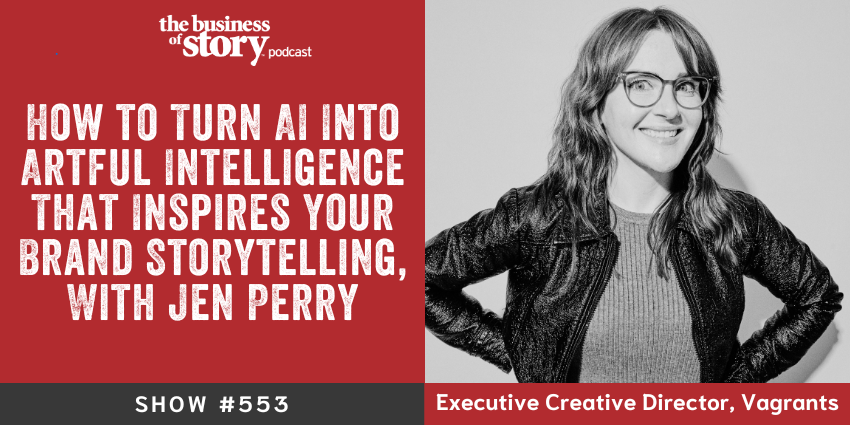
Today’s guest is Jen Perry, Executive Creative Director at Vagrants, where she leads the company’s evolution from a production shop into a creative powerhouse.
With over 20 years of experience building and leading creative teams, Jen’s guided projects for JetBlue, IKEA, and Dunkin’ Donuts, earning recognition from the Emmys, Cannes Lions, and The One Show.
Jen believes in the power of collaboration, coaching, and a strong creative process to bring bold, effective ideas to life.
What’s In It for You?
- How to reframe “artificial intelligence” as “artful intelligence” to unlock your creative edge.
- Proven strategies for keeping emotional intelligence at the heart of your brand storytelling—even as you embrace new technology.
- Actionable methods to build genuine, lasting client relationships and inspire your creative teams in a tech-driven world.
Why “Artificial Intelligence” Is a Branding Problem
Let’s face it—“artificial intelligence” is about the worst brand name for the most exciting technological leap of our era. “Artificial” feels distant, soulless, even a bit flaky. It focuses on what the tech companies make, not what they make happen for you.
But what if, instead of “artificial intelligence,” you started calling it “artful intelligence”?
Artful intelligence is about cleverness, skill, and creative ingenuity. Sure, the shadow side of “artful” is trickery or slyness—which haunts Gen AI with its hallucinations and general slop. But at its best, artfulness is about using technology with the same intention and finesse as an artist with a brush or a chef with a knife. It’s about weaving your story, your strategy, your unique voice into every interaction—so your message actually connects.
The StoryCycle Genie™: Your Platform for Artful Intelligence
That’s exactly what the StoryCycle Genie™ is built for. Sure, it runs on advanced AI, but at its core, it’s designed to amplify your humanness, not replace it. It helps you become more skillful, more elegant, more artful in the way you communicate, lead, and grow your brand.
The Genie doesn’t just spit out generic answers. It listens, adapts, and helps you craft stories that move people—because it’s built on proven story structures, including the Story Cycle System and the ABT narrative framework, that honor your audience as the hero and you as the guide.
Real-World Proof: How Artful Intelligence Outperforms “Artificial” Every Time
Take Tom Schwab, founder of Interview Valet, one of the world’s top podcast booking agencies. Tom built his own custom GPT, but ran into the same headaches you’ve probably experienced—hallucinations, trial and error, and generic, off-brand content.
Then Tom tried the StoryCycle Genie™.
“I was in awe of the content the StoryCycle Genie gave me. I largely copied and pasted three LinkedIn articles and six tweets. You made me sound smart, and you made AI sound like my brand. You can get AI crap in 10 seconds or get quality in 90 seconds. Either way, it saved me 4 hours and, more importantly, gave me a far superior product.”
He went on:
“Years ago, I paid a copywriter over $1,000 to do this type of email sequence. It took weeks and hours of my time with back-and-forth. I was never happy with the results until the StoryCycle Genie.”
That’s what artful intelligence is all about: using AI to amplify your voice, your humanness, and your brand.
Actionable Steps: How to Make AI Your Artful Ally
- Reframe your mindset: Don’t settle for “artificial.” Demand artful. Use AI to support your creative process, not replace it.
- Honor your audience: Always start with their needs, desires, and challenges. Make them the hero of your story.
- Embrace proven story frameworks: Use structures like ABT and the Story Cycle System to guide your messaging and keep it human-centered.
- Vet and shape AI output: Don’t just accept what Gen AI spits out. Edit, refine, and add your unique perspective.
- Collaborate and coach: Build teams that value emotional intelligence, curiosity, and bold thinking. Technology should make your people better, not obsolete.
Final Thoughts: Your Brand’s Artful Future
So the next time you hear “artificial intelligence,” and you struggle with using Gen AI, reimagine it as artful intelligence—especially when you use a narrative-native platform like the StoryCycle Genie™. That’s how you use technology to make something truly meaningful happen—not just for you, but for everyone your story touches.
And that’s why we created the StoryCycle Genie™—built by agency principals for agency professionals—to help you be more inspired, more creative, and more human—one artful story after another.
Jen Perry’s Conversation With Park Howell About How to Reframe AI into Artful Intelligence on The Business of Story
Park:
Hello, Jen. Welcome to the show.
Jen:
Thank you, happy to be here.
Park:
And you told me before we started recording, you’re coming to us from kind of cold Boston at this point.
Jen:
Unfortunately, yes, it is very frigid and windy here in Boston. So staying inside today. I encourage you to visit in the summer or the fall.
Park:
Just typical winter then. I have yet to go to Boston and I’m looking forward to doing that sooner than later. I missed out on an opportunity, but it would have been end of January. So I think I’ll wait till spring, summer, or fall. It’s great to have you here. Give our listeners a little bit of a background about you, some of the big brands and agencies you’ve worked with, and how it’s led to what you’re doing today.
Jen:
Hi, everyone. I’m Jen Perry. I am the executive creative director at Vagrants. We’re a creative production shop here in Boston. I have taken a meandering road in my career, starting with very traditional big agencies. That’s where I grew my career, became a creative, and came up in the industry.
From Copywriter to Creative Director
Park:
What were you doing as a creative—a writer, designer, filmmaker?
Jen:
Copywriter. I started in the big agency world at a large global agency in New York City as a creative assistant turned copywriter. I worked my way from the bottom up, didn’t go to ad school, just scrapped it together. That’s one of the things that makes me good for the role I’m in today: I’m not afraid to scrap it together and find my own path.
I made my way as a copywriter, then veered off to the brand side. I built and ran an internal agency at a tech company outside Boston for about four and a half years and learned so much. There’s this belief that once you go brand side, you don’t come back. Some people were shocked when I came back agency side to build and grow a more robust creative team at a small shop in Boston, and then within a media agency. Now, I’m building and shaping a creative offering within what was historically a production company, using the foundation I built at the start.
Park:
Did you get a chance to work on some big brands at those agencies and any campaigns we might recognize?
Jen:
Yes. I worked a lot on Dunkin’, which everyone is familiar with—America Runs on Dunkin’. That tagline has been around for a long time, and Hill Holiday was the agency of record for Dunkin’ for a long time. I was one of the lead creatives on the Dunkin’ Donuts account at Hill Holiday for about three and a half years, did a ton of Dunkin’ spots, and learned a lot about how that brand works.
I also worked on JetBlue, which was a really fun brand with a great story. Before that, I spent a lot of time on Unilever, focused on Degree Deodorant (called Rexona in Europe). I got to be on the main team for Degree in the States and traveled to Madrid to work on Rexona with a different team and pitch other Unilever products. So I had good global experience early on.
The Vagrants Story
Park:
Now you’re with Vagrants. Tell us a little bit about Vagrants.
Jen:
Vagrants was historically a video production company. What’s cool is that I met them as a client when they were just starting out and I was running an internal agency at a tech company. I was used to big agency life—having a production team, strategy team, account team. Then, brand side, I had to figure it all out myself. I needed a great production, but didn’t have a producer or a big budget. A friend from Mullen recommended Vagrants.
We met right away and had a great rapport. I’ve worked with them off and on for seven or eight years in different capacities—brand side, agency side, back again. As the industry has shifted and changed, we started talking early this year: What if Vagrants had a creative offering? It grew from there. Vagrants is an incredible company built by amazing makers, super creative. I always told people, if you want great work and a local production company, you have to talk to Vagrants. Now we’re building on that brand.
Holding on to Humanity in the Age of AI
Park:
With your background as a writer and in branding, you’ve worked with global clients and on a smaller level. Now you’re building a creative offering at Vagrants. For our listeners, what’s the one big problem we’re going to solve today and why?
Jen:
The big problem we need to talk about is how to hold on to our humanity in today’s world. Everything is AI and automated, but I want to talk about how we hold on to compassion, humanity, empathy, and emotional intelligence as things shift and change. It’s more important than ever.
Park:
I imagine you all use AI. It’s not a shortcut; it’s a new way of thinking about and approaching a project. But we can’t lose the humanity in the process. Give us ideas for holding on to and embracing humanity in creative work.
Jen:
It’s just like any other tool. It’s not meant to replace creativity, but to enhance it. Some folks see it as a way to cut costs, but I don’t think it works that way. In my experience, it helps synthesize information, but humans still come up with the disruptive ideas and make meaning of that information. That’s human insight and human emotion, not coming from an LLM.
I think about Rick Rubin, who says the confidence in his taste and ability to express what he feels is most helpful to artists. He’s not a technician, he gets paid for his taste. It’s that discernment and curation that becomes so important—and that comes from humanity, instincts, and emotional intelligence. That’s where the divergence happens between robots and humans.
Empathy, Client Collaboration, and Creative Success
Park:
How do you keep it human with clients and customers, especially in big video or film projects?
Jen:
When I think back to coming up in the industry, there was this belief that creatives can’t talk to clients. You’re kept “under the stairs” like Harry Potter—only the account or strategy team faces the client. That’s done creatives a disservice. Over the years, I started to get closer to clients because at the end of the day, a client is a human. You’re a human, the client is a human, and the audience is filled with humans. We tend to overcomplicate things, especially in big organizations with strict lanes.
I tried to get closer and be in conversations I wouldn’t have been in before, do things that were frowned upon—like emailing a client directly. The closer I got to clients, the better my career and my team’s work became, and the more efficiently I worked. More trust is built, as long as you don’t take over every role and lose focus on the creative.
The Power of Listening and Story Structure
Park:
Let’s talk about empathy. How do you approach that?
Jen:
Ask a lot of questions. So much of our job isn’t about making the creative work—it’s about psychology, hearing the ask behind the ask. If a client says, “I need a new marketing campaign,” you could take that at face value, or you could dig deeper: Why? What’s not working about the current one? What happened with previous partners? You have to dig like an anthropologist to find the real history and what’s really being said. That takes time, thought, emotional intelligence, and compassion.
Park:
One question can lead to a decades-long relationship. When I started my agency, I had one big account and was doing video and commercial work for Phoenix Sky Harbor Airport. One day the client needed a radio campaign. I asked, “You have an ad agency, why aren’t they doing it?” She sighed. I said, “Is everything okay?” and found out they were sideways with their agency. That led to a 10-year relationship—all because I asked the real question.
Jen:
Exactly. You heard that sigh and knew there was something underneath. Sometimes in meetings, if a client doesn’t like something, I coach my creatives to let them talk, don’t try to solve it immediately. What they’re saying might not be what they’re really saying. Let it go for a while, process, ask questions, and dig in to really understand before jumping in with solutions. That’s hard because we’re problem solvers.
Strategy, Story, and Audience Understanding
Park:
I love the five whys exercise—keep asking why until you find the real problem.
Jen:
That’s why I’ve always been interested in strategy. You’re digging for human insights.
Park:
I train my team and clients to use the “and, but, therefore” narrative framework as a story listening tool. When a client vents, you can say, “I know you want this and it’s important because of this, but you’re frustrated because of this problem. Therefore, here’s how we can help.” You use the three forces of story: agreement, contradiction, and consequence. Sometimes, that helps the client realize there’s one more thing—the real problem.
Jen:
It’s hard, especially for creatives because our work is personal. But if you seek to understand, things go better. Clients aren’t just being difficult; they have their own challenges, bosses, and pressures. When you see them as people with real challenges, things go better for everyone.
Audience, Client, and Creative: The Three Stories
Park:
You have three audiences: the customer buying something, the client paying you, and your own creatives. You need to understand each of their stories—their wants, the obstacles, and how you can help.
Jen:
It all comes back to human understanding. Emotional intelligence wasn’t as valued earlier in my career, but now it’s a superpower. I’m glad it’s talked about more. Take the Got Milk campaign: The strategy team found that people don’t think about milk until they’re out of it. That insight led to a hugely successful campaign, not just “milk makes your bones stronger.” It took digging and research.
Insights from Iconic Campaigns and Brand Positioning
Park:
People don’t buy what you make; they buy what you make happen. Milk is a commodity, but the Got Milk campaign understood the buyer’s real need. That campaign took on a life of its own.
Jen:
It really did. I was part of the Got Milk campaign at my first agency in New York. One big project was a collaboration between Burger King and the California Milk Processors Board to announce that Burger King now had milk. We did a photo shoot with the Burger King in a limo with champagne glasses filled with chocolate milk. It was funny and fun to work on.
Brand Evolution and Audience Personas at Vagrants
Park:
You bring that energy and creativity to Vagrants. As I do with all my guests, I ran your brand through the Genie and you sent me a deck for your rebrand. The Genie identified three audiences: ambitious marketers (Athena), brand creative teams (Julie), and agency creative directors (Robin). What are you doing with those profiles?
Jen:
Expanding beyond production into creative and strategy has been interesting. Brand-side creative leaders often lack resources and aren’t in environments that celebrate creativity. They need a more collaborative production partner than most companies offer. Until I met Vagrants, I couldn’t call up a director to help me work through ideas within budget and timing. Our flexibility and willingness to collaborate before something is sold resonates with brand creative teams.
Ambitious marketers are a new audience for us—direct-to-brand. Historically, Vagrants worked with agencies, but now we offer creative direct-to-brand, just like an agency.
Emotional Triggers and the Power of Partnership
Park:
The Genie says your top audience is ambitious marketers. Their challenges are managing lean teams while delivering premium creative in fast-moving markets. Their fears: agency fatigue from overpaying for bureaucracy while underdelivering on speed, quality, and clarity. Their frustrations: lack of cohesion and partners who overpromise and underdeliver. Their aspiration: a strategic creative partner who thinks fast, moves smart, and makes them look like they’re running well-oiled marketing operations.
Jen:
Absolutely. That’s what we aspire to be—more of a partner, more collaborative, flexible, and nimble than a big organization.
Framing the Narrative: ABT and Positioning
Park:
Here’s the ABT for your top audience: As an ambitious marketer managing lean teams and demanding results, you want strategic creative partners who deliver premium work and drive measurable outcomes without bureaucratic complexity. But you feel exhausted because most agencies overpromise and underdeliver. Therefore, with Vagrants’ production-forward approach, you find true partnership and a radically different creative experience.
Does that capture your story?
Jen:
I’d say so, yes.
Park:
Your position statement: Vagrants is the only production-forward creative shop that liberates ambitious brands from loaded creative processes through strategic thinking and world-class execution, delivered with radical transparency, flexibility, and serious fun.
Jen:
That’s similar to what we have in our deck.
Park:
Your unique value proposition: radically different creative experience.
Jen:
I can speak to that as a former client and now working directly for Vagrants.
AI, Writing, and Emotional Intelligence
Park:
As writers and creatives, I used to fear AI would ruin writing, but I’ve learned it actually makes me think and write differently, faster, and with more humanity—when used well.
Jen:
I agree. It gives you a nugget to build on, but it’s not a polished final product. You need to bring your emotional intelligence.
Actionable Advice: Connecting with Audiences
Park:
Can you give our audiences two or three ways to better connect with, listen to, and build relationships with their audiences—from customers to clients to creators?
Jen:
First, slow down. Take a beat to listen before you react or try to solve. I use the phrase “zoom out” with my teams and clients—look at the big picture. If you take more time, ask more questions, and probe more, you’ll end up in a better place. Fight the urge to people-please with a quick fix. COVID blurred the lines between work and life, and now we feel like we have to solve everything instantly, but quality suffers.
Second, give yourself space for thoughtful ideas. Timelines have compressed in creative, but just because AI can spit out ideas quickly doesn’t mean any of them are good. We need to be more thoughtful about our responses, solutions, and ideation.
Vagrants Originals and Looking to the Future
Park:
Where can people learn more about you and Vagrants?
Jen:
Visit vagrants.com or our LinkedIn. 2026 is going to be a big year for us. We have a feature-length film in the works called “Your Attention, Please,” about kids and cell phone use. We’re tackling important social issues and also have projects focused on life in the outdoors. Many of us at Vagrants are into the outdoors, and those interests make their way into our originals.
Park:
Will your films be distributed through Netflix or Amazon?
Jen:
We’ll see—we’re working on it and doing screenings now.
Park:
Thank you so much, Jen!
Jen:
Thank you. It was great to meet you and chat.
Frequently Asked Questions
Q: How can creative leaders maintain humanity and compassion in an AI-driven industry?
A: Creative leaders can prioritize empathy, active listening, and authentic storytelling to ensure technology enhances—not replaces—human connection. Regular team check-ins, open feedback loops, and client-centric approaches help preserve compassion in creative work.
Q: Why is emotional intelligence essential for successful client relationships in creative agencies?
A: Emotional intelligence enables agency professionals to understand client needs, navigate feedback gracefully, and build trust. By recognizing emotions and responding thoughtfully, agencies foster long-term partnerships and deliver impactful creative solutions.
Q: What strategies help creative teams balance innovation with empathy in the age of AI?
A: Teams can integrate AI tools for efficiency while maintaining a human touch through collaborative brainstorming, empathy mapping, and storytelling workshops. Encouraging diverse perspectives ensures technology supports, rather than overshadows, creative empathy.
Q: How has the role of creative agencies evolved with advancements in artificial intelligence?
A: Creative agencies now blend data-driven insights with emotional storytelling, leveraging AI for research, personalization, and automation. The evolution emphasizes strategic thinking, adaptability, and the ability to humanize technology in client campaigns.
Q: What lessons can creative professionals learn from iconic campaigns like Got Milk?
A: Iconic campaigns like Got Milk demonstrate the power of simple, emotionally resonant messaging. Creative professionals should focus on universal themes, memorable visuals, and authentic narratives to create lasting impact and brand recognition.
Q: How can agencies foster empathy and emotional intelligence within their teams?
A: Agencies can offer training in active listening, emotional awareness, and conflict resolution. Creating safe spaces for sharing experiences and celebrating vulnerability strengthens team bonds and enhances creative output.
Q: What are actionable steps for creative leaders to build trust with clients?
A: Leaders should communicate transparently, set clear expectations, and deliver consistent results. Regular check-ins, honest feedback, and a willingness to adapt demonstrate reliability and foster client trust.
Q: How does AI impact the creative process in agency-client collaborations?
A: AI streamlines research, automates repetitive tasks, and enables data-driven personalization. However, successful collaborations rely on human insight to interpret data, craft compelling stories, and maintain authentic client relationships.
Q: What role does compassion play in creative problem-solving?
A: Compassion allows creative professionals to understand client challenges deeply, leading to solutions that resonate emotionally. By prioritizing empathy, agencies can develop campaigns that connect with audiences on a personal level.
Q: How can creative agencies ensure their work remains emotionally intelligent in a tech-focused world?
A: Agencies should blend technology with human-centered design, prioritize storytelling, and regularly assess the emotional impact of their work. Encouraging feedback from diverse audiences helps maintain emotional intelligence in creative outputs.
Q: What are the benefits of integrating emotional intelligence into agency culture?
A: Integrating emotional intelligence leads to better teamwork, improved client satisfaction, and more innovative solutions. Agencies with emotionally intelligent cultures adapt quickly to change and build stronger, more resilient client relationships.
Q: How can creative professionals leverage AI without losing their unique voice and vision?
A: Professionals should use AI as a tool for inspiration and efficiency, not as a replacement for creativity. By staying true to their values, embracing authenticity, and using technology to enhance—not dictate—their creative process, they preserve their unique voice.
 Listen To More Episodes