Why Your Growth Depends on Truly Knowing Your Buyer
Why Most Founders Get Stuck (and How to Break Free)
When your brand storytelling speaks to the right buyers—like you know them intimately—you create predictable growth.
But you may feel trapped, working harder for less, because your message misses what your market really needs.
Today’s episode is all about escaping the founder’s trap by mastering message market match.
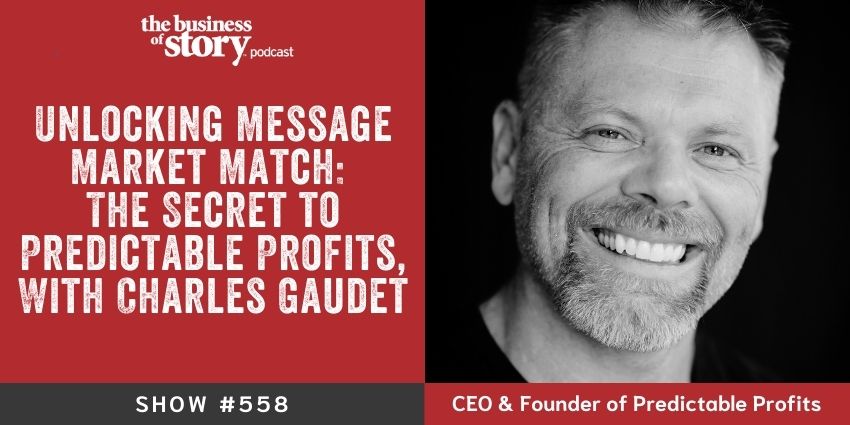
My guest, Charles Gaudet, is the CEO and Founder of Predictable Profits, creator of The Predictable Profits Operating System™, and “The CEO Whisperer” according to Yahoo Finance.
Charles has helped clients generate over $100 million in revenue, transforming founder-dependent businesses into scalable, predictable growth machines.
Why Message Market Match Is the Real Secret to Effortless Lead Generation
If you’ve ever wondered why lead generation feels so hard, Charles has the answer: it’s not about working harder—it’s about aligning your message with what your market truly wants.
When your story lands with the right audience, everything gets easier. When it doesn’t, you’re just shouting into the void.
Charles reveals that most founders are only about 60% accurate in knowing their real buyer. The secret? Stop guessing and start using data-driven insights to find your “super consumer”—the high-value segment that drives most of your profit.
What’s In It for You:
- Understand the difference between an ICP and a super consumer—and why most businesses get this wrong
- Discover why lead generation is a struggle when your message misses your market
- Learn the three paths founders face at inflection points: change your message, change your market, or change both
- See how reframing setbacks unlocks new opportunities for growth
- Find out how to use buyer data and narrative frameworks to create a business that doesn’t depend on you
Meet Charles Gaudet: The CEO Whisperer
Diagnosed with severe learning disabilities as a child, Charles built his first multimillion-dollar business by age 24. He’s been named one of the top business coaches alongside Tony Robbins and Grant Cardone, and his Predictable Profits Operating System™ has helped entrepreneurs generate over $100 million in revenue. Charles is a Forbes, Inc., and Business Insider-featured expert, and host of The Beyond 7-Figures Podcast.
His specialty? Helping 7- and 8-figure founders escape the “Founder’s Trap”—where the very skills that built their business become the biggest obstacle to scaling.
The Founder’s Trap: Why Working Harder Isn’t the Answer
Charles’s journey started with hustle—long hours, relentless drive, and a belief that outworking everyone else was the secret to success. But after a near-collapse from stress and overwork, he realized that hard work alone wasn’t enough. The real breakthrough came by asking better questions and reframing his approach.
He shares a powerful story about helping an Australian travel agency survive COVID—not by working harder, but by changing their message to meet the market’s new reality. The result? Record-breaking growth, even as competitors shut down.
From ICP to Super Consumer: Data-Driven Buyer Insights
Most businesses rely on an “ideal customer profile” (ICP)—but Charles argues that’s just a starting point. The real power comes from identifying your super consumer: the passionate, profitable segment that drives 80% of your results. Using buyer data, interviews, and real purchase behavior, you can craft messaging that speaks directly to their needs and aspirations.
Charles’s frameworks help you move from assumption to insight, closing the gap between what you think your market wants and what actually drives them to buy.
Reframing Setbacks Into Growth Opportunities
Every founder faces setbacks—lost clients, failed campaigns, unexpected challenges. Charles’s advice? Reframe every problem as a signal for improvement. By asking, “Why could this be the best thing to happen right now?” you unlock new solutions and build a culture of abundance and resilience.
The Predictable Profits Operating System: Setup, Sales, Scale
Charles’s Predictable Profits Operating System™ is built on three pillars:
- Setup: Create demand with a message that matches your market
- Sales: Qualify buyer-ready leads through authentic conversations
- Scale: Build systems and frameworks so your business grows beyond you
As buyers become more discerning—consuming more content and researching more options—your message market match becomes your biggest differentiator.
Authentic Storytelling in the Age of AI
In a world flooded with generic, AI-driven content, authenticity is your competitive edge. Charles and Park discuss how narrative frameworks like the Story Cycle Genie help brands reflect their true strengths, reveal gaps, and inspire new ways to connect with the market.
Links
- Charles Gaudet on LinkedIn
- The Predictable Profits Playbook
- Charles on X
- Charles on Instagram
- Charles on Facebook
- Beyond 7 Figures: Build Scale, Profit Podcast
- StoryCycle Genie™
Charles Gaudet’s Conversation With Park Howell on The Business of Story Podcast:
Introduction: Charles Gaudet on Message Market Match
Park: Charles, welcome to the show.
Charles: Hahaha. Pleasure to be here. Thank you for having me.
Park: And you’re coming to us from Jupiter, Florida? God, is that like a whole other planet on this continent or what? Jupiter, a pretty beautiful place.
Charles: That I am.
Charles: You know what? Sometimes in today’s world, I do feel like we’re on another planet. If I don’t log in anywhere, I feel like I’m in a bubble. And right now, it’s kind of nice to be in that little bubble sometimes.
Park: Yeah, I hear you. I’ve been coming to you from northern Arizona up in the mountains and we’re expecting snow tomorrow. So a little bit different than Jupiter.
Charles: Wow, yeah, I can imagine. I was from New Hampshire and I’m still thawing out down here.
From Founder’s Trap to Predictable Profits: Charles Gaudet’s Entrepreneurial Journey
Park: Well, so great to have you here. We’re going to talk about the Founders Trap. I think our survival brain is probably really interesting in this because any sort of trap does what? In this case, it strangles the growth of your enterprise—something you worked very hard to build. How did you become an expert in helping people get out of these Founder Traps?
Charles: You know, they say you learn to walk by falling down, right? So you fall down, get back up, fall down, get back up. That’s kind of how you learn to walk. I’ve been an entrepreneur since age four, never had a traditional “real” job. Bless you, by the way.
Park: Thank you. Yeah. Just hit me all of a sudden here. Maybe I’m an allergic entrepreneur at four. What were you doing at four?
Charles: Selling artwork to my neighbors.
Park: Well, there you go.
Charles: After college, I started a business that was nominated by Ernst and Young as one of the nation’s best seed stage companies at 24. I created my first multimillion dollar business and kept building and growing companies until 2010. That’s when someone offered to pay me to help them grow their business. I started Predictable Profits, and we’ve done quite well, gotten a lot of press and everything from that.
The Dangers of Overwork and the Founder’s Trap
Charles: When I was in my early 20s—21, 22—my dad always said the secret to success was hard work. Got it. He also said the early bird gets the worm. For anybody who knows me, when I go all in, I go all in.
So I’d set my alarm for 3:30 in the morning so I wouldn’t “oversleep.” If I woke up at midnight to go to the bathroom, I’d just say, “Look, I’m up. I’m going to start working.” I’d work until I couldn’t keep my eyes open. Seven days a week. Christmas included.
Park: And what was your company?
Charles: Back then it was real estate development. I built roads, neighborhoods. One day I’m driving home, looking over the hood of my vehicle, and I could see the house, but I knew I wasn’t going home that day. Suddenly I got a sharp pain through the base of my spine into my brain. Not long after, I ended up in the hospital. The doctor says I’m dying. My organs are shutting down. My body couldn’t sustain the lack of sleep, the constant stress. I was in over a million dollars in debt. I thought I was dying.
Learning Through Adversity: How Desperation Drives Innovation
Park: And you were 24 at this time? A young man in good shape, but just working yourself to death?
Charles: I wasn’t so much fit back then because I didn’t prioritize health. I prioritized work. My relationship was failing. My health was failing. The only thing I was making traction on was the business, but it felt like I was pushing a bus uphill. Everything was hard work. Every turn was hard because that’s the only strategy I knew—work harder.
My wife was driving me home from the hospital, and I was so frustrated. “I’m doing everything I’m supposed to do. Nobody’s outworking me. Nobody’s getting up earlier than me. And yet I look around and feel like everybody’s making more money and working less. Where am I messing up?”
My wife and I invested a quarter million dollars to Tony Robbins, traveling the world and learning from him. Tony says we make decisions for two reasons: desperation or inspiration. That was a moment of desperation for me. I couldn’t keep doing it. I had to change.
Through a series of asking different questions and testing, we found ways to create more leverage. About a year after that, I went from being over a million dollars in debt to paying it all off and creating my first real multi-million dollar business.
The Power of Asking Better Questions for Business Growth
Charles: My dad was an entrepreneur. I started at four because he said, “If you ever want to make something of yourself, you’ve got to be an entrepreneur.” I didn’t really get to know my dad until the fourth grade. He would get up before I was up, go to bed after I went to bed, seven days a week.
There was a moment in the third grade—my dad came home early, looked at my mom, looked at me, and said, “When did he grow up?” I could feel something from my father—maybe disappointment or sadness. In the fourth grade, he started taking weekends off, then summers off. But even late in life, he had limiting beliefs that frustrated me. I always wanted to help him.
Through all this, I ended up creating systems and processes that helped not only me but over a thousand different six, seven, and eight-figure entrepreneurs.
Case Study: Reframing the Message for Market Survival During COVID
Park: Give us an example. You sent me notes about an Australian travel agency going out of business because of COVID. They’re losing money, burning through cash, and they called you. What did you do?
Charles: He gets me on FaceTime—hair disheveled, standing outside his parents’ house. He said, “Charlie, I just need your blessing to shut the business down.” I said, “Why? What are you talking about?” He said, “I only get paid when I put people on a plane. Planes are grounded. My biggest competitors already closed.” I said, “Why could this be the best moment in the world for you to be in business?”
He looked at me like I had two heads. I wouldn’t stop until he started giving answers for why it could be good. “Are people still visiting your website?” “Yeah, all the time.” “Are they opening your emails?” “Yup.” “Clicking links?” “Yup.” At an inflection point, you either change the message to meet the market, change the market to meet the message, or change both.
We started by changing the message. “If they could get on a plane, would they?” “Yeah.” “What’s the advantage of buying now?” “More time to plan, pass savings, get on planes first when borders open.” We ran with that. Before long, he broke every sales record and created the largest, most successful company in his niche—all because he repositioned by changing the message to meet the market.
Three Paths at the Inflection Point: Changing Message, Market, or Both
Charles: Funny thing, we had a problem we didn’t anticipate—he was selling so fast he worried about fulfilling all the orders. He could have sold 4, 5, 6, 10 times more. But now he was pushing the brakes because sales were so strong. A good problem to have.
Why Reframing Challenges Unlocks Opportunity
Park: When you ask, “Why could this be the best time for you?”—that’s reframing. My biggest competitor just went out of business. It’s about reframing what’s happening as the story changes, especially during COVID.
Charles: Our first reaction is often emotional. When we get hit with a problem, we dwell on it. But that just digs a deeper hole. Now, with my team, whenever something happens—maybe a client leaves or we get a complaint—we ask, “Why could this be the best thing to happen to us right now?” At first, they thought I was crazy, but now they’re used to it. It reframes the situation, gets us looking for opportunities. Every time, zero exceptions, we come up with solutions that make us better. It creates a more cohesive culture.
Cultivating an Abundance Mindset in Business
Park: So you flip from a scarcity mindset to abundance and create that abundance with proactive efforts, rather than wallowing in sadness.
Charles: Exactly. Just before we got on the phone, I talked with a client who had a bad situation with an employee. I said, “We can’t control what happened. What’s the learning lesson?” He realized he hadn’t set up guardrails or monitored KPIs, just trusted the employee. I asked, “What if this happened when your company was twice as big?” It would have been disastrous. Sometimes things happen for us so we can learn from small situations before they become massive.
Building Systems to Escape the Founder’s Trap
Park: You gave him agency. Now he’s not playing the victim. So, tell us about the Predictable Profits operating system. How does it work?
Charles: In 2010, after years of experience, I started hitting one home run after another. But as the company grew, it remained dependent on me. That was unsustainable. I was working for my calendar, burning out. The business’s value was basically me. My team pushed me to build frameworks around what I do and how I do it. Our results were so unusual, it was clear we were doing something unique. Those frameworks became the Predictable Profits operating system.
The Predictable Profits Operating System Explained
Charles: At the base is “setup.” When people think about marketing, I tell them, “You can’t do marketing.” Marketing is a function—creating demand, capturing demand, nurturing demand. I asked a $500 million CEO, “How effective are you at creating demand? Capturing? Nurturing?” He didn’t know. Two-thirds of his marketing function was in the dark. Setup is the basis behind everything.
Buyers are changing. We went from 17 sources of info before a buying decision in 2019 to 36 now. By 2030, 100% of buying decisions will be rep-free. By the time they talk to sales, they’re already ready to buy. Setup ensures that by the time they get to sales, they’re buyer-ready leads. Sales is just qualifying. Then you focus on scale—systems, KPIs, culture, org chart. Most org charts aren’t built for scale.
Recognizing the Founder’s Trap: Signs and Solutions
Park: How does a founder know they’re trapped?
Charles: There are two hard parts to growing a business: starting and after success. You fall into the founder’s trap not because you failed, but because you’re successful. The more successful, the deeper the trap.
You start with you at the center—every marketing decision, lead, sale, operation depends on you. You think more leads will fix things, but then your calendar fills, you work later, you hire more people, but everyone still depends on you. You work more hours, feel like you’re making less. The more successful, the harder the business gets.
To escape, you have to release yourself from each component. When you do, it sets off an inflection point and growth accelerates.
Scaling Beyond Founder Dependency: Systems and Frameworks
Charles: We took one company from $950,000 to $66 million in a few years. As we removed constraints, things started to flow faster, easier, with less headaches and resources.
Preempting the Founder’s Trap for Young Businesses
Park: What about young founders who want to avoid the trap?
Charles: Up to $250,000, just work hard, close deals, prove the model. After that, focus on setup. Build a system to generate leads consistently, beyond your personal network. That gives you confidence to bring on sales help, refine delivery, and keep growing.
The Critical Role of Setup in Lead Generation
Charles: Park, you sent me something brilliant about my brand story. When you talk about setup, so many people speak to nobody because they’re speaking to everybody. If lead generation is hard, it’s because there’s a message market mismatch.
Why Message Market Match Makes Lead Generation Easy
Charles: When people look at your messaging and feel, “You wrote this for me,” lead generation becomes easy. When they visit your site, LinkedIn, or Instagram and feel you’re speaking to them, they trust you have the answer to their problem. Lead gen becomes easy. Everything else works out.
Consumption Drives Conversion: The New Marketing Metric
Charles: Prior to 2020, marketers optimized for conversion. After 2020, it’s consumption that drives conversion. The more content someone consumes, the more likely they are to buy. We studied people who converted in 0–90 days versus 90 days–2 years. The difference was how much content they consumed.
COVID’s Impact on Buyer Behavior and Content Consumption
Park: Did COVID impact that shift?
Charles: Absolutely. In uncertainty, buyers become more discerning. Before, buying cycles were shorter. Now, buyers weigh options—SEO, pay-per-click, outbound, coaching, social, or nothing. They need education to see why your solution is the best investment. Then, why your agency over others. Most business owners assume buyers have already decided, but you have to guide them through that journey.
Educating Buyers: Guiding Decisions in a Complex Marketplace
Charles: Buyers want to know, “Is this for me?” If you don’t call out your audience, they’ll have to dig to figure it out. Everyone feels unique. If your messaging makes them feel you know them, they’re more likely to buy.
The Importance of Founder Brand Content vs. Business Brand Content
Charles: As a founder, you need two kinds of content: founder brand and business brand. Founder brand generates leads faster and cheaper because people trust the person. Early on, people want to learn from you as the thought leader. When they’re ready to do business, they follow the company.
Authenticity as a Competitive Advantage in the Age of AI
Charles: Authenticity is the biggest competitive advantage right now. We have a hairpin trigger—people are tired of being tricked by AI. If your content isn’t authentic, you won’t stand out. Even if you use AI, it has to reflect your authentic voice and brand.
Using Narrative Frameworks for Brand Assessment and Strategy
Park: We ran your brand through our Story Cycle Genie, which uses human narrative frameworks, and sent you the assessment and narrative strategy. Did it feel accurate and authentic?
Charles: It did. Either I did a good job communicating my brand, or your algorithm is really good. It nailed so much of it. It validated what I’m doing well, revealed gaps, and inspired new ways to think about my brand story.
Building Brands from Scratch: The ComaDose Satire Example
Park: I once built a fake brand called ComaDose using the Genie. In under six hours, I created a brand, landing page, marketing materials, and a radio spot—all on a narrative platform with message market match.
Charles: Years ago, a client challenged me to sell a product I knew nothing about. I built a beautiful website, followed all the copy rules. He just researched the problem and wrote it up with a “buy now” button. He outsold me four to one. The lesson: if you skip true message market match, nothing else matters.
Research vs. Copywriting: The Real Secret to Conversion
Charles: It doesn’t matter how pretty your website is or how well you follow copywriting rules. If you don’t have the right message market match, you won’t convert. If I’d done his research and followed the rules, we’d have done even better.
Message Market Match: The Foundation of Business Success
Park: Is message market match the root of the founder’s trap?
Charles: Yes. The first thing we do with clients is ask, “For who?” We refer to the buyer as the “super consumer.” Most people talk about ICP (ideal client profile), but that’s theoretical. You have data. Data tells you exactly who your client is. For smaller businesses, use the 80-20 rule. For bigger, focus on the top 4%. Build your super consumer profile from real data.
Moving from Ideal Client Profile to Super Consumer Data
Charles: Many believe they know their buyer based on who they wanted to target originally. But after verifying, they’re only about 60% accurate. There’s a big gap between what you believe and what’s actually true.
Data-Driven Buyer Insights: Closing the Gap Between Assumption and Reality
Park: Very interesting. You have a free offer for our listeners?
Free Resources: Predictable Profits Playbook and Workshops
Charles: Go to PredictableProfits.com. Get our book, the Predictable Profits Playbook, listen to our podcast, or join a workshop. We always focus on delivering viable information that makes a difference. The book is free—you just chip in for shipping. Clarity equals power.
Final Thoughts: Clarity, Power, and the Three Ms—Message Market Match
Park: This has been awesome. I’ll have all those links in the show notes. Thanks for your time, Charles.
Charles: I’ve enjoyed this. Thank you. And thank you for the Story Cycle Genie. I’m going to dive much deeper into that with my team.
Park: If you have clients who want to test their brand story, send them to StoryCycleGenie.ai. It’s free, takes 60 seconds, and gives you a grade and a 14-point assessment—validates what’s working, reveals gaps, and inspires new messaging. Perfect message market match. Thanks, Charles.
Charles: Message market match. Love it. Awesome. Thank you.
 Listen To More Episodes