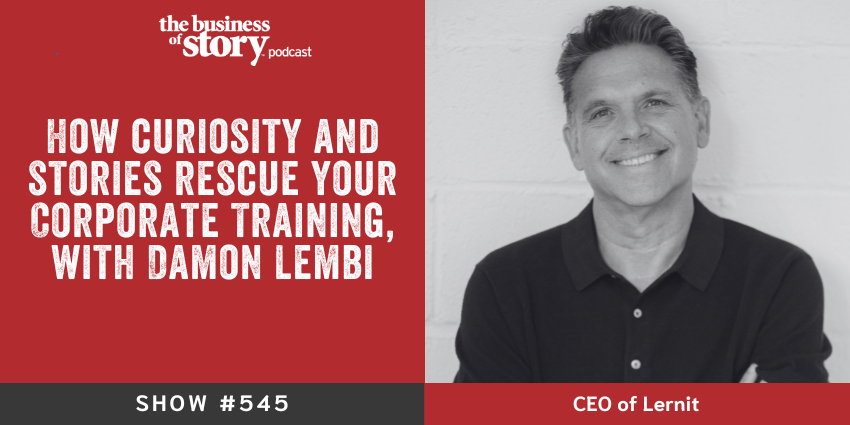
After Upskilling Two million People over 30 Years, Learnit’s CEO Shares the Relatable-Memorable-Emotional Formula That Makes Corporate Learning Actually Stick
You’ve invested in corporate training programs because you want your team to develop new skills and grow their capabilities. And you need those learned skills to actually translate into changed behavior and improved performance—not just forgotten PowerPoint slides.
But you’re frustrated because most training sessions are information dumps that people sit through politely and then never implement, leaving you wondering why your L&D budget produces so little measurable ROI.
What if the solution isn’t better content, but better storytelling?
Meet the CEO Who Turned Receptionist Into a 30-Year Learning Revolution
 Damon Lembi didn’t plan to become a learning industry pioneer. After hitting a home run in the 1994 College World Series for Arizona State, he expected to be drafted into Major League Baseball. When that didn’t happen, he found himself at 22 years old wondering if any of his skills were transferable.
His father had just started Learn It—a revolutionary training company built on a radical idea: corporate learning should feature great storytellers, musicians, and comedians who make people excited to show up. Not three-day Excel classes with thick manuals.
Damon started as a receptionist to prove his value. Thirty years later, as CEO of Learnit, he’s upskilled over 2 million people and learned exactly why some training sticks while most doesn’t.
The difference? Story.
What’s in it for You:
- The relatable-memorable-emotional formula: How Learn It designs every class with story in mind, starting with hook, building tension, and delivering resolution—ensuring learners see themselves in the content
- Why “learning without doing is treason”: The accountability mechanisms Learn It builds into training (drip emails, AI habit coaches, executive learning prompts) that transform passive learning into active implementation
- The narrative transportation secret: How metaphors and analogies create neural coupling where learners see themselves in your stories instead of feeling like outsiders watching generic content
- The know-it-all vs learn-it-all distinction: Why the best trainers speak UP to their audience (never down), coming from humility and vulnerability instead of trying to prove how smart they are
- The StoryCycle Genie transformation: How “confidence” emerged as Learn It’s emotional promise, revealing they were product-focused when they thought they were outcome-driven—and how that single word transformed their entire messaging strategy
Why Most Corporate Training Fails to Stick
Damon puts it bluntly: “Sometimes it’s less about what you’re actually saying and more about how you’re saying it.”
His father understood this three decades ago. Corporate training was information-based—read page by page, slide after slide. “I could just go get a book,” he said. “I’m not learning anything here.”
So he built Learn It around a simple principle: people should feel like learning is a place where they connect, learn things, and walk away inspired.
Not just informed. Inspired.
The problem plaguing most corporate training? It’s designed like Damon’s upcoming all-hands meeting challenge: “I’ve got a bunch of numbers this year, so I want to do my best to not bore everybody to death.”
Sound familiar?
How to Make Data Presentations Engaging Using Story Structure
Here’s the trap: when you show up with numbers and say, “We got this number and it’s because of this, and then this happened and then…” you never get out of exposition.
You’re “anding” your audience to death.
Their brains check out because you’re not giving them story structure—just information avalanche.
The fix Damon discovered? Don’t think about “storytelling” as some complex skill. Think about taking people to a moment in time when something changed.
For training contexts, this means:
AND: Set the context your learners actually live in (“We came up with this goal and we see it’s really important because…”)
BUT: Introduce the specific problem holding them back (“What’s stopping us from achieving that is this major challenge…”)
THEREFORE: Present the solution collaboratively (“We believe we have an approach, but we want to hear from you as well”)
Now you’ve given complete story context instead of drowning them in exposition.
The Three Stories That Prove Story Works in Training
The Engineer’s Transformation: A woman engineer at a large Bay Area transportation company had struggled for years with presentations. She’d read numbers, feel awkward, and rush to escape. After taking Learn It’s “Psychology with PowerPoint” class and learning to present data around story, she felt “much more confident and people actually connected with her more than ever before.”
The ESG Presentation Breakthrough: A student in a storytelling course worked in the complex world of sustainability and ESG. His presentations were typically boring data recitations. After learning the ABT framework, he tried it despite being terrified. Result? Fours and fives out of five on feedback forms and people saying it was the best presentation they’d ever seen him deliver.
The Learn It Discovery: Damon thought Learn It was already outcome-based. But the StoryCycle Genie revealed something eye-opening: they were actually showing up as product-focused, talking about “our training and workshops are great” instead of focusing on the outcomes and beliefs that drive results. That revelation transformed their entire marketing approach.
The Accountability Difference: Why Learnit’s Training Actually Gets Implemented
“Learning without doing is treason.”
Damon learned this phrase from David Katz of Plastic Bank, and it captures the core problem with most corporate training: people go from degree to degree, book to book, model to model without ever developing their own point of view or putting anything into practice.
They’re just lying to themselves.
Learn It solves this through systematic accountability:
Follow-up mechanisms: Cohort check-ins and drip emails asking for specific implementation examples
Executive engagement: Senior leaders get learning prompts to use in one-on-ones with their teams
AI habit coaching: An 80%-complete AI coach allows role-playing practice and tracks actual usage
Emotional design: Stories that are relatable, memorable, and emotional inspire action instead of passive absorption
The goal isn’t just teaching—it’s ensuring people have the courage to try what they learned.
Why Curiosity and Critical Thinking Trump AI Tools
As Learn It evolves from training company to workforce transformation partner, Damon sees a critical shift happening.
The question is no longer “How can we do this differently?”
It’s “How can we do this differently leveraging AI?”
But here’s the thing: AI without curiosity is just automation. AI without critical thinking is just noise.
Damon uses AI daily—not as a thought leader, but as a thought partner. “Give me three reasons why I could be wrong,” he’ll ask. Or “How does this look? Rate it one to ten.”
He even jokes about asking AI after arguments with his wife: “Give me three reasons why she’s right and I’m wrong.”
The power isn’t in the tool. It’s in the curious human asking better questions.
The Future Damon Sees: Leading Humans AND AI Agents
The next frontier? Hybrid leadership—not in-person versus remote, but humans leading teams of both people and AI agents.
This requires new skills. Because if human team members don’t feel important and valued, they’ll self-sabotage AI initiatives out of fear they’re being replaced.
Story becomes even more critical here. Because while AI can process data, it can’t create the empathy, ethical judgment, and authentic connection that makes humans trust their leaders.
That’s irreplaceable.
And it’s exactly why learn-it-all companies—the ones curious enough to experiment, humble enough to admit they don’t have all the answers, and story-savvy enough to connect authentically—will outpace their know-it-all competitors every single time.
Links:
- learnit.com
- Damon Lembi on LinkedIn
- Damon on Instagram
- Damon on X
- Learn-It-All Podcast
- Learn-It-All Leader: Mindset, Traits and Tools
- The StoryCycle Genie™
Related Episodes You’ll Love:
• The Storyteller’s Ledger: How Auditors Use Story to Turn Data Into Drama – Shagen Ganason reveals techniques for making numbers meaningful
• Why AI Makes Your Agency More Valuable, Not Cheaper – Drew McLellan shares research on what clients really expect from AI adoption
• The REST Method: Turning Leadership Vulnerability Into Engagement – Julie Lancaster on why failure stories create deeper connection than success stories
Ready to transform your brand storytelling? Discover how the StoryCycle Genie™ can help you create outcome-driven messaging that resonates.
Damon Lembi, CEO of Learnit, Transcript:
From Baseball Star to Receptionist to Celebrated Learning Industry CEO: Damon’s Journey
Park: Now you are in the learning world, the teaching world, the coaching world. Real quick, can you tell our listeners what you do and what Learn It is?
Damon: Yes. I’m Damon Lembi and Learn It is a live learning platform. Our customers are all B2B, and they turn to us when they have challenges like promoting people from individual contributor to new leader and they don’t have the skills they need.
Or maybe their organization is struggling with silos and communication is terrible. Or maybe retention is tough and they want to build career plans where people can learn and grow and better themselves.
So that’s really what Learn It does. We do it through mostly virtual training on Zoom, two-hour sessions, and we work across the board. I mean, hopefully I don’t look this old, but I have been at this for 30 years.
Park: 30 years and you’ve got two little kids too. So you’re starting late on that. A boy and a girl, yeah. Well, you’re going to learn about that too, my friend.
Before that you were playing baseball at Arizona State University just down the road from us. What position did you play?
The 1994 College World Series and Baseball Glory Days
Damon: Yeah, so I started off as a third baseman at Pepperdine actually as a high school All-American in my glory days, and then I ended up at Arizona State as a first baseman. One of my glory days was in the 1994 College World Series. I hit a home run in game one against Miami.
Park: Wow, that’s awesome. That was the Pat Murphy days as a coach, right?
Damon: It’s so funny. I did both. I played for Jim Brock the final year of his life—I have a great Jim Brock story if you want it, from two days before he died. Then the next year I played for Pat Murphy when he came in from Notre Dame. I believe Pat Murphy just won the National League Manager of the Year Award for the second time.
Park: Wow. And so it was Pat Murphy that took you to the World Series?
Damon: Jim Brock. Yeah, he went out on a high note. He was dealing with cancer and we knew he wasn’t going to make it through, but he was such a courageous man. He actually died right before our game three of the College World Series.
Park: Wow. And did you guys win that series?
The Bucky Buckles Story: From Roommates to World Series Rivals
Damon: No, we lost. We lost to Oklahoma. The really crazy thing about that was when I got to Arizona State, I was a transfer. My roommate at the time was a guy named Bucky Buckles. We said to ourselves, “I wonder if we’re going to make the team or what’s going to happen.”
Well, long story short, good old Bucky failed out of Arizona State during the fall season, which is a little tough to do. The next time I saw Bucky was the bottom of the ninth inning, one out, one guy on, facing him at Oklahoma.
How crazy is that? The year started with Bucky and I as roommates wondering if we’d make the team, and then facing each other in the ninth inning of the College World Series about nine months later.
He threw me a curveball—for anybody who’s a baseball fan—first pitch curveball lower right-hand corner for a strike. I knew I wasn’t going to be able to hit him. So he shut us down.
Park: Now that is weird. So what got you into the learning world?
When Baseball Dreams End: Finding Purpose After Not Getting Drafted
Damon: After that World Series, I was expected to be drafted between the eighth and 12th round. I’d already been drafted a couple of times, and I was really excited to start my baseball career. Well, 12 guys on my team got drafted. I wasn’t one of them. So I was completely depressed.
I went back for one more year at Arizona State, had a lackluster year, didn’t get drafted again. Here I am, 22 years old, and I don’t know if any of my skills are transferable. I didn’t know what I could do because I went all in on baseball.
I was really lucky. I came from a big real estate family. But I was intimidated. I didn’t know if I wanted to go into real estate or if I could even contribute.
My dad had started a bunch of different companies, and one was this computer training company.
How Learn It Was Born: Solving Boring Training Through Story
Like a lot of great entrepreneurs, he wanted to solve a challenge he saw for himself. He went and took a class somewhere, thought it was terrible—long and boring. He came up with this idea for Learn It that was short, 90-minute classes, and he wanted them to be story-type classes where people would just get excited about going there.
He came up with the idea for Learn It just as it was starting in June 1995 when I was getting done with school. I started off as a receptionist because I didn’t know any better.
I started as receptionist for two reasons: I didn’t know if I had any skills, and I also didn’t want to start at the top of the company because I wanted to work my way up and show my value.
So there I was, started off as a receptionist, answered more phones than anybody. Fast forward 30 years, I’ve been the CEO for probably 23, 24 years, and it’s been a wild but really fun ride.
Park: 30 years ago, your dad was ahead of the curve quite a bit, wasn’t he? Because not a lot of online training was going on, and especially this idea of bringing story to it. So many people are led by logic and reason when they’re trying to train something versus really incorporating story into it.
Why Storytelling Beats Information Dumps in Corporate Training
Damon: Absolutely. I mean, he was always ahead of the curve. He was a big thinker and he was trying to digitize his portfolio. He went to a class and it was just information-based—read page by page. He said, “I could just go get a book. I’m not learning anything here.”
That’s when he called the guy who was first CEO and said, “I want to have great storytellers, musicians, comedians. I want people to feel like learning is a place where they can connect, learn things, and walk away inspired.”
He was way ahead of the curve. Back in the day, you’d go take an Excel class and you had a big physical manual on the desk and it was three days long. Our classes were bite-sized, 90-minute sessions that were engaging and easier to retain information.
Park: Bite-sized back then is 90 minutes. This day and age it’s like nine minutes, isn’t it?
Damon: Well, yeah. I mean, bite-sized 90 minutes—now it’s like if you have to do it in the time of a TikTok video.
How to Incorporate Storytelling into Business Training Programs
Park: So how are you guys incorporating storytelling into the trainings that you do now? And one other question on that: is all this training emanating out of your people there, or are you tapping into brilliant minds all around the world?
Damon: That’s a great question. I want to say it’s a little bit of both. First of all, all our content we own ourselves—all the models we’ve developed, so it’s all our own IP.
But to answer your question about where we’re coming up with it: we’re listening to our clients.
We’re not just saying, “Our clients want this”—Henry Ford said if you listen to your clients, you build a faster horse, right? So we want to be on the cutting edge of things.
But we’re listening to our clients and really not looking at, “Okay, we want to build a critical thinking class, we want to have a new leader class.” We’re like, “What are the challenges and problems they’re having? How do we help them get to those outcomes?”
We’re looking for what those outcomes are and reverse engineering to build content that will work best for them.
Obviously right now there’s a lot around AI—not just how to use the tools, but AI adoption. How do you get people confident and comfortable leveraging these tools? We’re doing work across the gamut when it comes to AI.
Partnering with AI Experts for Workforce Transformation
Park: Yeah. With training such as AI, does that come out of professionals inside your organization, or do you go and tap into people outside the organization, bring them in, and have them train through your frameworks?
Damon: I would say our people internally—I’ve got about seven full-time instructors—are doing their best to learn how to leverage AI. But at the end of the day, it’s better to get people on the outside who are living it, rolling up their sleeves, doing it, learning from them, and co-collaborating with us to build out that content.
We’re even evolving from not just delivering the training, Park, but also looking at being a workforce transformation company where we have our training but also helping with behavior change—helping organizations understand what they need to do to get ready to not only roll out AI but execute on it.
When we do that, we’re 100% using people on the outside and partnering up with them. Maybe at some point—I’m transparent with these organizations—we’ll take off the training wheels and do it ourselves once we learn.
But right now we’re bridging that gap with our clients from just training to helping with this workforce transformation, using what you could call experts, even though with AI being so new, it’s hard to even say “experts.”
The Story Structure Behind Every Learn It Training Session
Park: So going back to my convoluted question I started with: how is it that you guys are bringing story into what you do with training?
Damon: First and foremost, I would say 80% of what we do is—I don’t like this term, but—soft skills: communication, leadership, power skills, human skills, whatever you want to call it. The other 20% is usually technical skills: Microsoft Excel, Co-Pilot.
That’s important to mention because I’m going to focus on the 80%.
All our classes are designed with story in mind. They all start with a hook, tension, and then they take you to resolution.
Park: When your dad kicked this off three decades ago and he was thinking about story, was he actually thinking about story frameworks, or really talking about personalities and characters that have lived and can tell a good story that you’re going to connect with?
Great Storytellers vs Story Frameworks: What Works in Training
Damon: The latter, 100% the latter. He just wanted people who could tell good stories and were engaging and made people walk out of the room feeling good. Because I think you know as well as I know, sometimes it’s less about what you’re actually saying and more about how you’re saying it.
He was a great storyteller, which I always admired. I’d sit in the back of his shareholder meetings. I’m not even sure sometimes if he knew what he was talking about, but he’d get people so pumped up with what was going on. He’d bring somebody else to share the details, but he’d get them really seeing themselves in the story that he’s telling.
That’s what we try to do with our Learn It classes as well. We don’t want it to be generic where it’s unrelatable. How do you see yourself and your organization in the content that we’re delivering for you?
The Storyteller’s Ledger: Making Internal Audits Engaging Through Story
Park: In my storytelling world, I’m always looking at different ways to tell stories and lots of different industries and angles. When I started Business of Story almost 10 years ago now and I had like 50 episodes in, people were going, “Well, what more is there to say about story?” I’m like, “I’m not really sure.” But all these people started showing up from all different angles.
I just had a guy on the podcast—it might be a book you’d be interested in when communicating data. In this case, it was about internal audits. The book is called The Storyteller’s Ledger, written by Shagan Gannison. I thought, “Auditing, okay, well how do we make this interesting?”
This guy does a remarkable job teaching how auditors can come in and put context to their numbers and their data through the use of story. He’s got story structures he uses, lots of great examples.
I’ll tell you, Damon, it’s one of the best books on storytelling that I’ve read probably in the last 10 years. It just came from such a surprising place, but I think it speaks to what you’re talking about. He trains auditors how to do this by using story to demonstrate how to do it.
Why Leaders Need Storytelling Skills for Data Communication
Damon: I’ve said this a million times and I truly believe this, Park: storytelling is kind of sometimes an overlooked skill, especially when it comes to leaders. There are so many bad storytellers out there, especially when it comes to dry data.
I’ve fallen into this trap. I actually have my all-hands meeting tomorrow and I’ve got a bunch of numbers this year, so I want to do my best to not bore everybody to death.
So many people just dump information, slide after slide. I think that’s such a lost opportunity to really connect with your audience.
I’m definitely going to check out that book because if you could make internal audits—for lack of a better term—sexy or engaging, I mean, you could make anything engaging.
Conflict Is the Marrow of Every Story: Adding Context to Numbers
Park: Yeah. Well, one of the big learnings I got from it is an internal audit is always filled with conflict, and conflict is the marrow of every story.
Instead of just going in and spewing out the numbers and “here’s what we found and here’s what we think you need to do,” he talks about you’ve got to set the scene.
What is the environment within the company that this is happening in? Who are the characters that are involved in this? What are their beliefs and values and how are they different than maybe what the expectations are? You need to understand all of that to be able to put real meaning to those numbers.
I always like to say the first syllable of the word “numbers” is “numb” because they mean nothing to us unless you have them in the context of the story.
I just think he’s done a beautiful job of teaching storytelling across the board, but especially in this sort of crazy-niched audit world where you wouldn’t imagine story would have a big impact.
Using Story Structure for Engaging Presentations
Damon: I believe you and I talked about this when you came on my show, but you say a good story needs to have some type of conflict or tension within the first minute or two.
Park: Yeah, I mean, it’s problem-resolution. That’s the way our brains are wired to make meaning out of the madness of being human beings.
If you just come on—like in this case, you’ve got your all-hands meeting tomorrow—if you were to just show up and say, “We got this number and it’s because of this, and then this happened and then…” Well, you never get out of exposition. You just “and, and, and” your audience to death, and the brain goes, “God, when will he stop?”
But if you said, “We came up with this and we see it’s really important here, BUT what’s holding us back from achieving that is this major problem. THEREFORE, we believe we have a solution for it, but we want to hear from you as well.”
Now you’ve given it complete story context.
How One Engineer Transformed Her Presentations with Story
Damon: Yeah, I love it. A quick little story about storytelling with numbers: we work with one of the largest transportation companies in the Bay Area. I went to the leadership graduation about three weeks ago.
This one woman came up to me and said, “Hey look, I’ve been an engineer here for years. I’ve always had the most difficult time getting up and presenting just because it makes me feel awkward. I just basically read numbers and just wanted to get out.”
She said, “From taking your presentation class”—we have one called Psychology with PowerPoint—”and presenting the data around the story, I don’t know if they used the ABT framework or not, but what I do know is that after she got done with it, she felt much more confident and felt great that people actually connected with her more than ever before.”
The Power of Adding Story to Complex ESG Communications
Park: Yeah, just because she simply told a story. I taught at Arizona State University—your old alma mater—for… I think I spent more time on that campus than I did my own at WSU. I was teaching a storytelling master’s course and there was a gentleman in there from the financial world in the sustainability ESG world, which is very complex communication.
He would get up and blah, blah, blah, blah. Then one day after learning the ABT and one other framework I taught him, he came back and gave me this big bro-hug out of nowhere in front of the entire class. I’m like, “What dude, what’s going on?”
He goes, “I tried it. I was so frightened to do it. I thought they were going to laugh me off the stage, but I started with an ABT and then a little connection story of how this is connecting with me or maybe his background.”
He goes, “I got fours and fives out of five on the form afterwards, and I had people come up and say, ‘I don’t know what you did, Jonathan, but that’s the best presentation I’ve ever seen you make.'”
It was simply because he added a little bit of story to the context.
Learning Without Doing Is Treason: Why Action Matters More Than Knowledge
Damon: What I think is important about what you just said right there is that he learned something, but he had the courage to try it.
I think that, Park, a lot of times that’s where learning fails—it goes from something that you sit there and maybe absorb, but if you don’t take the next step and get out of your comfort zone and actually put it into practice, then you just forget it and you lose it.
That’s the part of the story I love—he went in there and tried it because now he’s going to build that momentum and keep doing that.
For your listeners out there, whether it’s this podcast or Park’s storytelling workshop or whatever it is that people are doing, you’ve got to find something that you’re going to put into practice. Otherwise you’re just wasting your time.
Park: Yeah. You’ve got to prove it out to yourself. Does this really work? Let me try.
So that’s a good lead to this question then: in your work at Learn It, how do you build in—and what maybe are some of your secret sauces—that you build into your training to actually get people to do it? I mean, do it within the next 24 hours.
Building Accountability into Training: Learn It’s Secret Sauce
Damon: Well, there’s a couple of things. First of all, let’s go back to what we talked about when it comes to our classes and using story. We don’t want this just to be an information dump or a knowledge transfer. We want these stories to be relatable, memorable, and emotional so people can actually feel it.
When you do that, I think people are more acceptable of putting it forth and doing something with it. Now I don’t necessarily say you turn around the next day and implement it, but with a lot of the cohorts and the work we do, we actually have accountability built in.
We follow up with them or they get little drip emails saying, “Hey, give us an example of how you implemented the Four Growth framework around feedback” or our difficult conversations EEAR model.
People have to keep it top of mind, hopefully, and they come back and share it with us.
We’re also building—I know you’ve got StoryCycle Genie, which is awesome—but we’re about 80% through an AI habit coach. If you go take our feedback class and you maybe forget what you’ve learned and you have a conversation where you have to give feedback, you can run through verbally with this role-playing.
It also tracks that. It has a dashboard—doesn’t share the results of the conversation, but tracks that people are actually using it.
I think there’s a need big-time for accountability because there’s that saying that I love, Park: learning without doing is treason. You’ve got to put it into action.
What “Learning Without Doing Is Treason” Really Means
Park: Learning without doing is treason. Why treason of all words?
Damon: Well, you’re just lying to yourself. There’s a gentleman by the name of David Katz from Plastic Bank who taught me that.
A lot of people get stuck in just learning all the time. They’ll go from one degree to the next, they’ll go from one book to the next, try everybody else’s model, but they don’t have their own point of view. I feel like you’re just lying to yourself at that time.
It goes back to the gentleman who used the ABT framework. You have to put it into action.
Whether it’s getting an accountability partner or—a lot of times with our content, if it’s for mid-level managers, the senior executives all have learning prompts that they can follow up with their team on in their next one-on-one. We try to get them to bake it into their performance reviews.
That’s tough to do, but that’s where I come up with—I didn’t come up with it, but that’s the whole “learning without doing is treason.”
How Many Stories Should You Use in Training? The Answer May Surprise You
Park: Interesting. I was about a year ago doing a presentation—training actually, a 90-minute training in person with a group. After it, I got a question I’d never received before. Someone raised their hand and said, “Park, how many stories did you just use on us in this 90 minutes to make your point?” I go, “I have no idea.”
I had to go back and look, and I realized in every 90-minute training, I am presenting my points via anywhere from 21 to 27 anecdotal stories.
It fluctuates because some things, some questions will come up that you weren’t anticipating and you want to illustrate the point through something you experienced or you saw someone else experience.
I was like, “Wow, I didn’t realize in my storytelling training that I was actually using that many stories.”
Narrative Transportation: Helping People See Themselves in Your Stories
Damon: I think that’s awesome. If you’re out there doing these types of trainings virtually, or if you have one of those platforms that tracks transcripts, you can go back and run that through a GPT and it’ll give you answers like that to how many times you’re doing it.
I would say most of our sessions are two hours long. They’re full of metaphors and analogies because we’re trying to do—what’s it called?—narrative transportation where people can see themselves in these stories.
Park: Yeah, the neural coupling. So now you’re connecting with them, and then that leads to the transportation. You’ve got to have that coupling first.
It’s like a train, I suppose. You’ve got to couple their caboose to your engine and then transport them to a new place in the world.
Why People Struggle to Apply Storytelling (And How to Fix It)
Damon: Yeah. In your workshops, do you find that a lot of people struggle with seeing how they take what you’ve learned to putting it into action when it comes to storytelling because they’re afraid to put it in or they don’t know how to couple it with what you’re learning?
Park: Early on I did, yeah, and I learned as a trainer. It came to me once when I was working with this large sales team in Chicago—I’d done a lot of training, there were 60 of them.
The lead trainer came back to me—my sponsor that brought me in—and she goes, “We’re loving this, this is great, but we’re getting half of our people saying they’re afraid to do it because they don’t feel like they’re good storytellers or that story is going to work for them.”
I said, “So let’s reframe it. Let’s have them not think about story in and of itself, but have them think about a moment in time that they can talk about when everything changed. Something where they had this huge aha moment or they were working with a customer.”
The Five Primal Elements: Your Story Template for Business Success
We teach them to use the five primal elements so you can do this without being a story theorist:
Give me a timestamp. When did this happen? It triggers the limbic brain to say, “Man, something must have happened because Park just told me this was June of 2025. I better pay attention to what’s happening so I know what to do in case it ever happens to me.”
Then give it a location stamp. This happened in Chicago on a wintery afternoon in December or whatever. That fires up the theater of the mind. They’re now starting to couple with you and starting to picture what’s going on.
Then you introduce one central character. “I was working with Shelley. Here’s what Shelley was trying to do. It was super important to her because of this.”
But now we’re into Act II. As soon as you throw that “but” in, the pivot is there. Now you’re going to introduce the problem.
“BUT she was this tremendous salesperson who believed that she couldn’t tell a story because she didn’t know what storytelling was or how to do it. She was because of that losing out on revenue generation.
THEREFORE, she was able to 10x her success over the next six months simply by rethinking how story works and putting it into a moment in time that she can easily talk about because we have all experienced or have witnessed these moments in time that make our business point for us.”
That’s how I learned. It’s not about story. It’s about taking us to a moment in time.
Making Your Stories Relatable: The Key to Connection
Damon: Yeah. And also, you beautifully threw in there the ABT framework, but you made it relatable. You made it something that they could picture happening to themselves.
Park: That’s it. You want to connect with that person so they can look at you and say, “Wow, Damon’s just like me. Damon, I’ve experienced the same thing he’s experienced. We have that in common. So Damon, when it happened to you, what did you do? Because what I did didn’t work at all.”
Now I’m really interested in how you overcame that.
Know-It-Alls vs Learn-It-Alls: The Authenticity That Builds Trust
Damon: I think that’s so important. I try to do that whether it’s in a sales call or just a conversation. If you try to be somebody—I call them know-it-alls versus learn-it-alls—or you use complex language and you’re trying to make it sound like you’re better than somebody else, and then you try to come across to get them to move into action, well, it’s not going to happen because they don’t relate with you.
Several times they don’t even think you’re authentic. It’s all about creating that type of connection, and story is the key to make that happen.
How to Speak Up to Your Audience, Never Down
Park: Well, and to your point, you never want to speak down, talk down, teach down to anyone. You are always coming from beneath them, really understanding who they are, appreciating where they are in the world, what it is they want, empathizing with them why they don’t have it.
Here’s the “and, but, therefore” again: empathizing why they don’t have it, THEREFORE now sharing your support on here’s some new ways to think about and/or tackle this problem that we’ve seen a lot of success with. Would you like to hear it?
Who’s going to say no to that? Because you’ve spoken up to them.
The Biggest Mistake New Managers Make in Communication
Damon: Yeah. A lot of the customers we work with, their team members struggle with that because people are moving from an individual contributor to a new manager role.
The first thing that they think, Park, is that they’ve got to show how smart they are and how they’ve got everything figured out and they have all the answers, so they don’t connect with their people because they’re speaking down to them instead of coming from a place of humility.
For all you listeners out there who are in a role where you’re trying to get people to move them to action, it’s totally fine—be authentic, be vulnerable. Nobody expects you to have all the answers.
If you come across that way, like Park was just speaking, that’s where people will get buy-in and actually trust you.
The Best Thing to Say When You Don’t Know the Answer
Park: Yeah. That was the best statement I could ever make when I was running my ad agency and I was working with a client and they would ask me a question that I didn’t know. I would simply say, “That’s a great question. I have no idea. Let me go find out and I’m going to get back to you.”
Then you get back to them very quickly.
Damon: Yeah. I mean, the last thing I’d say about that is, “Hey, give me three days, I’ll get back to you,” and then you get back to them in one day. So you don’t over-promise and under-deliver.
Doing all that is what will lead to building trust with your team, with your customers, whomever.
The ABT Framework: Building the Three Forces of Trust
Park: Yeah. Well, that’s why I love the ABT as well. It uses the three forces of story: agreement, contradiction, consequence. But what it really does when you use it well is it builds the three forces of trust.
You are demonstrating that you understand your audience. You are illustrating that you appreciate what they want and why they want it. And you are showing them empathy as to why they don’t have it.
Understanding, appreciation, and empathy is going to lead to that neural coupling. They’re like, “All right, man, you’ve taken the time to understand who I am, what I’m about.”
Why Story Is Critical for Sales Calls and Customer Engagement
Damon: And if you don’t take the time to understand them, you lose them right there. That’s why I think—I was talking to you before about how important story is when it comes to sales calls—because it’s an opportunity for two things.
One, of course, for you to communicate and tell your story, but also for you as a sales rep to really learn how to listen and get the customers to engage and tell their story as well.
Park: Yeah, without a doubt.
Current Training Trends: Uncertainty, Disengagement, and Multi-Generational Workforces
So what are some trendings that you are seeing happening now in coaching? What are leaders and managers coming to you for that maybe they weren’t coming to you for a year or two ago?
Damon: Well, I mean, obviously it goes without saying the world’s under a lot of uncertainty and there’s a lot of craziness going on. There’s disengagement and burnout in organizations.
So it’s helping our leaders have the tools to learn how to be more transparent when communicating with their teams and over-communicating.
Because if you’re not being transparent or communicating, people are making up these stories in their own minds. We’re doing a lot of work around collaboration and communication more so than ever before.
Also, with five different generations in the workforce, we do a lot of work around that as well and have built a lot of content around how the Boomers and the Gen Zs can learn from everybody.
The Future of Leadership: Managing Humans AND AI Agents
I also—we could talk all day about AI. What I really see coming down the path is pretty soon teaching leadership courses on hybrid leadership. I’m not talking about in-person and remote. I’m talking human and agents.
Because you’re going to have—and you’re already seeing it—humans who are leading a team of agents and humans.
Making sure that happens in a way where the humans know that they’re important. Because if they’re not felt that way and they feel like they’re putting themselves out of a job, they’re going to self-sabotage a lot of these AI initiatives.
So there’s a lot of work around all those different topics.
Generational Differences in AI Adoption and Entry-Level Job Disruption
Park: Each one of those generations not only thinks and speaks a little bit differently because they’re coming from their own perspective—there’s no right or wrong, it is just what it is—especially in the acceleration of AI adoption.
You are saying, and I’ve been experiencing with the StoryCycle Genie, that the older generation—I’m saying 45 and up—is much more reluctant.
The younger folks coming in are like, “Hey, I’ve been using this stuff already, I’ve used it through school and whatever.”
Then add to that the loss of a lot of entry-level jobs because AI can do that stuff. It’s not necessarily a detriment to those new people coming into the market. It’s actually maybe doing them a favor by removing that minutia and the rigor of just that nonsensical work that AI can do and leveling them up to higher goals, higher ideals, and tapping into their talent faster than just being a pencil pusher or a copywriter or whatever.
Having said all that, it seems like we are in the fastest-evolving time I have ever seen in my 40 years in business. I imagine that it’s kind of even reframed some of the teaching you all are doing.
Why AI Won’t Replace Human Teachers (But Will Disrupt Everything)
Damon: Absolutely. I don’t think AI is ever going to totally replace human teaching. I think there’s always going to be the need for humans to lead classes because humans have empathy, ethical judgment, the ability to connect and everything.
But at the end of the day, I can’t stick my head in the sand and not realize it is going to disrupt this industry. It’s going to disrupt everything.
We’re just doing—we don’t have all the answers, but we’re experimenting with a lot of different things, whether it’s the AI coach, whether it’s AI modules that are replacing some of the content we’re doing, weaving things in.
If we think that what we’re going to be doing now two years from now is going to be similar, absolutely not.
You have to learn, grow, and evolve, and sometimes unlearn stuff because you’re either stuck in your ways or you try something and you want it to work and it’s not going to work.
That’s why I think it’s great to have these different generations because you have these young kids who are native with technology, and you’ve got somebody like me in my 50s who didn’t grow up with it as much.
If you can get them to collaborate and work together and even sometimes find a middle ground—in five years from now, what’s going to be most important for them? Five years is too long. Just figuring out how to develop training and learning that will actually stick as we move forward in the future.
The Role of Futurists in Navigating Rapid Change
Park: Do you have a futurist or do you play that role in your company?
Damon: I wouldn’t say I’m a futurist. I’m somebody with a zillion ideas. Whether it’s through podcasting or just through my network, I’m really fortunate to have friends—you can get him on your show sometime—Ray Wang, who’s a big futurist, a good friend of mine.
I just take these guys to lunch or have them come in and talk to our team on a regular basis and just have them push me out of my comfort zone and tell me what they think—and it’s all data-driven—what they think the learning world’s going to be like or the workforce is going to be like.
I think it all comes down to you need to be curious and open to change. That’s almost like one of the things we’ve talked about today. You really do.
So I’m fortunate I live out here in the San Francisco Bay Area. I’ve got access through Learn It or through just my network to have a bunch of AI-driven—whether you want to call them futurists or whatever—who’ve got all kinds of ideas that they’re more than happy to share.
Park: Well, I’ll have to ask you to introduce me to Ray. I would love to have him on the show.
Damon: Yeah, I’ll do it right after this.
Why Curiosity Is Your Number One Weapon Against AI
Park: That would be great. You used that word “curious.” I love it. I have heard it time and time and time and time again coming from marketers and AI folks and so forth. It always seems like it’s just lately been this big aha that people are saying: curiosity is going to be your number one lever against AI.
Get curious about how it works. Get curious about how you can apply it in your world, because AI will never replace the curiosity of a human being.
Damon: Yeah, I agree. There’s two things. One is curiosity. The other thing is critical thinking. I think you’ve got to continue to build your critical thinking skills.
But when it comes to AI—I learned this from Jeff Woods, who I had on my show, and I read his great book AI-Driven Leader—everything I look at now, and I try to model this for my team, if we’re trying to change a process, Park, or we’re trying to do something different, it’s no longer, “Okay, how can we do this differently?”
I want people to be curious and say, “How can we do this differently leveraging AI?” So that needs to come into every conversation.
When I have conversations because I’m always kind of—I don’t want to say poking my team, but—”What did you think about this? We did this event, what can we do differently?” I’m looking for them to say, “Well, we could use ChatGPT, or maybe we should use Perplexity or the StoryCycle Genie or whatever.”
That needs to be—for leaders out there and everybody—that needs to be part of your curiosity. You should end it with, “Okay, how can we do this differently by leveraging AI?” Start with that.
Start with Human Strategy, Then Add AI to Remove the Minutia
Park: Yeah. It really starts first with your strategy. Develop between your human teams: here’s what we’re trying to accomplish or here’s what we’re trying to amplify or here’s how we’re trying to make something even better. What are the systems we have in place to do that?
Now, is there a way we could incorporate AI to take out the minutia that is taking up all of our time and energy so that we can focus at a higher level on the creativity and the inspiration, the wisdom that we want to bring, and use AI to take care of that messy stuff that you don’t like to do anyway.
Damon: Yeah, and that’s great. That should be almost table stakes at this point. I don’t know about you, but I use AI all day long to vet my decisions and judgment as well. I’ll say, “Okay, this is what I’m looking at doing. Give me three reasons why I could be wrong.” Or “How does this look?”
I even joke about it. Sometimes I’ll be in an argument with my wife, and afterwards I’ll say, “Give me three reasons why she’s right and I’m wrong.”
I think it’s so powerful to get in there and start using it not as a replacement, not as a thought leader, but more as a thought partner that sits alongside you.
It’s always great—I mean, I wish I had somebody like you I could call and just, “Hey Park, what do you think about this?” Sometimes that’s not available, or most of the time it’s not available.
But you could always go to Claude or ChatGPT or whatever and say, “Hey, can you be a Park Howell and the ABT framework? Let me run this caption by you or this sales pitch. How well did I do it based off what’s going on here? Give me a one to 10. Where can I do it better?”
I have in the past used that to vet some of my own work.
The Park Howell ABT vs Randy Olson ABT: Know the Difference
Park: Yeah, that is awesome. I’ll tell you, when you put it in there—and anybody can do this—ask it to use the Park Howell ABT narrative framework. It’s different from Randy Olson. He’s the guy that taught me how to do the ABT. He uses it in the science and academic world.
They are notorious for saying, “We are not business people. We do not sell anything.” I come in and do a lot of training with scientists and academics. I go, “I hate to tell you, but if you’re trying to get funding for your plan or you’re trying to get someone to buy into your study, well, you’re selling.”
So that ABT is a little bit different. It still uses the three forces of story, but mine is written specifically for influence and persuasion in the sales and marketing and training work.
Damon: I’d like to say this to anybody who thinks we’re not in sales: I hate to tell you, we’re all in sales at some point or another. Sales doesn’t have to be this dirty word where it’s “car salesman.” It’s negotiating a point, trying to influence somebody. It’s all sales.
Park: You have a four-year-old boy, right? I love the pictures you share with him online.
Damon: I do. Did you see my most recent thing I posted with him on a little podcast? You’ve got to check that out.
Park: No, I haven’t seen that one. On LinkedIn, is that where you put it?
Damon: On LinkedIn, yeah.
Park: Okay, I’ll check it out. Well, what’s the thing he will absolutely not eat but you know it’s really good for him and it has to be a part of his diet at some point?
Damon: Broccoli.
Park: Okay, Damon, I want you to use an ABT on him the next time you sit down to get him to eat his broccoli and see what happens.
Damon: All right, I’ll do it.
Park: Then you have to report back and let me know.
Damon: Well, it’s going to be a lot less expensive, Park, if I do that because right now what I do is, “Eat those three pieces of broccoli and I’ll buy you a Lego set.” That’s like the absolute wrong behavior. But yeah, I mean, I’ll try anything. He’s adorable and he keeps me on my toes.
Park: Well, my point about that is to get your kids to even eat broccoli, what are you doing? You’re selling. So everybody is in sales whether you like it or not.
StoryCycle Genie Results: How “Confidence” Transformed Learn It’s Brand
You were one of the first pioneering adopters of the StoryCycle Genie and you’ve incorporated it there at Learn It. What do you think of it so far?
Damon: Love it. I’m a big fan of it. Going back to our very first conversation, Park—I don’t know if you remember this—when we first jumped on and you kind of rolled up your sleeves and did a bunch of work, one of the things that popped out through the StoryCycle Genie was the word “confidence” is showing up a lot.
That’s something that we just had our EOS session around vision. I brought that up. You’ll see that’s popping up a lot more in our marketing and just our branding—the confidence on the team, the confidence that we’re delivering to our learners and the company. So that’s one big win right there.
From Product-Focused to Outcome-Based: The Messaging Shift
It’s also been a game-changer for our team. Once we got everything—our playbook, our brand information—just going in there and tweaking the way our content is written and going from being, I hate saying this, but product-focused to using the StoryCycle Genie to be more outcome-based and belief-driven.
Through the tweaking and the work we’ve done through it, I think you can see a noticeable—and I’m not just saying it to say it—a noticeable difference in how engaging the content on the Learn It website is. We’ve got a long way to go. We’re not done yet, but it’s a good start.
Park: So that’s great. Well, it collaborates with you. It does get smarter with every iteration. Just so listeners know, we got connected about two to three months ago. We sat down and did a little demo with you guys and put your whole team through it.
I’m so happy to hear you say—when you’re talking about that word “confidence,” by the way, you’re talking about your emotional promise. The Genie said, “What’s that one emotional thing that we want to make sure everybody experiences from our colleagues to our customers to our vendors even coming in?”
When you work with Learn It and anybody from Learn It or learn from Learn It, you leave with greater confidence about whatever. The idea is to infuse that in all that you do in your communication.
What I’m so happy to hear you say, Damon, is that you guys have rethought how you tell your story, going from features and functions, logic and reason, to talking much more about what are the outcomes you actually create in people’s lives? What is the belief system that leads to those outcomes?
Now you’re really connecting on a very emotional storytelling level. Let’s face it, we all buy with our hearts and we justify our purchases with our heads. I’m delighted to hear that you guys have even evolved as storytellers using the Genie.
Damon: Yeah, and let’s face it, going into it we didn’t think we were being feature and product-based. We thought we were more outcome-based. But leveraging the Genie, it really pointed out that we weren’t. We were showing up differently than we thought we were—than in our minds we thought we were.
That was, I don’t want to say humbling, but it was definitely eye-opening to see, “Hey, this is a change that we need to make if we really want to be outcome and belief-based, not just saying ‘our training and workshops are great.'”
It goes much further than that. It’s been a game-changer for us.
Park: Yeah. Doing that pronoun shift from “our” to “you”—as in the audience—what is in it for you? I’m so happy to hear that.
The Future of Learn It: From Training to Workforce Transformation
So what’s next for Learn It? Is there going to become a Damon AI out there that people can ask Damon anything and all your 30 years of knowledge they can automatically get?
Damon: My wife would say, “Yeah, I’m sure that’s what you have next.” But I would say I touched on it a little bit. I think what we’re really trying to do is to help our customers through workforce transformation.
I don’t want to say give up the training, but work with our organization and say, “Okay, how are you doing around strategic execution, AI readiness?”
Help them from an executive level work on that and then have it reinforced through the learning and development that we do. If that makes sense, because at the end of the day, as much as I love the training and how fast everything is moving, you’ve got to get to it even quicker.
I think some of these executive workshops—I don’t know if you even call it consulting—is the place where you want to start, and then you reinforce it with the training, both live and AI-based training.
Helping Companies Execute Strategy, Not Just Create It
Park: So you’re looking at the larger workforce transformation, the change that is afoot right now, to help companies develop a strategy around how to do it and then to come in and deliver the tactical execution—the training—to make that strategy work.
Damon: Yeah. First of all, everybody typically has a strategy, but are they really executing on it? If they’re not executing on it, where are they missing out?
Part of the reason why we’re doing this is—you brought this up, Park, earlier—the world is changing like never before, and the workforce is changing like never before.
There’s so much disruption that all of us need to evolve and grow with it. If we could help our customers on that journey—most of our customers right now are getting ready to get ready for AI. But as that moves down the field, they’re really going to need a workforce transformation partner.
I’m confident that it’s a stretch from what we’re doing right now, but with our network and our ability to adapt and change like we always have over these 30 years—I mean, we’re not doing the same thing at all what we did 30 years ago.
That’s what excites me: seeing the behavior change that we can actually make within these organizations, both for themselves but obviously the people that work there.
Where to Learn More About Damon Lembi and Learn It
Park: Yeah, awesome. Where can people learn more about you and Learn It?
Damon: How we connected originally, you and I, is the Learn It All podcast. So check out Park’s episode on the Learn It All podcast. I had a great time doing that.
LearnIt.com is where you can find everything about Learn It. We joked about LinkedIn—I love to go on LinkedIn and respond to people. So Damon Lembi on LinkedIn.
What Really Gets Damon Excited About His Work
Park: Yeah, I just started following you a couple months ago when we first got acquainted, and I love your posts. I can see a lot of people love those posts too. You genuinely have a lot of fun with your business.
Damon: Thanks, man. You know what makes it the most fun for me? Sure, I love helping our customers, but I’ve got about 75 employees and I love my team. I love seeing them grow and evolve. Some stay for a long time, some move on, but they’re always going to be part of the Learn It community.
That’s really what gets me fired up to go to work every day—a great team.
Park: Yeah. Well, let me get you back to the team. Let me get you back to the plate. See if you hit a home run today like you did in the World Series. Thank you so much for being here, Damon.
Damon: Thanks for having me, Park. Had a great time.
FREQUENTLY ASKED QUESTIONS (FAQs)
What is Learn It and what does the company do?
Learn It is a live learning platform serving B2B customers through virtual training. They help organizations address challenges like promoting individual contributors to leadership roles, breaking down organizational silos, improving communication, and building career development plans. They deliver primarily through two-hour virtual Zoom sessions and have been in business for 30 years.
How did Damon Lembi transition from baseball to the learning industry?
Damon played first base at Arizona State University and hit a home run in the 1994 College World Series. When he wasn’t drafted after college despite expectations, he felt lost about transferable skills. His father had started Learn It as a computer training company. Damon started as a receptionist to prove his value and worked his way up to CEO over 23-24 years.
What made Learn It revolutionary when it started 30 years ago?
Damon’s father solved a problem he experienced—boring, long training classes. He created Learn It with 90-minute bite-sized sessions focused on engaging storytellers (musicians, comedians, great communicators) rather than information dumps. This was revolutionary when most training was three-day sessions with thick physical manuals.
How does Learn It incorporate storytelling into corporate training programs?
80% of Learn It’s work focuses on soft skills (communication, leadership, human skills). All classes are designed with story in mind, starting with a hook, building tension, and leading to resolution. They use metaphors, analogies, and narrative transportation to help people see themselves in the stories, making learning relatable rather than generic.
What are the five primal elements for business storytelling?
Park Howell teaches a simple framework for non-storytellers:
- Timestamp: When did this happen? (triggers limbic brain attention)
- Location stamp: Where did this happen? (fires up theater of the mind)
- Character: Who is in this story? (one central character)
- Action: What happened? (the problem/conflict)
- Aha: The insight, lesson, or revelation (resolution)
This allows anyone to tell powerful stories by focusing on “a moment in time.”
Why is conflict important when presenting data or numbers?
Conflict is the “marrow of every story.” When presenting data, you need to set the scene, identify characters involved, understand their beliefs and values, and show the conflict between expectations and reality. As Park says, “the first syllable of ‘numbers’ is ‘numb'”—numbers mean nothing without story context.
How does the ABT framework build trust with your audience?
The ABT (And-But-Therefore) framework builds three forces of trust:
- Understanding: You demonstrate you understand your audience
- Appreciation: You illustrate you appreciate what they want and why
- Empathy: You show empathy for why they don’t have it yet
This creates neural coupling where the audience connects because you’ve taken time to understand them.
What does “learning without doing is treason” mean?
This phrase from David Katz of Plastic Bank means you’re lying to yourself if you keep learning without putting knowledge into action. Many people go from degree to degree, book to book, trying everyone else’s models without developing their own point of view or implementing anything. Real learning requires action.
How does Learn It ensure people actually implement what they learn?
Learn It uses several accountability mechanisms:
- Built-in follow-up after cohort sessions
- Drip email campaigns asking for implementation examples
- Learning prompts for senior executives to use in one-on-ones
- Integration into performance reviews
- AI habit coach (80% complete) for role-playing practice
- Making stories relatable, memorable, and emotional to inspire action
What is hybrid leadership in the age of AI?
Hybrid leadership means humans leading teams that include both human workers and AI agents (not in-person vs. remote). The critical challenge is ensuring human team members feel important and valued. If humans feel they’re being replaced, they’ll self-sabotage AI initiatives.
How should organizations approach AI adoption in training and development?
Every process improvement conversation should end with: “How can we do this differently leveraging AI?” Start with human strategy (what you’re trying to accomplish), then identify where AI can remove minutia so humans can focus on creativity, inspiration, and wisdom.
Why is curiosity the number one weapon against AI?
AI will never replace human curiosity. Get curious about how AI works and how to apply it in your world. Combined with critical thinking skills, curiosity is essential for adapting to unprecedented rapid change and staying relevant in an AI-disrupted workforce.
How can you use AI as a thought partner effectively?
Damon uses AI daily to:
- Vet decisions: “Give me three reasons why I could be wrong”
- Test communication: “How does this look? Rate it 1-10”
- Challenge perspectives: “Give me three reasons why she’s right and I’m wrong”
- Practice frameworks: “Can you be Park Howell using the ABT framework? Rate my pitch”
Use AI as a partner alongside you, not as a replacement.
What’s the biggest mistake new managers make when communicating?
New managers think they must show how smart they are and prove they have all the answers. This causes them to speak down to their team using complex language instead of coming from humility and authenticity. Result: they don’t connect with their people and lose trust.
How should leaders communicate to build connection and trust?
Always communicate from beneath your audience, not above them. Understand who they are, appreciate where they are, and empathize with why they don’t have what they want. Then share support and new ways to tackle the problem. Be authentic and vulnerable—nobody expects you to have all the answers.
How do different generations approach AI adoption differently?
Older generations (45+) tend to be more reluctant, while younger workers are comfortable with AI from using it in school. The opportunity is collaboration: tech-native youth working with experienced older employees, finding middle ground for organizational AI adoption.
Is AI eliminating entry-level jobs bad for young workers?
Not necessarily. AI removing entry-level minutia may benefit new workers by leveling them up faster to meaningful work, tapping into their talent sooner rather than spending years doing rote work. It accelerates their path to valuable contribution.
What did Learn It discover using the StoryCycle Genie?
The word “confidence” emerged as Learn It’s emotional promise. This insight transformed their marketing and branding strategy. More importantly, the Genie revealed they were showing up as product-focused when they thought they were outcome-based—an eye-opening discovery that led to major messaging shifts.
What book does Park recommend for storytelling with data?
The Storyteller’s Ledger by Shagan Gannison teaches auditors how to communicate findings through story by setting scenes, identifying characters, understanding beliefs, and showing conflict. Park calls it “one of the best books on storytelling I’ve read in the last 10 years.”
What’s the difference between Park Howell’s ABT and Randy Olson’s ABT?
Randy Olson developed ABT for science and academic communication. Park Howell adapted it specifically for influence and persuasion in sales, marketing, and training. Both use three forces of story, but Park’s version is designed to move people to action in business contexts.
How many stories should you use in a training presentation?
Park discovered he uses 21-27 anecdotal stories in every 90-minute training session. Stories illustrate points through personal or witnessed experiences. The exact number fluctuates based on questions and context, but story-rich training is significantly more engaging.
Why is Learn It expanding from training to workforce transformation?
The world is changing faster than ever, and most customers are “getting ready to get ready for AI.” Learn It wants to help organizations with strategic execution, AI readiness, executive-level strategy, and behavior change support—not just deliver training but partner through the entire transformation journey.
 Listen To More Episodes