How to Turn Hard-Won Attention into Loyal Customers Without Wasting Another Ad Dollar
Why Your Marketing Story Isn’t Over After the Click
You’re a marketing leader who’s tired of watching your budget drive a flood of clicks—only to see most prospects slip quietly away, never to return. You want your marketing to mean something, to move people to act, and to finally see your website deliver the results you know are possible.
But let’s be honest: it’s frustrating. No matter how good your creative, how sharp your targeting, or how big your ad spend, prospects vanish after that first click. You’re left staring at analytics, wondering where the story fizzled out.
Welcome to the Business of Story. Today, we’re rewriting what happens after the click.
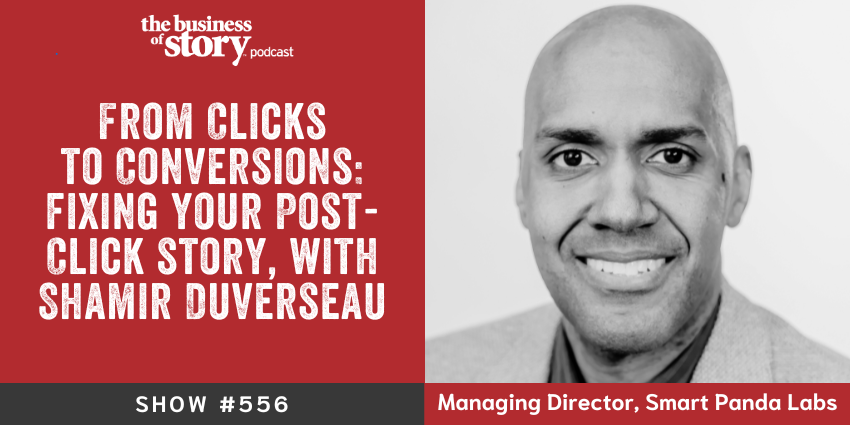
Meet Shamir Duverseau: The Post-Click Conversion Architect
Shamir Duverseau spent 25 years leading marketing for brands like Disney, Marriott, Southwest Airlines, and NBC Universal before founding Smart Panda Labs. After a career spent chasing advertising ROI, Shamir did something most marketers would call crazy—he walked away from ads to focus on what really matters: the post-click experience.
His framework has helped enterprise marketers and founders transform their websites into true conversion engines. Shamir’s mission? Help you stop being hostage to ad spend and finally understand where conversions are actually won or lost.
What’s in it for You
- Discover why the post-click experience is the biggest missed opportunity in digital marketing
- Learn how to align your teams for seamless customer journeys
- Get Shamir’s step-by-step framework for turning your website into a conversion engine
- Find out the exact tweaks that can dramatically boost your conversions
- See how to use research and feedback to create continuous improvement
- Get Shamir’s free guide to optimizing your own post-click experience
The Post-Click Problem: Why Most Marketers Miss It
Most marketers obsess over getting the click. But as Shamir shares, the real battle begins after that. “You need to make it as easy as possible for people to act—otherwise, they’ll bail far faster than you think.”
He breaks down the psychological levers that drive conversions: relevance, trust, orientation, and stimulation. Social proof, consistent imagery, and clear messaging aren’t just nice-to-haves—they’re essential to making your audience feel safe and ready to act.
Real-World Lessons from Disney, Marriott, and Beyond
Shamir’s stories from Southwest, Disney, Marriott, and Wyndham reveal a universal truth: when marketing, IT, and product teams don’t communicate, everyone loses. Projects stall, money is wasted, and the customer is left confused.
But when you get these teams rowing in the same direction, magic happens—campaigns convert, customers stick around, and marketing finally gets credit for real business growth.
Small Business? You’ve Got an Edge
If you’re running a smaller operation, you actually have an advantage: less bureaucracy, more agility. Shamir recommends using integrated tools like HubSpot to connect your CRM, marketing automation, and website. The key? Start simple, focus on usability, and build from there.
The Psychology of Conversion
It’s not just about tech—it’s about people. Shamir draws on research from Kahneman and Cialdini to explain why prospects bail: uncertainty, lack of trust, and missing social proof. He shares actionable tips, like using the same image from your ad on your landing page, or adding a simple “No credit card required” message to your call-to-action.
Usability, Persuasion, and Feedback Loops
The two biggest mistakes Shamir sees? Poor usability (making it hard to find information) and lack of persuasive content (not clearly explaining value). He urges marketers to gather feedback through analytics, heatmaps, and on-site surveys, then use that data to make continuous improvements.
Incentives: When and How to Use Them
Don’t rush to offer discounts or freebies. Solve usability and persuasion first—then use incentives strategically to tip fence-sitters into action. Shamir’s framework is all about context, clarity, and continuous testing.
Brand Assessment Insights and The Genie Experience
Shamir shares how running his own brand through the StoryCycle Genie revealed both strengths and blind spots. The Genie’s objective assessment validated Smart Panda Labs’ unique positioning and highlighted areas to clarify messaging and emotional resonance. “It was awesome timing,” Shamir says, “and gave us tools to make immediate improvements.”
Get Shamir’s Free Guide: Connect and Start Optimizing
Want to optimize your own post-click experience? Connect with Shamir on LinkedIn or Instagram and DM him for his free starter guide. You’ll get actionable tips for your website, email, and more—plus a template to track your own conversion opportunities.
Links
Deepen Your Communication Mastery: Three Essential Episodes
- How to Use Behavioral Science to Influence Action with Nancy Harhut — Discover the science-backed tactics behind persuasive marketing and why timing, cues, and nudges matter.
- The Art of Persuasion with Bob Burg — Explore the principles of influence, trust, and storytelling that move people to action.
- How to Find Your Red Thread with Tamsen Webster — Learn a repeatable framework for moving audiences to action and building clarity in your brand story.
Shamir Duverseau’s Conversation With Park Howell on the Business of Story Podcast
Park: Hello Shamir, and welcome to the show.
Shamir: Thank you so much for having me, Park. I’m excited to be on the show. I’ve listened to it a couple of times now and I really enjoy what you’re doing. So very happy to be here.
Park: That’s awesome. Today, we’re going to cover something we have not discussed in 555 episodes: the post-click problem.
This is the Business of Story, where we always talk about story, story structure, and how to bring narrative to your brand storytelling. But really, the end game is to get people to not only click on your stories, or click with your stories if they’re there in person—but what do you do after that click?
That click isn’t enough, is it? How do you really convert that prospect?
From our own experience launching the StoryCycle Genie, our SaaS platform, we get a lot of attention and a lot of clicks. But we would love to have even better post-click engagement than what we’re currently experiencing.
So today, thank you for coming on and through your coaching of me, you’ll be coaching all of our listeners.
But first, Shamir, give us a little bit of your background, your backstory. How did you get into this world of the post-click guru that you are?
Shamir Duverseau’s Career Journey: From Early Days to Digital Leadership
Shamir: Yeah, I think as probably with a lot of your listeners can sympathize with, you tend to learn how to help people solve a problem because you experienced the problem yourself.
In my world, my corporate world, I started out doing product marketing for Southwest Airlines. At the time, the internet was really starting to take off and become a major channel for organizations.
Eventually, because I was good with the tech stuff, I got moved onto more technical work. First, a little bit for Southwest with their vacation packages. Then I moved on to NBC Universal, working with Parks and Resorts. There, I officially got put on what was then the interactive marketing team, just because I was good with the tech stuff.
It was there where I got into the world that is all too familiar to marketers today—a mix of marketing, product, and IT that all have to dance together and really be in alignment to deliver a digital experience.
What I found was, in the organizations I’ve worked in—and many that I’ve heard about—marketing and IT just don’t tend to get along very well for a number of reasons.
Understanding the Post-Click Problem: Bridging Marketing and IT
Park: You might even throw sales in there too. I’ve always been surprised at the divide between marketing, sales, and IT.
Shamir: Yes, absolutely. What I started to figure out was how to get everyone at the bargaining table and start speaking the same language. The digital world made things a lot more complicated than they had traditionally been from a marketing perspective.
I realized this is a problem that a lot of marketers and organizations have: a lack of alignment. Why does this problem exist?
Marketing became so advertising heavy, especially as we moved into digital. Google became big. Facebook—now Meta—became huge. These are just massive players trying to get you to spend all this money on advertising.
But people weren’t considering what happens after someone clicks on the ad. What happens when they get to the site? That’s where it gets complicated and technical. That’s where you have to deal with IT, data, product, sales, and all these other groups.
It became easier to just throw more money at advertising, drive more people to the website, and hope more people go through the funnel. Meanwhile, tons of money is wasted because only a small percentage of people that actually get sent to the site end up taking the action you want.
Post-Click Success Stories: Lessons from Southwest, Disney, Marriott, and Wyndham
Shamir: Looking at that challenge, I started to figure it out from a corporate perspective. Then I thought, how can I help other organizations and marketers figure this out?
I wanted to help marketers become more collaborative, work better with IT, and deliver experiences that help them accomplish so much more in terms of meeting their goals.
Park: Let me unpack that. You started at Southwest Airlines in product marketing. What does product marketing mean there?
Shamir: At Southwest, product marketing was about selling vacation destinations, not airplanes or tickets. So, you want people to go to beautiful destinations as Southwest customers.
Park: When you talk about IT, is this customer engagement platforms? How would you describe IT in that case?
Shamir: IT is really any of the systems used to deliver the services or products you have. It could be anything from a reservation system, the website backend, the commerce engine, or the content management system. All those technologies are managed by IT, who host, maintain, integrate, and store data, and ensure privacy.
Post-Click Strategies: Small Business vs Enterprise Approaches
Park: IT folks are understandably territorial. They’ve built all this IT, and sometimes marketing doesn’t understand it. I’m definitely on the marketing side. So, you have IT delivering the best customer experience possible while also serving the business model and operations.
Then there’s marketing. Were you on the marketing side and feeling the disconnect with IT? What are the traditional barriers between IT and marketing that you’re now fixing?
Shamir: Absolutely. There’s a long history of issues where marketing goes to IT and says, “We want to build this tool or function.” For example, at Marriott’s vacation club division (timeshare), marketing wanted people to buy packages online, which had never been done before.
Marketing thinks in marketing speak, not about technicalities or flow. IT fills in the gaps and delivers what they think is needed. Marketing says, “Nope, that’s not what we wanted.” Back and forth, hundreds of thousands of dollars spent, and in the end, the project is abandoned. This dance happens everywhere.
The issue is a lack of communication—one group speaks French, the other Chinese, and there’s no translator. Once you have a history with a department, things get stigmatized and feed themselves.
When you can speak a little of the other group’s language, it goes a long way. That communication leads to collaboration, which leads to solutions. The problem typically exists in the post-click experience, where things get complicated and people get intimidated.
Building Your Technology Stack: HubSpot, CRM, and Marketing Automation
Park: You called it the Bermuda triangle of product, marketing, and IT. They all have to work together, but often don’t. Many listeners aren’t in large enterprises—they’re small or midsize businesses, or just a few people. But they’re trying to accomplish the same things as the big guys, just with less expense and greater efficiency. Where can we start?
Shamir: For small businesses, it’s easier to get started because you don’t have the complexities of people, departments, politics, or agendas. It’s just a small group finding the right technology and building on top of that.
Platforms like HubSpot allow you to have a technology stack encompassing the key elements for a post-click experience. HubSpot, for example, is known for its CRM—a repository of customer information. You can integrate marketing automation to communicate with customers, and a content management system to build your website.
All these systems can talk to each other. For example, when you add a pair of shoes to your cart but don’t buy, you might get an email later saying, “Hey, you left this in your cart—come back and get it.” That’s the technology working together.
You can use different technologies for your website, email, point of sale, and CRM, or use a platform like HubSpot that has all those components already integrated.
Welcome to the Business of Story: Introducing Shamir Duverseau
Park: Hello Shamir, and welcome to the show.
Shamir: Thank you so much for having me, Park. I’m excited to be on the show. I’ve listened a couple of times and really enjoy what you’re doing. So, very happy to be here.
Park: That’s awesome. Today, we’re going to cover something we’ve never discussed in 555 episodes: the post-click problem.
This is the Business of Story, where we always talk about story structure and bringing narrative to your brand storytelling. But really, the end game is to get people to not only click on your stories—or click with your stories if they’re there in person—but what do you do after that click?
That click isn’t enough, is it? How do you really convert that prospect?
From our own experience launching the StoryCycle Genie, our SaaS platform, we get a lot of attention and a lot of clicks. But we’d love to have even better post-click engagement than what we’re currently experiencing.
So today, thank you for coming on and, through your coaching of me, you’ll be coaching all our listeners.
But first, Shamir, give us a little of your background, your backstory. How did you get into this world of the post-click guru that you are?
Shamir Duverseau’s Career Journey: From Early Days to Digital Leadership
Shamir: Yeah, I think—as a lot of your listeners can sympathize with—you tend to learn to help solve a problem because you experienced the problem yourself.
In my corporate world, I started out doing product marketing for Southwest Airlines. At the time, the internet was really starting to take off and become a major channel for organizations.
Eventually, because I was good with the tech stuff, I got moved onto more technical work. First, a little bit for Southwest with their vacation packages. Then I moved on to NBC Universal, working with Parks and Resorts. There, I officially got put on what was then the interactive marketing team, just because I was good with the tech stuff.
It was there where I got into the world that is all too familiar to marketers today—a mix of marketing, product, and IT that all have to dance together and really be in alignment to deliver a digital experience.
What I found was, in the organizations I’ve worked in—and many that I’ve heard about—marketing and IT just don’t tend to get along very well for a number of reasons.
Understanding the Post-Click Problem: Bridging Marketing and IT
Park: You might even throw sales in there too. I’ve always been surprised at the divide between marketing, sales, and IT.
Shamir: Yes, absolutely. What I started to figure out was how to get everyone at the bargaining table and start speaking the same language. The digital world made things a lot more complicated than they had traditionally been from a marketing perspective.
I realized this is a problem that a lot of marketers and organizations have: a lack of alignment. Why does this problem exist?
Marketing became so advertising heavy, especially as we moved into digital. Google became big. Facebook—now Meta—became huge. These are just massive players trying to get you to spend all this money on advertising.
But people weren’t considering what happens after someone clicks on the ad. What happens when they get to the site? That’s where it gets complicated and technical. That’s where you have to deal with IT, data, product, sales, and all these other groups.
It became easier to just throw more money at advertising, drive more people to the website, and hope more people go through the funnel. Meanwhile, tons of money is wasted because only a small percentage of people that actually get sent to the site end up taking the action you want.
Post-Click Success Stories: Lessons from Southwest, Disney, Marriott, and Wyndham
Shamir: Looking at that challenge, I started to figure it out from a corporate perspective. Then I thought, how can I help other organizations and marketers figure this out?
I wanted to help marketers become more collaborative, work better with IT, and deliver experiences that help them accomplish so much more in terms of meeting their goals.
Park: Let me unpack that. You started at Southwest Airlines in product marketing. What does product marketing mean there?
Shamir: At Southwest, product marketing was about selling vacation destinations, not airplanes or tickets. So, you want people to go to beautiful destinations as Southwest customers.
Park: When you talk about IT, is this customer engagement platforms? How would you describe IT in that case?
Shamir: IT is really any of the systems used to deliver the services or products you have. It could be anything from a reservation system, the website backend, the commerce engine, or the content management system. All those technologies are managed by IT, who host, maintain, integrate, and store data, and ensure privacy.
Post-Click Strategies: Small Business vs Enterprise Approaches
Park: IT folks are understandably territorial. They’ve built all this IT, and sometimes marketing doesn’t understand it. I’m definitely on the marketing side. So, you have IT delivering the best customer experience possible while also serving the business model and operations.
Then there’s marketing. Were you on the marketing side and feeling the disconnect with IT? What are the traditional barriers between IT and marketing that you’re now fixing?
Shamir: Absolutely. There’s a long history of issues where marketing goes to IT and says, “We want to build this tool or function.” For example, at Marriott’s vacation club division (timeshare), marketing wanted people to buy packages online, which had never been done before.
Marketing thinks in marketing speak, not about technicalities or flow. IT fills in the gaps and delivers what they think is needed. Marketing says, “Nope, that’s not what we wanted.” Back and forth, hundreds of thousands of dollars spent, and in the end, the project is abandoned. This dance happens everywhere.
The issue is a lack of communication—one group speaks French, the other Chinese, and there’s no translator. Once you have a history with a department, things get stigmatized and feed themselves.
When you can speak a little of the other group’s language, it goes a long way. That communication leads to collaboration, which leads to solutions. The problem typically exists in the post-click experience, where things get complicated and people get intimidated.
Building Your Technology Stack: HubSpot, CRM, and Marketing Automation
Park: You called it the Bermuda triangle of product, marketing, and IT. They all have to work together, but often don’t. Many listeners aren’t in large enterprises—they’re small or midsize businesses, or just a few people. But they’re trying to accomplish the same things as the big guys, just with less expense and greater efficiency. Where can we start?
Shamir: For small businesses, it’s easier to get started because you don’t have the complexities of people, departments, politics, or agendas. It’s just a small group finding the right technology and building on top of that.
Platforms like HubSpot allow you to have a technology stack encompassing the key elements for a post-click experience. HubSpot, for example, is known for its CRM—a repository of customer information. You can integrate marketing automation to communicate with customers, and a content management system to build your website.
All these systems can talk to each other. For example, when you add a pair of shoes to your cart but don’t buy, you might get an email later saying, “Hey, you left this in your cart—come back and get it.” That’s the technology working together.
You can use different technologies for your website, email, point of sale, and CRM, or use a platform like HubSpot that has all those components already integrated.
Behavioral Psychology in Marketing: Conversion Levers That Drive Results
Park: I’ve talked to a lot of people and experienced it myself: these platforms can be big, complicated, and expensive. So many end up cobbling together different tools. Regardless, what are the secrets to post-click interaction and conversion? Why is it so hard to get people to make that next click?
Shamir: It comes down to psychology. We’re dealing with people. People who don’t feel like they have enough information to make a decision will bail—much faster than we think.
Research by Kahneman (system one, system two thinking) and Cialdini (levers of influence) shows people have a hard time making decisions. You need to make it easy by using shortcuts and translating psychological shortcuts into things that happen online.
Social proof is huge: “X number of people bought this,” “Here are reviews.” It validates people’s decisions and gives them the okay to do it, too. People follow the crowd because it feels safer than making a decision alone.
Website Usability and Persuasion: Designing for Higher Conversions
Park: So, at the top of any page, you need to be brief—headline, what you want, subhead, why you don’t have it, a quick “here’s how you’ll get it,” and then social proof.
Shamir: Exactly. There are many levers of influence, but it’s also about when you pull them. There’s a hierarchy: relevance (am I in the right place?), trust (do I trust this?), orientation, and stimulation.
You want to check the box on each one in order. You’re not trying to stimulate or motivate someone if they don’t feel it’s relevant or trustworthy. It’s like Maslow’s hierarchy, but for conversion.
Simple things—like using the same image from your ad on the landing page—create a mental connection and reinforce relevance. Clean, professional design builds trust. Copy and headlines that match the ad help with orientation. You’re constantly reinforcing certainty to help people feel comfortable making the right decision.
Leveraging Research and Customer Feedback for Continuous Improvement
Park: What are the routine mistakes we all make on our websites that lead to post-click drop-off? What are we doing wrong?
Shamir: The first two things to think about are usability and persuasion—in that order.
Usability: How easy is it to find the information someone needs to make a decision? Don’t assume people will figure it out—they won’t. You have to tell them.
We worked with Wyndham on their vacation rentals. We changed the call-to-action button from “Book your reservation” to “Start your reservation.” It bombed. The copy matters. We reverted and added a note under the button: “Your credit card won’t be charged.” Even though it was obvious, that simple statement improved conversion.
Park: That’s fascinating. We have a “Get your free brand assessment” button, but maybe we should add a note like “No credit card required.” Thank you!
Shamir:
Exactly. Letting people know upfront—no credit card required—builds trust and gives them a reason to move forward.
Incentives and Business Context: Motivating Action in Digital Marketing
Park: What else should we consider?
Shamir: After usability and persuasion, only then should you worry about incentivizing people. Promo codes and free shipping are fine, but don’t make incentives the main thing. Solve the basics first—make it easy and clear.
Some people will buy without incentives; others just need better information. Incentives should be targeted, not blanket.
There’s no one-size-fits-all. What works for B2C doesn’t always work for B2B. Early on, incentives can help grow market share and trust, but as you mature, context and business goals matter.
Brand Assessment Insights and Personal Takeaways from Shamir Duverseau
Park: We ran your brand through the StoryCycle Genie. What did you think of the assessment and narrative strategy it created for you?
Shamir: I thought it was great. I emailed you to say this is fantastic—I’m keeping it. We’ve been doing brand work to show how we’re different: focusing on technical marketing and the post-click experience.
The Genie’s assessment validated that direction and highlighted where we could be clearer. It was awesome timing to get that feedback.
Park: Was there anything in the assessment that surprised you?
Shamir: We want to be an extension of our clients’ team. Our job is to help people as individuals, not just companies. The Genie’s assessment didn’t fully capture that, so maybe we’re being too subtle.
Our core purpose is to give people a better story to tell. We want our clients to have a better story after working with us.
Park: Your brand purpose from the Genie: “Smart Panda Labs exists to empower marketing leaders to transform from overwhelmed coordinators into confident growth drivers who prove measurable impact and advance their careers.” It’s a mouthful, but I like your version even better. Just tell the Genie what you really want to drive for, and it’ll adapt.
Does the Genie’s audience analysis feel accurate?
Shamir: It does. The challenges, fears, frustrations, and aspirations it pulled out are spot-on for our customers.
Park: That gives you ideas for stories to connect on an emotional level: “You get me, you appreciate what I want, you empathize with why I don’t have it.” Then, show the logical solution.
Shamir: Exactly. We’ll use that to refine our content and website structure, to tell the story from those emotional drivers.
Get Shamir Duverseau’s Free Guide: How to Connect and Learn More
Park: You’ve got a freebie for our listeners to help them look at their post-click experience. What is it?
Shamir: Connect with me on LinkedIn or Instagram and DM me. We have a free template to help you track opportunities for improving your experience. There’s a starter guide with tips for your website, email, and more—things you can try that might be new to you.
Test and see what works for your audience. With today’s tools, it’s easy to measure and adjust.
Park: Is there a specific link, or should they just go to your website?
Shamir: Connect with me on LinkedIn and I’ll DM you the guide.
Park: We’ve got your LinkedIn link in the show notes at businessofstory.com. Shamir, thank you so much. This has been really helpful for me and, I hope, for our listeners, too.
Shamir: I hope so. Thank you for having me. It’s a great show to be on and to listen to. I’m very happy I could join you today.
Park: Awesome. Thanks.
Frequently Asked Questions (SEO, GEO, AEO-Optimized)
Q: What is the “post-click problem” in digital marketing?
A: The post-click problem refers to the challenge of converting website visitors into engaged prospects or customers after they’ve clicked on an ad or link. While much focus is placed on driving clicks, many businesses struggle to optimize the experience after the click—leading to lost leads and wasted ad spend. Shamir Duverseau explains how aligning marketing, IT, and product teams is essential for solving the post-click problem and increasing conversions.
Q: Why is alignment between marketing, IT, and product teams important for post-click success?
A: Alignment ensures a seamless customer journey from click to conversion. When marketing, IT, and product teams collaborate, they create cohesive digital experiences that reduce friction, build trust, and improve usability. Shamir shares real-world examples from brands like Southwest, Disney, Marriott, and Wyndham to illustrate how communication gaps can lead to costly failures—and how bridging those gaps drives growth.
Q: How can small businesses improve their post-click experience without big budgets?
A: Small businesses can leverage integrated platforms like HubSpot for CRM, marketing automation, and content management. By choosing tools that work together out of the box, they can create effective post-click experiences without the complexity of enterprise systems. Shamir recommends focusing on usability, clear messaging, and simple integrations to build a strong foundation.
Q: What are the key psychological levers that drive conversions after the click?
A: Social proof, relevance, trust, orientation, and stimulation are critical. Shamir discusses how using consistent imagery, clear headlines, and visible testimonials can reinforce relevance and trust. Social proof—like reviews and user counts—helps validate decisions, while clear orientation and stimulating content keep visitors engaged and moving toward conversion.
Q: What are common mistakes websites make that hurt post-click conversions?
A: The two biggest mistakes are poor usability (making it hard to find information) and lack of persuasive content (not clearly explaining value). Shamir’s examples show that even small tweaks—like adding “No credit card required” to a CTA—can boost conversions. He cautions against relying solely on incentives and stresses the importance of clarity, feedback, and continuous improvement.
Q: How should businesses gather feedback to improve their website’s post-click experience?
A: Use both passive tools (like Google Analytics and Hotjar for heatmaps and session recordings) and active methods (like on-site surveys and feedback tabs). Shamir advises asking simple questions such as, “Were you able to accomplish what you wanted?” and “What was missing?” to uncover actionable insights for ongoing optimization.
Q: Where can listeners get Shamir Duverseau’s free post-click experience guide?
A: Connect with Shamir directly on LinkedIn or Instagram and send him a direct message. He’ll share a free template and starter guide with actionable tips for improving your website and email experience.
 Listen To More Episodes