Make Your Audience Feel Your Message—Not Just Hear It
Why Tone is the Secret to Brand Resonance
You want your brand story to stand out, to move people, and to drive real connection.
And you know that in a world full of endless content, it’s no longer enough to just get the words right.
But you’re frustrated because, despite your best efforts, your communications often fall flat—failing to build trust, spark emotion, or inspire action.
You wonder what’s missing.
It’s probably the tone of your brand storytelling.
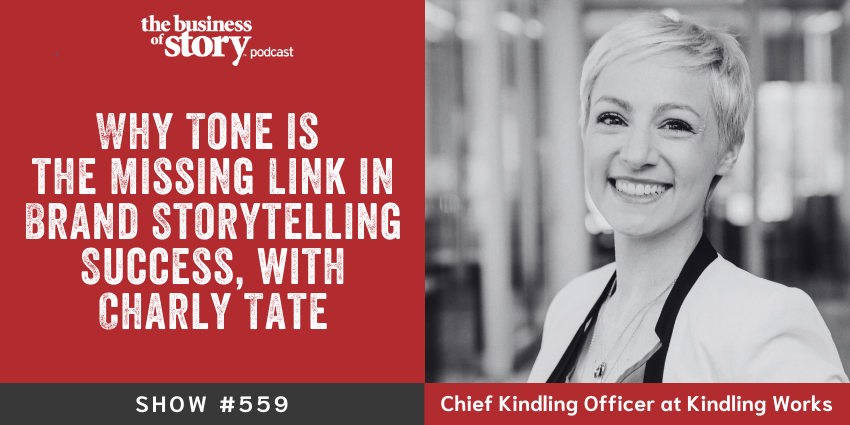
Charly Tate, founder and Chief Kindling Officer at Kindling Works, built her business by helping founders and business owners discover clarity in chaos and connection through intentional, heartfelt storytelling.
 With over a decade in communications and five years hosting her own music and storytelling podcast, Tater Thoughts, Charly knows it’s not just what you say, but how you make people feel.
Charly’s approach is rooted in her lifelong love of music—especially Queen—and her belief that tone is the undercurrent that gives your story life.
She’s seen firsthand how the right tone creates resonance, trust, and lasting impact.
What’s in it for You:
- Why your audience feels your message before they understand it
- How to uncover and express your brand’s authentic tone
- The biggest tone mistakes brands make—and how to fix them
- How to use music, mood boards, and emotional cues to shape your communications
- Ways to keep your tone consistent, even as your brand evolves
Charly shares her journey from a promising real estate career to launching Kindling Works after a major industry shakeup.
She reveals how losing her “tether” forced her to rebuild from the ground up—and why tone became her guiding spark.
You’ll hear how brands like Sherwin Williams and Cracker Barrel miss the mark with tone, and why others, like By Rosie Jane, win by staying true to their “why.”
Charly explains how even B2B brands need to bring emotion and humanity into their messaging if they want to build trust and loyalty.
Drawing on her podcasting and music background, Charly shows how the best brands—like Queen—evolve their style while staying true to their core.
She’ll inspire you to think of your brand story like a song: every note, every word, every pause is an opportunity to make your audience feel something real.
Ready to audit your own brand’s tone?
Charly recommends starting with your “why,” using mood boards and emotional touchpoints, and—most importantly—giving yourself space to step away and trust your intuition.
More About Charly Tate:
Charly is the founder of Kindling Works, a communications consultancy helping brands and leaders reclaim their voice.
She’s also the creator of the ToneSpark prompt, a tool for refining your message using the emotion of your favorite song.
You can find her at kindlingworks.com.
Links:
Charly Tate’s Conversation With Park Howell on the Business of Story Podcast
The Power of Tone in Storytelling
Park: Hello, Charly, welcome to the show.
Charly: Hi, thanks, Park. I’m so excited to be here.
Park: You and I got somewhat acquainted on LinkedIn a couple months ago.
I can’t honestly remember if you were responding to something I had, or if I was responding to something you did.
As we got better acquainted, we discovered our shared love for Queen.
So I said, all right, I’ve got to talk to Charly.
Then I realized you weren’t in Seattle, but down in Prescott.
Charly: Yes.
Park: Just about an hour and 20 minutes from us here.
Charly: That’s right.
I used to be up in Seattle until 2021.
Been in the high desert ever since.
Park: As we got acquainted a couple of weeks ago on a call, you brought up something I found really interesting.
In 10 years, I’ve not really covered it on the Business of Story: the importance of tone.
Charly: Yes, yes, it’s all about tone.
It’s all about the feels.
Park: Tell us about that.
Why tone?
What do you mean by tone?
Let’s give our listeners a description of what we’re talking about, and then how you came upon this as such a superpower in storytelling.
Charly: Tone is how a message lands, how it’s perceived when someone hears words, a sentence, or reads an email.
What does it make them feel like?
I saw a huge gap in this, and that’s why I found it interesting that you just said you hadn’t really touched on this topic.
We think so much about the words we’re using to draft a message or share our story.
Or make a simple announcement to a company or out to the press or whatever we’re doing.
But we don’t always think, how does this come across—the words I’m using, the tone I’m using, my demeanor?
How do we bring that through with a message that we’re crafting?
As I evolved in my communications career over the decade or so I’ve been doing that, I started noticing people were coming to me.
Sometimes VPs—like a VP of marketing—would come to me more than once and say, “Charly, how does this sound?”
Not how does it read, but how does it feel?
How does it sound?
I started to realize that this was a bit of a tether I had in my life.
I was always focused on how something felt.
That ties in with my love for music and how it affects us.
When I’m crafting something, or assisting someone with what they’re creating and the story of their business, it’s all about what is it that’s driving it that makes it feel a certain way?
How do we capture that and express it to the right people at the right time in the best way possible?
It sounds like this big, massive mess of “how do we do that?” but that’s another superpower I have too.
I have this innate ability to zoom way out and look at something on the 40,000-foot level.
But I can get really deep in the weeds and say, how are we going to achieve that result that we want to see or hear?
Part of the fun of it is going through that process.
Maybe that’s a sickness of mine, but I like to go through and explore different ways to help people discover their story and express it in the ultimate tone that’s going to resonate.
It’s all about resonance.
Charly’s Backstory: From Childhood to Communications
Park: So what is your backstory?
Because I’m sure you weren’t just growing up and at seven years old said, “Boy, tone, I think I’m going to pursue a career in tone.”
Charly: Gosh, I feel like I could go back to my childhood because this has been a long running sort of iron thread through my life.
I’ve always been hyper fixated on how things affect us emotionally.
Certainly that plays into what we do with our work, whether we’re part of a business or we own—especially if we own our business—how does that inform what we’re doing?
I think it’s all about being genuine and the integrity of ourselves.
This of course ties into the Queen aspect of things that we’ve talked about.
But how do you take who you are and work it genuinely into the work that you’re doing?
And what effect is that going to have?
For a long time, I tried to keep those two things separate.
I didn’t know how to do it.
I didn’t think I could.
I didn’t think it was safe to do it.
It always felt like there was a wall.
As I got a little bit bolder in my work, when I would present in front of people, or put together a campaign or messaging, I started including a little introduction about me.
It seemingly had nothing to do with the work, but it was all about the music I loved, or the fact that I love to run.
Sometimes people would be taken aback, but there was almost this collective sigh—literal or figurative.
If I was in a room with people and I would do that, there was almost just this, “Okay, she’s a person. I don’t need to be so worried. She’s not going to tell me what to do. She wants to help me.”
It suddenly humanized everything and made it easier to operate in my job.
Suddenly, I wasn’t trying to live up to this expectation that wasn’t real for me.
It opened that window to connection, which is so important in business and life.
Of course, in business and what we’re doing with our endeavors—whether we want to sell something or teach people—it’s so important to focus on putting them at ease and creating that avenue to let people connect with you on a real, genuine level.
Rebuilding After Real Estate: The Birth of Kindling Works
Park: Before you started Kindling Works, you had a very promising career in real estate.
You were working with a lot of these folks, helping them find their tone and present better.
Then that career kind of fell apart.
Charly: Yeah, and it was really a big fallout from just the industry, the state of the industry right now.
With the economy, the way it’s been, and interest rates, that was a big deciding factor.
There have been a lot of people in that industry that just haven’t been able to maintain it.
I loved what I did and loved working with the people, especially on the marketing and administrative side, helping agents own their business and connect with the right clientele.
But when my tether broke, I didn’t realize it was a tether.
I’ve never thought of myself as a big, for better or worse, corporate or business person.
Once that tether was cut and I didn’t have that job anymore, it threw me off kilter completely.
I didn’t expect it, because I never defined myself by my job.
This was a huge wake up call.
Everything around me felt like it was falling apart.
In the ashes of that fallout, I felt a spark to create something from it.
How am I going to do that?
Can I do that?
All the questions tumbling through my head.
With all the fear and uncertainty still brewing in me, I decided I was going to create this thing and make this business born out of the very fear I had.
What is my direction, what’s my why?
How can I make that genuinely a part of something I want to do?
I loved helping people discover that true aspect of themselves that they could turn into something successful or something that connected.
Kindling Works just naturally came out of that.
It was born out of a need to reclaim part of myself, very much so.
It was selfishly motivated at the start.
I wanted to prove I could do it.
As I started going through it and realized what it really meant, even coming up with the name—something that’s burning and alive and it’s collaborative and it lingers and connects people—it all came together.
People see that and resonate with it because I’m trying to put it all out there and be as honest and authentic as I can.
This is what my business is, it was born out of this, and that’s exactly what I want to help you do.
Finding Yourself Through Darkness and Connection
Charly: Find yourself through that darkness.
I know what that’s like—to feel like you’re aimless and you have no idea what you’re doing or where you’re going.
I still ask myself those questions a lot.
Am I really doing what I should be doing?
But that’s part of the journey.
I want to encourage people to follow what they really want to do.
Follow your dreams, follow that drive, and stay true to yourself as you do it.
You will find your people, especially if you’re launching a business endeavor.
Your people will resonate with those people, and you might not be for everyone, but you’ll certainly find the connection where it matters.
Tone at the Heart of Brand Storytelling
Park: So the core offering at Kindling Works is helping people and brands find their way.
Is this idea around tone at the core of what you do?
Charly: Absolutely.
Tone is in every service that I offer because that’s the initial spark of all of it.
What is your story that’s going to inform how you present yourself?
Tone is all around, not just the words, but the look of it.
I’ve talked about that with visual branding and what is presented to people on social media or anything visual, which is so common these days.
It really needs to all tie into the same core message of what your story is.
Whether it’s really alive and unconventional, or something that’s more poised and quieter, find what that is and put it into absolutely everything that you touch.
What I’m offering is things like a clarity capsule, which helps people define what they might be missing in their business or how to best tell their story.
Or I have a change comms service for people navigating a big shift or acquisition.
But it’s all about coming back to the heart of it, which is that spark, which is the tone.
The Biggest Misconceptions About Tone
Park: What is the biggest misconception brands have about tone in their storytelling?
Charly: One of the biggest blind spots is that I don’t think people are even thinking about tone.
It’s usually, “Just get this message out.”
There’s no thought of what it sounds like or how it’s going to be perceived by different audiences.
That’s another thing I think about: who are you giving this to and are they going to care?
Is it going to resonate?
So the biggest misconception is either there isn’t any consideration for tone, or if there is, people aren’t thinking about the feeling and emotional aspect.
It’s just about the facts, the timeframes, and “are all of the words there? Okay, just send it.”
Brand Tone Mistakes and Missed Opportunities
Park: Give us an example of a brand, maybe one you’ve worked with or seen in action, that blew up a campaign or messaging because they didn’t have their tone together.
Charly: I can think of some vague examples.
My memory is so awful.
But I know there…
Park: I’ve got one for you then.
One of the most tone deaf brands, and we love their product, is Sherwin Williams.
Their logo is a globe with a can of blood red paint being poured over the top.
Their tagline is something like “covering the world.”
The tone of that is so tone deaf in every possible way, and yet you see it everywhere.
We still buy their paint, still love it, but I laugh every time I walk into a Sherwin-Williams store.
Charly: Yes, yeah.
Park: And their tagline is just so off.
Charly: You’re absolutely right, and I’m glad you said that because it jogged my memory.
Recently, the rebranding of Cracker Barrel stood out.
This long-standing, a little bit antiquated but recognizable brand, associated with a certain tone and vibe.
When they simplified it, now it’s just words—no visual element that represents the tone of their brand.
A lot of people, branding experts included, were up in arms.
They didn’t even recognize it anymore.
That’s an example of a brand missing what actually matters to their clientele and customers.
They missed the mark with their rebrand.
When Tone Sends the Wrong Message
Park: That made me think of something else.
At Universal Studios, outside the Jurassic Park ride, there’s a big T-Rex model, and a sign below it says “don’t touch, fragile.”
It’s the T-Rex—it’s not fragile!
Charly: Sends the wrong message when you should be afraid and terrified of it.
How Brands Can Find and Maintain Authentic Tone
Park: What can brands do to ensure they find the right tone and connect authentically with their target audiences?
Charly: One of the biggest things any brand or company should be doing now is looking at what people are saying.
Brands often have blinders on, sticking to their plan for the year and not opening up to what’s actually being said outside the walls of their company.
Some brands still aren’t listening to the people that love them enough.
There’s a tendency to drift away from the why they started with.
Customers follow a company because they’re genuine and true to why they started.
When companies sacrifice that why for acquisitions or money, they lose what’s valuable to their most loyal people.
I’ve seen companies do that—change ownership, change everything, and lose their core audience.
It’s important to listen to what your people love about you and stick to those ideals.
Even if a company is tiny, have a brand strategy that’s dialed into what you’re doing.
Live by it every day, even if you’re just a team of one or two.
Brands Who Nail Their Tone
Park: What’s a brand you really love that has not changed their tone and consistently brings it through everything they do?
Charly: I’ll go back to fragrance.
There’s a brand called By Rosie Jane.
She’s from Australia and built everything from the ground up herself.
If you scroll back to her earliest posts or beginnings, she started in makeup and then transitioned into fragrance.
She’s never changed who she is, even as her brand has grown and added products.
Everything she does is full of her “why”—wanting to give people a breath of fresh air, to brighten their day.
I admire her work ethic and how she’s continued to stand by her ideals.
B2B and Tone: Bringing Emotion to Business
Park: How about on the B2B side?
People think of it as business to business marketing, but it’s often boring to board, losing the emotional essence.
Is there a B2B brand that does a good job with their tone?
Charly: B2B is interesting.
Having been in real estate, I always thought of it as both B2B and B2C.
On the administrative and marketing side, you’re working with real estate agents as independent contractors, so it’s more B2B, but you’re also marketing to clients (B2C).
I’ve seen some real estate companies do a tremendous job at both.
The important thing is recognizing what those independent contractors need and how to meet them where they are.
With B2B, businesses often have their way of doing things and expect the same from others.
But when a business stands on its integrity and what it really stands for, that reinforces trust—which is so important in big business.
Personal Passions and Brand Tone
Park: Our daughter-in-law, Jackie Howell, in Austin, Texas, is a great example.
She’s the “roller realtor” and brings her passion for roller skating into her real estate business.
She even teaches roller skating and runs a promotional company, Ignite on Wheels.
She uses her love of roller skating as a funnel to bring people into real estate.
She brings the same passion to selling homes as she does to skating.
Your love for music and tone, and your Tater Thoughts podcast, is similar.
You dissect songs and bring that love into helping people find the tone in their brand.
Charly: That’s the best way to do it because real estate is so much about community.
More industries should think that way.
With social media, everyone has a community, whether they realize it or not.
It’s like company culture—it happens whether or not you’re driving it.
People will associate something with you.
Your daughter really understands that identity and brings her passion into her work.
I used to play Dungeons and Dragons, and that ties into storytelling and dreaming.
Taking that enthusiasm and putting it into your work, alongside your other passions, creates a unique approach.
It brings humanity back into the work and makes it more resonant.
Queen, Music, and the Importance of Tone
Park: Let’s talk about your Tater Thoughts podcast and your love of music, especially Queen.
When was that moment you realized tone was your superpower?
Charly: I’ve always known tone was important.
I’ve always been extremely dialed into how things make us feel.
But I didn’t realize it was more important to me than most people until more recently.
That realization gave me courage to step up and use it as a superpower.
I’ve always been focused on how things affect us, how they make us feel.
I embrace that, especially with my Queen deep dives.
My love for Queen is because of their journey and their “why,” which was always “why not?”
They lived outside the norm, and that was their superpower.
I recently found a letter from their debut promo kit that said, “Queen, why Queen? Why not?”
They were always living in that mindset, and I connect with that.
Queen’s Musical Storytelling and Brand Evolution
Park: I remember getting the tone of Queen in 1974 when I was 12.
I heard Killer Queen on the radio and was mesmerized by it.
Charly: My first memory of Queen was when I was two or three, living in the UK.
I remember the song “Keep Passing the Open Windows” from their 1984 album, The Works.
The piano riff stuck with me for years.
Later, I started collecting Queen albums and heard that song again—it gave me goosebumps.
It awakened something in me.
Brand Storytelling Lessons from Queen Songs
Park: Let’s do a Tater Thoughts-style deep dive into Queen’s “Play the Game.”
How does that song relate to tone in brand storytelling?
Charly: “Play the Game” was the opening track and first single on their 1980 album, The Game.
It surprised people because it was a power ballad, and it ushered in a new phase for Queen with synthesizers.
The song is about accepting yourself and leaning into who you are.
It’s about integrity and evolution.
Even as Queen’s sound evolved, they stayed true to themselves.
The message is about embracing yourself and giving yourself away.
That’s why I love the song—it’s restrained, intentional, and authentic.
Queen’s Consistent Brand, Campaigns, and Musical Tone
Park: Queen created music in many genres, but never lost their brand tone.
Each album is like its own campaign, but always on brand.
Charly: Yes!
Their songs are so distinctive that sometimes you don’t even realize it’s Queen until you look back.
Everything they did was true to who they were.
Musical Structure, Ambiguity, and Brand Resonance
Park: Killer Queen uses a three-act structure in both music and story.
It modulates keys, creating mischief and ambiguity, and always returns to E flat major.
Charly: Freddie’s songs, especially early in their catalog, had a lot of key changes and shifts in tone.
But it all came together to create a cohesive narrative.
The attitude of Killer Queen is, “I’m not quite sure about this lady, but this sounds interesting and intriguing.”
The musical arrangement is playful and cheeky, but always dialed in.
It’s inviting and pleasing to the ear, and encapsulates who Queen is as a band.
Joy, Humanity, and the Jester Archetype
Park: Queen’s music always brought joy and fun, no matter the genre.
As a brand archetype, I’d call them the court jester—they speak truths in fun, surprising ways.
Charly: Every genre, every style—they did it all, but it was always Queen.
Their music was a collage of sound and tone, always tied together.
Even their most emotional or bluesy songs had a silver lining and a sense of celebration.
Radio Gaga, Artful Intelligence, and Brand Integrity
Park: Radio Gaga is a love letter to radio, reminding us that music still matters even as video takes over.
It’s about integrity and not losing what really matters, which is relevant today with AI.
Charly: Yes, and the song’s origin is great—Roger’s son said “radio caca,” and Roger ran with it.
The song was about the importance of sound over imagery.
It’s interesting how that message from 1984 is relevant today with AI.
We’re at a pivotal moment—people are using AI to make things easier, but sometimes at the sacrifice of what really matters.
Brand Assessment, Tone, and Artful Intelligence
Park: We ran your brand through our Artful Intelligence Story Cycle Genie.
What did you think of the assessment?
Charly: I was so impressed.
It was robust and thoughtful, looking at the whole picture of my brand and story.
It didn’t just give me a score, but actionable insights I could use as a business.
It felt like my story was being reflected back to me.
It resonated with what I intend to do with my work and was very affirming.
It was a big boost to see my intentionality and thoughtfulness reflected in the assessment.
How to Audit and Adjust Your Brand’s Tone
Park: What can our audience do right now to deep dive into their own brand story and see how their tone is coming across?
Charly: Start by asking why you did it.
Why did you start your business?
What was your intention?
It’s easy to lose sight of what motivated you in the first place.
Take a step back and assess your why.
Is it still informing the way you do business?
If you feel off or out of sync, it may be time for a change.
Park: Once you feel that, how do you go about making the change?
Charly: One tactic I use is thinking about visuals and making mood boards.
Write down little tagline ideas, piece together a puzzle of what things look like now and what you want them to be.
I’m a fan of structure, even though I love the abstract.
Having a process or checklist helps.
Maybe work with someone who can help you make those decisions, because sometimes it’s hard to put into words what you want.
Having an objective third party can make all the difference.
Give It Space: Letting Your Tone Emerge
Park: After you do all this, get away from it.
Go for a walk, close your eyes, and let your intuition work.
What does it feel like?
Charly: I do that all the time.
I’ll overload my brain, then put it down and walk away.
Sometimes the answer hits you overnight, or when you least expect it.
Trust that instinct and intuition.
Resources and Where to Find Charly
Park: Where can people learn more about you?
I think you have a worksheet or something they can download?
Charly: Yes, I have my ToneSpark prompt.
It’s a prompt you can plug into your favorite AI, LLM.
It helps you take a draft message and refine it based on the emotion of a song you love.
I did this with “Don’t Stop Me Now” from Queen.
I put in a boring draft, and the prompt reframed it to feel like “Don’t Stop Me Now.”
That song was voted the happiest song in the world.
Park: Your website is kindlingworks.com?
Charly: Yes, kindlingworks.com.
Closing and Gratitude
Park: Charly, thank you so much for being here.
I really appreciate this.
You’re the first guest out of 560 that I got to “weird out” with Queen.
It was awesome. Thank you.
Charly: I love it. I’m honored to be that guest, Park. Thank you.
Park: All right.
Frequently Asked Questions About Tone, Storytelling, and Charly Tate
Q: Why is tone so important in brand storytelling?
A: Tone is the emotional undercurrent that shapes how your audience feels your message before they understand it. It creates trust, authenticity, and resonance, making your brand memorable and relatable.
Q: How can a business owner discover their authentic brand tone?
A: Start by reflecting on your “why”—the core reason you began your business. Assess if your current messaging aligns with your original intention, and use mood boards or taglines to visualize the feeling you want your brand to evoke.
Q: What are common mistakes brands make with tone in their messaging?
A: Many brands neglect tone entirely, focusing only on facts or deadlines. Others forget to consider how their words make audiences feel, missing the emotional connection that drives loyalty and engagement.
Q: How does Charly Tate help brands find their tone?
A: Charly guides brands through a process of clarity and self-discovery, using her expertise in communications, storytelling, and music-inspired resonance to help clients express their story with intentional and authentic tone.
Q: What can brands do to ensure their tone remains consistent as they grow?
A: Brands should listen to their audience, revisit their core “why,” and establish clear brand standards—even if they’re a team of one. Consistency comes from living your values and integrating your tone into every touchpoint.
Q: How did Charly’s love for Queen influence her approach to storytelling?
A: Queen’s fearless embrace of their unique sound and “why not?” attitude inspired Charly to help brands find their own voice. She believes that, like Queen, brands should evolve while staying true to their core identity.
Q: What is the ToneSpark prompt and how can it help business owners?
A: The ToneSpark prompt is a tool Charly created that lets you refine a draft message using the emotion of a song you love. It helps you infuse your communications with the right feeling, making your brand’s tone more intentional and memorable.
Q: Where can I learn more about Charly Tate and her work?
A: Visit kindlingworks.com to explore Charly’s services, download the ToneSpark prompt, and connect with her for brand storytelling and tone consulting.
 Listen To More Episodes