Why the Hero’s Journey Is Your Brand’s Secret Superpower
Ever wonder why some stories just grab you and won’t let go?
When I first encountered the Hero’s Journey, it didn’t just change my business—it changed my life.
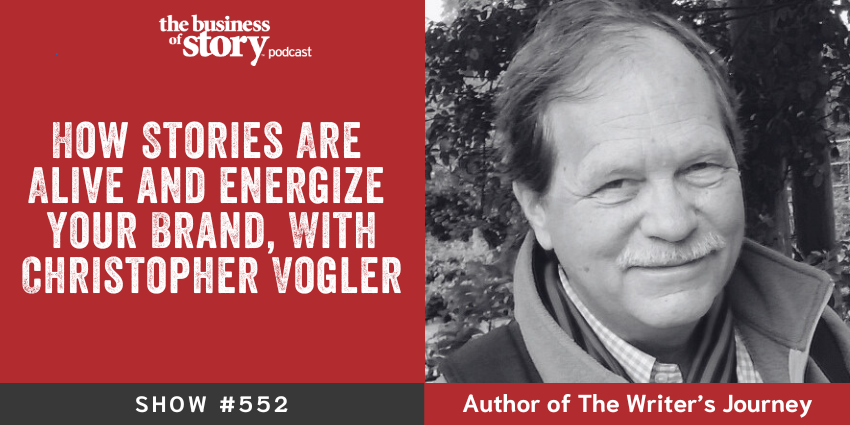
 So I’m honored to host Christopher Vogler, author of one of my favorite books on storytelling, The Writer’s Journey: Mythic Structure for Writers.
Chris is a renowned Hollywood story consultant, screenwriter, author, and educator famous for adapting Joseph Campbell’s “Hero’s Journey” into a practical guide for storytellers.
He significantly influenced Disney films like The Lion King and Hercules and consulted for major studios, applying his 12-stage narrative framework to numerous productions, making him a key figure in modern screenwriting theory.
What’s in it for you
- Discover how wish fulfillment drives every great brand story
- Learn why obstacles (“threshold guardians”) are your best teachers
- Find out how stories heal, orient, and energize us—even in chaos
- Get practical tips for turning your brand into a wish-granting mentor
- See why the Hero’s Journey is your blueprint for business (and life) growth
The Living Power of Story
Chris Vogler didn’t just write the book on story—he wrote the memo that changed Hollywood.
He reveals how the Hero’s Journey became the backbone of films like The Lion King and Star Wars, and why it’s actually a “handbook for life” that encodes the wisdom of generations.
Stories, says Chris, aren’t just entertainment. They’re a survival tool, a healing force, and the best way to make sense of a noisy, chaotic world.
Brands Are Wish-Granters
Park and Chris agree: The best brands don’t just sell—they grant wishes.
By understanding what your audience truly wants, and guiding them through obstacles, you create a story they want to live out.
Chris shares why every brand should honor the love story customers have with their products—and how changing what works (like Lego did) can break that bond.
Stories Heal, Orient, and Energize
When Chris’s wife faced a health crisis, mapping her struggle as a Hero’s Journey gave her hope and meaning.
The same principle applies to brands: stories help audiences see themselves, overcome adversity, and believe in transformation.
What You’ll Learn From Our Conversation
- How Chris Vogler shaped Disney’s story culture (and what you can steal for your brand)
- The science behind why stories “work” on your brain—and your business
- Why your customers’ wishes matter more than your product features
- How to turn obstacles into brand-building opportunities
- The “NOBA” secret to pitching, persuading, and standing out
- Real-life examples of story-driven transformation (for brands and people)
Links
Deepen Your Communication Mastery: Three Essential Episodes
To amplify your transformation from today’s conversation, these carefully selected past episodes provide complementary classical wisdom:
How to Use The Hero’s Journey in Business and In Life, With John Bucher
– Discover how the Executive Director of the Joseph Campbell Foundation applies the Hero’s Journey to brand storytelling and personal transformation.
Robert McKee: The Science of Story
– Explore the mechanics of narrative with legendary Hollywood story teacher Robert McKee and learn how story structure drives audience engagement.
Park Howell: The ABT Framework for Business
– Learn how to use the And-But-Therefore structure for powerful, audience-focused messaging in your brand and leadership communication.
Christopher Vogler’s Conversation With Park on The Business of Story Podcast
The Power of Connection in Storytelling
Park: This has been a long time in coming for me because I have been studying your work for, gosh, 20 years now, I guess.
And I was fortunate two episodes ago to have John Booker on here, the executive director of the Joseph Campbell Foundation. He invoked your name several times in our conversation. And I said, boy, would I like to talk to Chris. And he said, let me make that introduction.
So thank you for accepting my invite for coming on the show.
Chris: Yes, thanks to John, who is a great facilitator and connector. That’s a wonderful skill in life and kind of an archetype, in fact.
Somebody who has that ability to connect people up and wire things together all for the good. So he’s the good one.
Discovering the Hero’s Journey
Park: Well, and I first really learned about the hero’s journey back in 2006 when our son was going to film school at Chapman University there at the Dodge School of Film and Arts, very prominent film school.
He, of course, wanted to be a filmmaker, a director coming out, but now he’s really found his way in virtual reality and mixed reality filmmaking. And so Chapman was a fabulous education for him.
When I first saw the hero’s journey, it spoke to me and it said, well, this is a customer journey in my world. This is an agency owner’s journey. This is my journey.
Why don’t they teach this in the advertising arts and sciences? So I took it upon myself to understand as much as I could about it.
I attempted to read Joseph Campbell’s A Hero with a Thousand Faces, had a hard time digesting it. But your book was the book that really opened it up to me, the writers.
And it all kind of started with a memo, as I understand, Chris, that you wrote in 1985 to help other screenwriters in Hollywood understand and appreciate the hero’s journey. Can you tell us a little about that?
Chris: Yes, that’s sort of part of my legend that I built around myself, which I think is an important part of branding.
I’ve always paid a lot of attention to that, to how you create a unique identity for yourself and sort of define and put a particular spin on your value, whatever it is you’re bringing to the marketplace.
Telling stories about the origins of one’s ideas or one’s company is an important part of this puzzle work, all trying to put together.
The story goes back, like many stories do, long way. As a kid, was very deeply and even physically moved by stories and particular kinds of stories.
Fancy, fanciful things, imaginative things, historical dramas, adventure, swashbucklers, things like that, science fiction, all those things lit me up in my body.
So I was looking for the rule book, what we would call the algorithms that determine how you tell a story and get this emotional effect and physical effect.
So I was on the hunt for that and I found it in film school because a professor heard me yakking about mythological things, not having any idea what I was talking about. But he pointed me to the hero with the thousand faces and I at that time had the stomach for it to digest it and it isn’t easy to digest.
But I gobbled it up and, you know, felt that this was, wow, something really useful and impressive for what I was getting into at film school, being a filmmaker and finding my place in the story world.
So I started working for Disney. And while I was there, they went through a transition from the old Disney days, where they were sort of living on the fumes of Walt Disney’s own imagination and then they transitioned during my time to this new management which basically came from New York and television worlds and they revolutionized things and kind of pepped the studio up and decided they were going to go after animation and they put a lot of emphasis on memos on internal memos that gave sometimes vision and definition to what they were aiming for, what kind of stories and so forth.
And the great memo writer was Jeffrey Katzenberg, who eventually ended up being the production head of the studio and the guy who really led the charge on animation. So I studied his ways and I took Campbell’s ideas and basically translated it into movie language because he wasn’t thinking about movies and really hadn’t seen very many.
He almost bragged that he didn’t see anything between the last Charlie Chaplin silent movie and 2001. There was a gap while he was busy writing his books and studying.
So I felt there was a job there to do. I think like you, you see that here’s a thing that’s useful and it’s really useful in my area. So I said this is something that has commercial and immediate applications in movie storytelling and it was proven by George Lucas with Star Wars because when you see Star Wars and you know anything about Campbell, you can see they know each other. I did.
Park: So Lucas did this and as I understand it, he was a bit of a student of Campbell and kind of applied the hero’s journey to writing that first Star Wars script, which of course is legendary now.
But before that, the Wizard of Oz that didn’t know anything about the hero’s journey pretty much follows the hero’s journey exactly. Does it not?
Chris: Yes, with some variations, which always are great because they kind of prove the flexibility of this idea that it doesn’t exactly land where the model might show it. And that’s actually healthy because you don’t want to be bound as if it were a cookbook recipe that you had to follow.
So this is an issue that I have thought about a lot. The fact that Campbell’s ideas really didn’t come into consciousness in the filmmaking community until after Star Wars and actually quite a bit after that it sort of became current and part of the general knowledge of part of the brain of Hollywood.
But you look back and you see it everywhere. You see it in gangster movies and in westerns and in mysteries and in cowboy movies and science fiction and fantasy and all these other places as if Campbell had time traveled somehow.
But I think the answer is that all the writers that came before us very often had a classical education. In the old days, people used to study the Greek and Roman myths, so they had a grounding in that.
A lot of people came out of newspaper. I mean, I’m talking here about the great classic filmmakers of the 30s and 40s and 50s. Some of them had newspaper backgrounds, so they were a different kind of storyteller.
But this set of patterns, the hero’s journey, is something that I think transcends anybody who’s written about it. It’s just there. People have picked up on it and recognized it and don’t use the same terms maybe or didn’t think of it that way, but there it is and it’s kind of indisputable.
So we were talking about this memo and I just made that decision for myself that I want to really hammer this out and do this operation of taking pieces of Campbell’s ideas, which were much broader. I mean, he was talking about human psychology and about the sort of madmen malaise that men were going through in the 1950s. His book came out in 1949, but he was kind of feeling the post-war wondering of, you know, why are we here? And we’ve been through something terrible and now what do we do?
So I took out of that the pieces that seemed to apply to filmmaking and came up with my own slightly different framework from his and slightly different terminology, but it’s Campbell through and through.
And so I actually took time off from Disney and went to New York and hung out with a buddy of mine who’s a film professor at Columbia.
And he was a big film buff. And we just sat for weeks looking at classic films and going, well, where’s the hero’s journey in this? Where’s the call to adventure? Where is the, is there a mentor or not? You know, all these elements, we looked at them in every imaginable genre and in hundreds of films.
And the result of that was this memo. So I came back and planted it at Disney and it had this sneaky way of operating beyond my intentions or my physical control. I had this feeling about it that it was a viral idea. This is way before computers, so this wasn’t even a thought of things being viral at that time. But I felt that way that this is almost a living organism that I’ve created in this memo.
And it will go out. I had this very strong confidence. It will go out and do work for me of convincing people. And that actually turned out to be true because I think that a part of my legend is that somebody at the studio plagiarized the memo and put his name on it and presented it to the top management, to Jeffrey Katzenberg. And Katzenberg thought it was great. And I, heard about it through the grapevine and I contacted Katzenberg and claimed it. And he said, yeah, okay, I get it. You wrote it. You’re the guy. Go work with animation. They are doing this thing about lions.
So I went to the animation building thinking I would have to sell them on this idea, but I walked in and the memo had preceded me and they already had absorbed it as a corporation, as a part of the company, it was in their collective brain and there in the lobby was a cork board with the 12 stages that I talk about of The Lion King. It was a different title at that time, King of the Jungle, but there was the hero’s journey laid out according to my plan. So I didn’t have to sell it. It had done this work for me. And the reason I kind of have always leaned on this for advising people is when you write something, you don’t know how much it can travel and how much it can do for you.
But I think there is an operation of charging it with intention, which is what I did. I took those pieces of paper and I willed them to go out and do work for me and they did. So that led eventually to… a bulk version of this fully inflated and that is another kind of robot that goes out and does work for me.
The Writer’s Journey as a Handbook for Life
Park: Well, in the book, The Writer’s Journey, I recommend it all the time to people.
And to me, it’s a bit of a misnomer because people think, well, I’m not a writer, I’m not a screenwriter, I don’t need it.
But I’m like, no, this is much more than a writing book. Yeah, at its core, it’s a writing book. But it’s like an instruction manual to life. It’s an instruction manual for strategy development.
It’s an instruction manual on how to look at a circumstance you’re in in a different way that has much more humanity to it, much more energy.
And in the book, right towards the beginning, one of my favorite paragraphs is you wrote, I came looking for the design principles of storytelling, but on the road, I found something more, a set of principles for living.
I came to believe that the hero’s journey is nothing less than a handbook for life, a complete instruction manual in the art of being human.
Chris: Whoever wrote that, very wise man. Now, it struck me very early on that I had the corner of something much, much bigger than the screenwriting side of it.
I thought that was great and that made it worth doing, but that, as you say and as I said, there’s a lot more going on here.
And I think this is something we have to thank our ancestors for memorializing and for passing it down in the form, sort of encoded into the stories because it’s useful life strategy, survival-important information.
That’s part of the theory of myths and stories: that they do encode for us and capture the wisdom of the past if we’re smart enough to read it.
So I’m glad that other people get this. And it started happening as soon as I came out and spoke.
I think the first group I spoke to was the Romance Writers of Orange County. And they got it right away and just swarmed me wanting to know more about it because they were using, they needed it for their kind of writing, which is sometimes under pressure and they have to write three or four books a year.
So they needed something that made it a little bit systematic, not cut and dried, but kind of orderly.
But as soon as, I mean, that day, somebody came up to me and said, I’m not a writer. I don’t know anything about, I’m never gonna write anything. I’m a practical nurse or whatever. I forget what she was, but she said, this is in my business. I see this in my business every day, in whatever she was into.
Travel agents would come up to me and say, this is fantastic for people going on scientific expeditions or sort of scientific vacations to the Arctic. They said they needed this. They need this kind of orientation.
Yeah, it’s a much bigger treasure than this little nugget of speed writing.
The Energy and Life of Story
Park: Well, and let’s talk then about story and how it has an energy and a life all to itself.
And so when I look back for me, my hero’s journey, I didn’t even know I was on because I didn’t even know that’s what you called it, is I had been in the advertising world and the work we had done in traditional advertising wasn’t nearly as effective as it used to be in the early 2000s because of the advent of social media and e-commerce and the noise came at us and I was frustrated.
I wished to know what the answer was and I had this will to act and I was lucky timing-wise because we happen to have a son at Chapman and I thought, well, what the hell does Hollywood know?
As soon as I was introduced to the Hero’s Journey, it hit me like a ton of bricks. It’s like, well, my God, this is what I’ve been looking for.
The Hero’s Journey I was on actually led me to the Hero’s Journey that I’ve now used for the past 20 years to great effect.
And you say when you put a wish out there, it begins the adventure. It starts the story. Can you talk a little bit about that?
Chris: Yeah, this was one of the things that hit me as I was working for Disney.
They used me as an early form of Wikipedia. I was the answer man and they would throw all kinds of oddball things at me.
You know, what holidays are associated with trolls in Norway was a question that came up one time and I knew the answer. It’s New Year’s, but you know, I was on this trail.
And this is one of the things that emerged. I think I noticed it when I was in a class and we had distributed each other’s scripts and we were reading like out of the first 10 pages where, you know, you do this in writing classes, you assign parts and people read their own scripts so they can hear the dialogue and kind of see, you know, if they were on track or not.
And I noticed that maybe the dialogue was good and clever, maybe the characters are interesting and so forth. But I just wasn’t into it until somebody said, you know what, I want something or I wish I could get out of this boring town or I wish I could find somebody who understands me or I really wanna win for once in my life or can’t I be lucky for once in my life?
So as soon as that happened, my whole being was in it and paying attention. And like all of a sudden, I felt almost like it was about me because I have wishes too.
And so I think that’s part of the power of Disney was that they latched on to this idea of wishing when you wish upon a star.
But I have a more developed idea of it. I think you’ve already got a handle on that because you talked about wishing versus willing.
Willing is, you know, a little more directed and advanced form of wishing. But it just opened it up to me that something happens when somebody says or when it’s implied that they want something.
You don’t have to put it in the dialogue. If somebody’s in a crowded bar and there are two people over there kissing and the person is sitting alone, already it’s implied and understood they would like to be there too. They would like to have somebody to slouch with. The wish is there even if it’s not spoken.
Park: Yeah. And don’t you say too that the will is just a wish now concentrated and focused into action?
Chris: Yes, yes. And it’s kind of a necessary operation. If you just go on wishing, it can drive a story so far.
But at some point, that has to be concretized. That has to be put on the line. What are you willing to, you wish for something, but what are you going to pay for it? And what are you going to do to, in reality, in the physical world, what are you going to do?
On the stage that we can see, that’s the other side of it, not just in your head, but some action. So that entered my mind.
And I think in the book I mentioned, at Disney we were working on some of the old classic fairy tales and trying to see is there something here, could we find that.
And one of the stories I looked at was Rumplestiltskin, which is about this little girl whose father has bragged that she could, she’s so talented, she could spin straw into gold.
And the king is kind of literal minded and he says, I’d like to see that. And if you can’t spin straw to gold, I will cut your head off in the morning.
So she goes into the room with this pile of straw and it doesn’t even say that she cries in the, in the original story, but every illustration shows her crying.
And I believe that crying, that human emotion, that desire to get out of the room and solve her problem, brings the story into existence.
And the story is, like I’ve suggested there in the book, I think of it as a living entity that’s cooperating with you. It wants to train you. It wants to teach you. It wants to make you more conscious.
It wants to wake you up. It wants to get you out of your jam. It wants to help you, but it’s a little bit mischievous.
So the story, he says, somebody wants something. Somebody wishes for something. I’ll give it to them, but I’m going to give it to them in a twisty, unexpected, scary way that will teach them a lesson.
So stories, don’t just give you what you want right away. They deny it for a while or they give it to you in a crumpled up, messed up form that you have to then digest and deal with, or they keep you guessing.
They sort of, to my mind, come to life as soon as somebody wishes for something or has a strong desire or strong emotion, because that’s what happens in the story, this little man appears.
And he just comes out of nowhere and pops into the room, into this locked room and offers her this deal. Basically, it takes three times to do it, but they eventually get to, promise me your firstborn child and I will get you out of the room by spinning the straw to gold.
So, ultimately, the story is trying to teach her a lesson about what’s really valuable in life.
Park: In your book at the end of that chapter you say the real twist might be here is what did they do those three nights after all of that gold had been spun? So was that baby actually Rumpelstiltskin’s?
Chris: Yeah, I got that sense about many of the fairy tales as I explored them at Disney.
One of my principles that I always applied there was I went to the research department and I said, get me the earliest version of this you can find. If it was based on an Egyptian myth, I want to find that myth or I want to find the earliest translation.
Because the further back you go to the sources, the more insight and power you can get out of these things. That story of Rumpelstiltskin is in many, many cultures with different names. Not all silly names, but it struck me that this was really the story talking, teaching lessons.
Storytelling and Brand Wishes
Park: Well, a lot of the branders and marketers out there listening to this might be thinking, Park, what in the world does this have to do with my world?
And it comes back to something you say in the book that I’ve actually parroted in our world, because you said storytellers are wish-granters. They’re in the wish-granting business by telling a story of whatever the protagonist in that story wishes for and has the will to act upon is the same sort of thing the audience has.
And so they are co-creating or living in this story. I think brands to be successful are also in the wish granting business. Don’t sell what you make, but sell what you make happen and how you fulfill the wish of your prospect or customer through your product or service.
And you use the energy, the aliveness of stories to be able to connect with them that way versus a laundry list of bulleted features and functions with a little bit of benefits thrown in there.
No, put those aside. Don’t speak to the logic-reason brain. Speak to the heart, the emotional center. What does your audience wish to have? What do they want to make that wish fulfilled and how are you going to speak with them or share stories with them that triggers their will to act?
Chris: Yes, yes. I’m thinking as you spoke about some consulting work I did with the Swarovski Crystal Company. They drew together a number of brand managers from all over Europe, from BMW and different beer companies and jewelry companies and so forth.
And I gave a presentation on Mickey Mouse and how that idea had developed. And I made the statement that all your brands, just as you say, are in the wish fulfillment business. You know, it pays to figure out what is the audience’s or the consumer’s wish that you are aiming to satisfy.
And they asked me, well, what is it for Mickey Mouse and Disney? And I had to think a minute and I realized, the wish is that there would be some place in the world where people are nice. And that got approval from the brand managers. They agreed, yeah, that sounds about right.
That easy.
The Healing Power of Story
Park: Well, and that’s why this energy of story is so important. Stories are alive, you say, and their stories have a healing power. How do stories have a healing power?
Chris: Well, they suggest that life can be orderly and meaningful. And we get a lot of information, especially in the modern world, saying there is no meaning, everything is chaotic.
We live in what’s called the postmodern world, which to me means that all of the frames and the systems of the past have been shattered. It’s like somebody fired a bullet through a mirror and we’re living in the slow motion shards of that.
And it has some virtues that kind of everything is interchangeable. Young people have all these fashions and modes that they have to be in command of, that they have to be able to shift gears and talk different ways to different groups, ethnic groups or age groups. They have to have many different costumes available to them.
So a lot of information in the world was saying chaos, chaos, chaos. But the stories calmly refer us back to the idea that no, there is some structure and some meaning to things.
I’ll just give you a personal example here. My wife is going through some medical challenges and she was in the hospital for a couple of weeks this summer and hit a really bad place with it.
And she asked me, right, Mr. Hero’s Journey, where’s the Hero’s Journey of this? You know, difficult things she was going through. So I drew her a diagram that showed her falling down a well of this illness that had come on.
And then trying to navigate through a tunnel to a staircase where there was some light to get out of here. But I said, in the middle of it, there is a big pit. And you’ve already fallen in one hole. There’s another hole, deeper hole, which you could die.
So you’ve got to edge your way around that danger and then find your way out of it. And it was so, it was almost magical how it helped her. To go, oh, okay, so I see, I’ve gotta be careful now, and then I gotta pick myself up and get on out of this place.
And that’s the beauty, I think, of this idea, the hero’s journey idea of stories in general, is that they can give you orientation and also heal your soul by reassurance that your life means something. They seem meaningless—actually, it is part of a bigger picture, and there are reasons for things.
Survival Value of Story
Park: And stories have this survival value to them. So you’re talking a little bit about that, but you may tell a story of someone who survived, maybe what your wife is going through or something and how they did that.
And then your wife or other audiences can live through that through the metaphor of that story—it is again, kind of an instruction manual of how they might do it, that there is hope at the end of that tunnel.
Chris: Yeah, that’s exactly how I first came to define what a story is. I was kind of dodging that question as I taught classes for a long time. And then finally, I forced myself to define the thing.
I said a story is, I’m following Campbell here, a story is a metaphor. Everybody looks at a story as a metaphor for what? My own life.
So if you don’t see yourself in the characters, that story’s no good and you don’t attach to it. You might look at people in a theater and you can tell standing in the back of the theater if they’re into it or not into it by how they’re leaning forward or sitting back.
And you want them leaning forward and paying attention because in some way this is my story and it’s about me. Or there’s gonna be one little clue in here that is going to go into my story and help me one of these days.
So people are hunting for that all the time. They’re looking for clues. They’re looking for hacks and fixes and slight improvements.
It’s one of the things that Campbell said is that you know, don’t expect in every story there’ll be a huge transformation that a life-changing thing that, you know, is the peak experience of your life. It might be just this little refinement or a little amplification of something that you maybe turn up the volume a little on a channel or realize, you know, I’ve been making this slight error.
And I need, through examples in the story, through the experiences of the people in the story, you see either, that’s great behavior and I’m going to copy that, or that’s terrible behavior and I’m going to try to avoid that.
So people are always doing this internal metaphor thing of going, well, where am I? And what can I get out of it? And if I can’t do that, then I won’t stay with that story. I’ll drift off.
Why Some People Embrace Story and Others Don’t
Park: So there are some people, and like you said, Campbell didn’t watch a lot of movies while he was writing his thesis on the hero’s journey. And we’ve got lots of friends that are like, oh, I read a little bit. I don’t watch a lot of TVs. I don’t want TV. I don’t watch Netflix or whatever.
On the other end of that spectrum is my wife, Michelle and I. We watch a movie or something pretty much every single night. It’s our escape. It’s our way to sit down and say the day’s done, let’s go on an adventure somewhere.
Why is that? Why do some of us really embrace that story and others are like, no, I’m okay. I need to, I’m not doing that.
Chris: Well, I can’t speak to them. I don’t know why somebody would give up this wonderful tool, but also this meal.
I have the same experience. My wife and I are pretty firm in saying we see the same movie. We get bored at the same time. We say this is baloney at the same time. Or we say, that was pretty good at the same time. We very rarely disagree about those things.
And I just feel sorry for people who aren’t on the bus. That’s the way I always said, either you’re on the bus or you’re not on the bus. And it’s too bad if you miss that.
I used to talk in classes about these internal things that would happen in the story, how it would hook you in the guts. And you would feel this churning when you’re wondering what’s gonna happen and you’ve identified with the hero and you maybe get it shivered on your back when something meaningful happens.
And some people just didn’t get it at all. And I’m just sorry for them, but that’s human beings, you know, we have different modalities. Some people are very visually oriented and that’s how they take in the world. Other people need to touch it and feel it.
And some people are theoretical. There are different ways to get there. But man, what a great tool for those of us who get it.
Following Your Bliss and the Unexpected Journey
Park: Well, I go back to when I first saw the hero’s journey and started studying it and where Campbell said, doors will open where, when you really follow your bliss and people are like, Park’s blissing out. But I was like, OK, well, what does he exactly mean by this? You follow your bliss and doors will open where there were only walls before.
And I experienced that. So I started studying it. Right. And I was just like, wow, there is something to this.
Next thing I know, went to Robert McKee’s story, famous story conference with our son Parker. He went as a filmmaker. I went as a marketer because I wanted to understand it more. Sat through that amazing, amazing three, three and a half day event.
And then I was invited to meet him out of this home in Connecticut and interview him for my very first podcast. Was before I even had Business of Story up. And I’m like, what are the chances, is this what Campbell’s talking about? I started studying this thing. I went into this cave. I had no idea where it was taking me, but I had a sense there was something bigger, more magical there.
And then next thing you know, I’m sitting in one of the legendary screenwriting coaches’ homes in his living room, and I interviewed him for two and a half hours. And then he came on this show two other times. And of course, now it’s attracted the likes of you and John Booker on and so forth.
That would have never happened had I not first made that first wish of wondering how do I overcome this nonsense and noise of the internet and then my will is I’m willing to study anything and everything I can to make sense of this.
Chris: Yeah, well, this came in my life experience at a certain point. I tell the story in the book and the later editions of the book in the last chapter, which is called Trust the Path.
And there I literally was on a kind of vision quest where I had screwed up many things in my life. I lost a job, ruined a marriage, and wrecked a car, and you know, had done all those wrong turns and I needed guidance and orientation so I went on a hike unwisely by myself in a rainy season and got terribly lost and eventually though asked, I made my wish to the universe.
I just spoke out, get me out of here like the little girl in Rumplestiltskin and a voice came into my head and said, trust the path. And I looked around and said, that’s the problem, Mr. Voice, there isn’t any path. And what else you got? And the voice in my head said, trust the path.
So I looked around and the only path I could see was an ant trail. So I said, okay. And I got on my hands and knees and I followed the ant trail and that led to a deer trail that led to a fire road. And pretty soon I was out of the woods.
The phrase was like a gift from my own subconscious, perhaps. But who knows, who cares if it’s good? And it gave me that idea, which I think is, you know, along the lines of Campbell’s, follow your bliss.
Was my branding way to express that. I said, that’s a flag I can wave for a long time.
The idea that you’re on a trail and you may not even realize you’re on the trail, but you’re on a path. A lot of people have walked on that path before you, but your view is unique and special and valuable. So embrace that and look around you and realize you’re on a trail and it does mean something and it is going somewhere.
And if you trust that, as you say, the story will cough up all these things you didn’t expect. It’ll pay attention to your desire, to your express wish, or even more so to your will. When you start willing to do things and say, I’m going to pay for this, I’m going to put the time down and the effort down, then the universe really responds. And amazing things happen.
Entering the Extraordinary World and Facing Obstacles
Park: And that’s when you enter that extraordinary world of Campbell’s world, right? Where you have allies and tests and villains.
I like to say, like to call them villains, fog and crevasses in the business world. You know, your competitors are your villains who are out to kind of thwart your progress. Even your own self-talk could be your own villain. Right? Fog. What don’t you know you don’t know in your case, follow the path. But go out and try to find that path.
And then the crevasses are, what are the gaps? It could be the gaps in your operations, the gaps in your thinking, the gaps, you know, in all sorts of things that are keeping you from getting what you want.
Identify those, don’t fight them, but embrace them. Figure out a way around them and or even use their energy to your benefit. That’s true.
And also appreciate those in your customers’ lives. What are their villains, fog and crevasses that you as their mentor or guide are going to help them overcome?
Chris: Yeah, that’s great. That really wakes up a thought in me about sort of a refinement of the idea of villains is that we all encounter something called threshold guardians. That’s another of these recurring archetypes.
And those are, just as you say, things that look menacing, threatening. They seem to be blocking you. They’re like gate guards or cops, border patrols, something trying to stop you going to the next country, to the next phase.
And you can look at them as enemies. You can look at them as villains, but you can also find ways. And this is a real firm promise in this whole hero’s journey idea.
If you’re creative about it, you can take their energy as in martial arts. You take the energy of the attacker and all you do is maybe move to the side a little bit and figure out where is that attacker’s center of gravity and you just poke them with your finger and they crash to the ground.
I’ve seen many demonstrations of this where skilled martial arts people can do this. Or where you take your competitor and you simply watch for them to make a mistake and then you benefit from it. You’re like, thank goodness they made that mistake or they made that claim and they can’t back it up.
So, you know, sometimes your worst enemy can be a kind of an ally if you have the flexibility of mind to do that.
Storytelling in Brands and Organizations
Park: Isn’t that so true? Now, it sounds like you do a lot of work or have in the past with brands and teaching organizations about storytelling. It’s not just Disney. It’s not just Hollywood.
But when you were working with brands, what are some of the things you tell them that our listeners could take away when they’re thinking about the hero’s journey and story, the aliveness of story and how to use it?
Chris: Well, this mostly came out of a work with Swarovski. They were a forward-thinking company and very traditional in some ways, but willing to entertain these kinds of ideas.
And, you know, they were a company that already has a strong love relationship with their consumers. People just love those objects. They have a kind of dazzling quality because they work with facets and light and carving glass to make the impression of jewels.
And so people had a story that they were telling themselves. And I think that’s true for every brand—that the consumer has a story in their mind about it, that that product disappointed me or that product exceeded my expectations.
And people become really loyal when the company matches their wishes. I looked at the Lego company that makes the plastic blocks that the kids put together and adults put together too. And that company fulfilled a wish that the audience had, which was for perfection because their stuff was perfect.
Every block matched every other block. The colors were very consistent and people just were satisfied by that. And then the company drifted for economy reasons. They went off and outsourced making the bricks and they started being a little bit off and the colors didn’t match.
It used to be you could stack a little half-inch block, a hundred blocks high, and it wouldn’t fall over. But when they went to the other suppliers, things after a hundred blocks, the whole thing is going this way and that.
The brand loyalty began to shrink and they lost a large part, especially the adult Lego people, which was a big part of their brand. And so they came to their senses and they realized this, that we’re messing with a love story that people have with our brand. So let’s recognize that.
In fact, they went so far as to invite the consumers in to help plan the products and had a wonderful program. They still do this where you take their box of bricks that’s supposed to build the Eiffel Tower and you make Paul Bunyan or something out of it. You do something unexpected with it and they may take that and turn it into a production item.
That’s all fan driven. So this is the kind of thing I like is to understand the sort of romantic relationship that people have with products that they like and that should be honored and fed, you know, and be careful about monkeying with things too much.
Yeah, no, you could sour that relationship.
Brand Wishes, Story Energy, and Being Careful What You Wish For
Park: Well, and like you say in the book, too, you go back to the idea of wishing and storytellers in the wish granting business.
One of your things you call out as you say, be careful what you wish for, because you put it out in the world. It can and probably will manifest itself if you are not paying attention and have taken the will to act to make sure that your wishes are heading in the right direction.
Chris: That’s it. Yeah. Yeah. I think too, for the business world, you know, there’s a kind of a cook down version of this, which is of the hero’s journey.
I mean, which is somebody wants something, they try to get it, they meet obstacles and their original idea has to die or almost die in order to be reborn.
And you can kind of see this in every commercial, even in a 30 second spot, somebody wants something and they are frustrated. They want to look nice, but they’ve got some, you know, skin condition or they have dandruff or something.
And so they’re frustrated and you know, their hopes might seem to be about to die, but then the product comes and restores their wish. So, you know, I think that this basic mechanism of hope and death of hope and then revival of hope is a useful thing for translating this into the language of business and marketing.
The Universal Story Pattern
Park: I think Kurt Vonnegut, the famous American writer, said it best. He said, stories are a man gets in a hole, a man gets out of a hole. It needn’t be about a man and it needn’t be about a hole.
People love that story. I thought that’s the best summation of the hero’s journey I’ve ever heard.
Chris: Yeah, they gave it to us in film school on the first day. Said you’d get a guy up a tree, you put alligators under the tree and you start sawing the limb off and then you get them down the tree again somehow. But you make it really, really tough in the middle. Yeah.
Wants, Needs, and the NOBA Concept
Park: The last thing I wanted to cover with you very quickly is this idea about wants and needs and this concept of NOBA, not only, but also. And the reason why I ask is we talk a lot about in our work, the and but therefore narrative framework that I learned from Dr. Randy Olson, who’s a USC film school grad, Harvard PhD evolutionary biologist. He taught me about the and but therefore.
And then when I was reading through your book, I thought, well, there it is again, just kind of talked about in a little bit different way. Could you explain for our listeners what the NOBA concept is?
Chris: Yeah, this comes out of the world of pitching, which is a highly refined art form in Hollywood, of course, where you have a very short time to go into a meeting with strangers and, you know, bedazzle them and get them saying, yes, we will spend $50 million on the feeling that was created in this meeting.
I’m sort of a student of rhetoric. This is a piece of the old art of rhetoric, of how do you convince people with your verbal arguments and evidence. And I noticed that the good ones often would use this form where they would say, everybody knows about X, but what you didn’t know about X is Y.
So an example was somebody came in and pitched, everybody knows about Abraham Lincoln. He was the greatest president, then he freed the slaves and all that. But what you didn’t know about Abraham Lincoln is he was also a vampire hunter. And that was the pitch. And that was enough to get the studio executives to sign the check for that Abraham Lincoln vampire hunter movie.
So I said, there’s something here. And I think that has been for me a useful thing is to establish the first part of it establishes a connection and agreement with the person you’re talking to. Like, you know this, I know this, we all agree upon this.
But then I’m going to take and build on that by adding a piece that you don’t know or you hadn’t thought of. And that seems to get people going, yeah, you want that reaction. I hadn’t thought about that.
And they can project to an audience or a consumer who I know all about soft drinks, but I didn’t know there was a soft drink that will do this or that tastes like that. Something fresh and new.
So it’s good for things, especially when you’re offering an innovation, because you can build on all the other brands do this, but my brand, you didn’t know that my brand has this extra feature.
The ABT Framework in Practice
Park: Yeah, we call that that and statement of agreement, just as you said, is set the stage, set the scene. We can all agree this and it’s important because of this.
And then you have the plot twist. But you don’t have it because of this major problem or you didn’t know about this. And that’s the statement of contradiction.
And then you lead to the therefore, which is a statement of consequence. Therefore, imagine when you get this, if you do this with us and then you have that final pitch call to action in the second clause at the very end of the ABT and you keep it focused on your audience.
You make it about them, not about you, not about your brand. You’re demonstrating that you understand them and appreciate what they want and empathize with why they don’t have it because of this big problem that we are now going to help you solve for.
Chris: That’s right, yeah, yeah. All this is in this feeling area. I got a physical sensation, as you were describing that just now. And I think that’s what you’re really hoping to get.
And they may not acknowledge it. The listener may not even know that this is happening. But I believe that there is a kind of a physical keyboard in the body. And when you say something that lands as truth or that’s beautiful or symmetrical or pleasing, the body reacts and you get a shiver of almost a feeling of mystical power or an insight or shiver down your, you know, the kind of shiver down the arm you’d get.
That’s what I’m shooting for in scripts and also in pitches and in working with brands. You want that involuntary physical response of, yeah, yeah, that feels good, yeah, yeah.
The Physical Energy of Storytelling
Park: And isn’t that just an energy exchange? The energy of this disembodied story that you are sharing in the ether that connects with that human being somehow and gives them a visceral reaction and that reaction is literally energy pulsing through their being. That’s the magic of it.
Chris: Absolutely. Yeah. Yeah. Yeah. That’s hard to bottle and quantify, but it’s very real for most people.
I think we have to make the note, you know, that some people aren’t on that bus and they don’t feel these things because they’re operating entirely in the skull casing and are disconnected from their bodies.
But it’s interesting because sometimes you can take even those people and give them that all over, spinal feeling of, yeah, I never thought about that, but yeah, that makes sense, or that feels right.
And this was an important tool for me in meetings when we’re talking about story and people are throwing out different ideas. I was a yes man in the studio system. And I don’t mean that I said yes to everything the boss said.
I kept my mouth shut while the discussion was going on and crazy ideas, wrong ideas were going on. I didn’t shoot him down. I let him pass.
But when somebody said something that was right and I felt that in my body, that kind of click that it’s that’s right for the story, then I would say yes. And then I would be the yes man. And I would stand up and loudly say, yes, that’s a great idea. That’s a keeper.
And it was usually accompanied by some physical feeling that I got.
Pulling the Audience In
Park: That’s what we’re going for. Let’s bring this full circle with one of my favorite lines from your book where you said, stories are alive and conscious and respond to human emotions.
I love that so much because myself included, think most people think as story is just a communication that’s coming at you, maybe being pushed upon you. But really what’s happening when you do it right is you are pulling your audience into your story like the tractor beam from the Death Star.
Chris: Yeah, that’s good. Yes. Yeah, I think that there’s a thing that Disney Imagineers who create the theme parks and they’re a combination of artist and engineer. They talk about something called the story place.
And I believe that’s what we’ve just been talking about. That there is between the storyteller and the audience, there is this other thing that exists, you know, like in a cloud around your head, where you’re weighing this and comparing it to other things in your life, and you’re looking, always scanning for clues and hacks that will help you perform better, and even some little tiny way.
So, you know, the Storyplace has its own life and its own power.
The Writer’s Journey and Final Thoughts
Park: Your book, The Writer’s Journey, is a fantastic textbook on the use of the hero’s journey. And you don’t have to be a screenwriter to benefit from it.
And I think you just came out with your 25th anniversary edition of it, didn’t you?
Chris: That’s right, yeah, the year of that has come and gone, but that’s the latest edition, it’s the 25th edition. And I have nice illustrations that I commissioned for that book that I think enhance it and also some new material around the things we’ve been speaking about.
And I think if you wanna look around the corner of this a little bit and see some other sides of it, and maybe some war stories, I have a WordPress blog, which is chrisvogler.wordpress.com.
Park: www.chrisvogler.wordpress.com
Yeah, yeah, yeah. I tell the story there of how the original memo was written and many other adventures that I’ve had.
Closing Gratitude
Park: Well, I’ll definitely go check that out. I just want to thank you so much for being here with us today on The Business of Story. It means a lot to me, and I know our listeners are going to absolutely love this episode. So thank you for being here.
Chris: My pleasure. That’s what I was trying to do. Just to be useful. I’m like a sheepdog. My tail wags when I’m doing my job, you know? And that’s it. Bringing this to as many people as possible.
Park: Sheepdog, huh? Well, we appreciate it.
Chris: My pleasure.
Frequently Asked Questions (FAQs)
Hero’s Journey & Storytelling
Q: What is the Hero’s Journey and why is it relevant beyond screenwriting?
A: The Hero’s Journey is a universal narrative structure identified by Joseph Campbell and made practical for storytellers by Chris Vogler. It’s not just for movies or books—Chris and Park explain that it’s a blueprint for navigating change, transformation, and strategy in business, branding, and everyday life.
Q: How did Chris Vogler adapt the Hero’s Journey for Hollywood?
A: Chris Vogler translated Campbell’s mythic ideas into a practical memo for filmmakers at Disney. His framework became a Hollywood standard, influencing movies like The Lion King and Star Wars, and helping storytellers apply mythic structure to modern narratives.
Q: Why do stories have energy and healing power?
A: Stories provide order, meaning, and hope in a chaotic world. Chris explains that stories can help us process challenges, heal emotionally, and find orientation during difficult times. By seeing ourselves in stories, we gain strategies for survival and transformation.
Branding, Marketing & Business Applications
Q: How does the Hero’s Journey apply to branding and marketing?
A: Both Chris and Park emphasize that brands are in the “wish-granting business.” Successful brands help customers fulfill their wishes and overcome obstacles, just like a story’s hero. Marketers should focus on their audience’s emotional journey and transformation, not just features.
Q: What’s the importance of understanding your audience’s wish?
A: Knowing what your audience truly wants—and what they are willing to act on—is key to creating resonant stories and loyal customers. Brands should sell the outcome or transformation they make possible, not just the product itself.
Q: What is the NOBA (Not Only, But Also) concept?
A: NOBA is a rhetorical technique for pitching and persuasion, where you start with common ground (“not only do you know X…”) and then introduce a surprising twist or deeper value (“…but also Y”). It’s a practical way to create engagement and differentiation in business storytelling and innovation.
Creativity, Obstacles & Transformation
Q: What are threshold guardians and how do they relate to business?
A: Threshold guardians are obstacles or gatekeepers that appear to block progress on the journey. In business, these can be competitors, internal doubts, or market challenges. Chris suggests seeing them as opportunities to learn, redirect energy, or even turn adversaries into allies.
Q: Why do stories matter for personal growth and leadership?
A: Stories encode wisdom from the past and offer metaphors for our own lives. By relating to characters and journeys, we learn how to overcome adversity, make meaning, and grow as individuals and leaders.
Q: How can brands avoid alienating loyal customers?
A: Chris uses Lego as an example: when brands change what customers love about them (such as quality or consistency), loyalty can erode. Inviting customers into the story and honoring their wishes helps maintain strong emotional connections.
The Writer’s Journey Book & Resources
Q: Do you have to be a writer to benefit from The Writer’s Journey?
A: No. Park and Chris agree that The Writer’s Journey is valuable for anyone interested in transformation, strategy, or personal growth—not just writers or screenwriters.
Q: Where can I learn more about Chris Vogler’s work?
A: Check out Chris’s book, The Writer’s Journey (25th Anniversary Edition), and his blog at chrisvogler.wordpress.com for stories behind the memo and further insights into mythic storytelling.
 Listen To More Episodes