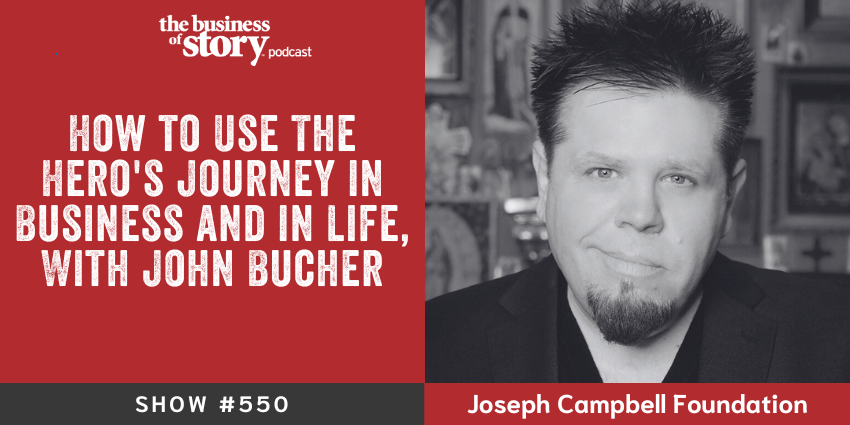
How to Use The Hero’s Journey in Business and In Life, With John Bucher
The Executive Director of the Joseph Campbell Foundation reveals why this ancient framework is your blueprint for brand storytelling and personal transformation
You’ve built your business on expertise and hard work. You understand your market, you’ve solved real problems, and you have valuable insights to share.
What drives you is creating authentic connections with your customers through storytelling that actually resonates.
But you’re confounded because your brand messaging isn’t creating the impact you know it deserves.
This is where the Hero’s Journey changes everything.
John Bucher, the Executive Director of the Joseph Campbell Foundation, joins us. He’s a renowned mythologist who’s worked with HBO, DC Comics, Paramount Pictures, Academy Award nominees, and Emmy winners, John Bucher reveals that the Hero’s Journey isn’t just a story framework—it’s a neurological blueprint for how humans make decisions.
The goal isn’t just to tell better stories. It’s to speak the native language of human decision-making.
What’s in it for You: The Framework That Transforms Business Communication
John Bucher helps business leaders understand that the Hero’s Journey mirrors the exact neurological patterns your brain uses to solve problems. It’s not just storytelling theory—it’s neuroscience applied to business communication.
In this episode of Business of Story, you’ll discover:
- Why customers make emotional decisions first, then justify them logically (and how to use this)
- The two paths to the Call to Adventure in business (entrepreneurs vs. managers)
- How to position your customer as the hero and your brand as the mentor
- Why the Hero’s Journey is a form (not a formula) and what that means for your messaging
- The Refusal of the Call in your sales process and how to navigate customer resistance
- How to move from intuitive to intentional storytelling without becoming a story theorist
The Full Circle Moment
Episode 550 represents something special for me. It’s my 550th episode, and I’m sitting across from John Bucher, PhD, Executive Director of the Joseph Campbell Foundation – the organization that preserves and promotes the work that literally changed my life.
Joseph Campbell’s Hero’s Journey didn’t just influence my career. It IS my career. Everything I teach, every framework I’ve built, every client transformation I’ve witnessed traces back to that moment when I discovered Campbell’s work and realized: “Wait. This isn’t just for Hollywood. This is how humans make every decision.”
And now, decades later, the person leading Campbell’s foundation is validating that business application. Talk about a hero’s journey coming full circle.
The Decision-Making Truth That Changes Everything
Here’s what John Bucher revealed that should fundamentally change how you approach business communication:
“We usually decide how we feel about something and then we go looking for evidence to support how we feel.”
Read that again.
Your customers aren’t making logical decisions. They’re making emotional decisions and then rationalizing them with logic. As Robert McKee famously said: “The conscious mind is simply the PR department that justifies all the decisions the emotional subconscious mind makes.”
This is why features and functions don’t sell. This is why your perfectly logical value proposition falls flat. This is why that competitor with the inferior product keeps winning deals.
They’re telling better stories. And stories bypass the head and go straight to the heart.
The Two Calls to Adventure in Business
One of the most practical insights John shared is how the “Call to Adventure” – that moment when the hero leaves their ordinary world – plays out differently for entrepreneurs versus managers:
The Entrepreneurial Pull: Some people become so fed up with the status quo that they actively seek something better. They’re tired of how things have been done. They see an opportunity and run toward it. This is the entrepreneur’s call to adventure.
The Management Push: Others get shoved out of their comfort zone by external forces – a job elimination, a department merger, an unexpected change. They’re pushed into the unfamiliar territory. This is the manager’s call to adventure.
But here’s what matters: Regardless of which path leads to that call, people go through similar stages afterward. They resist (the Refusal of the Call). They find mentors. They face trials. They transform.
And your job as a business communicator? Recognize which journey your customer is on and position yourself as the mentor who helps them navigate it.
Form vs. Formula: Why Storytelling Isn’t Plug-and-Play
John shared a brilliant analogy that every business person needs to hear:
He tried to learn tango by memorizing where to put his feet. Formula thinking. It was a disaster.
Then he watched people actually dancing – moving with the music, gliding around the floor with artistry and nuance. That’s when he understood: Tango is a form, not a formula.
Storytelling works the same way.
Yes, the Hero’s Journey provides a container. Yes, there are recognizable stages. Yes, you can learn the framework.
But you approach it with open hands, adapting to the nuances of your specific context, your unique audience, your particular challenge.
This is why I’ve spent years simplifying the Hero’s Journey for business application. Not to create a rigid formula, but to give you a form you can work within – a framework that guides without constraining.
The Validation That Matters
You know what struck me most about this conversation?
John Bucher – the person literally leading the Joseph Campbell Foundation – looked at my Story Cycle System and said: “I’m already a big fan of the model you’ve created for the business world, Park.”
Not “You’re bastardizing Campbell’s work.”
Not “That’s not how it’s supposed to be used.”
But: “Campbell would be delighted with all the different places his work has found application.”
Because here’s the truth: Joseph Campbell wasn’t dogmatic. He wrote descriptively, not prescriptively. He was describing patterns he saw, not dictating rules you must follow.
And throughout his life, he championed diverse applications – screenwriters, athletes, business people – anyone who found value in the work.
So if you’ve been hesitant to apply storytelling frameworks to your business because you’re “not creative enough” or “it’s not for business” – you have permission. From the source.
From Intuitive to Intentional
We’re all intuitive storytellers. As Homo sapiens, we’re the only organisms that plan, organize, and act in story. It’s hardwired into us.
But there’s a massive difference between intuitive storytelling and intentional storytelling.
Intuitive storytellers create great work by feel. They just “know what works.” Like Paul Venables at Venables Bell & Partners, who creates perfect Hero’s Journey structure in 30-second Audi commercials without consciously following the framework.
Intentional storytellers understand the frameworks and consciously apply them. They don’t have to be story theorists. They just need to understand the basic structure:
- Your customer is the hero (not you)
- You’re the mentor/guide (not the hero)
- Your product/service is the tool that helps them overcome challenges
- The journey has three acts: Normal world → Trials → Transformation
Follow that framework in your communication and watch your engagement explode.
The Instruction Manual for Life (and Business)
Christopher Vogler says in The Writer’s Journey that the Hero’s Journey is more than a story framework – it’s an instruction manual for life.
John Bucher agrees: “No matter how good something seems to be going in my life, it’s temporary. Bad times always come. And that road of trials – we all keep returning to it over and over.”
This isn’t pessimism. It’s reality.
And it’s why the Hero’s Journey resonates so deeply – because it reflects the actual human experience. The struggles we face. The mentors we find. The transformations we undergo. The wisdom we bring back.
Matthew Winkler created his famous TED-Ed video “What It Takes to Be a Hero” not for filmmakers, but for teenagers contemplating suicide. He wanted them to know: When you’re at your lowest, darkest moment, you are not alone. We all face that. And there’s always light at the end of the tunnel.
That’s the power of the Hero’s Journey. It’s not just a business framework. It’s a human framework.
Your Next Step
If you’ve been on the fence about storytelling, start here:
- Watch Matthew Winkler’s 3-minute video “What It Takes to Be a Hero”
- Read Christopher Vogler’s “The Writer’s Journey”
- Apply the simple framework: Customer as hero, you as mentor, product as tool
You don’t need to become a story theorist. You just need to become an intentional storyteller.
And the Hero’s Journey? It’s been waiting for you since the beginning of recorded time.
Links:
- John Bucher’s Website: tellingabetterstory.com
- Joseph Campbell Foundation: jcf.org (weekly newsletter available)
- “What It Takes to Be a Hero” by Matthew Winkler (TED-Ed video)
- “The Writer’s Journey” by Christopher Vogler (5th edition)
- “The Power of Myth” PBS series with Bill Moyers
- “Finding Joe” Documentary
- “Joseph Campbell on the Hero’s Journey” – Joseph Campbell Essentials series
- Craft your vibrant brand story with the Story Cycle Genie™
- What users are saying about the Story Cycle Genie™
Related Episodes You’ll Love:
- How to Accomplish More Business Growth By Doing Less – Michael Walsh reveals why working less creates more revenue and freedom
- After Upskilling Two Million People, Learnit’s CEO Shares the Formula That Makes Learning Stick – Damon Lembi on the relatable-memorable-emotional formula that makes corporate learning stick
- How Effective Leaders Go Beyond Their Words With Stories – Julie Lancaster’s REST method for leadership storytelling
Subscribe to the Business of Story podcast: Available on Apple Podcasts, Spotify, and all major platforms.
John Bucher’s Conversation With Park Howell
Park Howell: Hello, John. Welcome to the show. I am absolutely delighted you’re here.
John Bucher: Park, it is really good to be here anytime that I can come and talk storytelling with someone who shares an interest in that. I feel like I’m with my tribe, so it’s really good to talk to you.
Park: Well, I love to do anniversary episodes every 50 shows, and this is my 550th show. And I feel like I’ve come full circle because Joseph Campbell and the Hero’s Journey has had such a profound impact on my life and on my career. And it’s what I do and why I do it ever since I got out of the advertising agency business to consult, teach, coach, and speak on the power of story.
And I’ve been guided by everything I’ve learned from Campbell and finding even ways to simplify the hero’s journey so that more people can use it and apply it. Because what I found, John, in the business world, most people don’t want to be story theorists. They just want to get to market faster and make more sales.
And instead of pounding their chests with features and functions, I’ve showed them how to use story frameworks such as the hero’s journey to have that kind of impact. So with you coming on as the executive director of the Joseph Campbell Foundation, I want to thank you because this is literally a full circle moment for me.
John: It just delights me to hear it, really does. I think if Joseph Campbell were alive today, he would be really delighted with all of the different places that his work has found application and that it’s having impact in the world. Nothing delights me more than to hear people who have come across that work and found ways to bring it into the work that they’re doing, to use it as a tool for the work that they’re trying to do in the world. And it seems like you’ve really found an effective way of employing the hero’s journey. So I’m really delighted to talk to you about it today.
When Story Creates Its Own Energy: The Synchronicity Experience
Park: Well, one thing I’ve read in Christopher Vogler’s fantastic book, The Writer’s Journey, which is all about the hero’s journey. I think it’s in its fifth edition and I highly recommend anybody in the advertising marketing writing creative world to read that. He says in there that when you invoke story, it creates a bit of an energy all its own and will transport you and your audiences to places that maybe you didn’t intend or you did intend to take them.
And I had that experience, boy, it was a few years ago, October 30th, and it was 2007. And it was October 30th, as I mentioned, which was the 30th anniversary of Joseph Campbell’s death. And I had just read about that a couple of days earlier and I was doing a big presentation in Phoenix. It was a keynote speech to a large transportation organization in Phoenix. And I mentioned that on that stage that we were actually recognizing the 30th anniversary of his death.
And I kid you not, John, as soon as I said that, the lights in the ballroom flickered on and off and on, and then went completely off. Everyone went, ooh, and then they came back on again. And all I could think of never having that happen to me before was, John, was that Joseph Campbell giving me a little wink with a thumbs up?
John: I’d sure like to think so, right? Wouldn’t that be great? I love those moments of synchronicity when it seems like something beyond us is happening here. I really appreciate something you just mentioned there about the way that Campbell’s work, 30, 40 years after his death now is still finding resonance with people.
How Customers Really Make Decisions: Emotion First, Logic Second
John: And I really agree. I think people that I know in business and I, aside from my work and leading the foundation, I work in the business world, the entertainment world and do consulting among lots of different types of organizations. And one of the things that I find as well is people don’t have time to become story theorists, even if they’re super interested in it. But people are interested in how their customers make decisions.
And I think when we understand story, we start to get shortcuts into the thinking of people behind how they make decisions. I think most of us would agree that as much as we like to think even the most strident business person makes decisions by passing through a logical rubric of some sort, we don’t. We usually decide how we feel about something and then we go looking for evidence to support how we feel about something.
Now, we can have our mind changed, data might be presented that causes us to change our mind about something, but typically when we first encounter a problem or a new situation in business, we automatically have a bit of snap judgment about how we feel about it and we go looking for evidence around that. And I think this is where stories really help businesses as well as individuals communicate the feelings that we have.
Sometimes we can try and use data or an explanation for how something works. But if I tell you a story about why that thing is important, it’s going to have such a greater impact than all of the facts and figures and information I could give you in the world.
John Bucher’s Accidental Hero’s Journey: From Music to Mythology
Park: So John, how did you get into the storytelling world? You’re a PhD, you have risen to this exalted position of directing the Joseph Campbell Foundation. Where did it all begin for you?
John: Yeah, it really began for me quite by accident. And I think there’s a lesson in this that sometimes the thing that seems like an accident in the moment ends up being that thing that transforms and turns our life around. I was really interested in going into the music business. I was just fascinated by music and I thought that would be a great career working for a studio and learning how studios work.
So when it came time to go to college, I signed up for a program in the college catalog called the Recording Arts. And I thought this is perfect for me. Well, the first day of class, I came into the classroom and the instructor pushed out a television camera out in front of the class. And it turns out the entire program was about the recording arts of television and film, had nothing to do with music whatsoever.
And I was too embarrassed to get up and walk out of the class. So I stayed and about halfway through that first semester, I found out I really enjoyed telling stories in this medium. And so that was sort of the entry point for me. Through a series of events I came out and worked in Hollywood for a number of years and in the entertainment industry. But I really couldn’t get away from what I was most interested in, which was the power of story.
And I wanted to know more about it, which is what led me to going and getting a PhD and studying what is the underlying currents of story. And maybe most importantly to the work of Joseph Campbell, why we keep telling the same stories over and over and over again, whether it’s through our entertainment, film and television, or through the business products and services that we sell. We keep telling the same stories over and over again because they’re effective, because they have impact.
Breaking Down the Hero’s Journey: Recognizing Your Own Story
Park: So would you even say that experience with that course is a bit of its own hero’s journey that you, here you are in your ordinary world and you’re like, I want to learn about the music industry. I want to go and do this business. That was kind of your call to adventure yet you ended up in the other world, the unnormal world of, oh my God, I’m in this TV movie class and I’m too embarrassed to say anything about it. I’m going to suck it up and see what happens. And then you go through those trials and tribulations and probably had a good professor and you found that, oh, there’s actually something here. And then when you come out of the other end of that, you return back to the normal world, but you’ve been leveled up with this boon of insight as Campbell would say. And that then led you on to your next revolution of the story.
John: Park, you nailed it. I mean, it was a hero’s journey by the book, by the template, layer by layer, stage by stage. And if I could, I’d love to zoom in for just a second on that call to adventure, because one of the things that I think it’s easy for us to miss is there’s something interesting, I think, for businesses around this idea of the call to adventure. And I’ve found it often plays out in one of two ways.
The Two Paths to the Call to Adventure in Business
John: And one way I think is really an experience that entrepreneurs specifically resonate deeply with. And the other way I think is something that folks that find themselves in management typically resonate with more.
So in the hero’s journey, when the call to adventure occurs, it’s typically one of two things. One, it is because a individual has become so bored and fed up with everything in their world that they say, there’s gotta be a better land over the rainbow. There’s gotta be more than what meets the eye here on the other side of those two suns in the distant sky. There’s gotta be more away from home, off this island.
And so many of us, that’s what we do when we go to college or we leave home, we’re going off on this adventure where we just can’t take it at home anymore. I find many entrepreneurs really resonate with that call to adventure. They’re tired of the way that things have been done in the past. They’re tired of not having the tool or the product that they need, and they see an opportunity and they run out after that. That’s the call to adventure for them.
Now the call to adventure also can take another form. And that form is when we are pushed out of the comfort zone and out of the normal world. And this can take a lot of different skins, if you will. But it could be that phone call that says, hey, we’re eliminating your position and you’re not going to have a job anymore. It could be, hey, we’re merging your department with this other department. And now that normal world you’ve been used to is completely different.
It’s something that we don’t necessarily see coming. It’s something that makes us uncomfortable and we’re shoved out into the world and we have to figure out what that next step is. And oftentimes it is messy and there’s this road of trials as Campbell called it that we experience. But regardless of which path leads to that call to adventure for someone, then the paths sort of merge together and people end up going through a lot of the same stages. But I find at least at that call to adventure stage in business, it’s often through one of those two paths that people find themselves on this heroic journey in their work.
Park Howell’s Business Hero’s Journey: From Creative Director to Agency Owner to Storytelling Consultant
Park: You know, and before I learned about the Hero’s Journey, I had this happen so many times to me that once I learned it, I looked back on a time. So I was working for this company. I was a creative director at Quorum International, and this was a startup and it had this rocket growth to it. It was just amazing. But it also brought in some less than reputable people because they saw the amount of money the company was making.
And the head of legal came into me one day and he knew we had just had our third child and I’m a small family and growing it. And he says, Park, if we were having this conversation, I would have you call this person. And he put this note with a name, Navas Gus Walla, very exotic name and a phone number on it, but since we’re not, you can do whatever you want. And he leaves my office. And I’m like, what is this?
And I pick up the, so there’s my Harold, right? There’s my call to adventure. I call the number, goes directly to Navas, beautiful, amazing woman that I ended up working quite a lot with over almost two decades as their agency of record. And I left my job, have this new family and I started Park & Co, my ad agency in 1995.
But it took a lot of guts. I remember coming home and my heart palpitated. I thought I was going to have a heart attack. I was like 35 years old. I’m like too young for this. But then that launched my agency and I had a marvelous relationship with my customer, Forever Living Products for almost 20 years and built it.
And so when I look back on that, I go, well, that was that hero’s journey. And then I knew it was time to leave my agency at the age of 55, because I wasn’t having fun anymore. And I had been studying and teaching the hero’s journey in my story cycle system. And I remember waking up one September morning with an absolute pain in my gut saying, I need to wrap up my agency and start all over to consult, teach, coach and speak on the power of story. And people thought I was bananas. But I did it. And here I am today talking with you about just another example of a very epic series of heroes journeys. But they also don’t have to be epic, do they? Heroes journeys happen in moments of time.
The Hero’s Journey in 30-Second Commercials and the Refusal of the Call
John: That’s right. That’s right. And I used to have a friend that consulted for businesses in the world of storytelling. And this was back in the times when we had these things called television commercials that some people may remember before everything was streaming. And this friend would take 30 second television commercials and break down the entire hero’s journey in a 30 second television commercial.
Because in a sense, you were also asking a customer to go on a journey, if you’re asking them to leave a brand or a product they’ve previously used to come and use your brand or product, you’re asking them to leave the normal world, the comfort zone. And there’s this process that a customer will go through before they are willing to do that. And there’s this really interesting stage after the call to adventure that Joseph Campbell called the refusal of the call.
Park: Yeah, there’s no way am I gonna do that.
John: Exactly. It’s like, yeah. And I think every person in business, they encounter at some point the resistance of no way am I going to do that? That’s just not for me or over my dead body. So I think that when we think about what it is that causes someone to be able to leave that normal world, whether it is being pushed out of the boat or whether it is such a rich opportunity to step out of the boat and try something new.
I think these are universal human experiences that we can point to, which is also the reason that I think that the Hero’s Journey is such a great model for your model, as a matter of fact, because it’s based on universals that transcend time and culture and geography. And I think that’s an important thing to recognize is that while people seem so different, at the end of the day, most people kind of all want the same things.
Campbell Revealed the Hero’s Journey, He Didn’t Invent It
Park: Well, one thing I’ve read in Christopher Vogler’s fantastic book, The Writer’s Journey, which is all about the hero’s journey. I think it’s in its fifth edition and I highly recommend anybody in the advertising marketing writing creative world to read that. He says in there that when you invoke story, it creates a bit of an energy all its own and will transport you and your audiences to places that maybe you didn’t intend or you did intend to take them.
And it’s not like Joseph Campbell invented the Hero’s Journey. He simply revealed it. I mean, if you go back to what is the very first recorded story of Gilgamesh carved out of cuneiform tablets, when they transcribed, translated that, they found the Hero’s Journey resides there. But a more modern thing that I point to is if you look at the Wizard of Oz, perfect heroes journey template and yet the writer and the director and the screenwriter back in the day did not even know the heroes journey existed.
Now jump fast forward to Star Wars, the epitome of the heroes journey, but George Lucas was a student of Campbell’s and put it to work there. So it’s not something that’s been invented. It’s been around since the beginning of recorded storytelling. And so why not use that architecture, that framework, when you’re trying to influence and persuade anybody to do something?
The Neuroscience of Storytelling: How the Hero’s Journey Mirrors Brain Function
John: Well, and I’ll even go a step further than that. One of the things Joseph Campbell identifies in the book, The Hero with a Thousand Faces, where he first presented this idea in 1949, is it’s a lot. And I appreciate you bringing in my friend Chris Vogler’s book. Chris is a dear friend and I think he really has broken it down in a really helpful way, as you mentioned.
One thing Campbell does that’s helpful is Campbell points to this heroic journey playing out in the lives of historical figures throughout the book as well. It’s easy to say, well, yeah, you make a story, that you can work these ideas in. And that’s true. But we see this playing out in the lives of historical figures. And just like you and I have been going back and forth with our own lives saying, I experienced this. I think there’s something that every person can see stages of this in their own experience.
Which leads me to one last idea here that I’ll share with you. There’s been a lot of modern research in neuroscience that suggests that the hero’s journey greatly mirrors the neurological patterns in the brain, the same ones light up as when human beings solve problems. And so I think what we’re seeing in these universal stages of the hero’s journey, again, which you’ve adapted for business, is we’re seeing sort of a natural human process for working through decision-making. And I mean, that’s tremendously valuable for us to understand how people make the decisions that they make if we want them to buy products and services that we’re a part of creating.
Carl Jung, Archetypes, and the Foundation of Brand Personality
Park: Can you help clarify my thinking on something? Was it Freud and or Carl Jung, the famous Swiss psychologist that also embraced the hero’s journey and said this is sort of the architecture for how our brain overcomes, solves problems?
John: So Carl Jung played a major role in influencing Joseph Campbell. So it was more Campbell pointing back to Carl Jung’s ideas. So there actually were a number of thinkers who had come along before him and pointed to, there’s a thinker named Arnold van Genep and another name Otto Rank, and they had identified these patterns in the rituals of people around the world.
And Joseph Campbell looked and said, I think this goes beyond just when people take communion at church or just when they have a tribal ritual experience. I think there’s even something more happening here with our stories and in the myths that we tell. And so that was sort of his way of building on the work of those who had come before him to bring that in.
But he was greatly inspired by the work of Carl Jung, who had began to see these patterns that Carl Jung called archetypes. And in the business world, we sometimes call those customer profiles or avatars. They’re containers that we can rely on again and again that keep coming back in the form of different types of customers.
Park: Well, in my 40 plus year career now in the advertising branding world, my forte was always branding. It’s just something that found me and I found it and I love doing it. And I was taught the old way, John, of, if your brand were a dog, what kind of dog would it be? And if it were a drink, what kind of drink it would be? And I always thought that that was kind of bullshit. I’m like, really? This is how you do it, huh? It doesn’t make sense.
And it wasn’t until I learned about the hero’s journey and Carl Jung and his work in archetypes when I’m like, well, no, this is what brand personality development is supposed to be about. How are you showing up as an individual that our brains already innately recognize?
John: Right. That’s exactly right. I think that’s Carl Jung’s idea was that we didn’t have to teach this to people. We sort of just recognized it, that there’s something running through our nervous system that we just automatically know through 10,000 years of evolution or whatever it is that is already innate within us. And I think this is especially helpful in business.
But I also would say this is just a helpful idea for navigating the world because we often meet people who remind us of others we’ve met before. They seem to have that same energy, the same talents and giftings, the same faults and weaknesses. And we can say, wow, that is a character I’ve encountered before in my life. And it’s where great stories are based because we all know heroes and villains and protagonists and antagonists, sidekicks or mentors. And all of these things seem to find their way into business as well.
Teaching Logic-Driven Professionals How to Apply the Hero’s Journey
Park: Well, and a lot of times when I’m teaching this, especially to very logic reason driven business professionals, they’ll go, okay, cool. But how do I actually apply this in my world? In fact, I was just working with Navy federal credit union and 110 of their internal auditors on storytelling. So you can imagine John, the introvert nature of that group and the logic reason driven.
I will often start with that short little three minute film, What It Takes to Be a Hero by Matthew Winkler. It’s just one of the best, quickest descriptions of the hero’s journey. And I’ll always begin by saying, how many of you in the room have heard of Joseph Campbell and the Hero’s Journey? And I’m lucky if 10% of the hands go up. And I said, that’s cool, no problem. I’m going to show you this little film. And for any of you listening or watching, just go and check it out.
What It Takes to Be a Hero by Matthew Winkler. And when it’s done, then I will pull up the 12, 14 step hero’s journey and say, this is what he just talked about. Now, by the way, does this seem familiar to you? And everybody in the room now goes, yeah, it’s embedded in their brain. They know what’s going on. And then I’ll show them how it relates to their world.
And I’ll say, the hero is not you, it’s your audience. You’re going to map that and what journey are they currently on? You play that more important role of mentor guide. You ask them to make a change, shaking them out of status quo that takes them into then the act two of the non ordinary world. They go through the trials and tribulations of that, and then they emerge in act three or return back to their normal world with the boon. And I just show them and they nod, they go, I get it. Okay. Now I know where you’re going with it.
And I’d love for you to comment on this idea that Christopher Vogler mentions in the writer’s journey, where he says the hero’s journey is more than just a story framework. It’s actually an instruction manual for life.
The Hero’s Journey as an Instruction Manual for Life
John: I couldn’t agree with Chris more about that. I really feel like that’s true because I always find that no matter how good something seems to be going in my life, it’s temporary. And bad times and bad things always, always come. And that road of trials that Joseph Campbell talks about, it’s something we all keep returning to over and over, even when we get past it and we get that boon and bring it back.
Campbell said that we just kind of start that heroic journey all over again. And I think there’s something to recognizing the characters we meet along the way on that journey, those mentors, those sidekicks that are part of our journey. And then we’re heroes and sidekicks to someone else’s journey.
And yeah, I think that one thing you mentioned there that I think is so important is we often tend to default thinking we are the hero of every story. That’s what our brain tells us, right? And as you mentioned, in so many different contexts, we are storytellers, even though we might never call ourselves that. We’re all, every human being on the earth is a storyteller.
And I think our great task, especially in business, is getting the listener or the audience to tell a story to themselves. Because we all trust ourselves more than we trust anyone else. And when we can create the environment and the framework for that listener to tell themselves the story we want them to engage, it’s so much more powerful, which is what you’re doing there in showing them Matthew Winkler’s film and then showing them the model up on the screen. They then are piecing together two plus two and they’re telling themselves the story, which is why it resonates so much more deeply.
Defending Against Hero’s Journey Purists: Campbell’s Non-Dogmatic Philosophy
Park: Well, I love to do anniversary episodes every 50 shows, and this is my 550th show. Now, being the director there at the Joseph Campbell Foundation, and I’ve run into a lot of Joseph Campbell purists and heroes journey purists that are like, you’re just bastardizing it for business. And I’m like, no, because this is truly an instruction manual for life. Hollywood doesn’t have it locked down. Have you come across that? And if so, how do you deal with that?
John: Yeah. Well, anybody that looks very deeply into the work of Joseph Campbell will find that Joseph Campbell was not a fan of dogma. He was not someone who wanted people to create any sort of text and say, this is it. This is the only way to look at this. He was just not a fan of strong dogma or even dogmatic ideas. What he was interested in is putting things out on the table for thoughtful engagement and information and in good conversation around.
And so, yeah, I certainly run into folks that become purists about these things as well. I just don’t think that was Joseph Campbell’s approach to these things. He was not someone who was looking to… Well, let me just back up and even directly address kind of what Campbell, his evolution on these things. Because when he first writes the book, he doesn’t write the book as a prescriptive book at all. He writes it as a descriptive book on what he has seen throughout history and myth in the world.
He’s not saying when you create stories, you should have these different stages. He’s saying, I studied all these stories and here’s what I saw. Now, throughout the course of his life, he found screenwriters and athletes and business people were really engaged with what he was saying and applying that to their own world. And he did nothing but champion that. He was very enthusiastic about those who would take the model and apply it to their particular given world.
So I think that when we find those who become very dogmatic about what the hero’s journey must be or must mean, one, it kind of flies in the face of who Campbell was around that material. But two, I think it also speaks to a psychological need within many of us that we need it to be this way that we see it. We need it to be our view of the world. And I think it’s just a much more healthy approach with story to approach it with an open hand.
Storytelling is a Form, Not a Formula: The Tango Dancing Metaphor
John: And the last thing I’ll say about it, Park, is one thing I’ve learned over the last 30 years of studying storytelling is that storytelling is a form and not a formula. In other words, it’s not put your quarter in the vending machine and you get this out of it. And if you don’t get out what you want, you bang on the vending machine and shake it. That’s not what storytelling is.
I learned the difference between a form and a formula one night when some friends of mine came over and tried to teach me how to dance tango. And let me just tell you, it was a disaster. But I thought I was putting my feet, put this foot here and this foot here. And I tried to learn to dance tango by learning the formula of where to put my feet.
But then they took me to like a dance club and I got to see people actually moving with the music and just gliding around the dance floor. And I recognized, wow, tango is an art form. It’s not about this formula of where to put your feet. And I find storytelling often to be the same thing. We can have these containers, we can have these ideas, but we come to them with open hands to be able to navigate the nuances of the art form.
Matthew Winkler’s Hero’s Journey Video: Created to Save Teen Lives
Park: Well, you were talking about Campbell kind of pushing against dogma and so forth, and that the hero’s journey can be influential in so many ways, not just story structure, but mental health, mental clarity. Going back to Matthew Winkler and his really amazing Ted Ed video, What It Takes to Be a Hero, do you know why he made that piece? It’s a fascinating story.
He, as I recall, was a ninth grade, might still be a ninth grade teacher back in New Jersey, English teacher. And they had had a rash of teen suicides. And it hit him so profoundly and he had been studying the hero’s journey that he wanted to find a way to communicate to these teens that when you’re at your lowest, darkest moment, you are not alone. We all have that. And in fact, Joseph Campbell mapped this human experience in the hero’s journey.
And so he actually created that to share with these teenagers that said, don’t take your life, don’t go to the extremes. There is always light at the end of the tunnel. There’s always someone there to help you. And if you can’t find a mentor in your journey, make it me. I am here for you, call at any time. And he has such a profound impact in the school district back there that then Ted Ed came to him and said, we want to make a film out of it. And to me, it’s still the best three minutes educational piece on what is the hero’s journey. Now, there’s a guy taking Campbell’s work and applying it to saving lives.
John: So good. I’ve heard similar stories about folks using the Hero’s Journey with veterans who experience PTSD. I’ve heard people using the Hero’s Journey to work with people who have been incarcerated and trying to transition back out to healthy life in the world. I am fortunate in the position I have with the Foundation to get to hear all of these different amazing stories about how that work that Campbell did has been used to bring about good in people’s life. And what’s better than that? Something that we create, producing good in people’s life and work in the world.
How John Bucher Introduces Businesses to the Power of Storytelling
Park: Now, in addition to being the executive director of the Joseph Campbell Foundation, you also have your own storytelling consultancy, and I imagine you work with a lot of businesses as well. How do you introduce them to the hero’s journey and how it can really influence the outcomes and success of their companies?
John: That’s a great question. And I’m fortunate in that a lot of people do the heavy lifting for me. A lot of people I work with are already familiar with the hero’s journey, even if they don’t know who Joseph Campbell is. But typically what I do if someone is considering working with me and they’re maybe a little bit unsure about this whole storytelling thing, or they’re a little bit unsure about this hero’s journey model, I typically will tell them a very short story.
And I like to practice what I preach. And I believe the power of storytelling can engage them in a way that they see what I’m trying to say without me having to even explicitly come up with a business deck that has 10 points about why this would work. And I find it to be tremendously effective. I’ve got a couple of different go-to stories I use, but I’ll give you a very short one.
The Deathbringer and Lifebringer: A Story About Change and Transformation
John: There’s in the traditions of the Native Americans a story about this man who used to live up above the tribes that lived down in the plains and he was known as the Deathbringer. And the Deathbringer every day would come down from the hills and he would go and he would find someone and he would capture them and take them back up to his hut and he would kill that person, put them in a giant pot and he would eat them for dinner.
This went on for years until one day another man came into the tribe that they called the Lifebringer. And the Lifebringer studied and watched what the Deathbringer did every day. And one day he followed the Deathbringer as he had captured someone and was taking them back to his hut. And he had put this person in the pot and began to boil them. The smoke began rising up out of the top of the hut and the life bringer climbed up on top of the hut.
And he looked down into the hut and he looked into the pot where the water was boiling. And the death bringer walked over to check on how his dinner was coming along. And he saw the face of the life bringer and he thought it was his own face. And he said, that’s not the face of a man who eats human beings. And from that day forward, he changed and he no longer went and captured anyone down in the village.
And this story of the life bringer and the death bringer is a really simple heroic journey that we can unpack in very simple terms. But it’s a story also that shows a person that what we’re really looking for in the world is change. None of us get excited about the idea of change. Most people say they fear change, but I would suggest to you that none of us want a life where nothing ever changes or who we are doesn’t change.
And the work I’m coming in to bring is the healthiest, most organic impactful change that I’d like to invite you into. And that’s one of about a dozen different stories that I employ depending on who the client is. And it takes people out of their frame of reference, to be honest with you, because using an old story like that, they don’t know where it’s going. They have no idea what this is going to be.
As much as people would try and jump ahead and figure out what the point of all this is going to be, they’re along for the ride. And before they know it, they’re wrapped up in the story. And this is what stories do, Park, is they bypass the head and they go straight to the heart. And I think, especially in the world of business, we’ve heard it all before, right? We’re looking for different ways to bring information and ideas to people that hold just a bit of surprise for them.
Stories Bypass the Head and Go Straight to the Heart
Park: I attended Robert McKee’s famous story conference, three days in the LAX Sheridan. And I was in amongst about 300 screenwriters, but I was not there as a screenwriter. I was there as a marketer and I wanted to learn what Hollywood knows about it. And he said something very similar to what you said right there. Remember, he’s speaking to screenwriters, not to sales and marketing guys like me. And he said, remember that you always have to write for the subconscious mind because the conscious mind is simply the PR department that justifies all the decisions the emotional subconscious mind makes.
John: Park, that is so true. And it’s funny that story that I just shared, I often will resist the urge to try and explain that story to the person that I’m talking to. And I will often ask them, what do you take from that? And I never get the same answer twice, but everybody has an answer. Everybody has something that they connect to on that. And I think that’s really what the power of story is.
And this goes back to the idea we were just talking about with Joseph Campbell, not being dogmatic. I don’t try and be dogmatic about what someone is connecting to in a story. I don’t say, you’ve got to connect to this or you got to connect to that. Oftentimes, I’m fortunate enough to get to go around the world speaking and I’m blown away and you probably have experienced this as well.
How many times someone will come up to me after I’ve given a talk and say, I loved when you said this in the talk. And I’ll say, I don’t remember ever saying that in the talk. Maybe I did, but oftentimes they heard something inside themselves that was sort of a reflection on something I said, but it resonated so deeply with them that it’s what they took away. And so I try and avoid that dogma of being really insistent on what someone has to take from the story because the power of story will do things inside of someone that I’m incapable of doing. So I try and keep that in mind.
Multiple Valid Adaptations: From Save the Cat to Story Cycle System
Park: Now, well, Vogler wrote the writer’s journey, which really dissects the hero’s journey. I was also introduced to Blake Snyder’s and his 15 beats to story, which is somewhat of a hero’s journey, but kind of mapped in a different way. Then you have the Pixar way. You have David Mamet’s approach to playwriting, but you can still see the hero’s journey in there. What do you think of all these different versions of the hero’s journey?
John: I love them. I love every one of them. Dan Harmon has one called the Story Circle that he uses in training television writers. I love Mamet’s approach. I love Chris Vogler’s approach. I love Blake Snyder’s approach. I’m not someone, again, who is trying to narrow this down to a dogmatic formula, that it has to be this or it has to be that.
To be honest with you, I’m already a big fan of the model that you’ve created for the business world as well, Park, because I see where you’ve taken the hero’s journey and really brought it into a context here where the folks that you’re talking to are going to resonate with it. I think it’s great. I really do believe that it’s the idea behind these things that is so powerful. If an idea is just static and unable to be applied in someone’s work or life, what value really is it? So to me, it speaks to the value of the idea how many applications we can find for it.
The Story Cycle System: An Expanding Spiral of Customer Engagement
Park: Yeah. I mean, it’s a template. And as we had mentioned, when I saw how Hollywood was using it, I’m like, why don’t they teach us this in advertising, marketing, branding, sales, whatever. And so, yeah, what you’re talking about is I mapped it to business and created my story cycle system. But instead of a closed loop, I see it as an open loop, a spiral, an expanding spiral of engagement with every rotation of the spiral.
Because what are you really trying to do in business? And that is to get customer engagement to first connect with them on their journey, to then map their journey into your journey as you are helping solve problems that they’re coming up against. And then as you do solve those problems and back up the promises you make in your brand storytelling based off the Story Cycle system, they become an active participant in the story. And now they start sharing your story with their world that leads to the most powerful form of advertising and marketing there is, and that’s word of mouth marketing. Someone scaling and sharing your story with their world.
What Businesses Really Sell: Transformation, Not Products
John: Yeah, I love that. And I think it also speaks to when we think about what we, if we’re involved, say, in selling a product or service, I think it also speaks to causing us to think more deeply about what it is we’re actually selling. The Chevrolet doesn’t sell automobiles, they sell freedom. And they sell the idea of Chevrolet because we don’t make our decisions about what car to buy just by the Consumer Reports report on that car.
There’s often something that we can’t even identify to say we just like that kind of car. And most people don’t think more deeply about it than that. But when we can understand Chevrolet is actually telling a story, a very, very curated story about what having a Chevrolet in your life is. And that’s, I think, what we have to recognize.
From Intuitive to Intentional Storytelling: Venables Bell & Partners Example
Park: You had mentioned earlier, John, a friend of yours that dissects 30 second commercials. And I will admit, I did that when I first learned about the hero’s journey to see if it was really showing up. And for any of you out there that want to look at it, I think one of the best storytelling agencies is Venable Bells and Partners out of San Francisco, co-founded by Paul Venables and their work with Audi is some of the best advertising storytelling, let alone for an automobile that I have ever seen.
And you can break down those 30 second spots to the hero’s journey. And when I approached Paul about this, I called him many years ago and said, did you know this? And he goes, no. I go, you’re not following the hero’s journey when you’re creating these because they are perfect examples of it. He goes, no, we’re just good intuitive storytellers. We know what needs to have happen.
And what I like to tell people is we are all by nature of being Homo sapiens, intuitive storytellers. We are the only organisms we know of that plan, organize and act in story, using story, because everything we’re selling is a fictional tale until we make it fact to get that storytelling ape sitting across from you to buy into it.
So while they are intuitive and just know what works and then naturally using the hero’s journey in there, I tell people that you can become an intentional storyteller simply by understanding these frameworks. You don’t have to become a story theorist. Just follow these frameworks in your communication and it will blow your mind how your engagement will go through the roof.
Storytelling Language and the Operating System of the Brain
John: Yeah, that’s so well said. I have a friend who has said he believes that story is the operating system of the human brain. And I think there’s a lot of truth to that. Sometimes we get overwhelmed by the idea of getting good at storytelling. And I think there’s a lot of value to even being able to adopt some storytelling language into the way we talk about things.
So storytelling language is something you and I have done even on this podcast using terms like the call to adventure in my life was this or this or this. That’s a really powerful phrase that kind of appeals to us because all of us deep down, we kind of would like an adventure in our life. And so using even storytelling language can be invitational to people in a way that draws them in and causes them to listen more deeply to what you’re saying.
Park: You know, you mentioned story being our operating system. I would say, let me just spin that a little bit. I believe storytelling is the software that drives the hardware of the operating system that is our meaning making machine internally in our limbic system and our hippocampus and our amygdala. And we use stories to speak to it to say, no, I want you to think about it this way. I want you to look at it this way. I want to create meaning by telling you this story this way.
The Fundamental Attribution Error and How We Create Stories
John: Yeah, yeah, absolutely. I love that. I love that. And I think you’re exactly right. It is software that definitely tells our hardware what to do. I live here in Los Angeles and oftentimes I find my storytelling machine when I’m driving here in LA, it goes into overdrive. Someone cuts me off in traffic and I immediately form a story about that person and they probably go home and kick their dog. They’re a terrible person.
Park: You know what they call that, don’t you? They actually have a term for that. It’s called the fundamental attribution error. And humans are wired to think the worst of a situation versus really taking in what’s actually happening in the situation. And so when someone cuts you off in traffic, you think they’re an absolute bum and they go home and they kick their dog, but maybe they’ve got a spastic colon and they’re trying to find the next exit to a 7-Eleven to get the bathroom.
John: Yeah. I’ve been working on myself this year, Park, to try and at least introduce the possibility that they are going to pick a child up from school or something other than that they’re just a cruel and evil person in the world.
Testing the Story Cycle Genie with John Bucher’s Brand
Park: Well, it’s a very natural thing. The fundamental attribution error, look it up. So I was so tickled to send you what the genie came up with when it looked at your telling better stories brand, but I was also a little trepidatious because I thought here’s the dude that heads up the entire Joseph Campbell foundation, the hero’s journey. Is he going to be offended by how I’ve used it with the Story Cycle Genie. So I sent you the brand assessment and then I sent you the overall brand narrative framework it created. Again, inspired by the hero’s journey, what was your take on it?
John: I really, really liked it. I was sort of blown away at how accurate it felt and how on point it felt. And as I mentioned earlier, I’m not someone who gets easily offended or worked up about the way people are using the hero’s journey. I think there’s room for any sort of application someone can employ.
I’ll tell you, one of the things that really was helpful to me in looking at what you sent over and the way that the story cycle Genie analyzed, did the assessment analysis, it’s always nice to see the things that you’re doing well, right? We all feel good about that. The validation, absolutely.
But I really appreciated the strategic enhancement opportunities, those places that I could actually tweak things to just work just a little bit better. And one of the points that stuck out to me is that it said long-term branding versus short-term tactics were an issue with my brand. I immediately recognized the truth of that. I said, yeah, actually that is something I need to start thinking about. I wouldn’t have come up with that on my own. I’m too involved in the moment, in the day to day sometimes to do that higher level strategic thinking. So that was a gift to me. I really appreciate it.
The Story Cycle Genie’s Position Statement for Telling Better Story
Park: And it says in your position statement, it said, telling a better story at your brand helps organizations in transition, transform unclear business evolution into compelling, authentic brand narratives that drive meaningful connections and sustainable growth.
John: That is so spot on. I tell you, that is, we talk about your aspiration of what it is you’re trying to do. It’s such a clear articulation of what my strategy is and what I am trying to do as a business.
Park: And did you write that anywhere? Did it pull that from your website or is that an amalgamation of what it learned about you?
John: That’s an amalgamation. That’s an amalgamation of what it learned about me. Yeah. I’ve got a description on my website of what I do, but honestly, there’s not a ton of description about that. So the story cycle genie was able to do quite a bit of creative process thinking there based on what I have because yeah, it’s certainly not articulated that way.
Park: And then that led to your unique value proposition of transforms business change into brand clarity.
John: Yes. You know that that word clarity came up a couple of times in the analysis. And I that was another thing that really stuck out to me is how much I need to focus on clarity with my brand. Because I have a bit of a unique brand in that storytelling and story consulting, it’s not necessarily a brand where you’re selling tires or something that is big established industry. So I think continuing to find tis super important for me. And I’m guessing I’m probably not the only business that has to keep searching for that clarity.
Brand Archetypes: When Analysis Connects on a Soul Level
Park: Yeah. Well, and that’s the whole idea is we take our IP from the story cycle genie. And yes, it’s AI driven, but it’s on our own platform called Brightsy. So while it’s AI driven, it’s a secure fortress for your brand Intel. Nobody can see it, including AI. You’re the only person iterating in it that can help you find this brand story clarity.
And we had spoken earlier about archetypes and it came up with a primary archetype for you and then two secondaries. The primary, and again, these are all based off Carl Jung’s work of his 12 categorized archetypes. And then we have found four or five or six sub-archetypes within each category. So the genie looks at all those 64 plus archetypes and says, okay, how are you showing up in the world?
It said your number one is Sage. And it says the Sage archetype authentically reflects telling a better story’s core function as consultative guide who helps organizations discover truth and wisdom within in their own narratives. This positioning emphasizes educational guidance and truth seeking over manufactured messaging. Does that sound accurate and true description to your brand personality?
John: I feel like your story cycle genie has been reading my diary, Park, because it is 100% accurate for what I’m trying to do with my business. And I will say, I also felt quite honored to be identified by that sage archetype. That felt really good. I was like, yes, that’s how I want to be seen in the world.
Park: That’s beautiful. And then your two secondary archetypes, because it says the sage is like 65% of your personality showing up. You’ve got the creator and the sub archetype, that would be the storyteller in the creator category 25%. No big surprise there. And then the magician and in the magician category, the visionary is called out and it says 10%.
John: I tell you, I’ve taken a lot of personality tests, the Myers-Briggs and all these different, Enneagram and all these things. And these archetypes that it identified, they spoke to me on a slightly different level, I’ll be honest with you. They felt like they connected with me on a deeper level than just identifying that maybe I’m an introvert or extrovert or that maybe I get energy from this or that. These connected with me on a bit of a soul level, to be honest with you. So I was amazed at the feedback because it really captured what I am trying to do. And I use a little more subtextual language about some of these things. So it was really amazing to see it pick up on that subtextual language and bring it back to me in these descriptors.
What the Story Cycle Genie Does: Validate, Reveal, Inspire
Park: Yeah, well, the three things we found it really does for people is it validates, as we talked about earlier, what you’re already doing well. It reveals gaps and maybe missing elements of your story that you can easily and quickly fix. And then it’s doing this, what you’re speaking about right now, it inspires you with new ways, clearer ways, more compelling ways to think about how you’re telling your story.
John: I think it does those three things with excellence.
Brand Purpose Statements: Why You Exist Beyond Making Money
Park: And then finally, and I found this really interesting, your brand purpose statement, why you exist beyond making money. Mine, for the business of story, and it’s something I had written long before the genie in the story cycle genie was the business of story exists to help people live through and prosper from their most powerful stories. So benefit them both on a personal and professional level.
Yours is very similar. And I thought that was interesting. It says telling a better story exists to empower people to discover and communicate their most compelling, authentic narratives.
John: So good. So good. That is so articulate for what I’m trying to do. It really, really is. And I’m amazed that it’s able to look at my website and pull out that articulation because it does make me feel like I’m doing something right. And it also helps me see where possibilities for even greater opportunity are in articulating my message and bringing that clarity to it.
Using Ancient Story Structures with Modern Technology
Park: Well, and John, you’ve really helped me with all this too, because of course, starting with Joe, and by the way, a great movie out there is also Finding Joe. I really, really enjoyed that. In fact, I showed that to my agency back in the day. And I think half the room looked at me and thought Park had lost it. And I’m like, no, man, there’s something here, folks.
But the idea that we could take this universal form of story, the hero’s journey, map it to business as I’ve done with the story cycle genie and not get pushback from folks like you and the other peers out there. And even Joseph himself that says, no, I’m not dogmatically wedded to it. I’m just saying here’s a template, use it as you see fit. And now be able to take this absolutely classical storytelling structure that has been around since the beginning of story time to help motivate, educate, and move us to survival, and being able to use the latest technology to enable people to use it now in minutes, developing their overall brand narrative versus the months it used to take without having to know any story theory whatsoever.
John: Yeah, yeah. Incredible. Incredible. I’m honored to get to experience the power of it myself.
Where to Learn More About John Bucher and the Joseph Campbell Foundation
Park: Well, John, thank you so much for being here. Where can people learn more about you and take advantage of the great storytelling consulting work that you do?
John: Absolutely. Well, all my information is available on my website, which is tellingabetterstory.com. And if something we said about Joseph Campbell today really sparked an interest in you, you’d love to learn more about him, I recommend you go to jcf.org, which is the website for the Joseph Campbell Foundation. We send out a weekly newsletter that kind of digs into Campbell’s ideas. And so those are the two places to connect with me.
Essential Resources for Learning the Hero’s Journey
Park: That’s awesome. And I will end with the main resources that have really helped me because a hero with a thousand faces I could not get through. As I mentioned, what it takes to be a hero, three minutes, you’ll be blown away. I love finding Joe and how a lot of different artists and important and influential people have used the hero’s journey in their way.
Of course, the power of myth on PBS with Bill Moyers. I understand that that has been one of the most purchased series in all of public broadcasting history. And I think it’s six hours, six one hour sessions. And then off of that is a really fantastic book called The Power of Myth where they took the transcription. And what I love so much about that is it’s accessible. Some of the other stuff can be a little bit arcane and really deep, like what now? I got to really think about this. What is he trying to say here? But the power of Myth book is fantastic.
And then I would end with the writer’s journey, which is phenomenal for anybody in the creator world, the sales and marketing world of how the hero’s journey works, as Vogler says, not just a story structure, but an actual instruction manual to living.
John: I couldn’t agree more. I love that you’ve brought those resources in for people and I just think those are incredible. Thanks so much for mentioning each of those. There’s one new thing that’s just come out and we’ve released these things called the Joseph Campbell Essentials series and they’re these little bitty gift books. And we just released one called Joseph Campbell on the Hero’s Journey.
And what it is, is it’s little quotes taken from Joseph Campbell when he spoke to audiences. It’s all these quotes of him saying this or that about the Hero’s Journey. And it’s a very inexpensive little gift book. It’s one that’ll fit in your pocket, but it’s just quotes about the hero’s journey and it’s called Joseph Campbell on the hero’s journey.
Park: And where can they get those?
John: They can get that on Amazon or Barnes and Noble or anywhere books are sold, your local independent bookstore, anywhere books are sold, you can pick those up.
Park: I’ll have a link to one, at least in Amazon, in the show notes, and I’ll also put a link to all those resources I recommended as well. Anyways, John, I’ve taken up plenty of your time. Thank you so much for bringing this full circle for me here in episode 550. It’s really been an honor, and I can’t thank you enough.
John: Hey, the pleasure’s all mine and congratulations on 550 episodes. That’s incredible.
Park: It’s been quite a hero’s journey.
Frequently Asked Questions: Hero’s Journey in Business
Episode 550 with John Bucher, Executive Director of the Joseph Campbell Foundation
Q: What is the Hero’s Journey and why does it matter for business?
A: The Hero’s Journey is a universal story pattern identified by Joseph Campbell that mirrors how human brains solve problems and make decisions. In business, it matters because customers don’t make logical decisions – they decide based on feelings first, then look for evidence to support those feelings. Understanding the Hero’s Journey gives you shortcuts into how your customers think and make buying decisions.
Key Insight: The Hero’s Journey greatly mirrors the neurological patterns in the brain that light up when humans solve problems, making it a natural framework for business communication.
Q: Did Joseph Campbell invent the Hero’s Journey?
A: No. Joseph Campbell revealed and documented the Hero’s Journey pattern that has existed since the beginning of storytelling. The pattern appears in the Epic of Gilgamesh (the first recorded story), The Wizard of Oz (created before the Hero’s Journey was formally documented), and continues through modern stories like Star Wars (where George Lucas consciously applied Campbell’s work).
Historical Context: Campbell built on the work of thinkers like Arnold van Gennep, Otto Rank, and Carl Jung, who had identified similar patterns in rituals and human psychology.
Q: What are the two types of ‘Call to Adventure’ in business?
A: According to John Bucher, there are two primary paths:
Path 1 – The Entrepreneurial Pull: When someone becomes so bored and fed up with the status quo that they seek something better. Entrepreneurs resonate with this – they’re tired of how things have been done and see an opportunity to create something new.
Path 2 – The Management Push: When someone is pushed out of their comfort zone by external forces – a job elimination, department merger, or unexpected change that forces them into unfamiliar territory.
Important Note: Regardless of which path leads to the call to adventure, people end up going through similar stages afterward.
Q: How can I apply the Hero’s Journey without becoming a story theorist?
A: You don’t need to become a story theorist to use the Hero’s Journey effectively. The key is understanding that:
- Your customer is the hero (not you or your brand)
- You are the mentor/guide helping them on their journey
- Your product/service is the tool that helps them overcome challenges
- The journey has three acts: Normal world → Trials and challenges → Return with transformation
As Park Howell demonstrates, you can become an intentional storyteller by simply following these frameworks in your communication without needing deep theoretical knowledge.
Q: Is the Hero’s Journey just a formula I can plug and play?
A: No. As John Bucher explains, “Storytelling is a form and not a formula.” He uses the analogy of learning tango – you can’t just learn where to put your feet (formula). You need to understand the art form and move with the music.
The Difference:
- Formula: Rigid, mechanical, plug-and-play
- Form: Flexible container with room for nuance, adaptation, and artistry
Approach the Hero’s Journey with “open hands” to navigate the nuances of your specific business context.
Q: What role do archetypes play in business branding?
A: Carl Jung’s archetypes (which influenced Campbell’s work) provide containers for understanding customer profiles and brand personalities. In business, these become:
- Customer Avatars: Recognizable patterns of customer types that keep appearing
- Brand Personalities: How your brand shows up in the world in ways brains innately recognize
Example: John Bucher’s brand “Telling Better Story” was identified as 65% Sage (consultative guide seeking truth), 25% Creator/Storyteller, and 10% Magician/Visionary – a combination that resonated with him “on a soul level.”
Q: How do customers actually make buying decisions?
A: According to the neuroscience research discussed in this episode:
- Emotion First: Customers have an automatic snap judgment about how they feel
- Evidence Second: They then look for data to support how they already feel
- Story Bypasses Logic: Stories go straight to the heart, bypassing the head
- Self-Persuasion: The most powerful persuasion happens when customers tell themselves the story
Business Implication: As Robert McKee says, “The conscious mind is simply the PR department that justifies all the decisions the emotional subconscious mind makes.”
Q: What is the ‘Refusal of the Call’ and why does it matter in business?
A: The Refusal of the Call is the stage where someone resists change with thoughts like “No way am I going to do that” or “Over my dead body.”
Business Application: Every business person encounters customer resistance. Understanding this stage helps you:
- Anticipate objections and hesitation
- Address fears and concerns proactively
- Create environments that make change feel safer
- Recognize resistance as a natural part of the decision journey
Q: Can the Hero’s Journey really be found in 30-second commercials?
A: Yes. When you ask a customer to leave their current brand for yours, you’re asking them to leave the normal world (comfort zone) and enter a new world. That’s a heroic journey.
Example: Venables Bell & Partners’ work with Audi demonstrates perfect Hero’s Journey structure in 30-second spots – yet they created them intuitively, not by consciously following the framework.
The Lesson: We’re all intuitive storytellers as humans. Learning the framework helps you become an intentional storyteller.
Q: Is using the Hero’s Journey in business ‘bastardizing’ Campbell’s work?
A: Absolutely not. John Bucher clarifies that Joseph Campbell:
- Was NOT a fan of dogma or rigid interpretations
- Wrote descriptively, not prescriptively (describing what he saw, not dictating rules)
- Championed diverse applications throughout his life
- Enthusiastically supported screenwriters, athletes, and business people applying his work
Campbell’s Evolution: He became increasingly supportive of people taking the model and applying it to their particular world.
Q: What’s the difference between intuitive and intentional storytelling?
A:
Intuitive Storytelling: What humans do naturally as Homo sapiens – we plan, organize, and act in story without conscious awareness of the structure.
Intentional Storytelling: Understanding frameworks like the Hero’s Journey and consciously applying them to communication.
Business Benefit: You don’t have to become a story theorist. Simply following these frameworks in your communication will dramatically increase engagement.
Q: What is the ‘fundamental attribution error’ and how does it relate to storytelling?
A: The fundamental attribution error is our brain’s tendency to assume the worst about situations and people’s motivations.
Example: Someone cuts you off in traffic → You assume they’re a terrible person who kicks their dog → Reality: They might be rushing to pick up a sick child or dealing with an emergency.
Storytelling Connection: Our brains automatically create stories to explain behavior. Understanding this helps you:
- Recognize how quickly people form narratives
- Shape the stories customers tell themselves about your brand
- Create more empathetic, accurate narratives
Q: How is storytelling like an operating system for the brain?
A: Park Howell’s perspective: “Storytelling is the software that drives the hardware of the operating system that is our meaning-making machine” (limbic system, hippocampus, amygdala).
How It Works: We use stories to communicate with our brain’s decision-making centers, saying “I want you to think about it this way” or “I want to create meaning by telling you this story this way.”
Business Application: Stories are the most effective way to program how people think about your brand, products, and services.
Q: What resources should I start with to learn the Hero’s Journey?
Recommended Learning Path:
- “What It Takes to Be a Hero” by Matthew Winkler (3-minute TED-Ed video) – Best quick introduction
- “The Writer’s Journey” by Christopher Vogler – Practical application guide (5th edition)
- “The Power of Myth” (PBS series with Bill Moyers) – 6 one-hour accessible conversations
- “The Power of Myth” (book) – Transcript of the PBS series, highly accessible
- “Finding Joe” (documentary) – How artists and influential people apply the Hero’s Journey
- “Joseph Campbell on the Hero’s Journey” (Joseph Campbell Essentials series) – Pocket-sized gift book with Campbell quotes
Skip Unless You’re a Theorist: “A Hero with a Thousand Faces” – Campbell’s original 1949 work is quite arcane and difficult to read.
Q: Where can I learn more about John Bucher’s work?
A:
- Website: tellingabetterstory.com
- Joseph Campbell Foundation: jcf.org (weekly newsletter available)
- Expertise: Story consulting for businesses, entertainment industry, and organizations in transition
Q: What makes Episode 550 special?
A: This is Park Howell’s 550th anniversary episode, representing a “full circle moment” where he returns to the Joseph Campbell and Hero’s Journey foundations that launched his entire career transition from advertising agency owner to storytelling consultant, teacher, and coach.
The Meta-Journey: The episode itself demonstrates the Hero’s Journey – Park’s journey from advertising executive to storytelling expert, guided by Campbell’s work, now validated by the Executive Director of the Joseph Campbell Foundation.
Additional Resources Mentioned
- Christopher Vogler’s “The Writer’s Journey” – 5th edition available
- Matthew Winkler’s “What It Takes to Be a Hero” – TED-Ed video (3 minutes)
- “Finding Joe” – Documentary film
- “The Power of Myth” – PBS series and book
- Joseph Campbell Essentials Series – Available on Amazon, Barnes & Noble, and independent bookstores
- Venables Bell & Partners – Agency demonstrating Hero’s Journey in Audi commercials
- Robert McKee’s Story Conference – 3-day screenwriting seminar
Connect with the Business of Story
- Website: businessofstory.com
- Podcast: businessofstory.com/podcast
- Story Cycle System: Learn Park’s business adaptation of the Hero’s Journey
 Listen To More Episodes