The Premise Development Framework That Turns Experts Into Influential Public Voices
You’ve built deep expertise in your field. You understand your craft, you’ve solved real problems, and you have valuable insights to share.
What drives you is the vision of becoming a recognized voice—someone whose perspective shapes how others think and act in your domain.
But you’re confounded because your message isn’t creating the resonance you know it deserves.
This is where Jay Acunzo’s breakthrough changes everything.
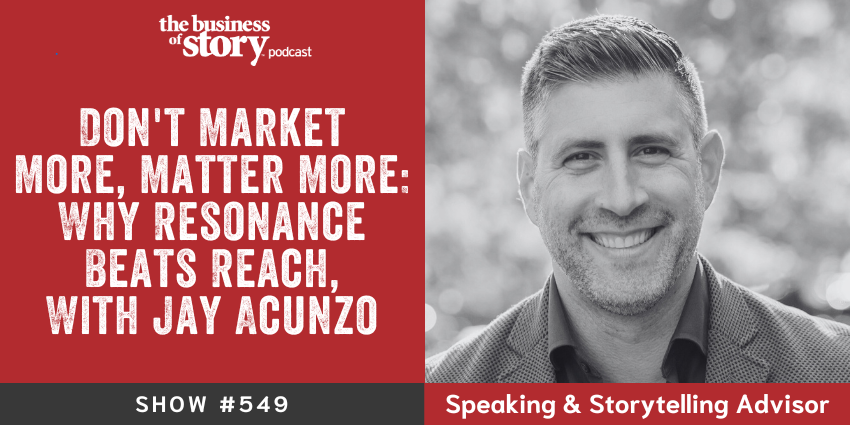
As an author, speaker, and public speaking coach who’s helped everyone from bestselling authors to seven-figure consultants become stronger public voices, Jay’s discovered that the secret isn’t marketing more—it’s mattering more through what he calls “Premise Development.”
The goal isn’t to be the best; it’s to be their favorite.
What’s in it for You: The Premise That Changes How You’re Heard
Jay Acunzo helps entrepreneurs and experts become stronger public voices by developing what he calls a premise—a defensible assertion that becomes your lens for seeing everything in your domain. It’s not a tagline or a mission statement. It’s an insightful reframe on a familiar topic that makes people think differently.
In this episode of Business of Story, you’ll discover:
- Why resonance over reach creates more business impact than volume-based content
- The six-beat narrative argument framework that moves audiences from skepticism to action
- How to use laddered messaging to communicate your premise at different depths
- Why Story 2.0 requires practice and posture, not just process
- The difference between clarity and strength in brand storytelling
Why Reach Without Resonance is Killing Your Influence
Most experts approach content creation like a volume game. More posts, more platforms, more frequency. The assumption is that if enough people see your message, some percentage will connect with it. But Jay challenges this fundamental assumption with a concept from physics.
When two frequencies are aligned, they are considered resonant, and the first can impart energy to the second. In business communication, resonance is the urge to act that someone feels when your message creates alignment with their deepest needs and values.
What good is awareness if you don’t have affinity? What good is reach if you don’t have resonance?
The volume-based approach treats communication like a numbers game. The resonance-based approach treats it like a craft. One asks how many people can I reach? The other asks what could I say that I could merely whisper, and it would connect so deeply that people would seek me out?
Meet Jay Acunzo: From Corporate Marketer to Premise Developer
Jay Acunzo is an author, speaker, and public speaking coach who helps experts become stronger public voices. He’s written books about creativity and storytelling, and he’s traveled the world giving keynotes to marketers and managers, dentists and designers, leaders and landscapers.
His clients include bestselling authors, mainstage TED speakers, startup founders, and seven-figure coaches and consultants. Brands like Salesforce, GoDaddy, Zillow, and Mailchimp have trusted Jay to support some of their most visible projects.
He began his career in sales and marketing at Google and HubSpot, and his own journey as a speaker has been featured in 3 different books.
What Jay discovered firsthand was that people with deep expertise, when done right, learn to package and communicate that expertise to resonate by first turning it into a concept or idea—a premise.
Then they build IP around that premise, creating a platform of influence where everywhere they show up, they’re communicating in a way that grips people and moves them to action.
The Narrative Argument: Six Beats from Skepticism to Action
Jay’s narrative argument framework provides the structure for moving audiences from where they are to where you want them to be. It’s how keynote speakers shift paradigms and how experts build compelling cases for their perspectives.
The six beats are:
Beat 1 – Their Goals: Start with alignment. What does your audience want? Establish immediate agreement on their aspirations.
Beat 2 – Current Approach: Acknowledge what they’re already doing. Show you understand their world.
Beat 3 – Problems with Current Approach: Articulate the pain they’re experiencing. Make the implicit explicit.
Beat 4 – Root Cause: Diagnose the illness, not just the symptoms. What’s really causing these problems?
Beat 5 – Change Needed: Present your premise—the shift in thinking or approach that addresses the root cause.
Beat 6 – How to Implement: Provide frameworks, stories, and practical guidance for making the change.
Throughout this structure, you’re looking for opportunities to show and tell through stories, metaphors, case studies, and examples. The argument provides the logical structure; stories provide the emotional resonance.
Laddered Messaging: Communicating Your Premise at Different Depths
Once you have your long-form narrative argument, you need to message it for contexts where long-form won’t work—product pages, quick interactions, above-the-fold website copy. Jay’s laddered messaging provides three distinct phrases that work in order:
We Want: Meet people where they’re at with a slight reframe. For Jay: Don’t market more, matter more. For StoryCycle Genie: You want a clear, concise, compelling brand story.
We Need: Introduce your premise—the philosophical change. For Jay: Think resonance over reach. For StoryCycle: Clarity doesn’t mean strength—you need a strong story.
We Hope: Articulate the grand outcome. For Jay: Don’t be the best, be their favorite. This is where you paint the transformation.
These three phrases give audiences distinct handholds to climb from superficial understanding to deeper alignment with your thinking.
Story 2.0: Why Process Alone Isn’t Enough Anymore
Jay’s frustrated with what he calls Story 1.0—the body of knowledge focused primarily on story structure and process. Why? Because AI can do that now. Your competitors can learn it. Having a pristine deck about your brand story doesn’t make you a storyteller.
Story 2.0 recognizes three P’s to the craft:
Process: Story structure, frameworks, the mechanics (Story 1.0)
Practice: Regular creation, refinement, iteration. Writing is thinking. You need a practice.
Posture: Seeing yourself as a storyteller. Having the grand delusion that you ARE a storyteller, pulling from daily life for material.
As Ira Glass said: Great stories happen to those who can tell them. You don’t wander the earth waiting for stories to happen to you. You experience life, document what you see, and craft that material into stories. It’s intentional. Piece by tiny piece.
From Clarity to Strength: What Your Brand Story Really Needs
In Jay’s conversation with Park about StoryCycle Genie, he identified a critical insight: everyone’s obsessed with clarity in brand stories. Clarity is important—you want people to understand your message. But clarity alone doesn’t spark action.
You can have a perfectly clear brand story that’s completely beige. Clarity just means I get it. Strength means I feel it, and I’m compelled to act.
This reframe matters because with AI and abundant story structure knowledge, clarity is now table stakes. Everyone can be clear. The question is: does your clear story also have the strength to create resonance? Does it make people feel something? Does it position you as their favorite, not just another option they understand?
Your Next Steps: Building Your Premise
Ready to transform your expertise into influential IP that makes you someone’s favorite?
Listen to the full episode with Jay Acunzo on the Business of Story podcast to hear the complete conversation about premise development, resonance over reach, and the frameworks that turn experts into influential public voices.
Start your premise journey: Pick your focus (the problem you’re solving), then build clarity through a writing practice. Raise your hand through frustration or curiosity. Turn observations into better questions. Iterate publicly, bringing your true believers along for the journey.
Remember: Focus is something you pick. Clarity is something you build. And your premise is what transforms expertise into influence.
Links:
- JayAcunzo.com
- Jay Acunzo on LinkedIn
- Jay on Instagram
- How Stories Happen podcast
- Craft your vibrant brand story with the StoryCycle Genie™
- What users are saying about the StoryCycle Genie™
Related Episodes You’ll Love:
- Presentation and Panel Moderating Secrets From an International Journalist and Speaker – Femi Oke reveals how to captivate audiences through preparation and authentic engagement
- After Upskilling Two million People over 30 Years, Learnit’s CEO Shares the Relatable-Memorable-Emotional Formula That Makes Corporate Learning Actually Stick – Damon Lembi on why story-based learning transforms passive training into active implementation
- Google’s Former Innovation Agitator Shares the Pretotyping Method That Separates Ideas Destined to Succeed From the 80% Destined to Fail – Alberto Savoia on validating your premise before building your product
Jay Acunzo’s Conversation With Park Howell on The Business of Story Podcast: How Premise Development Transforms Expertise Into Influential Public Voice
Park Howell: Hello, Jay. Welcome to the show.
Jay Acunzo: Thanks, Park. I appreciate it. Long time coming.
Park: Yeah, it has. I’ve been following your work for a long, long time and something really caught my attention a few weeks ago when you were talking about your approach to premise. We’ll do a deep dive into that, but putting Anne Handley’s story through it with her new book coming out. I just thought it was very fascinating. I have a lot of admiration for her and her work and of course, what you’ve been up to. So for our listeners who don’t know of you, can you give us a bit of your backstory?
Jay: Yeah, you can understand me with a very simple premise. We tell stories for storytellers. We market to marketers. My premise might just be premise. I’m like Ken from the Barbie movie. My job is just beach. My job is just premise.
My premise is to think resonance over reach. I want to help people who have deep expertise and what you’re searching for in the world is resonance when you show up to communicate.
I work with a lot of entrepreneurs and experts and executives to become stronger public voices. For me, that began by applying it to my own life as a wannabe sports journalist. I always wanted to tell saccharin stories of athletes and write human interest pieces bottled up into the sports world. It’s a microcosm of humanity.
In 2008, I got my first job in sales at Google of all things. Definitely not sports journalism, but it showed me that business is an even larger encapsulation of all of humanity where storytelling is very much needed. I did a tour of duty in tech working in sales at Google, head of content at HubSpot, then a small startup and even a VC firm before I became independent in 2016.
My first foray into independent work wasn’t to sell a service or start a software company. It was as a professional keynote speaker, which people think, well, did you get famous first? No, you can decide to do that the way you decide to build a design agency or a YouTube channel. These are consciously considered processes and crafts and there’s a business to it.
What Is a Premise?
What I saw firsthand was people with deep expertise learning to package and communicate that expertise to resonate by first turning it into some kind of concept or idea, which I call a premise. This show has a premise, a speech has a premise, a business, a platform and a personal brand needs a premise. Then you build IP around that premise.
All of a sudden everywhere that person shows up, they’re communicating in a way that grips you and moves you to take an action, even if that action is in your head or your heart.
As I emerged from road heavy travel based speaking and wanted to start a family and stay at home, I pivoted behind the scenes to doing that work for other people. You run an agency or you sell a product or a service. You’re not looking to be a full-time road warrior speaker, but I do think that if you have substance, if you have expertise, if you have a desire to serve, you can learn to communicate like the voices we admire.
I’m trying to be somewhat of an arms dealer for what I consider to be the good folks in the world, because Lord knows there’s a lot of people out there who have all reach and no resonance, all hype and no substance behind it. That’s why I tell people the goal is not to market more, it’s to matter more. So you can stop chasing attention and become the one that other people seek.
Resonance Over Reach: The Physics of Influence
Park: Well, and that’s a real pivot, isn’t it? Because most people in our world, they’re all about reach. How many followers do I have? How much engagement do I get? How many times am I shared online? They’re looking to really expand that reach. You’ve changed that. Don’t worry so much about the reach. Just make sure those who you are reaching you resonate with.
Jay: Yeah, it’s funny because when you investigate any one concept, you start doing seemingly silly things that really actually end up mattering to your IP. I looked in the sciences and the world outside of marketing for this concept of resonance. I didn’t coin that word. We all know the word resonance.
When I say resonance over reach, some people light up and they sort of implicitly get it, but you really have to make overt what you’re trying to say. When you look in the science you find something pretty important for our work in the business world: when two frequencies are aligned they are considered resonant and the first can impart an energy to the second.
Resonance in our world is the urge to act that someone feels when your message or a moment with you creates this sudden desire to take an action because they feel amplified. It’s the urge to act. We all want action, but we don’t know how to use our words, our messages, our stories to impart the urge to act that people need first.
Whether you’re a craft driven creative or a cold hard capitalist, you should care more about resonance because that’s why people take an action. You can get in front of people and still not spark an action for them. What good is awareness if you don’t have affinity, what good is reach if you don’t have resonance.
Why not start with the thing that triggers a result and then build your way outward from there instead of blasting more content out on the feed and checking more boxes and racing harder on the hamster wheel, shouting into the storm, hoping to be heard. What could you say that you could merely whisper and it connects that deeply that people go, yes, this, I’m going to go with you and I’m going to refer five friends to you because that’s the job, isn’t it? We’re supposed to be communicators. The job is not to get our words in front of people. The job is to ensure that people care.
Real-World Premise Examples
Park: Give us a real-world example of a premise in action.
Jay: There are several famous ones. Maya Angelou: People will forget what you said, people will forget what you did, but people will never forget how you made them feel. She was this walking embodiment of that premise.
My favorite storyteller ever, Anthony Bourdain, said, Your body is not a temple. It’s an amusement park. Enjoy the ride. Uncle Tony had a premise for how he approached food and travel.
Simon Sinek in the business world: People don’t buy what you do. They buy why you do it.
You can define a premise as a defensible assertion. You are here to defend your stance or your perspective. It’s a lens through which you see everything. People might not even hear your premise publicly, although I would argue why in our world you do want them to, but it’s a lens through which you see everything. It’s an assertion you make about a topic others care about.
It’s different than the Simon Sinek find your why thing. That guides you. The premise is definitely meant to be out in the market, helping you have an impact in the market and influence that market. Some people go, so it’s a niche. No, a niche defines the outer bounds of your market. Premise is how you influence that market.
A simple definition: if you think of the fact that your competitive set all talks about the same topics as you, the prompting question is how do you see your topic? Can you quickly articulate and defend that? We think of it as an insightful reframe on a familiar topic.
More recent examples: James Clear, Atomic Habits: You don’t rise to the level of your goals. You fall to the level of your systems.
My friend Michelle Warner, who coaches small businesses: You need to prioritize sequence over strategy because to build a small business, doing things in the right order matters more than doing any of them particularly well.
You might defend against these stances, but these individuals have all the IP, terminology, stories, and framework where they’re going to construct a logical case for why their audience should buy into their premise instead of yet more content that just generically talks about the topic directly. It’s all about taking your perspective, making it memorable and repeatable, and then creating a platform of influence around that premise.
Do You Need the Premise First?
Park: Do you have to have that premise down first before you create the resonance?
Jay: I love this question. When I run a training for a team or cohort, there are some people who really get stuck with that first question of it’s not it yet. I don’t have the idea. I’m not saying it as crisply as those examples you gave me.
What you learn as an author and a speaker is that you first raise your hand, whether you’re like me and you’re a spicy Sicilian with frustration when you observe conventional wisdom, or maybe you’re more calm and analytical. Either way, you turn the frustration or your observations into better questions. It always starts from a place of curiosity.
I’ll give you an example from my life. When I first started becoming a speaker, I really could not stand average content that everybody seems so intent on churning out. I was always more interested in the art anyway. Initially I would just raise my hand and say, is anyone else feeling this pain? I hate this. Do you see what I see?
Then I go investigating by creating a writing practice where once a week I’ll write about that topic, just for me, just to understand it, maybe to send up a flare into the sky that other people see and maybe come my way if they’re already aligned.
It starts by being this investigator asking bigger, bolder questions or even the obvious question that others might ask. It sends you on this investigative journey to understand why do I feel not great about the status quo? What am I really trying to say? You use your public content, not just as distribution, but as a way to think because writing is thinking, but also a way to bring with you your biggest supporters and true believers.
When you see somebody at scale with passionate responses, I don’t think it’s because they worked out a perfect idea and now suddenly they’re sharing it. A lot of those people have been with them on the journey all along. The book or the speech or the pithy turn of phrase is the culmination of an investigative journey.
A lot of people go, well, that means I can’t publish content, I can’t create any kind of resonance in the world, I can’t tell stories till I find my premise. No, at first it’s for you. It’s you trying to understand through frustration and curiosity what you’re trying to say. Then you make an attempt to say it.
My follow-up to why average content was best practices are bad. Best practices are the problem. Then you investigate that for a while. Then I realized, well, actually it’s not so much best practices. It’s why we find safety and comfort and confidence in somebody’s best practice. It’s because we live in this tyranny of the right answer.
In school, your worth is you have the answer. Now you operate in a business setting where there is no one right answer. Have you adapted how you approach the work? Don’t be an expert, be an investigator. That’s a premise. Both have merit. Being an expert matters. Expertise is foundational. Being an investigator, I’m here to say to solve this problem.
My first flurry of public content as an independent was addressing this. My first book, my first speech back in 2018, what I was saying to the world is I like expertise, expertise matters a ton, but let’s get our priorities straight. The premise is kind of this good versus good comparison. Goals are good. Systems are good. Resonance is good. Reach is good. How do you see these things? Put them in order for people or tell them which one matters in this moment or for that problem.
Long way of saying, these things are iterative. But in the iteration, you actually pick up some really passionate fans, so long as you can remain focused on the questions and focused on the problem you’re trying to solve. I like to say that focus is something you pick. You decide I’m going to focus on serving them and solving this problem. Clarity is something you build. When people go, I guess I can’t resonate for years or for a few months, I’m like, no, pick a focus, but you don’t have any clarity around what you’re saying around that focus. Now we got to go write and speak. Now we got to go build that clarity and I can provide frameworks and templates to make it easier.
The Narrative Argument Framework
Park: Can you use this approach to creating that signal in the noise, this premise—I also kind of think of it as positioning in the marketplace, but how you speak to that position is this premising. You use it to help speakers and experts find their voice to go out and be in the public, write a book, do this sort of thing. Can you also use it on a product? Where I’m going with this is our StoryCycle Genie, because I have now written a lot of different ways to talk about this thing and I go, well, what is the singular clear premise for our genie?
Jay: Yes, I love that. What we’re talking about fundamentally is you start by refining your ideas. You’re trying to get to the core of what you’d like to say to the world, but to do that, you have to get it out of you and onto the page. It’s messy to start and then you put good form and function and framework to it.
You have a lot out in the world, hopefully onto the page, then you try to construct that narrative argument. This is what I’m trying to say to the world. I might not actually say these exact things in that order. It might just inform what I’m doing or lead to good brainstormed content, but you start long form and then you need to message that in the places where long form isn’t going to fly like a product sales page or your website above the fold copy or a quick little interaction you have in the hallway.
The short answer is yes, this can apply to a product. You want to come up with three distinct phrases in order that sort of summarize your message. It takes the long form copy, makes it more palatable, not only for you to remember it as you bring it with you, but also for others to grab distinct handholds as they climb down from a superficial understanding with you to something deeper or superficial level of trust and relationship to something deeper.
I call this a laddered message. You want to find three phrases that you can either brand or just say a lot and own where it starts with we want and it goes to we need and it goes to our hope.
Laddered Messaging: We Want, We Need, We Hope
For me, I’m not going to say to the world immediately resonance over reach. I’m going to get a lot of questions and pushback. At first I’ll say don’t market more, matter more. That’s the tip of the spear. That’s the above the fold copy. That’s on the sales page. I’m going to make the claim that right now what you’re doing is a volume based approach to content, to speaking, to selling. Don’t market more, matter more. I have to use that phrase or other ideas like it to meet people where they’re at.
Then I move down to we need and I have a philosophical change, my premise. Think of it like this: if you want to matter more as we just agreed you do, then necessarily, logically, you need to think resonance over reach. Some people think what you need is X. I think what you need is Y. That’s the Y in my equation. That’s the premise informing everything I do. I can unpack that for you.
And by the way, our hope, this grand outcome, the best case outcome of embracing this premise is all of your work lands you in a really great place. You’re not trying to be the biggest, you’re not trying to be the best, the noisiest. Don’t be the best. Be their favorite.
Three distinct phrases worked in my case over months of time to find, but giving you a logical three rung ladder to construct your message. We want, we need, we hope. If you’re selling a product, in the we need section is where you start to introduce the specifics of what you’re selling, using website copy, testimonials, visual framework to map it, all these things that we do anyway, just structured and planted in the right order and maybe punched up a little bit.
Applying Premise to StoryCycle Genie
Park: I’m thinking through that with the StoryCycle Genie. A line we’ve used a lot is we’re turning the overwhelming prospect of brand development into an overjoyed experience.
Jay: Is that what they want? Or are they trying to say you want to evolve from a generic expert to a storyteller? What’s the obvious easy first moment of agreement?
A good example is my daughter the other day asked me why we have aquariums. I said, okay, so you know how we want to protect animals and the ocean. She’s like, yeah. It’s not a groundbreaking idea. It’s just they can already agree this is what you want. She already understands it. I don’t have to belabor it. I might reframe it slightly for her, or in my case, don’t market more, matter more. That’s a slight reframe, but given a quick second of introspection, anybody who is marketing would say they want it to matter more. That’s an easy first moment of agreement.
Park: In this case, it would be you want a clear, concise and compelling brand story.
Jay: There you go. Now, what do you think or what do you assert? Because remember, a premise is a defensible assertion. What do you assert about getting that, that others might debate you on?
Park: That you can now with AI do it very quickly following proven IP, so now you can turn that overwhelming brand development prospect that usually takes months, literally into minutes.
Jay: Okay. If I were to come along and say, I am an AI super fan or expert in the marketing space, I completely get this technology or even a casual observer, are they likely to disagree with that assessment of yours?
Park: Their biggest disagreement would be it’s just gonna be more AI slop.
Jay: Okay. So that’s what we’ve got to circle around. We got to figure out what is it about doing it with AI that you see? To me, that’s just the macro promise of AI—efficiency in many cases or seeing what you can’t because there’s too much data or too much text. I think what we’re trying to get to is what is something that the typical AI interested person or expert level person would go, I never thought of it that way.
Clarity vs. Strength in Brand Stories
Park: What I like to say: EI, emotional intelligence plus AI equals ROI, your return on intelligence. Take that a little bit deeper. This isn’t just general AI doing its thing. This is AI powering our intellectual property, the Story Cycle system that I’ve used for over 20 years, building brands by as much as 600 percent. I’ve taken that analog proven process and we built this AI that is infused with it. This is not your gen AI bot running around out there. This is a tool that knows our system, but then knows your brand. The more you iterate with it, it gets smarter and smarter.
Jay: If I scroll below the fold on StoryCycle Genie’s page, the immediate value delivered tests the strength of your current brand story for free. I’m wondering about the word strength. I’m wondering if there’s an assertion you can make where you play off the conventional wisdom that having a brand story is the goal. Nope. It’s having a strong brand story.
Or an alternative might be, you think that the whole point of a brand story is you have a clear message. The story itself represents the message you’re telling and it’s all about clarity. What you’re saying is actually thanks to story structure, consultants, content, giving advice, and even AI with all the things you can load it up with, clarity is now table stakes. What you need is a stronger story. Here’s what we mean by strong. Here’s the strength element and you can now use our tool to give you the table stakes stuff clarity, but more to the point how strong it is.
I’m seeing this copy. I’m looking for how does Park see this space in a way that makes me go, I hadn’t thought of it that way. It’s not just a line. There’s clearly a lot already here that I can find and pull out and just kind of massage or punch up. You’re already saying it and we’re just trying to articulate it, which is always the hard part.
Park: And you get so close to it, it’s hard to do it on your own. That’s one of the beauties of the genie—it’s like that outside consultant looking in and it validates what you do well, it reveals the gaps, it even inspires you with new ways of thinking about it. But it’s so hard to do it on your own.
Jay: I’m looking for that. You want a clear brand story or the success of your business depends on the clarity of your story. Nice little musical line there. The clarity of your story is what you’re anchoring to now. That’s now the conventional wisdom. I go and attack.
I have to think to myself, why do I dislike the fact that people think clarity is somehow good? Now, stepping out of this exercise, I do believe that clarity matters. I’m not trying to attack it. I’m on the side of clarity, but everyone out there, everyone I hear from, all my buyers, all my coffee meetings, everyone’s always using the word clarity for what I provide when I sell services. Now I’m going to go build this AI product. There’s something that’s always sat poorly with me around clarity. What is it?
You might go, aha, I know. It’s the fact that clarity is not open to interpretation. You understand it. But as Ishiguro said, stories are like one person saying to another, this is how it feels to me. Do you understand what I’m saying? In other words, clarity. Does it also feel this way to you? Alignment, resonance, emotion. That’s the part people miss in their obsession with clarity—they get these very clear, but sterile stories out there. Who cares about that? Everybody could be clear. But also just helps me know you’re clearly beige. Who cares?
I’m like, I’m going to go chip away. I might have it in my head or I might go, I don’t know if that’s it. I gotta go write my way to clarity. I gotta go find what I’m trying to say, not by navel gazing, but by creating content, talking to buyers, getting out in the market and taking stabs at it.
Story 2.0: Process, Practice, and Posture
A while ago, I made this claim that Story 1.0 was this body of knowledge based on story structure and process, and it got us here. Why am I so annoyed with it now? Because AI can do that and your competitors can do that. I’ve encountered many people that are well versed in story structure that I didn’t know existed, but they are expert in it. And I’m a better storyteller. Why? I practice more. I have the posture and the grand delusion that I am a storyteller.
Okay, so there’s process, Story 1.0. Then there’s practice and posture. There’s three P’s to the craft, not just one. Story 1.0 over indexed on the first P. Story 2.0 will necessarily bring to light this idea that you have to have a practice and you have to bring the posture, the way you see yourself in the world and pulling from your daily life and showing up with the reps repeatedly, not just the pristine deck.
For a while I was just like, yeah, there’s all this storytelling knowledge out there. I dislike it. Or it’s insufficient. Then I was like, okay, now there’s a Story 2.0 body of knowledge. I don’t know what that is. I’ll write my way to clarity and then seven or eight essays in, I come up with the three P’s. Now is that a thing or not? I don’t know. I have to go validate it, but this is the work of a public voice where all along the way I picked up fans and clients by writing about that because they liked how I thought when they invested more time. But to make it shorter, pithier, repeatable, I need to continue to validate it, continue to refine it, find the turn of phrase.
I’d send you off on that journey, Park, of continuing to dig, dig, dig and refine it so that you can then design the IP around it.
Clarity Doesn’t Mean Strength
Park: The idea there is that the common wisdom, conventional wisdom is yes, everyone wants a clear brand story, but if your story clearly sucks, then that’s no good.
Jay: Yes. Clarity doesn’t mean strength. Clarity doesn’t mean efficacy. Clarity is just, I get it. I understand. Is that enough to spark an action? Probably not.
Park: You need strength through alignment, strength through resonance. And then therefore, here’s how you get there.
Anne Handley’s Premise Punch-Up
Park: This has been fascinating, Jay. I was reading your Friday newsletter where you went through this with Anne Handley’s new book, ASAP as slow as possible. Can you walk us through your thought process in how you created the various premises and which one you felt was the best?
Jay: Anne and I text very few people about work things. She shares a lot of pain she’s going through or cool projects she wants to build. One of the things that I’ve grown very appreciative of is she’s very willing to get it right instead of try to be right. That’s a mistake a lot of us make. I have it. Here it is. And now my idea is a proxy for my self worth.
But the folks that I admire, including comedians or musicians, people who have these exceptional ideas out in the world, they put it in front of people they trust. They’re like, what do you make of that? It’s on the board in front of us. We’re shoulder to shoulder facing it. It’s not a proxy for me and my self worth.
Anne doesn’t need to do this at her stature anymore, but she’s always workshopping ideas to improve them. I’d done this with a friend of ours before in my newsletter, Joe Pulizzi. I said, I punched up Joe’s premise in public for his new book. I know you have one coming out and I’m happy to do the same. She jumped all over it.
What I asked her to send me was how do you currently articulate this defensible assertion you’re making about speed and its impact on our success, but also more broadly on our lives.
The description she sent me: In a world obsessed with speed, choosing to slow down is a joyful rebellion. Slowing down isn’t falling behind. It’s how you choose to get ahead. We’ve been told to move faster, hustle harder, optimize everything. But what if that’s the wrong goal? ASAP as slow as possible is a joyful rebellion against the cult of urgency.
What I notice here is there’s a line that approximates the pattern break. Great premises create a before and after effect. If I encounter you or your ideas, I will never see that topic the same way again. That’s why I fall in love with premise—I’m in love with speaking and good speeches do the same thing. They break patterns.
Here’s the line: Slowing down isn’t falling behind. It’s how you choose to get ahead. She’s taken this idea of slowing down and she is reframing it. Some people might say you should slow down and be okay with falling behind. Or some people might say run your own race. There’s other versions of this in the market and this feels sharp and it feels like there’s a before and after.
What I’m thinking about is slower is better is not the premise because that’s not what Anne is saying. She’s bringing nuance. How do you articulate nuance quickly without losing it?
One of the first ones was the fastest way to get ahead is to slow down when it matters most, which creates a little pop of paradox there. You’re like, tell me more. It’s sort of a riff on slow is smooth and smooth is fast.
I go back and forth with Anne and she’s like, yeah, but I’m not just speaking to people’s work lives. I’m not so sure about that. So you keep playing with the phrase. I’ll skip some of the messiness.
The one I landed on that I like most: In a world obsessed with speed, your competitive edge is knowing when to slow down. I don’t know if that’s exactly what Anne is going for, but I’m looking for how do I make sure that sticks and stays. How do I make sure that it equips Anne or people encountering Anne to go, I get it. And it’s not void of nuance.
That’s the last thing we want is to say it’s all about this. I have the panacea. What Anne is saying here is we are obsessed with speed out in the world. It’s important that we know when to slow down, not just that we slow down. Then this book is going to be ringing the bell for that truth and probably giving you framework for making those choices, which is exactly what you want if you’re an author or speaker—something powerful and pithy and memorable, but not either obvious that anyone else would say or lacking in nuance that people can just easily swat away.
Where to Learn More About Jay Acunzo
Park: This has been fascinating, Jay. Thank you so much. Where can people learn more about you and what you’re doing? And by the way, sign up for your newsletter. It’s really great.
Jay: Thank you so much. I’m refactoring my podcast, How Stories Happen. It’ll continue to have the guests that people grow accustomed to, but emphasis on the workshopping part. As many fancy people as I can get to be vulnerable and actually take us into a draft. Anne’s come on a couple of times with a draft of her newsletter pre-publish and we’ve workshopped that idea, or workshopping an opener of a speech.
I want to put the process on display, not because I want you to copy the process, but by doing that, the listener goes, I see how they’re workshopping it back and forth. They’re practicing here. It’s about the practice and now I need a practice. They have this posture of seeing it like a comedian sees their work or an actor, not a marketer.
That show is called How Stories Happen. We’re going to go inside even more than we have in the first two years. What does it take to actually develop a message, a speech, a story to resonate?
Park: When are you going to kick that off? 2026?
Jay: 2026, we’re taking a break. We just wrapped up with the great Scott Stratton. Probably mid Q1, early Q2, the show will be back with full force episodes and this renewed focus.
Park: Awesome. Well, Jay, thank you very much and I hope you have a fantastic holiday season coming up. Have a good one.
Jay: You too. Thanks, Park.
Frequently Asked Questions: Jay Acunzo on Premise and Resonance
1. What is a premise in business communication?
A premise is a defensible assertion—a lens through which you see everything in your domain. It’s an insightful reframe on a familiar topic that helps you influence your market rather than just participate in it. Unlike a niche (which defines the outer bounds of your market), a premise defines how you influence that market. Examples include Jay’s “think resonance over reach,” James Clear’s “you don’t rise to the level of your goals, you fall to the level of your systems,” and Simon Sinek’s “people don’t buy what you do, they buy why you do it.”
2. What does “resonance over reach” mean?
Resonance over reach means prioritizing deep connection with your audience over broad distribution. In physics, when two frequencies are aligned, they are considered resonant, and the first can impart energy to the second. In business communication, resonance is the urge to act that someone feels when your message creates alignment with their needs and values. What good is awareness if you don’t have affinity? What good is reach if you don’t have resonance? The goal is to create such deep connection that you become someone’s favorite, not just the biggest or best option.
3. What is the narrative argument framework?
The narrative argument is a structured approach to moving audiences from where they are to where you want them to be. It follows six beats: (1) What are their goals? (2) What’s their current approach? (3) What are the problems with that approach? (4) What root cause or illness do you see? (5) What change do they need? (6) How do they implement it? This framework helps experts package their knowledge into compelling arguments that get audiences to buy into their perspective, with opportunities for stories throughout.
4. What is laddered messaging?
Laddered messaging is a three-phrase structure that summarizes your message at different depths: (1) We Want – the tip of the spear that meets people where they’re at (e.g., “don’t market more, matter more”), (2) We Need – your philosophical change or premise (e.g., “think resonance over reach”), and (3) We Hope – the grand outcome or best-case result (e.g., “don’t be the best, be their favorite”). This creates distinct handholds for audiences to climb from superficial understanding to something deeper.
5. What is Story 2.0?
Story 2.0 recognizes that storytelling excellence requires three P’s, not just one: Process (story structure and frameworks – Story 1.0), Practice (regular creation and refinement), and Posture (seeing yourself as a storyteller and pulling from daily life). Jay argues that Story 1.0 over-indexed on process, which AI and competitors can now replicate. Story 2.0 brings practice and posture to light, emphasizing that great stories happen to those who can tell them—it’s a craft you develop through intentional work.
6. How do you develop a premise?
Premise development is iterative, not instantaneous. Start by raising your hand through frustration or curiosity about your domain. Turn those observations into better questions. Create a writing practice to investigate your thinking (once a week, just for you). Make attempts to articulate your stance. Refine through public content and feedback. The pithy one-liners come later—first you need the “two drink minimum version” where you can’t hold back the raw thinking. Focus is something you pick (the problem you’re solving), but clarity is something you build through iteration.
7. What’s the difference between clarity and strength in brand stories?
Clarity means your audience understands your message—they get it. But clarity alone doesn’t create action. Strength means your story creates resonance, emotional connection, and the urge to act. As Jay points out, you can have a perfectly clear brand story that’s completely beige and ineffective. Everyone can be clear now, especially with AI. The question is: does your clear story also have the strength to make people feel something and take action? Clarity is table stakes; strength is what wins.
8. How does premise relate to IP development?
A premise serves as your operating system for IP development. Once you have a defensible assertion about your topic, you can press every question, framework, and piece of content through that lens. It becomes your heads-up display (like Iron Man’s suit) that helps you see applications everywhere. This leads to consistent terminology, frameworks, stories, and logical arguments that construct a platform of influence around your premise. You’re not just sharing expertise—you’re using expertise to arrive at proprietary IP.
9. What’s the relationship between premise and keynote speaking?
Keynote speakers are fundamentally trying to shift audience paradigms and challenge perspectives. A strong premise provides the narrative argument structure needed to move audiences from conventional wisdom to new thinking. The best keynotes don’t just sound pithy or offer generic “be good” advice—they start from alignment with the audience, then logically argue for a specific change rooted in what the audience already cares about. The premise is the core assertion you’re defending throughout the speech.
10. How can you apply premise thinking to products like StoryCycle Genie?
Start by refining your core ideas through long-form exploration, then construct a narrative argument for what you’re trying to say. Finally, message it using laddered structure for contexts where long-form won’t work (product pages, quick interactions). For StoryCycle Genie, the “We Want” might be “you want a clear brand story,” the “We Need” (premise) could challenge that “clarity doesn’t mean strength—you need a strong story,” and “We Hope” articulates the transformation. The key is making an assertion others might debate, not just stating obvious benefits.
 Listen To More Episodes