Stop Explaining Your Brand and Start Sending Your Audience on a Quest
Why the best brand stories hold back, and what a legendary BBC drama producer teaches business leaders about it
You know story is your superpower, and you have felt it hold a room. But the moment you start explaining your business, the story disappears under slides, jargon and over-explaining, and the audience tunes out. Therefore the fix is not more information. It is a simpler shape: a quest with a hero your audience loves, an enemy worth defeating, a clear goal and a change along the way.
That is the lesson in this encore conversation from the first year of the Business of Story, with one of the world’s leading experts in narrative. The insights have only grown more relevant.
Meet John Yorke: The Narrative Expert Behind EastEnders, Shameless and Wolf Hall
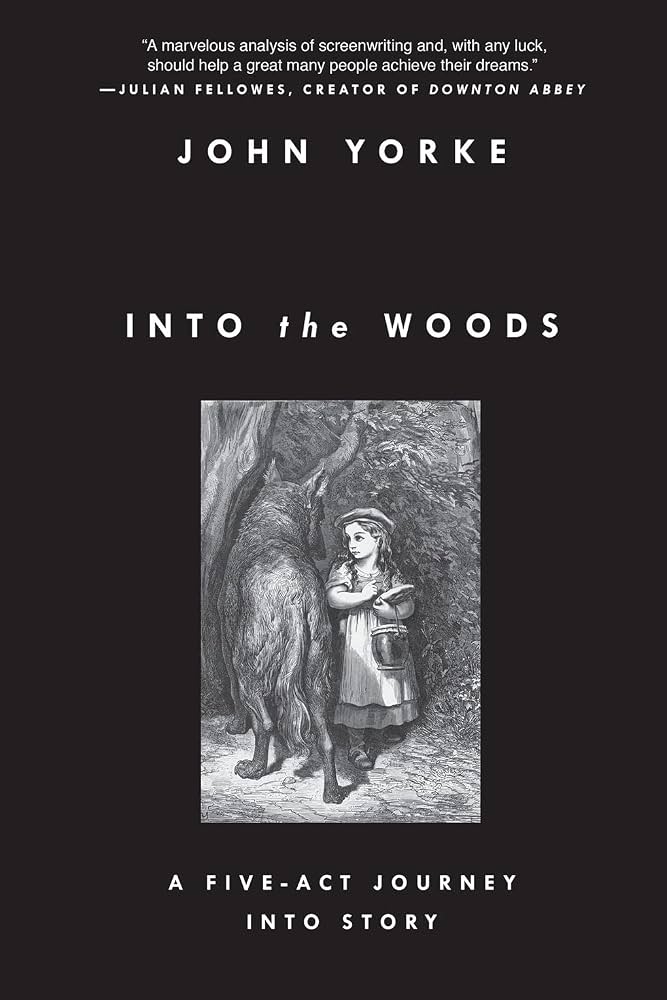
John Yorke’s Into the Woods has sold more than 250,000 copies worldwide.
John Yorke has spent years analyzing not just how stories work but why they resonate with audiences around the globe.
His book, Into the Woods: How Stories Work and Why We Tell Them, has sold more than 250,000 copies.
He is the founder of the BBC Studios Writers Academy. He produced EastEnders, the long-running BBC soap; Shameless, a comic family drama; and Wolf Hall, the Golden Globe-winning Tudor epic. His work has won BAFTAs and a Golden Globe. He also hosts the BBC Radio 4 series Opening Lines.
What’s in It for You:
- Why over-explaining kills your message, and how to let your audience add two plus two themselves
- Why empathy for your hero comes before everything else
- How a clear enemy and a clear goal pull people along
- Why change keeps an audience from tuning out
- How thesis, antithesis and synthesis explain why story structure works
Watch or Listen:
Why Over-Explaining Is the Biggest Storytelling Mistake in Business
John’s biggest bugbear is exposition, the need to explain where no explanation is needed. Story works far more powerfully when the audience infers the message. Give the audience two plus two, he says, and they will add it together themselves. That way they are actively involved and much closer to the material.
The second mistake is overcomplication. The most powerful stories, he notes, have a very clear good guy, a very clear bad guy, a very clear goal and a very clear prize at the end. Once you lose an audience, you never get them back.
Why Empathy for Your Hero Comes First
“If you don’t love your protagonist, nothing else is gonna work.” John points to two films that were expected to do well and didn’t: there was nothing in them to love. The same holds in business. People come on the journey only if they believe in the person giving the message.
How to Build a Brand Story Around a Quest
All stories are a quest, John says. Ask what the character wants. What is the problem, and what goal will solve it? Business works the same way. A company that wants to be the biggest in its field needs a strategy, and a strategy inevitably involves change.
John uses Ronald Reagan’s 1964 speech supporting Barry Goldwater as an example. Reagan made listeners feel they were on his side, largely by how he described the enemy, so that whatever your politics, you thought the enemy was worth defeating. In business, the Darth Vader can be sloth, inefficient working practices or whatever stands between your audience and the goal.
Why Change Keeps Your Audience Listening
John realized he was bored reading weak scripts because nothing changed. The moment information repeats, people zone out. Brands have to change too. Kodak and Xerox show what happens when they don’t, though values stay strong when they are reinforced by incremental change.
He also explains why structure works: three-act structure mirrors how we learn. We exist, meet something strange, assimilate it and change. That is thesis, antithesis, synthesis.
How to Keep Your Audience Asking What Happens Next
John quotes playwright Tom Stoppard: the essential art of the playwright is the ordering of the flow of information. Release it so people want to know what happens next. His practical tip for presentations is to put pictures on slides instead of the words you are saying. The audience has something to think about, and the great speaker tells people in such a way that they get there themselves.
Learn More About John Yorke and the Topic
- John Yorke’s website, including his online storytelling for business course
- StoryCycle Genie®
- Business of Story storytelling tools
- Park’s storytelling resource library
Related Business of Story Episodes
- The Five Essential Elements (the H.E.A.R.T.) of the Perfect Pitch With Ben Wiener: A framework for building a pitch that connects.
- The Objection Was Never the Problem. You Were Asking the Wrong Questions.: Tara Shuler shows how speaking in questions lets people reach their own conclusions.
- How to Tell Your Startup Lifecycle Story to Sell Investors & Customers on Your Brand With Gregory Shepard: How to tell your startup’s story across its lifecycle.
John Yorke’s Conversation With Park Howell on The Business of Story Podcast
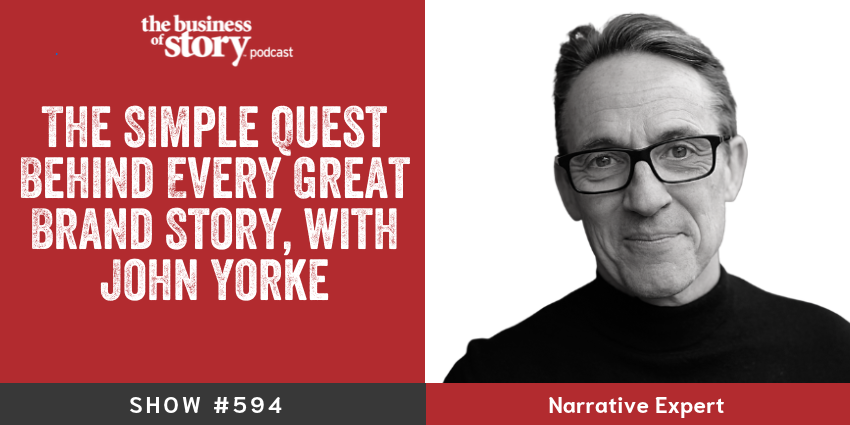
The Simple Quest Behind Every Great Brand Story, with John Yorke
Park Howell: Hello everyone, and welcome to another edition of Business of Story. I’m Park Howell, and my job here is to connect you with the top storytelling minds in business who share tips and techniques to drive growth for your professional services firm through, you guessed it, the power of story.
My goal here, whether through this podcast or working with you one-on-one, is to reignite your one true superpower, storytelling, so you can nudge the world in any direction you choose. You can learn more at businessofstory.com.
On today’s show, we have an amazing story artist from London, John Yorke. John is a drama producer, author and teacher who has spent 30 years studying our insatiable appetite for stories. He is the founder of the BBC’s Writers Academy, and a current TV show he is working on, Wolf Hall, has won a 2016 Golden Globe.
His long career in TV drama has given him the tools to identify the underlying shape common to all successful narratives, from drama to corporate reports to business-to-business marketing.
I first read John’s book on story structure, Into the Woods, about a year ago. It is one of the best resources I’ve found that combines theatrical story structure and storytelling with how we can all use it in our personal and professional lives, in our quests to gain things out there.
Today, John discusses why stories work on us, thanks to our mirror neurons, and how you, as a business communicator, can be more effective with your stories. We’ll look at what happens when you realize that all business stories are quests, and how that knowledge will shape your marketing. And at the end, the big mistakes we all make as business storytellers, and how we can quickly overcome them to craft and tell compelling stories that sell.
So let’s begin this episode of Business of Story with our friend John Yorke.
How John Yorke Got His Start in Storytelling: From BBC Radio to Television Drama
Park: John, welcome to the Business of Story.
John Yorke: Hello there. Thank you for having me.
Park: It’s wonderful to have you here. I read your book Into the Woods about this time last year, and when I heard we were fortunate enough to have you on the show, I went back through it again this week. It’s a wonderful book.
Before we get to that, you’ve got 30 years in the storytelling business. I guess I’m your contemporary. I’ve got 30 years in the storytelling business too, but in advertising and marketing. Yours is in entertainment. How did you get your start, and how did you get to where you are today?
John: Gosh, now there’s a question. I was always fascinated by narrative, from very early years. I had a father who was obsessed with making me read religiously, so storytelling was just part of my growing up.
I wanted to work in television from an early age, but I couldn’t get a job. The nice thing in England was that there were a lot of jobs going in radio at that time, so I got into radio.
I worked on a wonderful speech network, BBC Radio 4. After a while I realized that everything they did, whether history, news or current affairs, was storytelling. I worked initially as a sound engineer, but I was exposed to storytelling all the time. I started to think there’s a real art to this, and I wanted to know more about it. That’s how I got into it.
Park: Radio. I got my start in radio as well. When I first moved to Phoenix in 1985, I worked for an agency that did massive amounts of radio commercials. I wrote and produced them, and I loved it. It’s still my favorite medium, because you have the theater of the mind. You can paint pictures, or get your audience to paint pictures.
John: Yes. They always say the pictures are better, don’t they?
Park: Then you moved on to the BBC and have been there quite some time. You even have a writers academy there.
John: That’s right. I moved into television in the early nineties, initially in soap opera, which I always likened to working in an ER. Injured script after injured script comes in, and you have to fix it. You put the paddles on and bring it to life really quickly. If you can master that, you start to realize what the tricks of the trade are.
Over the years I worked my way up and found myself in what we’d call over here the more art house side of things. I moved from very popular storytelling to quite arthouse work, and I ended up running drama at Channel 4, which is our big alternative channel. I was working with some of the great British writers, in an amazing place to watch, learn and ask hundreds of quite annoying questions.
Wolf Hall and Why a Great Script Needs Almost No Notes
Park: Quite annoying questions to fix injured scripts. I love that. Did I read on your website correctly that you or your team recently won a Golden Globe for Wolf Hall?
John: That’s right. It’s been lovely. Wolf Hall was a rather extraordinary show to work on. The writer, Peter Straughan, who adapted Tinker Tailor Soldier Spy as well, is an extraordinary craftsman.
I can proudly say that my main contribution, apart from being managing director of the firm that made it, was to give almost no notes whatsoever. The script was beautiful. When you get a great script and the storytelling is perfect, the worst thing you can do is fiddle around with it. So I’m quite proud that I made almost no contribution.
The Biggest Storytelling Mistakes in Business: Over-Explaining and Lack of Empathy
Park: In fixing those injured scripts, what are the one, two or three mistakes writers make, not only in theatrical storytelling but in business storytelling?
John: I have two big bugbears. The big one is exposition: over-explanation, and the need to explain where there’s no need to explain at all. Storytelling works much more powerfully when the message is inferred. It’s the audience doing the work. It’s that old adage: give the audience two plus two and they will add it together themselves. That way they’re actively involved and much closer to the material.
The other, which I think is equally important in business and in fiction, is empathy. You have to love your protagonists. If you don’t love your protagonist, nothing else is going to work. So it’s all about how you get empathy, and you can get it in all kinds of surprising ways.
How Do You Build Empathy in Business Storytelling?
Park: How do you go about that? How do you find empathy?
John: There’s a writer over here called Russell T Davies, who for years wrote a show called Doctor Who. He argues that the worst way to find empathy is to think about it. I think there’s some logic to that. Empathy is born out of love. If you are absolutely in love with what you’re writing, that normally translates.
In fictional terms, if you don’t love your characters, nobody else will. But if you do, and you have the craft skills necessary, everything clicks into shape.
It’s really interesting looking at fiction this year. Two films that everyone predicted would do well at the Oscars, Black Mass, about Whitey Bulger in Boston, and the movie about Lance Armstrong, both died. The reason is obvious. In the end, there was nothing there to love. It’s the same in business. Love is a complex word, but you need to love the person giving the message.
Why Every Business Story Needs a Hero, an Enemy and a Journey
Park: How does that translate in business? We often tell our clients and listeners to have empathy for your audience and place them at the center of the story. How do you coach that?
John: When I talk to business people, the absolute first rule is: who are you talking to, and what are you trying to get across? But I also remind them that people will only come on the journey if they believe in you. So it’s how you present your message.
There’s a speech I use that always seems to work brilliantly, and bizarrely it’s by Ronald Reagan. It’s technically not business, but he’s selling a very early version of neoliberalism. It’s a speech he made in 1964 supporting Barry Goldwater. The campaign was a disaster for Goldwater, but Reagan came out of it with the seeds of a future president.
Whether you agree with him or not, he did two things. He made you feel like you were on his side, that we were all in this together. He did this largely by the way he built up the enemy. He described the antagonist, the thing we had to defeat, in such a way that, whatever your politics, you went, “You’re right. I will come on this journey, because that is worth defeating.”
Part of the skill is allowing the audience to identify with you, and then taking them on the journey to defeat the enemy who, like Darth Vader, we’ve got to stop at all costs. In business, Darth Vader becomes working practices, or sloth, or inefficiency, anything you like. But those principles are fundamental in fiction and in business. You identify with a hero and you go on a journey to defeat the bad guy.
Why Does Story Structure Exist? The Idea Behind Into the Woods
Park: Tell us about your book. How would you describe Into the Woods, and what was your motive for writing it?
John: I’d read quite a few screenwriting books and struggled with them a bit, although I realized there was some sensible stuff in Robert McKee, Syd Field and Christopher Vogler. I learned quite a lot from them.
After a while I got frustrated, because there was no rigorously academic approach. The one thing I’d been taught as a student was that you have to prove what you say. You have to back it up with evidence. What I found in all of those books was that there was no “why.” There was plenty of “there has to be an inciting incident on page 22,” but not one of them could explain why an inciting incident exists.
I couldn’t find anything that told me why structure existed and why it was the shape it was. So I thought I’d like to find out myself. That’s how it began.
Why Do Stories Work on Us? Mirror Neurons and Shared Experience
Park: With that question of why, let me ask you: why do stories work?
John: That’s a fair question.
Park: Big question, I know.
John: Stories seem to me as important to us as breathing. They allow us to share experience. They forge a common bond with the person you’re addressing. You join an experience together, and you understand how the world is seen from outside yourself.
There’s interesting work being done at the moment on mirror neurons. When you identify with a protagonist, your brainwave patterns start to reflect theirs. That seems really fascinating to me. You step outside yourself and see the world from somebody else’s shoes. That’s what stories are fundamentally designed to do.
The trick is to do them well. For all its skill, Black Mass doesn’t work as a story, because there are no neurons firing. You don’t care, in the end, and you have to care. So you go back to what makes a story work, and what makes it work is empathy.
A Mirror Neuron Story: Fish and Chips at Heathrow
Park: It’s funny you say that. As you were talking, I was listening to your voice and your accent, and I have to tell you a story about my wife, Michelle, and me. We were at Heathrow on our way to Amsterdam for some work I was doing with Arizona State University, and we had about a six-hour layover.
I got some fish and chips and a pint or two or three. We had a wonderful waiter with us pretty much the whole time. Halfway through, I started taking on a British accent. My wife said, “What are you doing? Are you making fun of him?” I said, “No, what are you talking about?” She said, “You’re talking in a British accent.”
I don’t know if it was the pints or my mirror neurons kicking in. I just cracked up. Those mirror neurons are really powerful.
John: It’s a desire to fit in, isn’t it? It’s a very understandable one, and a very powerful instinct.
Park: I was embarrassed for myself, and then I laughed. She thought I was making fun of him, and I didn’t even hear it coming out.
How to Simplify Story Structure for Business: All Stories Are Quests
Park: I enjoyed your book so much. I’ve read McKee. I was fortunate to have Robert McKee on the show in 2015, and I’ve been through his four-day story seminar and his business seminar. I even sat in his living room in Connecticut and recorded a podcast with him a few years ago. I’ve also read Save the Cat and Christopher Vogler’s work.
What I found different about yours is how you take the three-act story and expand it, showing how the five-act story comes into play. I have a hard enough time boiling down and simplifying the three-act approach for business. Do you have any secrets for people who aren’t in TV, theater and radio day in and day out, but have to be communicators and leaders? How can they use story in a very simple way to have an impact?
John: It’s a very good question. What I normally boil it down to is that all stories are a quest. All stories are a journey. So you always come back to: what does a character want? What’s the problem, and what’s the goal that will solve the problem? That works as well in business as it does in drama.
When new writers write scripts, the note I write on the top almost all the time is “What do they want?” Your protagonist is passive. What’s the goal? It’s not clear. Once you present people with a problem, and then the speaker or the fictional character goes in search of the solution, that normally clicks into place quite quickly.
Do Great Writers Need to Study Story Structure, or Is It Instinctive?
John: The extraordinary thing about storytelling is that it’s absolutely instinctive. Much as these books are important, they’re articulating an instinctive process.
There’s an interesting attitude in England, which I don’t think you get so much in the States. A lot of the top writers here are very skeptical about the study of story structure and won’t have anything to do with it. Russell T Davies is one of them. Another very talented writer I work with, whom I won’t name, said to me, “I hear you’ve written a book, John. Jolly well done. I shan’t be reading it.” I asked why. He said, “I’m scared that if I read that stuff, I’ll start thinking about it, and I don’t want to think about it, because I just do it.”
It’s a very common attitude. Eight of the top twenty writers in the UK have never studied story structure or read a word about it in their lives. Of course, what’s interesting about them all is that they write perfect structure.
Take Jimmy McGovern, who’s probably seen as the godfather of British television writing. He’s never studied structure in his life. His scripts are beautifully written, but more than that, they share an absolutely identical structure. The inciting incident always happens on the same page. The crisis always happens on the same page, in everything he’s written for the last 30 years. I tell him that and he gets furious. But he does it.
If you’re in tune with that instinct, you just do it. We just sit down and tell stories. I’ve just told you a story about Jimmy McGovern, without thinking about it.
Why Business Leaders Need an Intentional Story Structure
Park: To me, John, those are the one percenters, the people who are just gifted at it. They haven’t let education, society and social constructs get in the way of telling stories. But I think the other 98 or 99 percent of us need a pragmatic, intentional way to structure our thoughts and get them down on paper. Then we can make a unique story out of it. We can switch things around. The elements don’t have to happen in the exact order of the hero’s journey.
I see this in advertising too. Paul Venables of Venables Bell and Partners in San Francisco does brilliant storytelling work. They made a spot for Audi called “Prom” for the 2013 Super Bowl, and out of all the spots, it blew me away. I talk about it a lot on the show. I researched why it was such a strong spot, and I overlaid it on the hero’s journey, or what we call the Story Cycle, a simplified hybrid that I teach business folks. It followed the journey precisely, in order.
I called Paul and asked whether he was familiar with Joseph Campbell and the hero’s journey. There was a long pause, and he said, “Well, maybe, not really.” He said, “We are innate storytellers, and we’ve fine-tuned our craft.”
That underscores my hypothesis that we were all at the top of our storytelling game in kindergarten. Since then, our education, social climates and corporate environments have silenced that inner storyteller. The work you’re doing, and the work we do, is to show people an intentional, pragmatic way to put this superpower to work.
John: I think that’s absolutely right. There’s a great quote from the painter Delacroix, which I use in the book. He said, “First learn to be a craftsman. It won’t stop you from being a genius.”
Park: I love that. John, I need to take a break to hear from our sponsors. When we come back, I’d like to talk about drama being built on change, and how business people can use that to advance their missions further, faster. We’ll be right back.
[Sponsor break]
Why Drama Is Built on Change and What It Means for Business Strategy
Park: Welcome back to Business of Story, and our guest all the way across the big pond in London, John Yorke, author of Into the Woods. John, thanks again for being with us.
John: It’s a pleasure.
Park: I’ve now read your book twice, and it’s going into the resource library at businessofstory.com. Whenever I present workshops, people ask what books I’ve read, so I created a whole resource library. We’ll include Into the Woods in the story structure section.
John: That’s very kind of you.
Park: Here’s a question straight from your pages. If all drama is built on change and the internal struggle a character must undergo to achieve it, how can a brand, a business leader or a communicator use this elemental necessity of story to advance their company or organization? How do they use change in their work?
John: It’s a great question. All business communication seems to be about strategy, and strategy is the equivalent of the goal. What does a character want? He wants the lost ark, the Holy Grail. What does the business want? It wants to be the biggest microchip company in North America. How are we going to get there? That’s the strategy, and the strategy inevitably involves change, because you’re not there at the moment.
Years ago, when I had to read a lot of scripts, often by new writers, I’d get bored if they weren’t very good. I asked myself why. One day it hit me: I’m bored because nothing’s changed. The moment information is repeated, the moment you’re given what you already know, you start to zone out. It’s fascinating how quickly and profoundly that happens. You’re endlessly seeking new information and new stimulus.
People talk about iPhone addiction, or as they used to say, crack. There are arguments for that. But what modern technology really gives people is the ability to get new information, to get change, all the time. It’s profoundly addictive.
As a business leader, what you’re presenting is: this is where we need to get to. We’ll get there by doing this, then this, then this. Those incremental steps lead to the goal that we must strive for, because if we achieve it, we’ll be back on broad sunlit uplands. Without change, you lose the audience.
Apple’s stock price dropped this week, and people are saying they need a new product because people are bored of the iPhone. It’s interesting how quickly these things turn, and how much businesses rely on creating something new.
Park: When you look at Joseph Campbell, the hero’s journey and other screenwriting formats, you’re exactly right. It’s all about the inciting incident, the change in life, confronting the status quo. Without change, you lose relevance on a business level. If you’re the same old company delivering the same old product, and you’re not disrupting the market, or the market is disrupting you and you have no response, you really don’t have a story. One might argue you don’t have a very compelling business.
John: That’s right. You only have to look at the lessons of Kodak or Xerox to see what happens if things don’t change. There’s a lot to be said for stability and the power of a brand and its universal values. But those values are only reinforced by incremental change within the brand.
The Hero’s Journey in Real Life: A Workshop Example
Park: Last week I did a workshop for an NGO here called the Sonoran Institute. They had business leaders, community leaders, mayors, a chief of police, a sheriff and sustainability folks from Hurricane, Utah, and Wallace, Idaho, two very remote towns by Western American standards. They’d come down to Phoenix for two days on building resilient communities. I’m always the final workshop speaker, talking about using story to connect jargon-filled topics like sustainability and resiliency.
When I took them through the hero’s journey, I saw puzzlement on their faces. I said, “You’ve lived it. You’re living it right now. You started in your ordinary world in Hurricane, Utah, and Wallace, Idaho. You had a call to adventure, an invitation to come to Phoenix, an extraordinary world with new content. Many of you told me in your introductions that you didn’t want to come. You weren’t sure it was worth the money, and it was going to take you out of the office for four or five days. Yet here you are.”
They were in day two and loving it. They were leveling up, dealing with their demons and dragons. And the very next day they’d return home with the boon, smarter, wiser, faster and stronger. That is the hero’s journey. It speaks of change, getting out of your comfort zone, confronting the dark forces inside you, and returning leveled up.
Three-Act Structure, Thesis, Antithesis and Synthesis: How We Learn
John: I think that’s absolutely right. Story structure comes from real life. My argument is that three-act structure is based entirely on the method by which we learn. It mimics the process by which we assimilate new information. You exist, you’re confronted by something strange, you assimilate the lessons you want from it, and then you change.
Life mimics story structure every day. You also see it with mental illness. A classic sign of a healthy person is that they wake up with an ambition for the day, a plan, a desire, a strategy. Depression sets in when that disappears. So it seems fundamental to human existence, and derived from the basic processes of human existence.
Park: You talk in your book about thesis, antithesis, synthesis. A friend of mine, Randy Olson, wrote a book that came out just a couple of months ago, and you’re mentioned in it. It’s called Houston, We Have a Narrative. Randy teaches scientists how to be better at storytelling so they can actually connect with their audiences. No one cares how smart you are if I don’t want to listen to you. That’s the premise of his book, and thesis, antithesis, synthesis is part of it.
John: It’s fascinating. The thesis is you. The antithesis is every new stimulus you come across during the day. The synthesis is the marriage between you and that stimulus. You see how that repeats itself in smaller and bigger units. That’s how we assimilate knowledge and how we learn.
It certainly wasn’t a new thought from me. The first person I found writing about it was Lajos Egri, in The Art of Dramatic Writing back in the 1940s. David Mamet mentions it in his books, and I think Blake Snyder touches on it in Save the Cat. Thesis, antithesis, synthesis is how we experience the world. I always used to say to students: you come to this lecture, you listen, and whether you agree or disagree, you change. That’s it, isn’t it?
Why Our Brains Are Wired for Story: Survival and the Saber-Toothed Tiger
Park: Exactly right. Are you familiar with Lisa Cron and her book Wired for Story? She teaches how story structure works and why our brains are hardwired for it, and there are a lot of parallels with your book.
You said early in the show that story is as important to us as breathing. She has a great line that story is more important than our opposable thumbs for where we are today, because it kept us from getting eaten by saber-toothed tigers.
Your book has many great case studies. Next time we go to the theater or plug in Netflix and watch movies like Thelma & Louise, A Few Good Men, Chinatown, Star Wars or The Lion King, all mentioned in your book, what can we look for as students of story to apply in our business lives?
What Business Leaders Can Learn From Star Wars, The Lion King and Other Classic Films
John: You name films that immediately trigger big emotional connections. They feature characters who’ve become part of your lifestyle, your culture, part of you. That is the power of story. A story is absolute identification with the person who features in it.
It’s also the power of archetypal structure. Every film you mention is very archetypally structured. At its heart it’s very simple. The character exists, they have a problem, something happens that makes them confront that problem, they go on a journey with a specific goal to deal with it, and at the end they vanquish their foe.
The parallel to business is identical. A business exists, you have a problem, something makes you confront it, you strategize, and finally you confront and overcome that problem. At the risk of sounding a bit 1970s James Bond, if you win the problem, you get the girl.
Park: I like that. If you win the problem, you get the girl.
John: Or, in Jane Austen terms, you get the boy. It works both ways.
Park: There you go, and you return with the boon.
John: Exactly. They’re all metaphors for the same thing, and that’s what I love about it and find so extraordinary.
Park: Let’s take one more break. When we come back, I want to talk about your role in business storytelling and the one, two or three major mistakes we make that we can easily fix. We’ll be back right after this.
[Sponsor break]
How John Yorke Became a Business Storytelling Consultant
Park: Welcome back to Business of Story. Our guest this week is John Yorke, author, producer, writer, and now a business storytelling consultant. I don’t even know if I should say “now,” at the end of a 30-year career. I don’t know how long you’ve been doing business storytelling consulting, John.
John: For a couple of years. It grew naturally out of television and then the writing. Businesses started to come to me and ask, “How can we apply this?” I’d never really thought about it. But the minute you think about it, you go, “Of course, this is obvious.” If stories are about communication, then business is all about communication. So the lessons are numerous and the parallels fantastic. Everything is about communication and winning people over.
The Top Business Storytelling Mistake: Overcomplication
Park: What are the top mistakes business communicators make that you’ve learned from the theater world, which we can fix to be more powerful and compelling?
John: Overcomplication is the main one. Big popular storytelling, at its heart, is really, really simple. If you look at the top ten films of all time, there’s a very clear good guy, a very clear bad guy, a very clear goal and a very clear prize at the end.
In business, whether you’re selling something, writing a commercial, making a speech to your workforce or delivering a PowerPoint presentation, the key is to present information in terms of a story. You’re presenting it in terms of a battle that must be won for all our sakes. Simplicity is really key, because once you lose an audience you never get them back.
How to Make Your Audience Ask “What Happens Next?”
John: You’ve also got to be entertaining and keep people interested. The British author E.M. Forster, who wrote A Passage to India and Howards End, among many others, said, and I’m paraphrasing, that the only thing that matters in story is to create the question in the reader’s mind: what happens next?
That’s absolutely key. You present information in a way that is intriguing and makes the audience ask further questions. The worst thing you can do when you’re telling a story or communicating in business is spell everything out. Just as in fiction, what you’ve got to do is intrigue and arouse curiosity. Use all the techniques that make people say, “I can’t turn off, I can’t turn over, I’ve got to keep listening.” I think people in business don’t get those techniques so readily, and that’s a bit of a problem.
I quote a lot, because other people say it much better than I do. The playwright Tom Stoppard says the essential art of the playwright is the ordering of the flow of information. It’s easy to misjudge. Too much is bad, too little is bad, and the amount might be in the wrong order.
It’s how you release information, and when. You release it in a way that makes people want to know what happens next. You’re not telling them everything. You’re inciting questions in the listener. Those techniques aren’t technically structure, but they’re the techniques of fiction, and they’re just as important. Every great political orator does it as well. You don’t give the answer until the end.
Let Your Audience Do the Work: Why Two Plus Two Beats Exposition
Park: Does that play back to what you mention in your book about Andrew Stanton, one of the founders of Pixar and creator of Toy Story and Finding Nemo, and his two plus two equals four idea? You have to involve your audience, rather than standing in front of them with charts, graphs and data and giving them massive amounts of exposition: this happened, and this happened, and this happened.
John: Absolutely. Andrew Stanton is brilliant on this. The two plus two idea is absolutely his. There’s a marvelous lecture online, well worth tracking down, where he talks about the writing of Toy Story.
Park: Is that the TED Talk where he starts with a rather off-color joke?
John: It may be. I saw it listed under Harvard, so I’ll check it out.
Park: The TED Talk is wonderful. Sorry, go ahead.
John: He talks brilliantly about story structure, because it’s something he discovered as he was writing. A PowerPoint presentation where the speaker just reads what’s on the slide is boring, because there’s nothing for the listener to do.
I use PowerPoint a lot, but I don’t write what I’m saying on it. I put pictures on it. The pictures work as a prompt for me, which is handy in case I get lost, but they also give the audience a visual image for everything I’m saying. They’re actively thinking and actively involved.
That’s the trick. You want people to do it for you. You want them to get to the conclusion. There’s nothing worse than being told. The great power comes from the belief that you’ve got there yourself. The trick of the great speaker is that you tell people in such a way that they don’t realize they’re being told, and they get there themselves.
Where to Learn More About John Yorke and His Storytelling for Business Course
Park: John, you’ve given us so much insight into story, story structure and storytelling. Where can we learn more about you and your courses, and how can we take advantage of your 30 years of wisdom?
John: You’re very kind. I think you’re the pioneer in this area, so I should be thanking you. I have an online storytelling for business course, and it’s accessible at johnyorkestory.com, so it’s readily findable on the internet. We run the online course for any group, whatever size.
Park: And to be clear, that’s Yorke, Y-O-R-K-E, for us American listeners who aren’t paying attention to the Queen’s English.
John: That’s correct.
John Yorke’s Parting Advice: Storytelling Is Within You
Park: Any parting thoughts? What’s one last nugget we could share with our gang to make us better storytellers as soon as they’re done listening?
John: Someone said to me years ago: it’s within you. It’s all there. People say, “I can’t give a speech, I can’t stand up in public, I wouldn’t know how to do it.” You do know how to do it. Part of it is practice, but the biggest part is self-belief, because story structure is fundamental and intrinsic. It’s part of our DNA. So be confident, be brave, study it, and you’ll master it.
Park: I think that’s brilliant. That comes back to our earlier point about following a pragmatic, intentional path. Even if it feels a little awkward at first, you’re getting the important elements of your content down. Then you can start having the freedom to move it around and change the timing within the story. This is not so much a formula as a form to get you going. Then let that inner storyteller kick in and do its thing, the one that was silenced in kindergarten. All we want to do is reignite that true superpower of storytelling.
John: Absolutely. I couldn’t put it better.
Wrap-Up: Thank You, John Yorke
Park: John, thank you so much for being on Business of Story. I really enjoyed it, and it’s a great way to kick off our week. I think this is our thirtieth episode now. A gentleman told me last week that if you get past episode 15, you’ve really got something. So we’re twice that far, which is pretty cool.
For the rest of you, we’ve got lots of storytelling tools at businessofstory.com, plus the resource library I mentioned, including John’s book. Come visit Business of Story and start honing that innate talent of being a business storyteller. If you like what you’re hearing, please give us a five-star rating on iTunes, and share what you like about the show and what else you’d like us to cover.
I’m following my passion and learning from true story artists like John Yorke. Thank you for listening to Business of Story. Join us again next Wednesday for another wonderful guest, and until then, have a fabulous life.
John: It was a real pleasure.
FAQs: John Yorke on Brand Storytelling and Story Structure
Q: Why do business stories fail to connect with audiences?
A: According to narrative expert John Yorke, business stories fail for two main reasons. The first is exposition, which means over-explaining when the audience should be inferring the message. The second is a lack of empathy for the protagonist. His main fix is simplicity, because once you lose an audience, you never get them back.
Q: What is the simplest story structure for business communication?
A: John Yorke says all stories are quests. A character has a problem, and a goal that will solve it. In business, the hero is your audience or your company, the problem is the obstacle, and the goal is your strategy. A clear good guy, a clear bad guy, a clear goal and a clear prize at the end make the strongest stories.
Q: Why does empathy matter in brand storytelling?
A: Empathy is what makes a story work. Yorke argues that if you don’t love your protagonist, nothing else will work. In business, people will only come on the journey if they believe in the person delivering the message, so the audience has to identify with a hero before they follow a call to action.
Q: How do mirror neurons relate to storytelling?
A: Yorke points to research on mirror neurons suggesting that when we identify with a protagonist, our brainwave patterns start to reflect theirs. This lets us step outside ourselves and see the world through someone else’s eyes, which is what stories are designed to do. A story with no one to care about fires no neurons and fails.
Q: Why does every business story need an enemy?
A: An enemy gives the audience something to unite against. Yorke uses Ronald Reagan’s 1964 speech supporting Barry Goldwater as an example. Reagan described the enemy so clearly that listeners felt he was on their side. In business, the enemy can be inefficient working practices, sloth or another obstacle between the audience and the goal.
Q: Why is change essential in business storytelling?
A: Drama is built on change. Yorke notes that when information repeats or nothing changes, audiences zone out. A business strategy is the equivalent of a character’s goal, and reaching it requires change. Brands that fail to change, such as Kodak and Xerox, lose relevance, though a brand’s core values are reinforced through incremental change.
Q: What is the thesis, antithesis, synthesis structure of a story?
A: In Yorke’s view, three-act structure mimics how we learn. The thesis is you, the antithesis is each new stimulus you meet, and the synthesis is the marriage between the two, which changes you. This pattern repeats in smaller and larger units, which is why Yorke says story structure comes from real life.
Q: What does “two plus two” mean in storytelling?
A: It means giving the audience the pieces and letting them add them up. Andrew Stanton of Pixar popularized the idea. Yorke says audiences are far more engaged when they infer the message than when they are told. In presentations, he suggests putting pictures on slides instead of reading the words aloud.
Q: How do you keep an audience asking “What happens next?”
A: Control the flow of information. Yorke quotes playwright Tom Stoppard: the essential art of the playwright is the ordering of the flow of information. Release information in a way that arouses curiosity and incites questions in the listener. Don’t spell everything out, and don’t give the answer until the end.
Q: Do you need to study story structure to tell good stories?
A: Yorke says storytelling is instinctive, and many top UK writers have never studied structure yet write it perfectly. For most of us, though, Park Howell argues for an intentional, pragmatic approach, a form to get you going so your inner storyteller can take over. As Yorke quotes the painter Delacroix, learning craft won’t stop you from being a genius.
Q: What is Into the Woods by John Yorke about?
A: Into the Woods: How Stories Work and Why We Tell Them explains why story structure exists and why it takes the shape it does. Yorke wrote it because other screenwriting books never explained the “why.” It expands three-act structure into five acts and has sold more than 250,000 copies.
Q: Where can I learn more about John Yorke’s storytelling for business course?
A: John Yorke offers an online storytelling for business course for groups of any size at johnyorkestory.com.
 Listen To More Episodes