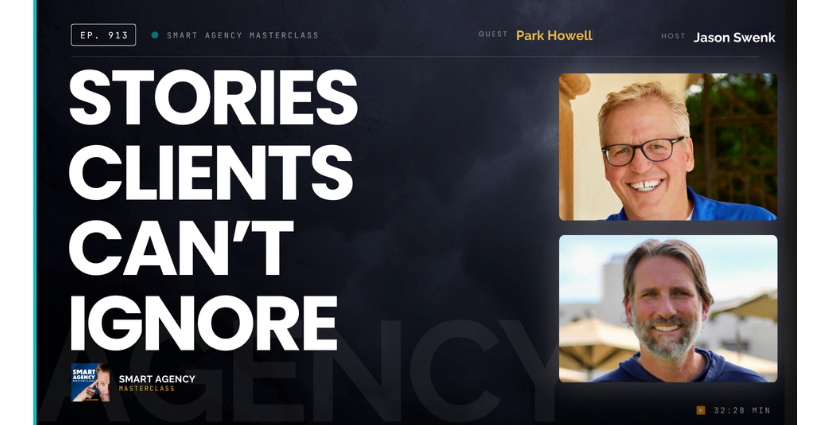
I Fixed That Live on the Smart Agency Masterclass with Jason Swenk
The three-word framework that changes every pitch you’ll ever make — starting today
Back in 2003, my agency produced two 30-second TV spots for Goodwill of Central Arizona. Same campaign. Same client. Same production run.
The first spot increased same-store sales 42% the following month. People were walking into Goodwill stores specifically talking about the commercial.
The second spot pulled zero.
When I went back and studied why, the answer was clarifying and somewhat embarrassing. The first spot followed every beat of great narrative structure — setup, tension, resolution, audience as hero. The second one was what I now call creative self-indulgence. We thought it was brilliant. We built it for ourselves. The audience walked away.
That contrast is exactly what I brought to Jason Swenk’s audience on the Smart Agency Masterclass. You can listen to or watch the full episode here — and I’d encourage you to do it before your next new business conversation.
Jason Swenk built and sold his own digital agency before creating one of the most trusted podcasts and communities for agency owners. His Agency Mastery program gives principals the frameworks and peer group they need to stop being the biggest bottleneck in their own business — to own their agency instead of letting it own them. When he invited me on, I didn’t just talk about story. We built a live ABT framework in real time using his own program as the test case.
What’s In It for You
The ABT framework — apply it before your next pitch. And, But, Therefore: three words that reduce any message to agreement, contradiction, and consequence. Dr. Randy Olson — Harvard PhD evolutionary biologist turned USC film school director — developed it specifically to help impossibly complex communicators finally get to the point. Agencies, this one’s for you.
Why agencies instinctively make themselves the hero. It’s not ego. It’s habit. We default to what we know best: our team, our work, our process, our awards. Meanwhile, the prospect is sitting there thinking, “What about me?” The guide hands the hero the sword. The guide doesn’t perform with it in front of them.
The live Agency Mastery ABT — built in 10 minutes, on air. Watch how Jason’s program goes from vague to visceral: an agency owner who is plateaued, wants the freedom she thought she was signing up for, and feels trapped because every decision still routes through her. Therefore: the community and frameworks that find the clarity and break the bottleneck.
Why Star Wars and The Wizard of Oz are literally the same film. Luke starts on a dusty farm in Tatooine. Dorothy starts on a dusty farm in Kansas. Glinda is Yoda. Once you see the universal story structure embedded in every film you love, you cannot unsee it — and you’ll use it in every pitch you write from here on out.
The Goodwill case study. Same budget, same campaign — one 30-second spot moved same-store sales 42%, the other moved nothing. The difference was narrative structure. Story isn’t decoration. It’s architecture.
Your free brand story assessment. Go to storycyclegenie.ai, enter your URL, and the StoryCycle Genie® delivers a free A+ to F- rating across 14 narrative criteria in under 60 seconds. No form. No pitch. Just a clear look at where your brand story is working and where it’s bleeding opportunity.
The Habit That Costs You the Clients Who Most Want to Pay You
The agencies I respect most don’t lead with credentials. They lead with the prospect’s tension.
They walk in already knowing the story — the agency owner who is plateaued and frustrated and quietly wondering if the freedom they imagined is still possible. And then they name it, out loud, before showing a single case study.
That’s the ABT applied.
There’s also something Harvard documented in 1978: the word “because” increases compliance in almost every situation it’s used. When you connect a problem to its root cause — “you feel trapped because you lack the direction your team needs to execute without routing decisions through you” — you’ve done something more powerful than a capability pitch.
You’ve demonstrated that you understand your prospect more deeply than they’ve articulated it to themselves.
You’ve become the guide they’ve been looking for.
Jason captured the whole mechanic after we built the framework together. “State what they want and why they want it. Then show them how to get it.”
Not the agency. The client.
Stop pitching. Start proving.
Go listen to or watch the full episode on the Smart Agency Masterclass. Then write your first ABT before your next new business conversation. You’ll feel the difference in the room before you say a word about your capabilities.
Story on.
Links:
- Smart Agency Masterclass with Jason Swenk
- Jason Swenk’s Agency Mastery Program
- Save the Cat by Blake Snyder
- Dr. Randy Olson — And, But, Therefore
- Free Brand Story Assessment — StoryCycle Genie®
- The Business of Story Podcast
Deepen Your Agency Storytelling Mastery: Three Essential Episodes
To amplify what you heard in today’s conversation, these Business of Story episodes go deeper on the frameworks Park and Jason unpacked:
How to Use the ABT Framework to Win More Agency Business — The And, But, Therefore in action across real agency pitch scenarios, including listener-submitted examples. (Verify episode URL at businessofstory.com/podcast)
Randy Olson on Why Scientists — and Marketers — Can’t Get Anyone to Listen — The man who developed the ABT framework explains the neuroscience behind agreement, contradiction, and consequence — and why your brain is already wired for it. (Verify episode URL at businessofstory.com/podcast)
The 10 Steps of the Story Cycle System™ That Build Brands Worth Remembering — Park walks through each Story Cycle element and how it maps to client acquisition, retention, and long-term brand authority. (Verify episode URL at businessofstory.com/podcast)
Park Howell’s Conversation With Jason Swenk on the Smart Agency Masterclass Podcast
Jason Swenk: Hey, Park, welcome to the show.
Park Howell: Thanks, Jason. Great to be here with you.
Jason: Yeah, excited to have you on. Tell us who you are, what you do.
Park: I am Park Howell and my clients call me the world’s most industrious storyteller. I love that tag because it’s a little braggadocious — I use it tongue in cheek. But I have been using story for over 20 years, really focused on it to help build brands, help build agencies, and so forth.
I’ve been in the advertising, branding, and marketing world for 40-plus years. We were always using storytelling, but we were never intentional about it — just intuitive. So I started studying story aggressively starting back in 2003. Now this is all I do: consult, teach, coach, and speak on the power of story and how to use proven frameworks to help anyone from agencies to clients to leadership have their messages land right, the first time, every time.
How Park Got Started in the Agency Business
Jason: How’d you get started in the agency business?
Park: God, I was never good working for anybody. As a kid, I always had my own lawn company — mowing yards and whatever. I got into the agency world right out of school. I graduated from Washington State University. The first five or ten years I was working for somebody else, but I was always jonesing to do it myself.
In 1995, I opened Park & Co — a one-man band in Phoenix, Arizona. Then we grew to two, to ten, to twenty and beyond. It just kept rolling. I always loved the advertising world since I was a little kid growing up in the Seattle area. I don’t know if you’ve ever seen the old Rainier beer commercials — those absolutely entertained me. I was like, “I want to do that someday.”
Jason: You know what got me into advertising? Watching Bewitched. Her husband Darrin was an ad man, and I used to love when he would pitch. He would always do all the work. I think Larry was the boss.
Park: Yeah, Darrin Stevens. Dick Van Dyke played him and he was in the agency world.
Jason: That’s kind of what got me curious. And I too, like you, mowed lawns. What did you charge per lawn?
Park: Oh my God, probably $2.50 way back when. You had a better market than I had.
Jason: I charged five to ten bucks.
The Pricing Conversation That Started It All
Jason: I’m always curious about how people come up with their pricing. My first website was $500. It’s rare to see someone come out of the gates charging a lot. To kind of get into the show — I want to talk more about the story. When did you first realize how powerful story was when you’re actually selling business?
The Goodwill Campaign That Changed Everything
Park: I think I always knew story was powerful. I just was never intentional about it. I really learned that lesson around 2003 when we got one of our largest clients at the time — Goodwill.
Goodwill of Central Arizona is one of the largest franchises in the country. They hired us to come in, we did a bunch of research, and then we created a TV campaign with two 30-second spots.
The first spot pulled unbelievably well. They did same-store sales comparisons the next month — after the campaign started — and it increased sales across the board by 42%. People were actually coming in talking about the commercial.
Then we ran the second spot in that campaign and it did nothing. Pulled zero. The client said, “Well, that was a waste of money. Let’s pull it off and just run the first one.” They ran that one spot for about four years.
When I went back and looked at those two spots through the lens of story, the first spot was perfect storytelling — setup, problem, resolution, following all the beats. You could even boil the hero’s journey down to 30 seconds and see it all happening there. It was just intuitive.
The second one was creative self-indulgence. We loved it. We thought we were going to win awards for it.
That’s when I realized: if we became intentional in our scriptwriting across the board — in all of our content, following these beats to story — would we be more successful in our campaigns? It proved itself out.
From Film School to the Story Cycle System™
Park: I was lucky that our son Parker was going to film school at Chapman University — a very prominent film school — between 2006 and 2010. Then he spent a dozen years in Hollywood. When he was in school, I said, “Send me your books and recorded lectures when you’re done with them since I’m paying for them — I want to know what Hollywood knows about intentional storytelling.”
That’s when I found the Hero’s Journey, Blake Snyder’s 15 beats to story, the Pixar way, and all of those. That’s when I boiled it down to our 10-step Story Cycle System™.
Save the Cat: Blake Snyder’s 15 Beats for Business Storytellers
Jason: What are the 15 beats? I’ve never heard about that.
Park: Save the Cat — fantastic book. If you want a really fun read, get it. Then get Save the Cat Goes to the Movies.
Blake Snyder was a screenwriter who sold more family-oriented screenplays in the 1980s and early 1990s than any other writer in Hollywood. He took what he did — which was essentially the hero’s journey — and boiled it down to his own 15 beats. I followed those and said, “Well, Hero’s Journey does this. Blake does this. I’m going to do this in business.”
It’s really fun to read Save the Cat and then sit down with a movie and follow right along. He has 40 different films in Save the Cat Goes to the Movies and you see every single beat of the story in each one. Our son Parker and I would ski for spring break and at night we would sit down, watch movies, and compare them to the 15 beats.
Jason: Give us an example of a beat.
Park: You open with your protagonist — that single character who has something at stake. You have, as Joseph Campbell would say, the call to adventure and the refusal of the call. They’re invited to do something and they’re like, “No, I can’t possibly do that.” Then something happens. Later in the beats, the bad guys close in — you’re about two-thirds of the way in, and they’re coming to get the hero, who barely escapes.
Then there’s what I call the moment of death — you’re thinking it’s all over, but no, it goes one step deeper. They’re really facing the guns. There’s seemingly no way out. They face death, overcome death, and then resolution.
It’s the hero’s journey made simpler and more practical. Less theoretical, more specific: this has to happen on such-and-such a page of the script, this has to happen by this page. It’s formulaic, then it’s up to the storyteller to make it their own.
Why Star Wars and The Wizard of Oz Are Literally the Same Film
Jason: That reminds me of Luke Skywalker facing Darth Vader. He has a decision to make, and then Obi-Wan or Yoda is the guide who pushes him along. Is that part of those beats?
Park: Yeah, it all feeds back to the hero’s journey. What I find so fascinating is that George Lucas followed the hero’s journey when he wrote Star Wars — it’s an absolutely perfect sequence.
But a movie that does it equally as well, when people didn’t even know about the hero’s journey, is The Wizard of Oz. If you watch both films, you can put them on a split screen and you will see the exact same story told.
Luke starts on Tatooine — a farm, dusty, miserable, double moons. He’s like, “There’s something bigger for me out there.” Where does Dorothy start? A farm in Kansas. Dusty as hell.
The inciting incident in Star Wars is when Luke comes back and sees that the stormtroopers have killed his aunt and uncle. Nothing’s left for him. That’s the call to Luke: “You’ve got something bigger to do.” He gets in a speeder, goes to Mos Eisley — the bar with all the crazy characters. What happens to Dorothy when the tornado spins her into the extraordinary world? She lands in Oz with a bunch of munchkins running around.
As she starts down the path, as does Luke, they both pick up allies. It’s a story that’s been around since the beginning — Gilgamesh, carved into a cuneiform tablet, is essentially the hero’s journey. It’s a template, a story embedded in all of us. It’s how we make meaning out of being human.
Jason: I need to go watch Wizard of Oz now. And a side note — I tricked my wife into naming our firstborn Luke so I could say, “Luke, I’m your father.” So let’s talk about what’s actually happening: agencies are telling the wrong story about themselves.
The Pitch Problem: Agencies Tell Stories About Themselves, Not Their Clients
Park: Yeah, about themselves. They go in and try to pitch capabilities. Everyone has the same capabilities. I’d rather have you pitch abilities — show them rather than tell them.
Jason: Like, what makes you unique? “We have the best people, the best process, the best portfolio. We care the most. We’re customer-centric.” Bullshit, bullshit, bullshit. You believe it, yes, but there’s no separation. You’re telling a story I would never watch.
So how can agencies tell a better story with the framework you’ve developed?
The ABT Framework: And, But, Therefore
Park: The reason so many agencies are clinging to life is that they don’t stand for anything. They haven’t communicated what makes them stand out. It starts with the agency principal. Why are they doing what they do?
Jason, you built an agency and then sold it. You were, as I heard on some of your other shows, an accidental agency owner. You built a spoof website for a buddy of yours, then someone said, “Hey, can you do one of those for me?” And next thing you know, you’re building an agency.
Was there a moment in that agency where you were really struggling? You built something, got momentum, and then it started collapsing — because you got to that point of: what does Jason Swenk stand for?
Jason: Probably for ten years, yes.
Park: Yeah. So you have to do some soul searching. Here’s one way to do it — and I’m going to teach you the And, But, Therefore narrative framework. Something you can use to clarify any complex message and make it crisp, clear, compelling, and totally focused on your audience.
The And, But, Therefore is not a framework I developed. I learned it from my good friend Dr. Randy Olson back in 2013. Randy was a Harvard PhD evolutionary biologist, turned USC film school director, who now writes and teaches scientists and academics how to use story. In his second book, he introduced me to the And But Therefore framework.
It’s essentially set up, problem, resolution. It plays off three forces of story: agreement — get people nodding yes, we have a shared vision — contradiction — here’s why you haven’t achieved that yet — and therefore, the statement of consequence. The way forward.
You always place your audience at the center of the story.
Building Jason’s ABT in Real Time
Park: Jason, let me ask you: do you want to do an ABT focused on this podcast or focused on your Agency Mastery program?
Jason: Do the Agency Mastery.
Park: All right. Who is your number one audience persona? And I always say one, because it’s the Pareto Principle — one persona typically makes up 80% of revenue.
Jason: An agency owner who is plateaued and just banging their head against the wall.
Park: Agency owner who is plateaued. Next: what do they want relative to your offering, even if they don’t know it exists yet? This is a way to foreshadow your call to action.
Jason: They don’t want to work all the time. They want more freedom.
Park: And why is that important to them?
Jason: Because originally they got into the business thinking they’d have the freedom to pick and choose. But the business owns them and they want a business they own.
Park: Great. Now the But statement of contradiction — what is their biggest problem? Why are they not owning this?
Jason: Probably because they don’t have clarity of where they want to go. And they can’t communicate that to the team. So all the decisions are routing through them, making them the biggest bottleneck.
Park: And what negative emotion does that create?
Jason: Frustrated. They feel trapped.
Park: Now the Therefore — how are they going to feel once they get this clarity?
Jason: Certainty. Like they know the path. And a lot of people know the path, but they need someone else to guide them and say, “Yeah, that’s right.”
Park: And how do you and Agency Mastery help them get there?
Jason: We help them figure out the biggest bottleneck, show them the clarity, remove the bottleneck so they actually own the business — and the business doesn’t own them.
Park: And how do you help them find these bottlenecks? Through the show? Masterclasses? One-on-one?
Jason: Mainly through community and frameworks. A lot of times they see their biggest bottleneck through other people in the community — when someone asks a question that names a thing they hadn’t been able to name. You think you have a leads challenge and then you realize you don’t know who you’re actually going after. Or sometimes an agency owner will give brilliant advice to another member that they themselves stopped doing. Our premise is: you don’t want to climb the mountain alone. It’s more fun, more enjoyable, easier — and safer — to climb with other people.
Park: And safer. When you start sliding, they can pull the rope.
Jason: Exactly.
The Vacuous ABT: How to Open Any Room
Park: Okay. So I’ve pulled in all of this intel. Here’s one more question: if you had one word for the theme of all of this, what would it be?
Jason: One word? Why do you make it one word?
Park: I’m trying to get you to focus on a singular problem-solution dynamic. We often try to solve too many things at once and lose our audience.
Jason: Habit. Focus.
Park: You actually said the word earlier: freedom. You want freedom, but you don’t have freedom. Therefore, I’m going to help you get freedom. Let’s use that.
And here’s the simplest version — the vacuous ABT, the conversational version. If you were on stage in Phoenix in front of 5,000 agency owners who don’t know you at all, you get up and say:
“As an agency owner, you want freedom — but you don’t feel like you have it right now. So the next 20 minutes, I’m going to show you how to get it.”
Everybody in the room immediately knows what you’re talking about. That’s where most of us lose our audience — we introduce the theme too late.
Now here’s the built-out version. This isn’t perfect — I’m winging it:
You are a proven agency professional who has built quite a remarkable company. And if you could just find more clarity on where you’re going, then you would have the freedom of owning that agency versus it owning you.
That’s the And — the statement of agreement. You should be nodding yes right now.
But you’re frustrated, because you are currently trapped in an agency that doesn’t have the crystal-clear direction it needs in order to provide you the freedom you so desperately seek.
Therefore — and you don’t have to use that word, but it’s the Lego building block here — imagine six months from now when on a Wednesday, you are water skiing with your kids, because your agency is on autopilot, running itself, making you money.
How do you do that? Through Agency Mastery — the place that provides you the community and the frameworks you need to find the focus and the clarity so that you own your agency, and it does not own you.
Something like that.
Jason: Very cool. State what they want and why they want it, how they get it. I like that.
The Three Forces of Trust Every Agency Needs to Build
Park: And you always keep it totally focused on them. Here’s the default: the owner of the brand will always introduce their offering directly after the Therefore. No. Pump the brakes. Keep it about them. Get them to picture already having what it is that they don’t currently have — because they worked with you — and then explain how.
We have if/then clauses in there: a pattern-seeking thing that our limbic buying brain loves. We use the word “because” in the But statement — Harvard did a remarkable study in 1978 about the power of “because” to get people to act. It plays to the cause-and-effect our problem-solving brain loves.
Lead with emotion. Then back it up with logic and reason.
One last thing: the ABT works on three forces of story — agreement, contradiction, consequence. When you do it right, it builds what I call the three forces of trust:
You are demonstrating that you understand your audience.
You appreciate what they want and why it matters to them.
You empathize with them as to why they don’t currently have it.
They’re going: “Yeah, you get me. You’ve been there. You know what I’m talking about. Therefore, let me show you the way forward.”
Jason: Yeah. It’s more about focusing on them rather than focusing on yourself. Even when I’m speaking at an event, I want to open with their tension — not a bio slide. I opened a talk recently by saying, “I built the world’s first AI agent to read your mind.” And then the room leaned in: how? I said, “Because I know all of you are thinking: am I screwed because of AI? I could read your mind.”
Park: Perfect. That’s the ABT in action.
How to Use the ABT in Your Next Pitch
Park: Here’s what I’d like your agency viewers to do. Get your principals around the room, teach them what you just learned, and then each of you individually write your own ABT about the agency — and then share them.
You’re going to get tremendous insight into how your people see where you’re going. A lot of clarity will come out of it. And ultimately you’ll end up writing one And, But, Therefore for the entire agency — co-written by everyone — that can help you move forward.
Then, for your next presentation or proposal pitch, go do your due diligence on that prospect and write an And, But, Therefore for them. Get yourself completely focused on a singular problem-solution dynamic that you are going to be solving for that prospect.
Agencies — I’ve been caught in this trap too — go in and pitch capabilities. But everyone has the same capabilities. I’d rather have you pitch abilities. Bring value with you through the ABT, starting with their story. Don’t just talk about what you can do. Show them what you can do by doing it for them.
Stop pitching. Start proving.
Jason: Love it. Thanks so much, Park, for coming on the show. Where can people learn more about you?
Where to Find Park Howell and the StoryCycle Genie®
Park: Come on over to my own show, The Business of Story. Every Monday I’ve got a new story artist on. I’ve been doing it for 12 years. You can find me at businessofstory.com. Hit me up on LinkedIn and let me know you saw me on Jason’s show.
And then check out our new tool, the StoryCycle Genie® at storycyclegenie.ai. It’s got ABT infused in it — it’s a branding platform that enables you to create world-class branding in a fraction of the time.
Jason, you don’t even know this yet: you can go to the homepage, click that red button, and get a free brand story assessment in 60 seconds. Just put in your name, email address, and URL. Under 60 seconds, you’ll get an A+ to F- grade across 14 storytelling criteria that validates what you’re doing well, reveals gaps you can easily fix, and inspires new ways to think about your brand story.
Check that out. StoryCycleGenie.ai. That’s all the selling I’m going to do, Jason.
Jason: Awesome. Thanks so much for coming on the show. And everyone listening — if you enjoyed this episode, like it, share it, subscribe. Until next time, have a swank day.
Frequently Asked Questions
What is the ABT framework for agency storytelling?
The ABT — And, But, Therefore — is a three-part narrative structure that reduces any message to its essential elements: agreement, contradiction, and consequence. Dr. Randy Olson, a Harvard PhD evolutionary biologist turned USC film school director, developed it to help scientists and academics communicate complex ideas clearly. For agencies, ABT structures pitches and presentations around the prospect’s tension rather than the agency’s capabilities, positioning the client as the hero and the agency as the guide. The three forces the ABT activates are agreement (“I get you”), contradiction (“Here’s why you don’t have what you want yet”), and consequence (“Here’s the way forward”).
Why do agency principals lose new business pitches they should win?
Most agencies lose winnable pitches because they lead with their own story — capabilities, awards, process, case studies — instead of the prospect’s story. This “agency as hero” framing creates emotional distance because the prospect can’t find themselves in the narrative. Harvard documented in 1978 that connecting a problem to its root cause using the word “because” dramatically increases engagement and willingness to act. Agencies that open by naming the prospect’s specific tension and positioning themselves as the guide consistently outperform capability-led pitches.
What is the Story Cycle System™ and how does it help agencies grow?
The Story Cycle System™ is a 10-step narrative framework developed by Park Howell, based on Joseph Campbell’s Hero’s Journey, Blake Snyder’s 15 beats from Save the Cat, and Pixar’s narrative principles. It provides a systematic, repeatable structure for building brand stories, client pitches, and marketing campaigns. For agencies, it transforms intuitive storytelling — like the one-off Goodwill spot that increased same-store sales 42% — into intentional storytelling that can be engineered, repeated, and taught across the entire team.
What are Blake Snyder’s 15 beats from Save the Cat?
Blake Snyder was a Hollywood screenwriter who sold more family-oriented screenplays in the 1980s and early 1990s than any other writer in the business. In Save the Cat, he distilled the Hero’s Journey into 15 specific structural beats that appear in every great narrative. Key beats include: introducing the protagonist with something at stake, the call to adventure and the refusal, the fun-and-games middle section, “bad guys close in” (about two-thirds through), the apparent moment of defeat, and the final resolution. The beats are formulaic in structure and flexible in execution — a map for emotionally compelling stories in any context, including agency pitches.
How are Star Wars and The Wizard of Oz literally the same story?
Both films follow the identical hero’s journey structure. Luke Skywalker and Dorothy both begin on dusty farms feeling called to something greater. Both experience an inciting incident that forces them to leave — the stormtrooper attack on Luke’s family; the tornado. Both enter an extraordinary world filled with strange characters — Mos Eisley Cantina; Munchkinland. Both gather allies on the journey. Both face an ultimate test before achieving resolution. Both have a wise guide — Obi-Wan/Yoda; Glinda the Good Witch. George Lucas consciously followed the hero’s journey in writing Star Wars. The Wizard of Oz achieved the same structure intuitively. The parallel demonstrates that the hero’s journey is not a theory but a universal story grammar embedded in human psychology.
How do you write an ABT statement for a new business pitch?
Follow these four steps: (1) Identify your single most important audience persona. (2) Write the AND statement — what they want and why it matters emotionally to them. (3) Write the BUT statement — the specific negative emotion they feel and the root cause blocking them, connected with the word “because.” (4) Write the THEREFORE — start with the positive outcome the client will experience, then position your agency as how they’ll get there. Critically: lead the THEREFORE with the client’s transformation, not your offering. Placing your agency too early in the resolution disrupts the audience-as-hero positioning that makes the ABT land.
What is the StoryCycle Genie® and how does the free brand story assessment work?
The StoryCycle Genie® is a branding platform powered by Artful Intelligence and built on the proven Story Cycle System™. It helps agencies, businesses, and marketing teams discover, build, and scale the brand story only they can tell. The free brand story assessment is available at storycyclegenie.ai — enter your name, email address, and website URL to receive a free A+ to F- narrative grade across 14 storytelling criteria in under 60 seconds. The assessment identifies specific gaps in your brand story structure, validates what’s working, and reveals actionable improvements based on the Story Cycle System™ framework.
What is the Smart Agency Masterclass and who is Jason Swenk?
The Smart Agency Masterclass is a podcast and community platform for agency owners hosted by Jason Swenk, who built and sold his own digital agency before creating the program. The show covers new business development, agency pricing, positioning, team building, and operational systems for sustainable agency growth. Jason’s Agency Mastery program specifically serves agency principals who have plateaued — giving them frameworks and a peer community to find the clarity, focus, and leadership systems that allow them to own their business rather than be owned by it.