
How to Measure Brand Debt, Manage It, and Stop Paying Compounding Interest on It.
Michele and I took our youngest son, Caedon, to Universal Studios Hollywood back in 2007.
We came around a corner, and the green-scaled body of a velociraptor erupted from the palm fronds, claws extended as it bared its teeth, yellowed by many kills.
He was nearly tripping over a sign on the fence that read: “Fragil Prop. Do Not Touch.”

Talking about a buzzkill.
That scene was the first thing I thought of when I read Harvard Business Review’s latest research on managing brand debt, and what happens to the companies that don’t.
Because that’s exactly how most enterprises treat their brand story. Magnificent to look at. Roped off from the real work of the organization. Fragile by design. Do not touch.
And the tab for that decision is already running.
Brand debt is the trust, relevance, and consistency lost when products, experiences, policies, and messaging drift out of sync with what customers expect.
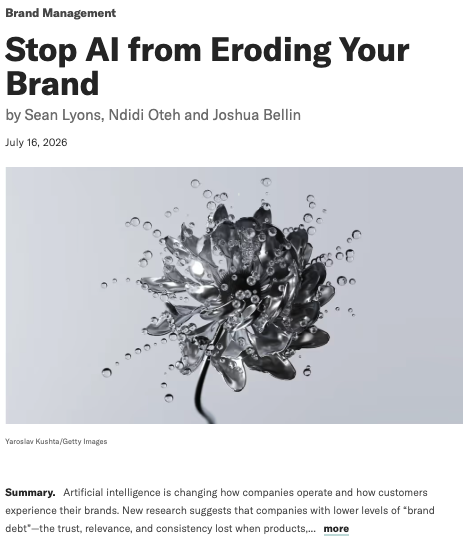
According to Sean Lyons, Ndidi Oteh, and Joshua Bellin of Accenture Song, Accenture’s global creative and brand agency, in “Stop AI from Eroding Your Brand,” published in Harvard Business Review on July 16, 2026, how well you manage brand debt is now a measurable predictor of whether your company outgrows its peers or doesn’t.
AI doesn’t create brand debt. It amplifies it, at scale, in public, in real time.
How Do You Measure It?
The Accenture Song team benchmarked 60 companies across athletic footwear and apparel and hotels and lodging, using 2022 as a common baseline, then tracked revenue growth against industry peers over one and three years.
In athletic footwear and apparel, companies in the lowest quartile of brand debt were 2.4 times more likely to exceed peer-average revenue growth after one year. 3.2 times more likely after three.
In hotels and lodging: 4.1 times more likely after one year. 3.7 times more likely after three.
Damn!
They scored it across four dimensions — four places the tab quietly accumulates.
- Culture debt: when a brand’s identity falls out of step with customer expectations. A brand projecting abundance during a season of financial anxiety doesn’t just miss the room. It pays for the disconnect in trust.
- Customer debt: when products stop delivering distinctive value. Premium brands are especially exposed when competitors move faster on AI-enabled capabilities customers now expect as table stakes.
- Credibility debt: when actions contradict promises. Leadership decisions, pricing practices, governance failures — anything that makes a customer say, “That’s not who you said you were.”
- Consistency debt: the one AI accelerates most directly. It accumulates when customers encounter different versions of the brand across channels, platforms, and AI-generated interactions. No single output is technically wrong. The aggregate tells a story the company never intended to tell.
These four don’t stay in their lanes. And here’s what makes this particularly uncomfortable: brand debt doesn’t live in marketing. It accumulates across products, technology, HR, operations, policy, and partnerships.
That’s not a role problem. That’s a governance gap.
Think of it as a prop nobody’s been authorized to touch — while AI quietly generates a hundred slightly different versions of it every day.
Bose: Diagnose First, Govern From There
As the article reports, when Bose closed its global retail stores in 2020, it lost distribution and the one place where customers could physically experience premium sound before buying.
Without those stores, the brand risked competing on price and star ratings instead of the experience that had always set it apart.
I’ve seen brands make this mistake repeatedly in my 40 years in this business: they respond to a strategic crisis with a campaign.
CEO Lila Snyder did the opposite. She appointed Jim Mollica as Bose’s first-ever global CMO, centralized brand leadership, and clarified decision rights across product, digital, retail partnerships, and marketing.
Governance came before creative.
That structure let Bose diagnose its debt with precision. Customer debt and consistency debt were the live liabilities.
Rather than a features-first tech playbook, Mollica built the Ultra Open Earbuds campaign around artists like Tyla, Central Cee, and BlackPink’s Lisa, positioning the earbuds as something you wear as much as something you hear.
His framing was direct: headphones are one of the most visible forms of fashion a person wears.
The ambient-awareness design wasn’t a marketing invention. It was the actual product benefit, reframed for a lifestyle context instead of a spec sheet.
A Forrester survey later found Bose ranked among the most salient brands with Gen Z consumers — a striking result for a sixty-year-old audio company that no longer owns a single store.
Cracker Barrel: The Prop Nobody Should Have Touched
Cracker Barrel didn’t lack a brand story. It had one of the most recognizable identities in American retail, built over five decades.
What it lacked was a governance checkpoint.
In August 2025, Cracker Barrel removed Uncle Herschel — the man in a rocking chair beside a barrel, part of the visual identity since the 1970s — in favor of a minimalist wordmark.
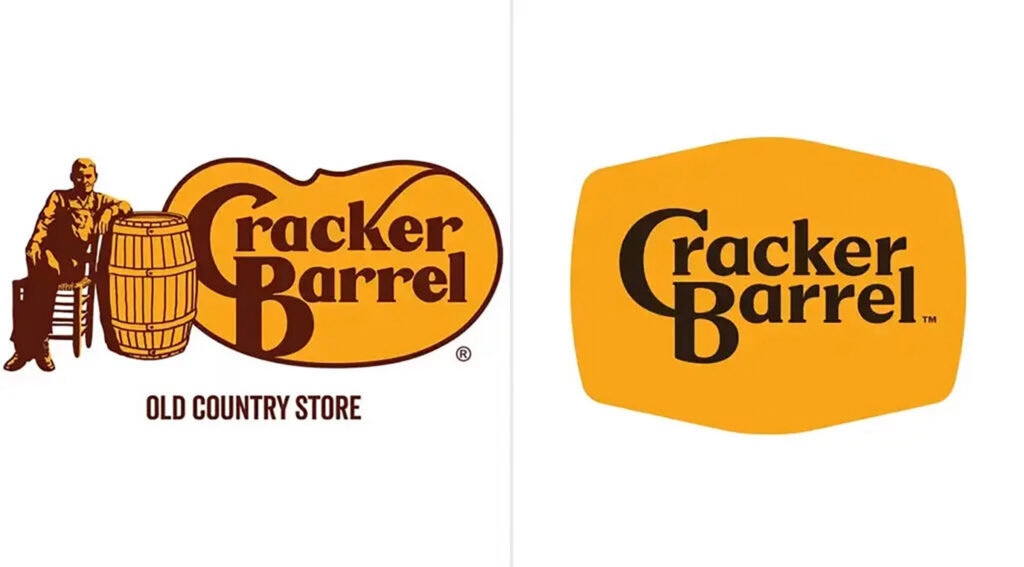
Within 48 hours, “generic,” “soulless,” and “bland” were trending. Stock dropped 12 to 14 percent. Close to $100 million in market capitalization, gone. Foot traffic down roughly 8 percent.
They reversed course within eight days.
But brand debt doesn’t disappear when the news cycle moves on. It sits on the books, accruing interest.
On July 27, 2026, CEO Julie Masino stepped down, having given her now widely quoted line in a media interview: “I feel like I’ve been fired by America.”
That’s more than brand debt. That’s brand hit for the lack of governance. And the CEO paid the price.
Wicked: Governance at 400-Partner Scale
Here’s where the argument gets counterintuitive.
Universal handed its Wicked IP to more than 400 outside partners, each making independent creative calls.
On paper, that’s a consistency-debt catastrophe. And yet it worked spectacularly, because Universal governed the story frame, not the executions.
Every partner worked inside the same fixed narrative: friendship, identity, transformation. Same emerald-and-pink visual code. Compartés didn’t invent its own Wicked story. It translated the existing one.
CMO Michael Moses turned down partnerships where the fit wasn’t right. Before the film launched, Universal brought 200 brand marketers to the London set to prove the cultural moment was real.
For the sequel, only 165 of the original 400 partners returned. That 59 percent turnover is the most telling number in this entire case study. Universal was actively pruning, not just scaling.
The number of touchpoints generating content on your brand’s behalf doesn’t determine your brand debt. What determines it is whether there’s a governed story every one of those touchpoints checks itself against before it ships.
Bose proved that at the scale of one company. Wicked proved it holds across 400 partners. Same discipline. Different orders of magnitude.
Ndidi Oteh, one of the three researchers behind this brand debt study, didn’t stay behind the research. Effective September 1, 2025, she became CEO of Accenture Song, succeeding David Droga.
The person who helped quantify how brand debt compounds now runs the agency-scale operation that has to prevent exactly that compounding across many clients, many creative touchpoints, and many teams that don’t report to each other. She didn’t just diagnose the tab. She inherited the job of keeping her clients’ brand books balanced.
That’s your job too, whether you’re managing one client’s brand across a dozen freelancers or hundreds of partners across a global franchise.
The Governance Infrastructure That Closes the Tab
Here’s the throughline all three cases share.
Bose’s fix was a person. Universal’s fix was two people. Both models work until the CMO leaves, the portfolio grows past what one person can track, or AI-generated content velocity outpaces any human review process.
That’s the gap StoryOps™ exists to close — treating brand governance as its own operational discipline, the way RevOps and DevOps turned “we should probably coordinate on this” into a systemized function with owners, checkpoints, and infrastructure.
Brand debt is narrative entropy by another name. The natural tendency of a story to fragment across every function, channel, partner, and decision that touches a customer, unless something actively governs it back toward coherence.
What StoryOps™ installs is a Brand Brain: a single governed source of narrative truth that every person, team, department, AI system, and partner checks their decisions against before those decisions ship.
Every major enterprise function has its operational discipline for the same reason: the function is too important and too distributed to be governed through individual effort and institutional memory.
Brand story is the single asset every one of those functions depends on to do its work with meaning and coherence. It’s the last ungoverned function in the enterprise stack.
Back at Universal Studios in 2007, eleven-year-old Caedon stood in front of that T. rex and read the sign out loud.
“Fragil Prop. Do Not Touch.”
He looked at me the way kids look at adults when the adults have clearly gotten something wrong.
He was right.
A prop is decoration. It isn’t load-bearing. And no company has ever been built on a story it was afraid to put to work.
Brand debt compounds quietly. AI just gave it a warp drive.
StoryOps™ is the accounting system.
Install it before the tab gets interesting.
→ Find out where your brand story is accumulating debt: Grade Your Brand Story Free →
Story on, my friend.
≈ Park Howell Founder, The Business of Story Creator of the StoryCycle System™ Author of Brand Bewitchery Host of the Business of Story Podcast Co-Creator of the StoryCycle Genie®
Sources
- Sean Lyons, Ndidi Oteh, and Joshua Bellin, “Stop AI from Eroding Your Brand,” Harvard Business Review, July 16, 2026. https://hbr.org/2026/07/stop-ai-from-eroding-your-brand
- “Bose no longer wants to be a product-first brand,” The Drum. https://www.thedrum.com/news/2023/07/31/bose-no-longer-wants-be-product-first-brand-and-rooting-itself-culture-instead
- “Star-Studded Tech Campaigns: Bose Ultra Open Earbuds,” Trend Hunter, October 18, 2024. https://www.trendhunter.com/trends/ultra-open-earbuds
- “Bose CMO on driving the brand’s cultural impact,” Marketing Dive, November 21, 2024. https://www.marketingdive.com/news/bose-cmo-brand-cultural-impact-ai-shakeout/733415/
- “Two years in, Bose’s first CMO outlines his plan,” Digiday. https://digiday.com/marketing/two-years-in-boses-first-cmo-outlines-his-plan-for-the-brand/
- “Marketers on Fire: Bose CMO Jim Mollica,” Chief Marketer, January 24, 2025. https://www.chiefmarketer.com/marketers-on-fire-bose-cmo-jim-mollica-on-tapping-into-culture-automotive-innovation-and-creator-led-content/
- “‘I Feel Like I’ve Been Fired by America’: Cracker Barrel’s CEO Steps Down,” 24/7 Wall St., July 28, 2026. https://247wallst.com/investing/2026/07/28/i-feel-like-ive-been-fired-by-america-cracker-barrels-ceo-steps-down-a-year-after-its-100-million-logo-disaster/
- “Cracker Barrel CEO Says She Felt ‘Fired By America,'” People/AOL. https://www.aol.com/articles/cracker-barrel-ceo-says-she-170943755.html
- Conor Murray, “A Timeline of Cracker Barrel CEO Julie Masino’s Exit,” Forbes, July 27, 2026. https://www.forbes.com/sites/conormurray/2026/07/27/fired-by-america-a-timeline-of-cracker-barrel-ceo-julie-masinos-exit/
- “Cracker Barrel CEO who oversaw controversial logo redesign to step down,” Yahoo Finance/AP. https://finance.yahoo.com/markets/stocks/articles/cracker-barrel-ceo-oversaw-controversial-141749800.html
- “Defying Gravity: How Wicked: For Good Collabs Help DTC Brands Rise With Gen Z,” elk Marketing, November 13, 2025. https://elkhq.com/blog/wicked-for-good-collabs-help-dtc-brands-rise-with-gen-z/
- “Inside ‘Wicked’s’ Marketing Blitz: How Universal Courted 400 Brands,” Variety, November 26, 2024. https://variety.com/2024/film/features/wicked-marketing-campaign-brand-partnerships-1236222100/
- “Diving In: Wicked,” ListenFirst, December 11, 2024. https://www.listenfirstmedia.com/diving-in-wicked/
- Joan Verdon, “Barbie Movie Boosted Mattel’s Sales,” Forbes, October 25, 2023. https://www.forbes.com/sites/joanverdon/2023/10/25/barbie-movie-boosted-mattels-sales-but-investors-held-their-applause/
- “Universal’s ‘Wicked: For Good’ creates a unique marketing challenge,” CNBC, January 24, 2025. https://www.cnbc.com/2025/01/24/universal-wicked-for-good-marketing-challenge.html
- Compartés Wicked: For Good collection, Uncover LA. https://uncoverla.com/2025/10/01/compartes-wicked-for-good-chocolate-bars-advent-calendar-collection-release-date-buy-online/
- “‘Wicked: For Good’ Marketing: Less Press Interviews, Memes and More,” Variety, November 13, 2025. https://variety.com/2025/film/news/wicked-for-good-marketing-less-press-interviews-memes-1236579660/
- “How ‘Wicked: For Good’ transformed brand collaboration,” Pulse Advertising, November 24, 2025. https://www.pulse-advertising.com/resources/social-media-news/wicked-for-good-marketing-campaigns/
Additional background sources:
“Cracker Barrel CEO Julie Masino stepping down,” CBS News. https://www.cbsnews.com/news/cracker-barrel-ceo-julie-masino-stepping-down/ | “Cracker Barrel CEO who proposed controversial rebrand steps down,” The Washington Post. https://www.washingtonpost.com/food/2026/07/27/cracker-barrel-ceo-who-proposed-controversial-rebrand-steps-down/ | “Cracker Barrel’s CEO stepping down is not a win for design,” Creative Bloq. https://www.creativebloq.com/design/logos-icons/a-bad-logo-could-cost-you-your-job | “Meet Jim Mollica,” Bose Corporate Leadership. https://www.bose.com/about/our-corporate-leadership/jim-mollica | “Jim Mollica,” Brand Innovators. https://brand-innovators.com/speakers/jim-mollica/ | “How Bose CMO Jim Mollica is Revolutionizing Marketing with AI,” Suzy. https://www.suzy.com/blog/jim-mollica-chief-marketing-officer-bose | “How CMO Jim Mollica Is Transforming Bose’s Cultural Presence,” Adweek. https://www.adweek.com/brand-marketing/bose-cmo-jim-mollica-transforming-cultural-presence/ | “5 Lessons From the ‘Wicked’ Movie Marketing Campaign,” PCMA. https://www.pcma.org/wicked-5-lessons-from-movie-marketing-campaign/ | “Marketing Lessons from Wicked’s Box Office Success,” ThinkSmartMarketing, December 17, 2024. https://thinksmartmarketing.net/2024/12/17/marketing-lessons-from-wickeds-box-office-success/ | “More Products, Less Press: How ‘Wicked: For Good’ Marketing Stayed Relevant,” Variety/AOL. https://www.aol.com/entertainment/more-products-less-press-wicked-153000832.html