And Why the Most Sophisticated Brand Strategy in the World Still Has to Run Through a Cave
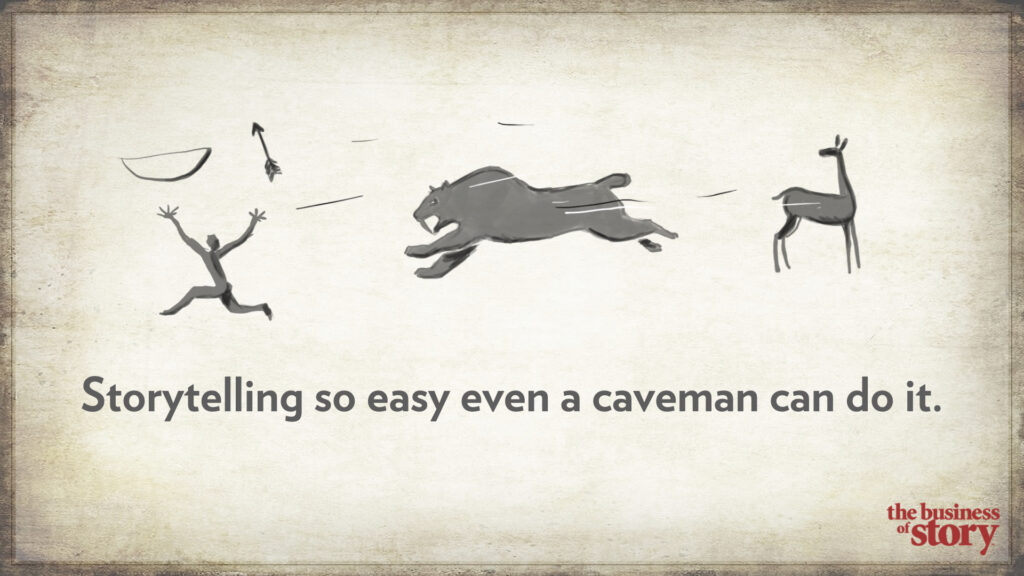
Thog ran.
Not because he had a marketing strategy. Not because his personal brand was on the line. He ran because something with teeth was right behind him, and if he didn’t make it back to the cave with a story worth telling, his tribe would walk into that same darkness completely unprepared.
That’s why story exists. Not to entertain. To survive.
I told this to Matt Davies and Jacob Cass on the JUST Branding Podcast recently — the full cave version, with Jacob playing Thog, Larry the lazy cave dweller by the fire, and a saber-toothed tiger stealing all the best lines — and somewhere in the telling of it, I watched the framework land the way it always does when the story does the teaching instead of the theorizing.
Your brand has a Thog moment. You just might not have framed it yet.
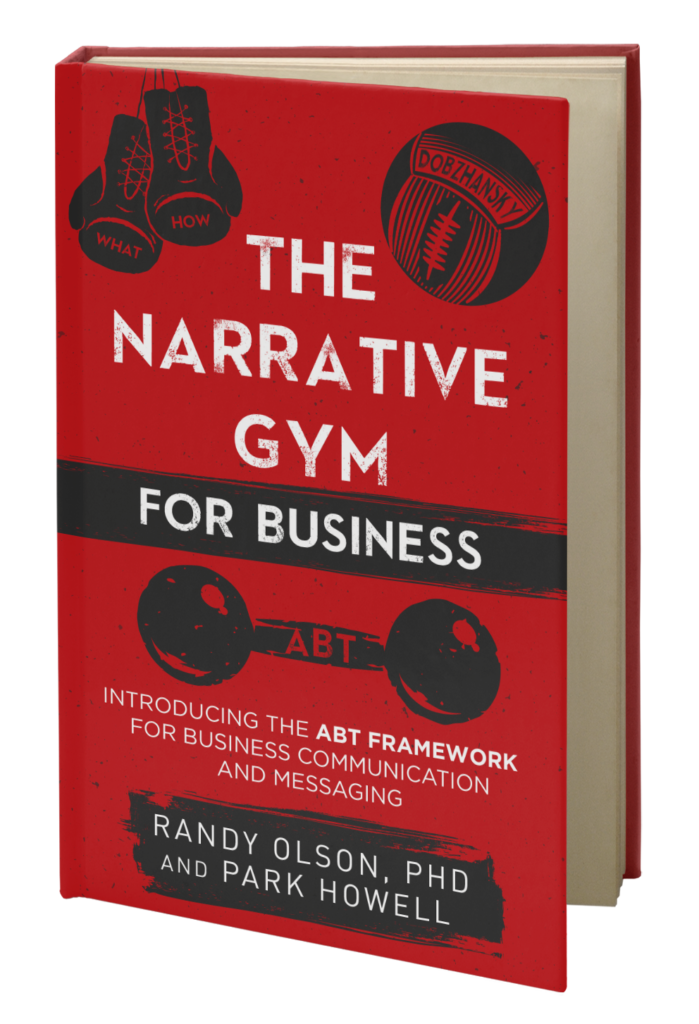
Click on the image to download the full eBook.
Brand Builders Are Skilled. They’re Just Missing a System.
Most brand work I see is technically competent. The logos hold up. The palettes cohere. The positioning statement passes the sniff test. What’s missing is something older than strategy: a repeatable framework for engineering narrative that works at every scale.
You’ve built brands that look the part. What drives you — the thing that actually got you into this work — is the conviction that a great brand should move people. That it should mean something beyond the brief.
Yet here’s what’s actually happening in most brand strategy rooms. Decks replace stories. Data replaces emotion. The pressure to appear professional pushes out the very vulnerability that makes audiences lean in. Even seasoned brand builders end up producing content that’s technically correct and humanly forgettable — because nobody ever taught them the neurological wiring that makes story the only proven delivery mechanism for meaning.
That drift has a name. I call it narrative entropy. Story that decays quietly. A thousand small inconsistencies that add up until your brand sounds like everyone else.
Now imagine having a systematic, repeatable framework for engineering narrative that works from a 10-second caption to a 10-year brand strategy. That’s what I broke down live for Matt and Jacob — and I want to walk you through the highlights here.
The ABT — Three Words That Will Change How You Brief
And-But-Therefore. The atomic unit of story.
Agreement. Contradiction. Consequence.
 It mirrors the felt experience of problem-solving — which is why the human limbic brain processes it without friction. The “but” clause is where your audience lives. That is the strategic real estate. No tension, no story. No problem, no solution. No problem, no reason for your brand to exist.
I built an ABT live on JUST Branding for the podcast itself:
You are a committed brand builder seeking to get more strategic in all you do. And if you could find the insights and the people who have been there before, you can become more valuable to the clients and colleagues you serve. But you feel lost and confused because you don’t have the clarity on how to build your strategic skills — and AI is making it even worse. Therefore, become ecstatic over the insights and expertise you’ll gain when you listen to JUST Branding — the only podcast in nine years that has brought you brand story leaders from around the world who generously share their insights so you can have the same success.
Matt wanted to use it as his new intro on the spot.
Here’s the rule: if you can’t write an ABT for your brand in under three minutes, your strategy isn’t clear enough yet.
Your Brand Story Is Not a Campaign. It’s an Operating System.
This is where the Story Cycle comes in. Ten steps that map the complete arc from backstory and stakes, through disruption and mentorship, to victory and ritual. It’s not a tagline. It’s a proof system.
A tagline is a promise. A Story Cycle is what keeps that promise.
Most brands fail not from a bad story but from no governance. The story is told once, then left to drift. New hires dilute it. AI accelerates the fragmentation. I call this drama drift: when your brand story drifts in and out of focus, it creates drama. The operational kind. The kind that costs you clients.
Artful Intelligence — AI That Amplifies Story Instead of Flattening It
AI is not artificial intelligence. Approach it as artful intelligence.
The StoryCycle Genie® was built to do exactly this — take the Story Cycle System™ and make it accessible in hours instead of months, without losing the narrative discipline that makes it work. You still have to bring the story. The system amplifies what you put in.
Garbage in, garbage out. But story in? That’s a different game entirely.
Story hasn’t changed since Thog’s cave. What’s changed is that the brands who govern it will own the conversation. The ones who don’t will fade into the noise.
Story on, my friend.
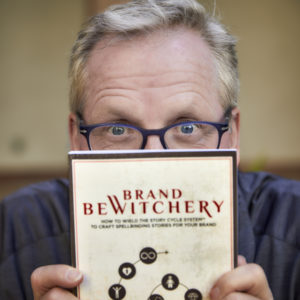
≈ Park Howell is Founder of The Business of Story, Creator of the Story Cycle System™, Author of Brand Bewitchery and The Narrative Gym, Host of the Popular Business of Story Podcast, and Co-Creator of the StoryCycle Genie®.
What’s in It for You — Five Things You’ll Learn from This Conversation
- Why humans are neurologically wired for story — and why data alone never moves an audience to action
- The ABT framework in action — watch Park build an And-But-Therefore live on the air, from scratch, in under five minutes
- The Five Primal Elements of a short story — the minimum viable ingredients any anecdote needs to make a business point that sticks
- How narrative entropy silently destroys brand coherence — and the StoryOps™ discipline that stops it
- Why AI is artful intelligence when governed by story — and how the StoryCycle Genie® compresses months of brand strategy into hours
Full Transcript — JUST Branding Podcast with Park Howell
Why Story Is Still the Most Powerful Tool in Brand Building
Matt: Hello, everybody, and welcome to the latest episode of JUST Branding. We’re going to be tucking into storytelling and particularly thinking about why story still wins in brand building.
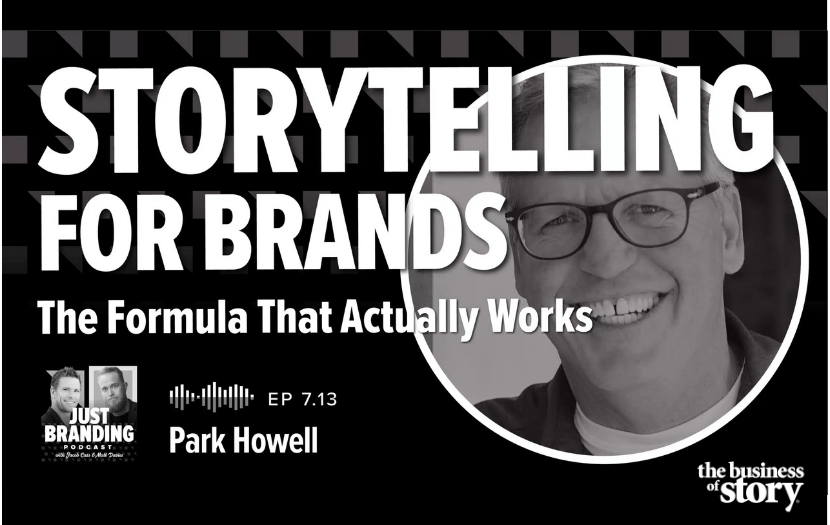
That is where the meaning and the value of a brand truly lies. So story is so important for us to wrap our arms around and get to grips with as we manage brands. And today we have the perfect gentleman to tuck into this beautiful subject with us. We’re joined by the one and only Park Howell to help us explore this. For those of you that don’t know Park, he is known as the world’s most industrious storyteller. He’s the founder of The Business of Story podcast, an Emmy award-winning brand strategist and host of one of the world’s leading podcasts on storytelling.
Park has shared the stage with Robert Redford, coached leaders on Necker Island, trained with the US Air Force for many years — and throughout his 40-plus year career, you don’t look like you’ve had a 40-plus year career, Park, just putting it out there.
Park: Glad to hear that.
Matt: Throughout that career, he’s helped organizations harness the power of story to build stronger brands, win more business, and create deeper connections with their audiences. He has also been exploring how AI can amplify rather than replace the strategic role of storytelling. Park, welcome to our show.
Park: Matt, thank you so much. Jacob, great to see you. I appreciate being on your program.
How a 40-Year Career in Advertising Led to the Business of Story
Matt: For those that perhaps haven’t come across you, Park, why don’t we start with the story of how you got into storytelling?
Park: I got into the advertising, branding, and marketing world well over 40 years ago. I ran my own ad agency in Phoenix, Arizona called Park & Co for 20 years. One of the things we were always really good at was taking complex messages and making them simple and interesting and compelling to consumers.
People would always come to me and say, look, I’ve got this big idea and this company, but nobody knows what we do. And I’d say, okay, pump the brakes. Take a breath. Give me your intel. Let’s figure out what is that core brand narrative. That’s really what I’ve done for 40 years.
About 10 years ago, I weaved away from being an ad agency owner and went totally into the Business of Story, where I now consult, teach, coach, and speak on the power of story to leaders around the world — from one-star to four-star generals and their staff at the US Air Force to Walmart Canada to still building brand stories for major companies.
What Gets Park Howell Out of Bed Every Morning
Jacob: Why do you keep doing what you’re doing? What gets you out of bed in the morning?
Park: Everybody asks me, are you retired yet? And I’m like, well, define retirement for me. I’ve not worked for anybody else but myself for 35 years. So if I were to retire, I’d be retiring from myself. And what? I can only play so much golf and build so many birdhouses.
I’m still really fascinated by the world of communication and storytelling, and how we homo sapiens — we storytelling apes — make meaning out of the madness of being human beings. And then how, when you become an intentional storyteller, the impact you can have on a person, on a team, on a society is really quite remarkable. That’s what keeps me going.
The Neuroscience of Storytelling — Why the Human Brain Is Wired for Narrative
Matt: Why does a story move another person beyond, say, some facts and some figures or some data?
Park: Let’s go way back. Let’s go 70,000 years back and find a cave on the savanna. We’ve got a cave mate — let’s call him Larry. He’s hanging out by the fire, warming his hands. In walks his other cave mate, Thog, with a broken fishing pole looking pretty disheveled.
Larry looks up — we’ll call him Jacob, actually — and says, Matt, where have you been? And Matt says, well, I was down at the river fishing, and a saber-toothed tiger showed up. Jacob goes, uh-huh. Matt says, but the saber-toothed tiger shows up. Jacob goes, uh-oh. Matt finally says, well, I gave salmon to the tiger. It likes salmon better than Matt. Therefore, I’m back here at the fire safe with you. And Jacob goes, uh-huh.
Three grunts. Three-act story structure. Setup, problem, resolution.
Stories serve the same purpose today that they did 70,000 years ago — as a learning tool, a meaning-making tool. Now Jacob knows if he finds himself out at the river with a salmon and a saber-toothed tiger shows up, he knows what to do for survival.
Let me ask you this: what’s the first syllable of the word “numbers?” Num. Numbers mean nothing to our brain unless they’re put in the context of a story so that our brain can picture it, can feel it, can understand it — and then it uses those logic-driven numbers to support the story we’re trying to tell.
Stories are as important to our survival as oxygen is to our lungs.
Why Brand Storytelling Became a Buzzword — and Why It Still Matters
Jacob: Storytelling has been used much more in the past decade than in all the previous years. Why all of a sudden has storytelling become this big buzzword?
Park: I first started hearing about story when I was running my agency in 2003. And I was talking to our creative director, Luis Medina, and I go, well, don’t we all do story? And we just had never talked about it.
That year I looked at a TV campaign we’d run — two 30-second commercials. The first one polled unbelievably well. It increased same-store sales by 42% the very next month. The second spot did nothing. The client made us pull it. And I didn’t know why that second one didn’t pull until I started studying story structure.
I realized that first one was intuitively a very well-structured story. The second one had no story structure at all. It was just us being creative and we loved it — we were going to win awards with it — but it meant nothing to the people who watched it.
After I started studying story, I realized we all fall into the trap of being intuitive storytellers. But if we leave it to our intuition, we end up winging it more than winning with it. The key is to become an intentional storyteller. You do that by truly understanding story frameworks.
I’ve got three that I work with:
- The ABT — And, But, Therefore. A three-word structure that will blow your mind.
- The Five Primal Elements of a short story — a story you can tell in under one minute that shows or makes your business point for you.
- The 10-Step Story Cycle System — the overarching brand story framework for strategy development and long-form communication.
The ABT Framework — How to Build an And-But-Therefore Story Structure
Matt: Let’s tuck into those three frameworks. Let’s start with the And-But-Therefore.
Park: Let’s show it in action. We are going to build an ABT live for your JUST Branding Podcast.
The ABT uses the three forces of story — agreement, contradiction, and consequence — that your pattern-seeking, problem-solving, decision-making limbic brain loves. It hand-delivers meaning without your brain having to work for it.
Story truth number one: you are not the center of your story. Your audience always is.
So, Matt and Jacob — as specifically as possible, who is the audience for this show?
Matt: Brand builders seeking to get more strategic.
Park: Good. And why is that important to them? What’s in it for them to become more strategic?
Jacob: To become more valuable to their clients and colleagues.
Park: Perfect. That’s our “and” statement of agreement. We’ve introduced our audience. You are a brand builder who seeks to become more strategic. And if you do, you will become way more valuable to the clients and colleagues you serve. That’s your statement of agreement — you don’t start with the problem, you start with the shared vision for the future.
Now let’s pull the rug out from underneath them. But what problem do they currently have that’s keeping them from becoming more strategic?
Jacob: They don’t have clarity on how to do it. They might feel a bit lost and confused.
Matt: And there’s a lot of noise out there. One other thing — people are a little worried that AI is going to come and eat their breakfast.
Park: That’s it. Now, a key rule: I want the negative emotion first, then use “because” to set up the problem. The word “because” speaks directly to the cause-and-effect meaning-making apparatus in our survival limbic brain.
So — but you feel lost, you’re confused because you don’t have the clarity on how to build your strategic skills. And AI is making it even worse.
Now let’s resolve it. Therefore, what is your solution?
Jacob: Listen to JUST Branding. You’re going to hear insights from knowledgeable experts from around the world. New perspectives. Tools and practical examples to use in their work.
Park: All right. Here’s your complete ABT:
You are a committed brand builder seeking to get more strategic in all you do. And if you could find the insights and the people who have been there before, you can grow and become more valuable with the clients and colleagues you serve — which also leads to even more respect for your profession and you.
But you feel lost and confused because you don’t have the clarity on how to build your strategic skills — and AI is making it even worse.
Therefore, become ecstatic over the insights, expertise, and tools you are going to learn when you listen to JUST Branding — the only podcast over the past nine years that has brought you brand story leaders from around the world who generously share their insights so that you can have the same success they do. Welcome to the show.
Matt: We’re going to use that as a new intro, Park.
Park: Good. Now here’s the rule: don’t let your call to action come in until the second clause of the “therefore” statement. That way, you keep it all about your audience and what’s in it for them.
How to Tell a Short Story That Makes a Business Point — The Five Primal Elements
Matt: Let’s move to the second framework — the Five Primal Elements.
Park: The five primal elements of a short story for big impact. There are five beats to this anecdote.
I used it on you when I told you the cave story. Let me break it down:
- Location stamp — the savanna. This fires up the theater of the mind.
- Time stamp — 70,000 years ago. The timestamp triggers the limbic brain: something must have happened, I better pay attention.
- Central character — Larry. A story is always about one individual.
- Action and surprise — the saber-toothed tiger shows up.
- The aha moment — I give salmon to tiger. It likes salmon better than Thog. Therefore, I’m safely back with you.
Jacob, take me to a moment in time that illustrates that JUST Branding is a go-to podcast for branding.
Jacob: All right. I got an Instagram DM from someone I’d never met — his name was Jude. He said I put the wrong cover graphic on one of our podcast episodes. The action I took was quickly fixing the graphic. Then I said, can I be a little cheeky and ask for a review? You sound like you’ve been enjoying the pod. And he said sure — and he sent the review in.
Park: What I read into the moral, Jacob, is this: in branding, some of your most powerful moments come at the brand’s worst times.
Not a great moment because we all make mistakes. But instead of apologizing and being embarrassed, you said, thank you very much — you must be a committed listener. And now you probably have an even stronger listener who gave you a review.
They can argue with your opinions and your expertise all day long. But they can’t argue with a true story well told that makes that business point for you.
Why the Hero’s Journey Is a Brand Strategy Blueprint
Park: All of this leads up to the biggest story structure of them all — The Hero’s Journey from Joseph Campbell.
I learned about it first in the early 2000s, when our son was going to film school at Chapman University in Orange, California. He said, Dad, read Joseph Campbell’s The Hero with a Thousand Faces. I did. And I went, oh my God — this is a customer journey. This is an agency owner’s journey. This is every journey we’re all on.
The Hero’s Journey is simply a very large, expanded ABT. The first part is the “and” section — setting the stage. The big long middle, where the protagonist goes into the weird world with all its trials and tribulations — that’s the “but.” The short third act that brings it all together is the “therefore.”
When I saw that, I said, this would be amazing in brand building. But I was afraid business people might think it’s too Hollywood woo-woo. So I mapped it to my 10-Step Story Cycle System.
Step 1: What’s your position in the marketplace? Step 2: Who’s your hero? Step 3: What do they want, and why is it important to them? Then you move through antagonistic forces, how to leverage conflict, and how to introduce the mentor — which is the brand — and the journey begins.
How to Use Storytelling Frameworks in Boardrooms Without Saying the S-Word
Jacob: How do you get over the woo-woo factor in a boardroom?
Park: Number one: never say the word story. Never say, let me tell you a story — because their defense shields will immediately go up.
You just simply hook them with a story. They don’t even know what’s going on.
Here’s what I do. If I’m in a room, I think like I’m Spielberg and this audience is sitting in a theater. I start my presentation with an ABT — I say it in under 15 seconds to hook them on that singular problem-solution dynamic we’re going to solve in that meeting. Then I immediately follow it with a little anecdotal story using my Five Primal Elements to show them that problem-solution dynamic in action right now.
In under 90 seconds, I’ve used two story frameworks and wormholed my way into their limbic subconscious brain. They’re thinking, oh, he might be on to something. Then I level up into the logic-driven brain and say, let me now show you the numbers to support the context of the stories I’ve shared.
Don’t tell them the magic you’re doing on them. Their limbic brain runs the exact same way regardless of how smart they are. Help it make meaning first. Then bring the numbers in to create context and support around that meaning.
Why AI Amplifies Great Storytellers — and Flattens Everyone Else
Matt: Tell us about AI and how you’re using it alongside storytelling.
Park: It goes way beyond dabbling. We have almost three years in the process now, and we’ve brought to market the StoryCycle Genie®, which takes our 10-Step Story Cycle System from my book and the work I’ve done with it over 20 years.
We’ve been able to use artificial intelligence and level it up to becoming artful intelligence. Inside the Genie, yes, we’ve got API calls going to ChatGPT and Claude. But the way we’ve programmed and built and prompted it, it’s more like you’re sitting down with a brand consultant or a colleague, and you collaborate with it to create.
What used to take three or four months and $100,000 to do, you can literally now do in a couple of hours — and have the same, if not greater, impact.
Matt: Park, a couple of days ago you kindly sent us through a review — a full assessment of our brands using the StoryCycle Genie®. I gave it your website URL, and it came back with a complete 14-page report. Overall brand strength: eight out of 10. It went deep on competitive positioning, differentiation, and narrative strategy. Genuinely mind-blowing. How can people access it?
Park: People watching and listening right now can get a free brand story grade. Just go over to storycyclegenie.ai and click the red button. It’s going to ask for your name, email address, and the URL of whatever brand you want to run through — yours, a competitor’s, or a prospect’s. In about two minutes, it will run a complete assessment and give you a grade from A-plus to F-minus on how well you’re showing up in the world. It will validate what you’re doing well, reveal the gaps you could quickly fix, and inspire you with new ways to think about telling your brand’s story. Totally free. No credit card. Just go check it out.
Jacob: I got 8.4, just to rub that in a little bit.
Matt: That’s got to be wrong.
Park: And the idea is that this builds out the brand brain. Over the course of a couple of hours, it builds your foundational brand narrative, then writes the version of it for your three primary audiences, then brings it all together in a content playbook. Once that’s done, you use it for all your strategy — campaign creation, blog writing, all your content creation — and it’s always going to be on brand.
We call it story sovereignty: finding the story that only your brand can tell, and then owning it.
Why Storytelling Is More Urgent — and More Powerful — Than Ever in the Age of AI
Matt: Where do you see the real value of storytelling in today’s world of AI?
Park: Storytelling hasn’t changed. The storyteller is going through an immense evolution with AI.
The biggest challenge and opportunity for agencies right now is this concept of operationalizing a brand story — what I call StoryOps™.
Big enterprises have marketing ops, sales ops, HR ops, FinOps, supply chain ops. But nobody has story ops. Someone whose full position is to make sure that the story is not only defined but automatically implemented across the enterprise through the tools your colleagues are already using.
Why is that so important? Because we are completely being bombarded with AI slop — unbelievable amounts of information that our brain was never built to make sense of. So if you are the signal in that noise, starting with things like the ABT and a crystal-clear brand story that’s been completely operationalized through the enterprise, you are not going to get drowned out.
When you don’t control your story, AI bots will control it. And they’re going to destroy it. It’s going to go into complete narrative entropy.
The only way to stop that is through story ops — because storytelling is not going to change. From Thog and Larry in the savanna to where we are today, it’s still the fundamental tool that we, homo sapiens storytelling apes, use to make meaning out of the madness of being human beings.
Rapid-Fire Branding Wisdom — Quick Answers from Park Howell
Matt: Let’s do a quick-fire round.
Park: Best brand story ever told?
Patagonia. They do a brilliant job in storytelling.
Matt: One brand that understands storytelling better than anyone else?
Park: Virgin. Sir Richard Branson. His whole life is one big, unbelievable narrative very well told. He plays that over into everything he does.
Matt: One storytelling myth you’d love to kill?
Park: That you think you’re telling a story and you never get out of “and, and, and.” You are anding your world to death. Insert the “buts” — then resolve the pain with the “therefore.”
Matt: A book every brand builder should read?
Park: Christopher Vogler’s The Writer’s Journey. It’s written for screenwriters and it’s in its fifth edition, but it’s one of the most marvelous explorations of the hero’s journey and how it works in our life. It’s not a leap for a brander to take everything Hollywood knows and start applying it in your world.
Matt: AI — friend or foe to storytellers?
Park: Friend. Don’t approach it as artificial intelligence. Approach it as artful intelligence. It is going to scale your storytelling abilities way beyond where you currently are. It’s not going to do it for you. It’s going to do it with you.
Jacob: One word that defines a great brand story?
Park: Enthralment. Capturing the fascinated attention of your core audience. Isn’t that what every brand wants to do?
Matt: If every brand did one thing differently tomorrow, what would it be?
Park: Assemble all your leaders in a room — it could be two people, it could be 20. Ask them each to write an ABT about your brand’s story. Compare the notes. You’re going to find one in five actually know your brand’s story. Then start fixing that.
Jacob: Last piece of advice for brand builders who want to become better storytellers?
Park: Study what Hollywood knows. Get Christopher Vogler’s book. Really understand that story is all about setup, problem, resolution — just like Aristotle said. And don’t be fearful of including that middle. That’s where all the grimy, disgusting conflict is. If you don’t have conflict, you don’t have a story. If you don’t have a problem, they don’t need your solution.
A customer once told me: sales is nothing more than find the hurt, amplify the pain, heal the wound.
That is storytelling in a nutshell.
Matt: Final thing — if folks want to follow up with you, how do they find you?
Park: Hit my contact form at businessofstory.com and let me know you heard me on Jacob and Matt’s excellent show. Or jump over to LinkedIn — I think I’m the only Park Howell on there. And I just started a new newsletter, Brand StoryOps for Agencies. Three weeks in, I’ve already got over 1,200 subscribers. I think I’ve hit a nerve.
Matt: Good for you. Thanks so much, Park. That was Park Howell, everybody. What an awesome episode.
Frequently Asked Questions About Brand Storytelling
What is the ABT framework in brand storytelling?
The ABT — And, But, Therefore — is a three-word story structure built on the forces of agreement, contradiction, and consequence. In brand communication, the “and” statement establishes the shared vision with your audience; the “but” introduces the problem or tension that blocks them from achieving it; the “therefore” presents the resolution your brand provides. Park Howell uses it as the atomic unit of story because it mirrors the neurological wiring of the human brain’s problem-solving limbic system, making it the most efficient structure for delivering meaning in marketing, pitches, and brand messaging.
Why is storytelling more effective than data and statistics in brand marketing?
Human beings are neurologically wired for narrative, not data. Numbers mean nothing to the brain until they are placed inside the context of a story. Storytelling activates the limbic system — the part of the brain responsible for decision-making, emotion, and memory — in a way that isolated data cannot. Park Howell traces this back 70,000 years: stories evolved as survival tools, encoding meaning so that the listener knows how to act when they face a similar situation. Data supports context. Story creates it.
What is the Story Cycle System and how does it work for brand strategy?
The Story Cycle System is Park Howell’s 10-step brand narrative framework inspired by Joseph Campbell’s Hero’s Journey and adapted for business use. The system moves through three acts: the setup (backstory, hero identification, stakes), the challenge (disruption, antagonists, mentor introduction), and the resolution (journey, victory, moral, and ritual). It functions as a brand operating system, not just a messaging exercise — defining not only what the brand says but how it sustains narrative coherence across every touchpoint, team, and channel over time.
What is narrative entropy in branding?
Narrative entropy is the gradual degradation of a brand’s story as it is repeated, reinterpreted, and diluted across teams, campaigns, and time. Park Howell also calls it drama drift: when a brand story drifts in and out of focus, it creates real operational drama — inconsistent messaging, confused audiences, and a brand that sounds like everyone else. Narrative entropy accelerates in the age of AI because generative tools produce confident-sounding content without governance, compounding fragmentation at scale. StoryOps™ is Howell’s discipline for preventing it.
What is StoryOps and why do brands need it?
StoryOps™ is Park Howell’s term for the operational discipline of governing a brand story across an entire organization. Just as enterprises have MarketingOps, SalesOps, and FinOps, StoryOps™ ensures that the brand story is not only defined but automatically embedded into the tools and processes teams use daily — so every piece of content, every AI output, and every new hire reflects the same coherent narrative. In an environment where AI accelerates content production without narrative discipline, StoryOps™ is the infrastructure that keeps the brand signal from disappearing into noise.
How can AI enhance brand storytelling without replacing human creativity?
Park Howell frames AI not as artificial intelligence but as artful intelligence — a tool that amplifies human narrative capability rather than substituting for it. The StoryCycle Genie® is built on this principle: it governs AI outputs using the Story Cycle System™ so that brand content stays coherent, differentiated, and on-brand at speed. The key distinction is governance: AI trained on a strong brand narrative produces high-fidelity storytelling; AI operating without that governance produces what Howell calls AI slop — plausible, forgettable content that flattens every brand it touches.
What is story sovereignty in brand strategy?
Story sovereignty is Park Howell’s term for a brand’s ownership of the specific narrative that only it can tell. It’s the opposite of narrative entropy. A brand with story sovereignty has identified its founding convictions, encoded them into a governed Brand Brain, and deployed them consistently across every channel, team, and AI output — so that the brand’s most distinctive story cannot be replicated by competitors or eroded by scale. It is the goal of the StoryCycle Genie® process.
What are the Five Primal Elements of a short brand story?
The Five Primal Elements are the essential building blocks of any anecdotal story designed to make a business point: (1) a time stamp that triggers the brain’s attention mechanism, (2) a location stamp that activates the theater of the mind, (3) a central character the audience can follow, (4) an action sequence that creates tension or surprise, and (5) an aha moment — the moral or learning that transfers value to the listener. Park Howell uses this framework to help business leaders tell under-one-minute stories that prove a strategic point more powerfully than any slide or statistic.
How do you use the Hero’s Journey framework in brand building?
Joseph Campbell’s Hero’s Journey maps a universal narrative arc — call to adventure, trials, transformation, return — that Park Howell adapted into his 10-Step Story Cycle System for brand strategy. In this application, the customer is the hero, not the brand. The brand plays the role of mentor or guide. The journey moves from identifying who the hero is and what they want, through the obstacles that block them, to the transformation your brand enables. This structure works because it mirrors the felt experience of every real buyer’s decision — the psychological stages are not invented; they are documented in thousands of years of human narrative.
Where can brand builders learn more about Park Howell and the Business of Story?
You can reach Park directly at businessofstory.com, connect with him on LinkedIn (he’s the only Park Howell there), or subscribe to his newsletter Brand StoryOps for Agencies on LinkedIn. To get a free brand story grade for your own brand or a competitor, visit storycyclegenie.ai and click the red button. You’ll receive a complete 14-point storytelling assessment — from A-plus to F-minus — delivered in about two minutes, no credit card required.