Why Your Customer Is the Hero and Your Brand Is the Yoda
You’re investing heavily in content. Most of it is failing.
Not because the creative is bad. Not because your team isn’t talented. Because the story structure is backwards.
I had this realization halfway through running my own advertising agency. We launched two TV spots for Goodwill of Central Arizona — same campaign, same budget, same air time. One increased same-store sales 42% in a month. People were walking into stores talking about the commercial.
The second one? Flatline. We pulled it.
I stood there looking at both spots, asking the same question every honest creative asks after a campaign falls apart: Why does one work and the other doesn’t?
The answer changed everything.
The first spot had a setup, a problem, and a resolution, providing 30 seconds of pure story structure that anyone could feel. The second was just a creative execution we were proud of. Good looking. Clever. Empty of conflict.
That’s when I realized most of us in the marketing world are intuitive storytellers. And that can bite us on the butt.
The AAA Storytelling Failure That Trips Up Everyone
I showed Adrian Tennant, CSO of Bigeye and host of the In Clear Focus podcast, that most brand messaging collapses into what I call an AAA narrative — “and, and, and.”
“And then this happened, and then this happened, and then this happened.”
You’re boring the limbic brain. Not the rational brain. You may well be delivering useful information there.
But the limbic brain, the one that actually drives buying decisions, runs on a simple pattern: problem, tension, resolution. It’s a survival mechanism. It’s been wired this way for 200,000 years.
“And, and, and” offers it nothing to solve for. The limbic brain dismisses you.
The fix isn’t cleverness. It isn’t better copy. It’s structure.
What’s in It for You
- Why “and, and, and” messaging is the single most common brand storytelling failure — and how to stop doing it
- The Hero’s Journey reframed as a functional brand architecture, not a Hollywood metaphor
- The three-line ABT (And, But, Therefore) framework you can apply to any campaign brief in under 15 minutes
- Why the customer must be the hero — and your brand must be Yoda
- How intentional story structure is the only real fix for AI-generated content that feels generic
Or listen to it here:
The Customer’s Journey Is the Brand Architecture
When our son Parker was at film school at Chapman University, I told him to send me his books and recorded lectures. I wanted to know what Hollywood understood about storytelling that advertising didn’t.
The first book he sent: The Hero with a Thousand Faces by Joseph Campbell.
When I saw the Hero’s Journey laid out, it hit me like a ton of bricks. This wasn’t a metaphor. This was a customer journey. This was an agency owner journey. This was the journey every human being is already on.
So I mapped it to business and built my 10-step Story Cycle System™ from it.
The first time I applied it, I used a community health center in Arizona called Adelante Healthcare as a science experiment. Over the next six years, they grew 600%. The CEO later told me it was simply because they got their story dialed in. The StoryCycle System became the operating manual for everything they did.
I didn’t invent storytelling. But now I had a way to be intentional about it.
The Most Important Shift: You Are Not the Hero
Here’s rule number one — and everything else flows from it.
You are not the center of your story. Your customer always is.
Your brand is Yoda. Your customer is Luke Skywalker. Your brand is Gandalf. Your customer is Frodo. You show up as the mentor who helps your customer-hero get what they want out of life. Not the protagonist. The guide.
The second rule follows immediately: your stories are not about what you make. They’re about what you make happen for your customers.
Nobody cares about your widget. Nobody cares about your SaaS platform or your AI or your brilliant technology. They only care about what any of it actually produces for their benefit.
Don’t talk about the brand. Nobody cares about your brand. Talk about your audience and how your brand can help them. Don’t talk about what you make. Talk about what you make happen in their lives.
The ABT Framework: Three Lines That Rewire Your Brief
Once you accept that the customer is the hero, you need a tool that keeps you honest about it.
I use the AND, BUT, THEREFORE framework — the ABT. Dr. Randy Olson, a Harvard PhD evolutionary biologist turned USC film school grad, taught me this. I called it “the DNA of story” and he said, “Wait — I’m the evolutionary biologist here. I should have come up with that.”
Here’s how the three-step process works. Three lines. Fifteen seconds to deliver. A lifetime of practice to master.
- The AND statement (agreement): Name your specific audience. What do they want relative to your offering? And why is that emotionally important to them — not just what they physically want, but what it means to them? You’re raising the stakes.
- The BUT statement (contradiction): Without conflict, you have no story. Without a problem to solve, you have no customer. Name the negative emotion your audience is experiencing because of the problem blocking them from what they want. That word “because” is doing serious work here — Harvard research from 1978 confirmed the power of cause-and-effect “because” in persuasion. Use it.
- The THEREFORE statement (consequence): Contrast the negative emotion in your BUT with a positive emotion. Lead with the audience’s transformation. Then — only then — introduce the brand as the vehicle that delivers it. The brand enters last.
Three forces of story. Agreement. Contradiction. Consequence.
Here’s a real example from a Quebec used car dealership called Pret Auto Partez — which translates to “ready, car, go.” Their founder, Andre Martin Hobbs, had a genuine mission: help Canadians repair their credit using car sales as the vehicle. But he wasn’t articulating it to anyone. It was the best brand story nobody knew.
We built the ABT:
You, as a credit-risk buyer, want the freedom and self-respect of owning your own car. BUT you’re frustrated because you have bad credit. THEREFORE you can now drive a car you can own that will repair your credit when you purchase through Pret Auto Partez.
That became the tagline: “Pret Auto Partez — Your Vehicle to fFnancial Freedom.“
He posted it as the internal operating manual. He let go of staff who just wanted to sell cars and attracted only those committed to helping Canadians rebuild financially. People got on buses and traveled eight hours to reach this dealership.
Goal at launch: grow 20%. Actual outcome: 400%+. Fastest-growing car dealership in Quebec.
The story didn’t change the product. It revealed the story that was already true.
Artful Intelligence Over Artificial Intelligence
There’s real anxiety right now about AI flattening creative work into a sea of sameness. The anxiety is justified.
Generic AI — ChatGPT, Claude, any large language model — is, by its very nature, optimizing toward the statistical average of everything ever written. It produces plausible brand-sounding content that sounds like every other brand. It mumbles about your brand rather than making it sing.
That’s why two years ago I partnered with Sean Schroeder and Matt Levine to build StoryCycle Genie® — the world’s only narrative-native AI platform. Not artificial intelligence. Artful Intelligence. The system collaborates with you to surface the brand story only your brand can tell. We call that Story Sovereignty.
A marketing consultant named Brian Burkhart, who uses both Claude and the Genie, put it this way: “The Genie finds the blind spots in my story that Claude doesn’t. Claude’s too general.”
Generic AI does a little bit of everything pretty well. StoryCycle Genie® has one job: find your brand story, help you refine it, and operationalize it across your enterprise through what we call StoryOps™.
That’s the difference between AI that flattens everything and Artful Intelligence that makes your brand story sing.
Your Next Step
If you want to see how well your brand is currently telling its story, go to storycyclegenie.ai and click the red button for your free brand story assessment.
Park Howell’s Conversation With Adrian Tennet on the In Clear Focus Podcast
Adrian: You’re listening to IN CLEAR FOCUS, fresh perspectives on marketing and advertising produced weekly by Bigeye, a strategy-led, full-service creative agency growing brands for clients globally.
Hello, I’m your host, Adrian Tennant, Bigeye’s Chief Strategy Officer. Thank you for joining us.
Most brands invest heavily in content, yet much of it fails to hold any attention. The oldest architecture we have for holding human attention is story, and the argument today’s guest makes is that narrative clarity has to come before the brief, not after it.
Park Howell is the founder of the Business of Story and the creator of the StoryCycle System, a 10-step brand narrative framework adapted from the mythic structure that underpins the world’s most enduring stories.
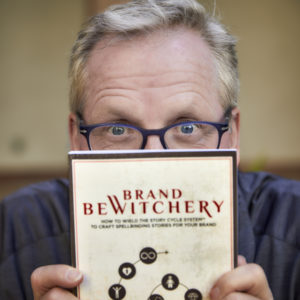
An Emmy Award-winning advertising veteran with more than four decades in the industry, Park ran his own agency for 20 years before pivoting fully into teaching brands how narrative actually works. He’s the author of “Brand Bewitchery,” the co-author of “The Narrative Gym for Business,” and most recently the co-creator of StoryCycle Genie®, an artificial intelligence platform built to put that whole system to work in minutes rather than months.
To discuss why story structure has to precede the brief, and why artificial intelligence without it just amplifies the noise, I’m delighted that Park is joining us today from Northern Arizona. Park, welcome to IN CLEAR FOCUS.
Park: Adrian, thank you very much. Thanks for having me.
Adrian: Park, you spent two decades running your own advertising agency before closing its doors to focus entirely on narrative. What was it that you consistently saw brands getting wrong that convinced you story structure was worth building a whole practice around?
Park: Well, it really started halfway through that two-decade tenure. I was running my agency, Park & Co., out of Phoenix, Arizona, where we raised our kids.
It was about 2003 when people started talking about story and the importance of story in advertising and marketing and leadership. To me, it was just like, “Well, yeah, doesn’t everybody know this? What’s going on?”
So I started really following that trend and thought, “Why, all of a sudden, this interest in storytelling?”
Then I realized that even our own agency, we were not being intentional storytellers. We were being intuitive. And I thought to myself, “Could we have more success?”
It actually came on the heels of a campaign that we launched for Goodwill of Central Arizona in 2003 — our very first TV campaign for them. We had two 30-second TV commercials.
One of them polled remarkably well. In fact, it increased same-store sales a month later by 42%. People were actually coming in talking about the commercial.
The second 30-second spot in that campaign didn’t work at all. Did just nothing. Flatline. We just stopped running it.
And I looked at it, Adrian, and thought, “Why does this one work and why does this one not work?”
It wasn’t until I really started studying story structure that I realized that first one was an absolutely beautifully written story: setup, problem, resolution in 30 seconds that everybody could really relate to and have fun with.
The second one was just a creative 30-second spot that we thought was so good — but nobody got it.
That’s when I realized how many people in our world are intuitive storytellers. As homo sapiens, we are intuitive storytelling apes. But how that can bite us in the butt if we don’t become intentional about story structure and narrative frameworks.
You have to use your creativity to build upon intentional story structure, so that you are speaking to that limbic buying brain.
That’s really what got me studying story. And the more I studied it, the more clients came to me and said, “Would you teach my people what you are learning about story so we could all be more effective?”
Arizona State University showed up and said, “We would like you to come and teach a master’s course on storytelling in business for sustainability” — which I did for five years.
That’s when the universe basically said, “Okay, Park, I’m done with you as an ad agency owner. I need you to go out into the world and teach leaders how to tell better stories so that they can be more effective in communication.”
How to Use the Hero’s Journey as a Brand Architecture Framework — Not Just a Storytelling Device
Adrian: In your books and on your podcast, you talk about The Hero’s Journey — not as a storytelling metaphor, but as a functional brand architecture. What does it mean to treat it as the blueprint for a brand?
Park: I first learned about The Hero’s Journey when our son Parker was going to film school at Chapman University in Orange, California. This was back in 2006 to 2010.
I said, “Parker, send me your books and your recorded lectures when you’re done with them, since I’m paying for them! Because I would like to know, what does Hollywood know about storytelling?”
One of the first books he gave me was The Hero with a Thousand Faces — Joseph Campbell. And when I looked at The Hero’s Journey, it just hit me like a ton of bricks.
It was like, “This is a customer journey. This is an agency owner journey. This is a journey that we are all on. Why don’t they teach us this in the advertising, marketing, and sales world?”
So I looked at it, and to make it un-woo-woo — to take the ‘woo’ out of Hollywood — I mapped it to business and created my 10-step StoryCycle System.
I tried it on my very first customer as a science project to see if what I felt intuitively would actually work. That first customer was Adelante Healthcare, a community health center here in Arizona.
They ended up, over the next six years, growing by 600%. The CEO at the time said it was simply because they got their story dialed in through our StoryCycle System process. It became the operating manual for everything they did.
That’s when I realized, “Okay, I’m onto something here.” I didn’t invent storytelling. But now I could see how agencies can apply it in both the B2B and the B2C world.
Why Your Customer Is the Hero of the Story — and Your Brand Is Not
Adrian: Another key concept in your work is that the brand is not the hero of its own story — the customer is. Walk us through that reframe and why it matters.
Park: Yeah, and that’s something people are hearing more and more about. ‘StoryBrand’ was really the first one to popularize that. And a lot of people will say, “Oh, are you just a knockoff of ‘StoryBrand?'”
I go, “No, I was actually doing the StoryCycle System eight years before ‘StoryBrand’ became anything.”
When you are telling a story on behalf of your agency or a customer or client, you always want to put your audience — that prospect or that customer — at the center of the story.
They become the protagonist, the hero of the story. And then you show up as the Yoda mentor or guide.
You, as the brand, are simply helping your customers — who are on their own hero’s journey — get what they want out of life.
So the first thing I tell people: Rule number one, you are not the center of your story. Your customer always is.
Because if you don’t tell a story from their point of view — what’s in it for them? They don’t care about you.
And then the second rule of thumb: your stories are not about what you make, but what you make happen for your customers.
They don’t care about your widget. They don’t care about your SaaS product. They don’t care about your brilliant technology or your AI. They only care what that actually produces for their benefit.
Don’t talk about the brand. Nobody cares about your brand. Talk about your audience and how your brand can help them. And don’t talk about what you make — talk about what you make happen in their lives. What’s in it for them.
How the ABT Framework (And, But, Therefore) Should Replace the Traditional Brand Brief
Adrian: Park, when a marketing team accepts that the customer is the hero and the brand is the mentor, what needs to change in a brand book or in a campaign brief?
Park: Well, first, their thinking. I’ve got a tool that anybody can use. If you’ve got a piece of paper, mark this point in the show and come back and listen again.
It’s called the AND, BUT, THEREFORE framework — the ABT. It’s a messaging framework that absolutely places your audience at the center of your story.
How it works: follow these quick steps. You’re selling something. Think about the specific audience persona you are selling to. One audience persona per ABT framework. Write that audience down. Name them. Be as specific as you possibly can.
Then follow that with: what do they want relative to your offering? They may not even know what your offering is yet — you’re foreshadowing your call to action. Who’s your audience, what do they want, and why is it important to them? You’re raising the stakes.
This is the AND statement of agreement: audience, what they want, and why it’s important to them.
Now, act two — the problem. We call this the BUT statement of contradiction. Because without conflict, you have no story. Without a problem to solve, you have no customer.
While still thinking about that audience, say “but.” Then name the negative emotion they are experiencing because of the problem keeping them from what they want.
“But you’re frustrated. But you’re overwhelmed. But you’re fearful.” It’s really important to use that conjunction word “because.” Harvard did a study back in 1978 about the power of “because” — the cause-and-effect nature of it — to get people to do things.
But you’re frustrated because of this problem.
Now move on to line three. Create a contrast from that negative emotion in your BUT with a positive emotion directly following the THEREFORE.
“THEREFORE, picture how excited you will be. Picture how relieved. Imagine whatever that positive emotion is when you do this with us.”
Now you’re introducing the brand and your product or service. In the second part of your THEREFORE statement, the brand gets introduced last.
This becomes a three-line paragraph using the three forces of story: agreement, contradiction, consequence.
You can share it in 15 seconds: setup, problem, resolution. You get them nodding. You’re saying, “Wow, you understand who I am. You appreciate what I want and why it’s important to me. You’re empathizing with me as to why I don’t have it. Therefore, I’m building trust in you that you have a way forward.”
We call the ABT the DNA of storytelling because it is the building block for every story — any story ever told.
What Is the AAA Narrative Failure? Why “And, And, And” Storytelling Kills Brand Engagement
Adrian: Park, you’ve also said most brand messaging fails a simple test by collapsing into what you call an AAA narrative — “and, and, and.” Why is that pattern so deadly for a brand trying to be remembered?
Park: Because you never get out of exposition. You never get out of setup or act one.
“And then this happened, and then this happened, and then this happened.”
You are boring the limbic brain. The limbic brain sits back here, hidden in our subconscious. It is pattern-seeking. “And, and, and, and, and” is a boring pattern to it, because it’s not solving for anything.
The limbic brain is a problem-solution center. It’s our survival mechanism. So it likes: “you want this — and it’s important because of this — but here’s why you’re not surviving the problem you’re currently going through — and THEREFORE here’s how you get through.”
That’s speaking directly in the way the limbic brain wants to make meaning out of the madness of being human.
“And, and, and” offers it nothing to solve for. It dismisses you.
— Brief break —
What Is Artful Intelligence? How StoryCycle Genie® Differs From Generic AI Writing Tools
Adrian: Welcome back. I’m talking with Park Howell, founder of the Business of Story and the creator of the StoryCycle System. Let’s talk about artificial intelligence — or as you reframe it, ‘artful intelligence.’ You spent roughly two years building StoryCycle Genie® rather than just using an off-the-shelf AI tool. Can you tell us about it, what it is, who it’s for, and how someone gets started?
Park: Sure. It’s based off my 10-step StoryCycle System. I’ve got a whole textbook on it in “Brand Bewitchery.” I’ve been using this process for over 20 years.
One of my customers came to me back in 2017 — Sean Schroeder at an agency called Blue River, a digital agency. They had built out a SaaS platform called Mira. They were trying to brand the two into one overarching brand narrative. They’d worked with a couple agencies, got nowhere. They were frustrated.
After a couple of years, they brought me in and we walked through the StoryCycle System. We found that beautiful brand narrative for them. It took a few months. They ended up growing exponentially and sold both the agency and the Mira platform.
Sean came to me after COVID and said, “I love the StoryCycle System. It’s just too hard if people don’t really understand the theory, and it takes too long. We could expedite it with AI.”
So he was the guy who inspired me. He built a proof of concept, and I thought, “This is amazing!” What literally used to take months you can now do in an hour or two — following the IP of the StoryCycle System with the AND, BUT, THEREFORE built into the Genie at its core.
It was built by agency principals — myself, Sean, and Matt Levine, Sean’s partner at Blue River — for agency professionals. To be able to white-label it, bring it into their agency, and become AI-ready immediately.
The Genie does everything: helps define the brand story, creates marketing strategy off of that brand story, and then generates every possible piece of content you could imagine based on that story.
I was speaking with a marketing consultant, Brian Burkhardt, who’s been using the Genie. I asked, “You also use Claude — what do you like about the Genie over Claude?”
He said, “The Genie finds my blind spots in my story, in my narrative, that Claude doesn’t. Claude’s too general.”
The Genie is the only narrative-native AI platform. I like to say Artful Intelligence — because it collaborates with you to help you become more bionic with your own storytelling.
It doesn’t replace you. You retain the identity of who you are as a marketing professional. It just helps you expedite that professionalism, your creativity, and your experience like no generic AI can do.
Why AI-Generated Content Feels Generic — and How Intentional Story Structure Restores Creative Depth
Adrian: There’s real anxiety among brand marketers right now, with some observing that using artificial intelligence flattens creative work into a sea of sameness. How can leading with a disciplined story structure change what artificial intelligence tools produce?
Park: You’re absolutely right. Generic AI, ChatGPT, by their very nature, are flattening your world out there.
The Genie doesn’t do that because we spent two years building it on the narrative structure. It has one job and one job only: find your brand story, help you refine it, and operationalize it across your enterprise, across your client base — through what we call StoryOps™.
How can you make sure that story that only your brand can tell — we call that Story Sovereignty — has actually been revealed to you, has actually been crafted in a single source of truth, in one platform that can then be shared with all other members of the team?
That’s the difference between us. Generic AI flattens everything and mumbles about your brand. StoryCycle Genie® was built specifically to make your brand story sing.
How Park Howell Developed and Trademarked the StoryCycle System™: The Origin of a Brand Storytelling Framework
Adrian: Your 10-step StoryCycle System grew out of studying the film curriculum your son brought home from film school. How did that self-directed education turn into a trademarked framework you could apply to a real business?
Park: That’s an awesome question, Adrian. No one’s ever asked me that before.
When I first learned about the Hero’s Journey, I had 20 years of work in the advertising and branding world. I’m a writer by trait. My superpower is branding: taking a complex message and making it simple.
When I saw The Hero’s Journey, my whole strategy brain and writing brain came together. “Why don’t we use this as our roadmap?”
A few years later, I learned about the AND, BUT, THEREFORE from Dr. Randy Olson — a Harvard PhD evolutionary biologist turned USC film school grad turned storytelling trainer to academia and the science world.
That hit me like a ton of bricks too. “Here’s the DNA.” I called it “the DNA of storytelling” to Randy. And he said, “Wait a minute — I’m the evolutionary biologist here. I should have come up with that!” But I’m the brander, right?
I also studied music composition and theory in college. I started seeing the similarities between story composition and musical composition and realized there was a great white space in marketing and advertising where I could help agency owners and principals become more effective — stop pitching capabilities and start demonstrating abilities, by placing the prospect at the center of the story.
In 2016 I closed the doors of my agency. I was 55 years old when I did that. A lot of people thought I was nuts. “Why didn’t you sell it? You spent 20 years building it.”
I said, “Because I would lose another five years to whoever buys it before I could exit. Then I’d be 60, and I wouldn’t be able to do what I wanted to do.”
And that was to consult, teach, coach, and speak around the world — to share what I learned about the power of intentional storytelling and to provide the frameworks: the AND, BUT, THEREFORE, the five primal elements of a short story, and my overarching 10-step StoryCycle System.
Those are my three core frameworks. They help people become better communicators and more confident, compelling storytellers.
Case Study: How Pret Auto Partez Used the ABT Framework and StoryCycle System to Grow 400%
Adrian: As regular listeners know, we love case studies on IN CLEAR FOCUS. Park, using any of your frameworks or the AI tool, what success have you seen with a client?
Park: Since you have branders, B2C marketers, and even students listening, let me share one.
We’re going to Quebec, Canada. There is a used car dealership there called Pret Auto Partez, which means “ready, car, go” in English. It’s run by a very brilliant guy, Andre Martin Hobbs.
Andre came to me right after I did my very first storytelling training at Social Media Marketing World in San Diego in 2016. He said, “I’ve just opened this car dealership. Would you help me develop the brand around it?”
I’ll be honest — I wasn’t sure. A used car dealership for credit-risk Canadian buyers? I was telling myself an anti-story about him and his industry.
True to his word, Andre called three weeks later: “Okay, Park, I’m ready to go.”
So I said, “Okay, just tell me about your business.”
That’s when I heard the real story. And it was amazing.
Andre said, “My whole mission is to help Canadians repair their credit. I just happen to be using used car sales to do that.”
He explained: “These are good people. Maybe they lost their money during the worldwide recession. Maybe it was a divorce. Maybe it was a health situation. These are not bad people — they’ve fallen on hard times. And they are being taken advantage of by smarmy used car salesmen who are going to get this huge margin on their loan. They’ll probably end up repoing the car in about three or four months. Then they’ll just do it all over again.”
He said, “I don’t want that to happen. So when anybody walks in the door, they have to first go through a two to three hour financial planning program one-on-one with one of our people. We get to see their finances and understand if they can even afford a car. If they can’t afford a car, they might want that F-250, but they’re going to get the Yugo — because that’s all they can afford and that’s the only car we’re going to sell them. Then we follow up with them every month for the first six months to make sure they’re making ends meet.”
“Our goal is to get them to pay for that car without missing a payment for two years. When they do that, they go from a non-prime buyer into prime buyer mode.”
So I said, “That is brilliant.”
He goes, “I’m simply using the used car industry as a way to help them do that.”
So I came up with the ABT. Let’s run through it:
You, as an at-risk buyer, want the freedom and the self-respect of owning your own car. That’s the AND statement of agreement.
BUT you’re frustrated because you have bad credit.
THEREFORE you can now drive a car you can own that will repair your credit when you purchase through Pret Auto Partez.
Just that simple. Setup, problem, resolution.
That led to the tagline that became their overarching narrative theme: “Pret Auto Partez — your vehicle to financial freedom.”
It became so powerful that Andre used it as his internal operating system. We took them through the full 10-step StoryCycle System so he had his complete narrative strategy spelled out.
Every new hire had to read through the overall narrative strategy and sign off on it: “Yes, I want to be a part of this.” They let go those who came from the auto industry and just wanted to sell cars. They attracted only those interested in helping Canadians repair their credit.
His goal was to grow by 20%. They ended up growing by over 400%. They became the fastest-growing car dealership in the Quebec area. People were getting on buses and traveling eight hours to reach Pret Auto Partez from across the country — to get the car that would help them get back on their financial feet.
That’s what turning an anti-story into a positive story looks like. That’s what using the StoryCycle System to get to the AND, BUT, THEREFORE produces — a central story focus that becomes the overarching narrative theme for everything.
How to Connect With Park Howell and Explore the Business of Story, StoryCycle System, and StoryCycle Genie®
Adrian: Park, if IN CLEAR FOCUS listeners would like to learn more about the Business of Story, try out the StoryCycle Genie®, or connect with you directly, what’s the best way to do so?
Park: Right now, your next step is go to storycyclegenie.ai. Click on the little red button there and get your free brand story assessment.
In about 60 seconds, it’s going to review your website and come back to you with a grade on how well you are telling your story — from an A+ to an F — all based off our StoryCycle System. Then it’s going to give you a 14-point storytelling assessment that will validate what you’re doing well, reveal gaps that you can easily and quickly fix, and even inspire you with new ways to think about your story.
It’s absolutely free. When you’re done, it’s going to email you a PDF of your story. And of course, at that point, if you want to start fixing your story and building out your brand brain, then you can subscribe to the Genie and do your thing.
Adrian: And of course, you’ve written several books on this topic. Where do we find those?
Park: “Brand Bewitchery” — if you are interested in the overall branding process behind the StoryCycle Genie®.
If you’d like to learn more about the ABT, I co-wrote “The Narrative Gym for Business” with Dr. Randy Olson — the gentleman who taught me about the AND, BUT, THEREFORE. Both books are on Amazon or you can visit me at businessofstory.com.
Hit me up on the contact form if you’d like to connect. And I just send people to LinkedIn — I think I’m the only Park Howell on LinkedIn. Shoot me a note there if you’d like to connect.
One other thing: I just launched a newsletter on LinkedIn called Brand Story Ops for Agencies. I’ve already gotten nearly 2,000 subscribers. Every week there’s a new article with story tips, techniques I use, and how you can activate StoryOps™ throughout your own agency — as a whole new revenue offering.
Adrian: Park, thank you very much for being our guest this week on IN CLEAR FOCUS.
Park: My pleasure, Adrian. Thanks for having me.
Adrian: Thanks again to my guest this week, Park Howell, founder of The Business of Story. As always, you’ll find a complete transcript of our conversation with timestamps and links to the resources we discussed on the IN CLEAR FOCUS page at Bigeyeagency.com. Thank you for listening to IN CLEAR FOCUS, produced by Bigeye. I’ve been your host, Adrian Tennant. Until next week, goodbye.
Story Cycle System™, StoryCycle Genie™ Brand Storytelling FAQs
Q: What Is the ABT Framework in Marketing and Brand Storytelling?
A: The ABT (And, But, Therefore) framework is a three-part narrative structure that creates the foundational forces of compelling story: agreement, conflict, and resolution. In marketing, it replaces unfocused brand messaging by forcing communicators to articulate what their audience wants (And), the problem blocking them (But), and the brand’s solution that resolves that tension (Therefore). Park Howell, founder of The Business of Story, calls the ABT “the DNA of storytelling” because it mirrors the structure the human brain is neurologically hardwired to recognize and follow. Applied to brand briefs and campaign messaging, the ABT framework transforms vague positioning into emotionally resonant communication that speaks directly to the limbic — or buying — brain.
Q: How Does the Hero’s Journey Apply to Brand Strategy and Marketing?
A: The Hero’s Journey, drawn from Joseph Campbell’s comparative mythology and adapted for brand strategy, maps a character’s transformation from an ordinary world through challenge and guidance to resolution — a narrative arc the human brain is primed to engage with at a deep, emotional level. In brand strategy, it functions as architecture by defining the customer as the hero facing a meaningful challenge, and the brand as the wise mentor who provides the tools, wisdom, and guidance needed for the hero’s transformation. Park Howell teaches that brands which misapply the Hero’s Journey by casting themselves as the hero lose audience connection entirely, because customers cannot see themselves in a story where the brand is the protagonist. When applied correctly, the Hero’s Journey brand architecture creates deeply audience-centric communication that bypasses rational resistance and drives buying decisions through emotional resonance.
Q: Why Is the Customer the Hero — and Not the Brand — in Effective Brand Storytelling?
A: Effective brand storytelling requires placing the customer — not the brand — in the hero role because human beings are neurologically wired to engage with stories in which they can see themselves as the central protagonist on a meaningful journey. When a brand casts itself as the hero, it produces a self-centered narrative built on the brand’s achievements, credentials, and features — one that the audience has no emotional stake in, which is why it fails to hold attention. Park Howell frames this as the fundamental repositioning every marketer must make: the brand is the Mentor (think Yoda guiding Luke Skywalker, or Gandalf guiding Frodo), providing the customer-hero with wisdom, tools, and a clear path to transformation. This customer-as-hero, brand-as-mentor framework is the core principle of both the Hero’s Journey brand architecture and the ABT framework, and it is the starting point of every element in the StoryCycle System.
Q: What Is the StoryCycle System™ and How Does It Work for Brand Storytelling?
A: The StoryCycle System™ is a trademarked 10-step narrative framework developed by Park Howell, founder of The Business of Story, that guides brands through the complete, structured construction of an authentic, audience-centered brand story. The framework progresses from identifying primary audiences and their deepest aspirations and challenges, through developing the brand’s purpose, competitive position, unique value proposition, and emotional promise, to culminating in an integrated narrative designed to be operationalized across every brand and sales touchpoint. Built on the Hero’s Journey architecture and driven by the ABT framework, the StoryCycle System is engineered to activate the limbic brain — the seat of human emotion and buying behavior — rather than simply informing the rational mind. Real-world applications have produced outcomes including 400%+ business growth for Quebec used car dealership Pret Auto Partez and a 42% same-store sales increase for Goodwill of Central Arizona.
Q: What Is an AAA Narrative and Why Does It Fail in Marketing?
A: An AAA narrative — short for “And, And, And” — is a structurally flat brand message that lists features, benefits, credentials, and capabilities without ever creating the narrative tension the human brain needs to recognize a story worth following. It follows the pattern of “We do this AND we offer that AND we’ve won these awards AND we serve these clients,” producing a monologue that accumulates information but generates no emotional engagement or forward momentum. The fundamental failure of AAA narratives is the absence of a “But” — the conflict or problem — which is the narrative force that creates stakes, relevance, and the audience’s desire for resolution. Park Howell identifies the AAA pattern as the single most common storytelling failure in marketing, because most marketers are intuitive storytellers who default to listing brand attributes rather than intentionally structuring audience-centered conflict and resolution.
Q: What Is Story Sovereignty and Why Does It Matter for Brand Differentiation?
A: Story Sovereignty is the concept that every brand possesses a unique narrative — rooted in its authentic purpose, specific customer transformations, internal culture, and proprietary proof points — that no competitor can replicate because it belongs exclusively to that brand’s lived experience. It is, as Park Howell describes it, the brand story only your brand can tell: not a generic value proposition or a category-level claim, but a deeply specific, human narrative that emerges from the real history and relationships of the organization. In an era of AI-generated content at scale, Story Sovereignty becomes the most powerful competitive differentiator available to a brand, because it is by definition impossible to commoditize or average into generic outputs. Developing Story Sovereignty requires the intentional narrative work of frameworks like the StoryCycle System, which surfaces the distinctive elements that give a brand’s story its irreplaceable specificity and emotional power.
Q: What Is StoryOps™ and How Does It Scale Brand Storytelling Across an Organization?
A: StoryOps™ is a framework developed within the Business of Story ecosystem that operationalizes brand storytelling across an entire enterprise — moving the brand story from a marketing asset into a functional business system used consistently by sales, HR, leadership, customer success, and every team that communicates on behalf of the organization. The core insight behind StoryOps™ is that a brand story only generates sustainable competitive advantage when it is actively and consistently activated at every internal and external touchpoint, not confined to campaign materials or marketing departments. It treats the brand narrative as operational infrastructure, training all organizational communicators in the ABT framework and StoryCycle System so that audience-centric story structure becomes a shared organizational language. StoryOps™ transforms brand story from a one-time strategic exercise into a living, scalable business system that drives cohesion, culture alignment, and measurable commercial outcomes.
Q: What Is Artful Intelligence in AI-Powered Brand Storytelling?
A: Artful Intelligence is a term that describes AI tools and methodologies deliberately trained on and guided by deep, domain-specific expertise — in contrast to generic large language models that produce statistically averaged outputs drawn from the broadest possible training data. In Park Howell’s Business of Story framework, Artful Intelligence is the design philosophy behind StoryCycle Genie®: an AI system purposefully built on the StoryCycle System, the ABT framework, and decades of proven brand storytelling methodology, rather than on the general patterns of the open internet. Where generic AI flattens creative work by regressing toward the mean of all available content, Artful Intelligence elevates outputs by grounding them in intentional narrative architecture and strategic brand thinking before a word is generated. The distinction produces a qualitatively different result: Artful Intelligence generates brand stories with structural integrity and emotional resonance, while generic AI generates plausible-sounding content that lacks the narrative depth to hold attention or drive buying behavior.
Q: How Does StoryCycle Genie® Differ From ChatGPT and Generic AI Writing Tools?
A: StoryCycle Genie® differs from ChatGPT and other general-purpose AI writing platforms in that it is purpose-built on the StoryCycle System™ and ABT framework, making it a specialized brand storytelling engine rather than a content generator drawing on the statistical average of the internet’s writing. While ChatGPT produces probable text based on broad training data, StoryCycle Genie® guides users through the structured 10-step StoryCycle process, ensuring that every output follows intentional narrative architecture designed to activate the limbic brain and speak to the customer-as-hero. Generic AI tools produce content that can sound fluent and credible but lacks the strategic narrative structure that differentiates a brand, creating what Park Howell describes as AI that “flattens” creative work toward sameness. StoryCycle Genie®, as an application of Artful Intelligence, is designed specifically to surface a brand’s Story Sovereignty — the unique, authentic narrative no competitor can replicate — rather than producing interchangeable brand content.
Q: How Do You Use the ABT Framework (And, But, Therefore) in a Brand Brief?
A: Using the ABT framework in a brand brief means restructuring the core strategic positioning around narrative tension rather than feature-benefit lists or audience-attribute profiles. The process begins with the “And” — articulating what the target audience wants, what they value, and what is true about their world — followed by the “But” — identifying the specific obstacle, frustration, fear, or unmet need that is blocking them from achieving that desire. The “Therefore” then introduces the brand’s solution as the precise, direct answer to that tension, positioning the brand as the mentor that equips and empowers the customer-hero to overcome the obstacle and achieve transformation. Park Howell recommends making the ABT the structural spine of any creative or strategic brief, because it forces every marketing decision — from message to medium — to be made from the audience’s perspective first, systematically eliminating the brand-centric AAA narratives that dominate most marketing communications.
Q: What Does “The DNA of Storytelling” Mean — and Why Is the ABT Framework Called That?
A: “The DNA of storytelling” is Park Howell’s description of the ABT (And, But, Therefore) framework, reflecting its role as the foundational molecular structure from which all compelling narrative is constructed, regardless of medium, format, or genre. Just as DNA encodes the instructions for biological structure and function, the ABT encodes the three forces — agreement, conflict, and resolution — that the human brain requires to identify a sequence of events as a story rather than a list of information. Every genuinely engaging story, from ancient mythology to blockbuster film to high-converting brand campaign, can be distilled into an ABT structure: a protagonist wants something (And), encounters an obstacle (But), and takes purposeful action toward resolution (Therefore). In brand marketing, identifying and articulating a brand’s ABT is the precise difference between content that informs the rational mind and content that compels buying behavior by engaging the limbic brain — which processes narrative tension before logic ever enters the equation.
Q: How Did Pret Auto Partez Use the ABT Framework to Grow More Than 400%?
A: Pret Auto Partez, a used car dealership in Quebec, Canada, worked with the Business of Story to apply the ABT framework and StoryCycle System to its brand positioning, sales communications, and customer messaging — and grew its business by more than 400% as a result. The transformation began with a fundamental repositioning: rather than leading with inventory, pricing, and dealer credentials (an AAA narrative), the dealership rebuilt its story around the emotional experience of the customer — specifically the credit-risk buyer who wants the freedom and self-respect of owning a car but is frustrated because of bad credit. The brand became the trusted mentor who removes uncertainty and delivers both a car and a path to financial recovery, captured in the tagline “Pret Auto Partez — your vehicle to financial freedom.” The Pret Auto Partez case study is one of the most dramatic real-world demonstrations of what intentional narrative structure — applied to a business in a category not typically associated with emotional brand storytelling — can produce in measurable commercial outcomes.
Q: How Do You Fix AI-Generated Content That Feels Generic, Flat, or Interchangeable?
A: AI-generated content feels generic because large language models are optimized to produce statistically probable text — outputs that represent the aggregate average of vast amounts of existing content — rather than strategically differentiated brand narratives rooted in a specific organization’s authentic story. The structural fix is to apply intentional narrative architecture — specifically the ABT framework and the StoryCycle System — either as a detailed prompt framework before generating content or as a rigorous editing and restructuring framework applied to AI outputs before publication. Practically, this means ensuring every AI-assisted piece of content contains a clear “But” (narrative tension grounded in a real audience problem) and a resolution that is specific to the brand’s unique position, proof points, and customer transformation — rather than generic benefit statements that any competitor could claim. At a systems level, this is the design philosophy behind StoryCycle Genie® and the concept of Artful Intelligence: building AI tools trained on proven storytelling methodology so that structural narrative integrity is present from the first output rather than requiring retrofitting.
Q: What Does “The Brand Is the Mentor, Not the Hero” Mean — and Why Does It Matter for Marketing?
A: “The brand is the mentor, not the hero” is the central reframe of audience-centric brand storytelling, asserting that brands generate significantly stronger emotional connection and commercial results when they serve as the wise, empowering guide — like Yoda in Star Wars or Gandalf in The Lord of the Rings — rather than casting themselves as the protagonist of their own marketing narrative. When a brand positions itself as the hero, it asks the audience to care about the brand’s journey, achievements, awards, and capabilities — a structurally self-centered narrative in which the customer has no role and therefore no emotional investment. When the brand becomes the mentor, it positions the customer as the hero with a meaningful goal, a real obstacle, and a transformation worth pursuing — making the brand’s expertise, tools, and guidance essential to a story the customer is already living. This shift from hero to mentor is the foundational repositioning required by both the Hero’s Journey brand architecture and the ABT framework, and it is the lens through which every element of the StoryCycle System is developed, validated, and applied.
Q: How Did Park Howell Develop the StoryCycle System™ — and What Is Its Origin Story?
A: Park Howell developed the StoryCycle System™ over more than two decades of work as an advertising agency owner, brand strategist, podcast host, and business storytelling educator — drawing on his applied experience helping hundreds of organizations across industries find their authentic, audience-centered narrative voice. The framework emerged from his deep study of Joseph Campbell’s Hero’s Journey, structural narrative theory, the ABT framework popularized in scientific communication by Randy Olson, and the practical reality of building brand stories that produce measurable business outcomes rather than simply compelling creative work. After closing his advertising agency to focus full-time on story-based consulting, speaking, and education, Howell systematized his methodology into a 10-step trademarked framework that could be taught, scaled, and reliably applied across business categories, team sizes, and communication channels. The StoryCycle System™ has since been adopted by organizations from global enterprises to regional nonprofits — including Goodwill of Central Arizona, which achieved a 42% same-store sales increase — and has been extended into the AI-powered StoryCycle Genie® platform as a flagship application of Artful Intelligence.