
How to Use the ABT In Your Brand Storytelling to Grow Your Influence, Persuasion and Revenue
As an ad agency principal or marketing consultant, you know the power of a crystal clear brand story. If you had proven way to develop and activate your differentiated brand stories, then you’d be enthralled by the success you achieve with your brand storytelling.
But you feel frustrated because you haven’t found a proven, repeatable, systematic process to create and activate your stories.
Now you do, with the timeless And, But, Therefore (ABT) narrative framework.
The ABT is at the core of the StoryCycle Genie™, the only narrative-native brand storytelling platform guided by the remarkable Story Cycle System™, which has grown brands by as much as 600 percent.
We call the DNA of Story, because it is an ancient story structure that you can use to make all of your messages land right the first time, every time.
I’ll show you why the ABT works to move people to action, how to wield it to make your communications clear, concise, and compelling, and give you loads of examples of other brands that leverage this messaging marvel.
Yes, it’s a 50-minute training. But you can jump ahead as I’ve called out the various chapters, build instructions and examples in the timecode notes below for easier navigation.
Or, just watch the whole dang thing. It’s worth it.
I promise.
INTRO
Hey, thanks for joining me for this micro training course on the and but therefore the ABT narrative framework. It really sits at the core of our story cycle genie. And so many people have asked me about what is it exactly and how do you use it? Well, we use it for messaging. We use it for unique value proposition development.
You will see within the Genie that the and but therefore plays an important role throughout because we found this little messaging marvel is like the most powerful way to make all of your messages land right the first time from your audience’s point of view. And that’s what it’s really all about. So let’s jump right in. So you get a sense of what this Genie is all about. Let me share my screen here.
So I’ve titled this presentation, How to Make Your Brand the Signal in Our Noisy World. And I should have probably added noisy, noisy, noisy world because it is so hard to stand out and to connect unless you have an important and powerful differentiator in the market and how you communicate it, your unique value proposition, essentially. So.
In the story cycle Genie, the and but therefore plays an important role as I mentioned it. It is one of three primary frameworks that we teach and we call everything we do at the business of story, the applied science and bewitchery of storytelling because well, there is truly an applied science to storytelling. It’s not just woo woo. There are algorithms, the and but therefore, the five primal elements of a short story for big impact.
the 10-step story cycle system. These are frameworks that if you follow, they work every single time. That is the applied science that then leads to the bewitchery. And you know what I’m talking about here with bewitchery. It’s when you hear a good story, you get excited, you get sad, happy, goosebumps, the hair stands up at the back of your neck. You have a visceral, energetic reaction to when you hear a good story because
NIKE ABT EXAMPLE (02:54)
Your brain is not just listening to a story. It is that neurocoupling. It’s sharing that story. It’s seeing that experience. It’s actually simulating that experience. And too few people in the advertising, branding, marketing world use story to their benefit. They lead with features and functions, logic and reason when what your audience really wants is the emotional pull of a story.
Everything we do at the business of story and in the StoryCycle Genie™ is based on what I call the DNA of storytelling, and that is the and but therefore. Let me show you one in action real quick. Let’s say Nike, for instance. What might be their ANd, But, Therefore foundational narrative framework for Just Do It? Well they might do something like,
“You want to live up to your potential, and if you start today, then you’ll discover the strength, health and confidence already inside you.”
That is our statement of agreement.
Now let’s insert the problem.
“But you’re frustrated because fear, excuses, and hesitation keep stopping you before you even begin.”
Now let’s go to the conclusion or the call to action. We call it the statement of consequence.
“Therefore, imagine the pride of proving yourself right. Just do it. Nike is with you every step of the way.”
Setup, problem, resolution. It’s the way our primal pattern-seeking, problem-solving, decision-making, limbic buying brain loves to receive information. This is the algorithm that leads to the bewitchery. Now I have shared our frameworks with many brands around the world, including the USA Air Force. Walmart Canada is a big customer teaching their people how to use it. I do a lot of work with small to medium-sized businesses in the B2B.
world at the Better Business Bureau, should say Coca-Cola, Carvana, Hilton, you name it. So this has been something I’ve been training for many, many, many years.
What is the Hero’s Journey? (04:37.754)
Before we dive into the ABT, I want to show you the bigger picture of storytelling based on Joseph Campbell and the Hero’s Journey.
This is where I first learned about it, when our son was going to film school at Chapman University back in, boy, 2006, graduating in 2010. I asked him, “Send me your books and your recorded lectures when you’re done with them, – since I’m paying for them – because I want to know what Hollywood knows about storytelling. And that’s when I was first introduced to and studied Joseph Campbell, The Hero’s Journey and The Monomyth. And it hit me like a ton of bricks. It was like, this is a customer journey.
This is an ad agency owner’s journey. This is a journey we all live in.
So why don’t they teach this framework to us in the branding, sales, marketing and advertising world? That’s what I started to do back in 2008. I took it upon myself to start sharing this big story structure with the world. Then I’m going to show you how we boil it down to the And, But, Therefore narrative framework. But first, I just want to share this quick video with you to get you up to speed if you’re not familiar with the Hero’s Journey.
Check it out.
What Makes a Hero Video: (05:30)
Story Cycle System™: Inspired by the Hero’s Journey and Applied to Brand Storytelling (09:20)
So even if you’re not familiar with the hero’s journey, you may be now. It looks very familiar, right? You’ve seen this. It is in all great movies and books and music you listen to and so forth. It has been a framework that has been around literally since the beginning of recorded storytelling. But here’s what I love about it relative to your customer journey and even the journey you’re on. When you are telling a story,
You always want to tell it from your prospect or your customer or your colleague’s point of view. You want to place your audience at the center of the story. And that’s what our story cycle system does throughout when it’s creating your narrative strategy, because you as the brand or the person or the guide are playing that role of mentor guide, helping your audiences, your prospects, your customers get what they want on their journey.
by following you through the progression of buying your products or your services to help level them up. But when you ask them to do that, you’re asking them to change and move out of status quo. That’s where we move into that special world, change or disruption. And as we all know, change can be more difficult when it first happens that you get through that J curve, as they call it, of trouble until you come out of the other end of it leveled up.
But as you’re taking people through that, you are guiding them. You are showing them the victories along the way. You are making your product or service what they need, the ideal tool they need to get through this change so that you can deliver them to the promised land, seizing of the treasure, which then returns them back to their ordinary world again. But now they’re leveled up. They’ve had success with you. And it leads to them now sharing your story, scaling your story with their world.
Through word-of-mouth marketing, and it all starts again. This was my inspiration to create the 10-step story cycle system, matching the hero’s journey, the monomyth, to business.
But instead of a closed loop, I see it as an open, expanding spiral of engagement with every revolution. What I’m talking about is when people first learn about you and your brand under brand awareness and the stories they’re buying into.
Then brand adoption, when they actually start working with you and buying your product or service, and then you are delivering on the promises you’ve made in those stories, they are now an active participant in your story, which leads to brand appreciation. And you can see how that spiral of engagement expands with every revolution to the point that now they’re telling your story with their world. And is that really what we all want is to be able to scale our stories?
This is the overarching guide for the StoryCycle Genie, everything that’s based on. This is the program that I’ve used for more than 20 years to grow brands by as much as 600%. And that is the StoryCycle system. I teach it, I train it, and I’ve got a book on it, Brand Bewitchery, that is a guide to lead you through it. And of course, you now know we have the StoryCycle Genie that is all based on this. But what I’m also training
I’m looking at simpler ways than just the 10-step process to help people share stories that make a real impact in the world. And I’ve got this five-step process, how to tell a short story for big impact with these five primal elements of a story. And I’m going to show you what that is towards the end of this presentation. But you can use these five primal elements in four different categories of stories, that connection story to build trust.
That story about change, I call it the story of truth because a lot of people, a lot of times, people don’t want to hear that change is afoot, but the truth is that it is happening, and here’s what we need to do about it. They then will often, when you’re asking them to change, create an anti-story as to why they possibly can’t change. That’s where this story of tension comes in, or what I call the overcoming of the anti-story, which you can never do with charts, graphs, facts, and stats.
The only way to overcome an anti-story is with a better story. And then finally, the story of triumph, which is a different way to tell a case study. Anyways, all four categories of these stories can use that same story chassis of the five primal elements of a short story. But what is all built on? Well, it’s built on the ABT, the DNA of storytelling that uses the three forces of story. So let’s use it just to set up this overall presentation.
An Example ABT for This Training (13:55)
As a communications professional, you want to connect deeply with your audiences AND quickly move them to action.
BUT you’re not connecting as deeply as you could because you push logical arguments, features, and functions when what our prospects really want is the emotional pull of a story.
THEREFORE, hook your prospects from the start using the ABT narrative framework that tickles the primal part of your customer’s brain where all of their real buying decisions are being made.
There it is, setup, problem, resolution. A very quick story that uses the three forces of story to hack through the noise and hook into the hearts of your prospects. And that’s where you want to be because we all buy with our hearts and then we justify that purchase with our heads.
We looked at Nike, a B2C company, right? Let’s look, how do you use this in B2B?
The Salesforce ABT as an Example in B2B Marketing (14:58)
Well, let’s take a look at what Salesforce is doing and what their And, But, Therefore might be that leads to their unique value proposition.
You want to deepen relationships with your customers. And if you can connect every interaction across sales, service and marketing in one platform, then you can deliver the seamless experiences they expect.
But you’re overwhelmed because siloed siloed systems, scattered data and disconnected teams that keep you from truly understanding your customers, leaving them feeling unseen and undeserved.
Of course, that’s the problem Salesforce is solving for. How do they solve it?
Therefore, now you can unite every touch point to deliver smarter, faster, more personalized customer success with Salesforce, the number one AI CRM.
And by the way, this is a new UVP that they’ve just created, “The number one AI CRM,” so you can see how this all levels up, and you can do this for your own company too.
Write an ABT from your audience’s point of view. What do they want relative to your offering, and why is it important to them? But why don’t they have it? What frustration? What annoying negative emotion are they experiencing because of what problem that you’re going to solve for them? Therefore, get them to picture what the future looks like with you when they work with you.
Setup, problem, resolution.
When to Use the ABT in All of Your Messaging (16:30)
Now, where do you use the ABT?
You can use it well beyond just creating unique value propositions. For instance, emails. Now, we all get ghosted all the time. And we have to write these darn emails all the time. So it’s a perfect proving ground or habit stacking, if you will. So make a goal to write three emails every single day, using the And, But, Therefore to strengthen your own skills with this messaging marvel.
And then watch what happens with engagement. I think you are going to see it go up, but what we’ve learned about the ABT and here’s the shortest ABT I know
A Home Depot sales pro asked me this one time during a training. “Park, what is the shortest ABT you know? Well…
The ABT is short AND sweet, BUT tricky. THEREFORE, practice, practice, practice.
Your emails are a great place to practice an ABT. It’s also great on all of your Slack platforms, Microsoft Teams, whatever you’re communicating on. If you are in a large enterprise, use the ABT to cut to the chase, get your point across to your colleagues super quickly.
Us the ABT in all of your social media, you’re going to see engagement go through the roof. And in fact, with Tremble, a SaaS provider out of Denver, back in March of 2022, they were running a LinkedIn campaign through five different countries in five different languages.
And they were getting about a 3 % engagement rate, which is pretty good considering LinkedIn itself says if you get anything over like 1.2%, you’re doing all right.
Well, in April of 2022, we took those same campaigns and reformatted them as ABTs in the different languages. I first wrote them in English and then they translated them, of course. And they saw engagement go up by 400%.
But it wasn’t because of stellar copywriting. It was simply because we reformatted how they wrote those posts as an And, But, Therefore.
So that’s the power of it online. It’s also great to focus your presentations on a singular problem solution dynamic, and in your long-form communications, your long-form posts, and so forth.
Always write an ABT for yourself first so that you know what your narrative thread is throughout that singular problem solution dynamic that you are covering in any long-form presentation or content.
And for any of those of you out there that have kids, it’s also great to use on them to get them to eat their peas. But as they grow up, they might return the favor and use it on you.
How Lauren Lowell Used an ABT to Get Her Dad to Buy Game 2 Tickets to the 2024 World Series (19:06)
Last year, in October of 2024, I was doing a training at Agital, which is a national digital ad agency, and they have a large office here in Phoenix. I was down working with their creatives and their account service people, and in the crowd was Lauren Lowell.
This was a Wednesday morning. I was giving their account and creative team a half-day Business of Story training. That afternoon, Lauren sent me an email that said to the effect, “Look, I’ve been trying to get my dad to buy us tickets to the L.A. Dodgers, New York Yankees Game two in the World Series. And it’s been crickets. In fact, I sent him a note on Monday, got nothing back in return, didn’t even reply to it. So this is the note I sent him after our session today.”
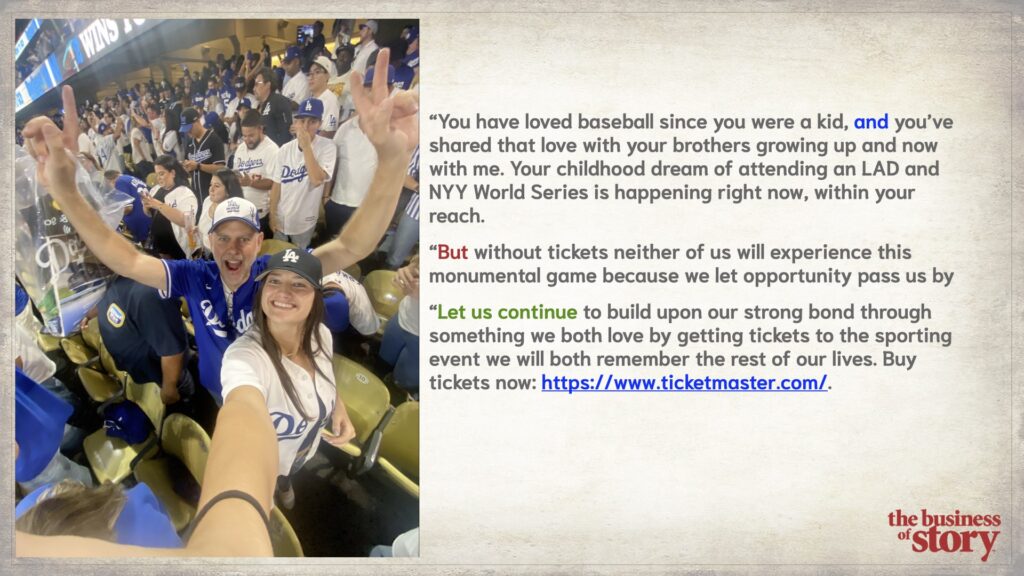
You have loved baseball since you were a kid and you’ve shared that love with your brothers growing up and now with me. Your childhood dream of attending an LA Dodgers and New York Yankee World Series is happening right now within your reach.
But without tickets, neither of us will experience this monumental game because we let opportunity pass us by.
Let us continue to build upon our strong bond through something we both love. By getting tickets to the sporting event, we will both remember the rest of our lives. Buy tickets now and Lauren is such a brilliant ad professional. She even include the link to Ticketmaster. Well, guess what? It worked. He responded that afternoon. They had the tickets. He’d already bought the airfare, got it over there. And then he sent me a note next week. He said, thank you for teaching my daughter this wonderful new trick. Now that I know about it, I’m going to keep an eye out for it all the time whenever she’s asking for something.
This is one of my favorite ROIs on the ABT from last year. Just love it.
But it’s so powerful because it simplifies and then clarifies our message through the noise of the loud, obnoxious, abundant world we live in. Our audiences have many, many choices. And so how do you get them to choose you? How do I get them to choose me? You do it because your unique value proposition.
And all of your messaging is clearly articulated through an And, But, Therefore. It hacks through this noise and hooks in the hearts of what I’m talking about, us as storytelling monkeys. Now, what’s interesting to me is our neuro cortex, this frontal lobe is so brilliant that we’ve been able to create this technology that is compounded at the rate of Moore’s law. Now add AI to it and it’s probably compounding a hundred times that pace. And
That means we are all getting bombarded with more and more communication every single day. And yet you and I and everybody we’re trying to connect with is still walking around with this fundamental monkey brain, this limbic system that has not evolved appreciably since our ancestors navigated and survived the Savannah is the same limbic system we speak to today to try to understand, navigate, and survive the onslaught of communication.
So let’s speak to it in the way it wants to receive information, and here’s how that works.
How the ABT Works in Our Brain (22:15)

So our brain, this organ that sits on top of our spinal column. It makes up 2% of our body mass, yet it consumes 20% of our calories. It burns 20% of our energy. And it has one job and one job only, and that is the survival and procreation of our being.
That’s all it really cares about, right?
So when we’re speaking to it and we confuse it, it will shut down and conserve that energy, and it will quickly whip up its own story, trying to figure out what you’re trying to say. If it can’t figure it out, it’s going to create its own story, and it won’t be the story you intended. If you confuse it, if you share obfuscation, if you share a bunch of content, it just doesn’t get it; it’s going to shut down and create a story, and it won’t be the story you intended unless you intentionally tell it a story.
Because the story lights up the theater of the mind. It becomes an active participant in it. It can put its dukes down and its ears up. It burns way fewer calories understanding how you’re communicating with it. That’s where the three forces of story come in.
The Foundational Structure of the ABT (24:00)
Those are agreement, contradiction, consequence, as you’ve heard me say before, that speaks to that pattern-seeking, problem-solving, decision-making, buying limbic brain.
That is the target for your story. That is the signal you want to push into the brain in that subconscious mind, the amygdala, the hippocampus. That’s where the buying decisions are being made.
And you do that, of course, with the fundamental DNA story structure of the And, But, Therefore.
Now here’s ABT 101. Here’s how you create that statement of agreement: You start with your audience, as I mentioned earlier in the Hero’s Journey. Your audience is always at the center of the story, and then you acknowledge what they want relative to your offering. They might not even know what your offering is yet, but you’ve done your due diligence and discovery enough that you know you can foreshadow your offering by really underscoring what they want.
And then you want to raise the stakes, and why it’s important to them. That’s your setup. That’s your Statement of Agreement. All you want to do is get them nodding yes, thinking, “You understand me. We have a shared vision. You appreciate what I want and why it’s important to me. Cool. You get me.”
Then you pull the rug out. You introduce the plot pivot, the problem with your But Statement of Contradiction.
What’s the frustration they’re experiencing because of what problem that you, of course, are going to solve for them?
And then the final consequence, that Statement of Consequence, that therefore, how will you help them get it through your unique and differentiated offering.
Set up, problem, resolution. This is how our pattern-seeking survival limbic brain loves to get information.
The ABT is truly the signal in the noise. It is how you stand out in the world.
What Silicon Marketer Christopher Lochhead Thinks of the ABT (25:30)
Now there’s a gentleman, you may know him, he’s a very fairly famous marketer in Silicon Valley, Christopher Lockett, who does a lot of work with a lot of large tech brands, and he’s written one of my favorite books on branding and category design called Play Bigger. Well, I was on his show a couple of years ago and I introduced him to the And, But, Therefore and how it works. After he tried it a couple of times, here’s what he had to say about the ABT.
So you gave me a gift with the ABT, you know in category design We have this thing called a POV a point of view and it is simply structured very similarly to that of the ABT which is essentially and this is such a profound insight it sounds like it’s nothing just like the ABT in a point of view it goes like this
Nobody buys a solution until they have a problem. And so a point of view starts with framing, naming, and claiming a problem. And when people understand the problem slash opportunity, then they become interested in the solution.
And then of course, the third piece from a POV perspective is how your product or service or your idea for that matter, you might not be actually marketing or selling anything, bridges the gap between the problem slash opportunity and therefore the solution. Okay. So with all that said, why do I love the ABT? The ABT takes the thinking that we did around points of view and does a fantastic legendary double click on it. And that’s why the and button therefore model is pure genius. It allows you to relate to people.
then it gives them the but which tees up the problem and then the therefore which points the way to the different future aka solution and it’s easily rememberable and if you start to play with it as I have since you taught it to me just like anything else you develop some prowess with it starts working you’re like wow it’s almost weird how this works.
And here’s what he means by it’s almost weird how this works. The next day, after I taught him the ABT on his show, he wrote this tweet:

Most entrepreneurs would love to design a new category and build a billion dollar business. But there is so much startup BS on Twitter, it’s hard to know who to listen to. Therefore, as implied, meet David Sachs. He knows a few things. And here’s what blew him away.
In less than six hours, he got over 60,000 engagements on this one tweet.
Now, Christopher is a prolific social media guy. So, to get this kind of engagement just completely blew his mind. And he has been using the ABT in all of his work ever since.
Airbnb ABT and Anecdorte (28:25)
Let’s jump in and look at the ABT for Airbnb, which, to me, was one of the best storytellers back in the day. I think maybe they’ve lost their way a little bit with storytelling, but I love this example because it shows you how the ABT can also be a strategy tool.
So they were doing rebranding back in 2013, and they wanted to come up with something that really helped people feel like they belonged. Not only from the traveler feeling like they belong in any Airbnb you stay at, but to the host being an aspirational stake in the ground that if you can’t make people feel like they belong in your home, then you don’t belong in the Airbnb family. And also with their own colleagues. We want to make sure you feel like you belong here in the corporation and that you are building your career in the right place.
So I really love this overarching, Belong Anywhere unique value proposition/campaign theme narrative arc. Now if I was going to be presenting this new campaign theme to the board of directors, I would build three different ABTs, one each for each one of my audiences my customers. I’d create an ABT for the hosts, and I would create ABTs for the colleagues so that it is specifically focused on one audience.
But for the case of demonstration, let me share with you what I think the ABT might be to set up this whole concept of Belonging Anywhere.
You love to travel, exploring interesting places around the world, and you wish to feel less like tourists and more like locals. By the way,
This came right out of the customer sentiments from their own research. So great place to start is just repeating what your customers have told you.
But you’re annoyed with typical tourism because it houses you in large hotels, promotes crowded tours and separates you from the indigenous experiences you seek.
That’s the problem that Airbnb is solving for, correct?
Therefore, now you can feel like you belong anywhere with Airbnb.
The ABT in an Airbnb Anecdote (28:26)
So now let’s take this one step further. Let’s go to the 25th anniversary of the fall of the Berlin Wall. Airbnb went in and did an economic impact study to demonstrate what it meant for both East and West Berlin for that wall coming down and Airbnb coming in. And of course, the numbers were off the charts good and they got all kinds of free earned media all around the world for that report. But while they were doing the research, started covering these amazing human interest stories. Stories that they made little short documentaries about to underscore this whole idea of Airbnb belong anywhere. And it’s a way for them to demonstrate, show this unique value proposition of Belong Anywhere in practice, versus the brand just sitting there beating their chest saying belong anywhere, belong anywhere. No one’s going to listen to that.
But when you show it to them through a true story well told, then it’s the natural moral of the story. So take a quick look at this great little animated short documentary that underscores this Belong Anywhere. And oh, by the way, you are gonna see not only the And, But, Therefore structure in this, but also the five primal elements of a short story for big impact.
Now isn’t that a beautiful little tale to support the overarching brand narrative, Airbnb – Belong Anywhere?
Examination of the Airbnb “Wall and Chain” Story (33:19)
Let’s take a look at it. So it’s not very long. I mean, if you didn’t have the animation, the music going on, whatever, you could actually tell a story in under a minute. But the five primal elements are this a timestamp, a location stamp, a central character action, and surprise that action that sets up your aha moment or your final moral of the story.
So they naturally did this. They’ve got a location stamp and a time stamp right up top, and they introduce you to the singular central character, right? So there are three of the five primal elements right off the bat.
What you’re doing when you introduce a time stamp is you are triggering that limbic brain to pay attention because it’s saying to itself, Park just gave me a moment in time. I better pay attention because something must have happened that I might need to respond to if case that ever happens to me.
It’s simply that storytelling as a learning tool, working with that survival brain.
And then the location stamp. It helps fire up the theater of the mind so they can picture it. Maybe they’ve been there, been to someplace similar. And then the introduction of the protagonist. And it’s not talking about two people or three people or four people. It’s always a story about one individual and what happened to them.
Yeah, there may be co-players in it, like in this case, the guard, but he’s a secondary player. It is all about the father. So then they move into action, right? After moving away, the father carried a piece of it with him. He had some PTSD, and so she wanted to take him back to show him what a beautiful place it had become.
But here was the aha, the surprise moment.
The stranger who answered the door became familiar. The guard who patrolled the opposite side of the wall now welcomed us as a friend.
And in every story, when you really look at it, there’s always kind of the surprise outcome, this pivot, this novelty that our brain absolutely loves. This all underscores their core aha moment, right? Their brand UVP of Belong Anywhere. Timestamp, location stamp, central character, action and surprise outcome that leads to the moral of the story.
And when you look at this, by the way, it’s also a perfect And, But, Therefore. You know, my father was a guard on the west side of the Berlin Wall while another man guarded the east. “And” is implied… Eventually the wall came down.
They even use “but” to trigger the pivot. Now we’re into the action of Act 2 that leads us to the therefore, which once again is implied. You could throw it in there. Therefore, things are better for my father. They simply said, “after that…”
And isn’t that last line really just another way of saying, and he lived happily ever after? One of the most famous story endings we’ve ever heard.
The Two Storytelling Truths (36:14)
So something I want you to think about when you’re telling your stories and especially writing your And, But, Therefores: there are really two extraordinary story truths. The first one is that you are not the center of your story. Your audience is. Always tell your stories from their perspective.
They are the ones on their hero’s journey that you are going to be their mentor or guide to help them get what they want.
Story truth number two: Your story is not about what you make, but what you make happen in your audience’s life. Outcomes trump offerings every single time. People actually don’t care about you. They don’t care about your brand. They don’t care about your widget. They don’t care about your special storytelling skills.
All they care about is how you can level them up in everything they do.
So let’s again look at how you build an and but there for. As you know, ABT 101 is you introduce who your audience is so you’re speaking directly to them and you’re thinking from their point of view. What do they want relative to your offering and why is it important to them? But why don’t they have it and therefore how are you uniquely equipped to help them get it?
ABT 101 & 201 Builds (37:00)

Now you can expand on the ABT as our story cycle genie does by bringing even more clarity and context to it using the If/Then clause.
So who’s your audience, what do they want, and if they can get it this way, then this is the positive outcome. And it’s just another way to speak to that problem-solving, decision-making, pattern-seeking limbic brain by adding more of these cause-and-effect clauses into your ABT.
In your but statement, I am a huge believer in the use of the conjunction of “because.” And so after the but, I want you to introduce a negative emotion because of (caused by) what problem.
We call this finding the hurt and amplifying the pain. The hurt is acknowledging how they feel, why they’re down. And then amplify the pain with the problem that’s causing it.
That word “because” is so important. I harken back to a 1978 study by Harvard: The Power of the Word ‘because’ to Get People to do Stuff.”
They did a really interesting study. They took a Xerox copier and they put it out in a very, very busy corridor where people would naturally line up to make their copies.
Then they sent in their test subjects and they gave them their first script, which was simply this: “Excuse me, I have five copies. May I use the Xerox machine?”
Well, it’s not an excuse. Actually, they’re just literally asking if they can cut in line.
And back in 1978, maybe people were nicer, I’m not sure. Maybe they’re more empathetic, but they got 60 % compliance. 60 % of the people said, sure, you can cut in line, go for it.
Then a little bit later, they sent the test subjects back in and they would say the same thing, “Excuse me, I have five pages, may I use a Xerox machine because I have to make copies.”
They saw compliance rise by 33%.
Now this isn’t even an excuse because everybody has to make copies, but simply by putting in that conjunction of because it has this cause and effect thing to it that it got people to comply.
Then they went around for the third time and they just asked them to actually add an excuse: “…because I’m in a rush,” and compliance only ticked up one more percentage point.
That is the power of the word “because” and why I always love to use it in my But Statement of Contradiction.
But you’re overwhelmed, but you’re feeling bummed out, but you’re nervous, but you’re anxious, but you’re fearful because of this physical problem, obstacle, gap that you have to overcome. Then when you get to the therefore, here’s the mistakes a lot of people make that you will never make in the StoryCycle Genie™ because it’s programmed to keep this from happening. People always lead with their brand right after the therefore. Therefore, buy X, Y, and Z and then you’ll get this. And that’s not what you want to do.
You want to keep the focus on your audience because, remember, they are the hero in this journey. So I want you to think about what does success look like to them?
Therefore, you are going to be free.
Therefore, you are going to earn more ROI.
Therefore, you are going to gain tremendous respect from your colleagues.
Finally, you introduce how you help them achieve that. You, as the brand, don’t come until the very end of this story structure, the second clause in the therefore statement. Something to really think about when you’re writing all your content. Always keep it about your audience.
The Three Forces of Trust Building (41:00)
By the way, I want to underscore here too, while the ABT uses the three forces of story of agreement, contradiction, and consequence, I’ve learned something about this. When you do it properly like you will do in the StoryCycle Genie™, it creates the three forces of trust building. And those are, number one, you are illustrating, showing that you understand your audience by simply calling them out at the very beginning.
Number two, you are demonstrating that you appreciate what they want and why they want it.
And the third one is empathy. In that but statement, you are empathizing with how they feel so they go, “Wow, you get me.” You understand you’ve been here before.
So with the ABT, while it uses setup, problem, resolution or agreement, contradiction, consequence, when you use it properly, you are instilling confidence in your audience, building that trust by demonstrating that you understand them, you appreciate what they want, and why it’s important to them, and you empathize with why they don’t currently have it.
Therefore, imagine when they get it because you are the natural way forward. Let me give you one more terrific example of this.
The Pret Auto Partez ABT (42:15)

Andre Martin Hobbs is the president of Prete Auto Partez, which is a used car dealership in Quebec, Canada. He came to me at the Social Media Marketing World event after I spoke there back in 2016.
He said, I’d really like for you to help us build our story for Prete Auto Partez, which by the way, in French means “Ready, Car, Go.”
When he told me it was a used car dealership, I was like, I don’t know, do I really want to work with a used car dealership? And then he raised the ante a little bit and he says, “Oh, and by the way, we primarily focus on credit risk buyers.”
All I could think of was, “Oh God, they’re predatory. They’re going to try to get these poor people to do whatever.
I built an anti-story in my mind as to why I didn’t want to work with him, and he told me he was going to call in about three weeks. I figured he wouldn’t. A lot of people say that and never show up, but Andre, good to his word, did. And what he told me in that call really changed everything because I was telling myself the wrong story, only because he didn’t have a proper, clear story to share with me, and that’s what we built together. But his main goals were this.
As I mentioned, Pret Auto Partez is a used car dealership for credit-challenged buyers in Quebec, Canada. They had to differentiate themselves from the typical smarmy used car dealerships, and he was hoping to grow by 20%.
Now here is the brilliance of André’s business model. He created a car dealership to help get Canadians who were down on their financial luck. It might have been because of the global recession, could have been they lost all their finances to a health problem, maybe they got a divorce and had to divvy things up.
He said these are good, good people that just want to get back on their feet, and they want to have the freedom, the luxury, if you will, and just that integrity of owning their own car. So at Pret Auto Partez, if you come in to buy a car, you have to sit through an up to three-hour financial planning session first.
You got to reveal all of your nasty little secrets in your finances, and then they will only put you in a car that you can afford to pay for every month, making your payments every month for two years to repair your credit.
So Andre had a brand purpose that was much larger than just selling used cars to at-risk buyers. It was about using the industry to help get Canadians back on their feet while providing their car.
Here is the And, But, Therefore we created that became the foundation for the entire Pret Auto Partez story that led to really an amazing unique value proposition and campaign theme. It reads…
You want the convenience of owning a car and you wish for the freedom it provides.
Now, these two words, convenience and freedom were the words that were spoken to Andre and his team when they did their customer research. This is what their buyers were saying to them. So we just put that and statement of agreement in the buyer’s voice, right? Here’s the problem.
But you have bad credit.
It’s just that simple. But you have bad credit.
Therefore, purchase a car you can afford to begin repairing your financial standing with Prete Auto Partez.
And here’s the theme, the unique value proposition this led to…
Prete Auto Partez, your vehicle to financial freedom.
Pretty powerful.
And Andre used this line, “Your vehicle to financial freedom,” and the entire brand story narrative for his recruiting, for his hiring, for his retention, and for how he uses social media to get his buyers to tell their story.
So he has that expanding spiral of engagement. That is the story cycle system that has grown brands by as much as 600 percent.
Because the brand first gets its clear, consistent, concise, compelling brand story in place. And then they deliver on the promises they make in those stories and get their customers to retell and scale that story.
If you’d like to hear more of Andre’s story, check it out on the Business of Story podcast, show number 499: How to Create an Enduring Business Based on Your Timeless Brand Story. We walk through the entire creation of his brand story using the Story Cycle system™.
By the way, it took us about three or four months to create his overall story foundation. But doing it the old mechanical way. Now with the StoryCycle Genie™, you can probably do it in about 60 minutes, maybe two hours, and have that same, if not even greater impact on your story.
Your ABT Exercise to Begin Building it as a Habit With Your Storytelling (47:23)

Here’s what I want you to do. I want you to think of the ABT as the storytelling dumbbell to build your narrative intuition.
So from this point forward, I want you to write three emails every single day, starting with an And, But, Therefore/ You got to write them anyway. You may as well practice there and build your narrative intuition.
Now that you know about the ABT, go and teach two people how to use it. I learned, teaching a master’s course at Arizona State University for five years on storytelling, that the best way to learn how to really use these frameworks and understand them is to teach them to someone else.
Test the Strength of Your Brand Story for FREE (48:09)
And then finally, go and review your homepage and rewrite it as an ABT because I guarantee you 98 % of your homepages are all speaking all about you, about the brand, about the features and functions, and not speaking from the point of view of your audience.
And if you don’t believe me, go and check it out for yourself. Go to storycyclegenie.ai.
Click on that white button and get a FREE brand story assessment. You’ll just put in your name, put in your email address, put in your URL that you would like the brand Genie to review and in under 60 seconds it’s going to give you a grade from A plus to F minus on how well you are showing up in the world with your brand storytelling. And it’s going to give you a 14-point brand story assessment. So you’ll know exactly where you need to go to get things fixed.
Everything from story structure to ABT messaging strength. And now that you know about the ABT, it could be even stronger for you, of course. Your customer struggles, clarity, so on and so forth.
You can read through that list and see that it gives you a whole host of intel that you can act on right now.

So the StoryCycle Genie™ validates what you’re already doing well with your storytelling. It reveals gaps and highlights missed opportunities that you can easily fix in your storytelling. And it will even inspire you with new ways to think about your story.
As I like to always end all my trainings is as you are growing as a more confident, compelling storyteller, remember that…
The most potent story you will ever tell is a story you tell yourself. So make that a great one.
Thanks for being here, and if you have any questions whatsoever about the Storycycle Genie, the ABT and or the Story Cycle System™, please reach out.
FAQs for the ABT Narrative Framework
Frequently Asked Questions: ABT Narrative Framework Training
1. What is the ABT (And, But, Therefore) narrative framework?
The ABT narrative framework is a storytelling formula that structures any message into three essential parts: And (setup), But (problem), Therefore (resolution).
It mirrors the way our brains process stories, making communications more memorable and persuasive.
Internal link opportunity: Learn about the Story Cycle System™
2. How does the ABT framework improve brand storytelling?
ABT sharpens brand storytelling by quickly guiding audiences through challenge and resolution, creating emotional resonance and clarity.
It’s proven to increase engagement whether you’re crafting emails, social posts, presentations, or long-form content. Learn how to spot and craft ABTs with these enlightening examples
3. Why does the ABT structure work so well in communications?
The ABT structure aligns with the primal wiring of our brains using the three forces of story: agreement, contradiction and consequence that speaks directly to our primal pattern-seeking, problem-solving, decision-making, buying limbic brain.
Stories that move from context (“And”), to conflict (“But”), to call-to-action (“Therefore”) activate attention, emotion, and motivation—helping messages stick and inspire action. Learn from my 10-year journey with the ABTs of storytelling.
4. Where can I use ABT storytelling in business communications?
You can use ABT storytelling in emails, social media posts, sales pitches, executive presentations, team trainings, and articles—anywhere clarity and persuasion are vital. How the ABT helps you sell more by saying less.
5. Who benefits most from ABT narrative training?
Marketing directors, CMOs, business owners, entrepreneurs, and sales teams gain a competitive advantage from ABT narrative training.
It instills consistency, emotional connection, and conversion power in every story they tell.
Internal link opportunity: Explore our training programs.
6. What are the five primal elements of storytelling referenced in the training?
The Business of Story’s training explores five primal storytelling elements: Timestamp, Location Stamp, Character, Action, and Aha Moment.
These elements underpin every compelling story and integrate seamlessly with the ABT structure for persuasive messaging. Learn how to simply craft a compelling brand anecdote.
7. Can you show examples of ABT in action from leading brands?
Absolutely. Nike, Salesforce, Airbnb, and Pret Auto Partez all use ABT storytelling to clarify their message and build emotional engagement.
For instance, Nike’s “Just Do It” campaigns often follow: “You want results AND you’re working hard, BUT staying motivated can be tough, THEREFORE Nike inspires action.” Create your own Know, Like & Trust Storytelling Flywheel with the ABT.
8. How do I write my own ABT statement?
Start by outlining what your audience wants (And), what stands in their way (But), and the solution you provide (Therefore).
Keep it concise and conversational, focused on a single hero’s journey for maximum impact. Take the ABTs of Storytelling micro-training course.
9. Is ABT effective in digital marketing and sales conversions?
Yes, ABT dramatically boosts clarity, response rates, and conversions across digital marketing and sales. Brands using the ABT have seen an increase in engagement in social posts and digital campaigns by 400+ percent.
It streamlines your messaging so audiences instantly understand what’s at stake and how your brand delivers value. Experience the ROI of the ABT in business storytelling.
10. What’s the connection between the ABT framework and the Story Cycle System™?
The Story Cycle System™ is the macro framework; ABT is its micro engine.
ABT brings clarity and emotion to every communication, while the Story Cycle System™ unlocks the strategic arc across brand stories.
Together, they turn casual readers into brand believers. Learn what I learned about storytelling from my TEDx Talk.
11. How does Business of Story’s ABT training differ from other narrative workshops?
Business of Story’s ABT training fuses classical storytelling wisdom with technology, offering mystical insights and actionable exercises not found in conventional workshops.
It’s rooted in the sacred mission of helping you excel through the stories you tell. Check out my Business of Story consulting options.
12. How can I start mastering ABT narrative skills today?
Take the ABTs of Storytelling micro-training course, try the ABT exercises in our blog, and download our guides for step-by-step mastery.
Every story you tell can become more clear, concise, and compelling—starting now.
Story on, my friend.