One Story Captured, Dozens of Deployments:
The strategic system that turns scattered anecdotes into your most valuable content assets
You want your content marketing to captivate audiences and drive measurable results, and you know that authentic storytelling creates the emotional connection that generic content never will.
But you’re frustrated because every time you sit down to write a blog post, create a presentation, or craft an email campaign, you’re starting from scratch.
Desperately trying to remember that perfect client success story or that compelling personal anecdote that would make your point land with impact.
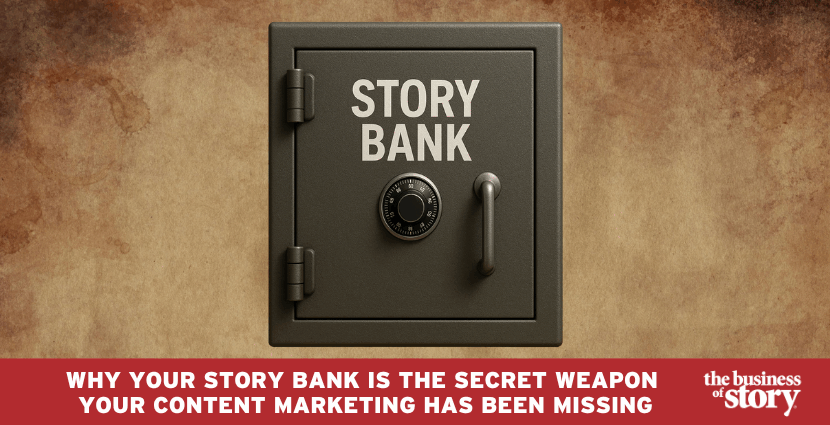
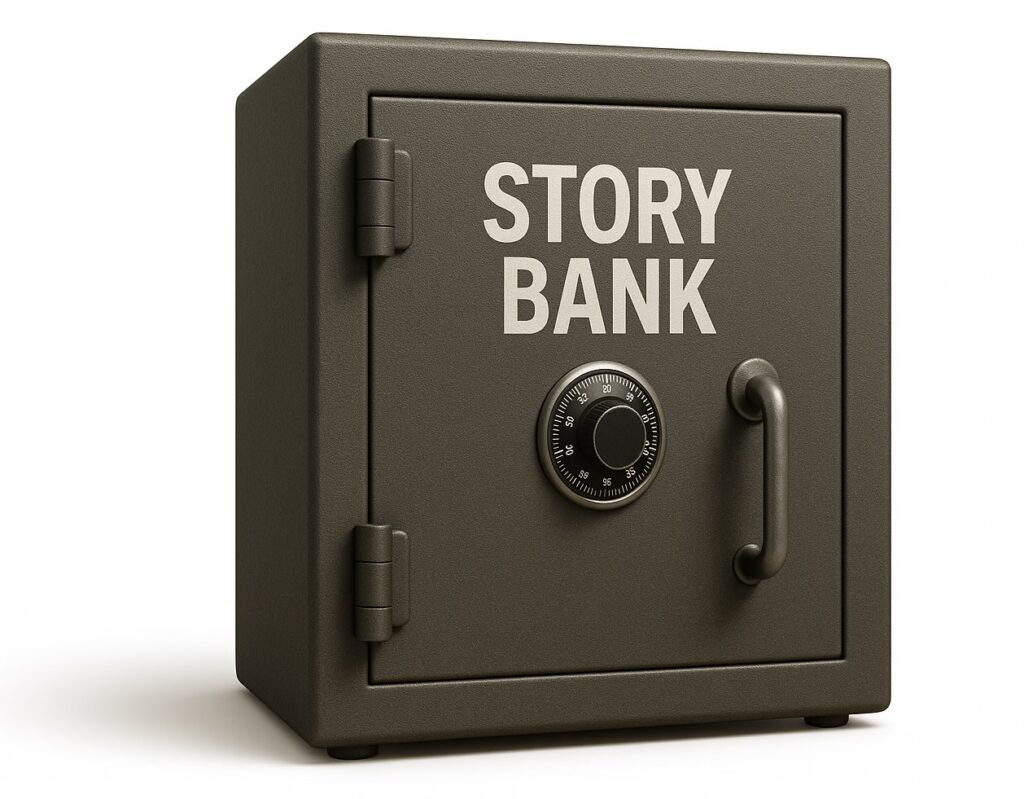
Now you can transform your content creation efficiency and storytelling effectiveness by building a Story Bank: your strategically organized collection of your most powerful personal/professional anecdotes, client successes, and teaching moments that puts the right story at your fingertips for any content situation or presentation.
The Content Creator’s Dilemma I See Every Day
Over my 40-year career, branding companies and teaching storytelling, I’ve watched capable professionals struggle with the same challenge.
They know stories work.
They’ve experienced moments worth sharing.
But when it’s time to create content, those stories vanish like morning fog.
One marketing director told me last month, “Park, I have amazing client success stories, but I can never remember the details when I need them. By the time I track down the metrics and reconstruct what happened, I’ve lost two hours and my creative momentum.”
Sound familiar?
Why You Need a Bank of Go-To Stories
This week on the Business of Story podcast, Femi Oke said something that made me laugh and that I’ll never forget. If you find yourself in a presentation emergency where you’re losing your audience, break glass and pull out a story.
She should know.
Femi is a highly-acclaimed international broadcast journalist who sharpened her storytelling chops with such organizations as CNN, BBC and Al Jazeera.
She founded Moderate the Panel to teach leaders how not to be boring. Spoiler alert: it’s about telling stories. But you have to find, curate, and bank them first.
Femi explains the importance of creating your own story bank so you’re not boring your audience, readers, viewers or listeners.
What Happened When I Built My Own Story Bank
Earlier this year, I started systematically capturing my stories in what I call a Story Bank.
Not just the stories themselves, but the strategic intelligence around each one.
The quotable moments. The emotional arcs. The teaching principles. The credibility elements. The specific contexts where each story delivers maximum impact.
Today, my Story Bank contains 35+ powerful anecdotes, and it’s changed everything about how I create content.
Let me show you what I mean.
The Anatomy of a Strategic Story Bank
A Story Bank isn’t just a collection of anecdotes thrown into a folder somewhere.
It’s a strategically organized system that captures:
- The Complete Story: Every sensory detail, every quotable moment, every emotional beat that makes the story memorable.
- Strategic Value: Why this story matters, what principles it demonstrates, what objections it overcomes.
- Application Guidance: Specific contexts where this story delivers maximum impact—blog posts about X, presentations addressing Y, emails overcoming objection Z.
- Credibility Elements: Data points, celebrity connections, client names, measurable outcomes that validate your expertise.
- Emotional Arc: The journey from setup through conflict to resolution that creates engagement.
- Teaching Principles: The universal truths your story illustrates that audiences can apply to their own situations.
When you capture all of this, you’re not just saving a story.
You’re creating a strategic asset that compounds in value every time you easily and quickly deploy it.
My Story Bank: A Real-World Example
Let me walk you through what 35+ strategically captured stories look like in practice.
Framework Validation Stories (When You Need Proof)
When I’m writing content that needs to prove frameworks work, I have stories ready:
Henry Belcaster’s Smart Nonsense: 0 to 2.4 million YouTube subscribers after unconsciously implementing the framework. Includes complete script example and exact timeline (7 months struggle, September 2022 breakthrough, 600K by January 2023).
Lauren Lowell’s 2024 NYY vs LAD World Series Tickets: Sent email to dad at 8:57am using the ABT framework, tickets purchased by 3:39pm same day. Her quote: “I feel so powerful with this story structure. You’ve got an ABT advocate for life!” Before the framework? Puppy eyes GIF got no response from pops.
Airbnb Wall and Chain: Berlin Wall 1987 story demonstrating all Five Primal Elements of a Short Story for BIG Impact in just 60 seconds. It include a father who was a guard, daughter narrator, East Side guard who welcomed them into his home and became a friend when the Wall came down. “Belong Anywhere” brand theme captured in one brief story. Complete breakdown showing how Timestamp + Location + Character + Action + Aha = brand storytelling gold.
Each story is captured with complete context, exact details, and strategic deployment guidance. And told quickly, in under 90 seconds.
Celebrity Credibility Stories (When You Need Authority)
When I need to establish credibility or validate storytelling’s importance:
Necker Island with Branson: Five days on his private island, leather-bound notebooks where global icons wrote stories, Branson’s wisdom about focusing on singular moments not epic adventures. Includes Fantasy Island reference, champagne on a speedboat, and COVID protocol challenges.
Gates vs Jobs Personalization: A tech conference where Gates stumbled with logic while Jobs captivated with personalized storytelling about Wozniak. Includes video reference, Jobs’ visible frustration during Gates’ response, demonstrating that personalization beats logic.
Margaret Atwood Academic Lunch: Non-PhD among 10 PhDs at ASU faculty lunch, JFK moonshot counterpunch proving science fiction informs science, Atwood’s subtle smile and nod validation.
Each with rich sensory details, exact quotes, and emotional validation moments.
Professional Transformation Stories (When You Need Connection)
When I want to show real business impact:
Russell Goldstein’s Breakthrough: CFP at U.S. Trust, Bank of America thought storytelling was “a joke, a gimmick.” After my 12-month ASU master storytelling program, he presented to 80 people at the Planned Giving Roundtable. Survey Monkey reviews: “Engaging, motivating, energetic.” “Russ is a great storyteller.” His quote to me: “Storytelling is like having a big ‘ol bonus check sitting in my top drawer.”
General Mookie Walker’s Transformation: Brigadier General at Lackland Air Force Base typically “wings” his presentations. After learning frameworks in my workshop with 110 Air Force generals, he completely transformed his West Virginia State football team speech approach in real-time. Created a reluctant hero narrative addressing the opioid crisis. Got a huge ovation from his fellow generals.
Jennifer Russo’s Career Clarity: 15 years as an international marketing exec at Rio Tinto mining, leaving to spend time with her two boys as a single mom. Vague job criteria (“maybe something in diversity and inclusion”). DIY Brand Story workbook revealed her positioning as the “Kinetic Communicator”—energy that attracts diverse thinking, mining untapped capital in collective diversity.
Each story captures a transformation arc, including credibility markers and teaching moments.
Client Success Stories (When You Need Proof of Expertise)
Adelante Healthcare: 600% growth demonstrating Story Cycle System™ in action. A 33-year-old community health center grew from 65 to 400 employees, 14,000 to 46,000 patients, $13 to $41M revenue. Became national leader, opened the nation’s first LEED Platinum certified community health center. CEO Avein Tafoya: “The Story Cycle process was instrumental.”
Vagina Gym: Dr. Stephanie Schull needed a memorable brand for her pelvic floor therapy practice. I created “Vagina Gym” in 20 minutes—fastest brand of my 40-year career. The brilliance? Triple wordplay. It’s a gym for strengthening pelvic floor muscles (literally true), uses equipment like dumbbells (the connection), and when the name hit me, I said, “This dumbbell finally understood”—calling myself a dumbbell for not seeing it sooner. Created “on the spot, which isn’t always easy to find” (another pelvic floor reference). Client loved it immediately.
Prêt, Auto, Partez: Montreal car dealership helping financially challenged Canadians repair credit through car purchases. “Your Vehicle to Financial Freedom” positioning. Tripled growth in 3 years, doubled personnel, and became the leading used-car dealership among thousands in Quebec. Reduced customer loan default rate to half the industry average.
Each with client names, specific outcomes, and measurable results.
The Four Types of Stories Every Story Bank Needs
Through building my own Story Bank, I’ve discovered four essential story categories:
1. Professional Transformation Stories
Client breakthroughs, workshop revelations, career-defining moments.
These stories say, “I’ve helped professionals like you achieve remarkable transformations.”
2. Client Success Stories
Real names, real outcomes, real transformation.
These stories say, “This framework works, here’s proof, and here’s exactly how it delivered results.”
3. Authority Validation Stories
Celebrity encounters, scientific studies, data-driven proof.
These stories say, “This isn’t just my opinion—here’s validation from people you respect and data you can’t argue with.”
4. Framework Demonstration Stories
Complete breakdowns showing frameworks in action.
These stories say, “Here’s exactly how to apply this framework, step-by-step, with proof it works in real situations.”
The Compound Interest of Strategic Story Capture
Every story you capture becomes more valuable over time because you’re documenting what worked, where it works, how to deploy it, and why it matters.
One story, captured once, deployed dozens of times.
That’s the compound interest of strategic story banking.
The Right Story in the Right Place
When I’m writing about framework skepticism, I deploy my “ABT is Too Simple” collection—10 resistance stories with proven responses.
When I need data-driven validation, I reach for Adelante Healthcare (600% growth) or Henry Belcaster (2.4M subscribers).
When I want to demonstrate trust through vulnerability, I share Anjella Crowe’s Ukrainian orphanage story—she grew up building alliances to survive, and now it’s her professional superpower.
When I need skeptic conversion examples, I pull the MuraCon software developers story—100+ programmers, half raised hands when I asked “Who thinks storytelling is bullshit?”, then laughed and gave me permission after the “stories are software that drives hardware of our minds” metaphor.
The right story in the right place isn’t luck.
It’s strategic asset management.
How StoryCycle Genie™ Makes This Effortless
Building my Story Bank manually taught me what’s essential.
But you don’t have to do it the hard way.
StoryCycle Genie™ provides the systematic framework for capturing, organizing, and deploying your stories with strategic intelligence.
Plus, with every story you infuse the StoryCycle Genie™ with, it becomes more proficient with you voice, tone, writing rhythms and inflections, so the content it creates with you is always on-brand.
Start building your strategic storytelling arsenal today.
Because we are truly a planet of storytelling apes.
And the storytellers with the best-organized story arsenals win.
Frequently Asked Questions About Building Your Story Bank
Why is a Story Bank important for content marketing?
Your Story Bank transforms content creation from exhausting to efficient.
Without one, you’re constantly searching for stories, reconstructing details from memory, and losing creative momentum.
With a strategic Story Bank, you’re selecting from organized assets with complete context, proven emotional impact, and clear deployment guidance.
That’s exponential value creation.
How do I start building my Story Bank?
Start with three stories:
One Professional Transformation Story: A moment when you or a client achieved breakthrough clarity or results.
One Client Success Story: A specific client who got remarkable results with names, metrics, and outcomes.
One Authority Validation Story: Celebrity encounter, expert endorsement, or data proving your framework works.
Capture complete narrative, quotable moments, emotional arc, teaching principles, deployment contexts, and credibility elements.
Then add three stories per week.
In one month, you’ll have 12+ strategic assets.
What details should I capture for each story?
The Six Essential Elements:
- Complete Narrative: Full story with every sensory detail and quotable moment
- Strategic Value: Why it matters, what it proves, what it teaches
- Application Guidance: Specific contexts where it delivers maximum impact
- Credibility Elements: Names, dates, metrics, outcomes
- Emotional Arc: Setup through conflict to resolution
- Teaching Principles: Universal truths that audiences can apply
How do I organize my Story Bank for easy access?
Triple-Tagging System:
By Category: Framework Validation, Authority Credibility, Professional Transformation, Client Success, Framework Demonstration
By Context: Blog posts, presentations, emails, social media, training materials
By Theme: Skeptic conversion, proving ROI, trust building, clarity revelation, optimism creation
This means you can search by category, context, or theme for instant story selection.
How often should I reference stories from my Story Bank?
Strategic deployment, not random:
• Blog posts: 2-3 stories (opening hook, supporting evidence, teaching example) • Presentations: 1 story every 3-5 minutes • Email campaigns: 1 powerful story per email • Social media: Story excerpts (quotable moment, surprising outcome, teaching principle) • Training materials: 1 story per framework principle
Rotate your arsenal so audiences experience your full range of expertise and authority.
Can I use the same story across different content formats?
Absolutely! That’s where compound interest happens.
Same core story, adapted for each format and audience.
How does a Story Bank improve my storytelling skills over time?
Your Story Bank becomes a laboratory where you study what works.
Which details created engagement? Which quotes became memorable? Which emotional beats drove action?
Knowing what works, you naturally incorporate these elements into new stories.
What’s the difference between a Story Bank and just keeping old blog posts?
Old blog posts are hard to search, mixed with analysis, formatted for one context, and missing strategic guidance.
A Story Bank captures pure stories with strategic value, multiple deployment options, category tags for instant access, and application guidance for maximum impact.
That’s the difference between archives and arsenals.
How do I know which story to use for specific content?
Your strategic capture includes application guidance.
Document for each story: Use when (addressing skepticism, proving ROI, teaching frameworks), Best formats (blog, keynote, email, social), Objections it overcomes, Principles it teaches.
When you’ve captured this, selection becomes obvious and deployment becomes effective.
Story on, my friend!