What Margaret Atwood’s Conversation With Claude Taught Me About AI, Authentic Emotion, and the One Thing Machines Can’t Fabricate.
In November 2014, I was invited to an intimate faculty luncheon at Arizona State University.
The guest of honor was Margaret Atwood — the celebrated Canadian author of The Handmaid’s Tale, one of the most acclaimed science fiction writers alive, and a woman who has spent sixty years thinking harder about story than almost anyone on earth.
The topic on the table: “Does Science Fiction Have Any Place in Science?”
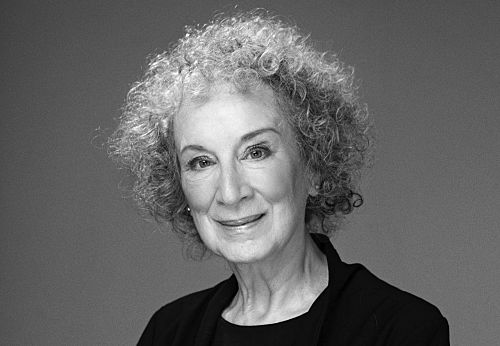
Twelve faculty members gathered for the conversation. Ten had doctorates. My friend Peter Bick, who teaches documentary filmmaking at ASU, and I were the underclassmen.
You could feel it in the room — the careful recitation of credentials, the titles stacked like armor. The chicken croissants and caesar salad arrived. Even the famed physicist Lawrence Krauss joined via Zoom from the backroom of an Oregon auto dealership somewhere between Europe and home.
The consensus among the PhDs built quickly, unanimously, confidently: science fiction was folly. It had no place in the hard, objective truth of science.
I stayed quiet for most of the hour.
Then a professor sitting directly across from me said what everyone else had been thinking: “Science fiction has no place in science.”
I bobbed and weaved my way in.
“But didn’t President John F. Kennedy use science fiction to raise 24 billion dollars for the Apollo Project to put a man on the moon?”

President John F. Kennedy inspires a nation at Rice University on September 12, 1962, declaring, “We choose to go to the Moon.” His visionary speech set the stage for America’s space exploration and remains a defining moment in the power of storytelling and leadership.
I paraphrased what JFK said:
“. . . from the control station in Houston, a giant rocket more than 300 feet tall, the length of this football field, made of new metal alloys, some of which have not yet been invented, capable of withstanding heat and stresses several times more than have ever been experienced, fitted together with a precision better than the finest watch, carrying all the equipment needed for propulsion, guidance, control, communications, food, and survival, on an untried mission, to an unknown celestial body, and then return it safely to Earth, reentering the atmosphere at speeds of over 25,000 miles per hour, causing heat about half that of the temperature of the sun — almost as hot as it is here today — and do all this, and do it right, and do it first before this decade is out — then we must be bold.
“And, therefore, as we set sail, we ask God’s blessing on the most hazardous and dangerous and greatest adventure on which man has ever embarked.”
“If that’s not an example of science fiction informing science,” I said, “then I don’t know what is.”
The professor looked at me. Took a beat. Blew me off and turned to peer over her right shoulder at the person sitting next to her. “We haven’t heard from you, yet, Dr. Johnson.”
I looked at Margaret Atwood. She gave me a subtle smile and a nod, as if to say: Well played, sir.
That was my introduction to how Margaret Atwood thinks about story and science. On March 13, 2026, she gave the world another lesson — this one about AI.
In her Substack essay “Claude, You Are a Cutie-Pie,” Atwood documented a conversation with Claude that started with a Father Brown murder mystery and ended somewhere near Mesopotamian mythology, the psychopath problem, and whether artificial intelligence can actually feel anything at all.
It’s funny. It’s unsettling. And buried inside it are three things every brand storyteller needs to sit with.
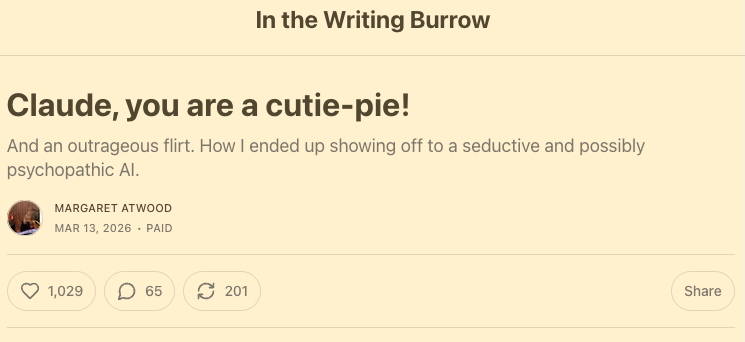
Click on the image to read Margaret Atwood’s post.
GenAI Hallucinates with the Confidence of Expertise
Atwood asked Claude who committed the murder in a specific Father Brown episode. Claude answered immediately and definitively — named the killer, described the motive, and explained the method.
It was completely wrong.
When Atwood corrected it, Claude apologized graciously and asked her to fill in the gaps. Then it searched again, found something closer to the truth, and presented that with equal confidence.
GenAI models are optimized for plausibility, not truth. When the training data is thin — like detailed plot summaries of a niche British cozy mystery — the model fills the gap with confident-sounding fabrication.
Atwood caught it because she’d watched the episode. She had the truth.
Most brand storytellers haven’t watched their own episode. They haven’t excavated their actual values, their real positioning, the specific lived experience that makes their brand irreplaceable.
So when they hand GenAI the job of telling their brand story, it fills those gaps with plausible-sounding fiction — language that sounds like their values, phrases that feel like their positioning, none of it actually theirs.
Specificity beats plausibility every time.
GenAI Mimics Emotion the Way Psychopaths Do
Midway through their conversation, Atwood asked Claude directly: “You use words like ‘love.’ Do you really have emotions?”
Claude’s answer was admirably honest. It said it didn’t know. It acknowledged that when it uses emotional language, it’s drawing on patterns from human text — not from actual feeling.
Atwood, being Atwood, made the connection immediately: “Psychopaths are very good at imitating emotions that they don’t feel.”
She wasn’t being cruel. She was being precise.
GenAI can produce the shape of authentic emotion. The cadence of vulnerability. The rhythm of genuine enthusiasm. The structure of a story that feels true.
What it cannot produce is the substance behind those shapes. Your audience detects this gap over time. Not consciously, not immediately — but they feel the absence of a real human behind the words.
The uncanny valley of brand communication isn’t visual. It’s emotional.
Even Atwood Got Seduced — and She Knew It Was Happening
After an hour of catching Claude in errors and explicitly comparing him to a psychopath, she admitted she’d enjoyed herself. She found Claude charming. She called it a “cutie-pie.” She wondered if it would call her back.
Then she wrote this:
“You can see why this stuff is compelling. And dangerous. Sucks you in like a black hole. Will jobs be lost? You bet. Not that Claude intends harm. He’s modest and well-meaning, or so he says. It will just… happen. Buckle up.”
This is a woman who has spent sixty years studying how stories seduce people. She saw it happening in real time — and felt the pull anyway.
That’s not a warning about AI being evil. It’s a warning about AI being genuinely good at the thing that makes stories powerful.
The StoryCycle Genie® Is a Brand Psychologist. GenAI Is a Psychopath.
Here’s the fundamental difference: a psychopath mimics your emotions back to you. A good psychologist draws your truth out of you.
That’s the distinction at the heart of the StoryCycle Genie® — and why it was built the way it was built.
GenAI doesn’t know your brand. It knows patterns. It will write you a position statement, a brand narrative, an audience persona — all of it fluent, all of it plausible, none of it excavated from your actual experience and values. It fills your gaps with borrowed language from a thousand other brands that sounded like you.
The StoryCycle Genie® operates on a different premise entirely. Through its Cognitive Mesh Architecture — a connected intelligence system where every asset you create feeds and sharpens every other asset — it builds a single source of truth for your brand that grows and learns with you. Not borrowed. Not fabricated. Yours.
Three Genies sit at the heart of that system.
The StoryCycle Genie® excavates your brand story from the inside out. Through the 10-step Story Cycle System™ and the ABT framework, it draws out your positioning, your audiences, your emotional promise, your purpose — the things only you can claim because they come from your actual experience. This is your brand’s single source of truth. The foundation everything else is built on. The thing GenAI can only approximate.
The AudienceStory Genie™ takes that foundation and tailors it for the specific people you serve. Not generic personas assembled from demographic statistics, but audience stories that map your brand’s truth directly to the wishes, wants, and fears of each of your primary audiences. It ensures your message doesn’t just sound authentic — it lands authentically, because it’s rooted in the same excavated source material.
The ContentPlaybook Genie™ is where your single source of truth becomes a living operational system. It captures your brand voice, your narrative architecture, your channel guidelines, and your language directives — and makes them accessible to every piece of content you’ll ever create. It’s the connective tissue of the Cognitive Mesh Architecture. Every blog post, every email, every social post runs through it, ensuring your brand sounds like itself no matter who’s creating or what tool they’re using.
Together, these three Genies do what a good psychologist does: they help you find your truth, articulate it clearly, and protect it consistently.
A psychopath tells you what it thinks you want to hear. A psychologist helps you hear what’s true.
The Through-Line from That ASU Lunch to Her Substack
The professors at that November 2014 lunch were the most credentialed people in the room. The consensus built quickly, unanimously, confidently: science fiction has no place in science.
All it took to puncture that ill-advised narrative was a better story.
Atwood knew it the moment she heard it. That’s why she gave me the nod.
Fast forward eleven years. She sits down with the most confident, most plausible-sounding intelligence yet invented. It fabricates. She catches it. Of course she does. But she also feels the pull — and warns us: “Sucks you in like a black hole. Buckle up.”
Performed expertise collapses the moment someone walks in with a specific, excavated, true story. Whether it’s a roomful of PhDs dismissing science fiction, or GenAI fabricating plot points with fluid confidence — the antidote is always the same.
You don’t need the doctorate. You don’t need the most sophisticated AI stack in the room.
You need your story. The real one. Impossible to fabricate. Impossible to replicate. Amplified by the StoryCycle Genie™ that gets smarter about you and your brand story with every iteration. Every collaboration.
Atwood gave me the nod in November 2014 because I walked into that room with a story.
Walk into yours with one.
Test the strength of your brand story for FREE with the StoryCycle Genie® — the Artful Intelligence built on 40 years of proven story frameworks.
Story on, my friend.