The Agency Reckoning Marcus Sheridan Saw Coming – and the Story Strategy That Answers It
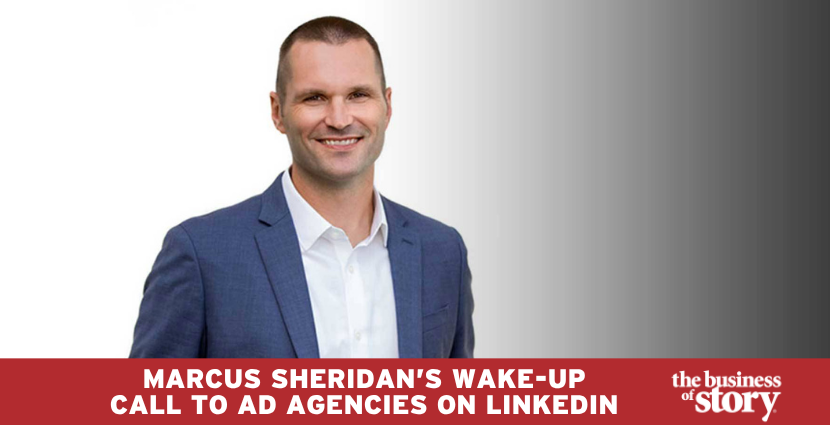
This morning, he posted a wake-up call for all agencies on LinkedIn.
I ran Park&Co, my Phoenix-based ad agency, for 20 years.
I’ve seen the industry shift before. The web. Social media. Mobile.
Each time, the agencies that survived were the ones who understood what was actually changing — and what never does.
This time is different.
Not because the technology is more powerful, though it is. Because the clients are waking up faster than the agencies are.
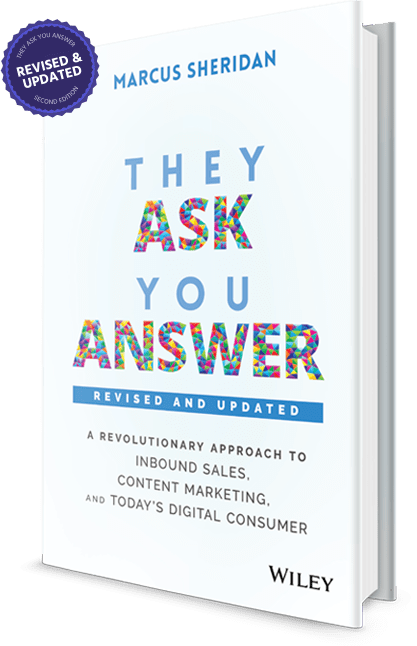
If you don’t know Marcus Sheridan, you should.
He’s the author of They Ask, You Answer, one of the most practical books ever written about content marketing.
He built a swimming pool company, River Pools and Spas, into a digital marketing phenomenon during the 2008 recession — by simply answering every question his customers were asking online.
He’s been advising companies and agencies on digital strategy ever since, and his LinkedIn following of 200,000+ people hangs on what he says because he’s almost always right.
Today’s post was about what he’s seen while spending time with a group of large enterprise brands. Multiple companies told him they’re pulling Social, SEO, and Paid in-house.
His diagnosis was blunt:
“The agency model of the last 25 years is in deep trouble. Doing paid ads and SEO for clients may continue to work for another couple of years, but it won’t be long before most business owners wake up to what’s possible with tools like Claude and other AI platforms.”
He named two primary drivers.
The first is Claude. His observation: “Talk to any Claude power user and they’ll quickly give you a funny look if you’re outsourcing services to an agency. Until you’ve seen what Claude can do, this can be hard to comprehend, but the second someone ‘gets’ it, they start believing they can do almost anything in-house.”
The second is creative bankruptcy. One of the brands he spoke with belongs to a power-group of large enterprise social media marketers. Most of them are fed up with agencies producing boring, soulless social content that gets no measurable results.
Soulless.
That word is doing a lot of work in that sentence. Because soulless content isn’t an execution problem. It’s a story problem.
But let’s first fix a fundamental AI story problem before we look at the agency solutions.
The Hidden Tax Nobody’s Counting
Most agency principals I know are trying to solve the AI problem by adding more generic AI tools to their stack. ChatGPT here. Claude there. A Canva AI subscription for the design team.
Every one of those tools is costing them far more than the subscription fee.
Our analysis of 50+ marketing teams found that a $20/month ChatGPT subscription is costing organizations $6,000+ in hidden labor costs every single month.
The math is brutal.
Generic AI first-draft usability runs at 17-20%. That means 80-83% of what it produces requires substantial rework. At a blended labor rate of $50/hour, a mid-size team producing 50 assets per month is spending nearly $9,000 in true monthly costs — subscription plus the invisible labor tax of prompt engineering, iteration, and rework.
Generic AI has four structural limitations that create this iteration hell: no persistent brand context (you re-explain your brand every session), no competitive intelligence, voice consistency that depends entirely on your prompting skill, and a 30-40% complete rework rate even after multiple iterations.
The “cheap” AI is the expensive one. Every time.
And when you combine that iteration hell with the absence of a coherent brand story foundation, you get exactly what Marcus’s enterprise clients are complaining about.
Generic. Soulless. Unmeasurable.
Marcus’s Six Survival Strategies — Read Through a Story Lens
Sheridan laid out six pivots every agency needs to make to survive the next decade. Every one of them is easier — and more defensible — when you start with a clear brand story foundation.
1. Become indispensable through high-level strategy and accountability.
This is story strategy. Helping clients understand who they are, who they serve, and why it matters — before a single piece of content gets created.
I learned this the hard way — and the rewarding way — back in 2009 when my agency Park&Co was pitching Arizona’s foremost educational nonprofit, Expect More Arizona, against Lavidge, one of Phoenix’s largest agencies.
I didn’t talk about our capabilities. I didn’t showcase our portfolio.
I wove together our family’s experience with the Arizona school system and our market research into immediate strategic recommendations. Three kids. Three completely different educational journeys. All within the same system EMA was working to strengthen.
We won.
They told me our presentation stood out because we proved our abilities through personal storytelling, demonstrated market understanding, and a sincere desire to help them succeed quickly.
That pitch cost us $25,000 in agency time and outside expenses. I can do it for about $2,500 today — here’s how we did it and you can, too.
2. Become your clients’ go-to AI expert.
The 2025 Agency Edge Report from Drew McLellan at the Agency Management Institute surveyed 401 agency client decision-makers. Only 26% think their agencies are AI experts.
That’s not a threat. That’s a blue ocean.
Clients want agencies to deliver better strategy with AI (58%), generate more new ideas (56%), and improve marketing analysis (55%). Fee reductions? Dead last at 31%.
As Drew puts it: “The underlying message here is that AI can actually help agencies charge a premium for their thinking.”
The agencies hiding their AI usage are losing ground. The ones transparently teaching clients how to use it — and demonstrating, through every interaction, that they’re one, two, or three steps ahead — are building premium positioning their competitors can’t match. The full breakdown of what clients actually want from AI is here.
If I were still running Park&Co, I’d rebrand it from an Advertising Agency to an Aidvertising Agency — and I’d be guided by this mantra: EI + AI = ROI: Your Return on Intelligence.
3. Integrate with sales teams.
Sales teams are telling the brand story in every prospect conversation. Most of them are doing it inconsistently, improvising from memory, hoping something lands.
The fix is a common storytelling language. The ABT (And, But, Therefore) narrative framework — the DNA of story — teaches salespeople to structure conversations around agreement, contradiction, and consequence. When our Trimble team used it to reorder content for their global SaaS platform on LinkedIn, engagement grew 400% across five countries.
That’s not marketing. That’s story working as it was designed to work. The workshop framework that builds this capability in your client’s sales team is here.
4. Obsess over AEO and AI visibility.
Sheridan has been beating this drum for months, and the numbers back him up.
Google’s share of web traffic referrals dropped below 60% for the first time in a decade. AI search platforms are up 300% year-over-year. By 2026, Gartner projects 40% of all searches will start with AI engines, not search boxes.
The rules of visibility have fundamentally changed. SEO still matters. But GEO (Generative Engine Optimization) and AEO (Answer Engine Optimization) are now table stakes. AI bots don’t reward keyword density. They reward clarity, context, authentic voice, and narrative structure.
The brands that get found by AI are the ones with coherent brand narratives built on proven storytelling frameworks. The rest are shouting into the void.
5. Prepare clients for agentic search.
This is where Sheridan is looking around the corner most sharply.
As he wrote in a separate post: “Instead of a person visiting your website to research a purchase, they’ll send their AI agent to do it for them… The ‘visitor’ won’t be a human. It’ll be a ‘digital representative’ acting on behalf of the buyer.”
The AI agent won’t be impressed by your client’s hero image. It won’t care about brand colors. It will ask one thing: does this business answer the buyer’s questions more clearly and completely than the alternatives?
That’s a story architecture problem. Clear positioning, coherent messaging, structured narrative — that’s what agents can trust and act on. Fragmented, inconsistent brand messaging gets ignored by agents. Good stories get cited.
6. Have a very fluid identity. Pivot fast.
The agencies that will survive aren’t the ones that found the perfect model and stuck to it.
They’re the ones with a brand story clear enough to remain recognizable through every pivot — and flexible enough to evolve as the landscape shifts beneath them.
That’s what the Story Cycle System™ builds. Not a tagline. A strategic operating system that keeps everything coherent even as the tactics change.
And the range of what that operating system can power is wider than most agency principals realize.
The StoryCycle Genie® handles 18 distinct use cases — from new business pitching and competitive research to crisis communication, merger brand integration, and thought leadership category creation. The same Brand Brain that powers your client’s social media calendar also powers their sales presentations, their training content, their keynote speeches, and their investor pitches.
One hour of strategic collaboration to build the Brand Brain. Unlimited leverage from there.
That’s what fluid identity actually looks like in practice.
Not scrambling to reinvent your positioning every time the market shifts. Not starting from scratch every time a new channel emerges. Not losing your voice every time a new team member joins.
Your story stays coherent. Your tactics evolve. Your clients trust you more with every pivot because you’re the one who keeps them grounded.
The StoryCycle Genie® as Your Agency’s Wealth Creation Engine
Every one of Sheridan’s six pivots has a story at its center.
And every one of them is faster, sharper, and more defensible when you have a systematic way to build that story.
The StoryCycle Genie® is the only AI platform built by agency principals for agency professionals, guided by the proven Story Cycle System™ that has grown brands by as much as 600 percent.
It fixes the story architecture problem at the root.
Run a prospect’s website through the Brand Story Grader in under 60 seconds. You get a 14-point storytelling assessment. In under six minutes, the Genie provides a full brand assessment and complete narrative strategy.
Add competitive analysis from the Brand Intelligence Genie™ — maybe another hour of your time — and you walk into your pitch with insights no other agency has.
The platform’s ecosystem of 36+ expert agents — from the Brand Story Genie™ to the Audience Story Genie™ to the Content Playbook Genie™ to a full team of content creation specialists — works together in our Cognitive Mesh Architecture.
You build your brand brain once. Everything downstream draws from it. The content is always on-brand because it’s always rooted in the same story.
That’s the antidote to soulless.
And the economics are compelling.
Agencies using value-first methodology win 35-50% of pitches instead of the industry standard 15-25%. Client onboarding that traditionally takes three months compresses to days. Campaign activation that normally requires 6-12 months of ramp-up starts in month one.
From One Agency Principal to Another
Marcus closed his post with something I want to echo:
“I love agencies. I want them to win. These are my people. But we have to start being more honest with ourselves. Claude is extraordinary RIGHT NOW. Where’s it going to be in 6 months?”
He’s right. And the answer isn’t to fight the technology or pretend the disruption isn’t happening.
The answer is to own what the technology can’t replace.
The story that makes a brand irreplaceable. The narrative that transforms a commodity into a conviction. The strategic clarity that turns soulless content into something people actually feel.
AI is extraordinary at execution. It always will be.
But the story that makes the execution worth doing?
That still requires a human guide.
That’s your job now. Your agency differentiator. Your lifeline.
And honestly? It’s a better job.
Story on, my friend.
See exactly where your clients’ brand story breaks down — and where you can step in: Free Brand Story Grader
Referenced in this article:
- Marcus Sheridan’s agency wake-up call post
- Marcus Sheridan on LinkedIn
- The $8,000 Invisible Tax: Why ‘Cheap’ AI Tools Cost More
- 18 Use Cases of the StoryCycle Genie™
- 21 Ways the StoryCycle Genie® is Your Agency Wealth Creation Engine
- Free Brand Story Grader
- Stop Pitching Your Agency in 2026 and Start Proving Your Strategic Value
- Is Your Agency the iPad or the Flip Phone in the AI Revolution?
- Business Storytelling Workshops & Deliberate Practice Program
- Beyond SEO: The Age of AI Search and the Rise of the Search Optimization Genie
- 2025 Agency Edge Report: Leading Through the AI Revolution
FAQ: The Agency AI Reckoning — Answers for Agency Principals
Q: Are marketing agencies really losing clients to AI?
Yes. Marcus Sheridan — author of They Ask, You Answer and one of the most followed voices in digital marketing — reported in early 2026 that multiple large enterprise brands told him directly they are bringing Social, SEO, and Paid media in-house. The two primary drivers: Claude and other AI platforms making execution feel accessible in-house, and agencies producing soulless, unmeasurable social content. This is not an isolated trend.
Q: What is the biggest mistake agencies are making with AI right now?
Treating AI as an execution tool instead of a story infrastructure problem. Most agencies are adding generic AI tools — ChatGPT, Claude, Canva AI — without a coherent brand story foundation to power them. The result is content that’s faster to produce but still generic, undifferentiated, and disconnected from what audiences actually care about. The tool isn’t the problem. The missing story is.
Q: Why does cheap AI actually cost more for agencies?
Because subscription cost is only a fraction of the true cost. Research from 50+ marketing teams shows generic AI first-draft usability runs at 17-20%, meaning 80-83% of output requires substantial rework. A mid-size team producing 50 branded assets per month spends nearly $9,000 in true monthly costs when you add prompt engineering, iteration, and rework labor — against a $20 subscription price. The full breakdown is here: The $8,000 Invisible Tax: Why ‘Cheap’ AI Tools Cost More.
Q: What is the Story Cycle System™ and how does it help agencies?
The Story Cycle System™ is a proven 10-element brand storytelling framework created by Park Howell that has grown brands by as much as 600 percent. For agencies, it provides a systematic way to build a client’s Brand Brain — their positioning, audiences, voice parameters, messaging frameworks, and narrative architecture — in about an hour. Once built, that Brand Brain powers every piece of content, every campaign, and every pitch. It’s the strategic operating system that makes content consistently on-brand instead of generic.
Q: How can agencies win more new business pitches using AI?
Stop presenting capabilities. Start proving strategic thinking by actually doing it before the pitch meeting. Running a prospect’s website through the Brand Story Grader takes under 60 seconds and produces a 14-point brand storytelling assessment. Adding a full brand assessment and competitive analysis takes under 30 minutes total. Agencies using value-first methodology win 35-50% of pitches versus the industry standard of 15-25%. The full framework is here: Stop Pitching Your Agency in 2026 and Start Proving Your Strategic Value.
Q: Do clients actually want their agencies to use AI?
Yes — overwhelmingly. The 2025 Agency Edge Report surveyed 401 agency client decision-makers. Clients want agencies to deliver better strategy with AI (58%), generate more new ideas (56%), and improve marketing analysis (55%). Fee reductions ranked dead last at 31%. Only 26% of clients think their agencies are AI experts. That gap is an opportunity, not a threat.
Q: What is AEO and why should agencies care about it?
AEO stands for Answer Engine Optimization — structuring content so AI systems like ChatGPT, Perplexity, and Gemini can extract, trust, and surface it as an answer to buyer questions. It’s the next evolution beyond SEO. Google’s share of web traffic referrals has dropped below 60% for the first time in a decade. AI search platforms are up 300% year-over-year. By 2026, 40% of all searches will start with AI engines. Agencies that help clients optimize for AEO — not just Google — are building a competitive advantage their competitors haven’t caught up to yet. More here: Beyond SEO: The Age of AI Search and the Rise of the Search Optimization Genie.
Q: What is agentic search and how should agencies prepare clients for it?
Agentic search means AI agents — not humans — are visiting websites, evaluating options, and making recommendations on behalf of buyers. The AI agent won’t respond to hero images or brand colors. It will ask one question: does this business answer the buyer’s questions more clearly and completely than the alternatives? Agencies that help clients build clear, coherent, structured brand narratives are preparing them for a world where their next “website visitor” is a non-human making a purchase decision.
Q: How does the StoryCycle Genie® help agencies pivot fast?
The StoryCycle Genie® builds a client’s Brand Brain in about an hour — a systematic codification of their positioning, audiences, voice, and narrative architecture. That Brand Brain powers 18 distinct use cases, from new business pitching and competitive research to crisis communication, merger brand integration, and thought leadership. When the market shifts, the Brand Brain stays coherent. Tactics evolve. Voice stays consistent. Clients trust agencies more with every pivot because the story holds.
Q: What is the ABT framework and how do agencies use it with clients?
ABT stands for And, But, Therefore — the three forces of story that human brains are hardwired to follow. The AND establishes context and desire. The BUT introduces the tension or problem blocking that desire. The THEREFORE resolves the tension with a solution. It’s the same structure Lincoln used in the Gettysburg Address, Hemingway mastered in his shortest stories, and Jobs deployed in every Apple product launch. For agencies, teaching the ABT framework to client sales teams transforms feature presentations into narratives that connect with the primal buying brain — creating genuine emotional engagement instead of information dumps.
Q: What is the StoryCycle Genie® Brand Story Grader?
The Brand Story Grader is a free tool that analyzes any brand’s website in under 60 seconds and delivers a 14-point brand storytelling assessment — graded from A+ to F. It shows exactly where a brand’s narrative is strong and where it breaks down. For agencies, it’s one of the most powerful pitch tools available: run it on a prospect’s website before a meeting and walk in with deeper brand intelligence than they have about themselves.
Generic AI tools like ChatGPT and Claude have no persistent brand context — you re-explain the brand every session, voice drifts, and every asset starts from zero strategic foundation. The StoryCycle Genie® is purpose-built for brand storytelling. It stores the client’s Brand Brain permanently, so every piece of content — every blog post, email, social post, sales presentation — draws from the same strategic foundation. It’s the difference between a generalist and a specialist who has studied your client’s brand for 40 years.