Why Narrative-First CMOs Win While AI-First CMOs Flail
What Joeri Billast’s Research Reveals About Marketing’s Backwards Evolution
Are you a CMO standing in the wrong line?
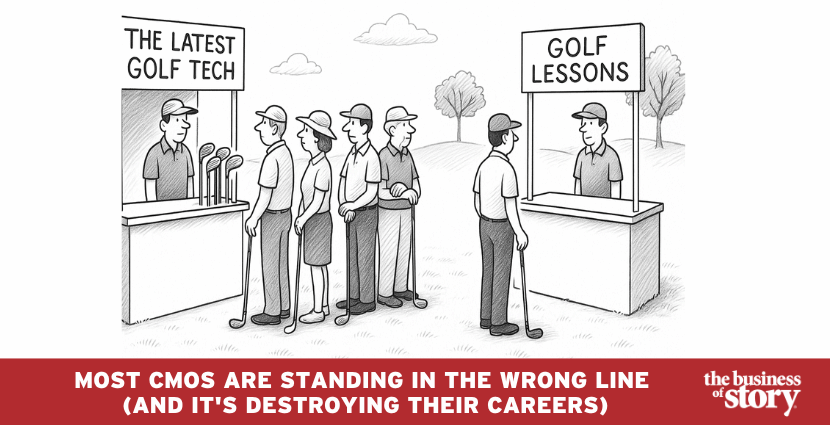
Have you seen the cartoon that shows a long line of golfers waiting to buy new golf clubs? The sign over the counter reads, “The Latest in Golf Technology.”
To the right is another line where just one player stands. The sign over that counter says, “Golf Lessons.”
Hackers notoriously spend loads of money on the latest and greatest technology without investing in lessons from a golf pro to actually improve their swing.
Tech before technique is exactly backwards if you don’t want to suck on the course.
The same is true with CMOs who place AI before first grooving their brand storytelling strategy. The tech will just lead you to more hooks, slices, skulls, and chunks with your campaign content rather than piping it down the middle every time with a narrative-first, rather than AI-first, player.
I’ve watched this pattern destroy marketing campaigns (and careers) for over two decades.
Every marketing leader knows that AI is democratizing tactical execution at lightning speed.
What you might not realize is that this democratization is creating a devastating paradox: the very technology promising competitive advantage is actually eliminating differentiation by making sophisticated execution universally accessible.
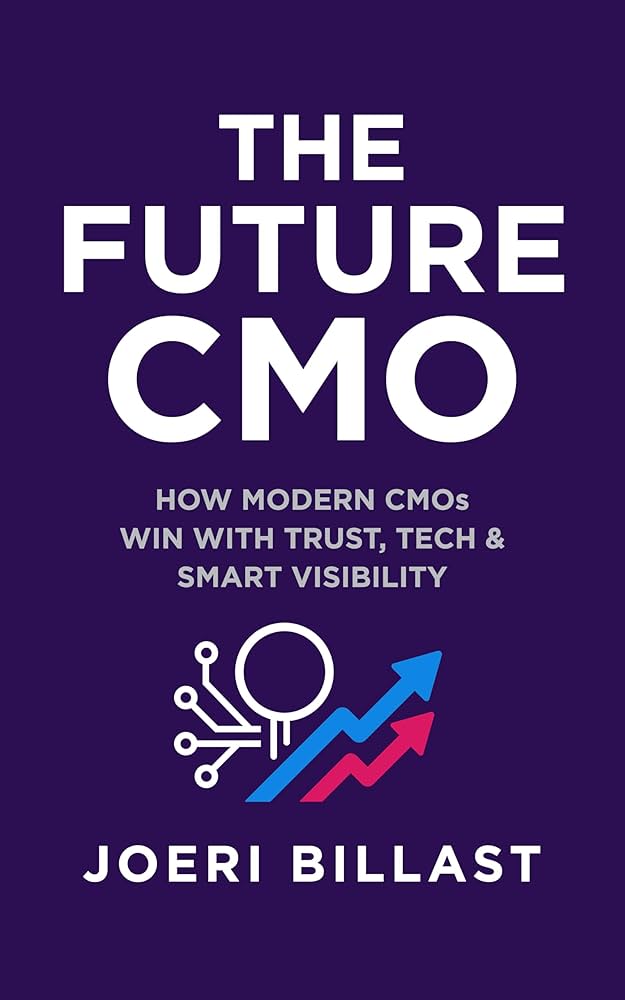 Joeri Billast’s new book The Future CMO: How Modern CMOs Win with Trust, Tech and Smart Visibility exposes the uncomfortable reality through interviews with over 250 marketing executives: most CMOs are trapped in what he calls “performance theater” – creating impressive-looking campaigns (swinging the latest PING golf clubs) that fail to drive authentic business transformation (the swing is awful).
The accountability gap is brutal.
While CFOs speak the language of margin optimization and lifetime value, CMOs continue reporting impressions and engagement metrics.
McKinsey research reveals that CEO confidence in marketing’s ability to demonstrate ROI remains persistently low, with belief in clearly defined marketing roles declining from 90% to 70% over just two years.
Only one-third of CMOs employ financial metrics as primary benchmarks (proper golf swing mechanics).
This explains decreasing CMO tenure and increasing organizational marginalization (Duffers).
The problem isn’t that CMOs lack technology sophistication or AI fluency. It’s that they’re building backwards – adopting AI-first strategies without establishing the strategic narrative foundations before tactical technical execution. Tech can amplify your differentiation, but can never create it.
Just like buying new golf clubs won’t fix a fundamentally flawed swing.
Why Technology-First CMOs Keep Slicing Into the Rough
Most CMO evolution advice follows a predictable pattern: master your martech stack, adopt AI for efficiency gains, and become technology-first leaders.
This creates what I call the “sophisticated mediocrity trap.”
According to a global survey by Boston Consulting Group (BCG), CMO Confidence in GenAI Is Higher Than Ever, with Over 80% Expressing Optimism of ~200 CMOs in April-May 2025: 71% plan to invest more than US $10 million annually in generative AI over the next three years.
Think about that.
Billions invested in technology that can eliminate differentiation instead of creating it. It’s like lining up for the latest driver with adjustable weights and carbon fiber shafts when your swing path is outside-in and your grip is all wrong.
My brother said, “Check out my new Callaway driver.” I said, “Cool. Now you can hit it farther out of bounds.”
When AI democratizes content creation, every marketing organization gains identical tactical capabilities. Technology amplifies whatever story you’re telling.
And if your narrative swing is fundamentally flawed, AI just helps you scale confusion faster.
Billast identifies this pattern brilliantly: “AI has commoditized basic competence. Content creation that previously required days now executes in seconds. Competitive differentiation emerges through human audacity, creativity, and strategic judgment.”
Mark Schaefer reinforces this: “Competence is ignorable. Audacity cuts through.”
But here’s what conventional CMO advice misses completely.
Being audacious without strategic story architecture? That’s just expensive chaos.
You can’t differentiate by being randomly bold with tactics.
You differentiate when every bold move reinforces the same transformation promise.
This is the backwards evolution problem.
CMOs are buying the latest AI clubs without taking story lessons first, hoping narrative coherence emerges accidentally from sophisticated execution.
It never does.
Technology amplifies whatever foundation you’ve built – and if that foundation is tactical rather than narrative, you’re just scaling mediocrity more efficiently.
What Billast’s 250 Executive Interviews Actually Reveal
Billast’s research across his Web3 CMO Stories podcast exposes patterns that most marketing leaders are missing entirely.
Successful CMOs aren’t just adopting technology. They’re building narrative-first organizations that groove their story swing before deploying AI amplification.
Look at the evidence.
Ledger didn’t partner with the San Antonio Spurs to promote hardware specifications. They built trust through cultural relevance and security education, connecting with communities while reinforcing their core value proposition. The strategy behind their “Don’t Get Rekt” brand storytelling campaign was to maintain identical safety messaging across claymation videos, creator partnerships, and localized media. The technical execution through these channels was secondary to their smart narrative-first approach.
Different formats. Same narrative DNA.
They dialed in their story swing first, then used technology to amplify it across channels.
GOAT Gaming built a five-million-member community within Telegram through viral engagement loops and AI-powered interactions, spending zero dollars on traditional advertising. Their secret wasn’t superior technology – it was a strategic story architecture that enabled co-creation rather than broadcast messaging.
Transak survived multiple bear markets by solving genuine problems through clear value propositions. While competitors retreated during market downturns, their narrative consistency maintained growth because customers understood exactly what transformation Transak delivered.
The pattern is unmistakable.
Technology provides amplification. Story architecture provides differentiation.
Yet most CMOs are still standing in the long line for new clubs – adopting technology first, then wondering why their sophisticated marketing feels generic despite flawless execution.
Billast emphasizes that “people don’t adopt technology – they adopt stories that reflect their identity and aspirations.” This insight reveals everything about why AI-first strategies fail.
You can’t automate identity. You can’t generate aspiration through algorithms. You can’t create authentic differentiation by deploying the same AI tools your competitors use.
You build these through a strategic narrative architecture that establishes coherent story infrastructure before technology enters the equation.
You take the lessons before you buy the simulator.
The Story-First Evolution That Pipes It Down the Middle Every Time

Using AI is just like golf; you have to perfect your skills and technique before the technology works for you.
This is where narrative-first positioning transforms everything.
Instead of competing on tactics that AI democratizes, you build story excellence that creates competitive advantages technology can amplify but never replicate.
Picture this: every marketing touchpoint – from social posts to sales presentations to customer service interactions – reinforces the same coherent narrative that positions your audience as heroes while establishing your brand as the indispensable guide to their transformation.
That’s not campaign coordination. That’s narrative architecture.
And it’s exactly what the StoryCycle Genie™ provides through story engineering that bridges classical wisdom with modern business application.
Let me show you how this addresses every challenge Billast identifies in his research.
The Accountability Challenge: When every marketing initiative reinforces your core transformation promise through coherent story structure, attribution becomes straightforward. The narrative itself drives conversion because customers understand exactly what success looks like and how you uniquely deliver it. You’re not measuring which club worked – you’re measuring how well your fundamental swing delivers results.
The AI Democratization Challenge: While competitors use AI to generate more content faster, narrative architecture ensures your content maintains story coherence that AI alone cannot replicate. Technology amplifies your unique storytelling blueprint instead of creating generic similarity. Being a narrative-first practitioner is like taking lessons and dialing in your swing before using the technology of a golf simulator to hone your game. Otherwise, the tech will just engrain and amplify all of the wrong things you are doing with your swing.
The Community Architecture Challenge: Story infrastructure enables co-creation by giving your community the narrative scaffolding to tell your story authentically. Instead of controlling messaging, you provide the architecture that empowers advocates to share your transformation in their own words.
The Trust Development Challenge: Billast’s research shows trusted brands command 15-20% price premiums and recover from crises 2.5 times faster than competitors (Edelman Trust Barometer 2024). Narrative consistency across every touchpoint builds this trust more effectively than transparency theater or social proof accumulation.
The Simplicity Challenge: Billast emphasizes Ariel Wengroff’s five-second connection rule – your story must resonate within five seconds or it won’t achieve viral distribution. The ABT framework (And-But-Therefore) creates this instant clarity by structuring every message around agreement, contradiction, and resolution.
You can see how this works.
Narrative-first brands build story infrastructure that makes AI amplification create differentiation. AI-first brands without narrative foundations use technology to scale mediocrity more efficiently.
The 90-Day Transformation That Conventional Approaches Take Years to Accomplish
Billast provides the diagnosis of what future-ready CMOs must accomplish: speak financial languages, own AI strategy, build communities over campaigns, simplify complexity, embrace audacity, and lead transformation.
But his research doesn’t address the operational question that keeps CMOs awake at night.
How do you actually implement this transformation when you’re already drowning in quarterly demands, budget pressures, and organizational resistance?
The StoryCycle Genie™ makes this transformation achievable through story engineering that compresses years of narrative development into 90 days of implementation.
Here’s the blueprint:
Day 1: Foundation Development
- Conduct story architecture audit across all marketing touchpoints using diagnostic frameworks
- Identify narrative inconsistencies creating customer confusion and diluting brand equity
- Define core transformation promise using the 10-element Story Cycle infrastructure
- Establish measurement baseline for story coherence and business impact correlation
- This is all created in a few short hours, building your Brand Brain in the StoryCycle Genie™

Day 2 : Strategic Architecture
- Deploy StoryCycle Genie™ for narrative blueprint development across all audience segments
- Build audience-specific story adaptations that maintain core coherence while addressing unique challenges
- Create platform-native story expressions that speak each channel’s language authentically
- Train team on narrative scaffolding principles and practical application

Days 3 – 10: Content Ecosystem Activation
- Generate story-structured content across all marketing channels using AI amplification
- Enable community story co-creation through narrative frameworks that empower authentic sharing
- Implement measurement protocols connecting story consistency to customer journey metrics
- Begin tracking story impact on acquisition costs, lifetime value, and referral velocity

Days 10-30: Optimization and Business Integration
- Analyze story performance data across channels, audiences, and customer journey stages
- Refine narrative architecture based on conversion evidence and engagement patterns
- Present story-driven business outcomes to executive leadership using financial language
- Scale successful story patterns while eliminating narrative elements that fail to drive results

Now here’s what most CMOs miss about this timeline.
In 30 days, you’ve accomplished your entire brand storytelling foundation, developed comprehensive marketing strategies, created activated always-on-brand content across all channels, AND benefited from nearly a month of customer exposure and market feedback.
Traditional approaches take 90 to 120 days just to create your brand narrative foundation through endless workshops, annoying stakeholder interviews, and frustrating revision cycles.
You’re not just moving faster. You’re compressing years of narrative development into a single month while simultaneously activating that narrative in the market and measuring its business impact.
That’s the difference between story architecture and storytelling theater.
Between taking lessons first and buying clubs first.
Why Only The StoryCycle Genie™ Delivers This Transformation
Competitors offer general storytelling advice or AI content platforms.
The StoryCycle Genie™ provides narrative architecture that bridges classical storytelling wisdom with modern business application through the latest technology.
It’s not AI that generates content. It’s narrative infrastructure that ensures every piece of content reinforces your core story while adapting to platform-specific requirements and audience-specific needs.
Think of it as the golf pro who develops your proper swing mechanics before you step into the simulator. Once your narrative fundamentals are solid, our StoryCycle Genie™ technology amplifies that foundation into consistent performance.
But if you skip the lessons and jump straight to the simulator, you’re just ingraining bad habits at scale.
When Billast emphasizes that “people don’t adopt technology – they adopt stories that reflect their identity and aspirations,” he’s describing exactly what story architecture enables: the development of narratives that create identity and aspiration rather than promoting features and specifications.
This is why technology-first approaches fail.
AI can generate content. It cannot generate coherent narrative architecture that positions audiences as heroes, establishes brands as indispensable guides, and creates transformation promises that compound trust over time.
That requires the marriage of your business instincts, client insights, and market acumen with classical storytelling wisdom amplified by modern business application – exactly what the Story Cycle Genie™ delivers through proven frameworks that have transformed marketing organizations across industries.
The Choice Facing Marketing Leadership Right Now
Billast’s conclusion is unambiguous: “The CMO role undergoes reconstruction because previous versions no longer function effectively. Brand guardians evolve into Chief Value Officers. Campaign managers become community architects. Creative directors transform into AI strategists.”
I agree with his diagnosis completely.
But this evolution requires narrative blueprints, not just aspirational goals.
You can continue standing in the long line for the latest AI tools, hoping story coherence emerges accidentally from sophisticated execution. I’ve seen dozens of CMOs take this path. It leads to efficient mediocrity and eventual replacement by leaders who understand that differentiation comes from story infrastructure, not technology adoption.
Or you can be the one golfer in the lessons line.
You can build narrative architecture first, then use AI to amplify that foundation into a sustainable competitive advantage.
The StoryCycle Genie™ provides the story engineering that makes this transformation achievable within 90 days rather than aspirational across years of trial and error.
The question isn’t whether this evolution will happen. It’s whether you’ll lead it or be replaced by someone who will.
Ready to build the narrative foundation that transforms your marketing organization from performance theater to business-driving storytelling mastery?
Discover how the StoryCycle Genie™ provides the story infrastructure that bridges Billast’s vision with operational reality.
It’s a difference between being a duffer and a pro.
Story on, my friend.