Why AI Scale Without a Brand Brain™ Turns a Slow Leak Into a Firehose
Stop paying attention to your house for a couple of years, and things start to go wrong.
Quietly at first. A small leak. A sticking door. Paint beginning to peel at the edges.
Ignore it long enough, and the vines move in. The siding falls off. The structure collapses under its own weight.
Entropy is the default state of everything ever built. That’s nature.
Your brand story works exactly the same way. Narrative entropy is the invisible force fragmenting it right now, slowly, almost imperceptibly, until the day it isn’t slow at all.
I talked about this recently with Derek Little, host of B2B Podcast Review and founder of TrailblazerMastery.com — one of the sharpest business development minds I have crossed paths with. Watch the full conversation on YouTube, listen on iTunes, or find Derek at TrailblazerMastery.com. He pressed me on something that gets to the heart of every brand problem I see: why can’t you just create a story and hope everyone tells it the right way?
Because hope is not a governance system.
A brand is the story people tell about you when you are not in the room. You can influence it. You can architect it. But if you do not govern it — with guardrails, with shared vocabulary, with a Brand Brain™ that everyone draws from — that story will fragment into as many versions as you have people telling it.
The Center of Gravity Problem
Derek has a framework I want every brand leader to read. In his article How to Build a Core Narrative, he describes the Core Narrative as the center of gravity of your business development — not another marketing asset, but the business worldview underneath your marketing.
The lens through which your firm interprets the buyer’s situation in eight parts:
- Priority buyer + buying situation
- Changing reality
- Misdiagnosed problem
- Consequences + urgency
- Distinctive insight
- Better path forward
- Distinctive approach
- Proof Anchor
He is exactly right, but organizations overlook many of these.
You can build a brilliant Core Narrative, all eight parts coherent, the insight genuine, the proof anchor compelling, and still watch it fragment inside six months.
Because a Core Narrative without governance is just a very good explanation waiting to be told differently by every department that encounters it.
Sales compresses it one way. Marketing interprets it another. HR invents something adjacent. A new hire improvises from memory.
Do you see narrative entropy creeping in like tree roots cracking a foundation, or poison ivy insinuating itself into your basement?
Derek’s Core Narrative is the worldview. The Brand Brain™ is the infrastructure that keeps that worldview from fracturing as the organization grows and as AI tools multiply the voices telling your story.
Narrative vs. Story
Most leaders use “narrative” and “story” interchangeably. They are not the same thing.
Derek asked me what the difference is. So I pulled up an analogy I haven’t used since a Business of Story keynote I delivered to Visit California tourist professionals at Disneyland several years ago.
Picture the Golden Gate Bridge. The main span and those massive cables arching overhead? That is your narrative — the overarching framework that transports your audience from one world into another.
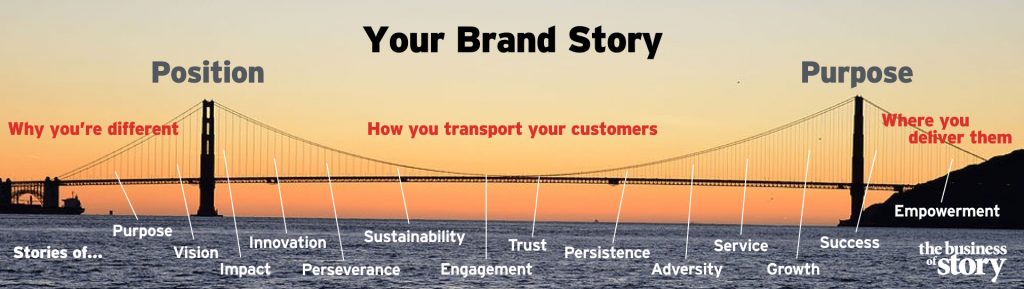
In Business of Story, Park Howell uses the Golden Gate Bridge to illustrate the critical distinction between brand narrative and brand stories: the main span and primary cables represent the unifying brand narrative, while each vertical suspender cable is an individual brand story. No story carries weight without the narrative holding it in place — and the narrative means nothing without the stories giving it strength.
The individual vertical cables supporting the structure? Those are your stories. The case studies. The testimonials. The origin stories. The anecdotes your salespeople tell in the field.
One rusted cable weakens the span. A dozen rusted cables and the whole structure starts swaying.
A foundational brand narrative is the overarching story everything else is built on. Sales will tell it differently than marketing. HR will tell it differently than the CEO. That is not a problem provided they are all drawing from the same structural cables.
My dad intuitive ran our family of nine on this exact principle. He built the Howell family values around what he called the Happy H brand. Be kind, honest, have intregity and always remember that hings tend to work out. He also had one other value for us seven kids: at the dinner table, you had to keep one foot on the floor. Everything else was fair game for eating.
Seven kids, all decidedly different. Yet to this day, people comment on how we all get along, how we carry the same essential values forward through our own distinct lives. That is story governance working at a family level. The Happy H narrative holds. The individual stories vary. The structure stays sound.
The AI Accelerant
AI does not create narrative entropy. It accelerates whatever entropy already exists.
If your brand story is fragmented across departments, across channels, across conversations — AI scale turns that fragmentation into a firehose. Statistically average brand voice at enterprise velocity.
This is what makes Derek’s eight-part model so urgent. Every organization is now being asked to produce more content, across more channels, at higher speed, using AI tools that will faithfully amplify whatever worldview they are given to train on. If that worldview is incomplete, contradicted, or ungoverned, you do not get brand coherence at scale. You get narrative entropy at scale.
Nike knows this better than anyone right now. Coming out of COVID, they lost governance of their brand narrative. Not their logo. Not their tagline. Their story. The result? Roughly two hundred billion dollars in market value erased while they scrambled to pull it back together.
That is what happens when a great Core Narrative loses its Brand Brain™.
The Proof That Governance Compounds
I worked with Pret Auto Partez, a used car dealership in Quebec serving subprime buyers — people who had fallen on hard times financially.
We built their foundational narrative together in 2016: Pret Auto Partez — your vehicle to financial freedom. One Brand Brain™ document. Still compounding today. Three times the growth. Default rates halved.
The document did not do that. The governance did.
Andre Martin Hobbes, the founder, had a genuine worldview: good Canadians who have fallen on hard times deserve a path back to financial stability, not a predatory interest rate.
That is Derek’s Core Narrative in practice — a changing reality, a misdiagnosed problem, a distinctive insight, a proof anchor.
But it was the installation of that worldview as Brand Brain™ infrastructure governing every conversation, every touchpoint, every new hire’s first week that turned a compelling story into a compounding asset.
The Story Driven leaders who will define the next decade are the ones who installed their story as organizational infrastructure before the rest of the market figured out that was the game.
The master equation is not a metaphor.
AI Scale × No Brand Brain™ = Narrative Entropy at Speed.
AI Scale × Brand Brain™ = Brand Coherence at Speed.
Build the worldview. Instill it in your people. Install it in your organization. Govern it before entropy does.
B2B Podcast Review with Derek Little featuring Park Howell: Narrative Entropy, Brand Story Governance, and AI
Park Howell on Narrative Entropy: Why Your Brand Story Is in Constant Decay
Derek Little: Hello everyone, I’m Derek Little, host of B2B Podcast Review, and this show is part of my ongoing research into modern business development.
If you’d like to see how your own business development system stacks up, you can visit TrailblazerMastery.com and take my free business development capability scorecard.
Today I’m joined by Park Howell, known as the world’s most industrious storyteller. Park is an Emmy Award-winning advertising veteran with more than 40 years of experience. He’s also host of the Business of Story podcast, which I’ve listened to for years. He’s also the author of Brand Bewitchery and co-author of the Narrative Gym for Business.
Park, thanks for joining me.
Park Howell: Derek, it’s a pleasure being here with you. Thank you.
What Is Narrative Entropy? The Hidden Force Quietly Killing Your Brand Story
Derek: Park, one thing in my notes that really caught my attention is that you talk about something called narrative entropy. From what I understand, this is how a brand story loses power, no thanks to AI.
Why can’t you just create a story and hope everyone tells it the right way? Why does this happen? What can companies actually do?
Park: Great question. Narrative entropy is the default state. Entropy, in the science behind it, means anything that is built as a structure will naturally fall apart.
Picture your house. When you move into a brand-spanking-new house, it’s beautiful, it’s gorgeous, it smells good. Then what happens six to eight months later? Things start falling apart. If you were to move out and not pay any attention to it for thirty years, it would literally be consumed by the environment around it. Vines would grow up. Siding would randomly fall off. You would start getting leaks even when you’re not using anything.
That’s entropy. And the same is true with your brand story.
Your brand’s story brings the structure to how people make meaning about your company. Everybody has a story, but they can’t necessarily find it. In the branding world, we help brands find that story, build it, launch it, get people to embrace it.
But if that company does not pay attention and govern that story — meaning putting guardrails on it so that it is shared coherently, clearly, and consistently across all departments, across all internal and external channels — that story will be like that home. It will just start falling apart.
Derek: When you refer to brand story, are you talking basically larger firms? Are these personal stories or could they be?
Park: They certainly could be. Whether it’s personal branding where it’s just yourself and you want to carry some sort of brand in the world — maybe you’re a solopreneur and people are buying from you — to a professional brand, which could be a small to mid-sized business or a large enterprise.
Brands to me are simply the story people tell about you when you’re not in the room. We Homo sapiens always create meaning through narrative and story to make sense of who Derek is, who Park is, what’s the Business of Story, what’s Coca-Cola, what does Nike stand for.
What happens if that story starts falling apart? Someone could be sitting in a room and say, “Boy, Park’s a really great guy.” And the other person goes, “I don’t know, I’ve met Park. I don’t think he’s such a great guy.” A third person might say, “I read something he posted online. He doesn’t seem like that great of a guy to me.” All of a sudden your story falls apart unless you govern every aspect of it.
Brand Story Governance: How to Find, Refine, and Protect Your Most Valuable Business Asset
Derek: I understand there are different types of stories — a marketing story, a leadership story. Are you referring to the most important stories that everyone is going to be repeating?
Park: I call it a foundational brand narrative. That overarching story that everything is built on. Sales is going to tell it a little differently than marketing, but it shouldn’t be a completely different story — which often happens. HR in talent recruitment and retention should be telling a similar story, not some other half-baked thing they think will get people in.
It’s all based on the same value. Let me put it this way.
I am one of seven kids, all born within nine years of each other. My mom and dad were fantastic parents, and to this day, people comment on how our big family all gets along. My dad had a brand for our family — the Howell family. He even got it registered as a brand. He called it the Happy H.
The Happy H is the way he and my mom preferred to go through life. You’re going to have your trials, your tribulations, your sadness — but find the happiness whenever you can and share that with other people.
Our overarching brand narrative is the Happy H. All seven of us kids, who are all decidedly different brands, still understand, appreciate, and embrace that overall Happy H context. We’ve shared it with our kids and grandkids. It’s a brand that has real substance to it. We all bring our own point of view to it, but we still go through life with the same visions, values, and virtues our parents gave us — just from our own particular point of view.
Derek: Yeah, so it’s like a family brand. The purpose of the family shared amongst the family members.
Park: Think of that in terms of Nike with their one overarching “Just Do It” brand. They’re selling tennis gear, basketball gear, football gear, casual wear, leisure wear — but it all has to support that “Just Do It” mentality.
They kind of lost the governance of their brand story coming out of COVID, to the tune of about a two hundred billion dollar loss in market value. And for the last year and a half they have been scrambling to get that story pulled back together.
Does B2B Storytelling Work the Same as B2C? The Truth About Narrative in Business-to-Business Marketing
Derek: Are you focusing more on consumer brands? B2B is a little bit different, do you think?
Park: It’s not different, because whether you’re B2B or B2C, what do they both have in common? You’re selling to human beings, Homo sapiens.
To me, B2B is a real misnomer. It means boring to bored in the storytelling vernacular, because business to business is historically stunningly boring. They forget that they’re not selling to a business — they’re actually selling to a human being within another business that they can help.
Stories work the exact same way on the brain whether you’re selling to an enterprise or to a customer. The magic of storytelling doesn’t change. You just, like in your world, Derek, tell stories from your audience’s point of view — first understanding what story they are currently living, what stories they may be telling about you.
I was just finishing an interview with a salesperson named Tara Schuler. She’s brilliant. She says, “I speak in questions.” Her whole thing about sales is to keep asking questions of your audience, of your prospects, so that you really understand their story and how you connect your story to what is driving them.
If you don’t have your story dialed in with story governance and you’re shooting from the hip, you’ll be winging it out there versus what I like to say — winning it every time — because you’ve governed that story. You’ve found it, you’ve put guardrails around it, and you make sure everybody in the enterprise shares it the same way, even from their own perspective.
Narrative vs. Story: Why Understanding the Difference Makes You a More Powerful Communicator
Derek: What would you say is the difference between a story and a narrative? Would you say they’re the same thing?
Park: They’re a little bit different. Narrative to me is the overarching point of view that your brand holds in the world. The stories then come in as the elements that support that overarching narrative.
An analogy I like to use is the Golden Gate Bridge. That bridge and those big looping cables are the overall narrative that transports the audience from one end to the other. All the individual vertical cables in there are the stories that support that overarching narrative. Get one of those stories rusting away or falling off, and that narrative starts losing its strength.
You can even picture the Golden Gate Bridge in three acts. Say you’re driving from San Francisco across the bridge. Act One is everything that happens just before that first large stanchion — you’re entering the story, realizing you are literally being transported from one world into another. Act Two is that big long expanse in the middle. You look over, it can take your breath away. You hear the stories about people who have jumped off it. All the conflict happens in the middle. Act Three — you’ve made it through the story arc. You’re on the other side and you’ve been transported into a whole new world.
The narrative is the overarching bridge. The stories are the individual cables that hold that narrative in place.
Derek: When you say brand story, you’re talking about an origin story as one of those stories in the narrative?
Park: Yes. My overarching brand narrative for the Business of Story is to help people excel through the stories they tell. That’s it. Then I have an origin story. You might ask, “Why are you doing this, Park? How’d this all start?” I tell you my origin story.
You might ask, “Give me an example of someone you’ve helped in a leadership realm.” Then I’d probably talk about the generals I work with in the Air Force over the past eight years to help level them up as leadership storytellers.
You might say, “Is this just for big companies or small businesses?” Well, let me tell you about the person I helped with their own individual story.
That overarching narrative is quite often what you’d call a tagline. Let me give you a quick example. There’s a company up in Quebec, Canada called Pret Auto Partes. It means “ready cargo” in French. They are a used car dealership for at-risk buyers — subprime buyers. Good people with bad credit.
Andre Martin Hobbes opened up this car dealership and came to me and said, “Can you help us with our brand narrative?” And I told myself a negative story — great, a used car dealership taking advantage of at-risk buyers, charging huge interest rates, repossessing cars after three or four months.
Until he told me his real mission. He said, “Park, these are great Canadians who have fallen on hard times. I want to help them get back on their feet. They can do it with the purchase of the right car that fits into their budget. Make sure they make those payments every month for two years and they go from subprime to prime buyer. I will not sell them a car they cannot afford. They have to go through a three-hour financial planning session with us first.”
That led to the overarching brand narrative I came up with: Pret Auto Partes — your vehicle to financial freedom.
They started using their origin story. Customers came in and shared their testimonials — some talking about taking a bus eight hours across Canada just to buy a car from them because they knew they could be trusted.
Andre took his entire business model and based it on the core brand narrative strategy we built using our Story Cycle System™, then used the stories of his customers to back up every promise they made in their overarching brand narrative. A good example of narrative versus story.
Derek: That’s great. I’m Canadian, by the way. I’m in Hamilton, Ontario — right close to Toronto.
Park: Hamilton! I grew up in Seattle and spent a lot of time in British Columbia, so I’m practically Canadian. And I am just overly distraught at what some of our leadership have done to Canada. It is just embarrassing. I apologize. We don’t think that way.
Derek: We have your midterm elections coming up and we’ll see what happens there.
Park: My fingers are crossed.
Derek: So what you’re saying is that family story about the Howell family — that’s kind of like your brand story for your business.
Park: It really is. The Happy H is the overall overarching brand narrative for the Howell family, and we each live into it in our own way from our own point of view, living our own stories — but all of them guided by the wisdom, virtues, values, and honesty that our mom and dad taught us.
Derek: I have a kind of story like that for my business, Trailblazer Mastery. It started as Trailblazer Writing, then Trailblazer New Media. I live just a mile from the Hamilton Escarpment, which starts at Niagara Falls and goes for five hundred miles — it’s like a big cliff.
When I started my business, I was kind of lost in life. I used to walk up and down the old rail trail every day to stay in shape. There are signs on the trees called blazes. When the Iroquois first created this path, they would mark the trees — that’s actually what a trailblaze is.
Park: I never knew that. Trailblazers going ahead and blazing into the tree.
Derek: Right. There’s a sign every so often for five hundred miles all the way up to Tobermory on the Niagara Escarpment. I looked into that and thought I had to come up with something on my own.
I mean, that didn’t really help me in terms of getting clients. Then I wrote my book, which is focused on authority. I typically work with small boutique consulting firms whose problem is they’re not recognized as experts. Expertise is what you do. Authority is being recognized for what you do. I wrote this book called The Authority Gap.
I created a core narrative focused on their situation. What you’re saying is your brand story is really one thing, whereas a narrative is kind of like the buyer’s worldview — multiple stories strung together to represent the customer’s situation. And then there are different stories within the company that may not help you get a customer directly, but they’re like a company culture story.
Park: Mm-hmm. And you introduced me at the beginning as “the world’s most industrious storyteller.” That’s not a moniker I gave myself. A client gave it to me.
We were in a room identifying what my story was. I was going around asking each person what their core narrative was — the one thing they could really hang their hat on. Then the client turned it on me, and I wasn’t ready for that. He goes, “So what’s your core narrative?” And I said, “I help people excel through the stories they tell.” He goes, “Yes, you’re very industrious about that.” And I said, “You just gave me my title — The World’s Most Industrious Storyteller.”
Now I have to live into that and back it up. I have to demonstrate to people how working with me or our online StoryCycle Genie® builds them, builds their brand, builds their revenue streams.
My archetype — my personal brand archetype — is the Wise Fool. I can go in and ask very pointed questions of my customers and CEOs and CMOs that their own people can’t ask, because that’s why they hired me. I will poke holes at things. The wise side comes literally from my 40 years of doing this. I have a pretty good sense of what works and what doesn’t. These are all stories that feed up to this idea of the world’s most industrious storyteller who will help you excel through the stories you tell.
How AI Is Disrupting Brand Storytelling — and Why Generic AI Content Is a Brand-Killing Risk
Derek: I know you’ve got a number of tools and solutions. You mentioned the Genie. Is that new? Is that the same as StoryOps or —
Park: It all plays into StoryOps. I wrote my book Brand Bewitchery, which is all about my Story Cycle System™ — a brand narrative strategy development platform I’ve been building and using for twenty years that has grown brands by as much as six hundred percent.
We brought it together. It’s AI-driven, but I like to say artful intelligent, not artificial, because you collaborate with the Genie using our intellectual property to build world-class narrative strategy in an hour or two versus months and months. And for around a hundred bucks versus thousands upon thousands. We have democratized world-class branding so anybody can benefit from it through our Story Cycle Genie®.
I also do a lot of virtual training for companies large and small to train their people first how to become better human, animal storytellers — really understanding in their brain how it works — and then how to use Artful Intelligence™ to amplify and scale the stories they are telling.
Derek: Do you think if someone used that tool, it would help them become a better podcast guest? I read a post you wrote about a guy who blew his AI pitch. He asked you: if AI can tell a thousand stories in the time it used to take a human to tell one, what makes a story worth believing? Can you tell me how your tool would help this guy be better at storytelling?
Park: Let’s go backwards. I asked that guy the question he posed to me — that was going to be the premise of the whole show — and he couldn’t answer it. All he did was default back to selling his own services.
When I kept asking him other questions, I realized I’d been totally hoodwinked. Generic AI fooled me, but then outed the guy. And that’s what stories will do. If you’re not truthful in your storytelling, the truth is ultimately going to surface.
After we got done, he asked me, “I’ve never been on a show before. You’re my first. How did I do?” And I said, “All right, since you asked, I’ll be brutally honest — not great.” He used a lot of filler words and all he would do was focus on selling his business. He could never answer any question that he himself had posed for me to ask him on the show.
That’s when I realized: you didn’t actually write this pitch. You had AI write it through one of your tools. He said, “Well, yeah, that’s right.” I said, “But you were unprepared to answer any of the questions your AI posed to me to ask you.”
Do you see how you fell into the AI trap even as an AI professional? The guy was very brilliant but very unprepared when it came to human conversation and how to actually prepare yourself for a story.
Don’t have AI pitch you. Be the pitcher. Pitch it yourself and actually be able to respond to the questions you put into the pitch.
Derek: Interviewing him, he should have had a story to tell you.
Park: He had one motivation — to sell his services. No one cares about your services until they care and trust you and know how you can actually help them. Then you can talk about how you do it.
How Park Howell Uses StoryCycle Genie® to Create AI-Powered Thought Leadership at Scale
Derek: So was he going to ask you that question about AI telling a thousand stories?
Park: He wanted me to ask him that question because he’d said, “Here’s what I’d like to focus on in this interview — here’s the question.” But the very question he posed, he couldn’t even remotely answer.
It sounds like he was trying to make a case for his AI tools.
In the StoryCycle Genie®, I use it for writing all the time, but I collaborate with it. I don’t just let it go off willy-nilly. It has a brand brain we’ve built, so it knows my brand inside and out. It writes in my voice.
If you go read my newsletter, Brand Story Ops for Agencies on LinkedIn, I’ve got over fifteen hundred subscribers already. I will work with the Genie and say, “You are going to be using the Business of Story content playbook. You’re going to use my voice profile. Here’s what we’re writing about. Here’s my core subject. Here’s my thesis. Here’s the research I’ve done. Find other research if you can find it. Now write the first fifteen-hundred-word thought leadership post from the Business of Story brand in Park’s voice profile.”
It will write it. It’ll be pretty dang good — about eighty percent there. Then I’ll go through it. I’ll say, “Yeah, that’s good. I wouldn’t say this. Take this out. I don’t like this part. Let’s move this.” And quite often I’ll look at the overall piece and think, “I want to put a personal anecdote at the beginning — something I actually experienced.” I’ll write that myself. I’ll give it back to the Genie, and then the Genie will go through and write a beautiful piece.
People come to me and say, “I feel like I was reading the New York Times when I was reading this article.” Plus it would have taken me ten to twelve hours to write those thought leadership posts. Now it takes me two to four, depending on how much editing and research I have to do. It’s amplifying my work, making me a better writer, a more critical thinker, a better editor. And it will write it completely search-optimized for SEO, GEO, and AEO, quite often adding an FAQ at the end.
Can AI Tools Make You a Better Podcast Guest? What Actually Works
Derek: Some people are just naturally bad at storytelling. They really need help. And some people are a little more open-minded — they can explore, they daydream a little more, they can see associations. So some people your tool will help a great deal.
Park: Yes. And people can go to businessofstory.com and get a free grade on their brand story using our Brand Story Grader. It’s a little red button near the top of the page. Put in your email address and the URL you want it to review, and in sixty seconds it will give you a free brand story assessment grading you from A+ to F−, plus a fourteen-point storytelling assessment that validates what you’re doing well, reveals the gaps you can quickly fix, and even inspires you with new ways to think about telling your story.
Now, circle back to your question about podcasts — can it make you a better podcast guest? Yes. There are actually two Genies inside for this.
If you’re a host — and I use this all the time — someone’s coming on my show and I’ll give their information to my Genie and say, “Help me really understand what would be the best through line for this interview and give me an outline and questions.” Within thirty seconds I’ve got all that. Then I can follow it or divert from it.
If I’m going to be a guest on a show I don’t completely understand, I’ll use the guesting Genie and say, “Here’s the show. Here’s the host’s thought leadership. Help me better understand this show I’m going on and what would be an appropriate topic I could share from my point of view.”
Because the Genie knows my point of view — it has my brand story, my voice — it’ll say, “Here, Park, are three different storylines you could follow. I like number one because of this, I like number two because of this, I really like number three because of this, and that would be the one I’d recommend.” Then I can go with whichever one it believes makes sense for that show.
Who Should Listen to the Business of Story Podcast — and What You’ll Gain From Following It
Derek: Let’s wrap up. What I ask each guest to do is sum up three questions: who your podcast is for, what it’s trying to do, and why it’s worth following.
Park: My podcast is for any business or personal leader who is already story-driven. They know the power of story, they understand that it works, they just don’t know how to do it. People often ask me, “How do you sell storytelling?” I say I don’t sell storytelling. You have to be a believer to show up. I instill it in your people and install it in your organization.
As for what my podcast is trying to do — I’ve been doing it for twelve years, every Monday. The first five hundred episodes were very much about storytelling in general and how you grow as a storyteller. When I got to five hundred episodes, I made a decided shift.
Now that AI is here, and artificial intelligence can destroy your storytelling if you’re not careful, my focus is showing my listeners how to use AI as Artful Intelligence™ to make them better storytellers and have the impact they want to make in the world.
Episode 589 is what I recorded this morning. The last eighty-nine shows have been specific around the use of Artful Intelligence™ and storytelling, and over the last dozen or so, this concept of story governance — how can you find the story only your brand can tell, refine it, define it, get people behind it, and make sure it doesn’t fragment into narrative entropy.
Because those AI bots out there will take your fragmented story and spew it around the world and confuse not only the bots, but your viewers, your readers, your customers. So we’ve been staying really focused on how do you find the story, and then how do you govern it once you’ve activated it.
Derek: That’s a really good point. People don’t experience your business the way you do. They get little bits and pieces of it. If you don’t have a narrative and a story holding everything together, they won’t get anything out of all those bits and pieces. Whereas if you have that story, it’ll add up to them.
Park: People ask me my definition of branding and I say a brand is the story people tell about you when you’re not in the room. You want to make sure they’re telling an accurate, honest, truthful, powerful, productive story. And that’s why you have to govern your story.
Derek: My final question is why is it worth following?
Park: Each episode, you will get one tip at a minimum that you can apply immediately in your world. Every show follows my own narrative structure of the And, But, Therefore and even my ten-step Story Cycle System™. At the core of that is a singular problem-solution dynamic that will be the thread throughout the entire show.
It may have some offshoots to other problem-solution things, but it has to support that overarching narrative — what are we solving for today for this audience, and what can they do right now to enact this? It could be a story tip, a sales tip, a marketing tip, a governance tip — but it’s always based on story.
Derek: Where can people find you?
Park: Come on over to businessofstory.com. That’s the name of the podcast. You can find me on any place where you watch and listen to your shows. Jump on over to LinkedIn and if you’re there, reach out to me and let me know you heard me on Derek’s show. Let’s connect there. Those are probably the two best places — Business of Story for the podcast, and LinkedIn.
Derek: Park, thanks for joining me.
Park: Derek, it’s been an honor. I appreciate you having me.
Q: What Is Narrative Entropy and Why Does It Cause Brand Stories to Fall Apart Over Time?
A: Narrative entropy is the natural fragmentation of a brand story when it is not actively governed. Just as an unmaintained house slowly deteriorates — a small leak, a sticking door, then vines consuming the structure — a brand story left without guardrails quietly drifts into inconsistency. Different departments tell different versions. New hires improvise. Over time the story loses coherence, credibility, and power.
Q: What Is Brand Story Governance and How Do You Use It to Protect Your Brand Story from Drifting?
A: Brand story governance is the system of guardrails, shared vocabulary, and organizational infrastructure that keeps a brand narrative coherent across departments, channels, and time. It means finding your foundational story, putting clear parameters around how it is shared, and ensuring every communicator — from sales to HR to marketing — draws from the same source of truth. Without governance, even a compelling brand story fragments into as many versions as there are people telling it.
Q: Is Storytelling in B2B Marketing as Effective as It Is in B2C, and Does It Work the Same Way?
A: Yes — because both B2B and B2C ultimately involve selling to human beings. B2B is often called “boring to bored” because business-to-business brands forget they are talking to a person inside another business, not to the business itself. Stories work the same way on the human brain regardless of the commercial context. The key is understanding the story your audience is already living and connecting your brand’s story to what is driving them.
Q: What Is the Difference Between a Brand Narrative and a Brand Story?
A: A brand narrative is the overarching framework — like the Golden Gate Bridge span — that gives structure and direction to all individual brand stories. Stories are the supporting cables: case studies, testimonials, origin stories, and the anecdotes your team tells in the field. The narrative governs how all stories connect and cohere. One rusted cable weakens the span. A dozen rusted cables and the whole structure starts swaying.
Q: How Is AI Changing the Way Companies Approach Brand Storytelling, and What Are the Biggest Risks?
A: AI accelerates whatever brand story already exists — coherent or fragmented. Organizations that adopt AI velocity without first installing a governed Brand Brain™ end up producing statistically average brand voice at enterprise scale. The biggest risk is generic AI content that sounds polished but belongs to no one — fragmenting your narrative across channels while making it harder for customers to understand what you actually stand for.
Q: What Is the Story Cycle System™ and How Does It Help Businesses Build a More Compelling Brand Story?
A: The Story Cycle System™ is a ten-step brand narrative strategy development platform built and refined over 20+ years by Park Howell. It helps organizations find the foundational brand narrative only they can tell, define it, refine it, and get every person in the organization behind it. Brands using the Story Cycle System™ have grown by as much as six hundred percent by installing their story as organizational infrastructure rather than leaving it to chance.
Q: What Is Brand Brain™ and How Does It Help Organizations Maintain and Protect Their Brand Story?
A: Brand Brain™ is a living, governed document that encodes a brand’s foundational narrative, voice, vocabulary, and story architecture. It serves as the single source of truth every communicator and every AI tool draws from. Pret Auto Partes built their Brand Brain™ in 2016 — your vehicle to financial freedom — and that one document is still compounding today: three times the growth, default rates halved.
Q: What Is StoryCycle Genie® and How Can It Help You Create Thought Leadership Content Faster?
A: StoryCycle Genie® is an Artful Intelligence™ platform built on the Story Cycle System™ that collaborates with you to create brand-aligned thought leadership content. Rather than generating generic AI copy, it writes in your brand voice using your content playbook and voice profile as its foundation. What once took ten to twelve hours of writing now takes two to four — while producing content that is SEO, GEO, and AEO optimized.
Q: How Can You Use AI Tools to Prepare for a Podcast Interview and Show Up as a Stronger, More Confident Guest?
A: The key is collaboration, not delegation. Using AI to write your pitch without being able to answer the questions it generates is a trap — as one guest discovered when Park pulled the interview because the AI had pitched the show but the human couldn’t back it up. The right approach: use AI to understand the show’s through line, identify the most relevant storyline from your own expertise, and prepare your personal anecdotes and answers yourself. AI prepares the stage. You have to perform on it.
Q: What Is the Business of Story Podcast, Who Is It Designed for, and Why Should Brand Marketers Follow It?
A: The Business of Story podcast is for business and personal leaders who already believe in the power of story and want to know how to use it. Hosted by Park Howell every Monday for twelve years — now at episode 589 — the show focuses on how to use Artful Intelligence™ to become a better storyteller, with a growing emphasis on story governance: how to find the story only your brand can tell, govern it, and prevent it from fragmenting into narrative entropy at AI speed. Every episode delivers one immediately actionable tip built around a singular problem-solution dynamic.