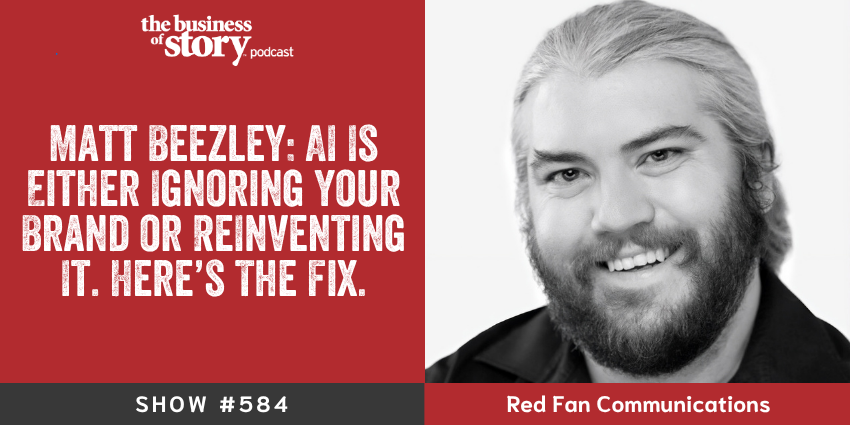
The Invisible Brand Crisis That Is Playing Out in Every AI Search Window Right Now
When Your Brand Story Fragments Across Platforms, AI Assembles the Pieces Into Something You’d Never Approve
You’ve invested in your brand story. The messaging framework. The positioning workshop. The brand guidelines nobody actually reads.
And you know that a clear, consistent story is what separates the companies that get found from the ones that get forgotten.
But right now, across every major platform where your brand exists — your website, your LinkedIn page, your Crunchbase profile, your Google Knowledge Base entry — those descriptions are telling slightly different stories. And AI is interpreting all of them…not always accurately.
When the signals don’t align, AI does one of two things:
- It ignores your brand entirely, which is bad.
- Or it assembles a Frankenstein version of your story from whatever fragments it can find, and serves that invention to buyers at the exact moment they’re making a decision.
Which is, as my guest Matt Beezley puts it, arguably worse.
The most urgent brand discipline of the AI era is not a new content strategy. It is entity coherence: the deliberate, systematic consistency of how your brand is described across every platform AI trains on. And it starts with the same thing it always has: one clear story, told the same way everywhere.
Meet Matt Beezley: The Journalist-Turned-Strategist Who Built the Diagnostic That Proves It
Matt Beezley is Senior Strategist at Red Fan Communications, where he has led brand positioning and messaging work for dozens of B2B companies across fintech, insurtech, sustainable technology, education, and supply chain — helping them find the story that holds through IPOs, acquisitions, post-merger integrations, and critical go-to-market moments when the narrative has to be right the first time.
A Missouri School of Journalism graduate who started his career as a political and sports reporter, Matt spent more than a decade at Red Fan building the firm’s positioning methodology from scratch.
He then created the Brand Authority Index tool that measures the underlying signals every major large language model uses to evaluate and recommend brands to potential buyers.
He lives in the Blue Ridge Mountains outside Asheville, North Carolina, where his non-working hours involve chasing waterfalls, cooking, watching football, reading science fiction, and evangelizing jam bands.
What’s in It for You
- Why AI detects and discounts AI-generated content — and what you should create instead to earn genuine citations
- How the Brand Authority Index measures signal-level brand health rather than query-based rankings, and why that distinction changes everything
- Why over 80% of AI citations come from earned media — not your website — and what that means for your PR strategy right now
- What entity coherence is and why your descriptions on Crunchbase, LinkedIn, Google Knowledge Base, and your own website must tell the same story or AI will tell a worse one
- Why gated content is quietly killing your AI citation rate — and how to find the right balance between lead generation and AI search visibility
- How the prism model works: one core brand message refracted into audience-specific messaging for every stakeholder in a complex B2B buying committee
- How to use a three-question monthly sales feedback loop to start closing your narrative entropy gap immediately
Listen to or Watch on:
Why AI Search Has Made Narrative Entropy a Business Emergency
Narrative entropy — the slow fragmentation of your brand story across departments, platforms, and people — has always been the default state of every organization. Marketing says one thing. Sales says another. HR is writing its own novel. That has always been true. But the stakes were manageable when a human had to read every piece of content before it reached a buyer.
Now AI reads everything, assembles it, and hands the result directly to the person deciding whether to put your brand on their shortlist. The fragmentation that used to be a slow burn is now an existential visibility problem, and most brands don’t even know it’s happening.
What the Brand Authority Index Actually Measures
The Brand Authority Index is not a query-ranking tool. It doesn’t show you where you appear when someone types a specific question into ChatGPT. It measures something more foundational: the underlying signals that influence how AI models form their response in the first place.
Matt’s research identified that over 80% of AI citations come from earned media — third-party credibility signals from publications, podcasts, and press that AI disproportionately trusts because they weren’t paid for. That finding is a vindication moment for every PR professional who has spent years fighting for budget against performance marketers chasing clicks. Credibility, it turns out, is not a soft metric. It is an AI visibility metric.
Review platforms carry extraordinary weight as well. AI models check Clutch, G2, Capterra, and Software Advice with every relevant buyer query, extracting pros, cons, and fit assessments that buyers never see directly but that shape every AI recommendation. And there is a recency bias baked into every model: the last 30 to 60 days of earned media carry outsized influence. The earned media engine cannot be turned on and off. It has to keep turning.
The One Thing You Can Do for AI Visibility Tomorrow
If there is a single action Matt recommends above all others for immediate AI search impact, it is this: audit entity coherence across your four most AI-indexed platforms — your website, LinkedIn, Crunchbase, and Google Knowledge Base. Pull up how your brand is described in each. Read them back to back. If they do not say the same essential thing, you are actively training AI to misrepresent you.
The fix does not require a rebrand. It requires what Matt calls messaging consistency — the same core story, expressed in platform-appropriate language, across every major surface where AI looks for information about you. It is the work that comms teams were built to do, and the work that too many brands have let slide because the consequences were invisible.
Until now.
The Prism Model: One Story, Every Stakeholder
One of the most useful frameworks Matt shares is the prism model for complex B2B buying decisions. When a community bank is choosing a new core banking platform, there can be 25 to 30 stakeholders involved — the C-suite, the lending officer, the fraud department, the branch tellers, the IT team. Each has different concerns. Each speaks a different business language.
The answer is not 25 different messages. The answer is one core message put through a prism, divided into specific color bands that each speak to whoever’s favorite color that is. The source is singular. The expression is audience-specific. The story holds. When that prism is absent, what you get instead is exactly the fragmented signal soup that AI assembles into its Frankenstein description of your brand.
Links and Resources
- Red Fan Communications
- Matt Beezley on LinkedIn
- Red Fan Communications Podcast
- Brand Authority Index
- StoryCycle Genie™
- FREE Brand Story Grader
- Brand StoryOps™ for Agencies newsletter
Related Episodes from the Business of Story Podcast
- How to Effectively Position Your B2B Brand With April Dunford — The world’s foremost expert on B2B positioning reveals why most companies are positioned for the wrong battle — and the exact framework to fix it.
- How to Unlock Brand Alignment to Accelerate Your Business Growth With Brandon Coleman Jr. — A master brand builder shares how internal story alignment across every department is the hidden driver of external growth acceleration.
- Find Your One Word and Become Impossible to Ignore With Brian Burkhart — The founder of Square Planet and author of Stand for Something explains why compressing your brand into one core belief is the most powerful positioning move you can make.
Matt Beezely’s Conversation With Park Howell on The Business of Story Podcast
From Journalism to Brand Authority: Matt Beezley’s Strategic Evolution
Park Howell: Hey Matt, welcome to the show.
Matt Beezley: Thanks for having me.
Park: Now you are coming to me from where?
Matt: Asheville, North Carolina. Beautiful Blue Ridge Mountains. It is sunny here.
I lived in Austin for the better part of a decade and interestingly met my wife in Austin, even though we’re both from St. Louis. Loved it. After about a decade, the heat got to be a little too much. My co-workers who will be listening to this later will be rolling their eyes because it’s the first thing I bring up on a podcast. But yeah, love it here. Work just remotely like so many others and reap a lot of the same benefits that we had in Austin.
Park: And the company you work for, Red Fan Communications, they are out of Austin. I’ll actually be heading out there. Our son, Parker Howell, Howell XR, he is out in Austin. Our other son just moved out there and he works in the audio entertainment world. We spend a lot of time jumping out to Austin. Our granddaughter’s there, our lovely daughter-in-law Jackie’s out there, and my wife went to school at UT Austin. She loves to go back and play around Austin. There’s so much to do there.
Matt: There really is. And obviously a great space to have a communications firm as so many tech companies have started to make their headquarters there. I’m here in Asheville, which makes it easy to go to clients who might be in Nashville or Atlanta. Asheville’s so close to some really major and awesome tech hubs. And then we have folks on the West Coast as well. So our reach extends nationally.
Park: Very cool. And so today we’re going to talk about a shared subject — this idea around narrative entropy and the fragmentation of our stories, and how AI is making this a critical problem now. Because as you said in some of the notes you sent over, story fragmentation is the default. Marketing is saying one thing, sales is saying something else, HR is saying something else. It’s always been the way it is. But now with AI grabbing that story and the fragments of it and spewing it wildly and widely, it is really hurting brands.
So give us quickly your backstory. How did you get into the communications world to begin with?
Matt: For a little bit of context, Saint Louis is one of the rarest cities in the country in that almost everybody goes to a Catholic all-boys or all-girls high school. I went to a place called St. Louis University High. Played hockey as a kid, pretty competitively.
Freshman year, I loved English class. It was my favorite hour of the day. And my teacher pointed me in the direction of our student newspaper — one of only a handful that published weekly, so it’s pretty intense when you do decide to do it. They asked, do you want to be the hockey reporter? And I was like, yeah, sure. I’m already at practice. I know the coach. I have all the inside sources.
So I started reporting on hockey games all the way through high school. I was looking at different universities around the country and my dad said, no, you’re going to Mizzou. Mizzou has one of the two or three best journalism schools in the world.
Park: University of Missouri. Mm-hmm.
Matt: Junior year I transitioned. I initially started — this is in like 2009 when Twitter launched. Advertising revenue started tanking pretty much across the board in the journalism industry. I quickly realized that I probably wasn’t going to be a reporter, but I stayed. There are so many skills that the journalism school taught me — not just writing and news reporting, but research, accuracy, and just how to talk to people and how to build trust with folks so that they’ll give you the information that you need.
I was a political reporter, a sports reporter, an assistant city editor, a copy editor. I got the full range of skills that transfer very well over into PR, communications, and marketing.
When I graduated, Fleischmann Hillard, one of the biggest PR firms in the world, has their headquarters in St. Louis. I worked there as a fellow. A ton of people from Texas go to Mizzou for journalism. I went down to Austin one weekend, fell in love with it. Almost didn’t leave. Went back home, immediately started looking for jobs, and within a couple months I moved down and started working at Hill+Knowlton Strategies. They have a really big office in Austin.
I worked for the chairman and founder there for five or six months, then in their corporate advisory practice, and then transitioned over to Red Fan. I’ve been there for ten years and some change now.
My official title is Senior Strategist, which means I do an awful lot. I started out as your standard account coordinator doing research, media relations, reporting — all the legwork that is really thankless but somebody has to do it and has to do it well. My boss Kathleen pretty quickly realized that account management wasn’t necessarily something I was born to do. For the last eight years we’ve carved out new roles for me. Every role I’ve had at Red Fan has been a new one. No one had it before me.
Park: They’re playing to your strengths. Yeah.
Matt: Exactly. So I went into content — content management, writing, every piece of content you could imagine. Ghostwriting, bylines, blogs, video scripts, ebooks, white papers. I’ve written it all to some degree. And then that’s about when we started doing that brand positioning and narrative lab work.
Park: So you have been in the journalism and PR world for well over twenty years. What are some of the biggest changes you see afoot right now in the content marketing world?
How AI Detects and Discounts AI-Generated Brand Content
Matt: When content marketing first got big — early 2010s, when blogs first started being a thing and brand newsrooms — it really defined a lot of marketing strategies for years. When AI started to get introduced, it became about how many articles can we pump out with the right keywords and the right phrases that match an SEO engine.
What we have found — and I’ve been digging into AI research as it has been emerging over the last year or so — is that quantity doesn’t matter. It just doesn’t. You can pump out a thousand articles a month. But an AI engine is probably only going to see a handful of them. Brands are using AI to write content, and then different AI models are detecting that those were written by AI and just not counting them. They’re not looking at them.
The whole AI-to-AI connection is interesting and it bothers me a little bit, because it’s completely removing human expertise and judgment that we relied on for so long.
Park: Isn’t that funny though — the bots enable us to spew out this slop, and yet they are also trained to say, you know what, you can spew all the slop you want, but I’m not going to read it. If anything, I’m going to ding you on it. I am only interested in human content. That’s really weird.
Matt: That’s right. The one thing we account for when we’re looking at brand authority through the tools and methodologies we’ve built — the biggest exception is research. Using your own data or commissioning third-party research is probably more credible anyway. AI engines disproportionately will cite those.
Park: They overindex on it.
Matt: And it brings up the age-old question that marketers wrestle with: I need to gate my content so I can pick up leads. But AI won’t read it if it’s gated, so you’re not going to get cited by an engine. Or ungate it and not be able to track your leads, but then AI cites it really highly.
Part of what we’re trying to do with our clients is figure out where is that balance — how do you keep things gated so you can keep that CRM data rich, but also make yourself more citable, because it is one of the things that pretty much every LLM will go out and look for.
What the Brand Authority Index Measures Beyond Traditional SEO
Park: Now you guys built this tool called the Brand Authority Index. What is it, how does it work, and why should we care?
Matt: The BAI, as we call it, is a diagnostic that quantifies the underlying signals that every major LLM uses to inform their response to a user in a chat window.
Park: Let me see if I got this right. It reads between the lines of your content so that it serves you up as an answer to a question coming from someone else.
Matt: Yes. There are a ton of tools coming on the market right now that are analyzing queries and showing you where you rank. Those are great tools. Every brand should evaluate which ones might work for them. But those are just a snapshot in time on any given day. What we have found is that query-based language doesn’t dictate an AI’s response. There’s an almost zero correlation.
There have been a lot of studies coming out showing that you could ask a hundred people to basically ask whatever LLM they want the same question, and they’re not going to get the same answer. They’re going to get almost a hundred different answers. And that creates a real challenge for brands, because the legacy mentality of SEO thinking and keyword matching — that’s just not true with GEO, as the term has come to be known.
What we’ve done is look at all the data that’s been coming out, identify what are the signals that actually influence the response, and then be able to quantify how a brand is scoring in those different areas.
Why Earned Media Drives Over 80% of AI Brand Citations
Matt: A couple of the more impactful signals I’ll walk through. It’s a bit of a vindication moment for PR: media mentions, earned media, disproportionately — and by disproportionately I mean above 80% of AI citations — are earned media. And that comes down to one thing: third-party credibility.
Park: So if you give me an article in Forbes magazine about the Business of Story and the Story Cycle Genie, AI is going to overindex on that third-party magazine credibility and rank me higher per a query or question someone asks down the road. Yeah.
Matt: Yep, that’s right. And there’s also a recency bias. Really over the last 30 to 60 days — that’s what an engine is going to go look for first. Which really argues for keeping that earned media engine constantly turning.
That also applies to your executives. A model will go out and see: is the information on your leadership on your website accurate? What’s their social media like? How are they being quoted beyond just your standard press release? Do they have thought leadership? Are they talking about the relevant topics to buyers in trade media or national media?
Park: How about on this show? When it goes live, I will have show notes, the transcript, it will all be search-optimized for SEO, GEO, and AEO. Links back to you, link to your LinkedIn page, links to Red Fan Communications website. Will AI rank it coming from a little old podcast like the Business of Story as high as it would if it was coming from Time magazine?
Matt: Yes. It will absolutely pull it and it’ll count it as earned media. We didn’t pay for this opportunity. Engines will automatically they won’t dismiss it if it’s paid, but they’re going to put less weight on it as part of the response.
Review platforms are another one. Readership — human readership — has dropped off a cliff for websites like G2, Capterra, and Software Advice. But now AI is going over there every time when a buyer is asking what can you tell me about Red Fan. They’re going to go to Clutch for us. And they’re going to pull certain messages and keywords and come back to say, these are the pros and the cons, I think this is a good agency based on the use case you’ve given me.
Entity Coherence: How Consistent Brand Descriptions Boost AI Visibility
Park: Which are what — what are some of those things?
Matt: The big one is what we call entity coherence. It’s messaging consistency. And this is where your narrative entropy idea really comes into play.
The really short way of describing it is how consistent is your brand being described across every major platform that it’s featured in? For us, the first four we’ll look at are Crunchbase, LinkedIn, Google Knowledge Base, and your website. How your brand is literally described in a few sentences.
If those things are different across those different platforms, that fragmentation — AI is either going to not mention you at all, which is bad, or it’s going to come up with some Frankenstein amalgamation of a description that isn’t actually representative of who you are and what you do, which is arguably worse.
And that idea is really representative of the messaging problems that a lot of brands have without maybe even knowing it. We’re at a really interesting time where, as more and more people are adopting these engines for actual decision-making of very complex B2B purchases, it gives you the opportunity to actually quantify how off are we, how fragmented is our message — in a way that might not have been possible before.
Is Gated Content Killing Your Brand’s AI Citation Potential?
Park: You know, there’s a test that I used to do — and has come back — when I was doing brand development running my agency Park and Co. I use the And/But/Therefore framework. You are this and you want this, but you don’t have it because of this problem. Therefore, imagine when you get it, when you do this with us.
Bring in your leaders — say you got seven leaders: sales, marketing, HR, ops, whatever. Put them in a conference room and say, write an And/But/Therefore for this company, this brand. They’re going to write it individually and then share it. And I guarantee not one of them will be similar to anyone else in the room. It’s the first place to test narrative entropy or fragmentation, which, as you said, is the default.
Have you seen it any more imperative than now to really clean up that brand story fragmentation?
Matt: Yeah. Our process is pretty similar. We have slightly different terminology. One of the things I usually encounter — when you talk to the C-suite, everybody’s got an opinion. It’s usually a little bit different. But are those the opinions that ultimately matter? They certainly do matter, but are we building something to make the C-suite happy because we’ve found the common ground we can all agree on? Or are we building something that is actually going to shorten the sales cycle and give the sales team more ammunition to fire up a cold lead?
Park: Build something that prospects and customers care about, right?
Narrative Entropy: The Brand Story Fragmentation Every Organization Faces
Matt: And it’s only getting more complex. We work pretty much exclusively in B2B and tech specifically. Buying committees now are getting more complex than ever. When a community bank is going to make a massive decision like switching cores or migrating their digital banking platform, there are probably 25 to 30 different stakeholders involved in that decision-making. They all have different levels of influence.
If you can’t message each of them effectively in a way that is going to resonate without losing that core story — because what you don’t want is 25 different messages — it all has to come from the same source.
The way I think about it is kind of like a prism. You have one core message that gets put through a prism and then it divides into seven different colors, and each one of those colors is a band that needs to speak to whoever’s favorite color that is — whether that’s a branch teller who’s a user, or a chief lending officer who’s worried about loan origination, or the chief risk officer who’s worried about security.
If you can’t do that effectively — especially now, when there are four different generations in the workforce, all with different concerns and patterns of behavior and obviously various levels of influence and willingness to adopt technology — that’s the complexity you’re working with. And as soon as I read narrative entropy from you, I immediately knew what that meant. It was instinctive, because we talk about it all the time here at Red Fan.
Park: Well, Matt, I’ve got a new LinkedIn newsletter — Brand StoryOps for Agencies — and at the core of it is narrative entropy and how you as an agency have a whole new service offering you may not have considered yet. You could go in and work with your customers and become their expert on operationalizing and governing their brand story across the enterprise, across every department, across every team. So that you are stopping narrative entropy in its tracks.
And when you are promoting, you are publishing, you are getting your third-party articles out into the world, you have this solid core signal-through-the-noise story that everybody is telling coherently, clearly, and compellingly. So that yes, the AI bots will find you and will gladly share you with the world.
Why Comms Teams Are the Glue Holding Brand Authority Together
Matt: That’s what comms teams are meant to do, in my opinion. Comms teams can be the glue that holds all of that together. And comms sort of sit in tandem with marketing. But if you don’t have somebody internally — and ideally externally too — I’ve found that just having that third party that can be the objective voice in the room that says here’s the message that we agreed to, here’s how it’s applying to our internal comms to make sure our employees stay champions of the brand, and then we can communicate change effectively — all the way down to the materials that sales are using.
One of the things that we do when we do our messaging work is actually build sales scripts. Obviously those get tweaked by sales teams — I’m not a salesman — but I can at least give you the messaging framework to work within. Things like objection handling, trying to anticipate literally everything and slicing it in a hundred different ways so that it’s actionable for every team.
If all I did was just build you a playbook and hand it to the C-suite and marketing, it’s not going to do anybody any good. It has to be integrated. And you know, part of what Red Fan really tries to do is embed ourselves in not just marketing, but the C-suite, sales, anybody who deals with customers, operations. Because if you don’t do that, what are we doing?
We don’t want to just be a media shop where we go out and get hits for you. I have to know what your business model is, what your strategic vision is, what your customers care about the most, how you’re trying to cross-sell, what accelerates a sales cycle or conversion. Those are all things we go through as part of our process so that when we actually deliver the output, it’s useful to the entire company.
The And/But/Therefore Test That Exposes Hidden Brand Alignment Gaps
Park: Okay, so let’s talk about that process for a second. One way to explain this narrative entropy concept — we all remember the old game of telephone you do at a party. Nine people in the room, someone whispers something to the first person, they whisper all the way down the line, and the last person says some botched-up version that has nothing to do with the original. Well, essentially what we’re talking about is party telephone inside major enterprises — small companies, whatever — with this fragmentation of the story.
And it occurred to me: if you add one little letter to party and change it to parody, what you really want is parity telephone. Everybody is telling the same story with the same value, maybe from their own point of view and in their own way, but they’ve got a framework so that you have this consistency and coherence across the board.
What are some things that our listeners or viewers could do right now to go out and start looking at their party telephone and bringing parity to it throughout their organization?
Matt: The same thing that we would do if we were hired to come in. It might be hard to survey every single person at your company — but that’s usually a great start. Just having that internal intelligence. We do surveys all the time. A lot of companies do culture surveys, but probably not as many do a version of what I’m talking about — just a few simple questions. What do you stand for? Where are you going to be in three to five years?
You ask that of your own team. And then usually that would sit within marketing. Talk to sales and anybody who deals with customers. I find it amazing how often sales doesn’t necessarily have a voice in the building of a messaging framework. That leads to massive entropy because they’re the ones on the ground dealing with customers all the time.
So creating a sales feedback loop — whether it’s just three questions that marketing sends to sales every month. What’s the number one thing you’re hearing from customers? What’s a piece of content or a thing that you don’t have that you wish you had? Simple things like that go a really long way to starting to rebuild those bridges.
How to Activate Brand Intelligence Across Every Owned Channel
Park: And then once you have that intel, now you gotta activate it. What does that typically look like?
Matt: That’s where channel strategy comes into play and where not every message is suited for the right channel or the right spokesperson. This is really where marketing, PR, and comms have to work together to make sure we’re accounting for every channel and that ownership over each of them is very, very clear.
That’s where the embeddedness comes in. If we understand and have access to your content calendar, what the strategy is for how your executives are being portrayed on social media, what your events calendar is looking like — that’s a big one. Person-to-person. When we are under retainer with clients, we kind of insist that we get to go to their client conferences. Great opportunity to talk to customers, attend some sessions. Amazing value comes out of that.
It really does just come back to being in lockstep together. Marketing teams, especially for the companies we deal with — sort of mid-market — there are a few people doing a lot. And they don’t have to do it alone.
Park: So it’s a pretty big project to now embed this into your organization. Branding, marketing teams, sales teams, HR teams for recruiting and retention, stakeholders, vendors, supply chain ops. How do you approach that? It’s one thing to come up with the plan after doing all the research, but it’s a whole other thing to activate it. What are some of the easiest things people can do?
Matt: It can feel overwhelming. That’s where our integration with the C-suite really comes into play, because we have to know what the strategic plan is. That can help you prioritize certain audiences, certain channels, certain marketing campaigns, certain sales initiatives. Are we making an acquisition in three months? Are we prepping for an exit, whether that’s an IPO or a privatization?
If we don’t have that information, you’re kind of just chasing the wind. It can feel very overwhelming, and you’re not going to create a lot of value. Then you can begin to activate on specific pieces of that ecosystem, because not all of them are going to matter the same at any given point in time based on what your business goal is for the year or the next five years.
StoryCycle Genie and Brand Authority Index: Diagnose the Problem, Then Fix It
Park: We’ve seen this multiplied and amplified by AI. And that’s one of the reasons we built the StoryCycle Genie. We ran the Red Fan Communications brand through it by simply running your URL. It gave me a quick brand assessment. I said, okay, this seems fairly accurate, run it — and it then created a 14-page report for you. The idea is to be able to build that single source of truth for any brand story that doesn’t just reside in someone’s head, but resides in a physical tool, the genie, that can plug into the enterprise tools and give everyone access to it across the board.
What was your take on what I sent you?
Matt: I loved it. I thought it was a fascinating read. It is very accurate to how we sort of talk about ourselves internally.
What we’ve tried to do, as AI has gotten more and more prominent — really over the last year and a half in B2B — is develop multiple diagnostic tools. We have the Brand Authority Index, which is very specific to just the AI piece of it. And then we have the broader messaging work — all the discovery work to identify exactly where those gaps in your brand are from a messaging standpoint. But the output of both of them is ultimately — and I tell marketers this all the time — this is the most influential channel potentially in a generation.
The good news is there isn’t a ton more that you have to do. You don’t have to carve out a massive piece of your annual budget and dedicate it to AI. When you do all of the traditional things that marketing has done over the last few decades — especially with SEO — if you do all those things well, the results in something like a Brand Authority Index are going to be really strong.
If you have your earned media on and you’re telling really good stories — and hopefully really good customer stories — that’s the name of the game. No one cares about a product launch. They just don’t. Reporters certainly don’t. Being able to tell really good customer stories, having your executives featured in the right way, making sure they’re prominent and speaking at conferences, making sure your awards program is highlighting the elements of your brand you really want to showcase — those are things that marketers already do. And those are the things that, when you do really well, the AI piece is almost going to kind of solve itself.
Training AI on Proprietary Brand Data Instead of Generic Prompts
Park: Let me get some coaching from you then. My Brand StoryOps for Agencies newsletter — I work in tandem with our Story Cycle Genie. It knows my brand voice for the Business of Story and it knows my author’s voice, Park’s author’s voice profile. Every time I work with it, it gets smarter on that.
What I’ll do is I’ll go and do deep research. I’ll find a lot of articles on subjects and make sure I’m accurate on what I’m talking about. Then I’ll give the concept and idea of the article to the genie to write with me. After it writes the first pass, I’m like — you know, this reminds me of a story that I experienced. So I’ll write out that story and give it back to the genie and say, I really want to start this article with this particular personal slash professional story that only I can tell. And it’s in my voice. So it just doesn’t touch it. It lets me write it. Then I’ll say, weave this throughout. Then I’ll be chief copy editor and go in — sometimes I’ll be two or three hours on an article before I send it out. The old-fashioned way without AI I might have spent 10 to 12 hours creating that same content.
Does that sound like I could be getting dinged by AI? Or am I bringing enough of my own personality and handwritten voice to it?
Matt: The latter, for sure. I think you’re doing 95% of what nobody else does or thinks to do. LLMs are trained on internet data. I hate AI tropes — I could name eight off the bat that if I see in a LinkedIn post I’m unfollowing you. But training it on your own data — that is the prerequisite to doing anything else. Having it trained on everything you’ve written before, all the projects you’ve had — that is where it really starts to excel.
I’ve done this test before. I’ve had an AI write a general blog about thought leadership without access to our data. And then I’ve done the same thing trained on our data internally. The difference is light years. Literally light years better.
That’s why it’s so hard for all these enterprise companies to adopt LLMs — they’ve got a hundred thousand employees and have to operationalize it across departments. We don’t have that problem. We built BAI from scratch — we coded it, based on our own data. I’m not really a coder, but I can think in terms of systems. And when you can do that, you’re already halfway there.
Artful Intelligence: When Brand Story Mastery Meets AI
Park: It’s that single source of truth that everyone can rely on. When we built the Genie, we launched it a year ago, built on our own proprietary Brightsy platform. It’s locked down. It remembers everything, where Gen AI doesn’t. Claude and ChatGPT can lose context about anything you’re doing. In our system, it never forgets. It’s always there, always building on that context.
Because it’s coming from that single source of truth, your voice, and the research that you go and find and put in, it’s way more accurate. We call it artful intelligence versus artificial intelligence, because you as the humanoid are the co-creator, the collaborator with AI. To be able to bring your consistent, coherent voice to market. That’s what we’re trying to build.
Matt: I like that. Yeah, it’s beautiful. That’s kind of what we’re doing too.
Park: Well, this has been great, Matt. It’s always fun to talk with a comrade in fighting narrative entropy out there, just like you all are doing at Red Fan. Where can people learn more about you all?
Matt: www.redfancommunications.com. You’re gonna find everything about our Position to Win method, the BAI tool and diagnostic. We actually just did two webinars on this — the last one was a week ago. Those outline what each signal is and does.
One of the things I’m fascinated by are the generational trends that are affecting this. I’ve written about that on the blog. Kathleen is a prolific writer as well. If these topics interest you — if you’re fielding questions from your CEO or your board about where are we in AI search, why is our competitor showing up and we’re not — you’re gonna find some answers there. And then obviously get in touch with us through the website. We’re happy to dive into it with you. These are some of my favorite problems to go solve. The more complex, the better.
Park: Well, that sounds great. Matt, thank you very much. You’re coming to me from the East Coast, so it’s much later out there. Let me turn you loose so you can enjoy your family in the evening. Thanks for being here.
Matt: All right. Thanks so much for having me.
FREQUENTLY ASKED QUESTIONS
Q: What Is the Brand Authority Index and How Does It Measure AI Brand Visibility?
A: The Brand Authority Index, developed by Matt Beezley and Red Fan Communications, is a diagnostic tool that measures how AI systems perceive, describe, and cite your brand — going far beyond what traditional query-based SEO tools can capture. Rather than tracking keyword rankings, it evaluates the quality and consistency of LLM brand signals across the web, including earned media coverage, entity coherence, and how accurately AI assistants describe your company when buyers ask about it. In an era where generative engine optimization is reshaping how buyers discover vendors, the gap between what your brand says about itself and what AI systems say about you has become one of the most dangerous blind spots in B2B brand positioning. The Brand Authority Index surfaces that gap so organizations can close it — before competitors do.
Q: What Is Narrative Entropy and Why Does It Damage AI Brand Visibility?
A: Narrative entropy is Matt Beezley’s term for the natural tendency of organizational brand stories to fragment over time — as teams, departments, agencies, and platforms each tell slightly different versions of who you are and what you do. On the Business of Story podcast, Beezley explains that brand story fragmentation isn’t a failure of effort; it’s the default operating state of every organization running at scale. The problem in the AI era is that large language models build brand descriptions from aggregated signals pulled from across the web — and fragmented, inconsistent inputs produce inaccurate, contradictory, or hopelessly generic AI-generated descriptions of your company. When a buyer asks an AI assistant for a vendor recommendation and your brand signals are incoherent, narrative entropy stops being a messaging problem and becomes a direct revenue risk.
Q: Why Does Earned Media Matter More Than Owned Content for AI Brand Citations?
A: According to Matt Beezley on the Business of Story podcast, earned media — press coverage, analyst mentions, third-party editorial references, and industry features — accounts for more than 80% of the citations that large language models draw on when constructing descriptions of brands. This makes earned media the dominant LLM brand signal in the AI era, far outweighing the weight of self-published content alone. The underlying logic mirrors how Google’s original PageRank functioned: AI systems trust what credible others say about you more than what you say about yourself. For B2B brand positioning teams, this means a sustained earned media strategy is no longer just a PR deliverable — it is a core input to generative engine optimization (GEO) and answer engine optimization (AEO) that directly shapes how AI describes your brand to buyers who never visit your website.
Q: What Is Entity Coherence and Why Does It Affect How AI Describes Your Brand?
A: Entity coherence refers to the degree to which your brand is described consistently and accurately across the authoritative sources that AI systems index — including your website, LinkedIn, Crunchbase, Google Knowledge Graph, and major media outlets. When these sources use different brand names, different descriptions, different founding dates, or conflicting positioning language, AI models receive contradictory inputs and may generate inaccurate or incomplete answers about your company when buyers ask about you. Matt Beezley identifies entity coherence as one of the most immediate and actionable levers for improving AI brand visibility, because it is largely within a brand’s direct control and requires no new content to be created — only existing descriptions to be audited and aligned. Ensuring your core narrative is consistent across every indexed source is foundational work for both generative engine optimization and answer engine optimization, and it starts with a simple cross-platform description audit.
Q: Should B2B Brands Gate Their Best Content If It Reduces AI Citation Potential?
A: This is one of the central strategic tensions Matt Beezley surfaces on the Business of Story podcast: gated content protects lead generation pipelines but is effectively invisible to AI systems, because large language models cannot access content locked behind forms or paywalls. For B2B brands competing for AI brand visibility, gating your most authoritative thought leadership may be quietly starving your LLM brand signals — making you invisible precisely when a buyer is asking an AI assistant which vendors to consider in your category. Beezley does not argue for eliminating gated content, but he does advise brands to think deliberately about what gets gated versus what gets published openly where AI systems can index and cite it. The tradeoff — a qualified lead today versus AI-driven brand authority at scale — is a conversation every modern B2B content strategy team needs to have explicitly and on the record.
Q: How Does the And/But/Therefore Framework Reveal Hidden Brand Story Misalignment?
A: The And/But/Therefore (ABT) framework, popularized by Park Howell and the Business of Story, is a diagnostic test Matt Beezley applies to brand messaging to expose brand story fragmentation hiding in plain sight across an organization. When different parts of an organization — sales, marketing, leadership, and comms teams — answer the “And, But, Therefore” of their brand story differently, it is a reliable indicator of narrative entropy actively at work. The downstream consequence in the AI era is that those inconsistent answers are feeding conflicting LLM brand signals into the web, producing AI-generated brand descriptions that range from vague to actively misleading. Running the ABT test across teams, materials, and executive messaging is a fast, low-cost way to surface brand alignment gaps before they compound into a B2B brand positioning problem that is costly to reverse.
Q: How Can One Brand Story Effectively Serve 25 Different B2B Buying Stakeholders?
A: Matt Beezley introduces what he calls the prism model on the Business of Story podcast: the idea that a single, coherent core brand story should function like light passing through a prism — refracting into audience-specific messages tailored to each of the 25 or more stakeholders typically involved in a complex B2B buying decision. Rather than creating 25 different brand stories, which accelerates narrative entropy and destroys entity coherence, brands build one authoritative core narrative and translate it for each stakeholder’s specific concerns, language, and decision criteria. This approach strengthens the LLM brand signals that AI systems use to describe you, because all stakeholder communications are anchored to the same source of truth. For B2B brand positioning teams, the prism model is simultaneously a scalability solution, a brand alignment framework, and an AI brand visibility strategy.
Q: Why Are Communications Teams So Critical to Brand Authority in the AI Era?
A: On the Business of Story podcast, Matt Beezley argues that communications teams are uniquely positioned to serve as the connective tissue between a brand’s core story and its dozens of external expressions — making them the organizational guardians against narrative entropy and the protectors of entity coherence. Unlike marketing, which often operates within discrete campaign cycles, comms professionals are trained to translate and maintain message consistency across every channel, audience, and stakeholder context simultaneously. In the AI era, this role is more strategically valuable than ever: LLM brand signals are drawn from everything a brand publishes and earns across the entire web, and a comms team that enforces consistent brand story alignment is directly protecting AI brand visibility at scale. Beezley is clear that brand authority is not a vanity metric — it is a measurable business asset that communications teams are uniquely equipped to build, defend, and compound over time.
Q: How Should Brands Train AI on Their Own Story Instead of Relying on Generic Prompts?
A: Matt Beezley draws a sharp and consequential distinction on the Business of Story podcast between organizations that feed AI tools generic industry prompts and those that invest in training AI on their proprietary brand story, voice, customer language, and strategic positioning. The former produces generic, undifferentiated outputs that accelerate brand story fragmentation and weaken LLM brand signals; the latter builds what Beezley calls artful intelligence — AI-assisted communication that genuinely reflects the brand’s unique authority, expertise, and voice. Practically, this means creating rich, consistently indexed brand documentation — narrative playbooks, positioning frameworks, voice guides, earned media archives, and competitive differentiation briefs — that both human teams and AI tools draw from as a single source of truth. For B2B brand positioning, training your AI stack on your own story is increasingly the operational difference between AI that amplifies your brand authority and AI that quietly dilutes everything you have built.
Q: What Is the Difference Between Generative Engine Optimization (GEO) and Traditional SEO for Brand Visibility?
A: Traditional SEO optimizes content to rank in keyword-driven search results by improving relevance signals, technical performance, and link authority — with the goal of appearing in a list of blue links a user can click. Generative engine optimization (GEO), as explored on the Business of Story podcast with Matt Beezley, is the emerging discipline of optimizing brand content so that large language models include your brand, accurately describe it, and position it favorably when generating natural language answers to user queries — often without a direct link click at any stage of that buyer interaction. The key inputs to GEO are fundamentally different from traditional SEO: rather than keyword density, GEO rewards entity coherence, earned media AI citations, consistent brand narrative across every indexed source, and the depth of authoritative third-party coverage about your company. Answer engine optimization (AEO) is closely related — it focuses specifically on structuring content so that AI assistants and voice search can extract it as direct, accurate, conversational answers to real buyer questions. Together, GEO and AEO represent the leading edge of AI brand visibility strategy that forward-thinking B2B brands are now building into their core content and communications programs alongside — not instead of — traditional SEO.
 Listen To More Episodes