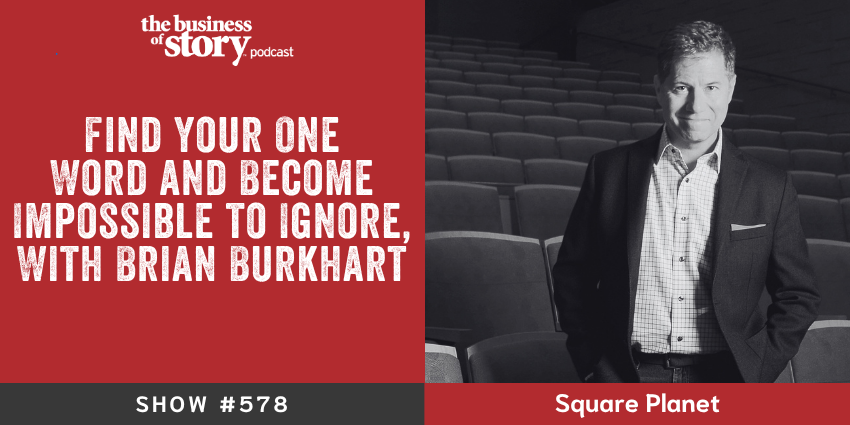
Find Your One Word and Become Impossible to Ignore, With Brian Burkhart
Because the difference between a commodity and a movement is one core belief.
You’ve built something real, and your team believes in what you offer.
But if you can’t name what you stand for, you won’t stand out — you’ll just be another commodity in a race to the bottom you can’t win.
Today you’ll find your one word — your core belief — and make it art that activates feeling and makes you impossible to ignore.
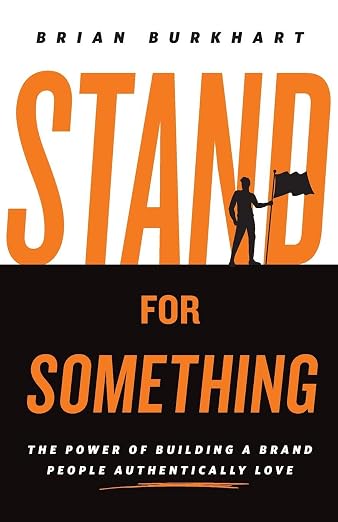 Brian Burkhart has heard that pitch before. As founder of Square Planet, and author of Stand for Something: The Power of Building a Brand People Authentically Love.
He’s also, impressivley, a former Disney submariner turned Fortune 500 communication strategist; he has spent decades helping senior leaders and TEDx speakers find the galvanizing signal that transforms commodities into movements.
Brian has done it for brands with 120 years of history and for first-time speakers stepping onto a red circle stage. His weapon is deceptively simple: one word that captures what you believe — and the art to make people feel it.
What’s in it for You:
- How to distill your core belief into one powerful word that galvanizes your entire organization
- Brian’s 10-step ancient Stoic framework that works for any presentation, pitch, or keynote
- How to reverse-engineer your core beliefs directly from your daily actions
- Why your audience decides with feelings first — and how to make art that activates them
- The Mad Men “It’s Toasted” moment that proves one idea beats every feature list
Why Most Brands Stay Invisible — and How One Word Changes Everything
Here is the brutal truth. Most businesses compete on features and price because they lack the courage to stand for something. So they push harder. Build a bigger deck. Add more bullet points. And every morning they wake up and push that boulder back up the same hill.
“You are now just a commodity. You are pushing that boulder uphill only to watch it roll back down. You’re not winning.” — Brian Burkhart
Brian illustrated this with a 120-year-old financial services company he worked with. Solid people. Impressive history. Zero differentiation. They weren’t best-in-class in any single product category. Then Brian showed them the Don Draper “It’s Toasted” moment from Mad Men. Every tobacco company could say their cigarettes caused cancer. Lucky Strike owned one simple idea instead. That one idea didn’t just win in 1960. It’s a masterclass in brand positioning that still wins today.
Your audience’s brain is not waiting for your feature list. It’s waiting to feel something.
How to Find Your Core Belief Through Your Daily Actions
Here’s where Brian’s framework gets practical. You don’t invent your one word. You excavate it.
Look at what you repeatedly do. Your actions reveal your beliefs. Brian’s personal core belief is “I elevate people.” That belief shows up in the way he replaces store-bought chip dip in a proper presentation bowl. In handwritten notes nobody asked for. In the care he takes preparing ideas so they honor the people receiving them.
What do you do — again and again — without being asked? That’s your belief. That’s your word.
Mine is enthrallment. To capture the fascinated attention of someone on something. That’s the ultimate goal of every brand, every presentation, every leadership moment worth having.
What Art Has to Do With Your Business Pitch
This is where Brian’s thinking earns its permanent spot in my communication playbook.
“Art is the unnecessary done on purpose to make someone feel.” — Brian Burkhart
Sprinkles on a cupcake. Colorful walls in a children’s hospital. Turndown service with a chocolate on a pillow. M&Ms in a tape box. None of those things are necessary. Every single one creates a feeling that outlasts the moment.
Your brand can do the same thing. The art doesn’t have to be big. It has to be intentional. The unnecessary thing done on purpose — the extra care, the unexpected touch, the presentation of an idea in a way that honors your audience — that is what separates a vendor from a movement.
The Ancient Stoic Framework That Makes Your Message Bulletproof
Brian built a 10-step presentation structure rooted in ancient Stoic principles, and he is clear about the hierarchy. Steps one and two carry almost all the weight.
Step one: tease the problem. Step two: state your core belief.
Everything else — the remaining eight steps — builds what Brian calls “little traps.” Moments engineered to produce nods of agreement, one at a time, until your entire argument is bulletproof. Each nod is a micro-commitment. By the end, your audience has convinced themselves.
We are feeling machines that think — not thinking machines that feel. Emotions arrive faster than logic and sit at the epicenter of every decision. Brands that activate feeling through art stop being commodities. They become movements people want to join.
Start with your one word. Make it art. Become impossible to ignore.
Brian offers a free 45-minute consultation to anyone who emails info@squareplanet.com — mention the Business of Story and he will make time for you.
Story on, my friend.
Links
- Square Planet
- Brian Burkhart on LinkedIn
- Stand for Something Book
- Contact Brian: info@squareplanet.com
- Business of Story Podcast
- StoryCycle Genie®
- Brand Story Grader — free tool
Related Episodes
- What Happens When a Brand Decides to Make Its Own Business Model Obsolete? With Shawn David Nelson — Lovesac founder Shawn David Nelson reveals why brand storytelling is not 50% of building a great company — it’s closer to 90%.
- The Agencies That Thrive With AI Will Project the Most Flexible Identity, With Marcus Sheridan — Marcus Sheridan makes the urgent case that the one word every agency needs to own right now is indispensable — and shows exactly how to earn it.
- What a Hit Song Has in Common With Every Great Business Pitch, With Rob D. Willis — Strategic story producer Rob D. Willis reveals why the one-four-five chord progression and the ABT framework are structurally identical — and how that insight transforms expert knowledge into decisions.
Brian Burkhart’s Conversation With Park Howell on the Business of Story Podcast
From Chip Dip Bowls to Core Beliefs: Brian Burkhart on Why Elevating People Is the Only Brand Strategy That Lasts
Park Howell: Brian Burkhart, my man, thank you for joining us. Welcome to the Business of Story, all the way down I-17 from Tucson.
Brian Burkhart: Park, it is such a good day. It’s a good day when I look at my calendar and I say, I get to hang with Park Howell. That’s pretty cool.
Park: You’re so nice. We have had a lot of fun together and you’ve been so kind to bring me into some of your events to teach storytelling. I love how you pull from Hollywood and make really fantastic analogies to connect with that B2B logic-driven mindset sitting in the room.
With your Disney background — and I love the idea that you were a submariner at Disney World — today we’re going to talk about core beliefs. I believe one of your core beliefs is always about elevating the individual you are with. Core beliefs. Set us up. What does that mean to you, Brian?
Brian: It means a lot. It’s a heck of a question. In many ways, it’s truly my life’s work. It’s what my book is about. It’s the stuff I do every day.
I’m going to go back in a weird way. There was a time when I was a single guy living in a cool apartment in downtown Chicago, doing all the things. And I had a roommate who was a pal of mine from Disney. We both drove the subs at 20,000 Leagues Under the Sea.
He goes into the fridge and rips off the lid of the plastic store-bought French onion dip. Rips open the bag of Ruffles. Sets those things on the table. We’re ready to have people over.
And I go, no, no, no, no. We will do nothing of the sort.
I go to our cupboard, grab a little bowl, put the dip in the nice little bowl, grab a bigger bowl, dump all the chips in it, put those on the table, and arrange a whole bunch of napkins nicely nearby. That’s how you do it, I said to him. This is a much more elevated, refined way of eating store-bought French onion dip and potato chips.
My core belief of elevating people — it’s old. It’s been with me literally since I was a little guy. I didn’t realize it then. It took much more time, experience, and wisdom to find those words. But that little moment of elevating that experience through simply repackaging food is exactly what I’m talking about.
The core belief leads to your actions. What you believe leads to what you do. If you believe your body is your temple, you’re probably not going to have a pack and a half of Marlboros on the daily. It’s a whole different way of being when you know your core beliefs — because then it immediately elicits the action steps.
In our world of working with senior leaders of some of the biggest companies on the planet, it’s shocking, Park. When I say, what are you and your organization and your people — what do you stand for? I often get no answer. A whole lot of hummana hummana. Or a tremendous amount of incongruence. They’ll pull some approved-by-legal, written-by-marketing nonsense that is nothing like they would say as human beings.
But when all parts have congruence — when they know with absolute certainty and ease of expression what they stand for — everything changes. Core beliefs are truly, literally the foundation of it all.
Trapped in the Commodity Cycle: How a 120-Year-Old Financial Company Finally Found Its Way Out
Park: It becomes your signal. That core signal. You had sent me a note about a company you’re currently working with — a very well-known financial company, over 120 years old. Their sales leader has to go out and present a new initiative, and you said it was just all over the place. Just mush. Can you give us more intel on what went down — and what to do if anyone else finds themselves in this situation?
Brian: First and foremost, if you find yourself in this situation — take yourself off the hook. When this guy called me and we walked into this thing, the first thing I said was, man, it’s okay. You’re okay. No one’s a bad human. This is not life or death. It’s just sort of the way it is.
Especially on longer-held brands — this thing’s over a century old — you can imagine the sheer number of people that have had a hand in the soup. It just kind of gets funky fast.
So first, a lot of forgiveness. Permission to be where you are. Second — this company had amazing people. A really great brand. They do incredible work. But if you look at their products and services and rank them against competitors, it’s very middle of the pack. There’s not a single category where they are clearly the one.
Park: Just a commodity, huh?
Brian: That is the exact word I used a thousand times.
You are now just a commodity. You are pushing a commodity uphill like Sisyphus, only to get to the top and have it roll back down and start all over again. You’re not winning.
Park: And it rolls down because the low price leader wins in a commodity play. And who wants to be the low price leader? There’s no margin in that.
Brian: Exactly. It’s a race to the bottom that is just a fool’s errand you shouldn’t even try.
The “It’s Toasted” Lesson: What Don Draper Got Exactly Right About One-Word Brand Positioning
Brian: So when I got into this thing, I helped him see that playing in the commodity space is a bad idea. And the answer is — let’s just tell a different story.
The thing that got him — and I know your audience will love this — I reminded him of an episode of Mad Men. Season one. When Don Draper is talking to the guys at Marlboro, and he says all cigarette companies are now in the same boat. Nobody can talk about health benefits. Then he says, we can say anything we want. And he lands on — it’s toasted.
In my real-life scenario, it was a hell of a lot better than “it’s toasted.” It was based on lots of very germane fact, but deeply embedded in what they stand for. And they’re going to kill it. Because they’ll get their core belief right, and their products and services will rise to the top.
Park: Will you be able to share what that core belief is?
Brian: One word, yep.
Park: We’ve been doing a lot of work with our StoryCycle Genie® on the idea of Story Ops. What we have is a platform where you go into an enterprise — they’ve got sales ops, marketing ops, revenue ops, financial ops, HR ops — but nobody has Story Ops. Nobody has that singular focus, that singular signal that makes you stand out, and then makes sure it gets incorporated, embraced, and embedded coherently and consistently throughout the entire organization.
Brian: It’s almost as if you’ve done this before, Park. Sincerely — that was spectacular. And it’s exactly the thing. I have used the word aspirational for this singular phrase with them over and over. It’s like Oz. It’s a place we are going toward. And we’ll probably never get there. And that’s the point.
It is also a very strong galvanizing agent. Even on this internal work with small teams, they’re more excited and pulling in the same direction than they’ve been in a very long time. The value created through this Story Ops work is almost inconceivable.
How to Find Your One Word: Reverse-Engineer Your Actions to Uncover the Core Belief You’ve Always Had
Park: In your experience, a lot of people dismiss this as too simple. That one word can’t carry that much meaning. Why do you think this large group of logic-driven financial professionals latched on to it?
Brian: I think my response is art. Art at its absolute defined core is something that moves us. We feel it. When we experience art, it creates tingles — we can’t always describe it, but we know it. And that feeling is what makes us so uniquely human.
For so long, in our corporate lives, it’s been driven out purposefully. The minute we put it back in — the minute we make this thing artful — we feel it. A simple word, a simple idea, something that really doesn’t even need to be fully defined. It just needs to be experienced in an artful way. And people get pretty fired up.
Park: Let’s take it a little deeper. How do you actually find that one word?
Brian: Lots of due diligence. I get in there on the client and the industry. I look for patterns. You see the same kinds of words and ideas, especially in commoditized businesses.
Then you start asking people some questions. Get them a little uncomfortable. They start revealing things they don’t think have tremendous value — but it’s often pots of gold at the end of the rainbow, and they don’t even know it.
One thing that went super far in this particular case was your StoryCycle Genie®. I had crafted a bunch of stuff, had some ideas, and I put it in the genie — and I was truly blown away. Mind blowing, mind numbing. That is going to be a no-brainer approach going forward.
Park: Well, I’m always glad to hear that. The one word I arrived at for our own brand is enthrallment — to capture the fascinated attention of somebody on something. And isn’t that what branding is? Capturing the fascinated attention of your colleagues so they’ll rally, your prospects so they’ll lean in, and then delivering on that fascination with your customers.
Why Steps 1 and 2 Are Everything: Inside Brian Burkhart’s 10-Step Ancient Stoic Presentation Framework
Park: So for the person who has a 15-minute presentation on Monday morning — how do they bring a little of this to their team when rolling out a new initiative?
Brian: Now you’re talking my language. Every day. It’s how do I help someone tell their story in a more engaging, effective way?
The stuff you’re talking about — this notion of I’ve got 15 minutes, what do I do? The answer is old. As in Socrates, Plato, Aristotle, Seneca old. People are still people. Our biology is identical to what it has always been. Technology’s changed, but our brain — unchanged.
I have built a 10-step framework based on those ancient Stoics that very much works for today. You follow the 10 steps, and you will be successful. I don’t care if you’re doing a best man speech, a TED talk, writing a book, doing an industry keynote, or an internal 15-minute message to get the troops fired up.
Step number one: set the foundation, tease the problem.
Step number two: tell them your core belief.
Those two steps are by far the most important. By far the hardest. The framework is simple, but it is not easy. It takes mastery and creativity to nail those two. But once you get it — it is absolutely gold.
Think about it this way. It’s one thing to bark out orders — this is what we’re doing. It’s another to say, this is what I believe. This is what I stand for. And then build nine other steps that support it. That’s where the influence kicks in.
The thing about my 10 steps is that we’re really looking for 10 moments of nods and approval. It’s almost like setting 10 little traps. When people go, yeah, that problem makes sense — that core belief makes sense — and then down the line, yes, yes, yes — 10 of those, you’ve got it. It becomes bulletproof. It becomes a no-brainer.
How to Break Through the Curse of the Expert to Find Your Signal
Park: It’s got to be hard for the person who is so close to what they’re pitching that they suffer from the curse of the expert. How do you help people hack through their own noise to find that signal? And what can they do on their own to prepare for that Monday presentation?
Brian: That is perhaps the hardest thing to do. But it is truly the work I find most rewarding.
We know that beliefs lead to actions. It is undeniable. So let’s reverse engineer.
It’s really easy to see what we do. I am a note writer. I like to write handwritten notes. I have piles of stationery and stamps at the ready. On any given week, three to ten handwritten notes go out. These are actions I repeatedly, regularly do.
Which helps me deduce: I have a core belief of making people feel special. And over time, I codify that down to something as simple as — I elevate people.
I know that by reverse engineering my actions.
So that’s one way. The other is a little more philosophical. I very regularly see people in the audience go misty. There could be hundreds of people and I’ll see the one or two who come to a realization mid-presentation. They’ll come find me at a break, and they’ll say, I need a new job.
And I say, I know. I saw it when I was on stage. I saw you realize that what you believe, what you stand for as a human being, and what your company stands for are two different things.
And so in that moment, while I’m speaking, they’re in their own head going — I gotta get out.
So be really comfortable knowing that not everyone is going to believe what you believe. And actually, you’re liberating people when you make it really, really clear. If it’s a bad fit, everyone kind of knows. Now you’re giving them the actual practical words and concepts to make it easy to liberate themselves.
Art Is the Unnecessary Done on Purpose: How the Brands You Can’t Forget Use Feeling to Stand Apart
Park: I read a new book called Eat the Donkey by Anthony Reeves — he’s the head of marketing for Kohler products. He makes a really interesting argument: your core belief has to cost you something. The principles that support your belief can’t be free. So let me unpack enthrallment for us.
The cost of the principles that support enthrallment for us: number one, we will not work with the frigid and the rigid. That costs us a prospect. Number two, 100% money-back guarantee if you’re not absolutely enthralled in the first month. That costs us. Number three, story sovereignty — everything you build inside the genie is yours. That costs us. And number four, we’re more expensive than ChatGPT. That costs us.
All of that leads up to enthralling every user who is open to it — so they’ll never ask for their money back, because they’re completely blown away.
Brian: Struck by something. A million years ago when I was in my 20s, I started my career as a media producer. Everything was shot and edited on magnetic tape — a total commodity made by a couple of manufacturers.
There was one provider who had a different approach. They would open the box from the manufacturer, score it with a knife, drop in a fun-size pack of M&Ms — like you’d give at Halloween — seal it back up, and ship it to clients.
What’s a pack of M&Ms cost? Ninety-nine cents? But when the UPS man dropped off that box, it was a race to meet him outside because everyone knew there were M&Ms. First come, first served.
Same tape. Same price. But we ordered from that one distributor every time.
It doesn’t take much. But it cost them just a little extra. Ninety-nine cents and thirty seconds of time. You’re exactly right.
Forget Persuasion. The Real Goal of Every Brand Communication Is Enthrallment
Park: I was just with your description going back to when I was enthralled as a kid. I must have been in sixth grade. The Partridge Family. Keith Partridge. We all wanted to be in the Partridge family.
My mom and dad took me and my little brother — we were both taking piano lessons — to the Fifth Avenue Theatre in Seattle. Fifth row center. Our very first musical. Yankee Doodle Dandy — and David Cassidy played the lead.
The big red velvet curtains down, slowly moving. People coming in. And then boom — the orchestra fires up. The curtains rise. David Cassidy right out center stage. The first time I’d ever seen a celebrity spectacle in person, right in front of me, as if he was singing to me.
I sat there for the entire two and a half hours, utterly enthralled. And I told myself — I don’t want to be David Cassidy. I don’t even want to be the performer. I want to be the guy who produces this kind of spectacle for people.
That’s the importance of finding your one word. Everybody draws to it. And then we have to back it up. We have to make sure that experience is as enthralling as possible.
Brian: I love everything about that.
What the Pageant of the Masters Teaches Every Brand Leader About Quiet Enthrallment
Brian: We are just weeks away from my wife and me heading to Laguna Beach to once again enjoy the Pageant of the Masters. I cannot recommend it enough.
It’s been running roughly a century. Two interruptions — one year during World War Two and one COVID year. It is the most hard-to-describe spectacle that fully enthralls me, so much so that we go back every single year.
It’s an outdoor stadium. No roof. You see stars. It starts at 8:30 PM — they need the dark. About two and a half hours. Live narrator, live orchestra, live performers, and then the main event right in front of you: they take works of art — paintings, sculpture — and bring the tableau to life with real people on a stage, much larger than normal scale.
Every year they end with The Last Supper by Da Vinci.
When it’s over, there’s like a hush. And then you start to think about it. And you go — my goodness, I was enthralled for two and a half hours.
The reason it’s important is because not everything is the Super Bowl halftime show or the Sphere in Las Vegas. In our work in the corporate world, enthrallment is often more quiet. It’s more hush.
So many of the presentations I work on, people say things like — I gotta be funny. You do? There are a zillion different kinds of emotions out there. That’s the only one? No. There are a million ways to enthrall people.
From Framework to Monday Morning: How to Put One-Word Positioning to Work Before Your Next Presentation
Park: Brian, as we wrap up — where can people learn about your 10 steps?
Brian: The easiest thing is just contact me. I put lots of stuff up on LinkedIn and I have some things on my website, but nothing is truly complete. It is the work that I do — the consulting practice I offer my clients.
That said, if people simply send an email to info@squareplanet.com and say, I heard you on Park’s show, I want your 10 steps — I will be effusive and quick to give you all kinds of stuff for the low, low price of nothing.
Park: And even for that low, low price of nothing, I believe you said you’d give them a 45-minute consult?
Brian: One hundred percent. I really would. We’ll set up a Zoom, share some stuff, walk through whatever it is you’ve got. And I can make you one real guarantee — if you spend 45 minutes with me to talk about your presentation, your website, your story, your book, whatever it is, I promise you, you will be leaps and bounds further at codifying your core belief than if you spent a year on your own.
Park: It’s a ridiculously good offer, folks. Brian works with TEDx speakers and Fortune 500 businesses. I can’t recommend him highly enough.
Dude, thank you so much for being here.
Brian: Are you kidding? Thank you, man. And for those listening — you’re fools if you don’t run to the StoryCycle Genie®. This thing is, my goodness — it’s real.
Q: What Is a Core Belief in Branding and Why Does It Matter?
A: A core belief is the single, irreducible conviction that drives every decision your organization makes — not your mission statement, not your tagline, but the thing you’d stand on a hill for. Brian Burkhart defines it as the philosophical bedrock beneath everything your brand does, says, and sells. Most organizations can’t articulate it, which means they compete on features and price instead of meaning and loyalty. When you nail your core belief, you stop being a commodity and start being a cause. It’s the difference between a brand people choose and a brand people champion.
Q: How Do You Find Your Brand’s One Word?
A: Brian Burkhart’s method is to reverse-engineer your own behavior — look at the decisions you make, the actions you take consistently, and the moments you feel most alive in your work, then find the single word that explains all of it. For Brian, that word is “elevating.” He didn’t manufacture it; he discovered it by asking why he does what he does, over and over, until the answer stopped changing. The one word isn’t a label you slap onto your marketing — it’s the belief you’ve always held that you finally put language to. Once you find it, every piece of communication you create becomes a purposeful variation on that single, resonant theme.
Q: What Does “If You Can’t Name What You Stand For, You Won’t Stand Out” Mean for Business Leaders?
A: In a market flooded with sameness, differentiation doesn’t come from better features — it comes from a clearer belief. If you can’t articulate your core conviction in a single, powerful word, your audience will default to comparing you on price. The brands people remember aren’t the ones with the best products — they’re the ones with the most compelling point of view. Name what you stand for, and you give your audience something concrete to stand with you on. That’s not a marketing principle; that’s a business survival principle.
Q: What Is the Commodity Trap and How Does a Brand Escape It?
A: The commodity trap is what happens when your market can no longer tell you apart from your competition — and more dangerously, neither can you. Brian worked with a 120-year-old financial company with deep expertise and loyal clients but no clear answer to why anyone should choose them over the next firm. The escape isn’t a new logo or a rewritten website — it’s excavating the core belief that has been quietly powering the organization all along and giving it a name that cuts through noise. When you stand for something at the belief level, price becomes secondary and loyalty becomes structural.
Q: What Can the Don Draper “It’s Toasted” Moment Teach Brands About Positioning?
A: In that iconic Mad Men scene, Don Draper doesn’t invent something new — he claims something true in a way no competitor had the audacity to. Every cigarette manufacturer used heat to cure tobacco, but only Lucky Strike would be “toasted.” One-word positioning isn’t about manufacturing identity; it’s about excavating the truth you already own and naming it before someone else does. The question every brand leader should be asking is: what’s our “toasted”?
Q: What Is Brian Burkhart’s Ancient Stoic Presentation Framework?
A: Brian Burkhart developed a 10-step presentation structure rooted in ancient Stoic philosophy — Socrates, Plato, Aristotle, Seneca — designed to move audiences from passive listening to active commitment. The framework works for any format: a best man speech, a TED talk, an industry keynote, or a 15-minute Monday morning team meeting. Each step builds a moment of agreement — what Brian calls a “little trap” — until your argument becomes bulletproof. By the time you make your ask, the audience has already talked themselves into yes.
Q: Why Are Steps 1 and 2 of the Stoic Presentation Framework the Most Important?
A: Steps 1 and 2 establish the philosophical and emotional contract with your audience before a single data point is shared. Step 1 is to tease the problem — open with a universal truth the audience already believes. Step 2 is to name your core belief — tell them not what you do, but what you stand for. Get those two right, and everything that follows lands with force. Get them wrong, and no amount of data or polish will save the rest of your presentation.
Q: How Does Art Activate Feeling in Brand Communication?
A: Brian Burkhart defines art as “the unnecessary done on purpose to make someone feel” — and that definition should change how you think about every piece of communication your brand creates. Sprinkles on cupcakes. Colorful walls in hospitals. M&Ms in a tape box. Hotel turndown service. None of it is necessary. All of it changes how you feel. When you deliberately add beauty, surprise, or humanity to your message, you activate emotional responses that logic alone never reaches. Brands that treat their communications as art don’t just inform their audiences — they move them.
Q: What Is Enthrallment and Why Should It Be the Goal of Brand Communication?
A: Enthrallment is the state of being completely absorbed — not just interested, not just engaged, but genuinely held. Park Howell defines it as capturing the fascinated attention of someone on something — and argues it should be the north star of all brand communication. When someone is enthralled, they’re not thinking about their phone or their to-do list — they’re simply and completely present with you. Enthralled audiences don’t just buy; they evangelize. And the tools for creating it are the same ones artists have always used: emotional truth, unexpected beauty, and the courage to be genuinely human.
Q: How Can I Apply One-Word Positioning to My Next Monday Morning Presentation?
A: Start with the question Brian Burkhart asks every client: what do you do this for, beyond the paycheck? The answer — honest, stripped of corporate language, consistent however you ask it — is your core belief. Build your opening around that belief stated as a universal truth, then connect it immediately to the specific challenge your audience is facing this week. Don’t open with an agenda slide or company history. Open with a sentence your audience will nod at before you’ve said anything else. One word. One truth. One room that’s actually listening. That’s not a branding exercise — that’s Monday morning leadership.
 Listen To More Episodes