The Agencies That Thrive With AI Will Project the Most Flexible Identity
The marketing agency model is being disrupted faster than most principals want to admit, and the threat isn’t coming from outside. It’s coming from inside the house.
Every agency wants clients who trust them completely — who renew without hesitation, refer without being asked, and never shop around.
And for years, the formula worked: build great campaigns, deliver measurable results, stay ahead of the platforms.
But the platforms are changing faster than any agency can keep up, AI is answering the questions your clients used to pay you to answer, and the services that built most agencies — SEO, paid ads, social campaigns — are being commoditized in real time.
So the agencies that survive this reckoning won’t be the ones with the best creative. They’ll be the ones willing to become something completely new.
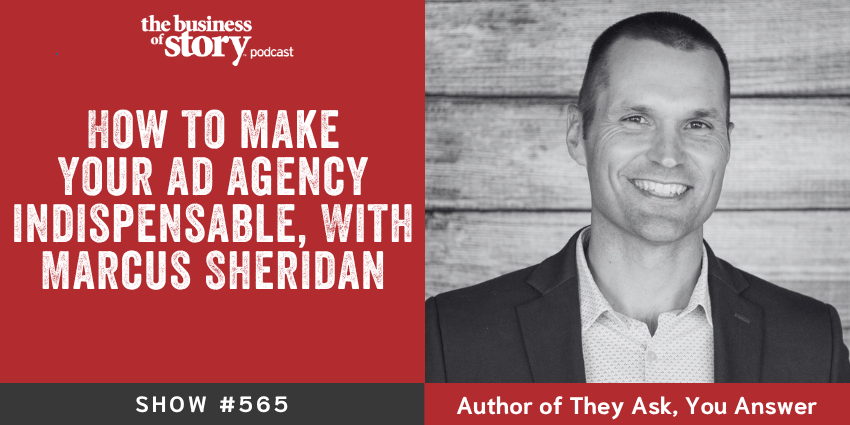
Marcus Sheridan is a world-renowned communication expert, bestselling author, and keynote speaker who revolutionized how businesses think about trust and transparency.
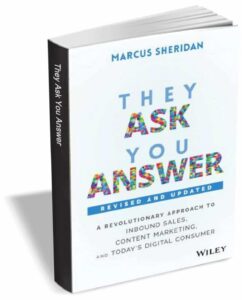 He’s the author of They Ask, You Answer — rated the #1 Marketing Book by Mashable and one of the Top 5 Marketing Books of All Time by Book Authority — a framework now adopted by more than 100,000 businesses globally.
He built River Pools and Spas into a digital marketing phenomenon during the 2008 recession by simply answering every question his customers were asking online, generating over $1 billion in documented economic impact.
His newest book, Endless Customers (2025), brings that framework fully into the AI era. Today, Marcus advises organizations worldwide on Transformational Communication, and his newest keynote, “Will AI Recommend You?”, is one of the most urgent talks in business right now. He’s spoken in 15 countries, delivered 500+ keynotes, 250+ workshops, and his weekly newsletter, Known and Trusted, reaches tens of thousands of leaders.
What’s in it for You:
- Why “identity fluidity” is the single most powerful quality an agency can develop right now — and what it actually looks like in practice
- How agentic web design, schema markup, and MCPs are becoming the new baseline for every website you build for clients
- Why vibe coding is already disrupting agency pricing models — and how to get ahead of it before your clients do
- Why you need to stop apologizing for using AI and start treating it as the professional standard it has become
- How to become the one word every client needs from their agency: indispensable
The Three Revenue Lines Every Agency Should Be Worried About
Marcus doesn’t sugarcoat it. SEO revenue? Gone. Count it as gone. Paid ads management? Going fast. Social media campaigns? Same story. If those three services make up more than 50% of your agency revenue right now, that revenue is disappearing — not someday, but now.
The evidence is already there. River Pools and Spas — the company Marcus built into a digital marketing phenomenon — lost 75 to 80% of its SEO traffic to AI-generated summaries. Not to a competitor. Not to an algorithm update. To an AI engine that started answering the questions his content used to answer. The content didn’t get worse. The distribution model changed underneath it.
Identity Fluidity Is the New Competitive Advantage
So what do the agencies that survive look like? According to Marcus, they share one quality above all others: identity fluidity. The willingness to release their attachment to what made them successful — and rebuild around what the market actually needs now.
That means becoming your clients’ AI implementation guide. It means building agentic-ready websites that communicate with AI agents, not just human visitors. It means understanding what schema markup means, what MCPs are, and why structured data is now as important as the copy on the page. It means being the one word every client needs from their agency: indispensable.
Vibe Coding Is Already Disrupting Your Pricing Model
Marcus shared two examples that should stop every agency principal cold. His chief of staff — no development background — vibe-coded a full AEO-optimized website in a single weekend. His 23-year-old electrician son built a complete field management app in three weeknights. Both projects would have cost $15,000 to $30,000 through traditional development channels. Both were built by people who had never built anything before.
This isn’t a future threat. It’s a present reality. Agencies that haven’t reckoned with what vibe coding means for their pricing and value proposition are operating on borrowed time.
Stop Apologizing for Using AI
There was a moment in our conversation that I haven’t been able to stop thinking about. I mentioned that we use AI in our work — and Marcus caught the hedge in how I said it. He called it a half apology. And he was right.
His position is unambiguous: it would be a crime not to use AI. Agencies and professionals who are still hedging, hiding, or qualifying their AI use are sending exactly the wrong signal to clients. Embracing AI openly — and demonstrating genuine mastery of it — is now a competitive advantage, not a liability.
Proactivity Is the Key. Reactionary Is the Problem.
That’s the whole episode in one line. The agencies that are going to struggle most aren’t the ones with the worst work. They’re the ones most emotionally attached to what made them successful in the first place — and most reluctant to let it go before the market forces them to.
The window for proactive positioning is open right now. It won’t stay open forever.
Learn more about Marcus and his work:
- MarcusSheridan.com
- Marcus Sheridan on LinkedIn
- They Ask, You Answer (2017)
- Endless Customers (2025)
- AI Trust Signals
- Price Guide
- Known and Trusted Newsletter
- Marcus Sheridan AI Agency Wakeup Call
- FREE Brand Story Grader
- The StoryCycle Genie®
Related episodes you’ll love:
- The Machines Can Code — But Can They Tell Your Brand’s Story? with Joe Lazauskas
- Using Artful Intelligence to Build a Sustainable Storytelling Culture with Bruno Sarda
- How to Effectively Position Your B2B Brand with April Dunford
Marcus Sheridan’s Conversation With Park Howell on The Business of Story Podcast
Park: Marcus, welcome to the show.
Marcus: Happy to be here, Park. I got a feeling we’re gonna have a lively, productive conversation today.
Park: Oh my God, especially if you’re running an ad agency out there in this world of AI. I want to first start with you — I haven’t had a chance to speak with you since a dinner Jay Baer was throwing at Social Media Marketing World in 2020 as COVID hit.
Around that table were you and a number of really the top speakers. I was the little guy on the totem pole at that table. Jay was very nice to invite me. I got to know you and some of the other guys. But I remember your phones going off — another cancellation, another cancellation — for about two hours. I felt like it was about $500,000 in billing fees that got lost during that dinner.
How Proactive Leaders Saw COVID’s Business Disruption Coming — And What Reactive Leaders Lost
Marcus: Yeah, it was a really wild time. The thing that hit me the most from that dinner was how Jay had told us that Jason Dorsey had already furloughed his entire staff. I thought that was incredibly fascinating — how did he know?
Months later, I went to Jay and I was like, how did Jason Dorsey know? Because everybody else was still in speculation land, very naive about what was going on. Dorsey apparently had worked in some industries that really understood virus and disease.
Park: What was his company?
Marcus: Jason Dorsey is a generational speaker — he speaks on the different generations. Somehow he was privy to this and he just knew exactly what was coming before any of the speakers knew that they were all going to get nuked. He furloughed everybody before it even happened.
If you look back at the history of the world, with big events, there’s always these people that just move faster than others and know what’s coming before they’re forced to act. They take action before they are forced to. That actually aligns itself with the conversation we’re having today — there are a lot of actions we could and should be taking, whether you’re an agency or a CMO, that many folks are not taking right now because they’re living in a state of denial.
River Pools and Spas: The Content Marketing Origin Story Behind They Ask, You Answer
Park: You’re a guy that’s lived through and actually caused some of your own disruption and evolution. You were running River Pools and Spas in 2008 during the big worldwide recession. That had to hit you hard — but you had an answer to that. That led to your radical transparency approach: answer any question any customer ever had. Did that springboard you into the speaking world?
Marcus: Yeah, it did. It looked like we were going to lose the business in 2008 because of the market crash. I started really studying inbound marketing and content marketing. I wrote my first blog post in March of 2009, and within six months I could tell we were cooking. Traffic was starting to explode.
We became very quickly the Wikipedia of pools. By 2011, we were the most trafficked swimming pool website in the world. But at the end of that first six months, I realized I was onto something. I’ve always been the type that if I see something, I want others to experience that success too. So I started a personal blog that really became the Marcus Sheridan brand as a speaker.
What’s funny though — I don’t really have a blog anymore. What I have is LinkedIn. Blogs were a big thing for individuals in the 2010s, but you don’t really see them very prominently now for individuals. It all pretty much moved towards social.
Identity Fluidity vs. Being Married to the Past: The Agency Reckoning Nobody Wants to Have
Park: Let’s fast forward. The next real big disruption we’ve all been experiencing is AI and what it’s doing, especially to agencies. After seeing that post you wrote about two weeks ago on LinkedIn, I thought — there it is. That’s what the dark side looks like for agencies unless they take action.
Marcus: I think the most powerful quality you can have right now — and I really mean this — is identity fluidity. If you as an agency are married to what you’ve always been, you’re destined for major pain. But if you are married to the marketplace and the evolution of the marketplace, and you’re not denying it for what it is, you can still be successful.
We can’t continue to lie to ourselves about what is and isn’t happening. We dramatically overvalue a lot of the stuff we do.
Let me give you an example. Have you seen a single agency come out and say, hey, we’re charging 50% less for websites than we were two years ago because we’re building your sites with AI? No. What are they saying? “Our prices haven’t changed because we continue to deliver the value.” This is bull. This is insanity at its finest.
You and I are old enough to remember VCRs when they came out. A VCR was a really big deal. When they first came out, they were over $1,000. Over the course of a couple of decades, they eventually got to below $100. If somebody came to you in the late 1990s and said, “I’ve got a VCR for you — it’s only $500,” you’d say, “That’s a ripoff.” They’d say, “But they used to be a thousand.” And you’d say, “Yeah, but I can get it for $75 at Walmart.”
The skills that go into coding — a very significant portion of them have been commoditized and will continue to be further commoditized in the coming weeks and months. We have to say weeks these days because one week can mean everything has changed.
I actually had an agency tell me yesterday: “We tell our clients now — we’re going to be creating a lot of this new website with AI, and that’s why we’re charging you Y instead of X.”
The Death of the Blue Link: How AI Answer Engines Are Replacing Google Referrals
Marcus: Look at what happened with SEO. The amount of SEO companies that said AI search isn’t going to affect Google at all — you are lying. Either you’re lying, you’re intellectually dishonest, or you’re intellectually aloof. One of the three.
Because anybody with any type of vision can see that the future is not clicking on a blue link — whereby you don’t even know if the answer is behind that blue link, which is what we’ve been doing for roughly 25 years. The future is immediate answer, a justification for that answer, and then an action taken to the next step, whatever that action is — by the tool, by the platform, by the agent.
I had 75 to 80% of my River Pools traffic disappear because people aren’t clicking on the blue link anymore. They’re getting the AI summary or they’re going to ChatGPT or Gemini. I’ve accepted that. Why is it so hard for us to accept so many things?
Marcus Sheridan’s AI Trust Signals Framework: How Businesses Win Visibility in an Answer-Engine World
Park: You’ve got a whole keynote about AI visibility now, right? That’s one of your main messages?
Marcus: Yeah, I’ve built a software called AI Trust Signals, which measures the likelihood that AI is to recommend your business based on the signals it uses to determine — trustworthy brand, not as trustworthy. Should I recommend them? I don’t want to recommend them.
I wrote They Ask, You Answer in 2017. The second edition came out in 2020. The third edition, called Endless Customers, came out in 2025. I tell you what — I’m not married to anything I’ve written up to this point. I’m ready to divorce it any second if I feel like things have shifted.
Somebody says to me, “Marcus, if you started River Pools today, would you do it the same way?” I’m like, no, because it wouldn’t work nearly as well. In 2009, all I had to do was answer questions in the form of text. I didn’t have to do any social media at all. It was a blue ocean.
How Agencies Become Indispensable in the AI Era: Training, Agentic Web Design, Schema, and MCPs
Marcus: When I think about the agency of the future and what’s going to help them be built to last — the most frustrating thing to me is most of them have not completely leaned into AI training for their clients.
Every great agency needs to be one word: indispensable. That’s your goal in life. Where the client says, “I don’t care if a nuclear bomb drops on our building, we’re not letting go of our agency.”
So you look at the biggest problem — the wailing, the gnashing of the teeth, the FOMO — it’s all these leaders, all these CMOs, saying: I just don’t know how to implement AI. I don’t know what tools we should be using. I don’t know how to set up agents. Why are you not doing that, agency?
If you don’t know what the word schema means as a marketer or as a web company in 2026, you have failed to stay with the times. Schema is like level one. And now we’ve got MCPs and all these other things we’re going to have to do to make sure websites interact with agents.
What should an agency be doing? They should be going to all their clients right now and saying: your website was built for humans. We have to prepare your entire brand to engage with agents. Within the next 18 to 24 months, everybody’s going to have essentially in their digital pocket an AI agent that does all their vetting for them. B2B buyers are going to have their AI agents doing the vetting. B2C buyers are going to have their agents. We need to create a website that communicates with agents.
How many agencies, realistically, are having that conversation with their client right now?
Park: Well, they don’t understand it themselves. So how can they?
Marcus: That’s right. And so it’s like, I don’t understand it myself, so I’m going to ignore it. You’ve got to be in the sandbox right now. You’ve got to be swimming in this stuff. You have to quickly become a power user.
I’m going to say this — it’s going to offend people, but I’m only speaking candidly here out of love. If you are not using the $200 version of Claude and hitting limits at least a few times a week or month, you’re not learning AI like you need to for your clients right now. Full stop.
I also think sales training is a massive opportunity. For years, these marketing agencies would get the leads and watch them die on the vine because of a poor sales process. I never understood why so many agencies did not integrate themselves into the sales process as well.
You cannot be a successful agency today and not be embedded with the sales team. If you are only doing marketing-based activity, you’re very replaceable. From now until the end of time, the sales team is going to get more budget than the marketing team. You need to make sure the sales team sees you as indispensable.
If you think SEO, paid ad services, and social media campaigns are going to hold you for the next five years — you’re living in a dream state. If those three things are more than 50% of your revenue right now, which for most agencies they are, that revenue is gone. Count SEO as gone. Count paid as gone. Social to a degree is gone.
I’m a shareholder in Impact, which has a paid wing and does website design-build. And I’m telling you — those two business models are in big trouble. If they don’t evolve, they’re going to die.
Vibe Coding Goes Mainstream: A Weekend Website and a Three-Night App Built by Non-Developers
Park: Let’s go back to website building. You mentioned your teammate who had never built a website was able to do it, and you’re pretty happy with it.
Marcus: I have an offshore fishing company called Speechless Sport Fishing. My chief of staff — she’s never built a website, but she’s gone all in on AI immersion. She said, “I want to take a swing.” She vibe-coded an entire website in a weekend, never having built a site herself.
I definitely would have spent at least $15,000 on this website at the lowest prices out there. She did an extraordinary job. It’s AEO optimized. It is absolute baller. You can find it right now at speechlesssportfishing.com.
My son is a 23-year-old electrician. He’s now my business partner — I opened up an electrical division of my swimming pool company. He came to me the other day because he’d been with us for two weeks. He said, “Your office software is fine, but your field software sucks.” So he spent three weeknights and vibe-coded an application. It’s got its own API. It handles all the inventory for the truck, receipt tracking, expense tracking, and he built a job pricing software so when you go to give someone a quote, you can do the pricing right then and there.
I was flabbergasted. My son knows zero code. But by nature he’s a builder with his hands, and he now represents the future. That app probably would have cost us $20,000 to $30,000. He built it himself over three weeknights.
Why do people get mad when they hear these things? Because they feel their identity is threatened. This is the problem. This is why your greatest superpower right now is fluid professional identity. You’ve got to be willing to move.
Every agency should also be a custom software developer at this point for their clients. Could you build self-service recommendation tools? Of course you could. Assessment tools? Of course. Estimators? Of course. You just have to have the idea. That makes you indispensable.
A Brand Assessment and Thought Leadership Article in Under 3 Hours: The StoryCycle Genie Demo
Park: Before this conversation, a couple of weeks ago when you made that LinkedIn post, I thought — I want to show Marcus what we built with the StoryCycle Genie. Picture me as an agency principal pitching business. I’m trying to pitch Marcus’s big company.
I noticed you wrote this article and you and I know each other just from that dinner. We’re not pals or anything like that. So I simply took your post, brought it into our StoryCycle Genie. The first thing I did was run your website through the Genie — in five minutes it created a complete brand assessment and the narrative strategy of how you are currently showing up in the world per your website.
Then I told the Genie: here’s what he wrote on LinkedIn. Write a thought leadership piece around this — all optimized for SEO, AEO, GEO, including a complete FAQ. Then it wrote the initial draft with a lot of my coaching. I wrote out an anecdote I wanted to begin it with, gave it back to the Genie and said, begin it with this and sprinkle it throughout. All in, I had less than two hours — reached out to you through LinkedIn, sent you your brand narrative strategy and assessment, and sent you the article already written — all within about three hours after you made that post.
Marcus: Yeah, and what was great about that too — we hadn’t talked in six years. The first time you come back to me, instead of an ask, you’re giving me value. And it was original value — something unique to you that was interesting to me as well.
It was a classic example of a real-time, beefy self-assessment of the brand. Got my attention, helped regenerate the trust, the relationship was rekindled. Really smart outreach.
That’s what companies need to be doing to generate conversations. You weren’t looking for me to buy something — you were showing me something really interesting. And it allowed us to rekindle a relationship that probably doesn’t happen if you don’t take the time to do those things. But you did them in a very efficient way — you delivered something that would have traditionally taken 20 hours, and you did it in less than two hours.
When you do stuff like that, it stands out. If we get to the root psychology of what drives us as human beings, there’s not a lot that catches our attention. But when someone teaches you something about yourself — that stands out.
Park: Did you find it accurate, what the Genie came up with?
Marcus: Oh yeah. Oh yeah. I remember reading it and thinking, this is a really good part. This is really, really impressive. The depth and breadth of it was really, really well done.
“It Would Be a Crime NOT to Use AI”: Marcus Sheridan’s Challenge to Stop Apologizing for Artificial Intelligence
Park: Thank you. It took us two years to build it out. It’s my IP that I’ve been using for 20 years — the old-fashioned way, the analog way, that would have taken two to four months and $40,000 to $50,000 to do. We put it all into our own platform, Brightsy. We do use artificial intelligence to get there, but it’s all locked down. I like to call it artful intelligence because it is working with you, collaborating with you.
Marcus: You know, when you just said that — “we do use AI with it” — it was a half apology. And I don’t think we need to apologize for using AI, because it’s quickly going to get to the point where you’re going to be apologizing if you’re not using it. You will not be up for selection if the prospect doesn’t see you as a forward-thinking, AI-integrating organization.
I think we all as business owners need to get very, very comfortable saying: of course I used AI with that. It’d be a shame if I didn’t. Do you think I’m going to waste my time and give you less quality work when I can train something and create this incredible skill based on years of my own work and my own IP — and make it in such a way that I don’t have to charge you $50,000 for it, but I can deliver it to you in a couple of hours? That would be a crime.
You better believe we’re going to use AI to build this new website. That’s what allows us to charge what we’re going to charge, deliver it in the timeframe we’re going to deliver it, at the quality it’s going to be delivered. Now all of a sudden you change the conversation — versus being married to the past when the agency doesn’t want to admit they’re using AI to build that website and yet they’re charging $75,000 to an SMB whose that’s their entire budget for the year.
Augmented Intelligence and the Proactivity Imperative: How to Lead When Everyone Else Is Reacting
Park: Last week on the show, I had Bruno Sarda here — one of the foremost sustainability minds in America. He works for Ernst & Young and heads up their climate change and sustainability services division. When I told him “artificial intelligence is the worst brand name ever — I prefer to reframe it as artful intelligence,” he laughed and said you better get a trademark on that. But then he took it one step further, which I really loved. He said: I think of artificial intelligence as augmented intelligence. It’s augmenting your own life experiences, your market knowledge, your customer insights, your creative writing ability. It’s not replacing you if you use it right. It’s augmenting what you can do — making it way faster, even more powerful.
Marcus: I like that. But make sure that you are not doing this in a reactive way to the marketplace. You want to be the one that resets your market. If the market resets and then forces you to reset, you’re going to really struggle. It takes a little bit of courage. It takes some bravery. You’re probably going to lose a couple of people because they don’t want to get on board with you. But you’d rather lose a couple than lose everyone.
Park: Go back to that dinner. Jason Dorsey furloughed his entire team because he saw what was coming. We’re not telling agencies to furlough your entire team — but you better do some deep-dive soul-searching on how you’re going to deal with this.
Marcus: Proactivity is the key. Reactionary is the problem.
Park: Marcus, thank you so much for being here. It’s really nice to reconnect with you. I love what you’re doing on LinkedIn — take all the stones thrown at you, because you are making a lot of sense for a lot of us out there. Where can people learn more about you?
Marcus: You can find me at marcusheridan.com. I continue to speak at events all over the world. For the agencies out there, aitrustsignals.com — we have a ton of agencies that use that to help companies see the problems with their AI visibility. And priceguide.ai — we have a bunch of agencies that use that for their clients too.
Park: We’ll put all those links in the show notes. Thank you.
Marcus: Thank you for this. Appreciate it, Park.
Frequently Asked Questions About Marcus Sheridan and Ad Agency Identity Fluidity in the Age of AI
What Is AEO (Answer Engine Optimization) and How Is It Different From Traditional SEO?
A: AEO — Answer Engine Optimization — is the practice of structuring your content so that AI-powered platforms like ChatGPT, Perplexity, Google’s AI Overviews, and other answer engines surface your brand as the authoritative response to customer questions. Unlike traditional SEO, which optimizes for blue-link rankings on a search results page, AEO optimizes for zero-click, immediate answers delivered directly by AI. Marcus Sheridan argues that the future of search is not clicking on a blue link to find an answer — it’s receiving the answer instantly, with justification, followed by a next action. Brands that structure their content for AEO now will own AI-generated visibility as search continues to shift away from legacy Google.
How Are ChatGPT, Perplexity, and AI Overviews Changing the Way Businesses Get Found Online?
A: AI answer engines are replacing the traditional search-click-read cycle. Marcus Sheridan notes that 75-80% of the traffic River Pools and Spas once generated through content marketing has disappeared — not because the content got worse, but because users are now getting answers directly from AI without ever clicking through to a website. Google referrals have dropped below 60% for the first time in the history of the web. Businesses that do not optimize for AI visibility — through schema markup, AEO content structure, and AI trust signals — risk becoming invisible to buyers who rely on AI agents to do their research.
What Is Agentic Web Design and Why Should Agencies Add It to Their Service Stack Now?
A: Agentic web design means building websites that are structured to communicate with AI agents — not just human visitors. Marcus Sheridan predicts that within 18 to 24 months, every buyer (B2B and B2C) will have an AI agent vetting brands, comparing options, and making recommendations on their behalf. A website built only for human readers will be invisible to those agents. Agentic-ready websites incorporate schema markup, machine-readable content structures, MCPs (Model Context Protocols), and AEO-optimized copy so that AI agents can accurately represent and recommend the brand. Agencies that offer agentic web design now become indispensable strategic partners — not commodity vendors.
What Is Vibe Coding and Can Non-Technical People Really Build Business Software With It?
A: Vibe coding is the practice of building functional software applications using AI tools — with little to no traditional programming knowledge. Marcus Sheridan shared two real examples from his own businesses: his chief of staff, who had never built a website, vibe-coded a fully AEO-optimized site for his offshore fishing company Speechless Sport Fishing in a single weekend. His 23-year-old electrician son vibe-coded a complete field management application — including inventory tracking, expense tracking, and job pricing — in three weeknights. Both projects would have cost $15,000 to $30,000 through traditional development. Vibe coding is accelerating the commoditization of software development and website creation, fundamentally resetting what agencies can charge for these services.
How Can Marketing Agencies Stay Indispensable When AI Commoditizes Their Core Services?
A: Marcus Sheridan argues that agencies must pursue “identity fluidity” — the willingness to abandon what they’ve always been and rebuild around what the market actually needs. Specifically, he recommends agencies: (1) become their clients’ AI implementation experts and trainers; (2) shift from execution to high-level strategy; (3) embed themselves in both the marketing and sales teams; (4) offer agentic web design and schema optimization; (5) become custom software developers for their clients using vibe coding tools; and (6) stop charging legacy prices for AI-accelerated work. The goal is to become so embedded in a client’s business that losing the agency feels unthinkable.
What Are AI Trust Signals and Why Do They Determine Which Businesses AI Engines Recommend?
A: AI Trust Signals are the factors that AI answer engines like ChatGPT, Perplexity, and Google’s AI Overviews use to determine whether a business is credible and worth recommending. Marcus Sheridan built a software platform called AI Trust Signals (aitrustsignals.com) that measures a brand’s AI visibility and identifies gaps in the signals AI engines use to evaluate trustworthiness. These signals include schema markup, content authority, citation patterns, review profiles, and structured data. Brands with strong AI trust signals are more likely to be recommended by AI agents. Brands that ignore these signals risk being excluded from AI-generated recommendations entirely.
What Does Identity Fluidity Mean for Marketing Agencies Struggling to Adapt to AI?
A: Identity fluidity, as defined by Marcus Sheridan, is the willingness to release your professional identity from what you’ve always done and rebuild it around what the market needs now. He argues that agencies married to legacy services — SEO, paid ads, social media management, and traditional website builds — are heading toward major pain because those services are being commoditized or eliminated by AI. Identity-fluid agencies, by contrast, ask: what does our client need most right now that we can uniquely provide? The answer increasingly involves AI training, agentic web strategy, custom software development, and sales integration — not the execution-heavy services that defined the agency model for the past 20 years.
What Is Augmented Intelligence and How Is It Different From Artificial Intelligence?
A: Augmented intelligence is a reframe of “artificial intelligence” that emphasizes AI’s role as an amplifier of human capability rather than a replacement for it. Park Howell’s guest Bruno Sarda (EY Head of Climate and Sustainability Services for the Americas) introduced this framing in a previous Business of Story episode: AI augments your life experiences, market knowledge, customer insights, and creative ability — it doesn’t replace them. Park Howell uses the related term “artful intelligence” to describe AI that is used with intentionality, craft, and human direction. Both framings stand in contrast to the passive, apologetic use of AI that Marcus Sheridan critiques — the “half apology” of saying “we do use AI” as if it were something to be ashamed of rather than a competitive advantage to be celebrated.
 Listen To More Episodes