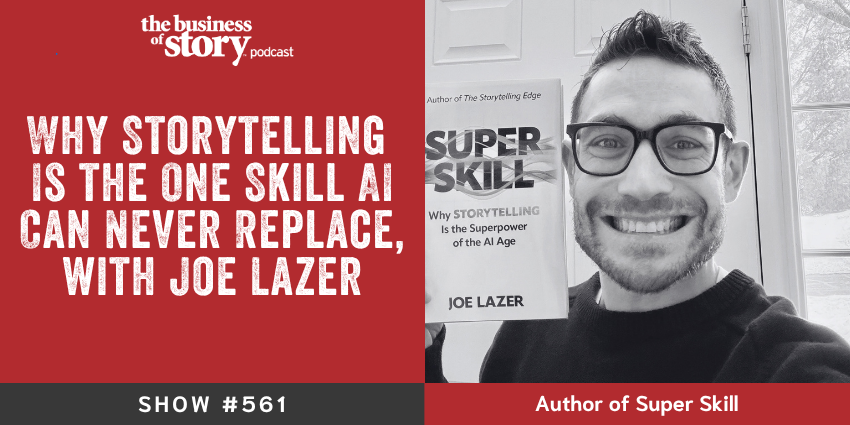
The Machines Can Code. They Can Calculate. But They Cannot Connect.
What a content marketing pioneer who built Contently discovered after five years inside AI companies will change how you think about your career — and your voice.
You want your brand story to cut through the noise and build the kind of trust that actually drives business — and if you’re using the right story structures, the ones rooted in how the human brain is literally wired to receive and remember information, then you will create the kind of connection no algorithm can manufacture.
But most professionals are quietly terrified that AI is coming for their creativity, their voice, and their value. Because every McKinsey report, every LinkedIn pundit, and every breathless headline has been telling them the same thing: writers and creatives are first on the chopping block.
Welcome to the conversation that changes that narrative.
Why the Doomsday Prediction Got It Exactly Backwards
Joe Lazauskas has spent the last five years inside AI companies — first running marketing at A-Team, a machine learning startup that raised $55 million, and now as CMO of Pepper, an AI-native organic growth company. He has watched the AI revolution from the inside.
 And his conclusion is the opposite of what you’ve been told.
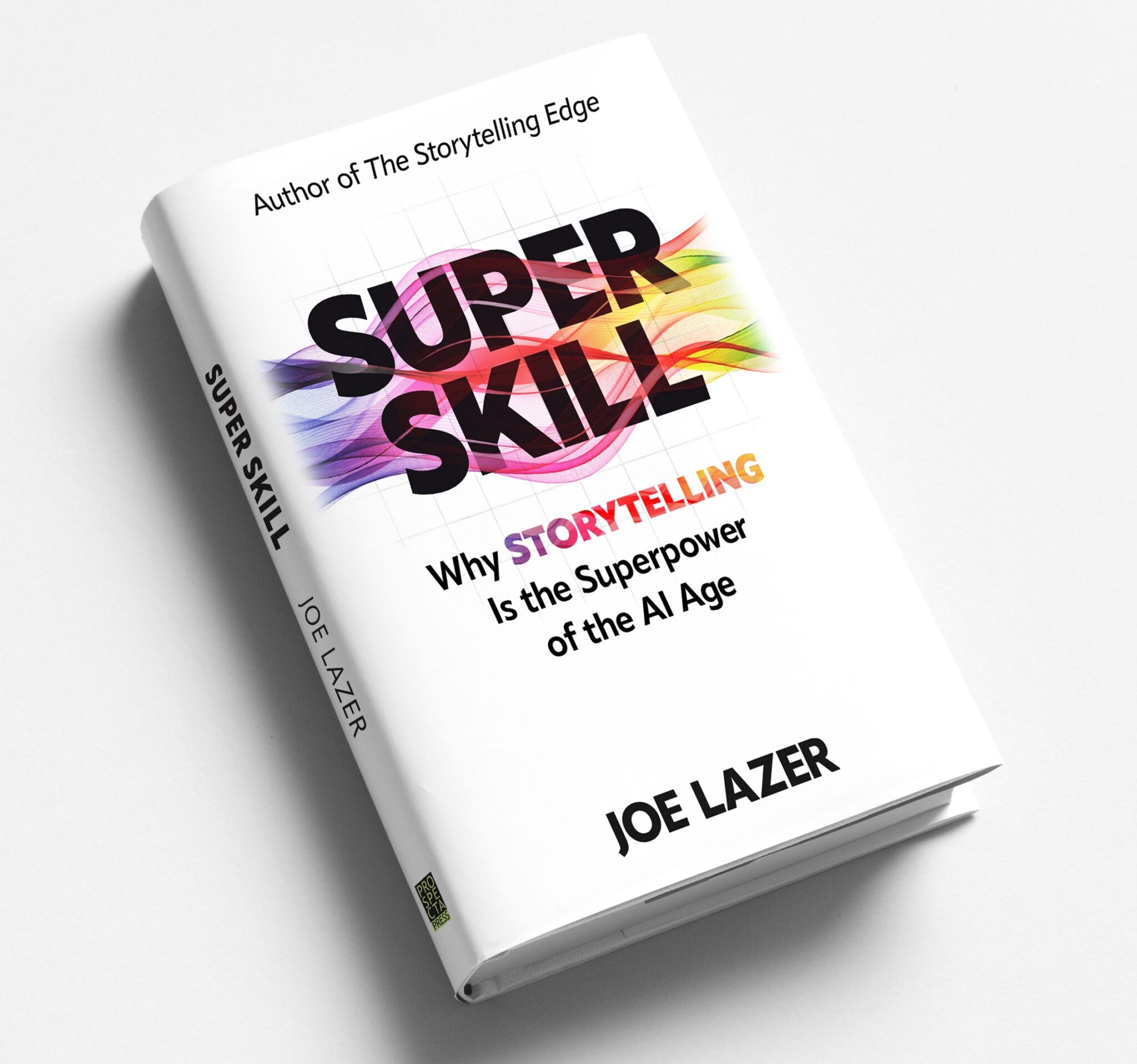
Joe is the co-founder of Contently, one of the first and most influential content marketing platforms ever built, and the author of Super Skill: Why Storytelling Is the Superpower of the AI Age. He has spent a decade studying the neuroscience and behavioral science of storytelling — and five years watching AI reshape the world of work.
His thesis: as AI gets better at technical tasks like coding and data analysis, the uniquely human skills of connection, empathy, leadership, and storytelling don’t become less valuable.
They become the only things that matter.
What’s in it for You:
- Why AI slop is flooding the web — and why that’s actually great news for great storytellers
- The four story elements — relatability, ease, novelty, and tension — that make any audience stop and listen
- How to use AI as a creative amplifier without ever letting it replace your voice
- The science behind the vulnerability loop and why it’s the fastest way to build real trust
- Why Kurt Vonnegut’s rejected anthropology thesis turned out to be right all along
- How the Neanderthals — despite bigger brains — lost to homo sapiens because they had no Wi-Fi
The Counterintuitive Truth About AI and Creative Value
Joe’s research led him to two realizations that most people in 2023 weren’t ready to hear.
First: AI-generated content — what he calls AI slop — was going to flood the internet. A sea of sameness. Mediocre content produced at scale, driving down the cost and perceived value of average work.
But here’s the counterintuitive part.
That same flood would drive up the value of authentic human storytelling. Because as human beings, we are wired to seek out genuine connection. We can feel the difference between a story that came from a lived experience and one that was assembled by a machine trying to predict the next word.
Second: AI was going to get better at technical tasks — coding, data analysis, structured problem-solving — faster than it would ever get at storytelling. Not because the technology isn’t advancing. But because you can objectively measure whether an app works. You cannot objectively measure whether a story moves someone.
The result? LinkedIn data now shows storytelling roles have doubled in the past year. OpenAI, Anthropic, and Netflix are paying over $500,000 annually for product storytelling talent.
Joe saw it coming. Most people laughed.
The Four Elements That Make a Story Impossible to Ignore
Joe maps the neuroscience clearly. Every story that works — whether it’s a LinkedIn post, a sales conversation, or a keynote — succeeds because it hits four primal triggers.
Relatability. The audience sees themselves in the character or situation. This is the easiest hack in storytelling and the most overlooked.
Ease. You have one to three seconds before someone scrolls, checks Slack, or mentally checks out. Obsess over your opening. Open a curiosity gap they have to close.
Novelty. The brain releases dopamine in response to new stimuli. New ideas, unexpected images, counterintuitive facts — they wake the brain up. Use them.
Tension. This is what makes a story a story. The gap between what is and what could be. Don’t sanitize your case studies. The struggle is what builds trust. Nobody believes the client who said everything went perfectly.
Writing Is Thinking — and That’s Why AI Can’t Do It for You
Joe has a hard rule: he doesn’t use AI to write. Not because he’s a purist. Because writing is thinking.
The act of writing is how you discover what you actually believe. It’s how you find the idea inside the idea. AI can research, automate, iterate, and refine. But it cannot do the cognitive work of figuring out what you have to say — because that work only happens when you sit down and say it yourself.
You see, the most effective people using AI today are already the best communicators. Because using AI well is fundamentally a storytelling skill — you have to articulate what you want, why it matters, and what success looks like.
Master the story. Then use AI to amplify it.
Links:
- Joe Lazer on LinkedIn
- Subscribe to The Storytelling Edge on Substack — and claim your exclusive 20% discount for Business of Story listeners, including a signed copy of Super Skill, access to the Storytelling in the AI Age course, live office hours, and dope socks
- The Art of the Zag Podcast with Joe Lazer and Shane Snow
- Pepper — AI-Native Organic Growth
- Test your brand story for free with the StoryCycle Genie®
- StoryCycle Genie® Blog
Deepen Your Storytelling Mastery: Three Essential Episodes
To go further with what Joe and Park explored in this conversation, these three episodes from the Business of Story archive will sharpen your story skills and your strategic thinking:
Why Building Your Audience Now Is the Only Moat Against AI, with Joe Pulizzi — The man who coined “content marketing” reveals the urgent 12–24 month window to build a discoverable human audience before synthetic content makes it nearly impossible.
Artful Intelligence: The Human Advantage in the Age of AI, with Jen Perry — Executive Creative Director Jen Perry shows how reframing AI as “artful intelligence” keeps emotional humanity at the heart of your brand storytelling.
Why the Hero’s Journey Is Your Brand’s Secret Superpower, with Christopher Vogler — Hollywood story consultant Christopher Vogler — whose work shaped The Lion King and Hercules — reveals why the same mythic structure Vonnegut mapped is your blueprint for business growth.
Joe Lazer’s Conversation With Park Howell on The Business of Story Podcast
Park: Hey Joe, welcome to the show.
Joe: Thanks for having me.
Park: Coming to us all the way from New York, New Jersey, somewhere around there — where are you?
Joe: I’m in Brooklyn, in the heart of Brooklyn. A few blocks from Barclays Center, where the Nets play. That’s gonna orient you in Park Slope, which is sort of the suburbia of Brooklyn. Tree-lined streets, lots of strollers, dog and a baby. One day you just wake up in your 30s in New York and you’ve transported from Manhattan to Park Slope, Boerum Hill, where I am right now. Yeah, it’s lovely.
Park: Very cool. You grew up out there, right?
Joe: I grew up in Jersey, just about 25 minutes over the river. So I cannot call myself a truly native New Yorker — truly native New Yorkers would be angry about that designation. But I had a little short bus called the Spanish Express that would stop in front of my house and get me into the city in 20 minutes. So I had an easier commute to Manhattan than a lot of people in Brooklyn and Queens and the Bronx. But I’ve been here in the city for almost 20 years now. Greatest city in the world.
How a Kurt Vonnegut Assignment Changed Everything
Park: You’ve got this new book out, Super Skill: Why Storytelling Is the Superpower of the AI Age. Before we get to that — how did you get into the storytelling world?
Joe: When do you become a storyteller? I think we’re all storytellers when we’re young. I have a three-year-old here in Brooklyn right now and he spends 98% of his time in Neverland, only about 2% actually operating in reality. I’ll be like, we have to go to school. He’s like, we’re building an airplane.
So I think we’re all born storytellers, but for me the eureka moment was in my sophomore year of high school. We got assigned this really fun assignment to write a bonus chapter in Kurt Vonnegut’s Cat’s Cradle, which is one of my favorite Vonnegut books.
I’d been a pretty bad student up to that point — fairly delinquent. But I got this assignment where you could write just a bonus chapter in the middle of it. So, like, chapter 16 and a half.
After I handed it in, I got called up by my sophomore year English teacher. She always had this stern look on her face and I was like, crap, I’m in trouble again. I used a couple of curse words in that chapter.
Then she said, I loved your chapter. Can you read it in front of the class?
I was super nervous. Hands shaking, body shaking. I start getting into it — and the class starts bursting out laughing. They loved it.
That was just this moment of connection for me. I was like, I love this feeling. I really enjoyed doing this.
From that, I wrote a terrible novel in high school. I joined the high school paper, ran the news section, wrote a couple of humor columns that were pretty popular. It just snowballed from there — ran the college newspaper, got into journalism, took a lot of creative writing at Sarah Lawrence, which is basically an MFA program as an undergrad. Started a media company coming out of college, went and built Contently, one of the first big content marketing companies, and pioneered the brand storytelling space.
The Joseph Campbell Sports Center at Sarah Lawrence
Park: Sarah Lawrence — isn’t that where Joseph Campbell taught for many years, the creator of the hero’s journey?
Joe: It is, yeah. He pioneered the hero’s journey there. The sports center is named after him. That’s kind of the tradition of Sarah Lawrence — some of just the best writers and writing professors you’ll meet, in 15-person seminars where you’re sitting around a round table tearing apart each other’s stories. A little bit vicious, but it was where I was forged.
It’s where I learned to write, learned to edit, learned to think. Because writing is thinking. Everything at Sarah Lawrence is writing-based. There are no tests — everything is a 30-page thesis. And I think that’s what ends up pulling out a lot of the cognitive super skills that are becoming more important now at work as AI gets better at coding and data analysis. We need to be questioning what’s our true human edge.
Park: You said the sports complex is named after Joseph Campbell? That cracks me up.
Joe: He was a big sports guy, apparently. There are sports at Sarah Lawrence — I founded the Ultimate Frisbee team. Swimming is strong. I did cover the basketball team. The basketball team was not great. Our center was like six feet tall. We were mostly playing cooking schools. But there was basketball — maybe a crowd of 40 people in the Joseph Campbell Sports Center.
Why AI Will Never Replace Great Human Storytellers
Park: Your new book — you begin with a story about your son, Max. How did you find the connection between that moment and AI and storytelling?
Joe: It’s the story of why I wrote the book. My son, Max, was born a few days after ChatGPT came into the world. In that early light of fatherhood, as I got back to my apartment here in Brooklyn on a short paternity leave from my job running marketing at a fast-growing AI startup, I started seeing the explosion of analysis around AI.
Once ChatGPT dropped, it felt like aliens had landed on earth and they were suddenly really eager to write blog posts for us. We had all of these prophecies that AI was going to wipe out writers and creatives — that the thing I’d based my career on was gone for good.
I wondered: what would this mean for me as a new father with a mortgage to pay? What would this mean for my son? Would he grow up in a beige world without human storytellers and creativity?
McKinsey, Deloitte, Accenture — everyone was predicting that AI was going to wipe out content teams and automate creativity. But one thing I’ve learned covering tech as a journalist over 15 years is that our first narrative about new technology usually isn’t quite right.
Think about how badly we got social media. It was originally going to be this bringer of democracy, this inherent good of connection. And in a lot of ways, it’s just divided us and become a mechanism for data aggregation and surveillance.
So I started digging into the fundamental question: what skills would matter most as AI progressed? I had a real advantage — I was running marketing at a company called A-Team, which had just raised $55 million around using machine learning to bring together high-performing teams in product, engineering, design, and marketing. Understanding how AI would change what skills matter was inherent to our thought leadership.
So I started a generative AI salon series in downtown New York, bringing in AI researchers, corporate leaders, and future-of-work researchers. And around mid-2023, I arrived at two key realizations.
First: AI slop was going to proliferate online. More and more people creating mediocre content using AI — a sea of sameness. That would drive down the cost and value of mediocre content, which would have this counterintuitive effect of increasing the value of great human storytellers. Because as human beings, we create human connection that feels authentic and genuine. AI was very likely to be a force against that — so we would seek out those human storytellers.
Second: as AI progressed, it would get better at technical tasks like coding and data analysis faster than at storytelling — for two reasons. One, it’s much easier to objectively define success on coding. The app works. The math is correct. Storytelling and connection are much more subjective. Two, there’s a lot more money in replacing coders than writers. And there’s a certain level of AI writing that becomes economically valuable — professional emails, landing page copy. But pure creative human expression becomes less the realm of AI.
So in a world where it’s harder to buy attention than ever, where slop floods the web, human storytellers would grow in value. And simultaneously, as AI took on technical tasks, it would force us to ask: what’s our human edge?
That’s all the relational work that matters most — empathy, communication, leadership, collaboration. AI can code and do data analysis. It can’t convince six different stakeholders to rally around an idea. It can’t inspire a team. It can’t build a culture.
When I first came up with this thesis in 2023, most people thought I was nuts. The prevailing narrative was that AI would replace writers and creatives the most. But now we’re seeing storytelling roles double in the past year, according to LinkedIn data. We’re seeing massive salaries at companies like OpenAI, Anthropic, and Netflix for product storytelling roles exceeding a half million dollars a year — from tech brands that adopted AI first, saw that the slop didn’t work, and realized the real way to drive growth is to have great human storytellers.
How Joe Uses AI Without Letting It Write for Him
Park: As a storyteller, how do you use AI?
Joe: I have a hard rule — I don’t use AI to write. That’s a promise and a social contract I have with my audience. People read my books. Between LinkedIn and Substack, I have a couple hundred thousand newsletter subscribers. My contract with them is that I’m not going to serve them something that was just generated by ChatGPT or Claude.
Park: But you must use it for efficiency somehow. How do you use it to amplify your work?
Joe: I use AI every single day. And I’ve found it to be incredibly helpful in scaling what I’m able to do. In the book, in the last part — Upgrade — I talk about using AI in your storytelling practice in three levels.
The first is automate. There’s so much busy work and shallow work in our day-to-day lives — tedious tasks where we’re not really cognitively engaged. AI is beautiful for automating those things. I have Claude set up to organize my computer, my files, my calendar, my inbox — understanding what I need to prioritize and respond to. It’s really powerful in that way.
There’s also a lot of derivative content that’s not really coming from me — landing page copy, CTAs, metadata. Things that would take a lot of time before that now you can do much more quickly. I’m redesigning my website using AI, able to basically vibe-code a website that otherwise would have taken me months to develop.
The second stage is iterate. One framework I call the thought leadership loop for AI — the cycle of ideation, research, creation, and refinement with AI. The key here is the order in which you use AI.
If you use AI first for brainstorming, you’re very likely to anchor on AI ideas and see some cognitive atrophy. You’ll produce very average ideas. But if you brainstorm on your own first — and then get to the point where you’re stuck or need additional ideas — AI can be really powerful. We come up with ideas in small iterative steps. Idea A spurs idea B, spurs idea C. AI is really good at unlocking this brainstorming dynamic because it’s like having a thousand interns in a room suggesting different ideas. Often the ideas it suggests won’t be the one you choose — but they’ll inspire another idea that gets you there quicker.
I use AI for research a ton. Deep research is the best use case we’ve seen from AI so far. It hallucinates much less than it used to. If you give AI the right context, the right instructions — telling it to use specific types of sources, academic studies, journals, highly reputable publishers — it can be a massive time saver. It’s like having a research assistant. Say I want to check a really obscure podcast transcript for something interesting a founder said years ago. Previously that would have taken dozens of hours. AI can crawl those transcripts and find the quote like that.
In the creation stage, again — you need to write on your own first. Writing is thinking. It’s how we figure out what we should be writing about, how we understand new ideas and directions we want to explore. However, when you have a big asset like a book and want to figure out derivative content — how could I translate this chapter into a LinkedIn carousel? — AI can be really powerful there.
Then on refinement — bringing the voice of your audience into the room. Creating synthetic personas where you basically teach the AI everything about the audience you’re trying to reach and have it act as that audience and give you feedback on what you’re writing. It gets you out of your own head. It’s like having the voice of the customer in the room. Not as good as a real human, but when you have multiple audiences you’re trying to reach, it can be really effective.
The Surprising Science of Listening and Vulnerability
Park: In Super Skill, what was one of the most surprising findings or aha moments you just didn’t see coming?
Joe: I’d point to two things. One I didn’t expect to be writing about as much is the power of listening and vulnerability.
The science here is very interesting. There’s a study from Japan where they put people in an MRI machine and did talk therapy-type sessions. They found that when the researcher outside practiced active listening — I’m listening to your story, I’m responding to it, I’m digging deeper — it actually lit up the parts of the brain associated with, essentially, I really like you. Just the act of listening to someone’s story, of being truly engaged with them, is one of the best ways we can connect with each other.
So when we think about the power of storytelling, it’s not just storytelling — it’s also story listening that’s really important.
Similarly, the power of vulnerability. There’s something called the vulnerability loop. If I share a vulnerable story or moment in my life with you, you’re very likely to naturally detect that and reciprocate it back. And then once I get that back from you, I acknowledge it — there’s this moment of connection. The vulnerability loop closes and stronger trust is established.
It’s not a woo-woo thing. It’s been shown to very quickly deepen relationships over and over again. And I think that’s more important than ever, where the role of human beings at work will be much more about building connections with other people than doing work at a computer.
The third and maybe most fun is the last chapter of the book, where I dive into experimental AI storytelling possibilities. Artists like Holly Herndon, who built an AI version of herself and essentially commercialized it — created this spawn of her voice that any of her fans could use in remix, with a profit-sharing agreement. Grimes did this as well. And if you extrapolate that — James Cameron creating a communal avatar universe, Harry Potter, Lord of the Rings, Star Wars — the possibilities are really interesting.
It’s also a moment where we have to think about how we can take advantage of our IP and our ideas before the AI giants just do it for us. I built one AI bot version of me that didn’t really work. Now I’m in the process of creating another one — thinking about how I can deepen the book storytelling experience and the way people engage with it using AI. Because the AI models, whether I get permission or not, are going to find a way to ingest my book. I’d rather train it in a deliberate way and own that myself.
Vonnegut Was Right: The Science Behind the Shapes of Stories
Park: You are obviously a Kurt Vonnegut fan. I love his Shapes of Stories — a man gets in a hole, a man gets out of a hole. It needn’t be about a man and it needn’t be about a hole. People love that story. I find most leaders I work with say, don’t trouble me with story theory — just show me what works. Do you come across that too?
Joe: I think it’s about the framing of it. Because what works is understanding those foundational shapes and structures of narrative — or else you’re just rambling forever, as some CEOs want to do.
I always find that the science of storytelling and how storytelling plays in our brain is often a good avenue in for welcoming them into this world. It presents a rational basis for what stories are doing and why they work.
Funny enough — researchers put all of basically the top literature of the last hundred years through a machine learning model a few years ago. And they discovered that Vonnegut was actually right. When you started to map them out, they basically just looked like Vonnegut shapes.
This was a theory he came up with as an anthropology student at the University of Chicago in the 1940s, right after he got out of World War II. He wanted to write about it as his thesis — that all the great stories of Western literature essentially followed a few fundamental shapes. He came up with eight in all, although a couple are very similar, so you could say it’s more like six.
His thesis idea got rejected. At that point, he said, screw it — and he became one of the world’s first content marketers at GE, writing about their technology. That introduced him to all the nerdy tech stuff that would help him write Player’s Piano, his first novel, and really take off from there.
But then when researchers actually looked at it — he was totally right. Of course he was. He’s Kurt Vonnegut. He’s the best.
Park: Well, they all basically follow that same pattern — get in a hole, get out of a hole, which is the hero’s journey. What do you learn from that?
Joe: Instead of a hole, it’s the abyss. We’re kind of going on the same journey. Boy meets girl — up, down, up. Cinderella. From bad to worse is maybe the hardest one to pull off. That’s Kafka, that’s The Metamorphosis. That’s some dark stuff right there. A little harder to turn into a viral LinkedIn post.
But man — a whole boy meets girl, which need not be about a boy, need not be about a girl, but is just a rise, fall, rise pattern. If you start to actually use these, it just helps you see how punchy, how fast your narrative is. You need to combine it with the core elements of what makes a story powerful — relatability, ease, novelty, tension. It’s not everything, but if you kind of frame it in the right way for them and have them actually practice it and see how that plays out on LinkedIn, that’s where you get the breakthrough.
Why Calling It a Framework Instead of a Story Changes Everything
Park: A lot of times I’m working with non-content creators — leadership, internal communication. And there are just a lot of times they’ll push back and say, I don’t have time for a story. I’m not really comfortable telling a story. Give me some frameworks I can use to get my messages across. And then doing that, all of a sudden the stories start coming alive in them.
Joe: So you have to tell them that it’s a framework and not a story. They’re in a storytelling workshop and they’re like, I don’t want to tell any stories.
Park: Interestingly enough — just like you said, you’ve got to appeal to the rational logic brain first. Here is a framework. Here is quantifiable data that demonstrates engagement rates. It’s the and, but, therefore — a statement of agreement, here’s the problem we’ve got to solve, therefore here’s the way forward. They get that.
They’re like, okay, I’ve got that. Now let me show it to you in a written memo. Let me show it to you in a landing page or whatever. Now all you’ve learned here is that setup, problem, resolution — the three basic acts of story structure. Now let’s expand on that. Let me show you the Five Primal Elements of a Short Story for BIG Impact — an anecdote you can tell in under a minute that makes your business point for you.
And then it always leads to — this is always great — I’m not comfortable telling stories. Nobody wants to hear my story. So then I’ve got to reframe it one more time and say, don’t think about it as a story. Just take us to a moment in time when something changed, something happened that plays through the setup, problem, resolution that makes your business point for you.
Give me a timestamp, a location stamp. You might be the center of the story. Tell it so your audience is living vicariously through you. What happened? What was the big surprise? What did things go south? How did you fix it? That then illustrates the point you’re trying to make. Oh, I could tell you about what happened last June down in Tallahassee… Take me to that very moment. They tell the moment — I say, there you go. You just told a story.
Joe: I love that. I might steal some of that from you.
Park: You can take any and all of it. I was teaching a very successful medical device sales team in Chicago — 65 of them — and the sponsor came back to me and said these people are really intimidated by the word story. I’m like, really? These are top-level salespeople. You would just think it would be more innate, more intuitive.
So we made the decision that day — a huge learning experience for me — let’s not talk about it as a story. Let’s talk about it as a moment in time that makes their business point for them. Tell that story. Use the ABT framework, expand it a little bit. Then all of a sudden they just bubbled with stories. Oh yeah, I can tell you about this.
And then when it was all said and done, I said, well, you all just told me a bunch of stories, even though you’re not storytellers.
The Four Elements of Storytelling That Will Always Beat AI
Joe: So I’d say to start — the overall way you should think about your skills moving forward, no matter what role you’re in. AI is going to continue to get better at technical tasks. That’s a lot of what we do when we’re sitting at a desk working on a computer. So we have to think about those strong relational skills of building connections with other people — leading, collaborating, teamwork, rallying stakeholders around a vision. Those relational skills are what’s going to make us valuable at work.
And if you really understand the behavioral science and neuroscience of storytelling, storytelling just naturally acts as a super skill that makes us better at all those surrounding soft skills. This is an evolutionary trait — it’s how we went from being a mid-rate species wandering the earth to ultra-social learning machines. We were able to work in groups bigger than our hunter-gatherer tribes, overcome Dunbar’s number — essentially the limit of we can only really know and trust 200 to 250 people — because we get rallied together around shared narratives. This is what makes religions, nations, hometowns — the sense that we are bonded by stories.
So if you’re skeptical of storytelling, the science is there. And it doesn’t have to be intimidating. As a child you spent your days telling stories. If you just pay attention for one day to how much of your life is spent telling stories to other human beings — these moments in time, these anecdotes — you’ll find it’s actually much of your waking life.
And I think we’re often told now that AI is the most important thing we can learn. I’m a proponent of learning AI. But AI alone isn’t what’s going to save you in the next stage of work. These tools are getting easier and easier to use. A couple of years ago, using ChatGPT or Anthropic felt like conjuring a magic genie — trying to figure out what incantation would get it to operate correctly. Now it’s starting to work much more effectively. In a couple of years, using AI is going to feel like using Google or knowing Microsoft Word.
But if you invest in your core storytelling superpowers — using them to think, to communicate, to write — and then use AI as an amplifier on top of that, you’re going to be much more effective. The most effective people using AI are already people who can communicate really well, who can articulate their ideas and what they want to accomplish. And then on a pure storytelling point:
Relatability. We’re drawn to stories where we can see ourselves in that character, where it’s a situation we’ve felt like we were in before. Simply presenting a character and situation your audience can relate to is one of the easiest hacks to telling an engaging story.
Ease. Breaking down the barrier between you and your audience is crucial. We don’t actually have shorter attention spans than we used to — a big meta-analysis from the University of Vienna found that our ability to concentrate on tasks has increased over the last 30 years. But our consideration span is much shorter. We’re constantly promised the next piece of content in the roulette wheel of our phones, so we only consider things for one, two, three seconds. Obsess over the hooks of the story you tell. How do you open a curiosity gap that your audience wants to engage in?
Novelty. Introduce new ideas. Our brains are programmed to notice new things in our environment. Think back to hunter-gatherer tribes — food sources, threats. Our brain gets a little hit of dopamine when we notice a novel image or experience. New ideas, new visceral imagery — that really gets people’s attention.
Tension. Don’t be afraid of tension in your storytelling. Tension is what makes a story a story. The gap between what is and what could be. Many businesses are allergic to it, but don’t just have a case study where everything was great for the customer. Talk about the challenges they went through with your company. How did you help them overcome it? What were the barriers? Because that’s what makes me actually trust you — to hear about the real story where there were stakes, where things weren’t always great, but you got through it together. That’s what makes me believe you’re going to be the type of partner who’s with me through the good times and the bad.
Neanderthals Had Bigger Brains — But No Wi-Fi
Park: I like to call it the applied science and bewitchery of storytelling — the applied science are these algorithms, these structures you talk about in Super Skill. And I like to think that storytelling is like the very first technology we homo sapiens really ever had. Stories are the software that drive the hardware of our limbic meaning-making machine.
And I find it so ironic that the very first technology of storytelling is how you overcome the synthetic, the halitosis, bot breath of AI — a technology that everyone’s fearing. Yet we still have this very innate, intuitive technology inside of us as storytellers. We’re the only beings we know of that think, plan, organize, and act in story.
Joe: Yeah — at least that we know of. Dolphins could be telling stories to each other, perhaps. But yeah, it really is what separates us from apes. I love the way Rutger Bregman puts that idea in the book Humankind. He talks about comparing us to Neanderthals back when we coexisted around 40,000 years ago.
Neanderthals had bigger brains than us. They were stronger. But they didn’t have nearly the same capacity for language and storytelling. And storytelling is what allowed us to drive so much more connection and pass down lessons to each other.
He says that Neanderthals were like a MacBook Pro — but without Wi-Fi. Humans were like a MacBook Air — but with Wi-Fi. Because we had that connection.
And if you think about it, the math actually works out. If a Neanderthal is likely to learn how to fish one out of ten times, but only has its cave roommate to teach — and a human is less intelligent, only figures it out one out of every hundred times, but has an entire tribe of 20 to 25 people to teach — all the humans are going to learn how to fish much faster than all the Neanderthals. That’s the way storytelling acts as that cognitive technology, that Wi-Fi that allows us to learn things much faster and grow and progress together.
Park: The very first story ever told that created a reaction out of Larry the cave mate out on the Savannah somewhere. Larry goes, uh-huh. Uh-oh. Ah-ha. Set up. Problem. Resolution. Learned through the use of story — which made the homo sapien the most aggressive, invasive species this planet has ever known.
Joe: Yeah — for good and bad. Maybe AI is the next alien species that’s going to take over that mantle.
Pepper: Organic Growth in the Age of AI
Park: So you are now the CMO over at Pepper after Contently. What is Pepper?
Joe: Pepper positions itself as an AI-native organic growth company. In simple terms, we work with brands to understand how to drive organic growth — bringing together an expert network of human creators with AI agents to solve for discoverability in AI search, social, and SEO. We allow you to grow by creating great content that engages people and creates a positive impression of your brand.
Working off the thesis that attention is harder and harder to buy. Organic is really where it’s at. But how can we do this in a much more efficient and effective way than we ever have before? We believe that combining specialized expert talent — great human storytellers — using AI intelligently is the way you unlock that growth.
The StoryCycle Genie Grades Pepper’s Brand Story
Park: As I do with all my guests, I took the Pepper website, fed it to our StoryCycle Genie, and in about two minutes it gave me a brand assessment. Not knowing your brand intimately, I said, okay, what I’ve read and what I see here, I feel like it’s 90% accurate. Go ahead and create the brand narrative strategy — and in about another four minutes, it created that eight-page document I sent over to you. Here is how Pepper is showing up in the world. And it follows our Story Cycle System, which was inspired by the hero’s journey but mapped to business. At its core is the and, but, therefore story structure. So it thinks, organizes, plans, and acts in story for brand development. What did you think of the outcome?
Joe: It was pretty damn accurate. I was surprised. I think you nailed it. Maybe that means there are still improvements I want to be making to the website — it’s a new website — but it seems like at least the narrative is getting across well. I’d say there are maybe some tweaks we can do to the audience personas, probably more the fault of the website than your tool. But mostly the third one — that enterprise CMO — is right on. SEO content director is right on. We often find growth directors as a core constituency for us as well. But it was really strong. Brand archetypes were pretty right on. Yeah, this is a great little tool. I’d like to try it with some of our competitors to see how we stack up.
Park: Absolutely. And in the Genie, we do have a Brand Intelligence Genie where you can go in and feed it any of your competitors. It knows you because you’ve built a brand brain inside of it. It will give you a complete report validating what you’re doing well, where you’re beating them, revealing the gaps you can easily fix, and even inspiring you with new ways to think about telling your story — to own some white space that neither you nor your competitor currently own.
And you can also go to the Genie and test your brand story for free. Just do the brand story grader. It’ll give you an A+ to F-minus grade depending on how well you’re showing up — a 14-point brand story assessment on what’s working, what’s not, and how you can fix that. You can do that with any of your competitors. Put it in there.
Joe: Amazing. Let me just get on there and really just bankrupt you through API calls.
Park: Well, those don’t cost a whole lot for that. But what we did is simply took my process — it usually took two to three months of brand story development — and built a Genie out of it using AI. And now people can do the process in under an hour. Instead of paying $30,000 for it, it might cost you $50.
Joe: Super, super cool. You’re practicing witchcraft over there, Park.
Park: Yeah — the applied science and bewitchery of storytelling. It is totally infused with these story structures. It thinks, plans, organizes, and acts with you, always with narrative at the core of its guidance.
Where to Find Joe and Super Skill
Park: All right, man — where can people get your book and learn more about you?
Joe: You can subscribe to my Substack newsletter at storytellingedge.substack.com. We’ll also give your listeners a special discount offer around the launch — a bundle if you subscribe to the paid version of my newsletter, which gets you a personalized signed copy of Super Skill, access to my Storytelling in the AI Age course, dope socks if you live in the continental US, access to virtual and live events throughout the year, and live office hours with me if you want to talk storytelling and content strategy.
I’ll give a special 20% discount for the very special listeners of the Business of Story show.
Very active on LinkedIn — which is sometimes embarrassing to admit when you tell Gen Z people you post on LinkedIn multiple times a day. But I feel like my LinkedIn feed has gotten a little less AI-parable-y. I’d love for you to join them.
I also have a podcast called The Art of the Zag with best-selling author Shane Snow, where we explore counterintuitive ideas and people who are winning in business and life by zagging when everyone else is zigging. Please check out my stuff — I think you’ll like it.
Park: Awesome. Well, I love your book. It’s one of the best books on storytelling I’ve read in several years. And the fact of how you tackle AI and bring it into the center ring with storytelling — folks, I’d really highly recommend you pick it up. So I appreciate you giving our listeners that special offer. Thanks, Joe. Have a good one.
Joe: Thanks, Park. Appreciate the kind words. You too.
Frequently Asked Questions: Storytelling as a Super Skill in the Age of AI
Why is storytelling considered a super skill in the age of AI?
A: Storytelling is a super skill in the AI age because it powers the relational abilities that AI cannot replicate — empathy, leadership, collaboration, and the ability to rally people around a shared vision. As AI gets better at technical tasks like coding and data analysis, the uniquely human skills of connection and communication grow more valuable. According to LinkedIn data, storytelling roles have doubled in the past year, and companies like OpenAI, Anthropic, and Netflix are paying over $500,000 annually for product storytelling talent.
Will AI replace writers and content creators?
A: No — and the evidence is moving in the opposite direction. Joe Lazauskas argues that AI will accelerate the value of great human storytellers, not eliminate them. AI-generated content (AI slop) is flooding the web, driving down the value of mediocre content and simultaneously increasing demand for authentic human voices. The brands that adopted AI first saw that slop didn’t work — and are now investing heavily in human storytellers who can cut through the noise.
What is the “vulnerability loop” in storytelling?
A: The vulnerability loop is a research-backed phenomenon where sharing a vulnerable story or personal moment with someone triggers them to naturally reciprocate with their own vulnerability. When that reciprocation is acknowledged, a moment of genuine connection closes the loop and deepens trust rapidly. It’s not a soft concept — it’s been demonstrated repeatedly in behavioral science research and is one of the most powerful tools for building authentic relationships at work and in brand communication.
How should storytellers use AI without losing their authentic voice?
A: Joe Lazauskas recommends a three-level framework: automate, iterate, and upgrade. Use AI to automate tedious tasks (scheduling, metadata, derivative content). Use it to iterate — but always brainstorm on your own first, then bring AI in to expand ideas, conduct deep research, and refine drafts. Use synthetic personas to hear your audience’s voice. The critical rule: never use AI to write the content itself. Writing is thinking. The act of writing is how you discover what you actually believe — and that cannot be outsourced.
What are the four core elements of a compelling story?
A: Joe identifies four elements drawn from behavioral science and neuroscience research:
- Relatability — The audience must be able to see themselves in the character or situation.
- Ease — Hook your audience in the first one to three seconds. Our consideration span has shortened dramatically even as our concentration span has grown.
- Novelty — Introduce new ideas or vivid imagery. The brain releases dopamine in response to novel stimuli.
- Tension — The gap between what is and what could be. Tension is what makes a story a story. Don’t sanitize your case studies — the struggle is what builds trust.
What did Kurt Vonnegut’s “Shapes of Stories” theory get right about narrative structure?
A: Everything. Vonnegut developed his shapes of stories theory as an anthropology student at the University of Chicago in the 1940s — the idea that all great Western literature follows a handful of fundamental narrative arcs. His thesis was rejected. Decades later, researchers ran the top literature of the last hundred years through a machine learning model and confirmed that Vonnegut was correct. The shapes — man in a hole, boy meets girl, from bad to worse — are the universal grammar of human narrative.
How do you get leaders and non-storytellers comfortable with telling stories?
A: Stop calling it storytelling. Park Howell and Joe Lazauskas both discovered that the word “story” triggers resistance in analytical, results-driven professionals. Instead, frame it as a framework — the ABT (and, but, therefore) structure — and ask them to describe a moment in time when something changed. Give them a timestamp and a location stamp. Ask what happened, what went wrong, and how they solved it. Once they tell that moment, you can say: that was a story. The resistance disappears when the label does.
What is the “thought leadership loop” for using AI in content creation?
A: Joe’s thought leadership loop is a four-stage cycle: ideation, research, creation, and refinement — with AI playing a supporting role at each stage, never the lead. Brainstorm alone first, then use AI to expand. Use AI for deep research with specific source instructions to minimize hallucination. Write the actual content yourself. Then use AI to create synthetic audience personas that give you feedback from your reader’s point of view. The order matters — AI first leads to cognitive atrophy and average ideas.
Why were Neanderthals smarter but less successful than homo sapiens?
A: Neanderthals had larger brains and greater physical strength than homo sapiens — but they lacked the same capacity for language and storytelling. As Rutger Bregman describes in Humankind, Neanderthals were like a MacBook Pro without Wi-Fi. Humans were like a MacBook Air with Wi-Fi. Storytelling gave humans the ability to transmit knowledge across larger social groups, overcome Dunbar’s number (the ~250-person trust limit), and build shared narratives that created religions, nations, and cultures. Storytelling is the original cognitive technology.
What is Pepper and how does it use AI for organic growth?
A: Pepper is an AI-native organic growth company led by CMO Joe Lazauskas. It brings together expert human creators and AI agents to drive discoverability across AI search, social media, and SEO. The core thesis: attention is harder than ever to buy, organic reach is where sustainable growth lives, and the brands that win will be those who combine great human storytellers with intelligent AI — not those who replace one with the other.
What is the StoryCycle Genie and how does it work?
A: The StoryCycle Genie is Park Howell’s AI-powered brand story development tool, built on the Story Cycle System™ — a 10-step narrative framework inspired by the hero’s journey and mapped to business. Feed it a brand’s website and in minutes it produces a comprehensive brand assessment and narrative strategy, including brand archetypes, ABT statements, audience personas, and positioning. A process that once took two to three months and $30,000 now takes under an hour for around $50. You can test your own brand story for free using the Brand Story Grader at businessofstory.com.
What is Super Skill by Joe Lazauskas about?
A: Super Skill: Why Storytelling Is the Superpower of the AI Age makes the case that as AI automates technical work, the most valuable human skill becomes storytelling — not just for marketers and writers, but for anyone who needs to lead, persuade, collaborate, or connect. Drawing on neuroscience, behavioral science, and five years of research at AI companies, Joe argues that storytelling is the evolutionary technology that made homo sapiens the dominant species — and it’s the same technology that will determine who thrives in the age of the machines.
 Listen To More Episodes