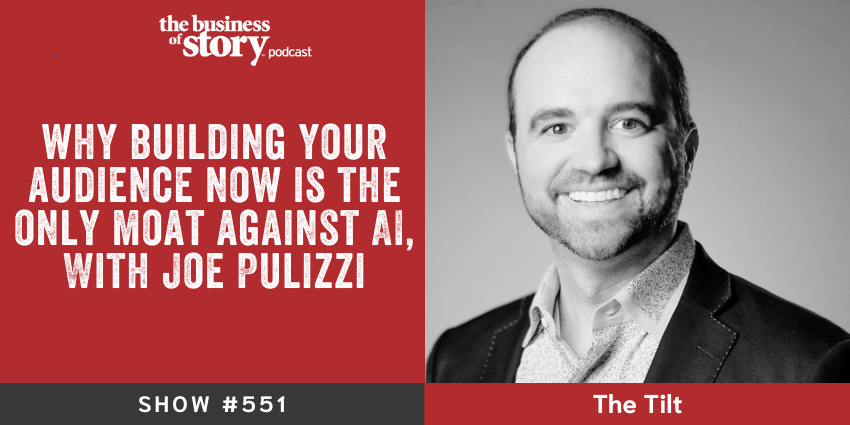
Why Building Your Audience Now is the Only Moat Against AI, With Joe Pulizzi
The content marketing pioneer reveals the urgent 12-24 month window to build discoverable human audiences before synthetic content makes it nearly impossible
As a creator, how well-known are you? How wide is your circle of influence?
How large is your most intimate audience who come to you for thought leadership, advice, and inspiration?
Today’s guest calls these essential elements of true popularity your moat against the onslaught of AI algorithms and synthetic content that are drowning out those who have not built their following.
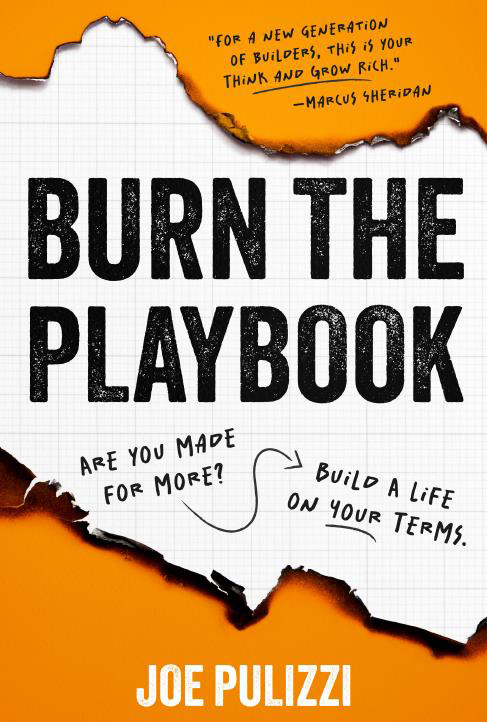 Joe Pulizzi, who coined the term “content marketing” in 2001, drops a reality bomb in this episode: 99% of content being created today is heavily influenced by AI.
Instagram can’t even keep up with the flood. The window to build a discoverable human audience is closing fast.
But here’s the thing—Joe isn’t running from AI. He’s running WITH it while building something AI can’t replicate: authentic human relationships.
The goal isn’t avoiding AI. It’s using AI as your collaborator while becoming vinyl in a streaming world.
What’s in it for You: The Survival Strategy for Human Creators
Joe Pulizzi helps creators understand that being known for something specific is becoming the only sustainable competitive advantage in an AI-dominated content landscape.
In this episode of Business of Story, you’ll discover:
- Why 99% of content is now AI-influenced and what that means for human creators
- The urgent 12-24 month window to build your audience before discoverability becomes nearly impossible
- Why being known (not famous) is your only competitive moat against synthetic content
- The “vinyl strategy”—becoming the 1% that builds loyal audiences who crave authentic human connection
- Joe’s 30-minute daily AI practice that gives you a decided advantage
- How to find your “tilt”—that one thing you’re exceptionally good at for a specific audience
- Why email and owned audiences matter more than algorithm-dependent platforms
- The generational advantage Baby Boomers and Gen Xers have in the AI age
The 99% Reality
Joe Pulizzi dropped a startling statistic: 99% of content being created today is heavily influenced by AI. Instagram recently admitted they can’t even keep up with the volume. They’re not blocking it because the sheer volume is overwhelming and increasingly undetectable.
But Joe isn’t an AI pessimist. He’s using ChatGPT as his co-CEO, health coach, and financial advisor. He created an entire presentation poolside by talking through ideas with AI. He edited his latest book using AI to identify gaps he was too close to see.
The question isn’t whether to use AI. It’s how to use it while building something AI can’t replicate.
You’re Vinyl in a Streaming World
Joe offers a brilliant analogy: human creators are becoming vinyl in a streaming world.
While 99% of content becomes synthetic commodity produced by trillion-dollar companies, there’s a critical 1% where human creators build small, loyal audiences that know, like, and trust them. These audiences crave authentic connection—they’ll attend your events, buy your books, join your community.
You’re vinyl. Premium. Authentic. Valuable precisely because you’re human.
But here’s the urgent part: Joe believes we have only a 12-24 month window to build these audiences before AI-dominated algorithms make human discoverability nearly impossible.
Being Known Is Your Only Moat
In Joe’s view, being known for something specific is becoming the only sustainable competitive advantage.
Not famous. Known.
Known to a niche audience for solving a specific problem in a unique way. Known well enough that when they need what you offer, you’re the first person they think of.
This is where Kevin Kelly’s “thousand true fans” theory becomes prophecy. You don’t need millions of followers. You need a focused group who value your unique perspective enough to support your work.
And you need to build that audience now.
The 30-Minute Daily Practice
Joe’s most actionable advice? Block out 30 minutes every single day to work with AI tools.
Not to become a “prompt engineer.” Just to get educated through experimentation.
Create a health coach. Build a financial advisor. Develop a co-CEO. Test different tools—ChatGPT, Claude, Gemini.
What matters is daily hands-on practice.
Joe compares this to the 1990s when knowing Microsoft Office gave job seekers massive advantages. Today, familiarity with AI tools is the new baseline competency.
Those who avoid learning are like those who refused to learn word processing.
They won’t survive.
Finding Your Tilt
Joe introduces the concept of your “tilt”—that one thing you’re exceptionally good at for a specific audience.
His exercise: Write down 10 things that make you YOU. Your skills, passions, interests, unique experiences. Then identify which audiences desperately need that specific combination.
Your tilt lives at the intersection of your passion, your skill, and audience need.
For Joe, it was his fascination with persuasion in publishing and marketing. He didn’t set out to create “content marketing”—he followed his curiosity and the category emerged.
For Park’s son Parker, it was combining filmmaking with VR technology. He won $50,000 from Meta because he was curious about a swim lane nobody else explored.
Curiosity is one of the most human traits. Point it in the right direction and opportunities emerge.
Why Joe Stopped a 527-Episode Podcast
Joe recently stopped producing Content Inc. after 527 episodes to focus entirely on his newsletter, The Tilt.
Why?
He asked himself: What should I stop doing so I can focus on what creates the most meaning and impact?
For Joe, that’s his newsletter—direct access to 80,000 subscribers with personal relationships with thousands of them. Email gives owned data and direct connection that algorithms can’t control.
It’s the same advice he gave Park 10 years ago: Focus on ONE thing. Don’t spread yourself thin. Go deep where you can build real relationships.
Questioning Retirement and the Systems We Live In
One of the most provocative parts of the conversation was Joe’s challenge to retirement.
Retirement at 65 was created when most people weren’t living past that age. The system hasn’t updated even though we’re living to 100+.
Joe’s family members who retired lost their purpose and meaning. Some got sick and didn’t enjoy those days.
He doesn’t believe in retirement. He believes it’s “a made up word by people that aren’t around anymore, that don’t care about what we’re doing.”
We’re living longer. That’s a long time to make an impact. Why default to outdated playbooks?
The Generational Advantage
Joe and Park both see a unique advantage for Baby Boomers and Gen Xers in the AI age.
They’ve spent decades developing their craft. They know how to write, research, create. They can spot BS. They know their history.
When they use AI, they’re chief editors bringing big thinking to life in their own voice. They leverage it to remove tedium while maintaining authenticity.
Younger creators without those foundational skills? They’re publishing 12 AI-generated books per day (Amazon had to limit uploads to 12 books daily).
The Action Steps
If you take nothing else from this episode:
1. Block 30 minutes daily for AI experimentation. Pick one tool. Create projects. Build custom assistants. Learn by doing.
2. Write down your 10 things. Identify what makes you uniquely you, then find the audience that needs exactly that.
3. Start building your audience NOW. Email, YouTube, Substack, in-person events—pick ONE platform where you own the relationship and go deep.
You have 12-24 months before this window may close forever.
The future belongs to the curious and the known.
Which one will you be?
Links:
- Joe Pulizzi’s Newsletter: The Tilt
- Burn the Playbook by Joe Pulizzi
- Content Marketing Institute
- This Old Marketing Podcast with Robert Rose
- The Orange Effect Foundation
- Craft your vibrant brand story with the Story Cycle Genie™
- What users are saying about the Story Cycle Genie™
Related Episodes You’ll Love:
- How to Accomplish More Business Growth By Doing Less – Michael Walsh reveals why working less creates more revenue and freedom
- After Upskilling Two Million People, Learnit’s CEO Shares the Formula That Makes Learning Stick – Damon Lembi on the relatable-memorable-emotional formula
- How Effective Leaders Go Beyond Their Words With Stories – Julie Lancaster’s REST method for leadership storytelling
Joe Pulizzi’s Conversation With Park Howell
Episode 551: Navigating the Creator Economy in the Age of AI
Joe Pulizzi on Building Audience, Embracing Technology & Redefining Success
Park: Hello, Joe. Welcome back to the show.
Joe: It must have been good the first time, or at least acceptable, that you had me back, so I’m surprised and happy about it.
Park: Well, what I did is I went back and I thought, because you were like in the first year of me producing this show, you came on and it was actually show number 51. And this is show number 551.
Joe: I can’t believe that. That’s hard. Congratulations.
Park: Thank you. People say, how the hell do you do it? You know, I mean, after show 51, people said, well, are you done? I mean, is there anything else to cover with storytelling? And I go, I’m not sure. I got to do 52 and see what happens. And, you know, it’s blown my mind about where story shows up in all facets of life in business and places that I didn’t even anticipate.
Joe: Absolutely. Well, I’ll tell you what, there’s not a lot of podcasts out there that have 500 episodes and I’ve got two of them. I just stopped producing one of them—Content Inc. It started in 2014 as part of the book Content Inc. that came out and I said, oh, let’s market it through a podcast and did 527 episodes. Right now I’m trying to focus on the most meaningful things we can do. We’ll get into this, but I’m kind of moving away from that podcast right now. We’ll see where it goes.
The Power of Strategic Focus
Park: That’s interesting. And I know you’ve been producing that and This Old Marketing with Robert Rose forever. Trying—well, you did it—producing two podcasts in one week. I can’t even imagine it because I have a hard enough time with one.
Joe: Yeah, I mean, we all have resolutions. We’re in a new year. And I think that it’s a great time to say, what do we need to stop doing? And what do we need to do more of? I’m like, okay, what’s really going to make an impact for my audience? That’s where I said, I’m really going to focus on my newsletter. I’m going to focus on textual content. Nothing wrong with This Old Marketing—I love it, we got a great audience, we’ve been doing it since 2013.
But where can I make the most difference in somebody’s life, a marketer’s life, a content creator’s life? I’m focusing on that weekly newsletter called The Tilt that I’m working on. We’ll see how it goes, but it’s the thing that I’m most serious about right now. I didn’t want any other distractions. I’m like, I’m going to just make this thing the best I can.
Park: Yeah. Well, you gave me a piece of advice 10 years ago that I have shared with loads of people and sent them back to that conversation even today. At that time I was making the mistake that I think probably most content creators were making. I was trying to be everywhere all the time and none of it was working very well. You gave me the sage advice of focus on one thing, Park. Is it going to be Facebook? Is it going to be LinkedIn? Was LinkedIn even around then? Is it going to be YouTube? Don’t spread yourself too thin. So my main focus has been this podcast and then the content created on that shared through the different channels.
Joe: Well, hopefully it was decent feedback at the time and it worked for you.
Park: Well, it really did. And it goes back to that thing of the one thing and just kind of like what you’re talking about for 2026. What are you going to stop doing and really focus on that one thing that has the biggest impact?
Questioning the Systems We Live In
Joe: Yeah, it’s interesting. For some reason, I just started focusing on systems—the systems that we’re in. The education system, people think of their career identity in that system, and then retirement. I think a lot of people are just going through the motions. I think we just have to stop for one second and say, okay, why do we make these decisions we make? And what decisions are we leaving to someone else? We’re making a decision without making it.
Retirement’s a great one. It’s like, I’m going to shoot for retirement. Well, who made that up? The Social Security Administration did because they wanted to move people out of the system. They said 65 will be good. Most of us weren’t living that long anyways, but we kept that system going still to this day. I’ve talked to people that retired—I mean, you probably know some as well. They retired at 65, 67, and they lost that purpose and meaning. They’re like, well, what do I do now? It’s like, well, you’re shooting at the wrong goal.
Nobody told you you had to shoot at this retirement goal. It’s just that that’s the way we believed it to be. That’s the system and that’s how it works. So I’m like, let’s push back on that a little bit. It doesn’t have to be this way. We don’t have to go to school for—we don’t have to go to college anymore. I mean, my kids went to college. I went to college. But when learning, when education is basically free today and you can get it anywhere and it’s accessible from anywhere, what is the institution of college become?
You could say you might need the learning, but you can get that anywhere. You might say you want a safe experience to grow and mature. That’s very expensive, but you can absolutely do that. But what is it really? It’s a credentialing system. I feel like I need some letters behind my name or I need to get this document to move up and to give me an opportunity or get a part of this club.
There’s nothing wrong with any of those. It’s just to say, before you make these decisions, let’s just know what we’re moving forward with. Of course we could talk about that when it comes to content creation as well. That’s where I’m just trying to get people to say, before you do these things that we always just did—to your point, we gotta be on Facebook, we gotta be on YouTube, we gotta be on podcasts today, what are we doing on TikTok?—just say, look, first of all, why am I here? What am I doing? What’s my purpose? What’s my meaning?
Then, okay, well, I would like to have more choices available to me. How do we make that happen? The best thing to do, I think right now in this limited timeframe we have, is to build an audience—to build an audience that knows, likes and trusts you. We can talk about ways to do that with AI, but that’s kind of where I’m at right now. That will give you the most available options to make choices and not be relegated to: I have to live here, I have to work here, I can’t get time off here, I have this healthcare here. All we want is the freedom to make as many choices as we wanna make wherever we wanna make them. I’m scared that a lot of people are just defaulting to this old playbook that just doesn’t exist anymore.
Rethinking Retirement and Purpose
Park: Well, you have an excellent Friday email newsletter, The Tilt, that I love. You always inspire me with something—one thing to think about in the following week. I did buy one of your books from your Tilt publishing on retirement. The Age of Retirement, I think. Was that Tom Marks?
Joe: Yeah, very good. Thank you. Good book. Really good book.
Park: Yeah. He’s the one that covers what you were just talking about, about the old way of thinking about retirement. It’s funny because I turned 65 on Valentine’s Day.
Joe: Congratulations, there you go.
Park: Thank you. I know I made it this far by God. But I can’t tell you how many people—not so much because they know me, but family and people I hang out with up here in our community in Northern Arizona—are you retired yet? When are you retiring? What’s going to happen? Why aren’t you retired yet? And I go, well, define retirement for me. What exactly do you mean? I mean, I don’t have to work anymore. But I love what I do and I can’t imagine making birdhouses and playing golf for the rest of my life. So retirement to me is a completely different thing. I tell them I’ve got a hobby that I get paid very well for.
Joe: That’s one. Yeah. I mean, I read an author recently who wrote a bestselling novel, became very popular and said, I get to do what I always wanted to do. I travel, I research the strangest topics and I write about them. And he’s in his bliss. That’s kind of where I’m at too. We’re both blessed to be in a position where we can do that. I’m like, okay, well, let’s spend some time talking about these things.
When I talk to somebody about retirement, that’s the saddest thing to me. I even have family who retired. They lost their meaning and they got sick and then they didn’t get to enjoy any of those days. I’m just like, we just need to—by the way, there’s nothing wrong with that if that’s what you decide to do. But just remember that that whole idea of retirement was put upon us by other systems, by an institution that said, you’re this age, you must move on. Well, what does that mean? Let’s take a little bit of that back and say, you know, to your point, what is retirement?
I don’t believe in it. I believe that it’s a made up word by people that aren’t around anymore, that don’t care about what we’re doing anymore. So let’s take a little bit of that agency back and say, you know what? We’re all living longer. You and I could both be living to a hundred plus if we take care of ourselves. That’s a long time to make an impact on society. So let’s rethink this a little bit.
Park: Joe, my mother is one hundred and a half years old. She’ll be one hundred and one on April 5th. In fact, I’m heading up to Seattle tomorrow to go see her again. She’s doing marvelously well for that age. She has her brains—she’s really very sharp, plays cards and whatever. Of course, her body’s given up a little bit, as one would after a century of being on this planet.
One last thing I would say about being a retiring hobbyist is that I’ve been in story for decades and I’ve always followed the hero’s journey. It’s been a huge inspiration for me. Just last week, I had John Booker on—the executive director of the Joseph Campbell Foundation. We spent an hour exploring the hero’s journey and how it shows up in all different aspects of our lives and our businesses. Had I retired six months ago, Joe probably wouldn’t have reached out to me or John wouldn’t have reached out to me and said, hey man, I’d love to come on your show and talk about the hero’s journey. After my 550th episode, which was an anniversary episode for me, I go, this has basically come full circle for me finally. But it’s because I’m still in the game.
The AI Opportunity and Challenge
Joe: We’re at a point where we have a huge opportunity. Anyone listening to this—we have such a huge opportunity today. That’s why I’m more of the AI optimist, if you will. Even though I don’t like some of the things that are going on, there’s never been a greater time to make a big impact on as many people as possible. There really hasn’t been. We have to do some things. We have to make some decisions, but those decisions are very exciting. We could talk about a lot of those as we go.
Park: Well, let’s jump into that. First, for those of you that maybe do not know who you are, you essentially coined the term content marketing back in 2001?
Joe: That’s when I first started using it. Yeah, absolutely.
Park: And you ran Content Marketing World forever and then sold that. I recall you sold several of your startups, but you have always been in the content world in one way, shape or form. A lot of your focus recently is AI and the impact on the creator economy. So given your 25 years now in this and 10 years since you’ve been on the show, let’s talk a little bit about what you see happening with AI. Let’s start with the pros and then let’s look at the cons.
The Pros: AI as Creative Amplifier
Joe: I think the pros are—I don’t know of a professional creator (and by the way, a creator could be, if you’re visualizing a YouTuber, newsletter writer, an author, that could be somebody independent or that could be somebody working at a company)—I don’t know of a professional creator who’s not using AI tools in some way.
It’s not either-or. You’re not seeing human-made content and AI-made content. You are seeing this melding of the two, if you will, where you get it all the way from: I want AI to help me with my titles, I want AI to help chop up this video into 16 mini videos so that I could distribute them on TikTok or Instagram or whatever—to you have some extremes that I’m not happy with where somebody will type in a couple of prompts and out comes a book.
My friend told me the other day, and I have to look this up so don’t quote me on it, but Amazon has limited the number of books you could upload per day to 12. Just think about that for a little bit. You and I, we’ve written books and how hard it is. 12 a day.
Park: 12! God. Takes me 12 years to write one.
Joe: It is a long and arduous process, but hopefully you’re using it as an advisor, as a helper, as an assistant. We’re getting faster, but maybe better. Maybe we’re getting smarter at how we’re using some of these tools. I don’t want to put it down in a lot of ways because sometimes I think about it from moving the typewriter to word processor. Wow, that was dramatic change. It was so much more efficient. I could get so much more done. Well, this is a hundred or a thousand X that.
Just as an example, non-creator example—I have my ChatGPT up, it’s right over here. I have a health coach. I talk to my health coach all the time and input what I’m doing. We talk back and forth. It’s basically my trainer that I have right here. I have my financial advisor right here as well. My co-CEO is right here. I use that so that I can be better and I can create better content and do better things.
From that standpoint, it’s almost a miracle the things that creators can do. We can create hopefully better content—I’m going to say hopefully, because sometimes it’s not. We all know about AI slop and we could talk about that. We create it more efficiently. It can give us the opportunity to do more things that are important to us. I can spend more time with family. I can go outside. I can travel. I can do whatever I need to do that’s important. That’s why we’re here on this earth.
I love that. I actually know a lot of creators who are like, hey, I used to work 50, 60 hours a week and now I work 20. Great.
The Cons: The Coming Wave of Synthetic Content
On the downside, what we’re seeing right now with the amount of AI—majority AI-created content. Again, you have a human being that’s behind this, not just AI creating content on its own. You have human beings that are creating. For example, at least in the last six months that I can tell, there’s been an AI song on the Billboard Top 100 that has been not human-created. I mean, a human created this thing and put in the prompts and pulled it out and maybe produced some of it, but it was AI-created. This is happening all the time.
Every day there’s more and more content that’s influenced heavily by AI content. I don’t know what the numbers are, Park. I mean, we can guess at the amount of AI content, but I’m under the assumption that 99% of the content out there right now being created is heavily influenced by AI.
Park: 99%.
Joe: I mean, if you look at even Instagram this week—they came out and talked about they can’t handle the amount of AI content that’s coming through. They’re not even going to block it because it’s just so much and they can’t tell anymore. It’s just very difficult to tell. I may be exaggerating. It might be 80% or 90%. All I want to get people is the idea: in the next year or two, the majority of content that consumers are going to be engaging in is synthetic content. That’s where we’re at.
We can have conversations that say an AI can’t be as authentic or human. I would like to think that that’s true. I really want to say—I mean, you and I love the idea of humans creating stories. Maybe it’s the most human thing of all, telling the story. But I’m seeing people fall in love with their AIs. I’m seeing people getting married to their AIs. There’s something pretty powerful. Whether I think that’s right or wrong doesn’t matter. It’s happening.
When that’s happening, do you think that a synthetic being can’t create authentically human content? I would probably venture to say that they can. When does that happen? It could be happening now, and it’s certainly going to happen in the very near future.
The 12-24 Month Window of Opportunity
The con about all this is: where does the creator go from here? My standard question to everything, Park, is I don’t know. I wish I had the answer, but I do feel that we have a 12 to 24 month window available where a human being can make an impact on a niche group of people on a niche topic and build an audience.
Why that’s important, why I feel that’s critical right now to do, is I don’t know if that’s going to be possible in three years. I don’t know if discoverability of a human-based creator that’s creating a newsletter or videos or whatever can break through any algorithm that’s out there. We’re relegated to things like email right now. My most important thing is my email newsletter.
For the most part, I’ve got some bots—everybody’s got bots signed up for their email—but the majority of these people are human beings. I’m starting to know a lot of them. I’ve got a newsletter list of 80,000 people. I know a couple thousand of those people that I’ve interacted with over the years. These are human beings that we’re building relationships with. I’ve been lucky that I’ve been around long enough to be able to build that through public speaking and through natural algorithms that benefited long-form content in the past, maybe not in the future.
We can do these things now. We can build an email newsletter. We can build a Substack. We can build a following on YouTube, on TikTok. We can do in-person events. We can do books. We can create those things and build an audience that we know. Specifically, I’m pushing through email or even through SMS text or something like that, where I actually have somebody’s data.
I feel like I can do that right now before the stream of AI content is so going to be so difficult to break through. That’s where I’m like—you and I talked a little bit beforehand—what do we do? Where are we going? If you feel like you have to build your personal brand now, you really have to be known for something. Being known is going to be the moat.
Being Known: The New Competitive Moat
When AI seems to be taking over everything, if you’ve been known before that happens, I think you’ve got an opportunity. You’ve got a business model there of some kind. That’s for a business, for content marketing, and that’s for an individual if you’re building out your own revenue sources.
You may not be able to go as broad as you wanted to. You may just have to focus on Kevin Kelly’s thousand true fans and really figure out this small topic where I can really make an impact, telling it this way in this form. A lot of that, by the way, is going and doing public speaking like you and I have done for so many years. Because right now—I’m saying right now because in the future I’m sure they’ll figure that one out too—right now, an AI can’t do that. Can’t get in front of an audience live, can’t shake somebody’s hand, can’t present material and impact people on a one-to-one basis.
I’d like to think that’s a negative, but it’s a pro. What I want people to do, Park, is not say I have time to do this. What I’m telling people is I don’t know if you have time. I don’t know if that content marketing model that I’ve been talking about for 25 years is going to work in five years, but I think it works right now. That’s where we have to take it seriously.
The Creator Adoption Curve
Park: The numbers—I’ve been looking at a lot of different research. One in particular was Drew McClellan’s research he did on what clients expect of their ad agencies in embracing AI in their work. What I keep seeing is kind of this one-third, one-third, one-third thing happening, both on the client side and the agency side.
One-third of the creator professionals out there or those hiring creator professionals are totally embracing AI and really running with it to build their agencies, build their client business, and so forth. One-third is still kind of on the fence, like, yeah, I’m dabbling in it. I do a little bit here, a little bit there. And one-third seems to be completely lost to it—they haven’t really, I don’t know if they think it’s a passing trend or what. What you’ve seen, do those numbers add up?
Joe: That’s probably some kind of reality. I know a lot of people. I’m seeing too many people that are certain. I just wrote an article about this. There’s people certain AI is going to be the devastation of the world. There’s people certain it’s going to be amazing. I think the one thing that I would say is we’ve been here before.
When I was first looking for a job, this is in the nineties, the reason why I got my job is because I was proficient at Microsoft Word, Excel, PowerPoint, and Access. That was the Microsoft suite—I knew the tech. Just take that example for what it is and move it here. If you go into any situation and you have some idea of: I’ve used ChatGPT, I’ve used Claude, I’ve used Gemini, Copilot—I don’t know anybody using Copilot, but let’s just say it’s Copilot for Microsoft.
One of my favorite tools is Whisper Flow, where I basically talk everything. It’s funny, where most of my day used to be typing things—and I do type to write—but most of my back and forth through all these AI engines I’m using is all through voice. I use Whisper Flow to do that. It’s a great tool.
I’m using all these tools. I’m listening to the Artificial Intelligence podcast. I’m listening to as much of this that I can get so that I have some idea of what I’m talking about, where things are going. I feel bad for those people that just heard from others about AI or, you know what, the company’s trying to get an AI council together and they’re sort of pushing away at it.
I hate to say it, but you got to jump in with two feet. You got to jump in the whole way and you got to test these things out because this is the new Microsoft Word. This is the new PowerPoint. It’s the new Excel or Sheets or whatever you want to call it. It’s just that much more important. When decisions are going to be made, if you’re in an organization or if you’re going to figure out what your business model is going to be on the creator side, if you have an idea of what’s going on with how you can use these AI tools, you’re going to be 10 steps ahead. You just are. I can’t even put a number on it, Park, how much more efficient I am just using these tools.
The Generational Advantage
Park: Absolutely. Well, you remove the tedium and the minutia of creation. You’ve got to go out and you’ve got to do your research. Someone made the point to me that folks our age—we’re roughly the same age. I mean, I’ve been at this for 40-plus years—that the Baby Boomers and the Gen Xers actually have an advantage because we’ve already been through the years of writing books and building our creative chops and really understanding writing.
When we work with AI, we don’t let it completely take over, but we know how to leverage it versus maybe the younger folks coming into the creator world who are like, well, I can publish 12 books today on Amazon because they said I could.
Joe: Yeah. Well, we know—I guess we can call BS too. If you know your history and you know how things work, you can. Because as we all know, whatever you put into it is what you’re going to get out of it. I never went for the whole thing like you have to be a prompt engineer. What I really like is I don’t necessarily create my own prompts. I just communicate as much information as I can.
My prompts are sometimes 10 minutes long. I will talk and I’m talking just like I’m talking to you now. I’m going, here’s how I feel and here’s where I’m going. And then I’m saying, okay, after all that, give me five questions and ask them to me one at a time so that we can get more clarity on this issue that I just regurgitated to you. Those are the types of things that are really valuable.
I was in Florida a couple of weeks ago, just trying to get warm. I’m sitting by the pool and I created a whole new presentation. I talked that all through with my co-CEO and just got it. It’s incredible that you’re able to do that.
By the way, I have some family members that are like, you use AI, you’re going down with the rest of them. You’re giving in. You shouldn’t be using the evil tools. I actually had one of my close family members tell me that yesterday. He’s a musician. He’s like, you can’t be doing that. You’re giving in. We got to keep live music forever, those types of things. But I’m like, hey, you know what, I’m not the one—I think everybody knows that.
Do you get to a point where you’re using it so much you’re like, that’s too much? I feel a little bit weird about that. That might not be mine and I’ll push it back a little bit and say, I don’t know where you got those thoughts. Those are not my thoughts. Let’s bring it back to my thinking. You have to push it back with it.
I would agree. I think that we’re in a really unique position as older folk, as you said, maybe because of the in-person event side as well. We grew up networking with another person and that is so critical. If you feel that—take that 99%-1% rule. The 1% is going to be you and I trying to build this audience. We’re basically vinyl.
The Vinyl Analogy: Human Creators in an AI World
That’s what I keep telling everybody. It’s just like, look, you’re going to have 99% of this stuff that’s just happening, this content that’s a part of the system. You’re going to have a lot of very large multi-trillion dollar companies. They’re going to make a lot of money off of these consumers that are consuming all this and they’re going to do what they do.
Then there’s the 1% where the vinyl—we have us, we have a small audience that knows, likes and trusts us. We’re able to do commerce through that in some way. They want to come see us in person or they want to buy our books or they want to be members in our community and do those types of things. That is a real possibility for people. I don’t think that, my God—you can use AI to do those things, to make sure.
I have a business model check all the time. It’s like, okay, I have my newsletter and I have my website. Could I create a multi-sponsored model out of that? How would that look and how much would I charge and what number of sponsors make sense? I’m just brainstorming with myself basically. I’m able to get to that point. I think that’s where the advantage is—you’re basically doing a lot of that work upfront where I used to need 10, 15 people, or I used to find who’s the person that I know in my network that knows that. Okay, I gotta call them up, or I gotta get a meeting, or whatever. Maybe you don’t need to do that as much anymore, so there’s an opportunity there.
Leveraging AI While Maintaining Authenticity
Park: Yeah. Well, here’s how I use AI and it has been over the past couple of years in the development of our StoryCycle Genie. Hats off to Sean Schroeder and Matt Levine, whose idea was to say, let’s take your IP to market and use it. I go in and I’ll spend hours in it, but I will have first of all already created my brand story, the brand brain in it, so it knows the business story. It also knows Park Howell’s voice because it’s read my books, it’s read my blogs, and it knows how to write like me, but it still can’t replace me.
Just a use case that I have: I don’t know how long it takes you to write a thought leadership piece. You’ve written a lot more of them than I have, but it’s probably an eight to 10-hour chore for me to do the research and all this. But what I will do, for instance, is I will have someone on the show. Let’s go back to Drew McClellan of the Agency Management Institute. He has this amazing research out. We talked about it on the show. I got a PDF of it and I just asked the StoryCycle Genie, I said, I want you to review the PDF and then I want you to write a thought leadership piece about how this tool, the StoryCycle Genie, can fill in the blanks for the agencies that haven’t adopted the technology yet and how they can kind of be first to market with it in a lot of ways.
It will then in about three minutes give me a 2,500-word thought leadership post, which by the way is already optimized for GEO, AEO and SEO. So I don’t have to think about that. I can think about the creation. Then I look at it and like you said, I start reading through it. I go, I’d never say it like this. Nah, let’s delete this section. I’ll go back and rewrite a bunch of it.
But what it will also do is trigger a story in me, an event that I experienced somewhere in my lifetime as a storyteller and agency owner. I’ll go, that reminds me of the time when I bought my first iPad, took it to my largest client and how they fondled it for 15 minutes. It was a way for me to position our agency as tech-responsive, ahead of the trends with them.
I said, let’s tell that story. I had to write it out because the StoryCycle Genie didn’t know it. Put it at the top of the post. It now becomes my singular premise: are you an ad agency that is embracing and advancing technology or are you fearful of it? Then I asked the Genie, sprinkle this idea throughout. It kept coming back and it did a scarily good job. Then I went back in and I tweaked it and added my voice back into it. But it took me about two hours to write that piece that would have taken me eight to 10 hours. It is my voice because it’s my experience. It knows my voice. I have gone in now as chief copy editor to be able to bring the big thinking to life in my own way.
The Power of AI-Assisted Editing
Joe: I love that example. It reminds me—my last book, Burn the Playbook, as you know, came out about six months ago, five, six months ago. It’s a shorter book, about 50,000 words. I worked hard on it. I put all the things together and I really needed some editing. I’m not a great editor. When you’re in your own book, you’re not your best editor. You’re too invested. I need somebody else to do it.
I started putting chapters into my ChatGPT editor. I’m like, okay, here’s the whole book. What’s missing? Focus on this, focus on this, focus on this. What am I not doing right? I’m like, my God, there’s things that I just missed. I think those types of things are so valuable because I’m just like, hey, don’t rewrite it. Just let me know what’s not bringing this thing together.
Of course it’s my buyer persona, or it’s my persona that I’ve already set up. This is a creator who is on their second or third career. They used to be in marketing or public relations or communications, and now they’re building an audience for themselves, those types of things. So that when—and they know that that’s who they are.
I think people in our circles are doing those types of things, but I think most people don’t know that that’s a thing that you can do, that you can really use that to save a lot of time.
Burn the Playbook: A Letter to the Next Generation
Park: Well, in your new book, Burn the Playbook, was that kind of inspired by your own kids that are moving into the career world and like, what do I do?
Joe: It was not supposed to be. Yeah, I wanted to give my kids—I have two kids, they’re almost 25 and almost 23 now—I wanted to give them some advice. As I think most parents feel, you’re not able to give a lot of that wisdom. When you do, they don’t listen to you very well.
Park: No, of course not.
Joe: I really wanted to put something together. I’m like, look, they’re both graduating from college or they’re moving on to their first jobs. I want them to know these things that I feel are true right now. So I just started writing. I’m like, look at the whole system that is being set forth about going to school and getting a job. Then we retire and we live a long, happy life. That doesn’t—if it ever existed, it doesn’t exist anymore.
What’s scary is that the school system and the job system is still set up the way it was 50 years ago. In essence, it’s the same. Nothing has changed. We’re all living in this broken model, but nobody seems to have noticed that either. They’re walking around like, yeah, it’s just the same old same old. But I’m like, everything has changed.
That’s where I said, hey, look at all these things that are happening right now. I think that there’s a better way to go about this. I go through a lot of the things that we’re talking about. It’s just where you have an opportunity to do something special in the world. You can actually create that through different means and tell your story to a group of people where you can make a major impact on the world and live this life of service, but also live a life where you’re generating revenue and you don’t have anybody telling you where you gotta live, what job you have to do and when you can take days off and all those types of things.
Although they’re both working for companies right now and they’re very happy. So that’s great. But my concern is that it’s not set up that way. The career paths and the jobs that you get at universities right now, most of those jobs are going away in five years. So what are we gonna do?
Right now is the perfect time to focus on: What do I love to do? What am I good at? What am I passionate about? When I get up in the morning, what am I thinking about? What’s really important to me? If you are really passionate about anything, you can monetize it.
That’s where I’m like, okay, well, what is that thing that you really love? I always got really interested in publishing and marketing. I was enthralled about the persuasive process and how that works and whatever. I started putting that together and lo and behold, it became content marketing. Who knew?
You do that process and figure out what is—we call it your tilt. What is that one thing that you’re so good at to some audience that you can break through all the other clutter out there? That definition was good 15 years ago and it’s just as good today. It’s the same thing. It’s just more content and there’ll be more content tomorrow and more after that. But there are people that need your information and want your information.
I wrote it for them. What was great about it, Park, is they were the first two that read it. I put it together and I said, hey, I wrote this for you both. I’m thinking about it—I might publish it, but I’m not going to do anything with it right now. I want you to read it and I would love for you to give me feedback. We set up a meeting. They wanted to go to Olive Garden. So we went to Olive Garden and they had their notes on their phone and they went through the whole thing. We spent two hours just eating breadsticks and going through the whole thing. It was amazing feedback and most of it I put in the book.
We just decided to publish it and it’s a really good book for kids, young adults who are just getting out of college or high school and they’re looking for what’s next. It’s also really good for people that have been at a job for 10-15 years, get laid off and decide that they’re living somebody else’s dream and they’re saying what’s next.
The Gift of Getting Laid Off
This is a great place to be because when you ask yourself what’s next, you’re open to questions and curiosity that you weren’t before. That is the most exciting place to be. It’s funny because I talked to a few people lately that just got laid off and I feel really bad about it. We’ve been talking to them. I’ll do a Zoom with them and I’m very excited for them and they’re depressed.
I’m like, I get it. Totally get it. I’ve been where you are. I got let go of a job a long time ago. Totally get it. Different position, but I said, you are in such an exciting position. You can do anything you want. They’re like, no, no, no, I can’t. I got bills. I got kids. I got that. No, you can do anything you want. The technology is available.
There’s not a middle person. We can reach the audience. We can actually talk to your audience directly using whatever tools are available now. You can do this. That’s why I’m excited for them because they never thought these things were possible. They always thought here was the path. I’m like, you can make your own path. We don’t know what it is yet. It is very exciting in a lot of ways.
A Case Study in Curiosity: Parker Howell’s Journey
Park: Well, as you were talking about that, kind of a poster child for Burn the Playbook—and I will be the proud father saying this—is our son Parker. Let me give you his journey real quick. He’s a little bit older than your boys. He just turned 38. He always loved filmmaking. In the early 2000s, 2006, he went to Chapman University, a very renowned film program, and graduated from there in 2010. He wanted to be a director—I want to direct great movies.
Then I think he kind of realized, well, that’s a little bit like saying I want to be starting quarterback for the Cleveland Browns—since you got your hat on there—or the Seattle Seahawks, which I’m…
Joe: I actually—yeah, you got to use a different example. It’s not that hard to be a Cleveland Browns quarterback. There’s been so many in the last few years. Go ahead.
Park: But he got out and the way he paid his way through school is first he worked for me at my ad agency and he learned Photoshop, Illustrator and all of these animation programs. He kept learning, totally self-taught. Chapman taught him nothing in this area. When he first got out, he needed to make some money. So he was doing graphic animations for Dancing with the Stars and some of these game shows. He was just on the production crew. He would crank them out, make some pretty good money.
Then he realized, he goes, yeah, I don’t want to be a director anymore. I am going to focus on mixed reality and virtual reality in Hollywood because nobody here knows how to do that stuff. So he dove headlong into VR, learned, taught himself how to write code so he could bring his creativity to the filmmaking world, but now in the virtual reality space. He made his very first film—an LA-winning VR film contest winner.
Jump ahead, AI pops up. This is when I was kind of like, I don’t know, Parker. I was kind of the doubting Thomas. It’s going to create this slop. I’m not really going to embrace it. I’m a writer. He goes, dad, you gotta pay attention to it. This was maybe four years ago.
One of his very first projects he did was the Council of Wisdom. You could ask ChatGPT anything and Jesus would give you a response. Gandhi would give you a response. He would take all these big thinkers and the council would get together and give you a response to here’s how you should do that. This is when it was first starting and he got a big kick out of it.
He moves on. He’s got a production company out of Austin, Texas now and all he does is virtual reality, mixed reality work for very large brands like Cognizant and so forth.
Joe: Oh my gosh, that’s beautiful. Yeah.
Park: He created his very first Meta VR mixed reality game called Monkey Tower that he launched in October. He spent his own money. He and a developer created it over the course of a year. But what I’m really proud of him—and this is just for anybody out there that’s thinking, do I really embrace this stuff or not—in four weeks, the month of December, he created a language learning augmented reality app in a contest through Meta.
Meta said they had 3,500 people in a number of different categories, and I think maybe they recognized 30 winners. Parker won his category and $50,000 to continue building out his app, all because he was curious.
Joe: Oh my gosh. Congratulations, that’s awesome. Yeah.
Park: And he goes, this is a swim lane nobody is figuring out yet. I’m going to be one of the best swimmers in it. I think that’s the best advice to any young people coming out in the world: figure out AI, because I think it’s probably the one big thing across the board that’s impacting us. Those who have lost a job—if AI is in your world (it’s in all of our worlds), but if it’s in your career path, how could you potentially leverage that for future growth?
Curiosity as the Most Human Trait
Joe: First of all, congratulations. That’s such a great story. I love that. I think the key word that you said was his curiosity. Isn’t curiosity one of the most human traits? You have storytelling and we’re curious. We’re just curious people. If you just point that curiosity in the right direction, especially with this whole thing going on—I talked to a newspaper guy this morning. I’m an old magazine guy. That’s where I started. He was an old newspaper guy.
We were talking about, my gosh, all the opportunities. If only people knew. Because when the newspaper went down and the magazine went down—or didn’t, it’s not as healthy as it used to be—there were all these other digital opportunities going on. If you were just a little curious and you started to talk to clients and say, where are you putting your money? What are you doing over here? What’s that? Why’d you make that decision? Why aren’t you running the six-time ad program anymore? You got your answers. All you had to do is just ask some questions.
It’s the same thing going on. What challenges do you have? What are your pain points? What’s keeping you up at night? Those types of things. There’s so many business models. We’re going to see the largest boom of entrepreneurship we’ve ever seen. We saw it during COVID. We’re going to see another boom again because out of necessity.
I hate to say it, but a lot of these corporations—their stock prices go up when they announce that they’re laying off more people. There’s no doubt about it that if you are a CEO today, you are given an edict to say, how do we create more revenue per employee and more profit per employee? That’s how stock goes up. If they can figure that, that’s a real thing.
We’re going to have a lot of opportunities. If we work for some of these corporations, there’s going to be things that are going to happen. We can jump that. It hasn’t happened all yet. Even though 80% of the world’s robots are owned by Amazon, all that stuff hasn’t happened yet, but it is going to happen. It is happening in front of us. We have a real opportunity to do something amazing like your son did.
I just want people to realize: don’t be like, man, this job’s not going to last very long, whatever. There’s going to be another job, another role, another thing, another audience, whatever. It’s right here. You have a unique set of skills that nobody else has. Let’s do something with it.
Park: Yeah. Well, like so many people just going back to him, graduating from film school: I’m not going to be a director. I guess I’m going to have to go and do some other pursuit. He’s like, wait a minute. Yeah, maybe directing is not my thing, but this thing over here is. He took advantage of it and applied it to his skill sets. That’s what I think.
Joe: Beautiful.
The 30-Minute Daily AI Practice
Park: If you were to share one idea with our listeners right now that are maybe on the fence with AI, afraid of AI, or fully embracing AI over 2026, what would you have them do?
Joe: I would probably put aside 30 minutes a day and block it out in your calendar. Block that out for working in an AI tool. I don’t even want to be more specific than that, Park. You need to block it out. We are in education mode. We’re in full training mode right now. Nobody knows anything. Let’s just start there, folks. Nobody knows anything.
Anybody who’s sure—you and I have talked about things we think are going to happen—we don’t know. I don’t know. I’m guessing on this. This is just my gut instinct from experience of where I’m going. Nobody knows anything. We all have huge opportunities, but you’re not going to know unless you play around with these tools.
Get in there. Whether it’s ChatGPT—pick a tool, I don’t care. Most of the large language models are between three and six months of each other anyways. I would pick Gemini, Claude, or ChatGPT and go in every day and start playing around with it. Create a project, do whatever. Do your strategic plan with it. Create a co-CEO. Let’s do something personal. Let’s say that you want to lose a few pounds. Create a health coach like I did. Let’s say you’re concerned about your finances right now, which all of us probably should be a little bit. Let’s create your own financial advisor.
These are things that you can do and build these things out and you will learn so much by doing that. That is probably the one thing I would say: you gotta get in the game a little bit. Then you can make your decision on what you do with it, but you can’t do anything if you’re still working on a typewriter. You need to know how to do bold, italics, how to create a new sheet, how to save your files, those types of things like the word processor did.
I got a job that I probably shouldn’t have got just because I knew stupid Microsoft Word back in 1997. I mean, this is crazy. So that’s what I would do—block out 30 minutes.
Know Thyself: The Foundation of Your Tilt
Probably the other thing would be: I think understanding where you’re going or where you want to go is critically important and doing some of that work upfront is almost a necessity to get there. Write down the list of 10 things that make you you. Write down: I’m good at this, I like this, I’m passionate here. Then you can really figure out what I would call your tilt. What is your differentiation? Where are you going to make your mark?
You might not have the answer about where that is yet, but if you really do a self-analysis of who you are and what makes you—and you can ask other people by the way, it doesn’t have to be just you. You can use your chat tools to get there. You can use a lot of things. But get there and figure that out and list those things. Then try to figure out where you want to go.
How do you know what you’re going to do? Even your son had an idea, course-corrected. You always pivot. We always pivot. But get some idea of where you want to go. Then you have an opportunity to get there. If you don’t know where you’re going to go, I can’t help you. You got to do some of that self-analysis.
I would get that down. Write down those top 10 things that make you you, and then start looking at, okay, well, what audiences really need the information that I have? That’s where you can maybe start a thing. That’s where I would say—that’s where you get your 12 to 24 months of building audience.
Now, please, if you get anything out of this: it could be a newsletter that goes to 50 people. It could be a little YouTube channel where you talk about something that maybe you know a little bit about that some people don’t know. Something that gets you known. Because in 24 months, I don’t know how possible that’s going to be.
Park: Wow. Crazy times.
Joe: It is crazy. It’s so crazy.
The StoryCycle Genie Assessment
Park: I wasn’t a huge believer two and a half years ago until Sean Schroeder showed up and said, hey, let me show you what we could do with AI and your IP. It blew me away when he showed me his first round of the build on the StoryCycle Genie. I had sent you the output for your brand story. All I did is ran it—had it run through your website, gave you an assessment and then it gave you an overall narrative strategy, which of course I didn’t touch because I don’t know your narrative strategy. It’s kind of like that mirror, mirror on the wall, how’s my brand showing up for all? There was your assessment and then according to that assessment, here would be a potentially recommended narrative strategy based off the hero’s journey or our Story Cycle system. What was your take on what I sent you?
Joe: I wanted to know how long it took. That was the first thing.
Park: It took two minutes for the assessment, and it took about four minutes to run the overall brand narrative strategy.
Joe: I liked it. It talked about if I was still in the game of what I’ve been doing in the past, I think it was perfect. I think what’s changed now—and you know this from my writing—my writing has changed in the past probably four months because I’m writing about different things and I’m changing that myself because I’m doing some of this analysis myself. But I think it was pretty darn good for, oh, hey, Joe, you’re the content marketing guy, you’re into the creator economy, here’s what you’re doing. I thought that was pretty darn good. It’s a very helpful tool.
Park: Well, thank you for that. We’ve got over three dozen expert agents inside the Genie. You can almost think of it like you’ve got a three-dozen-person marketing staff or agency working for you. You work with it individually. It learns you, you iterate in it, it learns your voice and it does a remarkably good job. We’ve sent some of the thought leadership posts out to Winston and some of the other AI sniffer agents out there, and it would pass 99 to 100% human. That’s how incredible it has become.
Joe: There’s my question. If a human wrote something and didn’t have any AI help, I bet you it would be less than that. I bet you it would come in like 82%. It can’t be. I think that’s good for you.
Park: Yeah. So that’s what we’ve been working on. That’s our swim lane now and it’s a platform anyone can use. They don’t have to know prompting. It’s just putting AI to work for you as a collaborator, not a replacer.
Joe: I love it. I love it. I think that it’s funny how we’re all making our own pivots with this technology and we’re all trying to find our way. It’s super—I think to your point, maybe the word of the show is curious. As long as we’re staying curious, I think we’re going to be relevant.
The Eternal Battle: Cleveland vs. Seattle
Park: Well, Joe, thank you so much. It’s really great to see you again. Had I known you were going to show up in your Browns gear, I would have put on my Seattle Seahawks gear.
Joe: You know, well you have a winning team. This is sort of like—I put this on so I want people to know what state I’m in. This has been—I’m crying for help. Somebody please. I’m still worried, bro. After, you know, we’ve been around for so long. No Super Bowl, no quarterback, but I’m still a fan. I’ll still support them.
Park: Yeah, you gotta be. You gotta be.
Joe: I can’t. It’s ingrained in me. I wish I wanna be a Seattle Seahawk. I wanna be any other team. I just can’t do it. I just can’t.
Park: Yeah. Well, I’ve lived in Arizona for over half my life now, and even my Seattle buddies go, well, aren’t you a Cardinals fan? And I go, you know, Seattle, the Seahawks showed up when I was in the ninth grade as our expansion team. So I’ve always felt like they’re my team. So here we are.
Joe: They got a good shot this year. Quarterback’s doing the job. It was a good decision, right? I mean, I don’t think you win that many games without him at quarterback. So there you go.
Park: I got a hell of a great defense. Yeah, he’s kind of our Achilles heel.
Closing Thoughts
Park: Anyways, it’s been a great pleasure and cheers to a prosperous 2026, Joe. I’ll keep reading your newsletter every Friday as it comes in. And folks, if you want to read a really great newsletter on content creation, what’s happening in the AI world, go and subscribe to The Tilt.
Joe: Thank you, sir. Appreciate it. Next 500 episodes, I’ll be on in 10 years.
Park: Yeah, I’ll see you. And I hope we’re still around. I’ll just have my bot record it for you. All right, man. Have a good one.
Joe: I have a feeling you will be. Thanks, you too.
Frequently Asked Questions: Joe Pulizzi on AI & the Creator Economy
Episode 551 – Business of Story Podcast
AI and Content Creation
Q: What percentage of content is currently influenced by AI according to Joe Pulizzi?
Joe estimates that 99% of content being created today is heavily influenced by AI. This includes everything from AI-assisted titles and video editing to more extreme examples like entire books generated from prompts. Instagram recently acknowledged they can no longer keep up with the volume of AI content being uploaded to their platform.
Q: How are professional creators using AI tools in 2026?
Professional creators are using AI as advisors, helpers, and assistants rather than replacements. Common uses include: generating titles, editing video content into multiple formats for different platforms, brainstorming business models, creating health coaches and financial advisors, developing strategic plans, and editing manuscripts. The key is using AI to become more efficient while maintaining human authenticity and voice.
Q: What is the “vinyl analogy” Joe Pulizzi uses for human creators?
Joe compares human creators to vinyl records in a digital music world. While 99% of content will be synthetic and produced by large corporations, there’s a critical 1% where human creators build small, loyal audiences that know, like, and trust them. These audiences want authentic human connection through in-person events, books, community membership, and direct relationships—just like vinyl collectors value the authenticity of analog music.
The 12-24 Month Window of Opportunity
Q: Why does Joe Pulizzi say creators have a 12-24 month window to build audiences?
Joe believes that within the next 12-24 months, it may become nearly impossible for human creators to break through AI-dominated algorithms and content streams. Right now, creators can still build email newsletters, YouTube channels, TikTok followings, and in-person audiences. But as synthetic content floods every platform, discoverability for individual human creators may become extremely difficult. The window to establish your presence and build direct audience relationships is closing.
Q: What does Joe Pulizzi mean by “being known is going to be the moat”?
In an age where AI can create unlimited content, being recognized as a known authority in your niche becomes your competitive advantage. If you establish your reputation and build your audience before AI content completely dominates discovery algorithms, you’ll have a sustainable business model. Your existing relationships and reputation become the protective moat that AI-generated content can’t easily breach.
Building Audience in 2026
Q: What is Joe Pulizzi’s primary focus for audience building in 2026?
Joe is focusing primarily on his weekly email newsletter, The Tilt. He recently stopped producing his Content Inc. podcast (after 527 episodes) to concentrate on what makes the most impact. Email gives him direct access to 80,000 subscribers, with a couple thousand people he knows personally. Email and SMS are critical because you actually own the data and can build real relationships, unlike algorithm-dependent social platforms.
Q: What is the “one thing” philosophy Joe Pulizzi recommends?
Rather than trying to be everywhere on every platform, Joe advises creators to focus on ONE thing and make it exceptional. Pick a single platform or content format (newsletter, YouTube channel, podcast, etc.) and dedicate yourself to building the best possible experience for a niche audience. Spreading yourself across multiple platforms often means none of them work well. Depth and focus beat breadth and mediocrity.
Q: What is Kevin Kelly’s “thousand true fans” concept Joe references?
Kevin Kelly’s theory suggests that a creator only needs 1,000 true fans—people who will buy anything you produce—to make a sustainable living. In the age of AI content, this becomes even more relevant. You don’t need millions of followers; you need a small, dedicated audience that knows, likes, and trusts you enough to support your work through purchases, memberships, events, or other commerce.
Questioning Systems and Retirement
Q: Why does Joe Pulizzi say retirement is a “made-up word”?
Joe argues that the concept of retirement at 65 was created by the Social Security Administration to move people out of the workforce when most people weren’t living much past that age. The system hasn’t updated even though we’re living longer and healthier lives. Many people who retire lose their sense of purpose and meaning. Joe suggests we should question this default path and define what meaningful work and contribution look like for ourselves, rather than following an outdated institutional system.
Q: What systems does Joe Pulizzi encourage people to question?
Joe challenges people to examine the education system (college as credentialing vs. learning), the career system (traditional employment paths), and the retirement system (arbitrary age cutoffs). He believes many people go through the motions without asking why they’re making certain decisions. The institutions that created these systems are often outdated, yet we continue following them by default rather than designing our own paths.
Practical AI Implementation
Q: What is Joe Pulizzi’s recommended daily AI practice?
Joe recommends blocking out 30 minutes per day to work with AI tools. This isn’t about becoming a “prompt engineer”—it’s about getting hands-on experience. Try different tools (ChatGPT, Claude, Gemini), create projects, develop a co-CEO bot, build a health coach, create a financial advisor, or work on your strategic plan. The goal is education and experimentation. Nobody knows everything about AI right now, so daily practice is essential for staying relevant.
Q: How does Joe Pulizzi use AI in his creative process?
Joe primarily uses voice input through tools like Whisper Flow rather than typing. His “prompts” are often 10-minute conversational explanations where he talks through challenges, ideas, or projects just like talking to a colleague. He then asks the AI to generate clarifying questions to help refine his thinking. He’s created specialized AI assistants including a health coach, financial advisor, and co-CEO that he consults regularly. He emphasizes pushing back when AI output doesn’t match his thinking.
Q: What AI tools does Joe Pulizzi specifically mention using?
Joe mentions ChatGPT (his primary tool), Claude, Gemini, Copilot (though he notes not many people use it), and Whisper Flow (his favorite for voice-to-text). He emphasizes that most large language models are within 3-6 months of each other in capability, so the specific tool matters less than consistent daily practice and experimentation.
Content Marketing Evolution
Q: Does Joe Pulizzi think the content marketing model he’s taught for 25 years still works?
Joe believes the content marketing model works right now but is uncertain if it will work in five years. He’s urging creators to take advantage of the current window (12-24 months) to build audiences while human-created content can still be discovered. The future may require entirely different approaches as AI-generated content dominates discovery algorithms and consumer attention.
Q: Why did Joe Pulizzi stop producing the Content Inc. podcast after 527 episodes?
Joe stopped Content Inc. to focus on what creates the most meaning and impact for his audience. He’s applying the “what should we stop doing?” question to his own content strategy. By eliminating the Content Inc. podcast, he can focus entirely on his weekly newsletter The Tilt, where he believes he can make the biggest difference in marketers’ and creators’ lives without distraction.
The Next Generation
Q: Who did Joe Pulizzi write “Burn the Playbook” for?
Joe wrote Burn the Playbook primarily for his two children (ages 25 and 23) as they entered the workforce. He wanted to give them wisdom about the broken systems they’re entering and how the old playbook (school → job → retirement) no longer exists. The book is valuable for young adults entering the workforce and for people who’ve been laid off after 10-15 years and are asking “what’s next?”
Q: What advice does Joe Pulizzi give to people who have been laid off?
Joe sees getting laid off as an exciting opportunity, not a tragedy. He tells people: “You can do anything you want.” The technology is available to reach audiences directly without middlemen. When you ask yourself “what’s next,” you’re open to questions and curiosity you weren’t before. You have unique skills nobody else has—now is the time to build something around those skills and create your own path.
Q: What is the “tilt” that Joe Pulizzi talks about?
Your “tilt” is the one thing you’re exceptionally good at for a specific audience that allows you to break through all the content clutter. It’s your unique differentiation. To find it, Joe recommends writing down 10 things that make you YOU—your passions, skills, and interests—then identifying which audiences need that specific combination of expertise. Your tilt is where your passion, skill, and audience need intersect.
Curiosity and Learning
Q: Why does Joe Pulizzi emphasize curiosity as a critical trait?
Joe identifies curiosity as “one of the most human traits” alongside storytelling. Curiosity drives discovery, learning, and adaptation. In the age of AI, staying curious about new tools, asking questions about where clients are spending money, and exploring emerging opportunities separates those who thrive from those who stagnate. Curiosity led Parker Howell to win a $50,000 Meta grant; it can lead anyone to unexpected opportunities.
Q: What historical comparison does Joe make about AI adoption?
Joe compares current AI adoption to the transition from typewriters to word processors and the early days of Microsoft Office. In the 1990s, simply knowing Microsoft Word, Excel, and PowerPoint gave job seekers a significant advantage. Today, familiarity with ChatGPT, Claude, and other AI tools is the new baseline competency. Those who avoid learning these tools are like those who refused to learn word processing—they’ll be left behind.
Public Speaking and In-Person Connection
Q: Why does Joe Pulizzi emphasize public speaking and in-person events?
Right now, AI cannot get in front of an audience live, shake hands, or present material person-to-person. Public speaking and in-person events create human connections that synthetic content cannot replicate. This gives human creators a unique advantage. Joe and Park both built their audiences partially through years of public speaking, creating relationships that algorithms can’t generate.
 Listen To More Episodes