Using Artful Intelligence to Tell Your Sustainability Story
You want your organization’s sustainability work to mean something, not just to regulators, but to customers, employees, investors, and the communities you serve.
And you know that the companies winning on sustainability right now aren’t just doing more. They’re telling it better.
But you’re frustrated because sustainability communications have a reputation problem.
Too many reports read like compliance documents. Too many campaigns feel like greenwashing. Too many organizations have done genuinely hard, genuinely important work, and watched it land with a thud because the story wasn’t there.
That’s exactly what this conversation is about.
Meet Bruno Sarda: The Chief Translation Officer of Sustainability
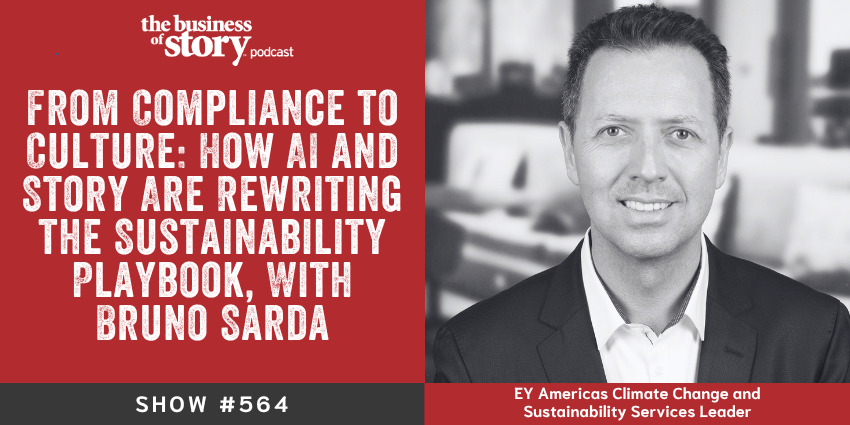
Bruno Sarda is the Head of Sustainability Services in the Americas for Ernst & Young, former sustainability leader at one of the world’s largest technology companies, former faculty member at Arizona State University, and host of the Sustainability Matters podcast.
 He holds a Master of Applied Ethics in Science and Technology — a credential that sounds almost prescient in the age of AI. And he brings something rarer than credentials: a practitioner’s instinct for translating sustainability from a compliance exercise into a competitive advantage.
His definition of sustainability for business is the one I’ve been using for years: sustainability done right will help you grow revenue, reduce risk, and amplify your brand. Full stop.
That’s not idealism. That’s strategy.
What’s in it for You
- Why the rollback of sustainability regulations has unexpectedly strengthened — not weakened — the business case for corporate ESG
- How AI is both a force multiplier for environmental progress and a potential accelerator of ecological harm — and why it’s an “and,” not an “or”
- Why the Chief Sustainability Officer is really a Chief Translation Officer, and what that means for how your organization communicates its ESG work
- The sustainability metric nobody talks about: employee engagement with your sustainability story
- How to move from compliance-driven sustainability to culture-driven sustainability — and why that shift is where the real competitive advantage lives
- Why we all have magic now, and what the Harry Potter analogy reveals about AI, purpose, and power
The Compliance Trap — and How to Escape It
For years, corporate sustainability was shaped by regulatory pressure. Companies built programs to satisfy disclosure requirements, respond to investor questionnaires, and stay ahead of enforcement. The compliance mindset took over.
And when you’re in a compliance mindset, Bruno told me, you’re mostly focused on one question: how do I satisfy this requirement at the least possible cost?
That’s not a story. That’s a checkbox.
Here’s the counterintuitive truth Bruno shared: the current US administration’s retreat from sustainability regulation has been, for many organizations, clarifying. When the regulatory mandate disappears, companies have to answer a harder question — why does this matter to us?
The organizations that can answer that question are the ones that embedded sustainability into their actual strategy, their actual culture, their actual purpose. And they’re not pulling back. They’re doubling down.
Compliance and culture are not the same thing. Compliance is what you do when someone’s watching. Culture is what you do when no one is.
AI: Force Multiplier for Good or Accelerant of Harm?
Bruno’s framing of AI in sustainability is the most honest I’ve heard: it’s a force multiplier, which means it amplifies both the good and the bad.
On the good side, AI is transforming how organizations collect, aggregate, and analyze sustainability data — turning what used to be a labor-intensive, error-prone annual exercise into something approaching real-time intelligence. It’s enabling companies to model climate risk, track supply chain emissions, and identify operational inefficiencies at a scale that was impossible five years ago.
On the bad side, the same technology is helping industries that have had a difficult relationship with nature do what they do bigger and faster. And the AI ecosystem itself — data centers consuming enormous quantities of energy and water — carries a material environmental footprint that sustainability professionals can’t ignore.
Bruno’s verdict: it’s an and, not an or. Our job is to make sure that when we look back, AI helped more than it hurt.
That’s where Park’s reframe of “Artful Intelligence” comes in. The difference between artificial intelligence and artful intelligence isn’t the technology — it’s the human bringing their expertise, judgment, and lived experience to the collaboration. AI augments. Humans direct. The story is still yours to tell.
We All Have Magic Now
Bruno’s Harry Potter analogy stopped me cold. In the wizarding world, everyone is born with magic. But magic alone doesn’t make you powerful. What you do with it — how you practice, how you craft your spells, how you use it in service of something larger than yourself — that’s what defines your place in the community.
AI is the same. We all have access to it now. The question isn’t whether to use it. The question is whether you’re bringing enough of yourself to the collaboration to make it artful rather than artificial.
Story on, my friend.
Links
- Bruno Sarda on LinkedIn
- Sustainability Matters Podcast
- The Big Pivot by Andrew Winston
- EY Climate and Sustainability Services
- Craft your vibrant brand story with the StoryCycle Genie™
- What users are saying about the StoryCycle Genie™
Deepen Your Sustainability and Storytelling Mastery: Three Essential Episodes
To amplify your transformation from today’s conversation, these carefully selected past episodes provide complementary wisdom:
The Machines Can Code. They Can Calculate. But They Cannot Connect., with Joe Lazauskas — Explores why brand storytelling is the one skill AI can never replace, directly complementing Bruno’s argument that sustainability stories must come from the organizational heart, not the algorithm.
What Happens When a Brand Decides to Make Its Own Business Model Obsolete?, with Shawn David Nelson — Lovesac’s forever philosophy and onshoring story is a masterclass in using sustainability as a genuine competitive advantage — exactly the business case Bruno argues for.
How to Effectively Position Your B2B Brand, with April Dunford — Dives deep into brand positioning strategy, amplifying Bruno’s point that sustainability becomes powerful when it’s the how of your business story, not the what.
Bruno Sarda’s Conversation With Park Howell on the Business of Story Podcast
From E-Business to ESG: How Bruno Sarda’s Digital Transformation Career Shaped His Path to Sustainability Leadership
Park: Hey Bruno, welcome back to the Business of Story.
Bruno: Hey, hey, Park, good to see you.
Park: Yeah, you and I go way back in the sustainability world when you were working in sustainable supply chains for a high-tech company. And then you were kind enough to invite me into your world at Arizona State University. We shared some teaching and professorial work together in sustainability there for five years — one of the greatest experiences of my life.
And then you’ve gone on to a number of different things. You are here today heading up sustainability services in the Americas for Ernst and Young. We’re going to explore what you’re seeing in AI and sustainable storytelling, where people are giving you the pushback, and where you see it going.
So with all that, Bruno, welcome again. Why don’t you give our listeners a little background on you and how you find yourself where you are today.
Bruno: Sure, well again, thanks for having me, Park. It’s been great to watch all the stories you tell through this remarkable podcast. Congrats on such an amazing platform.
My story is one I tell often. Many of my students want to know how I got to where I was. It’s easier to draw that narrative looking backwards — it’s not like I designed it that way.
I’ve had two main chapters to my career. I spent the first half in what we now call digital transformation. Back then, we called it e-business. About a decade in financial services, then about a decade in tech. I pivoted into sustainability about halfway through.
Really from the mid-90s, I was trying to help organizations absorb the massively disruptive force that was the internet. Today we take the internet for granted. But back then, when it started rolling out of university labs into corporate processes and customer experiences, it was massively disruptive. Very threatening to many organizations — how it would change customer relationships, cost structures, competitive advantage.
The old “location, location, location” was threatened by the fact that you could create virtual experiences, virtual call centers, virtual everything.
What I learned through those first 15 or so years was this idea of how do you take disruptive, transformative innovations like the internet — and later wireless technologies — and turn them to your advantage.
Sustainability Is the New Internet: Why Bruno Sarda Sees ESG as the Defining Disruptive Force of Our Era
My pivot into sustainability was partly based on that. Sustainability is kind of like the internet — a disruptive force for change that’s plowing its way through society.
Just like the internet didn’t leave anything unchanged — how we communicate, how we shop, how we meet each other (I’ve read over 90% of people now meet through dating apps) — sustainability is similar. It doesn’t have its own set of goals, but it’s about helping society transform in ways that create more sustainable, more durable, more equitable pathways to achieve the things we already want: prosperity, economic success, security.
The Business Case for Sustainability: Grow Revenue, Reduce Risk, and Amplify Your Brand
Park: When we started working together in sustainability, you had the best definition of it. And I actually used it on my show last week. I would see business people flinch at the term sustainability — they always felt like it was a cost. “My God, what are you going to make me do without?” Until I met you. You said, “Park, all sustainability is — use it to grow your business, reduce risk, and amplify your brand.” One of the best descriptions I’ve ever heard.
Bruno: Well, early in my sustainability days, somebody told me that the role of the chief sustainability officer is really to be a chief translation officer. Because some people care a lot about sustainability for what it is, but most don’t — not because they don’t care, it’s just because it lacks context and meaning for them.
Why the Chief Sustainability Officer Is Really the Chief Translation Officer for Your Business
Somebody once joked with me: sustainability isn’t necessarily a great aspiration on its own. If you say, “How are your kids doing?” and someone says, “They’re sustainable” — what does that mean?
In business, why sustainability matters comes down to this: it helps businesses achieve what businesses want to achieve — grow the top line, reduce risk and protect the bottom line, and enhance your brand as a product, as an employer, as a competitor, as a market participant.
Once you frame it in the context of something the organization is already trying to achieve, it makes it a lot easier. Sustainability becomes the how, not the what.
Park: Let’s talk about your evolution a little more. You got your master’s in — remind me of that program.
Bruno: Master of Applied Ethics in Science and Technology.
Park: Which is a natural evolution, whether it was prescient or not at the time, into AI. But before that, you’ve really evolved into your own storytelling position. You’ve got this great podcast, Sustainability Matters. When did you feel like your own innate storyteller started coming out?
What Hosting the Sustainability Matters Podcast Taught Bruno Sarda About Human Emotion and the Power of Story
Bruno: Well, I didn’t create that podcast. A former colleague of mine at EY had started it. When she left the firm, she wanted to make sure it’d be in good hands. I was fortunate to have the opportunity to take it over.
And you’ll know even better than I do, Park — there is so much human emotion at the heart of the work we do in sustainability.
The opportunity to get sustainability practitioners, leaders, and experts to really bring their story to life. Not just what they’re doing — what you could read in a report — but how did that go? What did it take? Who came along with your journey? Who were your champions, your heroes? What barriers did you face?
We find in the sustainability practitioner community that there is so much generosity in sharing what worked. A lot of pre-competitive collaboration — companies that wouldn’t collaborate on anything else collaborate on sustainability.
Stories and discussions like what you can do on a podcast get off the page a little bit. They ask the “how” questions and get more of that human emotion and tension that often exists in the system — trying to solve for multiple things that aren’t always aligned. Unpacking the “how did you get stuff done” is such a powerful reinforcement of the ingenuity, perseverance, creativity, and grit that so many people in sustainability have.
Park: From one host to another, Bruno — what was one of your own big ah-has that you learned about human interaction and storytelling?
How One Cement Company Is Innovating Its Way Through a 7% Share of Global Carbon Emissions
Bruno: I mean, we love all our children and all the episodes had their own magic. But one stands out for me — partly because I feel like I learned so much and it triggered some unlocks in my own brain.
It was with the chief sustainability officer of the world’s largest cement manufacturer.
You’d think it’s pretty hard to get excited about cement. But the carbon emissions associated with cement production are about twice that of air travel globally. Air travel is about 3 to 3.5% of global emissions. Cement manufacturing is about 7%.
Park: Wow. I wonder if the Romans knew that way back when.
Bruno: And this company, having about 15% of that market, meant that about 1% of global emissions were tied to that particular company. We talk a lot about big tech companies and big data centers — that would probably be a hundredth of what we’re talking about here.
What was fascinating to me was the responsibility and accountability that organization felt for that. They understood both the critical importance of what they do to the global economy — if cement manufacturing stops, a lot of things stop — and yet the incredible ingenuity, innovation, and collaboration that went into achieving very significant results in dramatically reducing the carbon intensity of cement.
You think of innovation and you think of pharma or tech or new textiles. Some of these more centuries-old industrial, very blue-collar kinds of things aren’t always given credit for how ingenious and creative the problem-solving is that goes into running those businesses.
Can AI Reverse Nature Loss — or Accelerate It? The Dual Nature of Artificial Intelligence as a Sustainability Force Multiplier
Park: You did a recent show — “Can AI help reverse nature loss or does it risk accelerating it?” What do you think about that with the advent of AI? Is it going to help or hurt?
Bruno: The internet was a massively disruptive force for change. We look back at it today and very few people say, “Oh, we should have never done this.” And yet at the time, we were having a lot of the same conversations — that the internet was going to unravel the fabric of society.
A lot of things we wish were different in society today could be tied back to the ubiquitous nature of online platforms. I think the honest answer is they’ve done both. It’s like any force multiplier — it’s going to amplify the good and amplify the bad. And I think AI is yet another very powerful and very disruptive example of that.
When we asked that question somewhat provocatively about nature, the point was to make that tension visible. It’s not one or the other. AI absolutely has the potential to dramatically unlock innovation at scale — how we monitor nature loss, how we prevent it, how we track keystone species. Things that are very hard to do without the kind of computing power and sensing capability we now have.
As a force multiplier, it can also lead to accelerated nature and biodiversity loss — helping industries that have had a tense relationship with nature do what they do bigger and faster. Or of course the environmental footprint of the current AI ecosystems themselves — energy, water, land.
I think it’s an and, not an or. Our job is to make sure that in the end we look back and say it helped more than it didn’t.
What EY’s Climate and Sustainability Services Team Actually Does: Five Core Areas Driving Business Transformation
Park: So let’s level set — what is the job that you all are doing there at EY with climate change and sustainability services?
Bruno: We’re very fortunate to be inside a very large, very ubiquitous organization that has a tremendous brand and reach in financial accounting, auditing, tax, strategy, transactions, and all kinds of advisory and consulting services.
We work with the world’s largest organizations. Some we audit, many we advise. Our job in the climate and sustainability team covers five key areas:
Broad sustainability advisory — strategy, goal setting, business case development, ROI strategies.
Climate advisory — decarbonization strategy, greenhouse gas accounting, climate risk assessment and modeling, climate transition plans.
Nature advisory — the same approach applied to nature and biodiversity.
Reporting and regulatory readiness — working closely with financial accounting colleagues and the finance teams of our clients.
Environmental health and safety — environmental compliance, environmental remediation, health and safety systems and controls.
Something that shocked me a couple of years ago: in 2024, the US had more workplace fatalities than in the previous 40-plus years. We assume that things like fatal accidents on the job were things we heard about in the early days of the industrial revolution. The fact is, many industries today still have very sensitive, dangerous operations.
And then AI becomes an enabler for all of that — whether in data collection and reporting, analysis of large complex data sets, or physical AI like robotics and sensors to enhance operations and limit human exposure to dangerous processes.
Artificial, Artful, or Augmented? Why Reframing Intelligence Transforms How We Use AI for Sustainability
Park: I come from the brand storytelling world. And it occurred to me that “artificial intelligence” is about the worst brand name you could ever come up with for one of the greatest technology advancements of our lifetime. It produces slop, it hallucinates, it gives you generalized stuff that sounds like everybody else. It truly is artificial intelligence.
I’d like to reframe it as “artful intelligence.” When a human thoughtfully brings their expertise, their business acumen, their consumer insights, their marketing trending to AI and collaborates with it — rather than just leaning all in on it — it truly can turn from artificial intelligence to artful intelligence.
Bruno: I love that. You should brand that somewhere if you haven’t already.
I agree. Some of the most exciting things about AI are less about the intelligence part and more about what’s done with it. Agentic AI — this idea that you can train these things to act, not just to think — has tremendous potential.
One framing I like is “augmented intelligence.” Because for me, that’s a better description. AI systems fundamentally learn from humanity’s knowledge, from humanity’s toil and labor and pride and content and art. And then try to pay back by augmenting what we already know how to do — helping us do it faster, cheaper, bigger, better.
The “artificial” nature of it doesn’t really speak to what it does or even what it really is.
The Hidden Environmental Cost of AI: Why Clients Push Back on Artificial Intelligence in Sustainability Strategy
Park: Are you seeing customers or colleagues still reluctant to embrace AI around sustainability? And how do you help lead them over some of those emotional hurdles?
Bruno: There’s lots of discussions we have with clients and colleagues. We at EY have started embracing it really fully — we think it truly is a great augmentation of our skills and capabilities.
A lot of the questions around AI as it gets close to sustainability relate to a few domains.
One that comes up a lot is the environmental footprint. It’s like, “Yeah, it’s great, but is it worth it based on the energy intensity?” The energy intensity comes from very large data centers that consume a lot of power and run very hot — so you need a lot of water to cool them.
Data centers have a decent amount of flexibility as to where they get sited. Many try to get sited where they can access relatively low-carbon energy. If you can create abundant amounts of clean and affordable energy, the energy footprint becomes less of a problem.
The water intensity can be a little more problematic. But there are lots of innovations already — air cooling, siting where water is abundant. Data centers don’t drink the water. They use it to flow through pipes to absorb heat and put it back a little bit warmer than they found it.
AI, Workforce Displacement, and the Elevator Operator Problem: What History Tells Us About the Future of Work
Then there’s the broader social impact of AI — what is it going to do to society? Questions about leveraging AI to accelerate the spread of false or misleading information, deep fake videos that are so hard to tell apart from reality. That can create mistrust in any information.
And of course the questions about whether AI could displace workers. The honest answer is it will and it has — just like every other tech innovation.
The internet displaced entire professions. There were as many travel agents as there are now coffee shops on street corners, because that’s how you booked your travel. One speaker I heard said every elevator used to have a job in it — an elevator operator — until somebody figured out you can just put buttons in there and the elevator will know where to stop.
We grew up seeing that every taxi had a job in it. There’s probably a future where taxis don’t have a job in them, because autonomous vehicles are already pretty good at getting around without somebody behind the wheel.
We’ve seen with every significant tech innovation that it creates entire new industries and ecosystems and displaces others.
It’s very early in the days of AI where it still feels like we look at AI the thing — just like back in my career we looked at the internet the thing. But when you look at what the internet enabled in our economy, some of the largest companies in the world now could not exist without that underlying technology. They created entire platforms, ecosystems, and value-added services on top of a technology they didn’t build.
I think it’s going to be the same for AI. It’s going to usher in a new era of creation and innovation. And it’s going to have, for sure, a disruptive effect.
I work personally pretty closely with the film and TV and music industries. They were relatively reluctant to embrace the digitization of their intellectual property. And so the largest media and streaming companies today aren’t necessarily the incumbents of 20 or 30 years ago — they’re entirely new brands that embraced that technology to create new kinds of experiences.
We’re going to see more of that. We’re going to see those who focus on protecting their moat, and others who will innovate around that and one day potentially be bigger than the behemoth competitors they’re going up against.
Why US Regulatory Rollbacks Have Unexpectedly Strengthened — Not Weakened — the Business Case for Corporate Sustainability
Park: You’ve become one of the most recognized sustainability voices and storytellers in the world. And you know that old saw — a story is only as good as your villain is bad. Right now you and the clients you’re consulting with are dealing with an administration that’s kind of throwing sustainability out the window. Does that make your job more daunting or more exciting?
Bruno: I have to say it’s made it more exciting. Because I think it’s given us a real opportunity to go back to what matters most.
Sustainability, which has been around in some form for at least two decades, was never about complying with policy or trying to follow the guide of policymakers and regulators. Policy has an important role to play in setting the right guardrails for society. But sustainability in business has always been led by business.
That’s one of the reasons I’ve really enjoyed being in this space — both as a practitioner in the corporation and having the opportunity to do what I do at EY every day. I think business is ultimately where sustainability is most needed and most possible. Business has a force for change as a nimble, agile force for change — much more so than government.
For a while there was a lot of research responding to policy and regulation in a way that frankly fostered more of a compliance mindset. And when you’re in a compliance mindset, you’re mostly focused on: how do I comply with this at the least possible cost?
But when you’re not forced into compliance, then you’re like: okay, why does this matter? Where does this show up in our business, in our evolution? How does this connect to our purpose or our values? How does this connect to what our customers and clients want most from us? And where does this allow us to better compete in the market?
Compliance vs. Culture: How Deregulation Is Transforming Sustainability from a Legal Mandate into a Strategic Imperative
Park: That’s really interesting. I’d never thought about it that way — where in the past with a lot of regulations and pressure to comply, it becomes a compliance tactic. When those are taken off and government forces don’t really care what you do, it becomes cultural. And one would argue even a stronger reason for why you should be doing this.
Bruno: Yeah, exactly.
So that’s frankly where we’ve been now for the last couple of years — this renewal, this refining of the business case and the ROI case for sustainability that really doesn’t have anything to do with what the government wants us to do. It’s: what is right for our own story, our own purpose, our own journey?
It’s been exhilarating to reconnect to the why. Policy and government never really led this in many ways — in the last few years they’ve been trying to play catch-up to the vanguard of the business community. There’s always a role for policy and regulation to bring up the rear, but not to lead from the front.
AI in ESG Reporting: Where Artificial Intelligence Accelerates Sustainability Data — and Where Human Judgment Still Matters Most
Park: Have you seen a lot of AI coming into telling the stories — for instance, with ESG reports and stakeholder communications? Are more companies relying on AI to produce those? And is that good or bad, taking some of the human out of it?
Bruno: For the most part, so far, that is not what we’ve seen. The level of adoption for AI is more deep into the guts of the work — it has tremendous capacity to collect, organize, aggregate, and ultimately analyze complex data sets.
Sustainability is all-encompassing. Whether it’s people-related data, supplier-related, operations-related, procurement-related, product-related — it’s a complex, taxing, labor-intensive work of love to collect, standardize, consolidate, and aggregate all this information so that you can arrive at relatively comparable data within an organization and across organizations.
AI will help make that simplified and streamlined — just like big ERP systems like HR management systems, financial accounting systems, CRM systems have brought a whole new way to simplify and better organize data over the last couple of decades.
But at the end of the day, when an organization chooses to tell its sustainability story, it has to come from the organizational heart. What is their center? What is their purpose? What is their mission? What are their values? How did they choose to tell their story? How did they curate it?
Often a sustainability report doesn’t get the credit that a museum exhibit gets for how well curated it was. And I think it’s going to be a while before AI systems know how to do that as well.
Having gone through that process many times myself — there is power in that process. All of the conversations you get to have with colleagues in different parts of an organization to get them to tell what this data means to them, what these results mean, what these successes and trials and tribulations mean.
Sure, the data is interesting. But when you get to tell the story of here’s what we tried, here’s what worked, here’s how we got there, here’s who was involved — a lot of what would fall to the cutting floor by the time you put your report together — to your point about culture, these are truly culture-building processes that reinforce the fabric of how organizations want to exist in the world.
Park: One of the best reports I’ve ever seen was one of the very first pioneering reports — Patagonia’s Footprint Chronicles. They chronicled everything they did right and wrong in their journey to sustainability to teach everybody else what to do and what not to do.
All right, Bruno, we’re coming to the end here. You’re a very thoughtful guy. How about a lightning round?
Bruno: Sure. Let’s go.
Park: Number one — biggest AI myth in sustainability right now.
Bruno: I think it’s the footprint. It’s not a myth because it’s real, but I think it clouds the real discussion. When people say, “AI — good or bad because of its environmental footprint?” — I think that will get resolved. There’s already plenty of things underway to deal with that.
Park: All right, so a lot of anti-stories going on out there about the data center footprints, AI footprints. And the only thing that beats an anti-story is a better story. Number two — the sustainability metric that matters most and nobody talks about.
Bruno: One that has always spoken to me a lot is the employee engagement part of sustainability. How well you connect your organization and its people to your sustainability program and storyline.
Park: I saw that real time with a very large pharmacy company in America. They were bemoaning the fact that their people didn’t know about a lot of the cool stuff they were doing. And yet when they went through their audiences, they put their own people down at number six out of eight potential audiences. I raised my hand and said, you might want to think about moving them to the top. Get them knowing what you’re doing because they become one of your most vocal advocates.
All right, next one — one episode of Sustainability Matters for the first-time listener. What would you recommend?
Bruno: There’s one I like a lot and I got a lot of feedback from first-time listeners. I can’t remember the exact title, but it’s something like “how to make sustainability everyone’s job.” It was with a couple of guests who had worked at a very large Scandinavian build-it-yourself furniture company — and they had created a really interesting approach to say: a few people in an organization will have sustainability in their title, maybe a few more will have it in their job description, but everybody needs to feel part of how do you make an organization sustainable?
Many of our listeners for the Sustainability Matters podcast aren’t necessarily sustainability professionals. So I really like that episode for how well it described the role that anyone can play in any organization to be part of their sustainability story.
Park: Awesome. One book every business leader should read on this topic.
Bruno: One of my favorite books that I still assign to my students — back from 2014 by my friend Andrew Winston — called The Big Pivot. It’s a great book. He’s written more since that are also worth reading. But The Big Pivot really helps, through the lens of corporate sustainability, understand the what, the why, and the how. It’s a very easy read, but it’s very powerful.
Park: We’ll have a link to that in our show notes. Finally, Bruno, finish this sentence for me: the future of sustainability is —
Bruno: Exciting.
Park: Beautiful. I can tell by the work you’re doing. Your show’s fantastic. I really appreciate you coming on today. I thought you were going to weave in the Harry Potter anecdote — you got to bring it here.
We All Have Magic Now: What the Harry Potter Analogy Reveals About AI, Purpose, and Power in the Age of Sustainability
Bruno: Okay, so — I’m a big fan. I read the books multiple times, both as a reader and as a dad. And one thing clicked for me early on when we were really trying to understand AI.
All of a sudden the realization hit me: we all have magic now.
Just like the wizard community in Harry Potter — they’re all born with magic, and still they have to learn how to harness it, how to craft their own spells, how to practice. And ultimately it’s what you do with your magic that defines both your power and your purpose and your place in your community.
For me, AI is the same. We now all have this superpower. We all have this thing we didn’t have before. We all have access to it. And we all have an opportunity to make use of it. I think we’re going to see exciting things done with it. I think we’re going to see frightening things done with it. But ultimately, I want to believe the punch line of that story will be a good one.
Park: I’ve said for 20 years — it wasn’t about AI, it was about storytelling. When you really learn story structures like the ABT and the five primal elements and the Story Cycle System, and put them to use in sustainability or anywhere you’re trying to increase your influence and persuasion, story in its own right is a magic.
But you have to understand the magic if you’re going to cast a spell. You have to know how to use these structures in the right place, at the right time, to win over your audience from their point of view.
And now, to your point with Harry Potter and AI, it’s just an amplification device. But don’t approach it as artificial intelligence. Approach it as augmented intelligence or artful intelligence — but it’s only artful and augmenting if you bring your own lived experiences to it. That’s where the magic is really going to explode and have an impact.
I think you’re right — there’s going to be good, there’s going to be bad. But I’m hoping that the bright archetype of AI will overshadow the shadow archetype of it, in story parlance.
Well, Bruno, thank you so much for being here. It’s always a pleasure. Can’t wait to see you and Jody again.
Bruno: Sounds great. Thanks again for having me and congrats again on such a successful podcast — and all the work you do beyond the podcast to bring stories to life and help so many organizations figure out how to tell their stories.
Park: Well, thank you. Now you’re making me blush.
Bruno: Right.
Park: Have a great one.
Bruno: Bye, Park.
STEP 3: FAQs
What Is Sustainable Business Storytelling and Why Does It Matter?
A: Sustainable business storytelling is the strategic practice of communicating a company’s environmental, social, and governance commitments through authentic, emotionally resonant narratives that connect stakeholder values to measurable business outcomes. Rather than reducing sustainability to data reports or regulatory disclosures, sustainable business storytelling translates complex initiatives into human stories that build trust, drive brand preference, and inspire action. It matters for three interlocking business reasons: it grows revenue by differentiating your brand among purpose-driven consumers and investors; it reduces risk by demonstrating proactive governance to regulators, partners, and capital markets; and it amplifies brand equity by aligning organizational identity with the values that define the next generation of customers and talent.
How Can AI Help Businesses Achieve Their Sustainability Goals?
A: Artificial intelligence can accelerate corporate sustainability efforts across five critical areas: data collection and aggregation, ESG reporting and disclosure, supply chain emissions tracking, predictive scenario modeling, and stakeholder communications. AI-powered tools can synthesize fragmented environmental data from thousands of sources, automate the generation of sustainability reports aligned with frameworks like GRI, SASB, and TCFD, and identify operational inefficiencies that human analysts might overlook at scale. However, AI’s role in sustainability is genuinely dual-natured: the same technology that helps companies reduce emissions also consumes significant energy and water through data center operations. Whether AI becomes a force for environmental progress or accelerates ecological harm depends entirely on how intentionally organizations deploy it.
What Does EY’s Climate and Sustainability Services Team Do?
A: EY’s Climate and Sustainability Services team helps organizations across the Americas navigate the full spectrum of ESG strategy, execution, and reporting. The team operates across five core service areas: sustainability strategy and transformation; climate risk and decarbonization; ESG reporting and assurance; nature and biodiversity services; and environmental health and safety. Led in the Americas by Bruno Sarda — a former sustainability executive at a major global technology company and former Arizona State University faculty member — EY’s team brings practitioner experience to client engagements. The integration of AI-powered tools into EY’s sustainability practice is enabling clients to move from annual reporting cycles to near-real-time sustainability intelligence.
What Is the Difference Between Artificial Intelligence and Augmented Intelligence in Sustainability?
A: Artificial intelligence, in its conventional framing, positions machine learning systems as autonomous decision-makers that replace human judgment. Augmented intelligence reframes the relationship: AI as a capability amplifier that enhances human expertise rather than substituting for it. In sustainability practice, the augmented intelligence model means AI handles data-intensive tasks — emissions calculations, supply chain mapping, disclosure drafting, regulatory monitoring — while human sustainability professionals provide the strategic judgment, stakeholder empathy, and ethical reasoning that machines cannot replicate. Park Howell introduced a third framing — “Artful Intelligence” — suggesting that the most valuable application of AI is in the craft of communicating sustainability stories with greater precision, creativity, and audience resonance.
How Do Sustainability Regulatory Rollbacks Affect Corporate ESG Programs?
A: Counterintuitively, the rollback of sustainability regulations has in many cases strengthened rather than weakened corporate ESG programs. When regulatory compliance is removed as the primary justification for sustainability investment, companies must rebuild the business case on fundamentals: operational efficiency, long-term risk management, talent retention, investor relations, and competitive differentiation. This shift from compliance-driven to culture-driven sustainability is significant. Organizations that embedded ESG into corporate strategy because they genuinely believed in its business value continue advancing their programs. Importantly, international regulatory pressure has not eased — the EU’s Corporate Sustainability Reporting Directive and global capital markets continue to demand robust ESG disclosure, meaning US-headquartered multinationals cannot fully disengage without material competitive and financial consequences.
What Is the Environmental Footprint of AI and Data Centers?
A: The artificial intelligence industry’s environmental footprint is substantial and growing. Training large language models and running inference at scale requires enormous computational power concentrated in data centers that consume significant quantities of electricity and water. Global data center electricity consumption is projected to double or triple by 2030, driven substantially by AI workload growth. Water consumption is an equally significant and often underreported concern. For sustainability professionals, this creates a genuine tension: AI tools that help companies measure, reduce, and communicate their environmental impact are themselves generating environmental impact. Responsible AI deployment in sustainability therefore requires organizations to account for AI’s footprint within their own Scope 2 and Scope 3 emissions reporting.
How Do Companies Tell Their Sustainability Story Authentically?
A: Authentic sustainability storytelling begins with the recognition that your audience can distinguish between performative ESG communications and genuine organizational commitment. The companies that tell sustainability stories most effectively share three characteristics: they lead with specific, measurable outcomes rather than aspirational language; they embrace honest tension between current performance and long-term targets; and they center human experience rather than corporate achievement. For brands working with the Business of Story framework, the And-But-Therefore (ABT) storytelling structure provides a powerful template: your audience wants a sustainable future (and), but existing systems make that difficult (but), therefore your organization is taking these specific, accountable actions (therefore). Authenticity is not the absence of imperfection — it is the honest acknowledgment of it.
What Is the Sustainability Matters Podcast?
A: Sustainability Matters is a podcast hosted by Bruno Sarda, Head of Sustainability Services in the Americas for Ernst & Young and former sustainability executive at a major global technology company. The show explores the intersection of business strategy, environmental responsibility, and human innovation — featuring conversations with sustainability leaders, entrepreneurs, scientists, and policymakers. Unlike many ESG-focused podcasts that prioritize policy analysis or investment strategy, Sustainability Matters distinguishes itself through its emphasis on human stories and emotional resonance — the belief that data alone rarely changes behavior and that real transformation begins with narrative. Notable episodes have examined how traditional industries like cement manufacturing — responsible for approximately 7% of global carbon emissions — are innovating radically to reduce their environmental impact.
 Listen To More Episodes