What a Hit Song Has in Common With Every Great Business Pitch
The Expertise Trap: Why the Smartest People in the Room Often Lose It
You’ve spent years becoming an expert. You know your field in profound depth. And every time you walk into a room that matters — with investors, with executives, with a client who could change your trajectory — you lay out everything you know.
The meeting ends. Nothing happens.
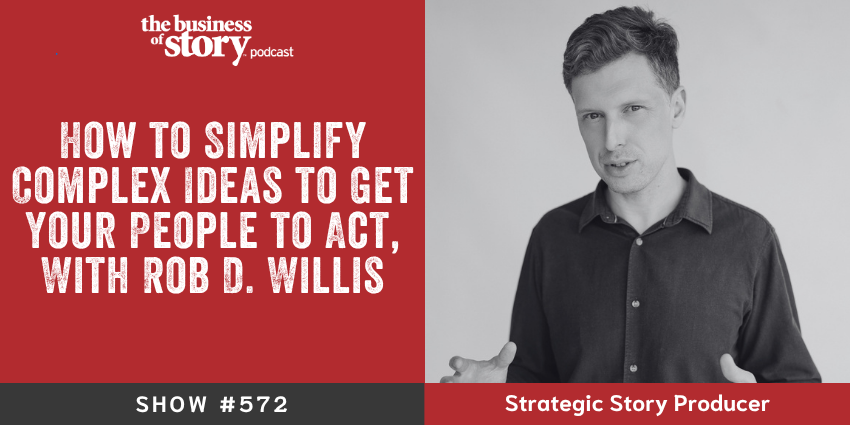
This is not a knowledge problem. You probably have more knowledge than anyone in the room. It’s a communication structure problem. And it’s one that Rob D. Willis — British music producer turned strategic story producer, now based in Berlin — has built his career solving.
Rob’s North Star: all communication that isn’t actionable is just noise. That framing comes from former US Navy SEAL and crisis consultant Mike Hayes. And it’s the lens through which Rob now helps tech founders, corporate innovators, and business leaders transform expert knowledge into the kind of clear, compelling narrative that actually drives decisions.
Rob D. Willis is a strategic story producer based in Schöneberg, Berlin, who applies the discipline of music production — turning a messy song demo into a radio-ready hit — to the challenge of business communication. He works with tech founders and leadership teams to build story-driven communication strategies that align organizations and move stakeholders to act. Follow him on Instagram and LinkedIn at Rob D. Willis.
What’s in it for You
- Why identifying your audience type before communicating is the foundation of everything else
- How to map your audience by interest and power to direct your narrative energy strategically
- The Downing Street grid: how Tony Blair’s government communication framework applies to your business
- The three types of complexity — intrinsic, extraneous, and germane — and how to manage each
- Why the one-four-five chord progression and the ABT framework are structurally identical
The Four Audience Types That Should Change How You Walk Into Every Room
Before Rob ever thinks about the story, he thinks about the audience. Specifically, he uses a framework from leadership communication expert Connor Neal that categorizes every audience into four types: friendly, adversarial, apathetic, and uneducated.
Friendly audiences are already on your side — move fast. Adversarial audiences resist your idea, but your goal isn’t persuasion in the moment. It’s planting a seed that makes them question their own preconceptions. David McRaney’s book How Minds Change is worth reading here: people rarely change their minds in a single encounter. They change them between encounters, often by examining where their original perspective actually came from.
Apathetic audiences don’t see why your message matters to them. Your job is to help them see themselves in the story. Uneducated audiences — and Rob is emphatic this doesn’t mean “stupid” — simply lack the framework to act on what you’re saying. Educate before you advocate.
In practice, Rob overlays these audience types with a simple stakeholder matrix: how much interest does this person have in your project, and how much power do they have to make something happen? Focus your narrative energy where those two axes intersect.
The Downing Street Grid: A Government Communication Strategy Worth Stealing
Alastair Campbell — Tony Blair’s communications director in the 1990s — developed a planning framework called the Downing Street grid. The premise is simple: map the year by weeks, with major announcements in one row, and supporting stories, events, and assets in rows beneath.
For a pharma company’s newly formed AI tools team, Rob applied exactly this approach. After running workshops to establish an origin story and launching internal story-sharing sessions to surface authentic experiences, the team built a grid to orchestrate everything — newsletters, short videos, executive briefings, platform workshops — so the right stakeholders received the right message at the right time.
The grid doesn’t guarantee results. But it creates the organizational alignment that gives your communication a real chance.
From Sand to Stones: What Happens When Structure Finally Arrives
Rob describes a bank board member he coached who was struggling with all-hands presentations. “It’s like I’m using sand rather than stones,” the executive said. He had all the information but no architecture to hang it on.
Once Rob walked him through a simple three-part structure — this is where we are, this is the tension and why it matters, this is where we’re heading — the executive stopped forgetting his notes. He stopped meandering. He stopped losing the room.
That’s the And, But, Therefore at work. And as Rob points out, that structure is older than any business framework. It’s the one-four-five chord progression: establish the key (And), create tension with the dominant chord (But), resolve it back to the tonic (Therefore). Paul Zak’s neuroscience confirms the mechanism: dopamine builds anticipation, cortisol creates tension, and oxytocin drives the social bond.
Story is not decoration. It is the architecture of attention.
Links
- www.robdwillis.com
- https://www.linkedin.com/in/robdwillis/
- Rob on Instagram
- Rob on Facebook
- Chief Story Officer Podcast
- StoryCycle Genie®
Deepen Your Storytelling Mastery: Three Related Episodes
The Machines Can Code. They Can Calculate. But They Cannot Connect., with Joe Lazauskas — Joe’s research on why human storytelling becomes the defining business skill in the AI era is the perfect philosophical companion to Rob’s practical frameworks. businessofstory.com/podcast/brand-storytelling-super-skill-ai/
How to Effectively Position Your B2B Brand, with April Dunford — April’s positioning framework is built on the same insight Rob uses: you cannot tell a compelling story until you are crystal clear on who you are telling it to and why they should care right now. businessofstory.com/podcast/b2b-brand-positioning-storytelling/
The Companies Winning the War for Talent Aren’t Telling Better Stories — They’re Telling Truer Ones, with Bryan Adams — Bryan’s work on building authentic story-sharing cultures inside organizations connects directly to Rob’s pharma case study and his story-sharing flywheel approach. businessofstory.com/podcast/brand-storytelling-talent-recruitment/
Rob D. Willis’s Conversation With Park Howell on The Business of Story Podcast
From Music Producer to Strategic Story Producer
Park: Hello, Rob, welcome to the show. You’re coming to us from Berlin, as I understand.
Rob: Hi, Park. Thank you for having me.
Park: Did you grow up out there?
Rob: I didn’t actually. I’m British, but I’ve lived here for about 17 years — most of my adult life. I came here to study at university on an exchange program and just kind of got stuck. Now it’s kind of inconvenient to go back.
Park: Well, there are worse places to get stuck. I was in Berlin about a year and a half ago for the very first time and absolutely loved it.
Rob: Yeah, it’s great in the summer. Don’t come in the winter.
Park: I was there in October — the colors were changing, still warm out, cool at night. Now you come out of the music industry and are working specifically in storytelling for tech leaders and founders. Tell us a little bit about your backstory.
Rob: I worked as a producer and songwriter, and production was my passion. That’s actually why I call myself a strategic story producer — I see what I do now as very analogous to what I did back then. Songwriters and artists would come to me with this long, jumbled-up thing of a song with no hook. Too much information in the beginning. And I would have to help them turn it into something they could communicate with their audience.
I’ve retained the title of producer because what I do is essentially the same: finding order in the mess that people present to you, and being able to present things in a way that’s simpler and more engaging.
All Communication That Isn’t Actionable Is Just Noise
Park: Tell us a little bit about your approach as someone helping founders and tech leaders tell their story.
Rob: The center and core of effective communication is this: what is the action or outcome we’re trying to elicit? There’s a wonderful quote by a former US Navy SEAL named Mike Hayes, who’s a crisis consultant. He said that all communication that isn’t actionable is just noise.
That’s always stuck with me. The problem isn’t that we don’t have enough information — particularly in the tech world, there’s too much. How do we turn data into something actionable that drives your project forward?
I work with people to figure out how to approach that — understanding their own goals clearly, then tying those goals to who they’re actually talking to.
The Four Audience Types Every Business Communicator Must Understand
Rob: I like to break audiences down into four types. This isn’t my own framework — it’s the work of Connor Neal, a wonderful leadership communication expert.
The four types are friendly, adversarial, apathetic, and uneducated.
Friendly means they like you and your ideas — you can go a long way. Adversarial means they don’t like your idea, so you won’t achieve immediate conversion, but you might get them to question their preconceptions. Apathetic means they don’t see why it matters to them — for them, you need to help them see themselves in the problem. And uneducated doesn’t mean they’re stupid. It means they don’t understand what you’re talking about, so they require education before they can act on anything you say.
Park: I totally apply that to your music world. The artists could show up with great music, but maybe they’re thinking it’s country and western and you’re like, no, this is actually much more pop. You have to get that understood first.
Rob: And that was something I really struggled with in my early 20s. I wanted to make cool music — I had a particular sound I wanted to get across. But the times I was disciplined enough to focus on the audience and not think about myself, that’s when I actually had success with what I created.
How to Map Your Audience by Interest and Power
Rob: There are a few ways you can do audience mapping, but one of the simplest is to use two axes: interest and power. How much interest do they have in you and your project? And how much power do they have to actually make something happen?
We ideally want to focus our communication energy on people who both care and have the power to make things happen. Spending that energy on people who don’t care and have no authority is a waste.
Park: And I see that a lot with AI. What we’re doing with the StoryCycle Genie is saying: don’t think of it as artificial intelligence. Think of it as artful intelligence — or as guest Bruno Sarda put it, augmented intelligence. Arguments you can use to overcome an adversarial audience.
The Book That Explains Why Facts Alone Never Change Minds
Rob: You’re making me think of a wonderful book by David McRaney called How Minds Change. It basically disproves the information deficit model — the idea that people just don’t know things, and if you gave them the facts, they’d see the world as you do. That’s been disproven.
When you’re trying to change someone’s mind, you can’t really do it in the moment if they’re naturally resistant. What you need to do is engineer a situation where they convince themselves between interactions. You do this by getting them to look at their own preconceptions and understand where those came from.
Once you begin to unpick that — usually through listening — you have the opportunity to begin changing someone’s mind.
The Downing Street Grid: A Government Communication Strategy Your Business Can Steal
Rob: One thing I love to do with my clients is map out a communication strategy. I use a framework originally designed for the UK government called the Downing Street grid — named after 10 Downing Street, where the British prime minister lives.
It was created by Alastair Campbell, Tony Blair’s communications director, in the 1990s. They mapped out the months of the year into weeks. Each week had a row for major events or announcements, and beneath that, rows for supporting stories and smaller events — so everything was aligned.
As Campbell said, you can’t guarantee the press will talk about what you want. But what this does is get lots of people aligned on what they’re going to say at the right time.
Inside the Pharma AI Team: A Story-Sharing Case Study
Park: Give us an example of your approach with a real client.
Rob: Right now I’m involved with a digital tools team at a large pharmaceutical company that’s just been created. They’re bringing this corporate behemoth into the AI generation — giving developers and tech teams the tools they need to use this new technology. The challenge is the company is massive. Getting anyone to do anything takes time.
You have leadership who decide whether you get resources. Technical teams who might think, “I don’t want to change — I’ve got my way of doing things.” Product teams throughout the organization who might not even hear about what you’re doing.
What we had to do was hold workshops to understand the tools and create an origin story. Then we started running story-sharing sessions with simple prompts — “When was a moment this week that you saw an internal stakeholder achieve something with one of our tools?” People tell that story, others react, and a conversation forms.
How AI Powers the Story-Sharing Flywheel
Rob: You can capture all those transcripts, and with AI you can extract stories and infuse them into assets — PowerPoint decks, short animated videos, platform demos. Then you have something like the Downing Street grid to orchestrate everything into a clear release schedule.
The right people get updates at the right time. You’re running workshops with particular groups. A newsletter goes out that tells a particular audience a particular thing. Everything flows.
Was it clean? It was a bit messy at times. We’re still working on it. But it’s been exciting.
How to Get Technical Experts Out of Their Own Heads
Park: How do you pry technologists out of their logic-and-reason brain? I was just in Seattle with a brilliant technologist who spent 40 minutes explaining the science behind his transistor technology. And my axiom is: your story is not about what you make, but what that technology makes happen.
Rob: I had a conversation exactly like that about two hours ago.
What I wanted to do was begin to unpick the moments that led him to create what he did. I wanted to understand his frustrations with the old way of working. He had a government job and went at a snail’s pace. He was frustrated with not being able to get things done.
Once we talked about the emotions, I asked: “How is your tool changing that? What impact is it actually creating?”
Once you walk people through — this is how things used to be, this is the frustration, this is how it solves that, and this is what success looks like — suddenly they’re like, “Yeah, that’s it.” There’s this weight lifted from them. Clarity arrives that wasn’t there before.
Park: That’s where the and, but, therefore came in when I was having coffee with this gentleman. After 40 minutes, I just reflected it back: “So let me know if I’ve got this right. This is the current state — fairly successful, but there’s a lot it cannot do because this component is far too large. Therefore, you’ve redesigned how this chip is made and it has applications across numerous industries. Do I have that right?”
He goes: “Yeah, that’s pretty much it.”
The Three Types of Complexity Every Communicator Must Know
Rob: There are three types of complexity. Intrinsic, extraneous, and germane.
Intrinsic complexity is built into the subject. Explaining a large language model is more complex than explaining how to use a toaster — that’s just true.
Extraneous complexity is how you describe something to people. The best speakers in the world speak at a relatively low readability score — not because their ideas are simple, but because they use simple words and don’t overload their audience at any one moment.
Germane complexity is how you sow the seeds of understanding. You give someone a framework within which to understand something, and then it grows out of their mind. They have a map to orient themselves, and the idea makes sense.
Why Story Structure and Music Theory Are the Same Thing
Park: I find it so interesting how our brains are wired to take in this kind of communication. In music you’ve got the one-four-five progression — a tripartite structure. You introduce, develop, and resolve. That’s the and, but, therefore. That’s the three-act story structure.
Rob: Yes. And our conscious brain — the prefrontal cortex — can hold about three to five connections at any one time before they start overwriting each other and we lose the thread. A story gives you enough of those connections to feel substantial and to give direction, but not so many that it gets lost.
Park: Joseph Campbell has the hero’s journey, but most effective stories are three parts. Maybe four. Certainly no more than five.
The Neurochemistry of Story: Dopamine, Cortisol, and Oxytocin
Rob: You’re making me think of research by Paul Zak, the neuroscientist who studied the edge of story — you’ve had him on the show. The idea of dopamine, cortisol, and oxytocin maps onto the elements of story.
Dopamine is the anticipation. Cortisol is the tension that needs to be resolved. Oxytocin is the social bonding — identifying with a character. A story needs all three or it doesn’t work.
Maybe music is the same. We need the tension of the dominant chord resolved by the tonic.
Park: Yeah. It just seems to be the way our brains are hardwired to make sense out of the madness of being human beings.
Rob: It is a madness, I’ll tell you that much.
What the StoryCycle Genie Revealed About His Brand
Park: You were exposed to our StoryCycle Genie. What was your take?
Rob: It’s pretty astonishing what it can do. I’m creating a new website right now and it found me at exactly the right moment. Being able to look through an entire website — all those different pages — and distill it down to a single simple ABT structure is immensely powerful. Generally when we’re making a website, we’re focused on individual pages, not thinking about how they fit together. That’s really hard to keep in your head. But the machine can do that. And that’s where the value lives.
Park: The other thing it does is remove you as the brand from the center of your communication. It writes to the website visitor — what’s in it for them? What do they want? Why don’t they currently have it? Therefore, they’re on the right website to fix it.
Anyone listening: go to your homepage and see if you’re not just pounding your chest about yourself when you should really be writing about your audience.
Rob: It takes real talent and discipline to truly empathize and let go of your own ego. To think of your audience as the center of everything rather than yourself.
Park: It’s a survival thing. We place ourselves at the center of the story because our limbic brain is about survival — what do I need to do right now to survive? But whenever we’re selling or influencing, it’s about their survival. You’ve got to speak to their survival brain.
How to Find Rob D. Willis
Park: How can people learn more about you and the great work you do?
Rob: I’m most active on Instagram at @robdwillis. I post every single day. I break down ideas about strategic storytelling and I love analyzing speakers — politicians, business people, even film characters — talking about the structure of what they’re doing.
LinkedIn is also a great place. If you search Rob D. Willis, just add the D because there are a million Rob Willises in the world. It stands for Douglas. Robert Douglas Willis.
Park: Sounds like you should be the author of a famous book.
Rob: Well, that is the aim.
Park: Rob, thank you so much for being here. I appreciate it.
Rob: Thank you for having me. This has been great fun.
STEP 3: SEARCH-OPTIMIZED FAQs
What Are the Four Audience Types in Business Communication and How Should You Approach Each?
The four audience types — developed by leadership communication expert Connor Neal — are friendly, adversarial, apathetic, and uneducated. A friendly audience already likes you and your ideas, so you can move more quickly toward action. An adversarial audience resists your idea; your goal isn’t immediate conversion but planting seeds of doubt in their current preconceptions. An apathetic audience doesn’t see why your message matters to them — you need to help them see themselves in the problem. An uneducated audience simply lacks the knowledge framework to act; they need foundational information before your story can lead anywhere. Identifying which type you’re addressing before you communicate is one of the most powerful decisions any leader can make.
How Do You Map an Audience by Interest and Power for More Strategic Communication?
Strategic story producer Rob D. Willis recommends plotting your audience on two axes: how much interest they have in you and your project, and how much power they have to make something happen. The ideal focus for your communication energy sits at the intersection — people who both care and can act. Spending your time trying to reach people with no interest and no authority is a waste of narrative resources. Mapping stakeholders this way before any high-stakes communication — internal or external — gives you a clear strategic picture of where your story should go.
What Is the Downing Street Grid and How Can Businesses Use It for Communication Planning?
The Downing Street grid is a communication planning framework created by Alastair Campbell for Tony Blair’s UK government in the 1990s. It maps the year by weeks, with one row dedicated to major events, announcements, or policy changes — and additional rows for supporting stories, smaller events, and messaging assets designed to align with the major narrative. Businesses and organizational teams can adapt this grid to orchestrate internal and external communications, ensuring that different channels, teams, and stakeholders are telling aligned stories at the right time. It doesn’t guarantee media coverage or mind-changing, but it dramatically increases strategic coherence across a complex organization.
How Do You Help Technical Experts Simplify Complex Ideas for Non-Technical Audiences?
The key is to work backward from emotion before expertise. Strategic story producer Rob D. Willis starts by asking technical founders about the frustrations they experienced before they built their solution — the feeling of moving at a snail’s pace, the pain of the old way of working. Once you surface the emotional context, you can walk the founder through a simple three-part structure: this is how things used to be, this is the frustration I and others felt, and this is what my solution makes possible. When founders experience that structure, many describe it as a weight being lifted — suddenly there’s clarity where there was only complexity. The and, but, therefore is not a technique imposed on their work. It’s already inside their story, waiting to be found.
What Are the Three Types of Complexity in Business Communication and How Do You Manage Each?
The three types of complexity are intrinsic, extraneous, and germane. Intrinsic complexity is built into the subject itself — explaining a large language model is simply more complex than explaining how to make toast. Extraneous complexity is how you describe something; even the world’s most respected communicators use simple words, low readability scores, and minimal information density per statement. Germane complexity is about building understanding — giving your audience a framework or map so that even complex information organizes itself in their mind and they can make sense of it without being overwhelmed. Of the three, extraneous is the one communicators most directly control, and it’s often where the greatest damage is done — and the greatest gains are available.
How Does the ABT Framework Apply to Strategic Business Communication?
The And, But, Therefore structure gives technical communicators and organizational leaders a three-part narrative scaffold that mirrors how the brain wants to receive complex information. The “And” establishes the current state and context. The “But” introduces the problem, gap, or tension — why the current state is not good enough. The “Therefore” delivers the resolution and what it makes possible. Applied to investor pitches, executive briefings, or internal organizational stories, the ABT simplifies expertise into a narrative with clear stakes and direction. As Park Howell and Rob D. Willis discuss in this episode, the ABT is structurally equivalent to the one-four-five chord progression in music — one of the most universal and emotionally resonant structures in all of human communication.
 Listen To More Episodes