Because If No One Is Governing It, AI Is Fragmenting It Faster Than You Can Fix It
The Moment Your Brand Story Stops Being a Marketing Problem and Becomes an Operational Emergency
As a brand marketer, you know how important it is to communicate a clear, cohesive, and compelling story to stand out in the noisy world we all compete in.
But you may be frustrated watching AI fragment your story at machine speed, because no one in your organization is actually governing it.
Marketing is saying one thing. Sales is saying another. HR is in a completely different novel. And every AI tool your team is running without a shared narrative underneath it is amplifying that fragmentation in real time.
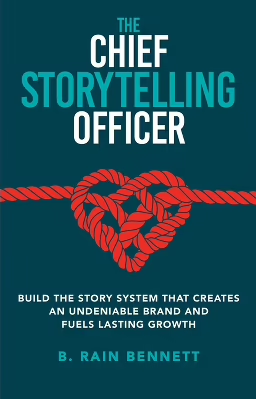
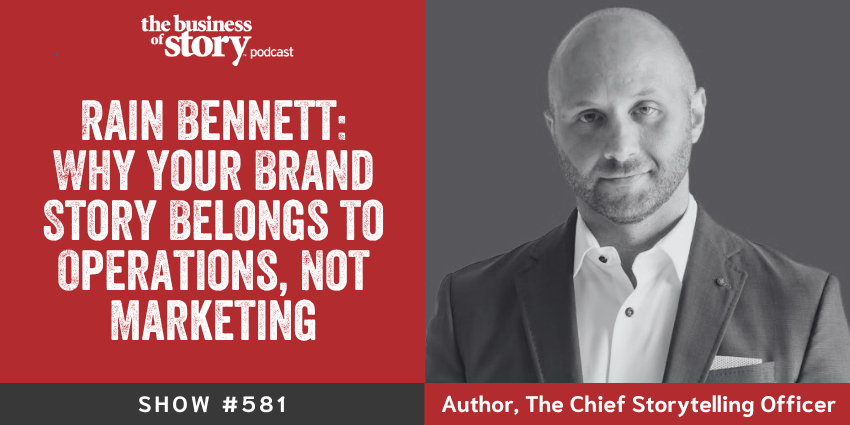
That’s the problem at the center of this conversation with Rain Bennett — award-winning documentary filmmaker, founder of Elamir, and author of The Chief Storytelling Officer. His new book makes the case — compellingly and correctly — that brand story isn’t a communications deliverable you hand to marketing after you’ve built the product. It’s the operating system you build your entire business on. And it belongs to every department in your organization.
Rain brings a perspective most brand strategists don’t have. Twenty years as a documentary filmmaker taught him how to find the powerful story inside any organization — even dense, technical, B2B companies — and make it clear and emotionally compelling for the exact people who need to understand it. That skill, he argues, is now the most urgently needed capability inside every enterprise navigating AI-accelerated narrative drift.
What Is a Chief Storytelling Officer — and Why Your Company Needs One Now
What’s in it for You:
- Why marketing, sales, and operations are telling three different brand stories right now — and the only way to stop it
- How Rain’s Narrative Operating System (NOS) governs story across Vision, Mission, Brand, Product, Marketing, Sales, and Feedback Loops
- Why the Chief Storytelling Officer is an engagement role, not a communications role — and what that distinction means for every function in your business
- How to extract the story your organization is already living before you try to tell the story you want to tell
- Why AI has turned narrative drift from a slow burn into an exponential emergency — and what the CSO does about it
- Why you must build your brand story alongside your product, not after it
Story Isn’t What You Say. It’s What You Do.
One of Rain’s most powerful points in this episode is that all stories are a collaboration. The story coming back to you from your customers, your employees, and your market is far more important than the story you are trying to tell.
He traces this insight directly to Nike’s Nelson Farris — arguably the world’s first Chief Storytelling Officer, named in the 1990s. When Nike was still Blue Ribbon Sports, Farris would bring prototype shoes to track meets and hand them to athletes. He wasn’t delivering a brand story. He was receiving one. That input loop, Rain argues, is the engine underneath every organization that has built a durable, coherent narrative over time.
This is what most companies get wrong. They treat story as outbound. One direction. We make it, we publish it, we move on. Rain calls that a governance failure — and AI has now turned it into a crisis.
When your team builds content, pitches, product features, and recruiting materials from five different interpretations of your brand story, AI scales all of that fragmentation simultaneously. The antidote isn’t better content. It’s a Narrative Operating System: a governing architecture, managed by a Chief Storytelling Officer, that threads a single coherent story through every department, every touchpoint, and every tool you deploy.
The CSO, as Rain defines the role, is not the head of any one department’s table. They have a seat at every department’s table. Their job is to translate the brand narrative into product decisions, sales language, recruiting conversations, and operations — and to make sure the stories coming back from those functions are feeding the narrative forward.
That distinction matters. The CMO owns data, analytics, and channel strategy. The CSO owns coherence. They are not the same role.
More From Rain Bennett and the Business of Story
- The Chief Storytelling Officer — signed copy for $10
- Elamir — human stories for the tech industry
- Rain Bennett on LinkedIn
- StoryCycle Genie® — build your Brand Brain and govern your narrative at scale
- Free Brand Story Grader — grade your narrative health in minutes
- How to Install StoryOps™
- Brand StoryOps™ For Agencies LinkedIn Newsletter
Related Episodes From the Business of Story
- State of Storytelling 2026 Proves Brand Narrative Is Finally a Business Discipline With Elliott Rayner — Research shows only 19% of employees can articulate their company’s core story — and the data that’s making the Chief Storytelling Officer the most valuable hire in business today.
- How to Unlock Brand Alignment to Accelerate Your Business Growth With Brandon Coleman Jr. — Why brand alignment across every department — not just marketing — is the multiplier most growth strategies completely ignore.
- What a Hit Song Has in Common With Every Great Business Pitch With Rob D. Willis — The music production discipline that turns complex, expert-driven content into clear, decision-driving narrative — and why it’s the same skill Rain Bennett brings from documentary filmmaking.
Rain Bennett’s Conversation With Park Howell on The Business of Story Podcast
Transcript: Rain Bennett — Why Your Brand Story Belongs to Operations, Not Marketing
How Documentary Filmmaking Shaped Rain Bennett’s Approach to Brand Storytelling Strategy
Park Howell: Hello, Rain. Welcome to the show. It’s great to have you back again. You were here about one hundred and twenty episodes ago, if you can believe that. It’s been that long. Seems like you and I just chatted not too long ago.
Rain Bennett: Thank you, Parker. I appreciate it. I agree, but you must do three episodes a week or something like that. A hundred and twenty.
Park: God, no. I couldn’t possibly. I do one a week for the last twelve years, every Monday, bringing a story artist just like you to the people.
Rain: So impressive, man.
Park: Well, what’s interesting to me is when I started this back in 2015, I got fifty episodes in and people started asking me, Park, are you still doing that show? Haven’t you really pretty much covered everything about storytelling in fifty episodes?
Then I got to five hundred and I kept asking myself, is there still more to cover? And now your new book proves it. There is this whole new trend taking place — we call it StoryOps, you call it Narrative Operating System. And your new book, The Chief Storytelling Officer, talks all about that.
So give us a little bit of backstory on you for those who don’t know you and what led you to write and publish this excellent book.
Rain: Well, I appreciate that very much. And it’s funny, I’ve had similar thoughts. Can we keep talking about stories? The answer is absolutely yes, because stories are in everything. Will we ever exhaust it? Seems like the answer is no, my friend.
For the folks listening, my background is in filmmaking — specifically nonfiction, although that is changing. I’m directing my first narrative feature this fall, actually in October.
So everything I do and my perspective on storytelling comes from a documentary filmmaking perspective. And what that really means is finding how to tell a powerful story that connects with people in a way that motivates action when you never have enough time, money, and resources.
Documentary filmmaking, even the best of the best, is not a lucrative business and there’s not a big budget for most documentaries. So you have to do a lot with a little.
That fully informed my philosophy and my approach on storytelling. How do we connect with people’s hearts first and then add tools to the toolbox to tell stories more effectively and deliver them more efficiently?
Why Brands Buy Tools Before Building Story Skills — and How to Stop Getting It Backwards
Rain: I see so many brands and people who try to put the cart before the horse. They go look for the tool to do the job for them or make the job easier. And I firmly believe you have to cultivate and acquire the skill first, and then you add tools to the toolbox as you go along.
Park: You’ve come into the branding, marketing, storytelling world really from the documentary filmmaking world. Were you a marketer in the past, or does marketing just come natural to a documentarian — not only creating a show on a budget with a central focus, but ultimately selling that show?
Rain: That’s a very good observation and question. I think it’s a two-part answer for me specifically.
One, my personal journey is I’ve always been fascinated with the startup world and the world of business. So I kind of naturally gravitated towards it. Also, when you do documentaries as your career, you have to do lots of projects, and often that lends itself to public service announcements, commercials, corporate work.
But I think what I’ve learned, looking back at my career, is the real skill in documentary filmmaking as well as brand storytelling is how to take something complex — a product, a vertical, an industry, a technology — and make it clear for people to understand. Specifically, for those people to understand the value for them.
The skill is really: how do we take a dense, esoteric, nuanced product that’s super complex and confusing to most people and keep it simple and convey the value to its ideal user?
When I realized that, and saw how many brands were having to tell stories — around 2015, 2016, 2017 — I realized my perspective as a doc filmmaker would really help brands that are scrappy startups, nonprofits, small businesses, solopreneurs. People who feel the same pain points: under-resourced and overwhelmed with all the things they have to do.
How do I tell good stories on Instagram or LinkedIn or wherever it might be? That became my primary audience — the team where everybody’s wearing multiple hats and they have to learn how to do this skill of storytelling that they weren’t prepared for.
Brand Story Fragmentation: Why Marketing, Sales, and HR Are Telling Three Different Stories
Park: Just over two years ago when you were on the show, we really focused on your approach to telling that six-second video — taking complex, making it simple, clear, and interesting. You were truly teaching story dynamics.
But you, like me and like so many others now, have evolved. It’s not just enough to know how to tell that overarching brand narrative. With AI fragmenting everything, and if your people are not telling the same story — marketing saying one thing, sales saying something else, HR in a completely different novel about your brand story — it’s getting fragmented at the speed of light.
Because AI is picking up on all of those fragmented signals, spewing them out to the world and flattening your story. So the need for a Narrative Operating System as you call it — how did you come about that realization?
Rain: Well, fortunately for me — and probably for you too — having the show open my eyes to so many different aspects of storytelling, because I’m learning from experts with so many different backgrounds.
I’ve been telling stories professionally for twenty-plus years, but I’ve also been studying them for ten-plus years.
In that process of research and finding people for the show, I started having Chief Storytellers on. The first one I had was Nelson Farris from Nike, who is arguably the first Chief Storyteller — or one of the first — because he was given that title in the 90s. You also have Steve Clayton from Microsoft.
How AI Is Accelerating Narrative Drift — and Why Brand Story Governance Is Now an Operational Emergency
Rain: The very first time I talked to somebody with that title was with Nelson, and he had been there for fifty years. He was telling me about the early days of Nike in the 70s when they were Blue Ribbon Sports.
When I started picking his brain, I started understanding it was way more than just telling stories. That’s what many of us — myself included — have been teaching for a long time: the art and science of stories, how to tell them effectively, a little bit of the why neurologically and psychologically.
But when Nelson started explaining their approach and philosophy, it became clear to me that it was embedded in everything.
Furthermore, it’s not just a branding, communications, or marketing thing. Nelson came from sales. This was very much the story he was crafting out in the field.
And here’s where I think the turning point for my perspective happened. The stories coming back to Nike — from customers, athletes, from the market — were far more important and impactful than the story Nike was trying to tell.
All stories are a collaboration. And I don’t think that’s my opinion — I think that’s objective at this point.
If I’m a comic on stage, my jokes and stories have no power inherently. The power lies within the audience. If they laugh or if they don’t — that’s the power. If I write a book like The Chief Storytelling Officer, it has no value unless somebody reads it.
Nike was doing that in real time because they were the new kid on the block versus Converse and Adidas. They would bring their prototypes to the track meets and let athletes try them on. They would receive stories.
That was the impetus of the book — thinking about this position and how I could create something for the people I serve, again under-resourced and overwhelmed, that serves as a guidebook.
All the Chief Storytellers I interviewed had some practice for extracting stories for input. That’s when I started to realize: this is not just a one-way street where we learn how to talk about ourselves. This is an ecosystem. This is a story universe that is evolving, and all people are buying into it and feeding into it.
That’s how you create this living, breathing thing around your brand — not just how we talk about ourselves, which is what we’ve historically thought.
Park: Is this a wake-up call that companies — right up to the CEO — have to pay much more attention to threading that narrative throughout the entire organization? And what has been the biggest trigger? Has it been AI?
Rain: I think AI has expedited the need — for sure — because now we’re moving much faster.
I’ve always said anybody can purchase or acquire the tools you have, and almost anybody can acquire the skills you have. That’s not special. But zero people on this earth have your story. That’s the one truly unique thing we can actually own that no one else can.
For brands and corporations, I see it very similarly. We should identify what we understand differently. Because AI allows us all to create things, it’s creating a lot of distrust. We’re seeing a lot of what we might call AI slop.
Understanding the why behind it all — who you are, how and why you are building what you build, and for whom — is completely important. AI is speeding up the process, but I think the need has always been there.
What Patagonia’s “Do Not Buy This Jacket” Campaign Teaches Us About Actually Living Your Brand Story
Rain: When you look at Nelson Farris and companies like Nike, they’ve been employing that kind of strategy for a long time.
I’ve been a part of companies where you build something, you’re focused on the market, you’re focused on the product, and you treat story and marketing and messaging as something you add on later. We’ll figure out how to talk about it. The premise here is: we’re building the story either before — ideally — or alongside the product.
Because if you’re doing it right operationally, it is informing and influencing the decisions you make about the products you build and the features you include. It’s not one or the other. These are things that should be built in tandem.
Park: Patagonia has been doing it for forty years, and it has informed everything from their business model to their go-to-market strategies to their advertising. To this day, they’re one of the strongest brands out there because they have a coherent and consistent message.
Rain: I love the Patagonia example. They famously took out a Black Friday ad in the New York Times years ago — their top-selling jacket in bold giant print: “Do Not Buy This Jacket.”
It had everybody in the ad space in an uproar. Nobody had seen anything like that, because that’s completely against what we think business is about.
But when they make repairability part of their core values — when their mission is we’re in business to save our home planet — that’s them living by the story they’re creating. Not just using it as some colorful language to sell jackets. Actually changing their process, changing their supply chain, being completely transparent, making their jackets more repairable and telling the buyer: we don’t want you to buy this jacket. We want you to keep this jacket for as long as you can.
That’s a huge stance to take. And in the film world, you can’t just tell me Park was a really good guy. You have to show me by Park’s actions. It’s the same thing in real life.
This is what businesses have gotten wrong for so long. You’re just talking. You’re just telling me what’s great about you. You have to live it, breathe it, and stand on business — as the kids say.
Chief Storytelling Officer vs. Chief Marketing Officer: What’s the Difference and Why It Matters More Than Ever
Park: Chief Storytelling Officer is a relatively new concept, and you’re seeing lots of job postings for it. What’s the difference between a Chief Marketing Officer — who, by the way, has an average lifespan at a Fortune 500 company of three and a half to four years — and a Chief Storytelling Officer? And does a CSO have more opportunity for a longer tenure?
Rain: Great question. Let’s start with the differences first.
As a caveat: this is still finding its way. The term has been out for a long time, but in terms of widespread adoption, it’s happening right now. So it will be a while before we get any standardization. The names change, the roles change, where they fit in the org chart changes.
What I argue in the book is that a lot of people hiring these roles are strictly in the communications and marketing space — they’re looking for people to own their social media. That is not what we’re talking about here. As I said earlier, it’s woven into every aspect, threaded through every touchpoint in your business.
Why the Chief Storytelling Officer Is an Engagement Role, Not a Communications Role
Rain: I always quote Terrence Gargilio, the Chief Storyteller at Accenture — great, great mind — and he said this one line I always go back to: the Chief Storytelling Officer is not a communications role, it’s an engagement role. It’s a people-to-people role, and engagement points happen everywhere in your business.
Recruiting — that’s engagement. Sales, obviously. Marketing, obviously. Operations, pitching — everything.
What I say in the book is: the Chief Storyteller is not the head of any department’s table, but they do have a seat at every department’s table.
To unpack that — take product, for example. My wife works in product at a tech startup. The Chief Storyteller is not going into product and telling the engineers what features to build. That would create a lot of friction.
They are there to ensure that the features being built are tied back to the brand narrative. Tied back to the story we are choosing to live by.
It’s very easy to get feature bloat. It’s very easy to look beside you and see what your competitor is doing and say, should we add that feature? And then you alienate your loyal fan base. The CSO has a role to ensure the narrative is cohesive, bought into, and being fed into by product.
It’s not just top leadership saying this is our story and everybody must subscribe. If it’s not bought into and fed into by everybody, it will not work. This is why the whole thing is a communication system.
So the CMO is very much focused on click-through rates, cost per click, customer acquisition costs — that data, those analytics, that strategy. The CSO is working alongside them, but the CSO has to translate to all other departments.
They’re a translator. They’re helping communicate and translate the narrative to product and back to leadership, to sales and back to leadership, to any stakeholder. They are the connective tissue between the overall narrative and every function that has to live it.
And that narrative is not one static thing you do in 2010 and never revisit. It changes with technology, with your customer base, with the times. It fluctuates. So you have to have someone managing it.
Park: Just think of yourself as a person. You’ve got a story that started from birth and evolves every single year with every trial and tribulation and success. Your core brand stays the same, but it evolves with everything around you.
Rain: Exactly. And you change as you grow and evolve. Your company will change too. So you have to have someone who is owning that. And when I say owning — I don’t mean dictating it, I don’t mean controlling it. You are guiding it. That’s why I like to think of them as either the navigator or the translator.
How the Narrative Operating System Works: The Hub-and-Spoke Model for Brand Story Governance
Park: Let’s walk through that hub-and-spoke wheel so people can picture it. Someone listening right now is driving down the road saying, okay, Rain and Park, that’s all well and good, but what the hell? How do I actually do this?
Rain: First, it’s having the understanding that this is something you want to do and why.
The question often comes back to ROI. Why should we do it? Because if you’re just trying to make a quick buck — like the mask business that exploded during COVID — you don’t necessarily need this kind of system. The ROI of using storytelling as a system is to bring it back to your example of being a person. Why do you choose to be a good person in your own life? It’s for the long-term gain.
If you’re trying to build something with a life partner, a family, whatever — that’s why you do it. What we’re trying to achieve here is longevity, sustainability, deep customer relationships that bring lifetime value, retention. Not just one-off sales.
This is where this really works well. And that’s why it has to be a story that we’re all buying into, including your customer.
So first: understand why you want to lead your business this way. Are you trying to create real, deep, meaningful relationships over the long term? Because you’re going to have ups and you’re going to have downs. But if you understand who you are as a company, what you stand for, who you serve, and why — then you’re able to be malleable when those inevitable storms hit.
Story Input Loops: Why Listening Before Telling Is the Foundation of Authentic Brand Narrative
Rain: The first step is input. You have to learn — because we all have our own interpretations of things.
If you and I both made a movie called The Odyssey with a hundred million dollars, our two movies would be different, just like Christopher Nolan’s was. Sales is going to have their interpretation. Marketing is going to have their interpretation. We’re all going to have different answers.
So first, as the leader, I need to understand what other people think this business is, what it stands for, and who it serves. The first thing I do — whether as a CSO coming on board or someone trying to do this themselves — is to understand what story is already being told. Not the story you want to tell. The story that’s actually being lived.
That will change your perspective. It might not be what you thought it was. And you might see that the gap is way wider than you imagined between the story you hoped it would be and the story it is.
Park: When we’d be invited in to do a brand story development, refinement, or refresh for a company, one of the first things I’d do is get all the leaders in the room and teach them the And, But, Therefore. Then I’d ask each of them to write an ABT for the brand from their own perspective.
You might have ten people in the room. There would never be two of the same ABTs. They were all different. And the goal is to take all of that interpretation, bring it in, and develop one ABT that everyone can get behind as the cornerstone for their brand story.
Rain: This is one hundred percent spot on. That’s the crux of it right there. That’s the issue we’re trying to address.
So you get them all in the room, you listen first, you collect the data and look at the patterns. And when I say if they’re going to buy into the story, they have to feed into the story. That means their opinions, their thoughts, their perspectives matter.
Once you get that input, you lay all the pieces of the puzzle out on the table and start to talk about who do we want to be? Why are we in business?
Patagonia’s original mission was so convoluted, so confusing — a bunch of buzzwords that didn’t make any sense. And then finally they landed on: we are in business to save our home planet.
What that does, when you’re that clear and everybody’s on the same page — when something is on the table, you ask: does this track back? Does this spoke connect to the hub of “we are in business to save our home planet”? Is this effort going to get us one degree closer to saving our home planet? If the answer is not yes, then that’s not a choice for us.
The next step after input is to get everybody together and understand what is our stance, what is our perspective, what is our story? Then and only then can you start to weave it through operations and ask: what does this story look like when lived out in the sales channel? What does it look like when we’re recruiting?
So you start with intention, you follow that with listening, you follow that with being intentional about constructing the narrative. And then you have to live it out — which is harder. And it’s a constantly evolving process.
The chief storytellers I interviewed for the book all come back to this process periodically. Is it weekly? Monthly? Quarterly? That depends on your business. But it is cyclical. We come back around to say: okay, now that Q1 is over, let’s have another story-sharing session. What did we see? What did we feel? What did we hear? What did we learn?
How to Co-Create Your Brand Story Without Letting It Become a Design-by-Committee Disaster
Park: It can be a little bit like building your story by committee. And let me preface that: it’s very important to co-create the story with your people so they are part of it. But in my experience, yes, you’ve got to get that input, but it’s also pretty wise to show up with a potential narrative outline to build on, edit, or refine. Don’t just throw it out there and think you’re going to get a core story from everybody else.
Rain: As always, spot on. I’m glad we’re clearing this up, because I don’t advise the design-by-committee approach.
It’s not that we have to use everyone’s ideas, but you do want everybody to feel that they are heard. And you should actually hear them. It doesn’t mean that one isolated anecdote should change the trajectory of your whole business. But you’re creating a collaborative space, which is what makes people — even your internal stakeholders — loyalists. Evangelists for you. Because they love working there and they love what you stand for.
I’m directing a narrative feature in October. My style is very collaborative. I want everybody to feel like they can have input, but certainly I’m not going to go with most of the other thoughts. Probably eighty to ninety percent, because I am still directing this thing. It’s my vision.
But somebody could come from a different perspective and say, what if these characters did this? Or what if we shot it from this angle? And I consider it. There’s a chance it could change what we choose to do.
The key is making people feel like they are heard. That does so much work. It does not mean it’s like mad libs where I write one sentence and pass it to you for the next. That is a recipe for disaster.
Homegrown or Outside Hire: How to Choose the Right Chief Storytelling Officer for Your Organization
Park: Do you see the Chief Storytelling Officer coming in from outside? Or are they more often finding the story already in place and now threading it through the organization?
Rain: I can see both sides. I’ve seen a lot of takes on this recently.
I think you can definitely have a professional storyteller come on board and help craft the story. That’s my skill as a documentary filmmaker — to go in, talk to you, enter your world, and find the powerful story. So I don’t disagree that an outside person trained in extracting stories can do this.
But I’ve also seen — and Nelson Farris is a good example — that there is often someone already on your team who’s kind of doing the work of a CSO. If you had ten people in the room doing the ABT exercise, who’s the one person who would nail it? There might be a general consensus. Usually there are one or two people who really understand and can articulate the story very, very well.
Nelson was in retail first. He understood the culture and their customers from being out at the track meets. He was the logical person for that role.
So they could be homegrown — they come up through the ranks before taking on that role. Or if they are skilled in this — not just in content and marketing, but in finding narrative — they could absolutely come to a company where a story is already built and either enhance it, change it, or find it if it’s unknown.
If someone hears this and thinks, “I want to employ this strategy, but I don’t know what our story is,” it’s perfectly acceptable to find someone skilled in narrative — not just content — to help you craft it. I’ve done that sort of thing as a documentary filmmaker, so I know it’s possible.
StoryCycle Genie and StoryOps: AI-Powered Tools for Governing Your Brand Narrative at Scale
Park: That’s what I built the Story Cycle System around over twenty years ago — first finding the narrative, then helping people tell that story. And that’s why we created the StoryCycle Genie, which enables you to find that brand story very quickly.
Every brand has a story. They can feel it. They just can’t find it. And using the Genie enables you to find that brand story very quickly — one that you can then use to co-create with others.
We’ve been out for a year. It took us two years to build it. And I ran your brand through it. What we’re finding is where the Genie really comes in is exactly what your book is covering. Here is now a tool you can use to operationalize your brand story — plug it into the enterprise using the same tools your people are already using. So it is governing your brand story and enabling everyone to find the coherence, consistency, and clarity across the board.
Rain: That’s cool. I see it.
Park: That’s where this whole idea about StoryOps came out. When we first built the Genie, it was about clarifying your brand’s story. And now it actually governs your brand’s story across the enterprise. That’s why when your book came out, I thought, I’ve got to share this with Rain — because you’re doing such great work in this area.
Your book is coming out right now. I’m assuming people can find it anywhere and everywhere.
Rain: Yes — Amazon, your local bookstore, Barnes and Noble. And I have a deal for your listeners: a signed copy for ten dollars if you go to rainbennett.com/businessofstory.
Park: We’ll definitely have that in the show notes. Rain, can you give us a brief description of what you do for people and how they can find you?
Rain: Lately this year, I started working with a company called Elamir — a team of documentary filmmakers who all share the same philosophy and approach: story first. Our tagline is “human stories for the tech industry,” and we work almost exclusively with vertical SaaS companies and B2B companies, helping them tell their customer stories, their founder content, and convey the impact and value of their product.
I recently did one about an ambient listening tool that rural hospitals use. Most people would say, what the heck is that? But when you understand it’s a medical note taker that allows doctors to keep looking their patients in the eye instead of turning their back to type — you understand that this is actually bringing back bedside manner.
Patients share more when they feel heard. When they don’t feel listened to, they withhold information. So the story we told was not about how the ambient listening tool works. It was about the impact on the patients of that rural community. That’s the same skill I’ve been using for twenty years making documentaries.
I work with companies to make the complex clear.
Park: That’s awesome. You can find Rain at rainbennett.com.
Rain, I appreciate you coming back. Congratulations on your new book. I really highly recommend it for everyone out there — especially for the times we’re in, with AI owning your story and fragmenting it. You’ve got to fight that narrative entropy, and his book is one great way to do that.
Rain: Good word. Thank you, Park. I appreciate all you’ve done for our space. You really are the prototype, my friend.
Park: Thanks, Rain. Have a good one.
Rain: You too, brother.
Frequently Asked Questions About Brand Story Governance, the Chief Storytelling Officer, and the Narrative Operating System
Q: What is a Chief Storytelling Officer and what does one do?
A: A Chief Storytelling Officer (CSO) is an executive responsible for developing, governing, and activating a cohesive brand narrative across every department of an organization — not just marketing. Unlike a Chief Marketing Officer, who focuses primarily on campaigns, content, and external communications, the CSO operates as an enterprise-wide engagement role with a seat at every department’s table — alongside HR, sales, operations, finance, and product — to ensure the brand story is embedded in how the company actually functions, not just how it speaks. The CSO’s core responsibility is building and maintaining a Narrative Operating System, a governing framework that keeps every function telling the same story in its own contextually appropriate way. Rain Bennett, author of The Chief Storytelling Officer, argues that without this role, organizations default to narrative drift: each department inventing its own version of the brand story until the brand becomes incoherent to the audiences it most needs to reach.
Q: What is a Narrative Operating System and how does it work?
A: A Narrative Operating System is a structured organizational framework that governs how a brand’s core story is built, maintained, and expressed consistently across every department, channel, and function within a company. It operates on a hub-and-spoke model: the central hub holds the master brand narrative — the organization’s foundational purpose, values, and story identity — while each spoke represents a department or function that adapts the core story for its specific context without departing from its governing principles. This system eliminates the brand story fragmentation that occurs when teams develop siloed, competing narratives, replacing it with a unified story architecture that scales across the enterprise. The Narrative Operating System also incorporates story input loops — structured listening mechanisms that allow real customer, employee, and stakeholder voices to continuously inform and evolve the brand narrative authentically.
Q: What is narrative drift and how does it damage a brand?
A: Narrative drift is the gradual fragmentation of a brand’s story that occurs when departments, channels, and individuals each evolve their own version of the brand narrative without a governing framework to keep them aligned. It typically begins when marketing, sales, HR, and product teams each develop messaging in isolation — with slightly different language, different emphasis, and different values signals — and the cumulative effect over time is a brand that feels inconsistent, untrustworthy, and strategically unfocused. In the age of AI-generated content, narrative drift is no longer a slow organizational problem that compounds over years — it can accelerate at machine speed as teams use AI tools to produce high volumes of content that each reflect a different assumption about what the brand is and stands for. Brand story governance, anchored by a Chief Storytelling Officer and operationalized through a Narrative Operating System, is the primary structural defense against narrative drift.
Q: How is AI making brand narrative drift worse?
A: AI content generation tools empower teams to produce brand-adjacent content faster and at greater scale than ever before, but without a governing brand narrative framework, each team’s AI output reflects its own interpretation of the brand story rather than a shared, authoritative version. The result is that narrative drift — which once unfolded gradually as teams slowly diverged in language and emphasis — can now happen in days or weeks as AI amplifies existing inconsistencies across thousands of content pieces simultaneously. When every department is prompting AI tools with different assumptions about brand voice, audience, and value proposition, the cumulative output creates a fragmented and contradictory brand identity that erodes audience trust and competitive clarity. Brand story governance and a Narrative Operating System are not optional luxuries in the AI content era — they are operational necessities that ensure AI tools amplify a single, governed brand narrative rather than accelerating its fragmentation.
Q: What is the difference between a Chief Storytelling Officer and a Chief Marketing Officer?
A: A Chief Marketing Officer is primarily responsible for the output side of brand story — external communications, demand generation, campaigns, and brand positioning in market. A Chief Storytelling Officer, by contrast, is responsible for the entire narrative ecosystem of the organization: how the story is built, governed, lived internally, and expressed consistently across every function — including HR, operations, finance, and product development, which the CMO rarely touches directly. The CSO operates as a cross-functional engagement role, ensuring that hiring decisions, product roadmaps, internal communications, and customer experience all reflect and reinforce the same governing brand story. In Rain Bennett’s framework, a brand cannot sustain a high-performing CMO function without first having a governing CSO function, because marketing campaigns built on a fragmented, ungoverned brand story will always underperform relative to their investment.
Q: What is brand story governance and why does every organization need it?
A: Brand story governance is the discipline of creating, protecting, and operationalizing a consistent, authoritative brand narrative across every department, channel, and touchpoint within an organization. It ensures that the brand story is not merely a marketing tagline or campaign theme but a living operational framework that guides hiring practices, product decisions, customer service standards, sales conversations, and executive communications. Without brand story governance, organizations default to narrative drift, where each team’s independent messaging choices gradually erode the coherence and credibility of the brand in market. A Narrative Operating System, overseen by a Chief Storytelling Officer, is the structural mechanism through which brand story governance is implemented, maintained, and scaled as the organization grows.
Q: What is StoryOps and how does it help organizations manage their brand narrative?
A: StoryOps is the operational discipline of building the systems, processes, and tools that allow an organization to consistently create, govern, and deploy its brand narrative across every department and communication channel. Modeled conceptually on DevOps and MarketingOps, StoryOps treats brand narrative as a strategic organizational asset that requires structured operational management — not just periodic creative inspiration — to maintain its integrity and effectiveness at scale. In practice, StoryOps encompasses the processes for capturing and codifying the master brand story, training cross-functional teams to apply it, auditing content for narrative alignment, and building story input loops that continuously feed authentic audience insight back into the story. Tools like StoryCycle Genie support StoryOps by providing AI-assisted brand story development and governance frameworks that help organizations build and operationalize their Narrative Operating System from the inside out.
Q: Should a company hire a Chief Storytelling Officer from outside or develop one from within?
A: Whether a Chief Storytelling Officer should come from inside or outside the organization depends primarily on whether the company already has individuals with deep organizational trust, cross-functional relationships, and a systems-level understanding of how the brand story currently operates — because the CSO’s most critical asset is not communications expertise but the credibility to influence every department’s behavior. An internal candidate who understands the company’s history, culture, values, and existing narrative has a significant advantage in earning cross-departmental trust and embedding a Narrative Operating System authentically. However, organizations whose brand story governance infrastructure is essentially nonexistent may benefit from an outside CSO who brings a proven StoryOps framework, an objective perspective, and experience building Narrative Operating Systems from the ground up. In either case, the most important qualification is not a background in marketing or communications but the systems thinking and relationship-building capability required to make brand story governance a lived operational reality.
 Listen To More Episodes