State of Storytelling 2026 Proves Brand Narrative Is Finally a Business Discipline
Why the Smartest Companies Are Hiring Chief Storytelling Officers to Operationalize Their Brand Story ACross the Enterprise
You’ve invested in marketing. You’ve hired talented people. You’ve built messaging frameworks, refreshed your brand guidelines, and probably paid an agency or two to capture what makes you different.
And you know story is the currency of connection. The thing that turns strangers into customers and customers into advocates.
But ask five of your most senior leaders to tell your brand story right now.
Odds are you’ll hear five different versions.
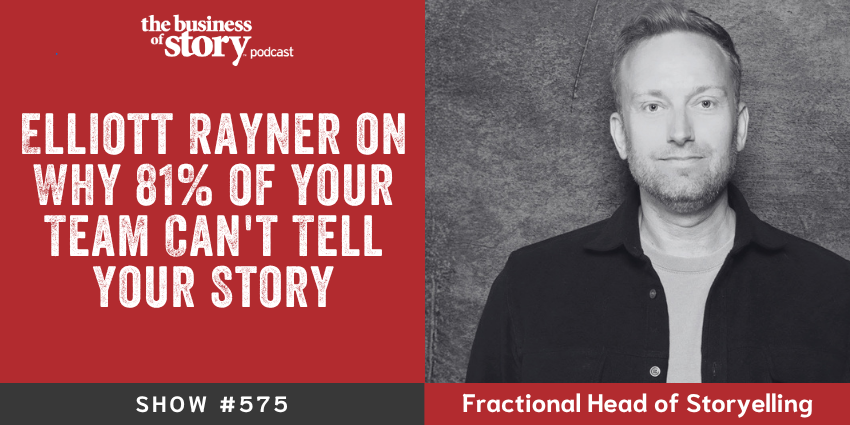
Research from Elliott Rayner’s State of Storytelling 2026 reveals that only 19% of employees inside most organizations can consistently articulate the three core questions about their company: what value do we create, who cares about that value most, and why are we the best at delivering it?
Nineteen percent.
That means 81% of your brand touchpoints — every sales call, every product demo, every investor pitch, every customer email — are being delivered without a shared, aligned story underneath them.
That’s Narrative Entropy. And it is quietly compounding in your organization right now.
Therefore, the most visionary companies aren’t just fixing their messaging. They’re building an entirely new operational function around the one discipline that governs every other function in the business.
They’re hiring Chief Storytelling Officers. And they’re paying up to half a million dollars a year to fill the role.
That’s the wake-up call at the center of this conversation.
Elliott Rayner is a fractional Head of Storytelling, product narrative strategist, and the author of The State of Storytelling 2026 — a landmark report built on anal ysis of twenty-five C-suite storytelling job descriptions from some of the world’s most sophisticated companies.
Based in the Netherlands and drawing on a career that began at the Adidas Global Headquarters and included product stewardship of the iconic New Zealand All Blacks kit, Elliott has spent the last decade helping companies discover and operationalize the story they can tell better than anyone else in the market. He teaches storytelling as a business function through his Maven cohort and publishes frameworks via his website ProductNarratives.com.
What’s in it for You:
- Why Narrative Entropy is measurable — and the three-question survey you can run inside your company this week to quantify it and build the business case for storytelling investment
- What a Chief Storytelling Officer actually does — and why it’s far less about creating stories and far more about creating alignment across the entire organization
- The Discover, Define, Deliver framework fractional heads of storytelling use to operationalize brand narrative in three to nine months
- Why AI makes this urgent — and how “execution has become cheap, but meaning has not” reframes every conversation about where human value now lives
- What the salary data reveals — and why the investment signals these organizations know exactly what they’re buying
Why the 19% Number Should Alarm Every Leader in Your Organization
When Elliott runs his alignment survey inside a new client, he asks three questions. He never gets it wrong.
On average, 19% of people in the organization agree on the answers.
The other 81% are working from an old deck. A half-remembered all-hands. Their own best interpretation of what the company does and why it matters.
This isn’t a creativity problem. It isn’t a marketing problem.
It is an operations problem.
Park has called it Narrative Entropy for years. The slow, invisible decay of your brand story as it passes through floor after floor, department after department, handoff after handoff — until the story your salesperson tells sounds nothing like what your product team published on the website.
Elliott’s research proves the entropy is real. And measurable. And costing organizations far more than they realize.
The Ops Parallel Every CEO Already Understands
Think about your CFO. Deep financial expertise. Operations mindset. Infrastructure to govern the function.
Your CMO. Deep marketing expertise. Operations mindset. Infrastructure to govern the function.
Your Chief Storytelling Officer? Deep narrative expertise — not just creative, but scientific. An understanding of ABT architecture, of what makes a story move a buying brain, of how to build the governance infrastructure that keeps the story coherent as the organization scales.
That infrastructure is StoryOps™.
It’s the discipline that treats brand narrative the way every other business-critical function gets treated: with governance, with measurement, with a single source of truth that every person in the organization can access and use.
Elliott’s research shows the market is waking up to this. The job titles are appearing. The salaries are serious. Some companies are even keeping their Head of Storytelling off LinkedIn entirely — treating the role as a competitive secret weapon.
The question isn’t whether your organization needs this function.
The question is whether you build it before your competitor does.
More Information:
- www.productnarratives.com
- Download Elliott Rayner’s State of Storytelling 2026 report
- Connect with Elliott and request the three-question brand alignment survey: linkedin.com/in/elliottrayner
- Explore Elliott’s storytelling frameworks and Maven cohort: productnarratives.com
- Grade your own brand story for free with the Business of Story Brand Story Grader: businessofstory.com
- Learn more about StoryOps™ and the StoryCycle Genie®: storycycle.ai
Keep Building Your Story Discipline:
- How to Unlock Brand Alignment to Accelerate Your Business Growth, with Brandon Coleman Jr. — Brandon Coleman Jr. maps the gap between where a brand is and where its story needs to be, and walks through his framework for achieving alignment across marketing, sales, and leadership.
- The Machines Can Code. They Can Calculate. But They Cannot Connect., with Joe Lazauskas — Contently co-founder Joe Lazauskas makes the neuroscience-backed case that authentic human storytelling is the one competitive advantage no algorithm can manufacture.
- The Agencies That Thrive With AI Will Project the Most Flexible Identity, with Marcus Sheridan — Marcus Sheridan explains why the brands that survive AI disruption will win on narrative coherence, not creative output.
Elliott Rayner’s Conversation With Park Howell on the Business of Story Podcast
Who Is Elliott Rayner and What Inspired The State of Storytelling 2026 Report?
Park Howell: Hello Elliott, welcome to the show.
Elliott Rayner: Hi there, Park. Thanks for having me. It’s really great to get the opportunity to speak to you.
Park: Awesome chatting with you. You are coming to us from Amsterdam area.
Elliott: Yeah, even more obscure than that. Denbosch, about one hour south of Amsterdam, where we’re suffering the hottest heat wave on record. It’s very warm at the minute.
I’m English, so I’m from the northeast of England — a place where I’m not really used to the sunshine or too much heat. My brain is just surviving with the temperature so far.
Park: And you’re English but you’re in the Netherlands. What brought you out there?
Elliott: I’ve been lucky to jump around with different positions. Germany, Denmark, the Netherlands. An exciting role brought me here. That role has come and gone, but the Netherlands is a really nice place to live, especially with a young family.
My wife is German, so it’s nice to be in the middle between the UK and Germany. This is where we call home.
Park: I love it out there. I was fortunate enough to spend five summers — a week to ten days in Amsterdam every summer for five years — when I was teaching a sustainable storytelling course in a master’s program at Arizona State University.
Our students were from around the world, and we would meet up in Amsterdam and work with a lot of your great companies out there. Philips Electronics. Tony’s Chocolates. The airport. Companies that were doing a lot in sustainability. They would open their doors and we would go in and do little exercises and programs with them.
What I loved most about Amsterdam was the people. So nice, so friendly, so much fun. The food is great, the booze is great. It was just a wonderful respite out of my summers for five years in a row.
Elliott: It’s got a really great international connection. All the scale-ups and companies work here. The amount of different cultures you’ve got working together is really unique.
You clearly had a lot of fun. We have to see if we can get you over for a sixth, seventh, and eighth time in the future.
Park: I would love that.
Now, you have just come out with this report — the State of Storytelling 2026 — where you looked at twenty-five different companies that are hiring this C-level leadership role of Chief Storytelling Officer. You dug into that to figure out what’s going on. Where’s this trend coming from? What’s it about?
What was your real motivation to go and do this research?
Elliott: A lot like you, I’ve been working in storytelling and narrative for a long time. I’ve learned not to mention the words “narrative” or “storytelling” because they can be quite hard to sell internally within companies, especially at the C-level.
Something curious happened at the beginning of the year. I started to see a couple of roles emerge. Director of Narrative. Head of Storytelling. Chief Storytelling Officer.
Sometimes these can be a way to grab attention from a brand. But then I started to see enough of them that it felt like a trend. Combined with something else that had gone quite popular — companies hiring storytellers as a reaction to AI taking a lot of our tasks away — I thought I would start collecting them.
These roles are live for about three days and then they disappear. So I learned to screen-grab them pretty early. I thought, let’s collect five and see what I can learn. Then ten. And then I got to twenty-five.
I was quite strict with the criteria. I wanted head-of positions, leadership roles at major companies, and roles that owned the narrative. Those were the things I was looking for.
You can learn a lot from job descriptions. There’s a lot of great data in there. By gathering those twenty-five and putting them together in this report, I was able to build a clearer picture of why this trend is happening.
From Adidas to the All Blacks to Fractional Storytelling: Elliott Rayner’s Path to the Research
Park: Give us your backstory in storytelling. How did you get into it, and why do you have this insatiable interest to go and do all this digging?
Elliott: I’m from Newcastle, a town in the northeast of England obsessed with sport. So I became obsessed with sport as well. It’s a great place for stories.
That took me to start my career at the Adidas Global Headquarters in Herzogenaurak, Germany. I was building products — things footballers would wear, football boots, kits for national teams, kits for the Olympics.
Over time I started to realize that my job wasn’t just to create technical products. It was to create product stories. Looking at the marketplace, I’d always seen that the products that win are very rarely the best products. They’re the ones that communicate something very clearly and very strongly.
I got the chance to work with people I consider to be great storytellers and started to learn from them.
I started writing and researching about storytelling around ten years ago, during my journey from the sports world into the tech world. That’s where I really saw a need for great storytelling. The markets were so crowded. The products were so complicated. They needed great storytelling.
Since then I’ve been working directly with companies, giving product narrative workshops where I help them discover what is the story they can tell better than anyone else in the market.
Park: When you were in the sports marketing storytelling business, you launched a major kit with the New Zealand All Blacks. Our son got into rugby in high school and absolutely loved it. He’s the one who really introduced me to the All Blacks. Can you give us a story about what you did there and how you turned it into a story?
Elliott: You look at a sports kit and there are very few products that are more emotional. People treasure them. They pass them down. If you go to New Zealand, you won’t go more than an hour without seeing an All Blacks jersey. It’s a very meaningful thing.
I was fortunate to have the responsibility of being the product manager for that. But it’s a challenge. It needs to be all black. There’s not much flexibility when it comes to design.
How do you tell a story?
We came across a quote from a Welsh player who once said, “There’s something about the blackness of an All Blacks kit that sends a shiver down your spine.” This idea that they were so intimidating, and part of that intimidation came from those deep, all-black kits.
So why not lean into that?
We worked with our designers and developers to create the blackest kit of all time. Taking away the famous white collar. Convincing sponsors to use very dark silver badges — which is not in their interest — but they bought into the story.
And that’s the point. Everyone knows that if the story works, everything else clicks into place. It’s easier for marketing. It’s easier for sales.
It was a great lesson in understanding that if you get the story right, everything else is easier.
But when I asked anyone at Adidas or ASICS how to tell a great story, people would say, “I have no idea.” Yet these were people who were creating and working with stories every day.
They were doing it subconsciously. They’d never taken a class, read a book, or really sat down to work out what is a story and why does it work. That’s the part I got really interested in — and what led me to where I am today.
Park: We were cut from the same cloth, Elliott, because I was looking at story too when I was running my agency. I was looking at a campaign we ran — one spot pulled very well and the other spot didn’t pull at all.
At the time I couldn’t figure out why. Until I studied story and realized that first spot was intuitively created as a perfect story structure. It increased same-store sales forty-two percent the next month. People were coming in talking about it.
The second spot did nothing. I realized it was just a creative message. No story structure.
This was back in two thousand and three. So I took it upon myself to say, my agency needs to stop being intuitive storytellers and start being intentional storytellers.
That’s what led me into really studying what makes a story work. How does it work? How can we use it? How can we be creative with the framework and still be committed to it, because we know how it moves people?
Elliott: I think that realization you and I had in our careers is exactly what’s happening in the market now. That’s why these roles are starting to come alive.
A lot of these C-level executives have probably learned the hard way that making a great product just isn’t enough anymore. They’re probably quite frustrated looking at why competitors are doing so well when their product isn’t as good — and realizing it’s story.
So they’re thinking, maybe we should invest in storytelling. And not something small, something big.
You can see in the report — these are big salary brackets, big roles for big companies. For me, what’s exciting is that the credibility of a Head of Storytelling is now coming to life. Which is probably exciting for you after twenty-five years of banging your head against the wall.
Park: For twenty-five years, Elliott. I mean, where have these people been?
What Does a Fractional Head of Storytelling Actually Do? Inside the Discover, Define, Deliver Framework
Park: What are you doing now? You are a fractional storyteller. Can you give our listeners a little insight into that?
Elliott: The nice fancy term would be fractional Head of Storytelling. For anyone who knows what fractional means — I’m working with many companies, not one.
Instead of doing ten things for one company, I’m doing one thing for several companies. And that one thing is helping companies understand what is the story they can tell better than anyone else in the market.
It usually takes between three, six, and nine months. I work through three elements.
One is discovering their narrative. Most companies don’t need more data — they have a lot of it. Maybe too much. That’s actually why their storytelling is bad: they’re using too much of it. We need to find the important ingredients. What is the minimum amount of information we need to tell this story?
Two is defining the narrative. This is the most difficult one, because marketing teams usually have no problem coming up with great narratives. They’re very good at it.
But how do you get everyone in the company — your head of sales, head of legal, head of compliance, even your CEO — to all say, “I love it, let’s do it”?
That’s where I come in with a specific technique and process to get a lot of people on board.
Three is delivery. And for me, this is the most important.
Where I’ve seen things fail from the agency side is that you can deliver a great story that everyone loves, then go back six months later and not see it on the website. Maybe half the sales team is using it, the other half isn’t. Or it gets lost when a new feature comes out.
The delivery is about adoption. How do you make sure the narrative is created in a way that anyone in the company can pick it up and utilize it?
In my spare time, I teach a Maven cohort where I use those companies as case studies to help people understand how they can be their own head of storytelling within a company — even if they don’t have the title.
Park: So you talk about discovering the narrative, defining the narrative, and delivery, which leads to adoption. If they aren’t adopting it, after six months everything falls down. All that work is for naught.
We call that narrative entropy. And it happens everywhere. Especially in large enterprises.
Narrative Entropy Explained: Why Only 19% of Employees Can Tell Their Company’s Story Consistently
Park: They find the narrative, share the narrative, don’t get people to buy into it, and it starts falling apart — unless you have governance around it. And that’s kind of what your study found too, right?
That you’ve got these chiefs of storytelling being sought after and brought in. But are they given the infrastructure and the governance — what we call StoryOps — to be able to weave that narrative coherently and consistently throughout the organization?
Elliott: The answer is some yes, some no.
One of the key findings from the report is that there are about seven different reporting lines for these twenty-five roles. A lot of different companies are trying to figure out what this role is and what it should achieve.
But I think the ones that will succeed will recognize something important: a head of storytelling probably shouldn’t be spending too much time creating stories. They should be finding the stories that already exist, lifting them up, amplifying them, tweaking them, and getting everyone on board with them.
My biggest learning is that a head of storytelling creates alignment.
What is a successful story within a company? For me, the measure of success is if you speak to a few people in sales, a few in product, and a few in marketing, and they’re all saying roughly the same thing. That’s alignment.
That’s why I start every engagement with a simple three-question survey. What value does your product create? Who cares most about that value? And how can we make them believe that you’re the best at creating this value?
Those three questions — you’d hope everyone in the company can answer them.
In my research, I found that on average I get around nineteen percent alignment.
That’s frightening, but not too surprising. A lot of people have worked at companies where it feels like you’re working for three different companies because everyone has a different opinion of what the product is and what makes it great.
How can you possibly convince people outside of the company what your value is if only nineteen percent of people inside the company can agree where it is?
A head of storytelling gets that nineteen percent up to sixty, seventy, eighty percent.
Park: Right. That means eighty-one percent of the people in your organization don’t know what or how to tell your story.
Elliott: And the survey — I challenge all of your listeners to add me on LinkedIn. I’ll send it to them as a Google form. Do not be scared of the results.
It’s actually a great way to convince your C-level organization that you might need to invest in storytelling.
Go ask your boss what alignment percentage they think you’d have. They’re always going to say sixty, seventy, eighty percent. Because it’s frightening to say anything lower.
Then you come back with the results. Whatever budget you’ve been struggling to get, whatever responsibility to own the narrative — that conversation is going to be a lot easier when the real number is staring them in the face.
Convincing people on storytelling can be hard. But convincing someone on alignment? That’s easy. A CEO, a CMO, anyone in the company can understand: this is costing us money to only be nineteen percent aligned.
It’s a great weapon to use.
Park: That’s the ultimate measure of narrative entropy. And no organization wants entropy in any way. That’s why they have marketing ops, sales ops, revenue ops, DevOps, FinOps — governance and infrastructure to guide each department so they’re all producing for the whole.
But nobody has StoryOps.
What Is StoryOps and How Does It Turn Brand Narrative Into an Operational Business System?
Elliott: That’s maybe what we’re seeing with this report.
One of my predictions is that we’re going to see convergence over time. It’s going to be very experimental. A lot of people will be hired with the wrong credentials and fired too quickly.
But the ones who do it right — those will be the ones emulated.
Storytelling ops is a great way to put it, because this isn’t a creative, fancy role. It’s quite dirty work to get in there, influence people, and get everyone on the same page.
It works really well at a startup and early scale-up stage because you’ve got a founder who’s in there every day beating his chest and saying, “Guys, this is where we’re going, follow me.” Everyone’s aligned.
But as you scale — and companies today scale incredibly rapidly — it becomes so difficult to keep that narrative going when you become less founder-led.
That’s maybe when you replace your founder with a StoryOps function. Whether that’s one person, a process, or even an AI agent or two in the future.
The most important thing is this recognition, especially from the tech industry, that having a good product isn’t enough. We need to get our narrative great, and we need to get it aligned.
What Chief Storytelling Officer Job Descriptions Reveal About the Future of Brand Communication
Park: Going back — you said these job descriptions only last two or three days online. Why is that?
Elliott: It’s standard for any type of role. They don’t want them live forever. It’s salary data — especially in the US, which is very transparent about that.
Reporting lines, too. You learn so much from them.
When I started, I wasn’t sure what I was doing. I was doing it for my own interest, because I was learning from them. Then as I started to pull them together and see the patterns, I thought this could be something a lot of people are interested in.
Especially in my world of product marketing, which has always had a good claim to own storytelling in an organization. And my concern was that when these roles appear, brand people or creative people would apply and get them rather than product marketers.
To tell a story, you need a really good understanding of the product, a really good understanding of the audience, and a really good understanding of the market. That person — if they’re doing the job right — is the product marketer.
Park: Where do you think it’s going in the future?
AI and Brand Storytelling: Why Execution Is Now Cheap but Meaning Is the Last Human Advantage
Elliott: We almost got to thirty minutes without mentioning AI. But here we go, because it’s relevant.
I see this as a big response to AI. Not just storytelling — I think this might be the first of some very new job titles we’re going to see across marketing and across a lot of different functions as we come to terms with the fact that our roles are no longer our tasks.
Because now we can hand over our tasks to AI quite efficiently. And that asks the question: what do I do, and where is my value?
For me, the value is storytelling. If that’s what I’m using artificial intelligence for, what is the value of my human intelligence?
I don’t think there’s any better display of human intelligence than the ability to create and communicate a great story. That’s what makes us human.
And that’s why we’re seeing this now — as a response to how the market is changing.
Park: After reading through your study, do you think the people putting out these job descriptions actually know what they’re asking for?
Elliott: No. I think a lot of them are going on the title alone.
I think there’s a big mix-up between a skill and a function. Do you want someone highly skilled in storytelling? Or do you want someone who owns the narrative as an organizational function?
Some of the job descriptions get it clearly — I highlight roles like Amazon and Anthropic, where the language points directly at owning the narrative.
And that is the key statement.
You don’t have to be a predictable, great storyteller to own a narrative. It’s almost a scientific process. It’s someone who can influence and knows the science of storytelling.
I think it’s going to be a mess for a while. A lot of them are going to get it wrong.
But I’m excited to do a second step of this research — actually speaking to the people who are hiring these roles, moving from predictions to real answers.
Park: You are in a very unique position to put the study together because of your role as a fractional head of storytelling. You’ve worked with a hundred-plus brands to help them defragment their storytelling and operationalize their brand story.
Elliott: That’s right. And that’s why I included a case study in the report — to show what are you actually doing day-to-day, what are the KPIs, what does it look like week by week.
I did a four-month project with a company called Ingrid in Sweden. It went extremely well and extremely quickly because they knew what they wanted from me and they knew the importance of narrative.
The reason why it works fractionally is that sometimes it’s good to have an outsider come in. Someone who isn’t too emotionally attached, who doesn’t know the full story.
It can be frustrating for the people who bring me in, because I’m probably saying the same things they have. But maybe it’s the British accent. Or just being an outsider. I managed to get it signed off.
The definition part is what I enjoy most. Getting five very different, very difficult people in a company to agree on something I’ve written — because once you’ve done that, those five people all see their fingerprints on it.
They become your champions to get the narrative through the organization.
How Much Does a Chief Storytelling Officer Earn? The Salary Data That Surprised Even the Researchers
Park: Out of everything you looked at in this report, what was your biggest surprise?
Elliott: The high salaries were a welcome surprise.
I thought this would be seen as a creative, fun, younger role. But on the salary scale, one of the roles went up to half a million a year.
That’s a great indication that this is being taken seriously. You don’t pay that kind of money unless you have a very clear understanding that narrative is going to contribute to return on investment. They’re planning to get that back.
When I started to think, is this just a trend? Is this just a role where you get a nice little office, get invited to a couple of meetings, make the decks look a bit prettier, and get sent to do keynotes?
The job descriptions themselves — and that’s why I encourage your audience to look through them — when you see the language used combined with the salary, it is reassuring that this is being taken seriously.
That’s the thing I’m most excited about. This is something that’s going to get more credible and tangible.
The Strategic Secret: Why Some Companies Keep Their Head of Storytelling Out of the Spotlight
Park: Were you able to talk with some of the people I referred you to?
Elliott: Yes. And this is really revealing.
A lot of the ones who are doing it don’t want people to know they’re doing it. I even had one person say they didn’t want to talk about it anonymously — because they’re acting as a head of storytelling, but they don’t shout about it.
They don’t have the title on LinkedIn. They see themselves almost like a secret weapon within an organization.
And that’s revealing. This trend I’m seeing using job descriptions — that might be just the tip of the iceberg. A lot of brands might have hired internally and said, “You’re going to act as head of storytelling, but we’re not going to publish it, because we don’t want everyone else doing the same.”
So if anyone listening is doing this role and is willing to talk, please reach out. This is research I want to continue doing.
It’s a little bit elusive at the moment. Which is quite exciting.
What AI-Native StoryOps Tools Are Emerging to Help Companies Operationalize Brand Narrative at Scale?
Park: We have been working with our StoryCycle Genie®, which is the StoryOps platform. You can build your brand narrative strategy, and then all of your content — and everybody in the organization — has a single source of truth about that brand story.
I ran your brand through it and sent it over to you. What did you think of the output?
Elliott: I really liked it. There were definitely some home truths there. My brand is something I’m building slowly and trying to keep very clear.
Your research really picked up on it. And it inspired me to dig into it a little bit deeper.
When I was reading it, the feeling that came through was this: less is more.
I want to challenge myself to communicate what I do and the value I create with as little words as possible. That was the big inspiration I took from it.
Park: And in your experience working with lots of brands to pull their narrative together — and what you’ve seen in the research — how do you see a narrative-native platform like the StoryCycle Genie® working inside an enterprise? And their reluctance to adopt something like that?
Elliott: The reluctance comes from one thing first: recognition.
Nobody wants to solve a problem they don’t really fear. And that’s changing. That will drastically change.
The next thing is what a tool like that truly offers — and it’s transparency. That’s such an underrated thing in an organization.
When we talk about nineteen percent alignment, the big misunderstanding is that it doesn’t mean everyone disagrees on what the story should be. It just means people think they’re telling the right story, but they’re working from an old deck or outdated materials. It’s misinformation.
That’s where something like this can be really helpful. Where do I go to get the most up-to-date information so I know that when I’m speaking to a customer, building a campaign, or developing a feature, I’m doing it with the right context?
The companies that build a tool or a role that encourages that alignment and transparency are going to see massive benefits.
Alignment and transparency might not seem like exciting things to invest in. But once you get them right — those are the companies that are succeeding and scaling quickly.
Park: How are you seeing enterprises using AI as a StoryOps tool?
Elliott: I see a lot of different things.
The idea of having a shared agent is a really good one. You can’t always reach the same people in an organization. So I see a lot of product marketing teams developing agents for their sales team.
If someone’s in a meeting and they need to take a bit of copy and rewrite it for a specific customer — something that might have been emailed to a poor product marketer who answered back, “It’s on slide fifty-six, just go read it” — an agent can solve that.
The big frustration for a lot of product marketers is that they’ve created content to create alignment, but it just doesn’t get adopted. An agent could solve that problem.
But one of the things I wrote about in the report is this idea: execution has become cheap, but meaning has not.
Yes, you’ll be able to execute things that help tell your story at a higher scale. But what we need to do is use that time saved to better understand what it is we’re trying to say.
What’s the difference between a good story and a great story? That’s not something that’s understood well enough.
If AI is taking away all those tasks, we can spend more time figuring that out.
Then the rest is easy.
Park: Where can people learn more about you and what you do, and where can they find your new report?
Elliott: The report is completely free to download. You can join my newsletter and get it sent directly to your inbox, or go to my LinkedIn and click to download it right there.
I also teach storytelling as a function four times a year on Maven. I usually work with around twenty-five marketers and product people and help train them over four weeks.
And all my books are available via my website at productnarratives.com.
Park: Well, very cool. Elliott, thanks for being here on the show and thanks for doing all this research. I found it absolutely fascinating.
Elliott: I’m hoping it makes your life easier, Park. It’s getting harder and harder to argue that storytelling isn’t one of the most important things to invest in as a business and as a person.
Now we’ve got some nice research to back it up.
Park: I appreciate that, Elliott. Thank you so much for being here with us today.
Elliott: You’re welcome.
Park: It was fun.
Frequently Asked Questions About the State of Storytelling in 2026 Report
Q: What Is a Chief Storytelling Officer and What Do They Do?
A: A Chief Storytelling Officer (CSO) is a senior or C-suite leadership role responsible for developing, protecting, and operationalizing an organization’s core narrative across all functions and communications channels. Unlike a traditional CMO or content director, the Chief Storytelling Officer owns the connective tissue between brand strategy and execution — ensuring every department, team member, and customer touchpoint reinforces a consistent story. According to The State of Storytelling 2026 by Elliott Rayner, discussed with Park Howell on the Business of Story podcast, demand for this role is accelerating as organizations recognize that narrative fragmentation is a measurable strategic liability. Salary data from the 2026 research reveals that compensation for this role is significantly higher than most organizations anticipated, reflecting its growing strategic importance.
Q: What Is Narrative Entropy and How Does It Damage Brand Performance?
A: Narrative Entropy is the organizational phenomenon where a company’s core brand story degrades as it passes through multiple departments, teams, and individuals — producing inconsistent, diluted, or contradictory messaging across every customer and stakeholder touchpoint. Research from The State of Storytelling 2026 shows that only 19% of employees can consistently articulate their company’s story, meaning 81% of the workforce is actively creating brand fragmentation in their everyday communications. This misalignment directly erodes sales effectiveness, customer trust, and brand equity because prospects and partners receive different versions of a company’s value proposition depending on who they talk to. Resolving Narrative Entropy requires systematic StoryOps infrastructure, not just updated brand guidelines or a new messaging document.
Q: What Is StoryOps and How Does It Work as an Organizational System?
A: StoryOps is the operational infrastructure — including processes, governance, tooling, and measurement systems — that enables an organization to tell its brand story consistently at scale across every role, department, and channel. Modeled conceptually on frameworks like DevOps or RevOps, StoryOps treats brand narrative as a business-critical operational function rather than a periodic creative output. A functional StoryOps system typically includes a canonically defined story architecture, organizational training and embedding mechanisms, and feedback loops to audit and correct narrative drift over time. The StoryCycle Genie®, discussed on this episode of the Business of Story podcast, is an AI-native StoryOps platform designed to give every person in an organization a single source of truth for the brand narrative.
Q: What Does a Fractional Head of Storytelling Do, and When Should a Company Hire One?
A: A fractional head of storytelling is a senior brand narrative strategist who partners with an organization on a defined-scope basis to diagnose narrative alignment gaps, develop a canonical story architecture, and operationalize consistent messaging across teams. The engagement typically follows a three-phase model — Discover, Define, Deliver — moving from story audit and alignment research, through narrative architecture development, to implementation of StoryOps systems that sustain the story over time. Companies should consider a fractional storytelling lead when messaging inconsistency is creating friction in sales cycles, when leadership cannot align on a core value proposition, or when rapid growth is diluting brand identity faster than internal teams can manage. This role is distinct from a content strategist or copywriter — it operates at the level of organizational culture and communications infrastructure.
Q: What Is the Discover-Define-Deliver Framework for Brand Storytelling?
A: The Discover-Define-Deliver framework is a structured three-phase approach used by fractional heads of storytelling and Chief Storytelling Officers to build, align, and operationalize brand narrative inside an organization. In the Discovery phase, the practitioner audits existing messaging and deploys alignment tools like the three-question survey to quantify where Narrative Entropy is causing the most damage. The Definition phase synthesizes findings into a single canonical brand story architecture that leadership can align around and all teams can draw from consistently. The Delivery phase builds the infrastructure to operationalize that story: training programs, story guides, sales enablement content, onboarding materials, and StoryOps systems that embed consistent messaging into daily operations.
Q: Why Can Only 19% of Employees Tell Their Company’s Story Consistently?
A: The finding that only 19% of employees can consistently articulate their company’s story reveals a structural gap in how most organizations treat brand narrative: as a marketing deliverable rather than an operational system. Brand guidelines and messaging decks are created but rarely embedded through systemic training, governance, or accountability structures, so story integrity degrades naturally as the organization grows. The problem compounds in companies with distributed teams, high turnover, or multiple product lines, where no centralized storytelling function exists to maintain narrative consistency. Without a Chief Storytelling Officer, a fractional storytelling lead, or a formal StoryOps function, the brand story lives in a PDF that most employees have never read.
Q: How Is AI Changing Brand Storytelling Jobs and the Demand for Storytelling Leaders?
A: AI is reshaping brand storytelling by dramatically reducing the cost and time required for content execution, which is elevating the value of human storytellers who operate at the level of strategy, meaning-making, and narrative architecture rather than content production. While AI tools can generate copy, scripts, and assets at scale, they cannot determine what story an organization should tell, why that story matters to a specific audience, or how to align an entire company around a coherent narrative. As Elliott Rayner states on the Business of Story podcast: “Execution has become cheap, but meaning has not.” Rather than replacing storytelling roles, AI is elevating their strategic positioning — creating stronger demand for fractional heads of storytelling and Chief Storytelling Officers who provide the direction that AI tools then execute against.
Q: What Is the Three-Question Brand Alignment Survey and How Is It Used?
A: The three-question brand alignment survey is a rapid diagnostic tool that measures how consistently employees across an organization can articulate the company’s core story. It asks employees to independently answer: What value does your product create? Who cares most about that value? And how can we make them believe you’re the best at delivering it? When the results are aggregated, the survey quantifies the degree of Narrative Entropy present. Elliott Rayner offers the survey as a free Google form — connect with him on LinkedIn to request it. Most organizations that run it discover their alignment scores are far lower than leadership assumed, making it a powerful tool for securing internal investment in storytelling leadership and StoryOps infrastructure.
Q: What Are the Most Significant Findings from The State of Storytelling 2026?
A: The State of Storytelling 2026 by Elliott Rayner is a landmark research report examining how organizations are professionalizing brand narrative as an operational business function, drawing on analysis of twenty-five Chief Storytelling Officer job descriptions from major global companies. Its most impactful finding is that only 19% of employees can consistently tell their company’s story — quantifying the scale of Narrative Entropy that is silently undermining brand performance, sales effectiveness, and organizational cohesion across most companies. The research also documents accelerating demand for storytelling leadership roles, with compensation data reaching up to half a million dollars annually — signaling how seriously leading organizations now view narrative as a strategic business function. The report concludes that AI is not eliminating human storytellers but amplifying the strategic premium placed on those who can provide meaning, direction, and narrative coherence that AI alone cannot generate.
Q: Should a Company Hire a Chief Storytelling Officer or Engage a Fractional Storytelling Lead?
A: Whether to hire a full-time Chief Storytelling Officer or engage a fractional storytelling lead depends on the scale of your narrative infrastructure needs, your organizational stage, and your investment capacity — but both roles address the same underlying problem: Narrative Entropy and the absence of systematic story alignment. Early-stage and mid-market companies experiencing rapid growth, messaging fragmentation, or sales narrative inconsistency are typically best served by a fractional head of storytelling, who can rapidly audit, architect, and operationalize a brand story without the overhead of a full C-suite hire. Larger enterprises or companies for whom brand narrative is a primary strategic differentiator are increasingly building the business case for a full-time Chief Storytelling Officer, with salary data from The State of Storytelling 2026 confirming that these roles command executive-level compensation. The right first question is not which title to create, but rather: how severe is our Narrative Entropy problem, and what level of investment does solving it require?
 Listen To More Episodes