Why Brand Story Governance Is the Only Guardrail Standing Between You and Strategic Collapse
Even the Smartest Brands Make Fatal Mistakes — Here Is How to Avoid Theirs
You know your brand story is your most powerful strategic asset. When governed and operationalized across your enterprise, it protects you from the catastrophic business decisions that silently erode — and ultimately destroy — even the most iconic brands in the world.
But most companies treat their brand story as a marketing artifact rather than a strategic guardrail. When it drifts, fragments, and loses coherence, narrative entropy sets in. And today, AI accelerates that collapse at light speed.
That is exactly why this conversation with Magda Adamska is one you cannot afford to miss. She has spent over two decades studying what separates the brands that endure from the ones that implode — often in spectacular, painfully avoidable ways.
Meet Magda Adamska: The Brand Strategist Behind 250-Plus Case Studies
 Magda Adamska is the founder of BrandStruck, the world’s only database of brand strategy case studies — 250-plus deep, spanning nearly 50 countries, and regularly updated as brands evolve (and sometimes collapse). A former brand director at MTV and Nickelodeon inside the Viacom portfolio, and an independent brand consultant with over 20 years guiding C-suite executives through brand transformations and portfolio optimizations, Magda has worked with the most recognized names in global business: Nike, Nestlé, Pearson, JP Morgan, Procter & Gamble, and Guinness World Records.
She is also one of the most rigorously objective analysts in the branding world — her Sage-with-a-warrior-streak personality comes through in every insight she shares. She doesn’t editorialize. She studies, synthesizes, and delivers.
What’s in It for You
- The four strategic traps that have destroyed even the most iconic brands — and how to recognize which one is threatening yours right now
- Why MTV had every advantage Spotify needed — and still failed to act before it was too late
- How Nike’s pandemic-era data trap triggered a brand crisis that is still unfolding today
- Why GoPro’s leap into streaming nearly destroyed the company — and what it reveals about the limits of brand extension
- The single most dangerous mistake any strategist can make when building a long-term plan
- Why a governed brand story is not a communications luxury — it is the strategic guardrail that protects every business decision you make
The Four Strategic Traps Killing Iconic Brands
Magda didn’t set out to write an article about brand failure. She was doing what she always does — updating case studies, reading business data, noticing patterns. And a pattern emerged that troubled her enough to publish it.
She identified four distinct strategic traps she calls the Comfort Trap, the Efficiency Trap, Over-Expansion, and Growth-at-All-Costs. Each one plays out differently. All of them share a common root: a breakdown in the connection between brand story and business decision-making.
The Comfort Trap is MTV. A brand with one of the most powerful stories in media history — beloved by an entire generation, with established artist relationships, label access, and rights-clearing expertise — who watched digital transform the music industry and couldn’t mobilize fast enough. Not because they didn’t see it coming. Everyone did. But the revenue model was shackled to TV ratings, and investment in digital couldn’t justify itself on a three-year P&L window. Spotify built what MTV already owned the pieces to build. The brand hasn’t appeared in Interbrand’s rankings in over a decade.
The Efficiency Trap is Nike. Flush with pandemic-era digital sales growth, Nike made a strategic bet that D2C was the future and ended wholesale partnerships with Foot Locker and Macy’s. The math from an anomalous period became the foundation for a long-term strategy. It backfired — badly. Nike is now spending years rebuilding the retail relationships it abandoned.
Over-Expansion is GoPro, which responded to slowing camera upgrade cycles by trying to become a streaming media company. It diverted resources from the core business into 30 original series that never materialized and nearly broke the brand entirely. As Magda notes, only companies with unlimited budgets — Apple, Amazon — can pull off a media company pivot. Everyone else loses.
Growth-at-All-Costs is BrewDog, a brilliant rebel brand that borrowed at 18% interest rates to fund aggressive bar expansion, watched the debt service consume the brand’s financial foundation, and ended up selling a company once valued at two billion pounds for 33 million.
The Guardrail Every Brand Needs But Most Ignore
What connects all four traps? A brand story that was no longer governing the decisions being made in the boardroom. Magda put it plainly in our conversation: certain decisions simply won’t be on brand — and that is not a creative constraint. It is a commercial one.
Don’t launch a completely different category in-house. Don’t cut costs past the threshold where brand experience suffers. Never build a long-term strategy on data from an atypical period. And don’t confuse explosive growth with a sustainable foundation.
The brands that endure are the ones where the story is alive, governed, and operationally embedded — not filed in a brand guidelines PDF no one reads.
More From Magda and the Topics We Explored
- Brand Struck
- Magda Adamska on LinkedIn
- StoryCycle Genie™
- FREE Brand Story Grader
- Brand StoryOps™ for Agencies newsletter
- How Brands Shrink: Four Scenarios article
- Free BrandStruck Case Studies: Nike, Lego, Ikea
Three Related Episodes Worth Your Time
- Rain Bennett: Because If No One Is Governing It, AI Is Fragmenting It Faster Than You Can Fix It — Rain makes the case that brand story is your operating system, not your marketing department’s deliverable.
- Elliott Rayner: State of Storytelling 2026 Proves Brand Narrative Is Finally a Business Discipline — Only 19% of employees can consistently articulate their brand story — and narrative entropy is compounding in silence.
- Brandon Coleman Jr.: How to Unlock Brand Alignment to Accelerate Your Business Growth — The practical playbook for turning brand story into a cross-enterprise alignment engine that drives measurable growth.
Magda Adamska’s Conversation With Park Howell on The Business of Story Podcast
Four Strategic Traps That Destroy Even Iconic Brands
Park Howell: Hello, Magda Adamska. Welcome back to the Business of Story.
Magda Adamska: Hi, Park. Thanks for having me again.
Park: Yeah, you were here well over six years ago, back in 2020. You had launched Brandstruck three years before that and came on, and we talked a lot about your work doing case studies around the most iconic legendary brands in the world and what other people can learn for their own branding through those case studies. So it’s great to have you back.
Today we are going to talk about how to operationalize and govern those brand stories across an enterprise and the importance of that. But first, why don’t you give our listeners a reintroduction to you, your backstory, and why did you build Brandstruck in the first place?
How Brandstruck Was Born: Filling the Gap in Real Brand Strategy Intelligence
Magda: Sure. So I’m a brand strategist and also the founder of Brandstruck. Brandstruck is a database of brand strategy case studies.
Before Brandstruck, I used to work for agencies. I was a strategist at agencies. Then I worked on the client side as a brand director responsible for financial performance of the brand. I worked for MTV, worked for Nickelodeon and other brands within the Viacom portfolio, then I moved to Pearson.
Eleven years ago, I quit the corporate life and became an independent brand consultant. Around end of 2015, I came up with the idea of Brandstruck because I needed some case studies to prove my point when working on a project.
I was 100% sure that there was already a tool like this, that someone must have collected case studies of the best, the biggest, the most interesting brands. And I was surprised that there was no such thing.
I was very delusional. I decided, yeah, I’m just going to launch it myself. I prepared my timeline, my P&L estimates. I can still laugh at those estimates because it was much, much harder than I thought. But here we are — more than 10 years later, Brandstruck is still up and running.
We have more than 250 case studies, which are regularly updated because some brands change their brand strategies. I have clients from almost 50 countries. So it’s a very interesting journey for someone who launched a platform like this from my sofa, really.
From MTV Brand Director to Independent Strategist: Why a Corporate Branding Expert Went Solo
Park: What made you move out of corporate branding and marketing into doing your own thing?
Magda: It’s very interesting. I never ever wanted to be an entrepreneur. I never wanted to be on my own. All my family had their own businesses and almost everyone failed. I don’t even — to this day — see myself as an entrepreneur. I’m more a strategist.
But to be absolutely honest, I was just fed up with the corporate world and with how much time you wasted on useless stuff. You probably know what I mean — all the calls, all the meetings, all the people that need to be involved.
I’m a strategist, but I’m very much action oriented. At one point I was just like, I’ve had enough. I thought I was just taking a break, doing something entrepreneurial for a very short time. But here we are, 11 years later, I’m still here.
The Philosophy Behind Brandstruck: Standardized Format, Objective Analysis, Substance Over SEO Fluff
Park: So you initially started Brandstruck for yourself so that you could put together these brand case studies, demonstrate strategy in it, and then go out and sell your services — and then realized that maybe you’re onto something here as a subscription product for other agencies to learn from. Is that right?
Magda: I launched it because I thought it would be very easy to launch. What was missing was that you had all these blogs where people describe brand strategy — and often what they write about isn’t even brand strategy.
I thought there needed to be a resource where people could find what certain brands stand for, what the real brand strategy is.
I also remembered when I worked on the agency side, how much our clients liked seeing brand case studies. We always wanted to prepare these case studies in a similar format. So that was also the idea behind Brandstruck — I wanted all the case studies to be presented in the same format.
I chose one positioning model. I chose one kind of narrative structure. So every single case study is analyzed in the same way.
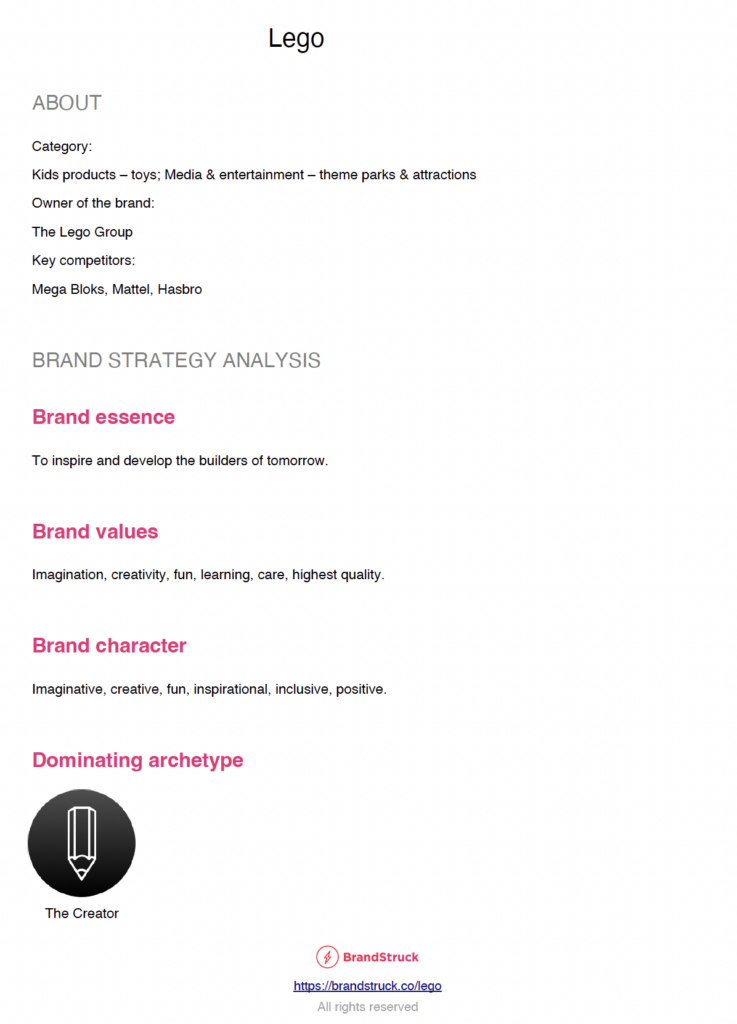
There are always three free case studies on Brandstruck. You don’t need to log in, you don’t need to register. Right now it’s Nike, Lego and IKEA. So you can check what the case studies look like.
Park: Yeah, I downloaded the Lego case study because I had just written about them in my new LinkedIn newsletter called Brand Story Ops for Agencies. We are examining brand story narrative adoption, governance across an enterprise, and what happens when they don’t govern that. We call it narrative entropy — the story starts falling apart.
And of course, AI grabs that fragmented story and scales it at light speed, really harming the brand’s differentiation. It sounds like everybody else. Even AI search optimization has shown that if your story is confusing and getting lots of different bits that don’t really tie together, you actually lose search ranking among the AI bots. So this idea of keeping the cohesion of your story together — both internally and externally — is very important.
Before we dive into that, you mentioned that each case study is written with a narrative structure. What is the narrative structure for each of these and how did you come across that particular structure?
Inside the Brandstruck Case Study Framework: The Bull’s-Eye Positioning Model and Structured Brand Decoding
Magda: It was purely based on my personal needs as a strategist. Before launching Brandstruck, I also did a few interviews — I contacted strategists on LinkedIn from all over the world, US, Shanghai, London — and asked them what they would find useful.
Based on this feedback and what I knew as a strategist, I created this structure. It always starts with a short introduction — what the brand is, what the competitors are, who owns the brand.
Then one level down is the decoded brand strategy. I use a bull’s eye positioning model — brand essence in the middle, then brand values understood more like brand pillars, the things that the brand stands for. Then brand personality as the bigger circle, which is often executed through tone of voice.
On top of that, I added brand archetypes. I’m decoding each brand — what one or two brand archetypes it stands for.
Some people don’t find archetypes that useful. But as a practitioner, I find brand archetypes super useful, especially when you run workshops with people who have never worked with brand strategy before and are then expected to implement it. It’s much easier for them to understand what they’re supposed to do — what kind of tone of voice they should use — when they know what brand archetype the brand stands for.
Then after the brand strategy analysis, we go to the structure of the case study. Starting with brand heritage, brand history, explaining the story behind the brand. Some stories are absolutely fascinating — and you understand how brands evolve just based on the heritage.
Then I try to explain how brand strategy reflects the business strategy. Then if there were any changes — some brands like Nike have had the same strategy for decades, while others like Uber change brand strategy every few years.
Then how the brand strategy is reflected in communication strategy. Then anything interesting about the business — for example, with Nike, I thought it relevant to explain why Nike got into trouble. Such an amazing brand story, and the share price is the lowest it’s been in years.
The last part is the explanation of why those archetypes — because brands almost never explicitly say what archetype they are, but when you analyze what they do, what their values are, how they talk about themselves, you can almost always assign one or two archetypes.
And then you have the tagline, most important campaigns, sources, and some interesting articles and photographs. So that’s the structure.
Park: Yeah, it’s almost like having a PhD in branding when you go through it. Are you the only person that curates all of this information and updates it?
Magda: I would like to say I have a team of researchers. But Brandstruck is still a small business. I’m not an entrepreneur — probably someone could grow it much faster. I’m just growing it in an organic way. So yes, I’m the only one updating those case studies.
Brand Archetypes in Practice: How Jungian Psychology Reveals the Hidden Personality Behind Every Brand
Park: So, Magda, you were talking about brand archetypes, which are basically personality archetypes. A lot of them are built from the work of famous Swiss psychologist Carl Jung.
I love them because when I first got into the branding world, I was taught the most inane approach — if your brand were a dog, what would it be? If it were a car? If it was a magazine? I never understood how you were going to devise any kind of personality information out of that.
When I started studying archetypes, I go — yes, this is what I’ve been looking for. In our Story Cycle Genie, we have built-in archetypes so it looks at your website and determines — right or wrong — the way you are showing up in the world. What your brand personality archetype is.
I ran yours through it. Your primary archetype is Sage. Within that is the Expert as the sub-archetype — 65% of your personality is being expressed as the Sage. The Sage slash Expert archetype is Brandstruck’s essential identity. Every brand signal confirms this. Do you agree with that?
Magda: This is a funny thing because I work with archetypes for other brands and I don’t think I ever really thought about what brand archetype Brandstruck should be based on. But yeah, I would say the Sage is right — I really try to make Brandstruck as data-based and as objective as possible.
I’m a very opinionated person, so it’s very difficult to keep my opinions detached from Brandstruck. But I would definitely say it’s the Sage.
Park: There’s also a secondary archetype — the Hero. And in the Hero category, the sub-archetype is the Warrior. It says 13% of your brand personality is communicated as such — Brandstruck carries an unmistakable Hero dimension, specifically the Warrior variant that takes a principled stand against mediocrity and equips practitioners to win.
Magda: Amazing. Sounds great. That was my intention when I launched Brandstruck. When I checked what was available online at that time — to this day, if you look for any brand strategy analysis, you find just SEO-optimized text with almost no substance. Just words repeated.
I was so frustrated that there was no single resource — especially for junior planners and junior strategists who want to learn the art and science of brand strategy. There was no resource where you could say: this is how Apple is positioned, this is how Nike is positioned, this is how Airbnb is positioned. And they as strategists have to know this stuff. This is basic knowledge. Yet everything on the internet felt like the quality wasn’t great.
Park: And then your third archetype is the Creator — the sub-archetype being the Inventor. It says Brandstruck brought something into existence that had never existed before. This is the Creator’s defining act.
Magda: True that. It’s so funny because I never thought about this. With Brandstruck, I just wanted to solve a problem that I saw. I didn’t think about the brand’s archetypes behind this. I definitely wanted it to be an expert tool. But it’s very interesting that your tool picked up on these two other aspects — Hero and Creator — because it’s true.
Brand Story as Single Source of Truth: Why Even Brand Experts Lose Sight of Their Own Narrative
Park: And that’s what we talk about with the Story Cycle Genie being the single source of truth for a brand. Quite often, like you have indicated, we get so close to our own brands working day in and day out that we don’t really focus on the brand narrative and story as much as we should.
By collaborating with the Genie, it enables you to build out that single source of truth about your brand’s story, and then you use it to govern, operationalize, and maintain its coherence across all of your communication.
And that’s really what we want to talk about today because of your recent article — brand drift, how brands are losing their mojo for lots of different reasons: institutional reasons, business decision reasons, and of course the decay of their brand story, which we call narrative entropy.
So what are you seeing out there? You have your pulse on the trending of what’s happening with brands, especially with AI.
Brand Drift, Narrative Entropy, and the Four Business Traps That Destroy Iconic Brands
Magda: The article that I wrote — I wrote it because I noticed certain trends by analyzing and updating all 250 case studies. I also read a lot of business data, which helps me see things in perspective.
In the UK where I’m based, everyone in the marketing and branding world is obsessed with the work of the Ehrenberg-Bass Institute for Marketing Science and the book How Brands Grow by Byron Sharp. It’s a bible — everyone should read it, everyone should follow it.
But when I analyzed the brands, I realized that some brands shrink — not only for marketing reasons. The Ehrenberg-Bass Institute says: if you want your brand to grow, increase penetration, increase mental and physical availability, make sure you have strong distinctive brand assets.
Yet there are some brands who apply those rules and still decline. That’s why I wrote this article — about four different business decisions, some of them in contrast to each other.
I wrote about four brands, but in fact there are more brands that could fit these scenarios. I wrote about four scenarios in which brands either over-exploit the business model, squeeze the profit margin too much, over-explore and go in too many directions, over-diversify, or completely ignore the profit margin — the revenue grows, but the costs are so high there is no profit and sometimes brands go bankrupt.
Park: I really would like our audience to hear these four scenarios and your insights about them.
The Comfort Trap: How MTV Surrendered Cultural Dominance by Refusing to Evolve Beyond Television
Magda: Sure. I have the most insight about the first one and I’ll tell you why.
The first scenario is on the over-exploitation side. I call this the Comfort Trap — when a brand is so attached to its business model that in the long run, it’s basically killing the brand. The example I used is MTV. And I know this example very well because I worked for MTV for around six years.
MTV was an amazing brand. Everyone loved MTV. I had this video recorder and we would record music videos, watch them with friends, repeat them. It was like a window to a bigger world.
I joined MTV in 2007. Already when I joined, it was still doing very well — but everybody knew that digital was the future, that people would watch music less and less.
There were already a lot of reality series, a lot of shows that some people thought were not great for the MTV brand. But this is what people really wanted to watch. They preferred to watch series rather than music. And later, YouTube took over that space.
You could think: why did a brand like MTV — with probably one of the best stories ever, with the strongest brand strategy ever — why did they never innovate properly? Why didn’t they take their brand somewhere else, somewhere more digital?
It was very difficult because at the time, most of the revenue was directly related to TV ratings. Revenue from digital was close to zero.
So MTV had some presence in digital, but it was never its main act. The ratings just went down and down and down. Until last year, they closed several MTV music channels.
The brand hasn’t been in the Interbrand ranking for at least 10 years. Meanwhile, Spotify and YouTube are now much more part of the culture and MTV is not. It’s a very sad story because I loved MTV — everyone who worked for MTV loved MTV.
But when you’re a publicly traded company, you need to deliver results to your shareholders. The only perspective you have is three years maximum. Spotify itself didn’t report its first annual profit until 2024. At MTV, a situation like that couldn’t happen.
Park: So how could a company like MTV — so innovative when it first launched — fall into this Comfort Trap? Is it that they can’t get out of their own way? This is who we are, this is what we do — we are MTV and therefore we can’t fail?
Magda: I think everyone knew that digital was the future and that something should be done. But nobody could do anything because at Viacom, to have any business case approved, you really needed to show profitability within three years. It was very much focused on short-term results.
I wouldn’t say it was just sticking to the story — I think MTV’s story was so strong that it could be executed on multiple different platforms. Like Spotify is just a perfect example.
MTV had already everything that Spotify didn’t. MTV had relationships with artists, relationships with labels, experience in clearing rights for very different use cases. And yet they didn’t do this because it would just require too much investment. I think Viacom prioritized other brands — like Paramount — and treated MTV as a cash cow.
Park: Do you think this is an example of narrative entropy? They had a brand story, it was very strong, and somehow it lost its governance, its maintenance across the enterprise as well as with the investors.
Magda: I think it was a failure in recognizing how you can operationalize the story on different platforms — not just be a TV channel.
And not just too much sticking to the same story or letting the story go in multiple directions. They just didn’t see the potential.
I’m not sure if you know, but MTV was apparently in talks to acquire YouTube. And they never did. Instead of acquiring YouTube, they sued YouTube — because YouTube put some MTV content on the platform and Viacom just behaved in this traditional way, trying to scare them with legal action.
Look at them now. Where is YouTube and where is MTV?
The Efficiency Trap: How Nike’s D2C Pivot and Cost-Cutting Eroded Its Brand Story and Wholesale Relationships
Park: So your first category is the Comfort Trap — over-exploitation by falling into comfort. What’s number two?
Magda: Number two is still on the over-exploitation side, but now it’s over-exploitation of the profit margin. It’s basically any company that tries to cut costs in a way that hurts brand experience.
The example is Nike. They did a few questionable things, but the biggest mistake was that they believed the way digital sales grew during the pandemic would continue to grow in the same way. They thought they could become a D2C brand.
So what they did — they stopped investing in brand, started investing in performance. And the biggest mistake was that they ended contracts with wholesale partners like Macy’s and Foot Locker. They believed they could sell as much product through their own digital channels.
Unfortunately, it turned out to be a big mistake. Nike is now trying to rebuild these partnerships, but it will take years.
Park: When you live by a brand of performance and your brand’s story is about always creating the best, charging a premium, surrounding yourself with all the top athletes — and then you go into a cost-cutting role — it’s bound to impact the quality of your product and your business decision-making.
Magda: Yes.
The Over-Expansion Trap: How GoPro’s Diversification Into Drones and Streaming Destroyed Shareholder Value
And then moving to the third scenario — the right side of the matrix. These are the opposing scenarios to the first two — these are over-expansion.
Number three is when a brand’s revenues are going down and they think, we need to do something, and they suddenly go in many directions. The example I use is GoPro.
GoPro had such an amazing product that people were not really eager to upgrade — the cameras they bought five years ago were still good. So revenue was slowly going down and they were thinking: what do we do?
They made three decisions. Two of which I believe made sense, maybe not executed properly. The third one — very questionable.
First, they tried targeting a wider audience beyond extreme sports enthusiasts. Second, they launched drones — wanting to move into a new category. That makes sense. The only thing is, they didn’t know how to build drones and the drones were falling out of the sky.
And then the third decision — the one that did most harm — they decided: we have all this footage, people create all these videos, why don’t we become a streaming platform and media company? They invested in 30 original series and none of it materialized. Resources were moved from the core business to all these new initiatives, and the share price collapsed.
Park: If you were consulting with the brand, what would you have told them?
Magda: Expanding the target audience — very good move. Using this specialty product for everyday life, wanting people to replace their smartphones with GoPro cameras — slightly unrealistic. But the concept of targeting a wider audience was right.
Drones was a great move because there’s still a huge demand for cameras on drones. But maybe it was a matter of execution — finding the right partner to build it.
You can’t have your drones falling out of the sky.
The third thing — I would never ever recommend to anyone. Having worked for a media company, I know what it takes to be a good, profitable media company. This needs to be your core expertise. Only companies like Apple or Amazon with unlimited budgets can pull it off. No other company could ever pull this off.
They were inspired by Red Bull. But Red Bull succeeded because extreme content is their brand. GoPro’s brand is the camera.
The Growth-at-All-Costs Trap: How BrewDog’s Debt-Fueled Expansion Led to Administration and a 98% Valuation Collapse
Park: Stay in your swim lane. And what’s number four?
Magda: Number four is the opposite scenario to what Nike did. Nike was the Efficiency Trap — this is what I call Growth-at-All-Costs. Just: we are growing, so let’s put all the money into growth and we’ll see what the consequences are later.
The example I’m using is BrewDog. I’m not sure how well known BrewDog is in the US. In the UK, it’s a very famous beer brand built on a rebel, outlaw archetype. Amazing brand, great product.
And then they decided that beer wasn’t enough — they started producing gin, opened bars. Most of those bars were owned and operated by BrewDog, not franchised. They had a school of brewing. A lot of different things.
But the biggest problem was that they wanted to expand the bar network so aggressively that they had to borrow money. And the loans they took — some were at 18% interest rate. Servicing the debt needed for this expansion basically killed the brand. They went into administration, were acquired by an American cannabis company, closed the majority of bars, and the valuation went massively down.
Park: Was this amplified by explosive growth during COVID — people locked down and drinking more beer?
Magda: They grew before lockdown. They just had this amazing, crazy marketing with the founders doing very controversial stuff. They built brand awareness very quickly. And they were early in the craft beer scene in the UK before it exploded.
The valuation was around two billion pounds. They sold the company to Tilray Brands for 33 million. So that’s the story.
How a Strong Brand Story and Consistent Brand Governance Protect Against Catastrophic Business Decisions
Park: With all of this in mind — these four scenarios — how does a very consistent, coherent, clear brand story play into this? If governed and operationalized correctly, where everyone is bought into it and understanding and sharing the same story, how can brands avoid falling into these bad business decisions?
Magda: Some of it could be linked back to the story.
My first learning from these scenarios: don’t ever try to build a completely new category in-house. If you are a camera producer and you suddenly want to be a media company, this is too far. The brand story should restrict your actions in a way — because certain things won’t be on brand, but also won’t be great for your commercial performance.
My second learning: every category has an optimal profit margin. There is always this temptation to cut more costs — move all customer service to chatbots, make slightly smaller packages, add cheaper ingredients. All this optimization undermines the brand story and what the brand stands for, and in the long run it will cost you business.
It always backfires. There is a certain level of profit margin — stick to it. Make sure you invest in the right things. Don’t try to cut costs everywhere because the brand experience will suffer. And two or three years later, revenue will suffer and the brand may become irrelevant.
My third learning: don’t ever prepare long-term strategies based on data from an atypical period. Don’t do what Nike did — see digital sales going up in COVID and launch a long-term strategy based on that. Don’t ever prepare strategy based on data from periods like pandemics or when something goes viral. These are anomalies.
Having said that — all of these scenarios could also be examples where the strategy actually worked. It’s only in hindsight that we see how this didn’t make sense. It’s very easy to comment on someone’s mistakes because any of these scenarios could have worked. They just didn’t. It just shows how difficult brand management is — and how even the smartest people make mistakes.
Park: Well, Magda, I really appreciate you coming on today. For all of you out there that aren’t following Brandstruck, get on their subscription list — the case studies are amazing.
I’ll include the Lego example in the show notes — it’s free to everybody. For anyone out there that is a brand storyteller, strategist, marketer, her work is phenomenal and a must-add to your resource library.
Magda: Thank you so much. Always a pleasure. And congratulations on continuing with the podcast. It’s amazing to see someone with so much passion for brand strategy, branding, and all things marketing.
Park: It’s kind of madness. I think this is show number 586.
Magda: Thank you so much, Park.
Q: What Is Narrative Entropy and How Does It Damage Brand Strategy?
A: Narrative entropy is the gradual fragmentation and incoherence that occurs when a brand’s core story is not actively governed, operationalized, and maintained across an enterprise. Coined by brand strategist Park Howell, the term describes the natural tendency of brand stories to drift, dilute, and contradict themselves over time — particularly as organizations scale, leadership changes, or strategic priorities shift. When narrative entropy sets in, different departments, agencies, and spokespeople begin communicating inconsistent versions of the brand story, eroding the distinctive positioning that makes a brand recognizable and valuable. In the AI search era, narrative entropy becomes even more damaging: AI systems and large language models crawl and synthesize fragmented, contradictory brand signals and serve up confused, generic, undifferentiated representations of the brand in search results. Brands with high narrative coherence — a single, consistent, well-governed story — are far more likely to be accurately cited, recommended, and surfaced by AI assistants and generative search engines like Google AI Overviews, ChatGPT, and Perplexity.
Q: What Is Brand Story Operationalization and Why Does It Matter for Enterprise Brands?
A: Brand story operationalization is the process of translating a brand’s core narrative, positioning, archetypes, values, and personality into practical, actionable guidelines that govern how every person, department, and partner in an organization communicates on behalf of the brand. It is not enough to create a compelling brand story — that story must be embedded into hiring onboarding, content creation workflows, agency briefs, product development criteria, customer service scripts, and leadership communications. When brand story operationalization is done well, every touchpoint — from a LinkedIn post to a sales proposal to a product packaging decision — reinforces the same strategic narrative. When it is absent, the brand story exists only in a document on a shelf, disconnected from the decisions that actually shape brand perception. Magda Adamska of Brandstruck argues that several of the most iconic brand failures of the past decade — including MTV’s inability to evolve, Nike’s D2C miscalculation, and GoPro’s diversification disaster — were failures not just of strategy but of brand story operationalization.
Q: What Are the Four Business Traps That Cause Iconic Brands to Fail?
A: Based on Magda Adamska’s analysis of over 250 global brand case studies on Brandstruck, four distinct business decision traps consistently destroy strong brands. The first is the Comfort Trap — an over-exploitation failure in which a brand is so locked into its existing business model that it fails to evolve. MTV’s inability to transition from television to digital platforms is the defining example. The second is the Efficiency Trap — also an over-exploitation failure but focused on squeezing profit margins in ways that degrade brand experience. Nike’s decision to abandon wholesale partners and shift to a direct-to-consumer model during the COVID pandemic illustrates this failure. The third is the Over-Expansion Trap — an over-diversification failure in which a brand facing declining core revenue scatters resources across too many new directions simultaneously. GoPro’s ill-fated pivot into drones and a streaming media platform exemplifies this. The fourth is the Growth-at-All-Costs Trap — in which a brand prioritizes aggressive top-line growth over financial sustainability. BrewDog’s debt-fueled bar network expansion, funded at interest rates as high as 18%, drove the brand into administration and a collapse in valuation from approximately two billion pounds to a sale price of 33 million pounds.
Q: Why Did MTV Fail to Adapt to the Digital Era Despite Having a World-Class Brand Story?
A: MTV’s failure to adapt to the digital era is one of the most studied cases of the Comfort Trap in brand management. Despite possessing one of the most powerful brand stories in media history, MTV was constrained by the financial structure of its parent company, Viacom. Revenue was almost entirely dependent on television ratings, and any business case for digital investment required demonstrating profitability within three years — an impossible standard for long-term platform investment. Viacom treated MTV as a cash cow, extracting short-term profits while deprioritizing reinvention. Most damning of all, MTV was reportedly in talks to acquire YouTube and declined — then sued YouTube for copyright infringement instead. The brand had every asset Spotify lacked: artist relationships, label partnerships, deep experience in music rights clearance, and unmatched youth cultural credibility. MTV’s absence from the Interbrand Global 100 for over a decade is the measure of that failure.
Q: What Mistakes Led to Nike’s Recent Brand Decline and Loss of Market Share?
A: Nike’s brand decline in the mid-2020s is a case study in the Efficiency Trap. Nike’s primary strategic error was extrapolating the extraordinary growth of digital direct-to-consumer sales during the COVID-19 pandemic and building a long-term strategy around that anomalous data. Believing it could sustain pandemic-era online sales volumes, Nike terminated wholesale partnerships with major retail partners including Macy’s and Foot Locker, betting it could sell equivalent volume through its own digital channels. That bet did not pay off. Nike lost critical shelf presence, reduced its physical brand availability, and found it could not replicate wholesale sales volumes. Simultaneously, reducing investment in brand-building advertising in favor of performance marketing undermined the emotional and cultural storytelling that had made Nike’s brand among the most valuable in the world. The lesson: long-term brand strategies must never be built on data from extraordinary, non-repeatable periods, and brand experience — including distribution and retail presence — is inseparable from the brand story.
Q: What Went Wrong With GoPro’s Diversification Strategy and What Should the Brand Have Done Differently?
A: GoPro’s diversification failure is a textbook example of the Over-Expansion Trap. GoPro faced genuine business challenges as its action cameras were so durable that existing customers had little reason to upgrade, creating natural revenue stagnation. In response, the brand pursued three simultaneous diversification moves. Expanding beyond the extreme sports enthusiast segment to target everyday consumers was reasonable and brand-aligned. Moving into drone cameras was also strategically sound — but poor execution, including products that literally fell out of the sky, destroyed consumer trust before the category launched. The third and most damaging decision was attempting to become a streaming media company, investing in 30 original video series. This moved the brand so far outside its core competency that it diluted management focus, drained capital from the core business, and confused brand positioning. The Red Bull comparison that inspired this move was flawed: Red Bull’s media operation succeeds because extreme sports content is the brand’s fundamental identity. GoPro’s identity was and remains the camera.
Q: What Caused BrewDog’s Financial Collapse and What Does It Teach Brands About Growth Strategy?
A: BrewDog’s financial collapse is a vivid illustration of the Growth-at-All-Costs Trap. BrewDog built one of the UK’s most powerful craft beer brands on a genuine Outlaw/Rebel brand archetype, generating enormous cultural buzz through provocative marketing. The critical error was the pace and ownership model of the bar network expansion: rather than franchising locations to reduce capital requirements, BrewDog owned and operated the majority of its bars, funding that expansion with high-interest debt — some loans carrying interest rates of up to 18%. The cost of servicing that debt overwhelmed the business model. BrewDog entered administration, was acquired by Tilray Brands, and saw its valuation collapse from approximately two billion pounds to a sale price of 33 million pounds — a destruction of roughly 98% of enterprise value. The brand governance lesson is stark: growth ambition must be anchored to financial sustainability, regardless of how strong the brand story is.
Q: What Is the Bull’s-Eye Brand Positioning Model and How Does It Structure Brand Strategy?
A: The bull’s-eye brand positioning model is a concentric-circle framework used to decode and articulate the complete strategic architecture of a brand. At the center sits the brand essence — the single organizing idea that captures what the brand fundamentally stands for. The next ring contains brand values or brand pillars — the core beliefs and commitments that give the brand essence substance and consistency. The outer ring represents brand personality, most commonly executed through tone of voice guidelines. Brandstruck founder Magda Adamska uses this model as the analytical foundation for all 250-plus case studies in the Brandstruck database, adding a further layer of brand archetype analysis to give practitioners an intuitive, human-scale understanding of the brand’s personality. The model’s strength lies in its ability to create alignment and shared understanding across an entire organization, providing a common strategic language for decisions ranging from product development to communications to partnership evaluation.
Q: What Are Brand Archetypes and Why Do They Matter for Brand Strategy and Governance?
A: Brand archetypes are universal character patterns, drawn from the psychological framework of Carl Jung, that describe the fundamental personality types a brand can authentically embody. The most commonly used frameworks identify twelve to seventeen archetypes including the Hero, the Sage, the Creator, the Outlaw/Rebel, the Explorer, the Caregiver, the Ruler, the Magician, the Jester, the Lover, the Everyman, and the Innocent — each carrying distinct emotional associations, communication styles, and implied value propositions. Brand archetypes matter for brand strategy because they translate abstract brand values into concrete, intuitively understandable behavioral guides. For brand governance, archetypes serve as a rapid alignment tool, especially in cross-functional workshops with participants who have no background in brand strategy. Magda Adamska integrates archetype analysis into every Brandstruck case study because, while brands rarely identify their own archetypes explicitly, careful analysis of their values, behaviors, and tone of voice almost always reveals one or two dominant archetypes operating beneath the surface.
Q: How Does AI Search Penalize Brands With Fragmented or Inconsistent Brand Stories?
A: In the era of generative AI search — including Google AI Overviews, ChatGPT, Perplexity, and other large language model-powered answer engines — the coherence and consistency of a brand’s narrative has become a direct search ranking and citation factor. AI systems build their understanding of brands by synthesizing thousands of signals: website copy, press coverage, social media content, reviews, third-party analyses, podcast transcripts, and more. When those signals tell a consistent, differentiated story, AI systems can confidently represent the brand accurately in response to user queries and recommend it in relevant contexts. When those signals are fragmented, contradictory, or generic — a symptom of narrative entropy — AI systems cannot build a coherent brand model and will either misrepresent the brand, fail to surface it in relevant searches, or describe it in undifferentiated terms that make it indistinguishable from competitors. Generative Engine Optimization (GEO) and Answer Engine Optimization (AEO) both reward brand narrative clarity and penalize incoherence.
Q: How Should Brands Use Their Brand Story as a Strategic Filter for Business Decisions?
A: A well-governed brand story functions not only as a communication guide but as a strategic decision-making filter — a test that any proposed business decision, partnership, product extension, or cost-reduction initiative must pass before it is approved. When brand story operationalization is working correctly, teams across the organization ask: Is this on brand? Does this deepen our brand story or contradict it? Does this serve the audience our brand exists for, in the way our brand has promised to serve them? Magda Adamska identifies three specific brand story governance lessons from the four failure scenarios she analyzed. First, never attempt to build a completely new category in-house if it requires a fundamentally different core competency — the brand story itself should define the boundaries of strategic expansion. Second, respect the optimal profit margin for your category and resist cutting costs in ways that degrade the brand experience. Third, never build long-term brand strategy on anomalous data from atypical periods like global pandemics or viral moments. Used as a strategic filter, the brand story becomes the organization’s most reliable protection against the four traps that destroy even the greatest brands.
Q: What Is Brandstruck and How Does It Help Brand Strategists, Agency Planners, and Marketing Professionals?
A: Brandstruck is a subscription-based database of over 250 brand strategy case studies covering the world’s most iconic, innovative, and strategically sophisticated brands, founded and curated by brand strategist Magda Adamska. Unlike the SEO-optimized, substance-light brand analysis content that dominates most of the internet, Brandstruck applies a rigorous, consistent analytical framework to every case study — using the bull’s-eye positioning model to decode brand essence, brand values, and brand personality; assigning primary and secondary Jungian brand archetypes; tracing brand heritage and strategic evolution; and examining how brand strategy is reflected in communication strategy and business performance. Brandstruck currently serves clients from nearly 50 countries and maintains a rotating selection of three free case studies — currently Nike, Lego, and IKEA — that require no login or registration. For brand professionals who need an objective, data-grounded resource for client work, competitive analysis, team training, or ongoing strategic education, Brandstruck fills a gap that no other platform addresses. Visit brandstruck.co to explore the full database.
 Listen To More Episodes