![Sir Richard Branson, founder of Virgin, [setting] on his private Necker Island in the British Virgin Islands](https://businessofstory.com/wp-content/uploads/2026/09/richard-branson-virgin-founder-necker-island.jpg.jpg)
What Founder-Led Brands Can Learn About StoryOps™ From Branson and Virgin®
Virgin’s brand strategy ran on four parts: written values, a market-entry screen, a brand guardian, and a chief storyteller. Here’s how that StoryOps™ system worked, and where Virgin Cola, Necker Island and the Epstein files show it breaking.
In March 2021, as the world was cautiously reopening, Michele and I left Phoenix with a folder of negative COVID tests and five days on Sir Richard Branson’s private island ahead of us.
We tested in Phoenix. We tested in Miami. We tested in the Dominican Republic. We tested on Tortola. Then a private speedboat carried us across open water to Necker Island, and the team waiting at the dock tested us one more time.
We were the first visitors Branson had welcomed back to Necker since COVID shut the world down. I was there to lead a Business of Story program for auto dealers who had flown in from across the country, and for five days Sir Richard welcomed us with that legendary smile.
One afternoon we gathered on Branson’s tennis court. Sir Richard played a fun match against one of our dealers, who beat our host between the lines.
After the match, Branson climbed into the umpire’s chair, a brown perch six feet up that looked a lot like a lifeguard tower. From up there he kept a friendly distance from the 30 of us – one last COVID precaution after umpteen tests – and rained down high praise and backhanded one-liners as we volleyed below.
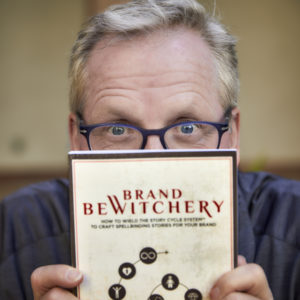
While the rest of us chased tennis balls, Michele quietly made her way over to the chair. She pulled a copy of my book, Brand Bewitchery, out of her beach bag and handed it up to him.
“Excuse me, Mr. Branson,” she said with a smile. “My husband is a big admirer of you, and he included you in his book. Twice. I wanted you to have a copy.”
“Thank you,” he said.
“Even though I probably wasn’t supposed to give you this book,” she added, “I figured it’s something you would do if you were in my shoes.”
Branson laughed. “You’re right,” he said, with a rebel nod.
That nod is the Virgin brand in a single gesture.
![Park Howell and Richard Branson [setting] on Necker Island, British Virgin Islands, March 2021](https://businessofstory.com/wp-content/uploads/2026/09/richard-branson-brand-storytelling-park-howell-necker-island-2021-768x1024.jpeg)
Branson shows up in Brand Bewitchery more than once. I called him “the marvelous brand showman.” I filed him under the Daring Explorer archetype, right beside Amelia Earhart. And I quoted him:
“The Virgin story—its ups, downs, opportunities, and challenges—is what attracts people to its products and services, as well as attracting employees to join the Virgin family. We would be nothing without our story.”
I believed that when I wrote it in 2020. I still do. What I didn’t fully appreciate on that tennis court was the chapter of Branson’s story that had played out on the same island eleven months earlier, and what it reveals about every founder-led brand.
Did Richard Branson Use a Brand Storytelling System?
Yes. Richard Branson ran Virgin on a four-part brand storytelling system: six written brand values, a screen for entering new markets, a licensing company that guards the Virgin® name, and Branson himself as chief storyteller. That operating discipline now has a name, StoryOps™. Virgin’s failures show which parts a founder-led brand must install beyond the founder.
StoryOps™ is the operating discipline that governs brand narrative across every function, channel, and communicator at the precision of organizational infrastructure. Branson never used the word. He built the machinery anyway, and business schools have been documenting it for three decades.
Key takeaways
- Virgin codified its story in six brand values that every Virgin company inherits.
- The brand story decided which markets Virgin entered: places where customers felt ripped off and incumbents had grown complacent.
- Virgin Enterprises Limited owns the Virgin name and licenses it, which makes the brand story a governed asset.
- The system broke in three places: when the founder overrode the screen (Virgin Cola), when the founder’s own story collided with the moment (Necker Island in 2020), and when the promise outran operations (Virgin Galactic and Virgin Orbit). The Epstein files expose a deeper failure: values with no system to guard them in a moment of temptation.
- The lesson for any founder-led brand: install a screen, a guardian, and a Brand Brain™ that live outside the founder’s head.
What Were the Four Parts of Virgin’s Brand Storytelling System?
1. Six written brand values
Every Virgin company inherits the same six brand values: value for money, good quality, brilliant customer service, innovation, being “competitively challenging: sticking two fingers up to the establishment,” and fun (Robert M. Grant, Contemporary Strategy Analysis case, p. 284). An airline, a bank, and a gym chain all answer to the same six lines.
2. A screen for entering new markets
Virgin goes where “the customer has been ripped off or under-served, where there is confusion and/or where the competition is complacent” (Grant, p. 284). The brand story works as a strategy filter. It decides which markets the company enters before the marketing department ever sees a brief.
3. A brand guardian with legal teeth
Virgin Enterprises Limited owns the Virgin name and licenses it to every company that carries it. Its intellectual property lawyer described the job plainly: “Our role is both to optimize and enhance the value of the brand and to protect that by ensuring that that value is not diminished” (Grant, p. 289).
I call this Story Sovereignty. Story Sovereignty means treating your brand narrative – the only story your brand can tell – as property you license, audit, and defend.
4. A chief storyteller
Branson himself. A teaching note for the Grant case concludes that the Virgin brand “is closely associated with the personality and character of Branson,” to the point where the two are nearly impossible to separate (Grant teaching note). Branson made the point himself on his blog: “Today, if you want to succeed as an entrepreneur, you also have to be a storyteller” (Virgin, 2016).
Did Virgin’s system produce measurable results?
Yes, at least by Virgin’s own measure. Virgin Atlantic tracked six “Virginness” attributes against British Airways from 1993 onward. Between 2007 and 2009, the airline reported £213.64 million in incremental revenue from £20.77 million in communications spend, or £10.28 for every £1 (The Marketing Society). Those are company-reported figures from an awards entry. They still show a brand story being tracked like an operating metric.
Most companies stop at the first part. They write the values, frame them in the lobby, and call it a brand. Virgin installed all four. The trouble is that one of the four was a single human being.
Why did Virgin Cola fail?
Virgin Cola failed because the underdog story was true and the product gave it nothing to stand on. Virgin launched the cola in 1994 as a declared war on Coca-Cola. By 1997 it was losing £5 million on £30 million in revenue (Grant, p. 286).
Branson later called it “one of the biggest mistakes we ever made” and admitted, “Declaring a soft drink war on Coke was madness” (Virgin). His lesson was to enter only businesses “where we were palpably better than all the competition” (Fox Business). The cola tasted marginally better. Marginal doesn’t beat Coke.
The screen existed. The storyteller overrode it. The same rebel nod Michele earned on that tennis court waved Virgin Cola straight past the screen.
That’s the first place the system broke. No one in the building had the authority to tell the founder his favorite story lacked a product to back it up.
What Happened When Branson Offered Necker Island as Collateral?
On April 20, 2020, Branson published a letter asking the UK government for a commercial loan to keep Virgin Atlantic flying, and pledged to raise money against Necker Island and his other assets (CNBC).
The public reaction was brutal.
Virgin Atlantic staff had already taken eight weeks of unpaid leave, and Labour deputy leader Angela Rayner suggested Branson sell the island to cover his employees’ pay (CNBC). The brand’s most mythic asset, the place where the legend lives, became the prop in its worst headline.
That’s the island we landed on eleven months later.
Why is a founder-led brand a single point of failure?
A Brand Brain™ is the living source of truth that holds a brand’s story outside any single person’s head. Virgin’s Brand Brain was Richard Branson.
That design works beautifully while the founder is the most trusted voice in the room. When the founder’s own story collides with the moment, every company wearing the logo takes the hit.
INSEAD professor Manfred Kets de Vries saw the risk back in 2000, when his case on Virgin asked whether the brand could sustain itself beyond its founder’s involvement (INSEAD). Twenty years later, the answer arrived in a single news cycle.
What Do the Epstein Files Reveal About Branson’s Brand Story?
In early 2026, the U.S. Justice Department released another batch of Jeffrey Epstein’s files, and Richard Branson’s name was in them.
The emails show Epstein visiting Necker Island in 2013, five years after his guilty plea for procuring a minor for prostitution.
After one visit, Branson wrote, “Any time you’re in the area would love to see you. As long as you bring your harem!” (LBC). In another email, he suggested wording Epstein might use to repair his reputation, describing the crime as having “slipped up many years ago by sleeping with a 17 1/2 year old woman” (Canberra Times).
I read those words with a sinking stomach. This is the man I held up in my book as a marvelous brand showman. Necker is the island where Michele handed him that book.
Virgin says the contact was limited, that Virgin Unite turned down Epstein’s donation after due diligence, and that Branson considers Epstein’s actions abhorrent (Alliance magazine). The emails still say what they say. The people Epstein harmed deserve to have them taken seriously.
Here’s what the emails reveal about story. The rebel voice that sells airline seats followed Branson into a conversation with a convicted sex offender and joked along. And one of the great brand storytellers of our time drafted a redemption story for a predator.
Every one of us has lapses in judgment. Temptation is human. Evil can touch any of us.
That’s why values need a system around them. A brand StoryOps™ discipline asks one question before anyone hits send: does this sentence honor the story we tell the world and the people that story serves? Virgin’s six values had no answer for that moment.
Nobody was sitting in the umpire’s chair.
Honorable StoryOps™ means living your truest story when no one is watching, and guarding it most closely when temptation is.
What Went Wrong With Virgin Galactic and Virgin Orbit?
The space businesses carry one of the most Branson stories ever told: space travel for the rest of us.
Virgin Orbit filed for bankruptcy in April 2023 (TechCrunch). Virgin Galactic flew its last commercial mission in June 2024, and in August 2026 it pushed its next one to February 2027 (Space.com).
The story is magnificent. Operations can’t keep its schedule.
Narrative entropy is the steady erosion of a brand’s meaning when what it promises drifts away from what it delivers.
Every missed launch date makes the next promise a little harder to believe. The story still sells tickets. It just keeps selling them for flights that keep sliding to the right.
What Should Founder-led Brands Learn From Richard Branson?
Branson proved a story can carry a brand into airlines, trains, banks, gyms, and orbit. His failures show three jobs a story needs help with:
- Saying no.
- Keeping promises on schedule.
- Surviving the storyteller.
Those three jobs belong to the operating layer. Whether you run the company or run the agency that serves it, install these three:
- A screen that can say no to the founder.
Write your market-entry and brand-extension criteria down, and give someone the authority to enforce them. - A guardian with teeth.
Treat the brand story as licensed property with an owner, standards, and a regular audit. - A Brand Brain™ that lives outside any one head.
Codify the story so your people carry it when the founder is on a speedboat, in a headline, or gone.
I still picture Branson up in that white umpire’s chair, calling our shots with a grin while we scrambled below. He was an unbelievably generous, charismatic host.
Every brand needs someone in that chair. The job belongs to whoever holds the authority to call the founder’s shots out, too.
Branson built the story.
StoryOps™ keeps it alive after he leaves the room.
Install yours. Build your Brand Brain™ with the StoryCycle Genie®, and hear how other leaders govern their stories on The Business of Story podcast. More free resources are in our Story Tools library.
Story on, my friend.
Frequently Asked Questions About Richard Branson and Brand Storytelling
What is StoryOps™?
StoryOps™ is the operating discipline that governs brand narrative across every function, channel, and communicator at the precision of organizational infrastructure. Business of Story defined the term. Richard Branson’s Virgin Group is an early example of the discipline in practice, decades before it had a name.
What are Virgin’s brand values?
Virgin’s six brand values are value for money, good quality, brilliant customer service, innovation, being competitively challenging, and fun. Every company that licenses the Virgin name is expected to live by them, which is how one story holds together an airline, a bank, and a gym chain.
How does Virgin manage its brand across so many companies?
Virgin Enterprises Limited owns the Virgin name and trademarks and licenses them to each Virgin company. Its role, in the words of Virgin’s intellectual property lawyer, is to “optimize and enhance the value of the brand” and to ensure “that value is not diminished.” The brand story works as governed, licensed property.
Why did Virgin Cola fail?
Virgin Cola failed because its underdog story had no product advantage behind it. Launched in 1994 against Coca-Cola, it was losing £5 million on £30 million in revenue by 1997. Branson later called it one of Virgin’s biggest mistakes and resolved to enter only markets where Virgin was “palpably better.”
Why did Richard Branson offer Necker Island as collateral?
In April 2020, Branson pledged to raise money against Necker Island and other assets while asking the UK government for a commercial loan to keep Virgin Atlantic flying through COVID. The request drew heavy public criticism because Virgin Atlantic staff had already taken eight weeks of unpaid leave.
What is narrative entropy?
Narrative entropy is the steady erosion of a brand’s meaning when what it promises drifts away from what it delivers. Repeated delays at Virgin Galactic are one example: every missed launch date makes the brand’s next promise harder to believe.
What is a Brand Brain™?
A Brand Brain™ is the living source of truth that holds a brand’s story outside any single person’s head. It lets employees, partners, and AI tools carry the story consistently when the founder is out of the room.
Park Howell is the founder of Business of Story, creator of the Story Cycle System™ and StoryCycle Genie®, host of The Business of Story podcast, and author of Brand Bewitchery. More about Park.