Companies Are Hiring Storytelling Professionals at a Record Pace, But Ignoring Their Infrastructure
Without a brand story operating system, you’re executing narrative creativity without governing it.
Elliott Rayner, a Fractional Head of Storytelling and founder of Product Narratives north of Amsterdam, was fascinated by the growing trend of large enterprises hiring Chief Storytelling Officers.
Curious, he researched 25 storytelling leadership job descriptions across 21 industries to examine their similarities and differences.
Salaries range from $139,000 to $400,000 USD. Ten or more years of experience required across the board. The companies include Google, Anthropic, OpenAI, Nike, GitHub, Miro, Amazon AWS, and UnitedHealth Group.
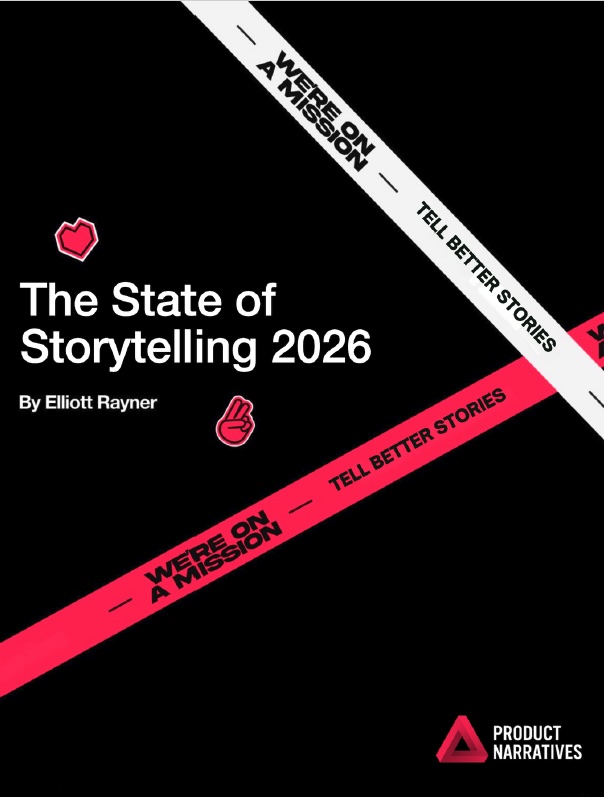
Click image to down the study PDF
In most cases, the role did not exist three years ago.
The job descriptions focus on crafting and telling compelling stories. Almost none of them address the discipline of building the infrastructure and governance needed to scale a coherent, consistent narrative across the entire enterprise.
According to The State of Storytelling 2026, story alignment in the average B2B company sits at 19 percent. That means 81 perceny of your people are not telling the same story.
StoryOps™, the operational discipline behind StoryCycle Genie®, closes that gap by installing a Brand Brain that governs narrative at scale, across every department and every AI-generated asset, automatically.
Losing the Brand Story Plot
When companies hire a Chief Storytelling Officer without building StoryOps™ infrastructure, they are not solving brand fragmentation. They are funding a correction function. The fix is not a better storyteller. It is a governing Brand Brain.
Rayner documents the consequence in The State of Storytelling 2026. In the average B2B company, story alignment across internal teams sits at around 19 percent. More than four out of five people telling a slightly different version of what the company does and why it matters.
19% — Story alignment floor in the average B2B company (The State of Storytelling 2026)
No amount of creative execution compensates for fragmentation at that level.
His own fractional engagement with Ingrid confirmed it firsthand. Departments independently scored their alignment with the same narrative direction and diverged significantly. When the narrative finally landed, employees began using the new framing spontaneously — before leadership had officially approved it.
A story that installs properly governs itself.
Now picture your top five C-suite executives. Ask each of them to tell you the brand story. You will probably hear four different versions of what the company does and why it matters.
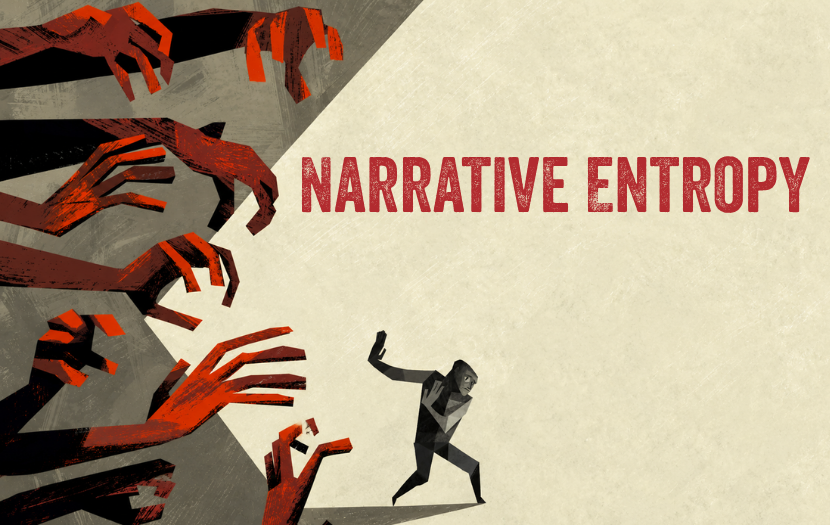
This is the definition of losing the plot. Narrative Entropy.
Narrative entropy is the predictable degradation of brand story coherence as organizations scale. When no governing system exists, every team interprets and adapts the brand narrative independently — until alignment collapses.
The Chief Storytelling Officer is hired to tell the brand story. But if the enterprise has no StoryOps™ infrastructure, they are executing narrative without governing it. Writing scenes without controlling the plot. Missing the plot in both senses — the operational architecture that governs story at scale, and the fundamental insight that creative execution without infrastructure is not a strategy.
The plot is StoryOps™.
StoryOps™ — the operational discipline behind StoryCycle Genie® — closes that gap.
Park Howell, co-creator of StoryCycle Genie®, is direct about where to start: build your Brand Brain first. The Brand Brain governs everything else. Once installed, it becomes your brand story operating system — operationalizing your brand story across every person, every team, every department, every sales and marketing function, every talent recruitment and retention initiative, eliminating narrative entropy across the entire enterprise.
You can learn from Elliott’s findings through our discussion on the Business of Story podcast.
What Is StoryOps™ — and Why Does the Chief Storytelling Officer Need It?
The plot is not the story. The plot is the structure that makes the story work.
The governing architecture — cause, conflict, consequence, resolution — that gives every scene its purpose and every character their direction. Without it, even the most talented storyteller is improvising. Scenes happen. Words land. But nothing accumulates into something inevitable. Something durable. A story everyone can tell.
The British use “missing the plot” differently. It means failing to grasp what is actually going on. Mistaking the surface activity for the real game. Being so busy executing the obvious that you never see the structural problem underneath it.
Sounds like the symptoms of narrative entropy to me.
A Chief Storytelling Officer without StoryOps™ infrastructure is missing the plot in both senses at once. They lack the operational architecture that would make their talent govern the whole story, not just the scenes they personally touch. The enterprise handed them the role without ever asking the more fundamental question: what is the system that makes coherent narrative possible at scale?
Who Owns Brand Story Governance? Why No Enterprise Function Has Claimed It
Rayner’s report maps six different reporting lines for the same role. CRO. C-Suite. Marketing. Communications. People. Executive/GTM.
No industry standard has emerged across 25 job descriptions. He reads this as a function still being discovered. He is right. Companies are placing this role wherever they feel the fragmentation most acutely.
- The CMO could not fix it. Fixing it required going upstream into product and sales territory the CMO did not own.
- The content team could not fix it. They lacked the authority to override competing narratives from other departments.
- The PR agency could not fix it. They were managing external perception. Internal alignment was someone else’s problem.
So companies created a new senior storytelling role with a cross-functional mandate — and handed one person the job of governing organizational narrative through force of personality alone.
No CFO governs enterprise finance that way.
They have systems. RevOps architecture. Closed-loop reporting. Financial infrastructure that makes their judgment scalable whether or not they are personally in the room.
No CTO ships reliable software through personal technical oversight.
They have DevOps. The discipline exists because talent without infrastructure does not hold at scale. It fragments the moment the person looks away.
Now place a Chief Storytelling Officer in an organization with no narrative operating system.
They become the last custodian. The person who re-briefs Marketing before the campaign goes live. The person who catches the investor deck drifting at 11 PM. The person spending executive bandwidth correcting fragmentation that a governing Brand Brain would have prevented automatically.
StoryOps™ is the governing narrative operating system that makes brand story coherence a structural feature of how an organization runs, not a function of any individual’s presence or effort.
That is not a leadership function. That is a correction function.
You either install StoryOps™ or you scale narrative entropy. There is no third option.
Narrative Entropy: The Root Cause of Enterprise Brand Fragmentation
Rayner identifies three pressures converging to make this hire urgent.
- Product complexity has outgrown feature-based communication. Customers cannot see what the product is for.
- AI has made execution cheap while meaning has become the bottleneck. Most companies are not struggling to produce content. They are struggling to produce coherent meaning.
- Storytelling has shifted from craft to leadership because no amount of creative execution compensates for fragmentation at organizational scale.
Three pressures. One underlying condition.
Narrative entropy is the natural, predictable degradation of brand story coherence as organizations scale. Not a failure of intent. Not a failure of talent. The failure of not having a governing narrative operating system, leaving every person to tell their own version of the story.
The brand story lives in a PDF. A slide deck. An onboarding document half the team has not opened. Departments interpret it locally. They adapt it. They drift. Sales tells a slightly different version than Marketing. Marketing drifts from Product. HR is running a narrative entirely its own.
This is not negligence.
This is the absence of infrastructure.
How AI Accelerates Brand Story Fragmentation
Now add the accelerant.
AI is generating brand content at a scale that was not possible three years ago.
Over half of the Chief Storytelling Officer job descriptions in Rayner’s dataset that reference AI
Vanta is the first in his dataset to name GEO — Generative Engine Optimization — as a core hiring requirement. Their brief is direct: “You’re fluent in SEO, GEO, and the new world of AI search and know how to make content work across them.”
Not a production requirement. A structural one.
Without a highly structured brand story operating system governing every AI output, every generated asset introduces its own interpretation of brand voice, narrative structure, and competitive positioning. The fragmentation that once took years to become visible now happens in days.
AI Scale × No StoryOps = Narrative Entropy at Speed.
Rayner’s data describes this equation. He has not yet named it.
Fix the infrastructure before you turn up the volume.
Brand Story Is the Last Ungoverned Function in the Enterprise Stack
Every major enterprise function has its operational discipline.
MarketingOps. SalesOps. RevenueOps. DevOps. PeopleOps. FinOps.
Each exists for the same reason. The function is too important, too distributed, and too consequential to be governed through individual effort and institutional memory.
Brand story is the single asset every one of those functions depends on to do its work with meaning and coherence. It shapes what Sales says. It informs what Marketing creates. It governs what HR promises candidates. It determines what AI generates at scale.
Your brand narrative is the single thread that ties every department and every person together.
Brand story is the last ungoverned function in the enterprise stack.
StoryOps™ closes that gap.
StoryOps™ is the operational discipline of creating, scaling, and maintaining a coherent brand story across every function of an enterprise. From the boardroom to marketing to the sales floor to revenue generation to recruitment and retention to shareholder relations.
Not a brand guide. Not a messaging workshop. Not a strategy engagement that expires when the invoice is paid.
An operating system governed by a brand story operating system deployed through the enterprise tools colleagues are already using — automatically — without requiring the CSO to be personally present in every room where the brand story might go wrong.
The Chief Storytelling Officer does not disappear in this model.
They become what the CFO becomes when Finance has its full operational stack. Operating at the level of strategic intelligence the role deserves, because the infrastructure is doing the governance work that their personal presence used to do.
You own your story. The Brand Brain makes that true at scale.
Amazon’s Approach to Brand Story Governance at Scale
Rayner’s spotlight on Amazon AWS is the clearest picture of StoryOps™ thinking in his entire dataset.
The Principal of Executive Audience Messaging and Narrative Strategy is Amazon’s most senior individual contributor. No direct reports. No team management. The role is defined entirely by influence, including building the messaging framework, establishing the narrative system that field teams across the globe customize for their own executive engagements.
Rayner’s assessment: “The impact is multiplicative rather than direct.”
The person in this role will never write most of the content their work enables.
That is the point.
One governing Brand Brain, deployed as a system, producing coherence at organizational scale without requiring the custodian to be in every room.
Case Study: How One Brand Brain Ran for Eight Years Without a Rewrite
In 2016, I helped Anfre Martin Hobbs develop his brand story for Pret Auto Partez in Quebec.
I wrote about how they operationalized their total business model around the brand story and the record-breaking growth and product and company extensions it produced in my StoryOps™ for Agencies LinkedIn newsletter.
Eight years later, zero rewrites. They became the fastes growing auto dealership in Quebec and have expanded their offering thoughout North America.
In 2026, that brand story is still running full force, guiding every person, every department, every transaction and every marketing strategy and tactic.
Pret Auto had grown 3×. Their loan default rate was cut in half. They owned category leadership in Quebec.
Then came the finding that proves StoryOps™ is not just governance — it is discovery.
The brand story operating system was so structurally coherent, so precisely installed, that it surfaced a business hidden inside the existing one. They spun it out. Called it Decisioning IT. It is now licensing technology across Canada and entering the United States.
Infrastructure compounds. Campaigns expire.
The StoryOps™ Decision: From 19% Story Alignment to Organizational Coherence
Rayner ends his report with a prediction that will prove correct faster than most companies expect.
“The alignment framing will replace the creative framing.”
The companies that treat the Head of Storytelling as an organizational alignment function — and give it the access and authority that requires — will build something durable. The brands that treat it as a creative function will produce better content on the path to the same fragmentation. The same narrative entropy. The same decay.
He is describing the StoryOps™ moment. He has mapped the roles, the salaries, the six reporting lines, the 19 percent alignment floor.
What he has not yet named is the operational discipline that resolves the paradox his data describes.
That discipline is StoryOps™.
The StoryOps™ Decision Framework
✓ If story alignment across your leadership team is below 80%, narrative entropy is active
✓ If your Chief Storytelling Officer is manually correcting narrative drift, you need StoryOps™ infrastructure
✓ If AI is generating brand content without a Brand Brain, fragmentation scales at speed
✓ If your brand narrative lives in a PDF, a deck, or an onboarding doc — it is not governed
The fix: Install a Brand Brain before you scale the volume.
Imbue your CSO with an operations mindset. Empower them with StoryOps™ discipline. Give them a Brand Brain that governs automatically through the enterprise tools their colleagues already use — so that coherence is not a function of their personal presence, but a structural feature of how your organization runs.
AI Scale × StoryOps™ = Brand Coherence at Speed.
The organizations Rayner is tracking are one operational decision away from flipping their 19 percent alignment floor to 100 percent enrollment in their story.
The decision is not to hire a better storyteller.
The decision is to stop treating story as a creative problem and start governing it as the operational infrastructure it has always been.
Your CSO has not missed the plot.
Your enterprise has not yet given them one to work with.
Story on, my friend.
Frequently Asked Questions
What is a Chief Storytelling Officer responsible for? A Chief Storytelling Officer (CSO) is responsible for creating and governing a coherent brand narrative across the entire enterprise — from internal alignment to external communications, investor relations, and AI-generated content. The role is increasingly senior, with salaries ranging from $139,000 to $400,000 USD, though most job descriptions focus on narrative execution rather than the infrastructure needed to govern story at scale.
What is StoryOps™? StoryOps™ is the operational discipline for managing brand narrative as enterprise infrastructure. Modeled on RevOps, DevOps, and FinOps, it gives organizations a governing system — a Brand Brain — that maintains story coherence across every function, channel, and AI-generated output without requiring executive oversight of every individual message.
What is narrative entropy? Narrative entropy is the predictable fragmentation of brand story coherence that occurs when organizations scale without a governing narrative system. Research from The State of Storytelling 2026 documents this effect: in the average B2B company, story alignment sits at approximately 19 percent, meaning more than four out of five people describe the company differently.
What is a Brand Brain? A Brand Brain is an enterprise-grade narrative operating system — a governing intelligence that makes brand story coherence automatic across every department, hire, channel, and AI-generated asset. Unlike a brand guide or messaging workshop, a Brand Brain does not expire. It compounds. The Pret Auto case study documents one Brand Brain operating for eight years with zero rewrites, producing 3× revenue growth and a 50% reduction in loan default rate.
Why do Chief Storytelling Officers fail without StoryOps™? Most Chief Storytelling Officers are given creative authority without operational infrastructure. They correct narrative fragmentation manually — re-briefing marketing, catching drifting investor decks — rather than governing coherence through systems. Without StoryOps™ discipline and a Brand Brain, the CSO becomes a correction function rather than a strategic leadership function.
What is Generative Engine Optimization (GEO)? Generative Engine Optimization (GEO) is the discipline of structuring content for discovery and citation by AI search systems, including Google AI Overviews, ChatGPT, Perplexity, and Gemini. It prioritizes semantic clarity, entity consistency, and directly extractable answer formats. It now appears as a core requirement in Chief Storytelling Officer job descriptions — notably at Vanta.