What Barry LaBov and I Uncovered Live on Difference Talks
Barry LaBov literally wrote the book on differentiation.
So when I asked him, live on his own podcast, to boil his brand story down to one word, I figured he’d nail it.
“Differentiation,” he said.
Differentiation is what his firm, LABOV, makes. So I asked what LABOV makes happen for its clients.
“Confidence. Engagement. Inspiration.”
There it was. By my count, Barry had said “inspire” or “inspiration” close to ten times in the previous five minutes without hearing it.
If one of the sharpest differentiation minds in business reaches for the widget first, what are the odds your company does too?
I talk about this with Barry, founder and CEO of LABOV and two-time Ernst & Young Entrepreneur of the Year honoree, on the Difference Talks podcast. Thank you, Barry, for having me and for being such a good sport as my live ABT test subject.
Watch or listen to Park Howell on Difference Talks: Buzzsprout | YouTube | iTunes | Spotify, or wherever you get your podcasts.
Why Do Smart B2B Companies Sound So Boring?
Because they tell the story of their widget.
I wrestled with this for 20 years running Park&Co, my largely B2B agency in Phoenix. Every B2B message lands on a human being inside a business, someone with fears, frustrations, and ambitions. As I used to joke with our CEO clients, B2B does not have to mean “boring-to-bored.”
Barry described a brilliant engineering VP whose breakthrough product was barely selling. His theory: if people want something great, they’ll find it.
My answer is an axiom I teach every client: “Your story is not about what you make. It’s about what you make happen for your customers.” Buyers have to trust you can deliver that outcome before they’ll care about your offering.
And you still have to tell them. Sandy Peterson, one of my first bosses at Peterson Communications in Phoenix, put it best: “Even a 2,000-year-old church rings its bell every Sunday morning to let the customers know their doors are open.”
What Does an ABT Sound Like When You Build It Live?
The And, But, Therefore (ABT) framework from my book The Narrative Gym for Business is what I call the DNA of story.
- And names your audience and what they want.
- But names the negative emotion they feel, because of the problem in their way.
- Therefore pictures the relief, with your call to action saved for last.
Here’s the ABT Barry and I built on air from his notes, with inspiration as the narrative thread:
As a CEO of a growing B2B or healthcare organization, you want to inspire your people and your customers with your offering. And if you had a crystal-clear brand story built on a differentiation only you can own, you’d see that inspiration lead to engagement, revenue, and even a better night’s sleep.
But you’re frustrated, maybe even exhausted, because you’re not living into the revenue and impact you dream of. Your people aren’t inspired, and your customers aren’t engaging, because your story lacks the differentiation that cuts through the noise.
Therefore, imagine the relief when all your people show up every morning ready to do work that impacts the world. LABOV can help you get there through brand reengineering.
LABOV doesn’t appear until the final line. Everything before it builds what I call the three forces of trust: understanding, appreciation, and empathy. Trust earns the call to action.
What Does Generic AI Do to Your Brand Story?
It flattens it.
Barry voiced a fear I hear constantly: leaders replacing their marketing teams with one person and a chatbot. Let generic models publish for you unsupervised, and they sand your copy down until your differentiation disappears.
I call this narrative entropy: the fragmenting of your brand story. If AI can’t understand what makes you different, it won’t recommend you, and I’m watching more buyers ask AI for referrals instead of searching Google.
Artificial intelligence is the worst brand name ever given to the most amazing innovation of our lifetimes. I prefer artful intelligence: collaborating with AI on your specific story, guided by your experience and customer knowledge.
What Is a Brand Brain, and Why Build It First?
A brand brain is the single source of truth your team and your AI tools draw from. Build your narrative strategy, create a version for each of your top three audiences, and bring it together in a content playbook. Skip it, and everyone writes from their own version of the story.
I write my Brand StoryOps™ for Agencies newsletter with StoryCycle Genie® working from my brand brain.
I bring the idea, the argument, and 40-plus years of anecdotes.
The Genie helps research and draft. An issue that once took 10 to 12 hours now takes about four, and a friend recently wrote me, “Your writing has gotten really good.”
In fact, this post is an example of what the Genie makes happen for me. Here are the steps I use to write these posts that are completely search-optimized for SEO, GEO and AEO, as well as written from your point of view, the reader’s.
- I start my collaboration with the StoryCycle Genie® by first telling it Brand Brain, that I want to work from the Business of Story content playbook and Park’s Voice Profile so it writes everything on-brand and in my voice.
- I then feed the Genie the transcript from our conversation so it has a total understanding of the content while identifying the singular problem/solution dynamic that is thread throughout the entire conversation and this article.
- I direct it to write an 800-word thought leadership post fully optimized for SEO, GEO and AEO search, and to follow a prescribed format.
- In 30 seconds, based on the transcript, it provides the article, which I then edit and add anecdotes and other insights applying even more of my voice and insights for the reader.
- Once I’m happy with the article, I have the Genie clean up the transcript by adding H2 subheads to make the sections of the conversatiobn more easily readable while adding greater search content for the AI bots.
- We finish the piece together with the FAQs that are easily skimmable by readers and are cat nip to the AI search and recommendation engines.
- Finally, I ask the Genie to provide the most search-rich metadata and permalink for the hero graphic and the article URL.
Producing this thought leadership piece takes about 30 minutes with the Genie. It would take four hours writing it the old way.
So What Does Your Company Make Happen?
Barry found his answer in a few minutes: inspiration.
Find yours. Build it into an ABT. Lock it into a brand brain, and let artful intelligence carry it everywhere your buyers look.
Then ring the bell.
Park Howell’s Conversation With Barry Labov on the Difference Talks Podcast
Why Do Smart B2B Companies Sound Boring?
Barry LaBov: Every business has a story, but not every business knows how to tell it in a way that makes people care. Our guest today, Park Howell, has built his career helping leaders close that gap.
He is the founder of the Business of Story. He’s written several books. He has his own creative process that he has turned into a brilliant technology we’ll talk about.
And after two decades of running an agency, he’s now out there helping leaders communicate and tell their story. Park, welcome to our show.
Park Howell: Barry, thanks so much for having me. Great to see you again.
Barry: Great to see you again. I have a question, because this is something I’ve dealt with. We work with companies that are B2B, industrial, healthcare, et cetera.
Why do so many smart companies make themselves sound boring?
Park: Well, you said the first acronym there: B2B, business to business. I ran into this all the time over 20 years with my agency. We worked mostly in the business-to-business realm.
We had to keep reminding the CEOs and CMOs we worked with that they weren’t actually communicating to businesses. They were communicating to human beings inside a business.
I would often joke with them that B2B does not have to mean boring to bored.
In fact, you need to flip that on its ear and really excite and surprise your audiences. Know that you’re always selling to humans: what they care about, what they fear, what their frustrations are.
If they don’t have a problem, they’re not going to buy your solution. So really understand what that is, and turn boring to bored into brilliant.
Why Your Brand Story Should Focus on Customer Outcomes
Barry: I like that. So often I’ll sit down with, let’s say, an engineer who’s the VP of a manufacturing company. They’re brilliant.
They’ve come up with an incredible new concept, spent lots of money and lots of time, and they’re wondering why it’s not selling.
After talking with them, I’ll ask, “What are you doing to promote it?” Most of the time they say, “Well, we figure if people really want something great, they’ll know what we’re doing and they’ll buy it.”
I also often ask, “Are you selling it at a premium?” And they’ll say, “Well, no. We have competition. We can’t afford to do that.”
Park, what insights can you give that brilliant leader who’s sitting there thinking, “I’m living in a crazy world here, because there’s too much being left on the table, even though we’ve created genius ideas, products, and technology”?
Park: The first thing is an axiom I really like and promote a lot with my clients and the people I train: your story is not about what you make. It’s about what you make happen for your customers.
Your customers don’t really care about your genius. They don’t care about your widget. They don’t care how you cobbled together AI to do this thing and that thing for them.
They only care about the outcome. How are you going to solve a problem for me? How are you going to make my life better, easier, faster, more fun, more profitable? That’s what they’re looking for.
They first have to trust that you can deliver on that outcome before they care about your offering. If you can make me handsome and rich in the next six months, I’m interested. How do you do that? Then you talk about your service or offering.
But what typically happens is they flip that, just like you said. They show up with what they believe, and may know, is a brilliant product or service.
They get so enamored with it that they believe their audiences will see it, recognize it for what it is, and say, “I’ve got to have some of that.” It just doesn’t happen that way.
We are all so bombarded with communication that unless you’re talking to people emotionally, about what’s in it for them, the rest falls on deaf ears.
Why Marketing Still Matters: Ring the Bell
Park: Number two, you remind me of something Sandy Peterson once told me. He was one of my first bosses, way back in the day, at Peterson Communications, a primarily B2B agency in Phoenix.
He would tell his clients, “Even a 2,000-year-old church rings its bell every Sunday morning to let the customers know their doors are open.”
If you’re not marketing out there, if you think people are just going to randomly show up and find your wonderful product, you’re completely missing the bells.
How to Promote Craftsmanship Without Bragging
Barry: I love the bells. That’s brilliant. All right, answer this for me. I dealt with an Amish RV manufacturer, which sounds like the beginning of a stand-up comedian’s joke, right?
Park: It does.
Barry: He was walking me through the work they do and the craftsmanship, and my gosh, it was really impressive.
I mentioned some of the things you just did, and he said, “Look, we don’t want to brag. We don’t feel it’s appropriate to brag.” What’s your response to that?
Park: Don’t brag, because that’s another thing about storytelling. I said your stories are about what you make happen. The other thing is that your stories are not about you.
People don’t actually care about you or your brand. They care about themselves. So instead of being the braggart, place them at the center of the story and what’s in it for them. You’ve heard me say that two or three times now.
What Is the And, But, Therefore (ABT) Framework?
Park: Barry, you know me and the work I’ve done. In my second book, The Narrative Gym for Business, there’s a fabulous framework called the And, But, Therefore framework.
I think your listeners and viewers would get a great deal of value out of it, if you want to take a couple of minutes and go through it.
It shows how to message to your audience by placing your customer at the center of the story: what’s in it for them, and how you’re going to help them get what they want. You want to try it?
Barry: I love And, But, Therefore. Please do it, because that’s what this show is all about. We’re trying to inspire and give great information. Let’s go for it.
Park: All right, I’m going to take some notes, because I’m going to use you. Is that okay?
Barry: Sure, go right ahead.
Park: Let’s demonstrate the And, But, Therefore framework. I call it the DNA of storytelling, because it uses the three forces of story: agreement, contradiction, and consequence.
Think about this for your brand. I’ll give you the overview, and then we’ll work you through it, Barry.
So, everyone out there, including you, Barry: who is your number one audience? Be as specific as you can, because chances are that number one audience makes up 80% of your revenue.
That’s your audience persona. It’s the Pareto principle, and I’ve seen it over and over again in 40 years in the advertising world.
Identify that audience and describe what they want relative to your offering. They may not even know what you’re offering, so you’re foreshadowing your call to action. But you know them so well that you know what they want and that you can help them get it.
That’s the And statement of agreement: name your audience, what they want, and why it’s important to them. Keep it aspirational and positive.
You want them nodding in agreement: “Wow, Barry, you know me. Park, you understand me. You know what I want.”
Now you introduce the contradiction, the big But. Explain a negative emotion they’re experiencing right now. It could be fear, frustration, a lack of optimism, whatever it might be, because of what problem?
The problem keeping them from getting what they want, which you’re going to help them fix.
So we’ve got the statement of agreement: audience, what they want, and why it’s important. Then the statement of contradiction: but they’re frustrated because of this problem.
Finally, you go to the Therefore statement of consequence. Get them to picture a positive emotion in contrast to the negative emotion in the But statement. Imagine how great it’s going to feel when this happens because you worked with us.
You save your call to action, your brand, your actual offering, for the second clause of the Therefore statement.
Basically, Barry, what we’re talking about is setup, problem, resolution. It’s the way our subconscious, limbic, buying, pattern-seeking brain wants to receive information.
And for you as the storyteller, it makes you tell your story from your audience’s point of view. What’s in it for them? Why is it important to them? Why don’t they have it? Therefore, how are you going to help them get it? Does that make sense?
Barry: It’s brilliant. Absolutely brilliant.
How to Build an ABT: A Live Brand Messaging Example
Park: So let’s build one very quickly for you. We could build it on the podcast audience, if you want more people coming to the podcast, or on your overall service offering. Which would you like?
Barry: Let’s do my overall business.
Park: Okay. Who is your number one audience persona? How would you describe them in as few words as possible?
Barry: Leaders of B2B or healthcare organizations.
Park: And when you say leaders, are these CMOs, CEOs?
Barry: CEOs primarily, CMOs secondarily.
Park: Okay, so CEOs of B2B and healthcare organizations. Interesting, you’ve got two of them.
What is it that they want, that you know they want, that you can get for them? Remember, these are people who don’t know anything about you or your agency.
Barry: They need a clear description and story around what they offer that is unique in the marketplace compared to their competition.
Park: And what will that get them if they have it?
Barry: It will inspire their employees as well as their selling distribution system, whether that’s dealers or distributors, enabling them to charge a premium and command market share.
Park: All right. Thanks for your patience. I’m just writing madly over here.
That’s what they want. Why don’t they have it? What are they feeling right now? Are they frustrated? Are they exhausted? What’s the main emotion they’re feeling because they don’t have this?
Barry: They have great frustration, because internally there’s a lack of inspiration among employees to do great work. Why would they care, as an example?
They’re frustrated with their selling distribution system, because it lacks loyalty and engagement. They feel they’re leaving too much on the table every day.
Park: This is great. What are they going to feel when you solve this problem? Get them to picture a brighter tomorrow. What’s the feeling opposite the frustration?
Barry: There will be relief and inspiration, because they can wake up every day knowing they’re focusing their entire enterprise on what they do best, something that cannot be copied by the competition.
It will inspire employees and align that distribution network. It will allow them to command a premium and strong market share.
Park: And how do you help them do this?
Barry: We have a process called brand reengineering, where we discover what makes their product or service unique. We help them name it and communicate it.
And we go deeper than that, because we can inspire their entire enterprise, which includes training people to present that product or service.
How to Find Your Brand’s Single Narrative Thread
Park: Great stuff, Barry. For all of you out there, this is the way an ABT always comes together. Get your thoughts down: “What am I trying to say? I’m trying to say this.”
It’s going to end up long. Just get the notes out of your head. It’s a little like Wordle meets Sudoku, but for your brand. It’s a puzzle you’re solving.
Now that you’ve told me all of this, I’m going to look for the singular narrative thread. In everything you told me, Barry, can you boil it down to one word that is the theme of this entire And, But, Therefore statement?
Barry: Differentiation.
Park: Okay. Can I offer you an option? Differentiation is what you make. But what do you make happen for your audience? What’s the emotion? You said it about ten times when you were talking through that.
Barry: Well, there’s confidence. Engagement. Inspiration.
Park: That’s it. That’s what I heard you say over and over again, which tells me that’s your main theme right now: inspiration.
You want to run an inspired enterprise, but it’s uninspired at the moment. Therefore, we can bring inspiration through our proven methodology.
We call that a conversational ABT. It’s very vacuous, but it gets us down to: you want inspiration, you don’t have inspiration, therefore we’re going to give you inspiration.
Barry: Right.
The Finished ABT: A Brand Story Example for B2B and Healthcare CEOs
Park: Now you go back in and fill in the blanks we went through. This is coming off the top of my head from these notes.
I like to use second person, “you.” I want to picture that CEO sitting right across from me, because it gets me out of my head as the brand, as the engineer, and makes me live in their world. So it might be something like this:
As a CEO of a growing B2B or healthcare organization, you want to inspire your people and your customers with your offering. And if you had a crystal-clear brand story built on a differentiation that only you can own, you would see that inspiration lead to engagement and revenue, and even a better night’s sleep. Throw some fun stuff in there, right?
But you’re frustrated, maybe even exhausted, because you’re not living into the revenue and impact you dream of. Your people aren’t inspired, and your customers aren’t engaging with you, because your story lacks the differentiation that cuts through the noise.
Therefore, imagine the relief you’ll feel when all of your people show up every morning ready to do the work that’s going to impact the world. We can help you do it at LABOV through… and then you fill in what you do there.
But you save your call to action for the very end. You’re keeping it all about them.
How the ABT Builds the Three Forces of Trust
Park: Here’s something I’ve found. While the And, But, Therefore uses the three forces of story, agreement, contradiction, and consequence, doing it this way also builds what I call the three forces of trust.
You understand who your audience is, and you demonstrate that by naming them right up top. You appreciate what they want and why it’s important to them.
So they’re looking at you saying, “Geez, Barry, you’ve done your homework. Thank you. You really do get me.” And you empathize with what they’re going through.
Through that understanding, appreciation, and empathy, you build trust for the final line: here’s what a brighter tomorrow can look like if you work with us. Setup, problem, resolution.
The ABT is the most powerful framework I’ve found to answer the question you started this interview with: how do I talk directly to my customers about what’s in it for them?
Barry: That is absolutely genius. When we come back for the second half, I’m going to ask you about AI, because today you’re very engaged with a very innovative, AI-based product.
And we’re in a world where AI is taking over much of the messaging, for better or very possibly for worse. We’ll be right back on Difference Talks.
Is Generic AI a Threat to Brand Differentiation?
Barry: We are back with Park Howell, brilliant writer, creator, and brand story genius. Park, let’s focus our second half on AI, because you’re a pioneer in this field.
At the same time, many of us feel it’s a threat to creativity, to branding, et cetera. Please tell us your position and what you’re doing.
Park: Well, it is a threat. If you just use generic AI models like ChatGPT and Claude to write your stuff and put it out in the world, they’re going to generalize it and flatten it.
Barry, you’re all about differentiation, and you are going to lose your differentiation in the market if you do that. I call it narrative entropy: the fragmenting of your brand story.
Now your story is in all these different pieces. The AI bots grab it and spew it back out into the world. Nobody really understands your core differentiation anymore, or even what you do.
It goes so far that if the AI bots don’t get you, they won’t recommend you or refer you. And more people are going to AI and ChatGPT for referrals than looking on Google.
What Is Artful Intelligence?
Park: So, job number one: artificial intelligence is the worst brand name ever given to the most amazing innovation any of us has ever experienced. If you’re using it in a generic way, it is artificial.
Barry, I like to think of it as artful intelligence. That’s when you truly collaborate with the models to do specific things, like we built ours, the StoryCycle Genie®, to do.
It helps people find their story, define it, create it, and then govern it across the enterprise, so it doesn’t suffer the narrative entropy everybody is fighting. The default mode is your brand story falling apart.
You can use the artful intelligence of AI to find your story, define it, and get everyone behind it. That’s what I’m really bullish about and really excited about with AI in our world.
Should You Replace Your Marketing Team With AI?
Barry: Tell us a little more about that, because I love “artful intelligence.” My experience, like most of us, is that I can easily detect when somebody uses AI to spit out a message, and you go, “My gosh, please.”
Help me with this. I have a fear, I’ll call it an anxiety. I know many, many people in business who think, “You know what? We’ll let go of our marketing people, our marketing department. We’ll use AI. We’ll have only one person, and that person will just use AI and spit this stuff out.”
Help us understand the downsides to that, because there are many very smart people running companies who are thinking, “Get rid of those people. Let’s use this one person, or this one AI concept, instead of human interaction, human knowledge, and decision making.”
Park: Great question. Artificial intelligence does not have your experience. It doesn’t have your customer knowledge or your ability to see trends in your industry: where you’ve got to pivot, where you could take advantage of white space.
It can help you research that, but it can’t help you communicate it at the level and depth you need as a human being.
If you’re just relying on generic AI and spewing stuff out into the world, it’s doing you no good. It’s doing you way more harm, because you’re losing your differentiation. You’re even losing your search visibility in doing so.
How to Use AI to Write Thought Leadership Content
Barry: Park, how do you use AI? Share that with our audience.
Park: We created our Story Cycle System™, the branding process we’ve used for over 20 years, and grown brands by as much as 600% with it.
We built the StoryCycle Genie® on the Brightsy platform, which is totally proprietary, and we use Claude, ChatGPT, and some of the other models to help build out brand stories. We have a specific use for this tool: to help you find, refine, and get everyone behind your brand story.
First, I build the brand brain, so it understands the Business of Story’s overall brand story and my messaging to my different customers.
Then, for instance, Barry, I launched a weekly newsletter on LinkedIn about three months ago called Brand StoryOps™ for Agencies. It’s about how agencies can help clients govern their brand story.
That becomes a whole new service offering and line of revenue for them, because governing the story is so critical now with AI.
You can go to LinkedIn and read any of those issues. I’ve got a new one going out today, as a matter of fact, and I use our Genie to write it.
Here’s how I do it. I have the idea. I know what my argument is. I know the kind of research I’m looking for. It’s me, a human with 40-plus years of experience in this world, saying, “I see this trend happening. I’m curious. Let’s talk about it.”
I then use the Genie and Claude’s research tools inside it to pull out the research. I read through it.
This week’s issue is about brand archetypes and the importance of having a consistent brand personality to help govern your overall story. The Genie gives me a first draft, written as thought leadership, and I ask it to pose lots of questions to my readers, who are primarily agency owners.
While it’s writing, I think of anecdotes. This one happens to come from the kind of world you’re in, Barry: Brokk, a Swedish manufacturer of demolition equipment, heavy concrete breakers and that kind of thing.
I talk about a campaign we did for them back in 2001, and one of those ads is still running today, because we really dialed in their brand persona and took them from boring to bored to brilliant marketing that stood out.
I wanted that at the beginning of my article. I wrote the anecdote myself and gave it back to Claude. Now it knows that story, it goes into my story bank, and it helps me weave that story throughout.
The piece ended up being, believe it or not, a 5,000-word blog post. I thought, “That’s way too long. No one’s going to read it.”
So I asked the Genie whether it was worth keeping it that long or whether I should split it into two articles. It gave me an argument for both sides and recommended keeping the whole piece.
So I posted that on my blog, then worked with the Genie to create the shorter issue for the LinkedIn newsletter, which links back to the blog post.
All in, I spent about four hours writing an article that would have taken me 10 to 12 hours without the artful intelligence of AI, the Genie, working with me.
And now people write to tell me how strong my articles are. I got a note from a friend today who said, “Wow, your writing has gotten really good. I didn’t know you were that smart.”
It’s gotten better because AI has amplified what I already know: my human experience and how I want to communicate it.
It’s made it easier for me to focus on the most important parts of those articles instead of burning energy on minutiae AI can handle for me.
What Is a Brand Brain, and Why Does Every Leader Need One?
Barry: A couple of questions, because we have just a few minutes left, and I want our audience to have a really good grasp of where AI is today for them.
Let’s say it’s the leader of a company, and he or she has a marketing team using AI to some extent to generate presentations and recommendations. The leader isn’t paying extraordinarily close attention to it and isn’t in touch with that output.
What should that leader be making sure they’re doing? What’s the most powerful, or at least most efficient, use of AI for that leader today, to protect them but also give them as much productivity as possible?
Park: Job number one is to build a brand brain. Whether you’re using a generic AI model or the StoryCycle Genie®, the idea is to first build your narrative strategy. You iterate with the Genie until it’s completely dialed in the way you like it.
Then the Genie creates a version of that narrative strategy for each of your top three audiences, so it’s told from their perspective, their point of view, what’s in it for them.
Then you bring all of that knowledge together in a content playbook. Once the content playbook is built, the brand brain sits there informing everything your team creates.
Without a brand brain, people start creating content based on what they believe the brand story might be, or how they see it from their own perspective, and you get drift. You get narrative entropy.
So, job number one, whether you’re using generic AI or a custom tool like ours: build the brand brain, lock it down, and then build all of your strategy and content from that brain.
That helps ensure you have the story governance you need to stop narrative entropy.
What Fuels a Storyteller’s Best Day?
Barry: I’m going to finish on a question that’s more personal. You’ve dealt with a lot of different companies.
In my situation, I love our clients because, in a lot of cases, they’re so smart. Sometimes they’re engineering geniuses, sometimes medical geniuses. They’re unbelievable.
What is a best day for you, when you finish working with more energy and more inspiration than when you got up in the morning? What does that day look like, and what happened?
Park: It’s a day when I’ve had an aha moment, usually through writing or observation. As you know, you’ve been on my show, The Business of Story.
I’ve had the podcast for 12 years, and I’m coming up on 600 episodes with story artists from around the world. Every time I have a conversation, even today’s, I get a spark, an aha moment.
I let it percolate a little, and then when I sit down to write a thought leadership piece about it, it really gestates in my brain and I can see the big picture.
When I finally get that piece done and posted, whether in my LinkedIn newsletter, on my blog, or on the Genie site, I feel like, “Yes, I got this out into the world. I’m going to watch to see what happens.”
I try to get it done by noon or one o’clock, because I’ll often take the rest of the afternoon off to hike, play golf, or take my dog for a walk.
Finding those little aha moments has always driven me, because they feel like I’ve just learned something big, and I can’t wait to share it with everyone else.
Barry: I love that. I live that life too. I love the aha. I love doing something that’s never been done before, or realizing something and going, “My gosh.”
I truly think it keeps us alive and vibrant. It would be a horrible loss not to have that in your life, because that’s what fuels everything.
Park, thank you so much. We covered a wide range today, which I think our audience is going to love. We got very granular with your process in the first half. We talked about AI and the best ways to use it.
And we talked about the person who says, “I have this great company, and we’re just not capitalizing on it. Something’s missing.” Maybe we’ve helped that person today too.
I’ll make sure we leave links in the show notes so people can reach out to you. And I want to thank our audience. We appreciate your excitement about our show. Until next time, thank you from Difference Talks.
Park: Thank you, Barry.
Q: Why do so many smart B2B companies sound boring?
A: Smart B2B companies sound boring because they tell the story of their product instead of the outcome it creates for customers. On the Difference Talks podcast, brand storyteller Park Howell explained that every B2B message lands on human beings inside a business, people with fears, frustrations, and ambitions. His reminder to CEOs: B2B does not have to mean boring to bored.
Q: What does “your story is about what you make happen” mean?
A: It’s Park Howell’s axiom for customer-centered brand storytelling: “Your story is not about what you make. It’s about what you make happen for your customers.” Customers care about the outcome, such as a better, easier, faster, or more profitable life or business. They have to trust you can deliver that outcome before they’ll care about your product or service.
Q: How can a company promote its craftsmanship without bragging?
A: Put the customer at the center of the story instead of the company. Park Howell advises that people care about themselves, not your brand, so frame your craftsmanship around what it makes possible for the buyer. That way you’re telling their story, and the quality of your work becomes the proof.
Q: What is the And, But, Therefore (ABT) framework?
A: The And, But, Therefore (ABT) framework is a three-part narrative structure built on agreement, contradiction, and consequence. Park Howell calls it the DNA of storytelling and teaches it in The Narrative Gym for Business.
The And statement names your audience, what they want, and why it matters. The But statement names the negative emotion they feel right now, because of the problem in their way. The Therefore statement pictures the positive resolution and saves your call to action for last.
Q: How do you write an ABT for your brand?
A: Start by naming your number one audience persona, which likely drives about 80% of your revenue. Write down what they want, why it matters, the frustration they feel without it, and how they’ll feel once they have it.
Then find the single narrative thread, one word that runs through all your notes. On Difference Talks, Barry LaBov first answered “differentiation,” which is what LABOV makes. His real thread was “inspiration,” which is what LABOV makes happen for its clients.
Q: What is an example of an ABT for a B2B or healthcare company?
A: Here’s the ABT Park Howell built live for LABOV: As a CEO of a growing B2B or healthcare organization, you want to inspire your people and your customers with your offering. But you’re frustrated, maybe even exhausted, because you’re not living into the revenue and impact you dream of, since your story lacks the differentiation that cuts through the noise. Therefore, imagine the relief when all your people show up every morning ready to do work that impacts the world, with LABOV’s brand reengineering helping you get there.
Q: What are the three forces of trust in brand storytelling?
A: The three forces of trust are understanding, appreciation, and empathy. In an ABT, you show understanding by naming your audience up top, appreciation by knowing what they want and why, and empathy by naming what they’re going through. Together, they earn the call to action in your Therefore statement.
Q: What is narrative entropy?
A: Narrative entropy is the fragmenting of your brand story as it spreads across people, channels, and AI tools. Park Howell explains that it’s the default state of any brand story. Left ungoverned, it erases your differentiation, confuses customers about what you do, and makes AI tools less likely to recommend you.
Q: Does generic AI hurt brand differentiation?
A: Yes, when it’s used to write and publish content without human direction. Generic AI models generalize and flatten copy, which strips out what makes a brand distinct. Park Howell warns that AI lacks your experience, customer knowledge, and read on your industry, so relying on it alone can cost you both differentiation and search visibility.
Q: What is artful intelligence?
A: Artful intelligence is Park Howell’s term for collaborating with AI on your specific brand story, with human expertise steering the work. He calls artificial intelligence the worst brand name ever given to the most amazing innovation of our lifetimes. Used generically, AI stays artificial. Guided by your experience and story, it becomes artful.
Q: Should companies replace their marketing teams with AI?
A: No. Park Howell argues that AI can help with research and drafting, but it can’t replace the human experience, customer insight, and judgment that brand communication requires. A company that swaps its marketing team for unsupervised AI output risks losing its differentiation.
Q: What is a brand brain?
A: A brand brain is the single, governed source of truth your team and your AI tools draw from. You build it in three steps: write and refine your narrative strategy, create a version for each of your top three audiences, and bring it all together in a content playbook. It keeps every piece of content aligned and stops narrative entropy.
Q: How can AI help you write thought leadership faster?
A: Park Howell uses StoryCycle Genie®, working from his brand brain, to research and draft his weekly Brand StoryOps™ for Agencies LinkedIn newsletter. He brings the idea, the argument, and the anecdotes, and the Genie helps with research and first drafts. A piece that once took 10 to 12 hours now takes about four.
Q: What is StoryCycle Genie®?
A: StoryCycle Genie®, the tool built specifically to help brands govern their story and stop narrative entropy, applies the Story Cycle System™ to help brands find, define, and govern their story across the enterprise. It’s built on the Brightsy platform.
Q: Who is Barry LaBov, and what is the Difference Talks podcast?
A: Barry LaBov is the founder and CEO of LABOV, a two-time Ernst & Young Entrepreneur of the Year honoree, and author of The Power of Differentiation. He co-hosts Difference Talks, a podcast about differentiation and what makes brands unique.
Q: Where can I listen to Park Howell on Difference Talks?
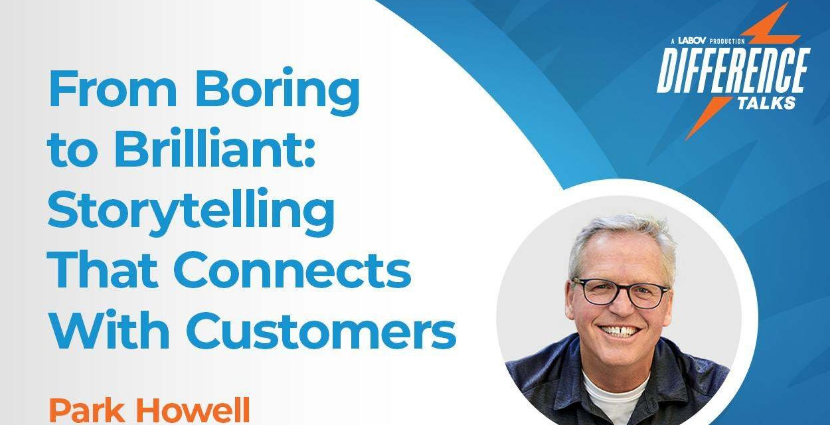
A: Listen to “From Boring to Brilliant: Storytelling That Connects With Customers” (Season 3, Episode 24) on Buzzsprout or Apple Podcasts.
The doc still has the earlier version of both sections. If you want the doc to match what’s above, I’ll update it.