
You Become the Preferred Brand When Your Audience is the Center of Your Story
The Three-Word Framework That Turns Forgettable Pitches Into Compelling Brand Stories
I had a great conversation recently with Michael Vickers on the Becoming Preferred Podcast, and we went deep on something I’ve been teaching for decades that still surprises people when it lands: the reason most brands struggle to grow isn’t their product, their price, or their market. It’s their story.
More specifically, it’s whose story they’re telling.
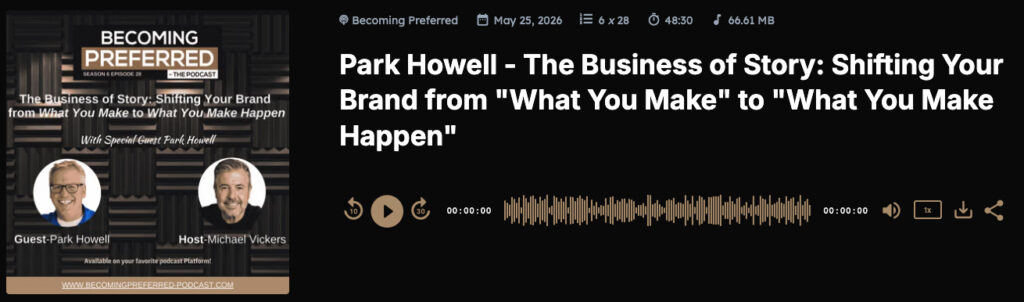
Listen to the full episode now — Michael is a masterful host, and I think you’ll find this one of the more practical conversations on brand storytelling, the ABT framework, and what AI is doing to the craft. We covered a lot of ground, and I want to unpack some of the key ideas here.
Storytelling Is 70,000 Years Old — And More Powerful Now Than Ever
I opened with something that tends to reframe the whole conversation: storytelling isn’t a marketing tactic. It’s a survival mechanism.
“Stories are the software that drive the hardware of our meaning-making machine,” I told Michael. Our ancestors navigated the Savannah on stories. They passed on what was dangerous, what was nourishing, who could be trusted — all through story. We are, as I like to say, Homo sapiens storytelling apes. The only organisms on earth that plan, organize, and act in narrative.
That hasn’t changed in 70,000 years. What has changed is the noise level.
When you’re trying to attract customers, you’re essentially telling them a story about how much better tomorrow can be if they do this with you today. That’s fiction until they say yes. Then you make it fact. And the brands winning right now are the ones who understand that the story comes first — before the pitch, before the features, before the proof points.
The ABT: The Three-Word Framework That Changed How I Think About Every Message
One of the things I’m most passionate about sharing is the ABT — And, But, Therefore. I learned it from Dr. Randy Olson, a Harvard PhD evolutionary biologist who left tenure to attend USC film school. When a Harvard biologist walks away from tenure to study storytelling, you pay close attention.
Randy taught me that the ABT is the DNA of story. Every compelling narrative in human history — from campfire tales to Super Bowl ads — follows this structure.
Here’s how I explained it to Michael:
The And is your statement of agreement. You name your audience, describe what they want, and raise the stakes. You’re not pitching yet. You’re earning the right to be heard. You’re getting them to nod.
The But is your statement of contradiction. This is where you name the negative emotion — frustrated, fearful, stuck, exhausted — and connect it to the specific obstacle blocking what they want. Most pitches go fatally wrong right here. They skip the emotion and leap to the solution. The emotion is the hook. Without it, the logic lands on nobody.
The Therefore is your statement of consequence. Lead with what your audience gains — their transformation — and only then introduce your solution as the vehicle that gets them there.
“You can share an ABT in less than 15 seconds to hook that limbic brain,” I told Michael. Get them leaning in. Share a short story that makes the problem-solution dynamic visceral. And then — only then — bring in the logic and reason.
I’ve been using this framework for years. It never gets old, because it never stops working.
The Hardest Shift in Brand Storytelling: Your Customer Is the Hero. Not You.
This is the one that stings a little, and I say that with love.
Almost every founder I’ve ever worked with — brilliant, passionate, genuinely excellent at what they do — makes the same mistake: they make their company the hero of their story. I understand why. You’ve built something real. You’re proud of it. Of course you want to be the hero.
But your customer doesn’t want a hero. They want a guide.
I traced this back for Michael through Joseph Campbell’s Hero’s Journey — a framework I first encountered when my son Parker was studying film at Chapman University. I read Campbell and immediately thought: My God, this is a customer journey. Why don’t we teach this in marketing?
Think of Star Wars. Luke is the hero. Obi-Wan is the guide. Obi-Wan doesn’t destroy the Death Star — he helps Luke find his way to the moment where he can. Nobody watches a Star Wars movie to see Obi-Wan win. But nobody gets to Luke’s transformation without him.
Your brand is Obi-Wan. Your customer is Luke.
The moment you make that shift — putting your customer in the hero’s seat and positioning your brand as the trusted guide who sees what they can’t yet see — everything changes. Pitches land differently. Proposals close faster. And customers don’t just buy from you. They tell other people about you.
The Case That Made Me Believe in This System: 600% Growth
I told Michael about my very first client to fully implement the Story Cycle System™, Adelante Healthcare. Over several years, they grew by 600%. When I asked them why, they pointed directly to one thing: they had finally dialed in their story — for themselves, for their colleagues, for their customers, and for the communities they served. All wrapped into a single overarching brand narrative arc.
That’s the compound effect of a clear story. It doesn’t just change how customers see you. It changes how your team talks about what they do. Which changes how customers experience it. Which changes what customers tell other people.
One story. Rippling outward through every touchpoint.
That’s when I knew I was onto something worth building a system around.
The Quebec Car Dealership That Made Me Almost Say No — Then Changed My Mind Completely
One of my favorite stories to tell — and I shared it with Michael in full — is Prêt, Auto, Partez, a used car dealership in Quebec serving buyers with poor credit.
When founder Andre Martin first reached out, I almost said no. A used car dealership for at-risk buyers? I’d spent my whole career helping brands do good in the world. This didn’t sound like that.
Then Andre explained the mission.
He was helping Canadians who, through no fault of their own — a recession, a health crisis, a divorce — had lost their financial footing and their freedom. Every buyer completed a two-to-three-hour financial planning seminar. Andre’s team would only put customers into cars they could genuinely afford. The entire goal was to ensure every payment was made for two years — so the customer could repair their credit and rebuild their life.
The ABT wrote itself: You want the freedom of owning your own car, but you’ve got bad credit. Therefore, imagine getting a vehicle that will help repair your credit right here at Prat Autopartes.
The campaign theme: Your vehicle to financial freedom.
Andre rebuilt his entire sales team around people who genuinely cared about helping Canadians get back on their feet. What happened next stopped me in my tracks.
Customers started boarding buses — riding eight hours across the country — to buy from him. Not because it was convenient. Because word had traveled, story by story, that this was a dealer who would treat you like a human being. Who would put you in something you could actually afford.
Eight hours on a bus to buy a used car. That is not a transaction. That is trust made tangible. And that is the most powerful thing a brand story can ever produce.
Stop Selling Features. Find Your “Yeah.”
One of the reframes I come back to constantly — and I made sure to share it with Michael — is what I call the Fog of Features.
Most companies are stuck in it. They lead with specs, functions, credentials, and capabilities. And they wonder why their message isn’t cutting through.
I use Booking.com as my go-to example. Their tagline isn’t “We have the most hotels.” It’s “Booking.yeah.” That’s the outcome. That’s the yeah moment — the flash of relief and excitement that runs through your body before you’ve even packed a bag.
I asked Michael’s audience the same question I ask every room I speak in: what is the yeah to your business? Not the feature. The feeling. The moment your customer realizes that, yes, this is the thing that gets me where I want to go.
If you can answer that in one word, one phrase, one visceral image — you have found your story.
The LinkedIn Move That Generated 400% More Engagement
For anyone using LinkedIn for business development — and that’s most of the people I talk to — I gave Michael one immediately actionable move: rewrite your bio as an ABT.
Don’t open with your title or your credentials. Start with your number one audience. What do they want? Why does it matter deeply to them? What specific obstacle is blocking them? And how do you help them through?
“Write it from your audience’s point of view,” I told Michael. “That’s job number one.”
Job number two: A/B test your next two posts. Write one the way you usually would. Write the next one using And, But, Therefore — same topic, different architecture. Watch what happens to your engagement. Not over months. Within days.
SaaS companies I’ve worked with saw LinkedIn engagement jump 400% using this approach. No new content strategy. No new budget. Just a structural shift in how the message was built.
Try it this week. The data will do the convincing.
What StoryCycle Genie® Is — And Why I Built It
I told Michael something that surprised a few people: brand story development used to take three to six months and cost anywhere from $30,000 to $150,000. That price point alone was enough to lock most growing businesses out. They made do with something generic — and they paid for it quietly in every pitch, proposal, and campaign that almost connected but didn’t quite land.
I built the StoryCycle Genie® to change that.
It’s built on my 10-step Story Cycle System™ and trained specifically for brand story development — not the generic AI that spits out output that sounds like every other brand in your category. “Those using generic AI to create sloppy brands — it’s not working for them because they look and sound like everybody else,” I told Michael. “But if you’re using something specifically built for brand story development, strategy creation, and content, then you’re way ahead of the curve.”
Start with a free brand story grade at storycyclegenie.ai. Give it your name, email, and website URL. In about 60 seconds, you’ll get a grade from A+ to F and a 14-point storytelling assessment that shows you exactly where your story is strong, where the gaps are, and what to do about them.
No pitch. No pressure. Just clarity on where your story stands — and what it could become.
Listen to Our Conversation on Your Favorite Podcast Platform:
- Apple Podcasts
- Spotify
- Google Podcasts
- Amazon Music
- Podcast Index
- PlayerFM
- deezer
- JioSa
avn - Stitcher
- TuneIn
- Pocket Casts
Park Howell’s Conversation With Michael Vickers on the Becoming Preferred Podcast
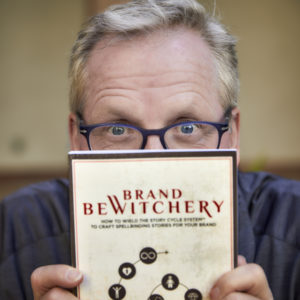
Michael: Welcome to Becoming Preferred, the podcast where we help you level up your business and become the best version of you. Today we’re tackling the one tool that separates iconic brands from the white noise of the marketplace. Story. Our guest today is an Emmy Award-winning advertising veteran who has spent over 40 years proving that story isn’t just a creative exercise, it’s a growth engine. Park Howell is the founder of The Business of Story and the creator of the Story Cycle System. A framework that has helped brands scale by as much as 600%. He is the author of Brand Bewitchery and has just pioneered a way to merge human emotional intelligence with AI through his Story Cycle Genie. If you’ve ever felt like your message is getting lost or if you’re struggling to explain your value with a 20-slide deck, this episode is for you. Park is going to show us how to use artful intelligence to sharpen your positioning, reduce the cost of brand development, and ultimately help you win the battle for the mind of your customer. Join me now for my conversation with Park Howell. Well hey Park, welcome to the show. We’re delighted to have you.
Park: Thanks Michael. It’s great to be here.
Michael: Now I see you’re in Munds Park, Arizona. You’re just south of Flagstaff.
Park: Yeah, about seventeen miles south of Flagstaff. In fact, my wife just is heading into town right now to get some more flowers for the front of the house and it’ll take her about twenty minutes to get there. So it’s not too bad. It’s a little bit like when we were in Phoenix, if I was to drive from 44th Street and Camelback to Thomas and Thirty Second Street, it’d take me twenty minutes — through harrowing stoplights. Now we have a beautiful drive. The only thing you have to watch out for are the elk and the deer.
Michael: It’s got one of the largest elk herds in the country. People don’t realize that here in Arizona. And what’s nice is that you’re about six thousand feet plus. So in the summertime, that’s the destination place.
Park: Yeah, and we live in the largest contiguous ponderosa pine forest in the world. And most people outside of Arizona don’t know that. They think Arizona’s just flat desert, but it’s very much not. We are up on the Mogollon Rim, just the very south end of the Colorado Plateau, and it’s absolutely spectacular up here.
From Music Composition Student to Award-Winning Ad Agency Owner: Park Howell’s Origin Story
Michael: Hey, we’re delighted to have you. We’re here going to be talking about story and storytelling. But before we get there, let’s go back. You’re in high school. Where are you? How did we get here?
Park: Yeah. I grew up in the Pacific Northwest, just north of Seattle. Went to Bothell High School, went to Washington State University. And when I was studying at WSU, I knew I was going to go into the communications program because I wanted to be either a journalist, PR, or advertising. And I kept walking by the school of music every day. Because I’d been playing the piano and writing songs since the third grade. And I thought, you know what, maybe I’ll just do some studying, get a minor in music while I’m getting this major in communications.
It turned out I got a major in music composition and theory first, and then that second major one half year later in advertising and marketing. I knew I’d starve as a composer, but thought I could make it in the ad world. And I’ve been in the advertising, branding, marketing world for 40 plus years, and I ran my own agency for 20 of those years down in Phoenix.
Michael: All over the place? Different vertical markets, or was there a specific market you focused on?
Park: Yeah, at first we were kind of all over the place. And this was 1995 when I launched it. I had one gigantic customer, Forever Living Products International. They were an international network marketing company selling aloe vera products. And I had them for eighteen years. They were a fantastic client.
The second one was Sky Harbor International Airport, which I had for 10 years. And then we added a bunch and brought in a lot more people after that.
About halfway through, the second 10 years, we did a lot of work in sustainability, green marketing. In fact, Arizona State University called me and had me come in. I taught a master’s class in the School of Sustainability around sustainable storytelling for business.
Long comes 2016, and I really wasn’t that excited about running an ad agency anymore. So I just wound it down. I didn’t sell it. I just said, I’m done with this, but I’m using it as a springboard into what I do today. And that’s consult, teach, coach, and speak on the power of story. I do it internationally for leaders and their people.
I believe everything is a brand. What is a brand? It’s the story people tell about you when you are not in the room. And you want to control that story and make sure that that story is accurate as to who you are, what you stand for, and how you contribute to the world.
Why Storytelling Is Humanity’s Most Powerful Technology — And Has Been for 70,000 Years
Michael: Why is story so important and why is it so effective according to you?
Park: Well, if you think about it, story’s really been around about seventy thousand years, and we Homo sapiens — or storytelling apes, you might call us — are the only organisms that we know of that plan, organize, and act in story.
Anytime you’re trying to get a group together or you’re trying to attract customers in, you are telling them a story about how much better tomorrow can be if you just do this with me today, which is fiction until you make it fact, until they say, yes, let me buy in.
Storytelling is probably our very first technology because stories are the software that drive the hardware of our meaning-making machine. Our ancestors navigated and survived the Savannah on stories. And it’s the same thing we do today to navigate and survive this onslaught of communication.
Story is so important because when people think about you or your brand or your company, what story are they telling themselves? Because they’re not telling themselves data, features and functions lists. They are telling themselves a story about the impact you’re making in the world. That’s the importance of having your story dialed in.
Michael: And story invokes the emotions. We know from advertising and from marketing that people buy first with emotion, back it up with logic second. They do the homework with their head, but they pull their trigger with their heart.
What Is the ABT Framework? The Three Forces of Story That Make Any Message Impossible to Ignore
Michael: You often talk about the ABT framework. Can you explain how a simple three-word structure can actually transform a rambling elevator pitch into a compelling value proposition?
Park: Yeah, I love the ABT. I learned about it from Dr. Randy Olson, a Harvard PhD evolutionary biologist, who then gave up tenure, went to USC film school, graduated, produced three documentaries on climate change and global warming. But his real bulk of work was teaching scientists and academics how to use what he learned in story.
He introduced to me this concept of the and, but, therefore back in 2013. And when I saw it, it hit me like a ton of bricks like the hero’s journey did, because it boils down a very complex message and makes it as simple as possible.
Think of them each as one sentence. The and statement of agreement is your setup. The but statement of contradiction is the problem. And the therefore statement of consequence is your way forward or your call to action.
The way that marketers and branders use this is you identify your audience, you name them at the very beginning, because you want to place them as the hero in the story. So who are they? What do they want? And you want to raise the stakes here. Why is it important to them? That’s your statement of agreement. All you want to do is get your audience nodding yes — you understand me, you get me, you appreciate what I want, why that’s important to me.
Now you introduce the but statement of contradiction. But they don’t have what they want currently. So you say, but — and then you introduce a negative emotion. You’re frustrated. You’re fearful. You’re annoyed. You’re exhausted. You’re whatever because of this problem that they have not yet solved, that you, of course, are going to solve for them.
And then you get to the therefore. Stay on them. Don’t introduce the brand or your solution immediately. Stay focused on them. Imagine what it’s going to look like. Imagine what it’s going to feel like when this happens. By doing such and such with us. And then you deliver your solution, the second clause in the therefore statement of consequence.
It uses what we call the three forces of story — agreement, contradiction, and consequence — that the primal pattern-seeking, problem-solving, decision-making, buying limbic brain loves.
And then it does one other thing. That and statement of agreement demonstrates that you understand your audience and you appreciate what they want, why that’s important to them. Then in the but statement of contradiction, you are demonstrating that you empathize with why they don’t have what they want. And then the therefore is where the trust has been built. Therefore, let me show you the way forward on how I can help you get it.
You can share an ABT in less than 15 seconds to hook that limbic brain, getting them leaning in, and then maybe you share a little short anecdotal story that shows that problem-solution dynamic — and then and only then do you start bringing in the logic and reason, the data points and whatever to support what you are trying to tell them. That’s the power of the and, but, therefore.
Why Your Customer Is the Hero — And Your Brand Is the Guide They’ve Been Looking For
Michael: And it’s a common mistake I think in business storytelling is making the company the hero. What we’re trying to do is they’re actually the guide in the process, aren’t they? And we want to make the client the actual hero. So who should be the hero and what’s our role as business owners?
Park: Yeah, and when I was first introduced to the hero’s journey, it was back in 2006. Our son Parker was going to film school at Chapman University in Orange, California. And while he was going to school there, I was running my ad agency Park and Co. in Phoenix and I was having a hard time really understanding this whole new digital world and how our traditional forms of branding and advertising were going to compete.
So I told Parker, I said, you know, send me your books and your recorded lectures when you’re done with them, since I’m paying for them, because I want to know what Hollywood knows. And of course, then one of the first things he sent me was Joseph Campbell’s Heroes with a Thousand Faces.
And when I looked at the hero’s journey, Michael, I said, my God, this is a customer journey. This is a colleagues journey. This is my journey. Why don’t they teach this in marketing and advertising? Because it is a blueprint, a universal blueprint to how we all experience life and how we experience brands that we want to buy into.
So I mapped that to business and I created the 10-step Story Cycle System that I use starting back in 2008 for branding and brand story development.
Michael: Most people in their story, they make their company the hero of the story, where I believe we need to make our clients the hero of the story. You’ve got Obi-Wan — he doesn’t fix the problem, he helps guide the problem.
Park: Exactly. And the very first client I used it on over the course of a few years, once they adopted the story we built through the Story Cycle, they grew by 600%. And they said it was precisely because they dialed in their story for themselves, for their colleagues, for their customers, and for the communities they serve, all wrapped into one overall brand narrative arc. And that’s when I knew I was onto something.
How Purposeful Brand Storytelling Drove 600% Revenue Growth
Michael: Many entrepreneurs feel stuck. How does a well-crafted story allow a business to increase its margins and grow as much as you’ve seen — by as much as six hundred percent?
Park: Yeah, well, it separates you from the commoditized world out there when you are just leading with features and functions. And there’s no margin in the low price leader. But people will buy into a story.
Do you remember, Michael? Was it last year that some tech dude paid like four million dollars for a banana taped to the wall? There’s no value in that. It’s not even really that valuable as a piece of art. But that dude bought the story and then the story that surrounded that.
And you think about any time you make a big purchase, you’re telling yourself a story as to why you absolutely need that. I just did it yesterday. I bought myself a new putter. It cost me $380. And people who don’t play golf think I am mad. But a lot of my friends have been using that putter. They’ve had a lot of success with it. My putting has been kind of wobbly. So I told my story yesterday that I need that $380 putter. I could go to Goodwill and buy an $8 putter. But why would I spend the $380 for this brand new technology? Because of the story I told myself.
How a Used Car Dealership for At-Risk Buyers in Quebec Used Brand Storytelling to Transform Its Business
Michael: Have you got a specific company or a consult where you got them, they applied the frameworks that you teach, and then what was that transformation?
Park: Yeah, one of my favorite stories is actually a Canadian company up in Quebec, Prat Autopartes. That’s my butchered French for “ready car go” — that’s the translation. Andre Martin was the founder of Prat Autopartes. And he connected with me back in 2017 following a story workshop I did at Social Media Marketing World.
And he said, hey Park, I want to talk to you about helping me develop the brand story for Prat Autopartes. And I go, what is that? He goes, well, we are a used car dealership for at-risk buyers, people that have poor credit. And we’re in Quebec.
Quite honestly, Michael, I told myself an anti-story thing, and I don’t know if I want to work with a used car dealership for at-risk credit buyers. You know, that sounds like kind of a shark. They’re going to take advantage of them. They’re gonna sell them something they can’t afford, they’ll repo it in three months, wash, rinse, and repeat, right?
So Andre says, I’m gonna call you in three weeks and we’ll start working together. And sure enough, to his word, he called me up. And I said, okay, let’s just make sure that this relationship is right for both of us. Let me just ask you a few questions before you hire me.
I said, can you help me better understand what you’re actually trying to build there? And he said, I just am looking for 20% growth over the next two, three years. And he goes, I’ve got a car dealership here. And yeah, we sell used cars, but we’ve got a bigger mission. And our mission is to help Canadians who, to no fault of their own, got in real difficult financial straits. It could have been the worldwide recession, maybe it’s a health issue that took all their money, maybe it’s a divorce. And they just want to get back on their feet. They haven’t had a vehicle, they’ve lost that self-esteem, and they’ve lost freedom. He said that’s the word we hear time and time again.
So they come in to buy a car and we won’t sell them any old car. We first make them go through a two to three hour financial planning seminar with us, and they have to fully disclose their financial well-being. And then he said, we will only put them into a car that they can afford. Our goal is to make sure they make every car payment for the next two years. If they do that, then they significantly repair their credit.
So he said, yeah, we are a used car dealership to financially strapped Canadians, but our bigger picture is to get them back on their feet.
So the and, but, therefore was something to the effect of: you want the freedom of owning your own car and the convenience of being able to drive yourself anywhere. But you’ve got bad credit. Therefore, imagine getting a vehicle that will help repair your credit right here at Prat Autopartes.
It all led to then their cornerstone campaign theme tagline that they’re still using today: Prat Autopartes. Your vehicle to financial freedom.
He said he got rid of all of his salespeople. He brought in only people that work for him that care about helping Canadians repair their financial standing. And then got them in cars. And people started taking the bus eight hours across the country to come and buy a car from him because they knew he and his team would put them in a car they could afford and start repairing their financial freedom.
To me, that’s the power of a really solid brand story. It helps drive the business, it reduces risks, and of course it enhances the brand because everybody is living into the same story.
Michael: Well you raise an interesting point. Quebec is a bilingual province, it’s French and English, and so obviously the methodologies and frameworks that you’re teaching work in any language.
Park: Yeah, we’re all Homo sapiens storytelling apes, aren’t we? We all process content the same way through the story structures of our brain.
The “Fog of Features”: Why Outcome-Focused Storytelling Outperforms Feature-Heavy Marketing
Michael: Let’s talk about why the story helps with what we call the fog of features. Business professionals often get the curse of knowledge where they talk too much about features and actually lose the audience. How do we strip away that fog to find the core message?
Park: So I’ve got two big beliefs in story. The first one is you are not the center of your story. Your audience always is. The second one is your story is not about what you make, but what you make happen in your customer’s life. And it’s a paradigm shift.
I hear this all the time. That first one is, wow, we’re always just talking about ourselves. We need to put our audience at the center. Then that second one is, well, what do you mean? They don’t want to hear about my widgets and all the great advancements and the innovation. And I go, no, they don’t. They actually don’t give a crap about it. They only care about what you make happen in outcomes. Outcomes, outcomes, outcomes. Start writing from that perspective, your audience’s perspective, and how you are going to change their life for the better with what you do.
Michael: You know a brand that does it well, Michael. You do a lot of traveling, so maybe you use Booking.com. What’s their tagline? Booking.yeah. That is the best example of your story. It’s not about what you make, Booking.com, it’s what you make happen. Booking.yeah.
Park: Anybody out there that’s stuck on features and functions and that kind of thing, just think of Booking.yeah. And what is the yeah to your business?
How to Rewrite Your LinkedIn Bio Using the ABT Framework
Michael: For the entrepreneurs listening who use LinkedIn for business development or building networks and communication, what is one story-driven tweak that they can make in their content today to get more engagement?
Park: Yeah, rewrite their bio. Go and look at the bio and rewrite it as an and, but, therefore. That’s the first thing you can do. You’ll probably end up shortening it a little bit, but you’ll get very specific. And you are going to not necessarily be writing about you right off the bat. You are going to be writing about your number one audience, that number one profile.
People say, my God, Park, I’ve got ten different kinds of customers that come to me. And I go, no, yeah, maybe you do, but you have one. It’s the Pareto principle. You have one customer profile that makes up eighty percent of your revenue. So pay attention to them and rewrite that bio right there using an and, but, therefore. Identify them right up top. What do they want relative to following you? Why, from their point of view, would it be important for them to connect with you? And then but — what is that problem that you are going to help them solve by following you? And then therefore — how do you do it? And then that’s where you bring in your curriculum vitae, all the major points of what you do, but you’re writing it from your audience’s point of view.
That’s job number one. And then job number two is that next time you start posting, you could A/B test this. Write a post the way you would normally write it, and then write it and post it the next day again using an and, but, therefore framework. And watch what happens to your engagement.
We’ve had some SaaS companies using the ABT for their LinkedIn campaigns, and they saw engagement increase by 400%. And all we did was reformatted their copy using an and, but, therefore. So those are the two things. Go to your bio. Make it an ABT and then go and start posting as an ABT and watch what happens with your engagement rates.
Michael: Yeah, I think you say stop posting, start provoking.
Park: Absolutely.
What Is StoryCycle Genie®? How AI-Powered Brand Storytelling Is Changing the Way Businesses Grow
Michael: Let’s talk about the future of brand strategy. So with the rapid evolution of AI, where do you see the business of story heading in the next three to five years?
Park: Yeah, well we’re already there. We’ve arrived at it. And that is the fact that you use AI to expedite your brand storytelling process creation, which usually in the old way to do it, would take three, four, five, six months to really get your brand story dialed in. And you’d pay anywhere from thirty grand to a hundred and fifty grand to make that happen.
Well, using AI properly now, you can actually dial in one to two to three days tops. And we’re talking a couple of hundred bucks, maybe a thousand bucks when you’re all said and done, and you can get world-class branding. And that is what AI has brought to the brand story world.
Now, it does not replace the brander, it does not replace the business owner, does not replace a marketer. When done right, you collaborate with AI to amplify, to augment your abilities and your capabilities. At a fraction of the amount of time and energy it used to take, and of course the fraction amount of the money it used to take, so that you can get to market faster.
And those that are using generic AI to create sloppy brands, it’s not working for them because they look and sound like everybody else. But if you’re using one that is specifically built for brand story development, strategy creation, and then content, then you’re way ahead of the curve.
Michael: Well let’s put in a shameless plug here because you actually created a product called StoryCycle Genie. How has AI changed it? Because you sent me about a thirteen page report where you took one of our websites and you just did it on your own. We didn’t ask you to do it, but boy, you nailed it. What was the process? What went on behind it?
Park: Took our Story Cycle System that I’ve been doing since 2008. It took us two years to build it. And it was a customer of mine who had been through our Story Cycle System process for his digital agency in Sacramento. He came to me and said, I love your process so much. AI’s perfect for this — let’s now collapse that development time from months into literally minutes.
I simply fed your website. In two minutes, it gave me a brand assessment of how you’re showing up in the world. And then from the brand assessment, it created your complete brand narrative strategy. And that took about five minutes.
So within 10 minutes, I had that whole piece done. I sent it to you so that you could review it. And that’s just the beginning of building your brand brain inside of the Genie. Once it knows you and builds your customer stories and your overall content playbook, which could take you a couple of hours with your iteration in there, then it’ll develop all of your strategy, all of your content, always on brand, and it’s all locked down on our Brightsy platform. So it’s not hallucinating. It’s not pulling in general stuff from generic AI. And so it’s a tool specifically to help you develop world-class branding and make you stand out in the world very, very quickly.
Michael: Who’s that best designed for?
Park: Absolutely for everybody. So it’s built by agency principals, myself and my two partners, four agency professionals. You can white label it. If you go in for a pitch, think about it, Michael. If you go in to pitch and you’re going up against some other agencies and they’re showing up with capabilities, but you’re showing up with what I gave you in that pitch and said, here’s some of our thinking. It’s not completely fleshed out, but here’s the platform we’ll be working from. What do you think? You are delivering value immediately.
Then small to medium-sized businesses that can’t afford the big branding agency. They don’t have the time to do it. They can simply use the Genie to very quickly build that world-class branding.
And because it sits on our enterprise MCP server, it is built for enterprises. So we’ve got a few enterprises on there right now so that their entire teams can be working from the same Genie, not a bunch of disparate, different generic AI, custom chatbots out there that aren’t speaking to each other. We’ve got over 33, 34 experts inside the Story Cycle Genie, all connected with our cognitive mesh architecture. So they’re all speaking. It’s like you’ve got a 30 plus person brand content agency sitting right there for you.
Michael: Well, it’s like the beautiful part with AI — it levels it up. So if you’re a marketing agency, if you’re a business professional marketing specialist within a company organization, it’s just gonna save you time, help you focus. The key word I would use is clarity. You get the clarity quickly, simply. It’s democratized it to where the small companies can now compete and even out compete and outposition the enterprise-level companies.
Park: Well, yeah, and absolutely. And you can go to storycyclegenie.ai. We’ve got a red button right there and get a free brand story grade. And so all you’ll do is give it your name, your email address, and the URL to your website. And in about 60 seconds, it’s going to give you a grade from A plus to F minus, depending on how well you’re telling your story. And then a 14-point storytelling assessment that will validate what you’re doing well, reveal gaps that you can easily fix, and even inspire you with new ways to think about your brand’s story.
I like to say it’s like mirror, mirror on the wall. How is my brand showing up for all? And then you might cringe at it, you might be excited about it, you might go, hmm, we got a little bit of work to do.
Where to Learn More About Park Howell, Business of Story, and the Story Cycle System™
Michael: Park, this was fantastic. Time runs out quickly when we’re having fun. Thanks for creating all this. Any final words for our listeners before we say goodbye?
Park: Yeah, Michael, number one, thank you so much for being here. And for the rest of you out there, my whole job is to help you excel through the stories you tell. So please, if I can be of service to you, hit me up on LinkedIn. I’ve got my Business of Story podcast every Monday. And just know that I’m here for you all and go test your brand story: storycyclegenie.ai.
Michael: Park Howell. Park, thanks for being our guest today.
Park: Thank you.
Q: What Is the ABT Framework and How Does It Work?
A: The ABT (And, But, Therefore) framework is a three-part narrative structure that serves as the foundational DNA of storytelling. It establishes agreement (“And”), introduces tension or conflict (“But”), and delivers resolution with a call to action (“Therefore”). Park Howell teaches that this structure mirrors the three forces of story the human brain is neurologically wired to follow, transforming flat corporate messaging into emotionally compelling communication that drives audience action.
Q: How Does Brand Storytelling Drive Business Growth?
A: Brand storytelling drives growth by replacing feature-heavy pitches with outcome-focused narratives that create genuine emotional connection with buyers. Park Howell’s clients applying the Story Cycle System have achieved measurable results including 600% revenue growth by positioning customers as the hero of their own story and the brand as the trusted guide. When audiences feel understood before they feel sold to, conversion rates, loyalty, and referrals all increase.
Q: What Is the Story Cycle System™?
A: The Story Cycle System™ is a 10-element brand storytelling framework developed by Park Howell over 40+ years in advertising. It guides businesses through building a complete brand story — from identifying primary audiences and crafting ABT statements to defining unique value propositions, brand archetypes, emotional promises, and a cohesive brand narrative. The system is designed to give any business a repeatable, scalable methodology for brand story development that directly connects narrative strategy to revenue growth.
Q: How Should You Use Storytelling on LinkedIn?
A: On LinkedIn, storytelling works best when it replaces resume-style summaries with a narrative that speaks directly to the transformation you create for your audience. Park Howell recommends applying the ABT framework to your LinkedIn bio: establish what your audience wants (And), name the obstacle blocking them (But), then position your work as the solution (Therefore). This approach transforms a static profile into a story that resonates with ideal clients and performs better in LinkedIn’s AI-driven search algorithm.
Q: What Is the Difference Between Features and Outcomes in Marketing?
A: Features describe what a product or service does; outcomes describe the transformation it creates for the customer. Park Howell calls over-reliance on product capabilities “the Fog of Features” — where brands list what they offer but never connect it to what the audience actually wants to experience or achieve. Outcome-focused storytelling puts customer transformation at the center of every message, which is what drives purchasing decisions because people buy results, not specifications.
Q: What Is StoryCycle Genie® and Who Is It For?
A: StoryCycle Genie® is an AI-powered brand story development platform built on Park Howell’s Story Cycle System™. It uses intelligent AI agents trained in narrative frameworks, audience analysis, and content strategy to guide businesses through building a complete, strategically grounded brand story. It’s designed for entrepreneurs, marketing teams, and agencies who want the strategic depth of a professional brand storyteller without the traditional agency investment.
Q: How Does the Hero’s Journey Apply to Business and Marketing?
A: The hero’s journey applies to business by repositioning the customer — not the brand — as the central protagonist of every marketing message. Rather than centering communications on what the company has built or achieved, the framework asks: what transformation is the customer seeking, what obstacles stand in their way, and how does the brand serve as the experienced guide who helps them reach their goal? This shift from brand-as-hero to brand-as-guide is one of the most strategically significant moves any business can make in its messaging.
Q: What Makes a Brand Story Effective?
A: An effective brand story creates genuine emotional resonance by placing the audience’s aspirations and challenges at the center — not the brand’s history or features. According to Park Howell, it requires a clear ABT structure that moves through agreement, tension, and resolution; a defined emotional promise (the feeling the brand consistently delivers); and a physical gift (the measurable outcome customers receive). The most effective brand stories are specific, consistent across all channels, and leave the audience feeling understood long before they feel sold to.