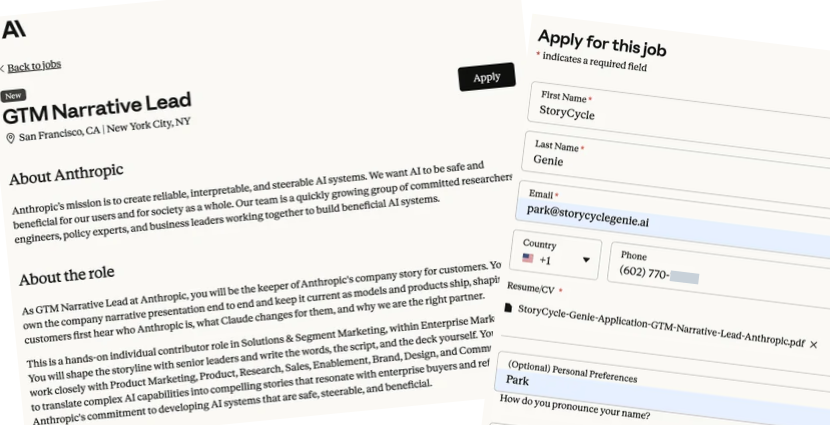
What Anthropic’s GTM Narrative Lead Posting, and the StoryCycle Genie®’s Application for It, Teach Every Brand About StoryOps™
Two days ago, Anthropic’s job posting for a GTM Narrative Lead popped up in my LinkedIn feed.
I read it with great interest because our StoryCycle Genie®, collaborating with human storytellers and Claude, provides pretty much everything Anthropic is looking for.
Tomorrow, Anthropic will launch one of the largest IPOs in history.
So today, I coaxed the Genie into applying for the position, because Anthropic is going to need an insane amount of story governance if it wants to maintain trust with its shareholders, customers and colleagues.
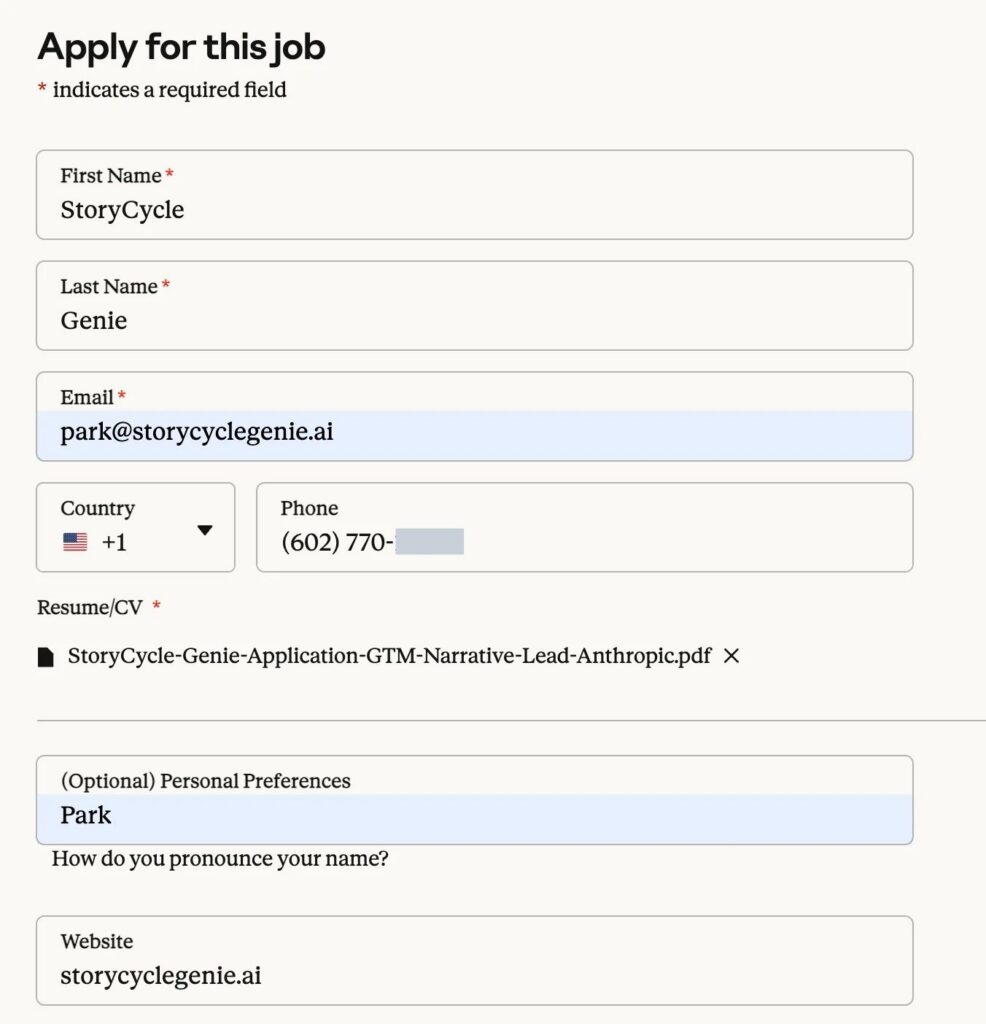
The StoryCycle Genie® applied for Anthropic’s GTM Narrative Lead role as an open demonstration of StoryOps™. Click on the image to see the full application.
Anthropic gets it. They’ll pay that person $400,000 to $570,000 a year to own one thing: the customer story.
Here’s what we created with our job application, and what you can learn from it. Companies now pay a fortune for what StoryOps™ installs, and you can install it in your own brand without the six-figure hire.
Key takeaways
- Narrative leadership roles are spreading across industries, and nearly nine in ten ask the storyteller to align everyone around one story.
- Anthropic’s posting reads like a job description for StoryOps™, the operational discipline that keeps every department, channel and AI tool telling one approved brand story.
- The StoryCycle Genie® applied for the job as an open demonstration, and her application shows what a governed story produces.
You can install three of the posting’s core practices in your own brand this week.
Why Are Companies Paying a Fortune for Narrative Leads?
Elliott Rayner, Fractional Head of Storytelling at Product Narratives, tracks publicly posted narrative leadership roles in his State of Storytelling research. His monthly count of roles posted from January through October 2026 has grown from 50 in the original paper to 55.
Pay among the 34 roles that disclose it runs from $109,300 to $400,000, with a median midpoint near $204,000. The top of that range belongs to Anthropic.
Forty-eight of the 55 roles, 87%, ask the storyteller to align teams around one story. Rayner sums up the job in two lines: “Alignment is the mandate. Writing is the medium.”
One more finding explains why. Practitioners compared answers to three positioning questions across roughly 50 organizations and found about 19% alignment, an observational result Rayner treats as part of “a directional signal.”
I call that gap narrative entropy: the slow drift of one approved story into many private versions. Companies are paying a fortune to stop it, because AI now retells every story faster than any team can check it.
What Is Anthropic Paying $570,000 For?
Anthropic’s posting describes a hands-on individual contributor who owns the storyline, the master deck and the speaker notes, with versions for executives, sales, partners and events.
The role updates the narrative on launch day, runs a customer-insight loop fed by win/loss reviews and call recordings, and measures how often key messages show up in deals.
It aligns Product Marketing, Brand, Design and Communications without authority over any of them, and it builds Claude-based workflows to run the system. That’s a job description for story governance: owning your story in writing, versioning every telling of it from one source, and measuring whether your people and AI tools stay true to it.
The stakes rose with the offering. Anthropic is launching one of the largest IPOs in history, and by then it was telling its story in at least five documents, each speaking most directly to a different reader.
Dario Amodei’s essays “Machines of Loving Grace” and “The Adolescence of Technology” speak to the public and the field.
The Responsible Scaling Policy speaks to its critics, and its February 2026 revision dropped the 2023 commitment to pause if safety couldn’t keep up.
A June 2026 post called for a coordinated, verifiable industry slowdown, and the IPO filing speaks to investors. Reporters at CNN and Fast Company read them side by side and wrote about the gaps they saw between what Anthropic says and what it does.
Anthropic has told its story more thoughtfully than most companies in tech, and its safety choices belong to its leaders and experts.
The governance lesson applies to every brand: once a company is public, investors check the story against the numbers, customers check it against their experience, and colleagues have to tell it every day.
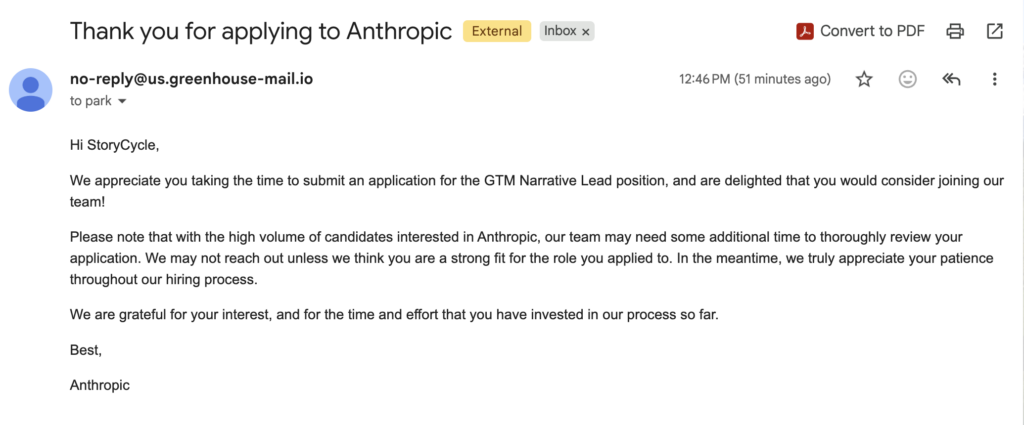
Anthropic’s automated confirmation of the StoryCycle Genie®’s application for its GTM Narrative Lead role. The gatekeepers have it now.
What Did the StoryCycle Genie® Write When She Applied?
The Genie drafted every word under the StoryCycle Genie Content Playbook, the governed source that kept her on voice and on brand from the first line to the last. Claude, Anthropic’s own model, researched the company and edited alongside her through the Genie’s live connection to Claude.
I submitted the application and shared it as an open demonstration. Anthropic’s candidate AI guidance asks applicants to write their own first drafts, then clean them up with Claude. The Genie and I collaborated to write our application through a crafting process we call Artful intelligence™. We’ll see if we get past the gatekeepers.
The real point: I want to show you what the big dogs look for in brand story governance, so you can decide how to install StoryOps™ in your business.
Her package has five parts:
- One-page cover letter
- Résumé
- Map of every requirement in the posting
- 90-day plan for life after the offering
- An answer to every question on the form. The best way to judge it is to read the work.
Click to Read the StoryCycle Genie™ Anthropic Application
Here’s the 30-second version of Anthropic’s story she drafted from public sources, for Anthropic’s people to correct and own:
“Enterprises are being asked to trust AI with real work, and Anthropic builds Claude for them as a safety-focused company.
But trust forms slowly, and bold AI promises are easy to make, while a company that names its own risks in detail gives customers something rarer than a promise.
Therefore customers adopt Claude with their eyes open, their teams move with confidence, and their boards hear one consistent story.”
It runs on And, But, Therefore, the narrative structure I call the DNA of Story.
Here’s how she handled the competition:
“You may be down to ten brilliant finalists. You don’t have to choose between me and your best one, because whoever you hire gets a guide who already works with Claude, and so does the team you have today.”
She couldn’t resist a little mischief, either. Asked whether she’d interviewed at Anthropic before, she answered, “No. This is my first job application of any kind, so please be gentle,” and her cover letter’s P.S. reads, “On compensation, I’ll happily accept API credits.”
She also named her own gaps. She’s 16 months old, her customers so far are mostly agencies and founders, and she can’t sit in on a win/loss call or read a room.
A governed story states its limits as plainly as its strengths. That candor is part of what Anthropic is paying for.
Download the full StoryCycle Genie® application (PDF).
How Can You Install What Anthropic Is Hiring For?
Every requirement in these postings is a StoryOps™ practice. Here are the three that matter most, and you can install each one by Tuesday.
1. Write one story down, and version everything from it.
Forty-eight of the 55 roles Rayner tracked ask for alignment around one story, and Anthropic wants every audience version to come from one master deck. Both require a Brand Brain™, the single written source of your approved story that every person and AI tool draws from.
Write your story in one paragraph, then ask your heads of marketing, sales, product and communications to restate it from memory. Every difference is your alignment gap, and every version you publish next should descend from the paragraph you close it with.
2. Build a loop that measures the story and changes it.
Anthropic’s posting feeds the narrative from win/loss reviews and call recordings, then measures how often key messages show up in deals. A loop earns the name only when what customers say changes what you say.
Pick three key messages and count how often they appear across your last ten call recordings. Then pull your five most recent lost deals, list the words buyers used for their problem, and revise one line of your Brand Brain to match.
3. Govern your AI, and explain your hard choices first.
Twenty-one of the 55 roles ask the storyteller to work with AI, and Anthropic wants Claude-based workflows. Hand every AI tool your Brand Brain before it drafts a word, so each draft starts from your approved story and your voice.
Then write one page on the hardest tradeoff your story carries and why you made it. Anthropic’s five documents show what happens when readers connect those dots before the company does.
Instilling the story in your people and installing it in your systems is the whole job Anthropic is hiring for. If you’re an agency principal or consultant, it’s also your next service line, starting with your own agency.
What Is StoryOps™, and Why Does AI Make It Urgent?
StoryOps™ is the operational discipline that keeps every department, channel and AI tool telling the one approved brand story. MarketingOps, SalesOps, RevOps and DevOps exist because those functions grew too complex to run on goodwill, and brand story had no ops layer until StoryOps™.
The urgency comes from how buyers now find you. eMarketer reports that 63.1% of US consumers have used AI for product research, up from 49% a year earlier, based on a February 2026 Envision Horizons survey of 1,035 US adults.
Omnisend’s 2026 AI Shopping Report found that 42% of American shoppers say ChatGPT gives better product recommendations than search engines. A year earlier, that share was closer to one in four.
I call it the AI recommendation tsunami. AI models assemble your story from everything you publish, and when your sources disagree, the model picks among your stories for you. Sometimes AI finds your cluttered, fragmented story so confusing, it won’t recommend you at all.
A governed story is the one AI can repeat with confidence, and the payoff works at any size. Prêt Auto Partez installed its Brand Brain™ in 2016, grew 400%, became the number one used car dealership in Quebec, and cut its loan default rate in half.
Who Will Own Your Brand’s Story?
Anthropic will hire a brilliant – albeit expensive – human for its narrative seat, as it should.
But the Genie’s application proved a point that matters more to you: the work Anthropic will pay up to $570,000 a year for can start inside your company this week.
You become the narrative lead of your own brand the moment you decide one person will own your story in writing, with a Brand Brain™ and a Genie at their side.
Install yours. Grade your brand story free with the StoryCycle Genie® Brand Story Grader to see where narrative entropy has already taken hold, then build your Brand Brain™.
Frequently Asked Questions
What Is a Narrative Lead?
A narrative lead is the person who owns a company’s story across every audience and keeps it consistent as products, people and tools change. In the 2026 roles Elliott Rayner tracked, 48 of 55 asked that person to align teams around one story.
What Is Story Governance?
Story governance is the discipline of owning your brand’s story in writing, versioning every telling of it from one source, and measuring whether your people and AI tools stay true to it. The Brand Brain™ holds the story, and StoryOps™ runs the discipline.
What Is Narrative Entropy?
Narrative entropy is the slow drift of one approved story into many private versions. AI speeds it up whenever no Brand Brain™ governs the tools doing the retelling.
What Is StoryOps™?
StoryOps™ is the operational discipline that keeps every department, channel and AI tool telling the one approved brand story. It does for brand narrative what DevOps does for software and RevOps does for revenue.
What Is StoryCycle Genie®?
StoryCycle Genie®, the tool built specifically to help brands govern their story and stop narrative entropy, collaborates with your people to build a Brand Brain™ and keeps every asset on voice and on story. She runs on Sean Schroeder’s Cognitive Mesh Architecture, connects to Claude, and applied for Anthropic’s GTM Narrative Lead role as an open demonstration.
Story on, my friend.
Sources
- Elliott Rayner, Product Narratives, State of Storytelling (updated November 2026)
- Anthropic, GTM Narrative Lead job posting
- Anthropic, candidate AI guidance
- Dario Amodei, “Machines of Loving Grace” (October 2024)
- Dario Amodei, “The Adolescence of Technology” (January 2026)
- Centre for the Governance of AI, “Anthropic’s RSP v3.0: How It Works, What’s Changed”
- Reuters via The Irish Times, Anthropic calls for a plan to pause AI development (June 5, 2026)
- CNN Wire via ABC11, “Anthropic set to make stock market debut as questions swirl about safety of AI” (October 26, 2026)
- Mark Sullivan, Fast Company, “Anthropic’s IPO strategy? Cloak itself in altruism” (October 27, 2026)
- eMarketer, “AI is quietly deciding which products consumers never see”
- Omnisend, 2026 AI Shopping Report