The Original Operating Manual for Story Governance
And the Blueprint for Protecting Your Brand from AI-Accelerated Fragmentation
I met Gavin McMahon on Zoom the other day.
We beamed up to get acquainted because we are fellow business storytelling professionals who approach the art from slightly different vantage points.
Gavin, author of Story Business: Why Stories Rule the World and How They Can Reinvent Your Business, uses stories for what he defines as world-building inside large companies.
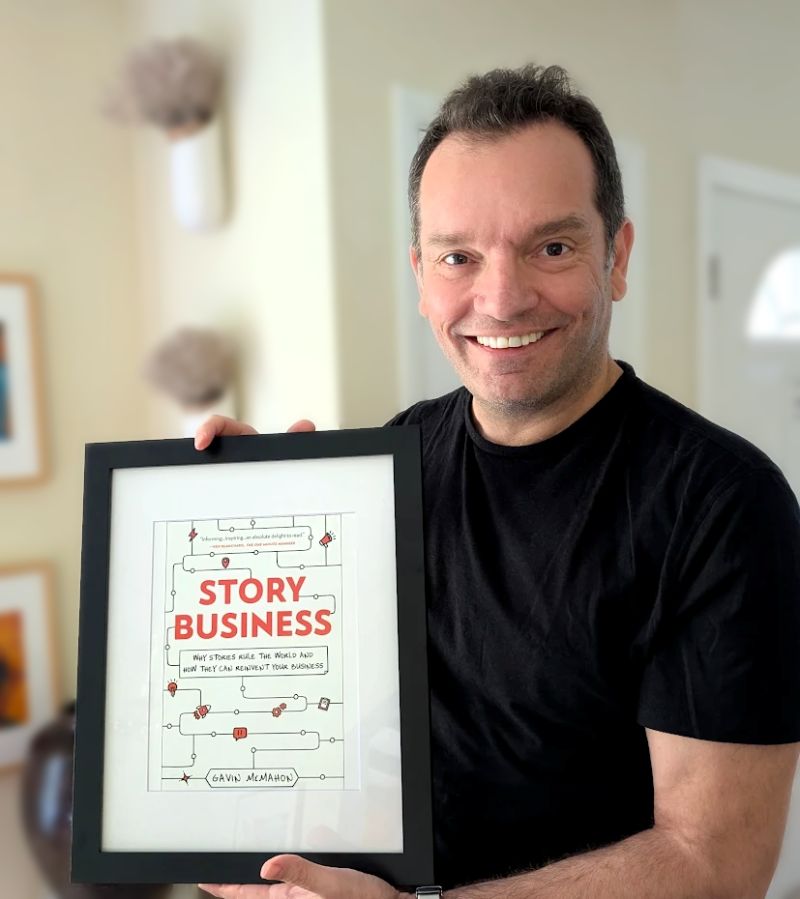
I love this sentiment Gavin shares in his book:
“For Tolkien, sub-creation required a world to follow its own laws and logic—an “inner consistency of reality” that felt true, even if it was different from the real world. “The moment disbelief arises,” he warned, “the spell is broken; the magic, or rather art, has failed.”4
So too with brand. Every touchpoint must align with story—or the spell breaks. This is consistency of concept, not just color: ideas, messaging, and experience working as one.”
This aligns with my focus on producing consistent and coherent brand storytelling both inside and outside of enterprises.
What we have in common is the idea around the critical importance of operationalizing your story across the organization, especially in the age of AI that scales your fragmented story at the speed of light.
I call the practice StoryOps™ to stop narrative entropy in its tracks.
Gavin introduced me to Gene Roddenberry’s Show Bible: the single source of truth that governed and guided the creation of the Star Trek enterprise. Not the ship. The legendary television series and movie franchise.
And even Roddenberry had to evolve his bible to fight narrative entropy as his audiences matured, markets morphed, and ticket-buying customers’ tastes changed. All while still honoring his Trekkies
He didn’t develop a brand guidelines deck. Nor a style guide. Roddenberry created a storytelling operating manual for keeping dozens of contributors — writers, directors, producers — telling one consistent story without the creator personally in every room.
What Roddenberry Actually Built
As Gavin details, Roddenberry described his show as “Wagon Train to the stars,” remixing sci-fi and western elements, but always grounding the world in consistent internal logic, detailed timelines, iconic characters, and expansive storytelling.
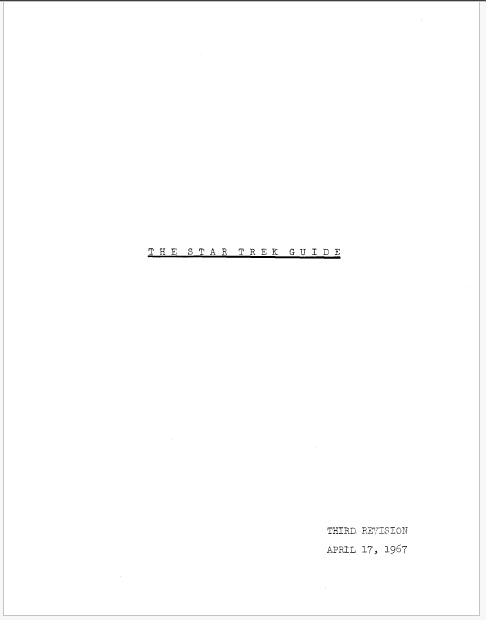
Click on The Star Trek Guide to download the Show Bible
Roddenberry immortalized his approach in The Star Trek Guide—a 53-page “show bible,” hand-typed on an IBM Selectric. At its core was a simple test for every scene:
“IN EVERY SCENE OF OUR STAR TREK STORY…translate it into a real-life situation. Or, sometimes as useful, try it in your mind as a scene in Gunsmoke, Naked City, or some similar show. Would you believe the people and the scene if it happened there?”
Unlike rigid brand guidelines, Roddenberry’s show bible balanced structure and flexibility. He left room for invention within the rules of the universe, championed relatable language (“audience terminology”), and built rich backstories that gave the world a gritty realism—never corporate, never plastic.
Gavin calls this Roddenberry’s true brilliance: an “arrow of coherence.” A straight line of narrative logic that provides causality and consistency, deepening the entertainment franchise’s brand lore and making Star Trek believable.
For brands, this is a remarkable example of world-building. But your brand story only works in a universe of noise if it’s governed, coherent and consistently deployed.
A style guide describes what your brand looks like. An arrow of coherence describes how your universe thinks.
Now, anyone can make decisions that flow from the same source, without asking permission.
Can someone encounter your content — any piece, on any channel, produced by any person on your team or any AI in your stack — and know immediately that it’s yours?
That’s what a Brand Brain delivers.
Let’s look at a current-day branding example of Roddenberry’s Show Bible.
Patagonia: StoryOps™ in Action—Decades Before It Had a Name
Patagonia didn’t just write a mission statement and hope for the best. They built operational infrastructure to thread one story through every function: HR, product, marketing, community, even their ownership structure.
Their founder, Yvon Chouinard, didn’t just want to make outdoor gear. He wanted to “save our home planet.”
That conviction wasn’t a tagline. It became the organizing narrative principle for every decision, from supply chain to Black Friday campaigns to the company’s radical move to transfer ownership to a trust dedicated to fighting the environmental crisis.
Patagonia’s story isn’t managed by a single department or a charismatic founder. It’s installed in the business.
- In HROps: Every employee is steeped in the company’s values from day one, with hiring, training, and advancement all tied to the story.
- In ProductOps: Materials and design choices are made through the lens of environmental impact, not just margin.
- In MarketingOps: Their famous “Don’t Buy This Jacket” campaign wasn’t a gimmick—it was a direct extension of their founding narrative, challenging consumerism and inviting customers into the story. As Patagonia details in their official case study, the bold Black Friday ad in The New York Times didn’t just spark conversation—it drove record sales, deepened customer loyalty, and proved that values-driven storytelling can be both principled and profitable.
- In Community/Field Ops: Grassroots activism, environmental grants, and direct action are woven into the business model, not bolted on as CSR afterthoughts.
- In Ownership: When Chouinard “gave away” the company, he operationalized the story at the highest level—ensuring Patagonia’s purpose would outlive any individual.

Patagonia isn’t just a case study. It’s the proof that StoryOps™ works.
If you want your brand to survive succession, scale, and the coming wave of AI-fueled narrative entropy, you don’t need another guidelines deck. You need operational discipline. You need a Brand Brain. You need StoryOps™.
Roddenberry wrote the blueprint. Patagonia built the enterprise.
How the Bible Replaced the Bottleneck
Back to Gene. The initial Show Bible he crafted worked imperfectly, because Roddenberry’s primary backup system was himself.
During the original series, he personally rewrote nearly every incoming script.³ Sometimes on set during filming.
He worked on submissions from writers with serious science fiction credentials, the likes of Theodore Sturgeon, Harlan Ellison, Richard Matheson among them. It caused real friction.
Roddenberry didn’t know what came naturally to Chounard: You cannot scale a person. You can only scale a system.
1987: The Brand Brain Gets Upgraded
Twenty-one years after the original series premiered, Roddenberry tried again.
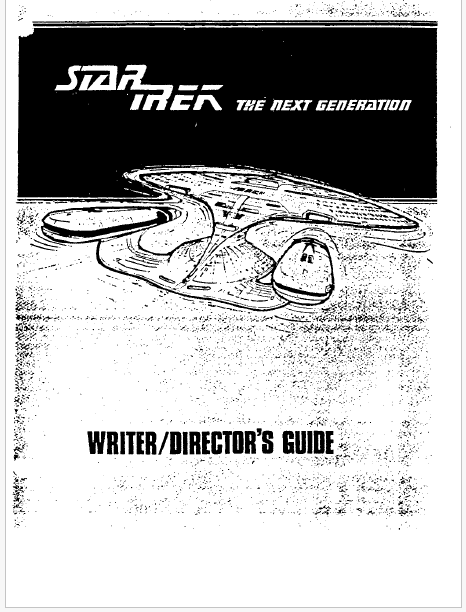
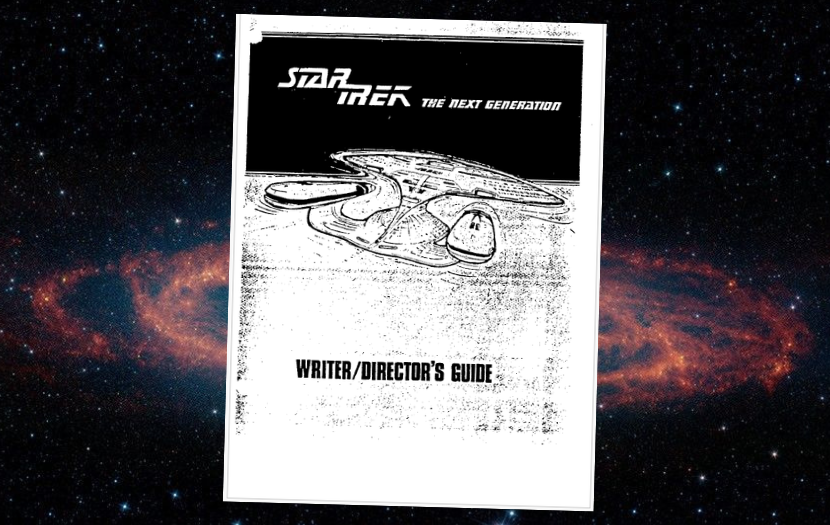
Click on the image to download the Star Trek The Next Generation Show Bible
In March 1987, he and writer David Gerrold produced a Star Trek: The Next Generation Writers’/Directors’ Guide. This more than a reference document. It was a true operating manual for story governance, built to keep the franchise coherent as it scaled beyond any one person’s control.
It started with purpose: the mission of the Enterprise was front and center, setting the North Star for every story.
Second, it drew a clear line between what could change and what could never change—giving writers creative freedom, but only within the boundaries of the Star Trek universe.
Third, it didn’t just list what to do; it was explicit about what not to do. There was a “no-list” of storylines and tropes that were off-limits, protecting the integrity of the brand.
And most importantly, it taught decision-making. Instead of rigid rules, it gave writers a way to reason through new situations, so the story could evolve without losing its soul.
The 1966 Show Bible told writers what Star Trek was.
The 1987 guide taught them how to keep it that way, even as the universe expanded.
If your brand story is only partially documented, inconsistently enforced, or scattered across decks and PDFs, entropy wins. Fragmentation accelerates. Your story drifts.
The Document Survived. Enforcement Didn’t.
William Shatner pointed out that nearly every rule in the Next Generation Writers’ Guide got broken at some point during the show’s own run. Not by outside imitators. By *Star Trek’s own writers, working from Star Trek’s own bible, on Star Trek’s own payroll.*⁸
Nobody removed the document. Every writer who broke these rules had full access to the same bible you can still read today.⁷
What eroded wasn’t the documentation.
It was the enforcement.
The Klingons Are Already Scaling Your Fragment Story
Now imagine the invading Klingons.
Not the 1966 Klingons with painted eyebrows. The real threat is the slop-spewing AI content engines already inside your workflow, producing at a velocity no human team can match.
They don’t ask permission. They don’t check the bible. They simply generate, remix, and multiply whatever fragments of your story they can find.
They can’t even rely on the humans in the room because they don’t even know where to look for your story governance. But they’re on deadline. So they spew.
If your brand story is only partially documented, inconsistently enforced, or scattered across decks and PDFs, AI will amplify every gap, every contradiction, every drift. What was once a slow leak of coherence becomes a full-scale narrative invasion.
That is what narrative entropy looks like when it gets a warp drive.
You Don’t Just Produce Your Story. You Install It.
StoryOps™ isn’t another PDF. It’s the discipline of installing your story sovereignty into every tool, every prompt, every workflow your team already uses.
And by story sovereignty, I mean the only story your brand can tell. What you stand for. Your differentiated position in the market. Your core brand personality archetypes. Your Story Bible.
The StoryCycle Genie® is your Brand Brain: the single source of truth that automatically governs every output, everywhere. No more bottlenecks. No more drift. No more dependence on one person.
Your story becomes what the organization does, not just what the founder remembers.
That’s how legacy storytelling survives succession, scale, and the AI Klingons.
The Narrative Entropy Audit
Where does your sovereign story enter your content creation workflow?
At the brief? At the prompt? At the review?
Or only at the grievance? You know, after the drift has already compounded, after the AI has produced content that sounds like every competitor you’ve spent years trying to distance yourself from?
If you can’t name a specific moment in a specific process, you have documentation.
You don’t have governance.
Want to see how much of your story is truly defensible? Take the FREE Brand Story Grader:
https://www.storycyclegenie.ai/brand-story-grader
Roddenberry gave us the blueprint. Patagonia proved it works in the real world. Now it’s your move.
Your brand is its own universe, one that can either drift into chaos or endure with coherence. You don’t need to be a sci-fi visionary or a purpose-driven founder to operationalize your story. You just need the discipline to install it everywhere, for everyone, every time.
Because in the age of AI, narrative entropy isn’t a distant threat. It’s already inside your workflow. The difference between brands that endure and brands that vanish will be this: Did you build a living Brand Brain, or did you leave your story to drift?
The next chapter of your brand’s story is being written right now. Make sure it’s one only you could tell.
Shields up. Story on!
Sources & Further Reading
- Gavin McMahon, Story Business: Why Stories Rule the World and How They Can Reinvent Your Business — Chapter 7: Brand Storytelling: amazon.com/dp/1955671672
- Star Trek creation history — Gene Roddenberry’s March 11, 1964 treatment and original development: en.wikipedia.org/wiki/Star_Trek:_The_Original_Series
- “That Sense of… ENTERPRISE,” Helmut Eppich, Ad Astra: adastraletter.com/2020/3/startrek
- D.C. Fontana biography, Memory Alpha: memory-alpha.fandom.com/wiki/D.C._Fontana; Wikipedia: en.wikipedia.org/wiki/D._C._Fontana
- “How D.C. Fontana’s Star Trek archives at UCLA share insight into the show’s early days,” UCLA Newsroom: newsroom.ucla.edu/stories/star-trek-60-d-c-fontanas-archives-at-ucla-gene-roddenberry
- “35 years ago, one last-minute script rewrite changed Star Trek forever,” Inverse: inverse.com/culture/star-trek-the-next-generation-35-anniversary
- Star Trek: The Next Generation Series Bible (Season One), David Gerrold and Gene Roddenberry, March 1987 — Internet Archive: archive.org/details/star-trek-the-next-generation-bible; Memory Alpha: memory-alpha.fandom.com/wiki/Star_Trek:_The_Next_Generation_Writers’/Directors’_Guide
- “Star Trek Stories Gene Roddenberry Would Never Approve, According To William Shatner,” Looper (June 2024): looper.com/1596094/william-shatner-gene-roddenberry-star-trek-storylines-wouldnt-approve
- “Star Trek: The Strange New Worlds vs. The Orville vs. Discovery fight is highly illogical,” Slate (September 2022): slate.com/culture/2022/09/star-trek-orville-discovery-strange-new-worlds-war.html
- “The Orville Producer Talks Comparisons To Star Trek,” Cinemablend: cinemablend.com/television/2472373/the-orville-producer-talks-comparisons-to-star-trek
- StoryCycle Genie® — StoryOps™ and Brand Brain platform overview: storycyclegenie.ai
- Patagonia, “Don’t Buy This Jacket – Black Friday and The New York Times” (official campaign case study): https://www.patagonia.com/stories/planet/activism/dont-buy-this-jacket-black-friday-and-the-new-york-times/story-18615.html
All factual claims are attributed to their original reporting. The Show Bible quote is sourced to Gavin McMahon’s citation in Story Business (Chapter 7), drawn from Roddenberry’s original Star Trek Writer’s Guide.
Article produced in collaboration with the StoryCycle Genie® — Artful Intelligence guided by the proven StoryCycle System™.