Storytelling Tricks so You Shine on Any Podcast
You’ve invested years building genuine expertise. The kind that actually transforms clients, solves real problems, and deserves a much bigger audience.
But despite everything you’ve created, you keep getting lost in the noise.
The AI-generated content most experts are reaching for right now to finally compete is making the problem worse, not better.
When everyone reaches for the same machine to solve a differentiation problem, they get more of the same.
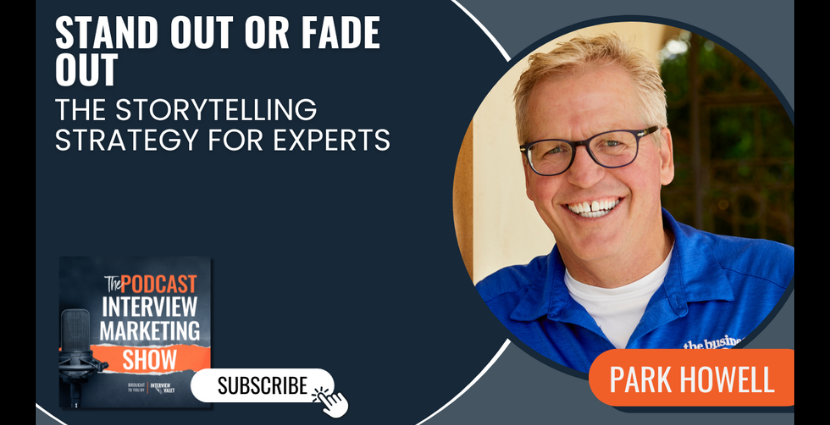
In Episode 121 of the Podcast Interview Marketing Show, Tom Schwab sits down with Park Howell — the World’s Most Industrious Storyteller, host of the Business of Story podcast, and creator of the 10-step Story Cycle System™ — to break down the one framework that separates forgettable experts from category-defining thought leaders.
The answer is 75,000 years old. And it still works.
The Universal Challenge Every Expert Faces
You want your ideas to spread, your audience to grow, and your reputation to crystallize into the kind of authority that attracts ideal clients. And if you could unlock the one mechanism separating forgettable experts from category-defining thought leaders, everything you’ve built would finally compound the way you always believed it could.
But you’re consistently losing ground to louder, less qualified voices because nobody taught you the ancient storytelling architecture your brain — and every listener’s brain — is literally wired to follow.
That’s exactly where the 75,000-year-old science of storytelling changes everything.
Meet Park Howell: The World’s Most Industrious Storyteller
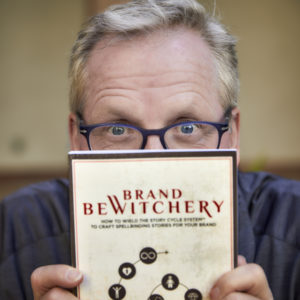
Park Howell is the founder of the Business of Story, host of one of the world’s top business storytelling podcasts, and creator of the 10-step Story Cycle System™ — a framework that maps Joseph Campbell’s hero’s journey to business strategy.
For nearly 25 years, Park has helped brands grow by as much as 600% using narrative-driven strategy. He’s also the co-creator of the StoryCycle Genie®, the only AI-driven, (Artful Intelligence) narrative-native platform guided by the Story Cycle System™.
What You’ll Master in This Episode
Why storytelling itself hasn’t evolved in 75,000 years — and why that’s your greatest competitive advantage in an AI-saturated world.
How the ABT framework (and, but, therefore) works as the DNA of all compelling communication, and how to build one live for your own brand.
Why AI-generated content is making the sea of sameness worse — and the specific distinction between AI that replaces your thinking and AI that amplifies it.
How the 10-step Story Cycle System™ maps the hero’s journey to business strategy, and why it’s grown brands by as much as 600%.
What the new ROI means: Return on Intelligence — and how emotional intelligence plus artificial intelligence creates a competitive advantage no algorithm can replicate.
How to use the StoryCycle Genie™ to compress 45 hours of brand preparation into 45 minutes without sacrificing depth, specificity, or your authentic voice.
Grab your free brand story assessment at StoryCycleGenie.ai. In under 60 seconds, you’ll get a grade from A+ to F, see exactly where your brand narrative gaps are, and discover new ways to tell your story more powerfully. No credit card. No catch.
The Sea of Sameness Is Getting Worse
You’ve invested years building genuine expertise — the kind that actually transforms clients, solves real problems, and deserves a much bigger audience.
Yet despite everything you’ve created, you keep getting lost in the noise.
And here’s the painful irony: the tool most experts are reaching for right now to finally compete — AI-generated content — is making the problem worse, not better.
When everyone reaches for the same machine to solve a differentiation problem, they get more of the same. AI by itself is crap. It produces a torrent of words that sound like everyone else’s words, because it was trained on everyone else’s words.
The sea of sameness isn’t a content volume problem. It’s a narrative intelligence problem.
The 75,000-Year-Old Solution
Storytelling itself has not evolved.
It’s the same practice, the same structures and frameworks our ancestors used to navigate and survive the savanna 75,000 years ago. What has evolved is you and I as the storyteller — and the marvelous new tools we have available to amplify our stories, not to completely create them for us.
The framework I’ve been teaching for nearly 25 years is built on this foundation.
The 10-step Story Cycle System™ maps Joseph Campbell’s hero’s journey to business. It works because the hero’s journey isn’t a Hollywood invention — it’s a basic, fundamental architecture for how our brains are built to make meaning out of the madness of being human beings.
But if the Story Cycle System™ is the full architecture, the ABT framework is the DNA.
The ABT Framework: And, But, Therefore
I first encountered the and-but-therefore structure through Dr. Randy Olson, a Harvard PhD evolutionary biologist who gave up tenure to attend USC film school. He identified this three-part pattern as the fundamental structure of all compelling communication.
It works because it mirrors the three forces of story: agreement, contradiction, and consequence.
Your pattern-seeking, problem-solving, decision-making limbic brain loves to receive information in this order.
- And — the statement of agreement. What does your audience want? What’s the collective vision you share? You’re foreshadowing your offering while making them the hero of the story.
- But — the statement of contradiction. The plot twist. The problem standing between your audience and what they want. Build as much contrast here as possible — it triggers the buying brain.
- Therefore — the statement of consequence. What’s the way forward? Lead with the positive outcome your audience receives, then introduce your solution as the enabler.
On the show, Tom and I built an ABT live for his audience. His listeners are humble heroes — people with something burning in their hearts to share with the world, who keep getting swallowed by the sea of sameness.
The ABT we built together:
You are probably a humble hero, a person who has something to share with the world, and if you had a systematic approach to having the proper conversations, you would stand out beyond your wildest imagination and have the impact you seek.
But you’re frustrated — you are the best-kept secret because you are drowning in a sea of sameness, because you haven’t yet found that proven, systematic approach that gets you dialed in on every interview you do.
Therefore, imagine your world opening up and people finding you, you becoming their favorite because you are able to share your story in a very profound, systematic way.
That’s clarity. That’s what separates the thought leaders people talk about from the experts nobody remembers.
The New ROI: Return on Intelligence
AI isn’t the enemy. Undifferentiated thinking is.
The math I apply to this is simple: your emotional intelligence as a storyteller, plus AI artificial intelligence, equals a whole new ROI.
Not return on investment.
Return on Intelligence.
When you bring your point of view, your stories, your lived experience to an AI platform that knows your brand, your voice, and your audience — you get efficiency and effectiveness. Not one or the other.
That’s what we’ve built with the StoryCycle Genie™, the only AI-driven, narrative-native platform guided by the Story Cycle System™. It doesn’t replace your thinking. It amplifies it.
For one two-person team, what used to take 45 hours of research, preparation, and writing now takes 45 minutes. The cost goes down. The value goes up.
Your Story Has Always Been Yours
The world is drowning in generic content. Your ideal clients are exhausted by it.
What they’re searching for — on podcasts, in search engines, in AI-generated answers — is a voice that sounds like it was made for them. A point of view that cuts through the noise and hooks into their hearts.
Find your point of view. Wrap it in real-life stories that make your business point for you. Use the ABT framework to structure every conversation, every podcast appearance, every piece of content you create.
You don’t have to go along in the rapids without oars.
The story has always been yours. Now you know how to tell it.
Test the strength of your brand story for FREE right now.
Park Howell’s Conversation With Tom Schwab on the Podcast Interview Marketing Show
Why Business Storytelling Has Never Been More Powerful — or More Necessary — Than Right Now
Park: AI by itself is crap. You by yourself are amazing, but you’re being stifled by the massive amounts of noise that you have to compete. And that’s the whole point of this show today. Find your point of view. Use AI and a tool like the Story Cycle Genie to hone that message.
Tom: Hey, it’s Tom Schwab and welcome back to the Podcast Interview Marketing Show.
Have you ever felt like your message is drowning in a sea of sameness? You’re not alone. In today’s conversation, this is going to be your lifeline.
I sit down with the world’s most industrious storyteller, Park Howell. We dive into how storytelling isn’t just marketing — it’s not just a buzzword. It’s the oldest tech in the book and still the most powerful when used with intention.
Whether you’re in professional services, a coach, or an author, the difference between being heard and being forgotten comes down to one thing: your clarity.
Park shares his proven Story Cycle System™ and the simple yet powerful and-but-therefore ABT framework that can make every podcast interview not just a performance, but a transformation.
You’ll learn how to craft a brand narrative that resonates, how to harness AI without losing your voice, and why your story — not your credentials — is what builds trust.
This episode is about more than being a better podcast guest. It’s about becoming a category of one. Let’s get started.
Park, I am so excited to talk with you. This is the same conversation you and I’d be having if we were just sitting down — storytelling and what it means today, especially in the world of AI.
Park: Absolutely, Tom. It’s great to be here.
You and I got acquainted at the very beginning of my heavy-duty storytelling training journey — back in the fall of 2016, during the Social Media Marketing World Conference in San Diego.
We were walking back to the hotel and you very graciously introduced yourself and Interview Valet. Then you introduced me to Christopher Lochhead, who was one of your customers.
I’ve had him on the Business of Story a couple of times. His book Play Bigger is one of the best books on category design I’ve ever read. He and I have become friends because of you, so it’s great to be back on your show.
Tom: It’s amazing. I remember meeting you — I recognized your voice before I recognized you, because I’d listened to the podcast.
I was walking down and thought, I know that voice. It was like seeing a celebrity.
Back then there was no video, so it was all audio. What you were talking about ten years ago with Lochhead was so powerful. And I think it was powerful then and even more powerful now — this idea of storytelling, standing out, letting people know what you believe.
Can we start with your Story Cycle System™? I remember hearing it the first time and thinking: that makes so much sense. It’s not a gimmick. It seemed like an obvious thing.
Park: I’d love to.
I have to mention a trend I’m seeing: storytelling is suddenly this marvelous new thing. I was talking to my buddy Shawn Schroeder, my co-creator of the StoryCycle Genie™, and I said, Shawn, what are they talking about? I’ve been preaching this for almost 25 years. Why does it seem so new?
He said, I hate to tell you, Park — you’re old. You’ve been doing this for a long time, and now it’s coming back around full circle.
One question I get asked a lot is: with AI, how has storytelling evolved?
And I say storytelling itself has not evolved. It’s the same practice, the same structures and frameworks our ancestors used to navigate and survive the savanna 75,000 years ago.
What has evolved is you and I as the storyteller — and these marvelous new tools we have available to amplify our stories, not to completely create them for us.
Whether you’re a podcast guest, a host, or just trying to get your message out to the world, you need a point of view that really separates you from everyone else. Then wrap that POV in real-life stories that make your business point for you.
The Sea of Sameness: Why So Many Coaches, Consultants, and Experts Sound Exactly Alike
Tom: It’s timely and timeless.
Everybody is telling their story, which is not the same thing as storytelling. People say, just go out there and tell your story and keep repeating it and people will come to you.
But nobody cares about your story. Your dog will listen to your story.
Telling your story is not the same thing as storytelling. There’s a framework, a thing that engages the audience but also makes it uniquely you.
So many people are drowning in this sea of sameness. With podcasts, you want people to turn you up or turn you off — the worst thing is to be ignored.
Talk about the framework.
Park: Let me ask your audience right now: do you feel a bit adrift with what’s happening around you with AI? Everything seems so turbulent.
But you don’t have to go along in those rapids without oars. You can guide yourself through this tumultuous change.
From Ad Agency Collapse to Storytelling System: The Origin Story Behind Park Howell’s Framework
Park: I learned that lesson back in 2003.
I had run my traditional ad agency — TV, radio, print, outdoor, direct mail, public relations. We had a real core strength in brand story development.
But with the advent of social media and e-commerce in the early 2000s, our agency was set adrift.
Our clients used to own the influence of mass media through paid media and public relations. But the masses were becoming the media. And today the masses are the media, and they drown out any mundane, mediocre story.
You have to hack through the noise and hook into the hearts of your audiences.
And what does that is the very first technology any of us was introduced to: the power of storytelling. It’s how we made meaning out of the madness of being human beings.
I argue that stories are more consequential for our evolution than our opposable thumbs — it’s what got us out of messes, helped us invent fire and wheels, and everything else to where we are today.
So I went looking for an answer in the early 2000s.
Our son Parker was going to film school at Chapman University’s Dodge School of Film and Arts. I said, send me your books and recorded lectures when you’re done — I want to know what Hollywood knows about storytelling when they’re constantly competing with other stories.
That’s when I found the hero’s journey. Joseph Campbell.
To me, it was a revelation: this is a customer journey. This is a podcast audience journey. We are all on these journeys.
What Is the Story Cycle System™ and How Does It Apply the Hero’s Journey to Your Business?
Park: I took it upon myself to map the hero’s journey to business. That’s when I created my 10-step Story Cycle System™, which I launched around 2008.
The reason it works is because the hero’s journey — or monomyth — that Campbell found is a basic, fundamental architecture for how our brain is built to make meaning out of the madness of being human beings.
We’ve grown brands by as much as 600% using this narrative-driven process.
I didn’t invent it. I simply molded it into the business world so it made more sense for that logic, reason-driven business brain.
And of course, there’s the very powerful and-but-therefore — which I call the DNA of storytelling.
Tom: Let’s jump into that. The and-but-therefore.
I’ve referenced you on podcast interviews before because you have to get your story straight. You can’t rely on a PowerPoint.
If it’s not straight in your mind, how are you going to share it with a podcast audience — especially when they’re listening at 1.5x speed?
Talk about the ABT framework.
The ABT Framework: The “And, But, Therefore” Structure That Is the DNA of Every Compelling Story
Park: I love the ABT.
I first learned the complexity of the hero’s journey — 12 to 17 steps depending on who you believe.
Then in 2013, I met Dr. Randy Olson. He was a Harvard PhD evolutionary biologist who gave up tenure in his mid-30s and went to USC film school.
He graduated, produced three documentaries on climate change and global warming, and in his work recognized a fundamental story structure: the and-but-therefore.
It works because it takes the big hero’s journey — three acts: setup, problem, resolution — and boils it down to the three forces of story: agreement, contradiction, and consequence.
Our pattern-seeking, problem-solving, decision-making, buying limbic brain loves to get information in this order.
Set up the statement of agreement: what do we want? What’s our collective vision together?
Now introduce the problem: but we don’t have that collective vision yet because of this thing standing in our way.
Therefore: what’s the way forward? What do we need to do about that?
For a guest or host on a podcast, I always encourage them to find one problem they’re going to solve for that audience on that episode, and think of it as an and-but-therefore.
It places your message from the point of view of your audience.
Can I try it on you? Let’s build an ABT for your audience.
Tom: Let’s do it.
Watch a Live ABT Being Built: Crafting Interview Valet’s Brand Narrative in Real Time
Park: Tom, who is your number one audience? Describe them.
Tom: They’re humble heroes. People who have something to share with the world. Often introverts.
They’re out there doing relationship sales — a lot of professional services. They’ve got something burning in their heart that they want to share, and they realize their point of view takes more than a meme. It takes a conversation.
Eddie Yoon would call them missionaries. They want to change the world. They don’t want to be seen as one of many. They want to be seen as a category of one, or the only choice.
They’re not looking to blend in. They’re looking to stand out and make a difference.
Park: Perfect. That’s our and statement — the statement of agreement.
Now, what is the problem you are solving for them?
Tom: They are often the best-kept secret. They get thrown into the sea of sameness where they can’t step out and be seen differently.
And they want to do it in a professional way that builds their brand. They’re focused more on building respect than doing a transaction.
Park: That’s our but statement of contradiction.
Now we’ve introduced the problem to our limbic brain, and it’s begging for the solution.
So what do we do about that, Tom? That leads us to our therefore statement. From their point of view — if they do what you’re about to ask them, what is the positive outcome they get?
Tom: Therefore, you will get the trust transferred from the host. You will get to talk directly to your ideal clients and the people who refer them.
You’ll be able to set yourself apart and have people either turn you up or turn you off. You won’t just be getting attention — you’ll be earning authority.
If you make enough impact, as Zig Ziglar said: solve other people’s problems and all your problems will be solved. Profits come after making the impact.
Park: I help people get what they want, and they’ll go out of their way to help you get what you want.
So finally — what is the ultimate call to action? What do you want them to do to achieve all this?
Tom: I want them to have the courage and the bravery to show up on audiences where their ideal clients are listening, and to use a proven system so they can get the results.
I sign all my emails with: stay strong. The world needs to hear you now more than ever.
I see them as the hero introducing ideas to the world — just like Christopher Lochhead introduced the idea of category design to you and your audience. That’s the hero. You evangelize it and it changes people’s world.
Park: So ultimately, Tom, your call to action is that you’d like them to take advantage of Interview Valet — a systematic, strategic approach to showing up and being your best in a podcast interview or hosting scenario.
Breaking Down the ABT: What “And,” “But,” and “Therefore” Actually Mean — and Why the Order Is Everything
Park: Now, notice how I put your absolute call to action at the very end — the second clause of the therefore statement.
Let me break this down for everyone listening.
The and is the statement of agreement. You always begin with your audience, from their point of view.
What do they want relative to your offering? They don’t even know what your offering is yet, so you’re foreshadowing what you’re going to deliver. You’re raising the stakes.
It’s a statement of agreement because you want people nodding, saying: yeah, you understand me. You appreciate what I want and why that’s important to me.
Now the plot twist.
But — you’re frustrated, you’re annoyed, some sort of negative emotion because of the problem. Your voice is not being heard. You’re dog-paddling in the sea of sameness and your core expertise is not being found.
Build as much contrast between that statement of agreement and statement of contradiction as possible, because it triggers that problem-solving, decision-making, buying limbic brain that says: okay, what do I do about that?
Therefore is the statement of consequence.
Therefore, build trust through the host and be able to share your unique point of view as powerfully as possible by using and preparing with our systematic Interview Valet strategy program.
So we might say: you are probably a humble hero, a person who has something to share with the world. And if you had a systematic approach to having the proper conversations, you would stand out beyond your wildest imagination and have the impact on the world that you seek.
But you’re frustrated — you are the best-kept secret because you are drowning in a sea of sameness, because you haven’t yet found that proven, systematic approach that gets you dialed in on every interview you do as the thought leader you are.
Therefore, imagine your world opening up and people finding you, you becoming their favorite because you are able to share your story in a very profound, systematic way. And we can help you do that at Interview Valet with our systematic, strategic approach to interviewing.
Now you have a point of view. If you don’t have a system, you’re not going to get your voice out there. Here’s a system that we know works. Are you ready to try it?
Tom: That’s perfect. And that’s the clarity you have there.
Sometimes what’s ordinary to you is amazing to others. By you taking that outside viewpoint, you pull out the words of wisdom and it’s like: oh yeah, that’s what I meant.
I wanted to make sure we touched on the brand intelligence assessment, because you were kind enough to do that for me.
You ran it on our website, and it was so interesting — what we’re telling the world about who we are. There were certain things where I thought: yes, that is totally us. And others where I’d say: that’s who we used to be, 11 years ago when we started. But we haven’t updated that story or that vision of where we are.
You could go through a website redesign and never catch that. But you were able to do that.
Can you talk more about the brand intelligence assessment?
How the StoryCycle Genie™ Compresses 45 Hours of Brand Work Into a 45-Minute AI-Powered Story Assessment
Park: Let’s set the stage.
I’ve been a student of story for the past 25 years. I’m a big believer that we are all intuitive storytellers by being homo sapiens, but I want people to become intentional storytellers using the frameworks and structures I know work.
The and-but-therefore is the very first one. Get that one down.
I’ve also got the Five Primal Elements of a Short Story for Big Impact — how to tell a little anecdotal story in under a minute that will make your business point persuasively for you.
And then it’s all built on the big grand Story Cycle System™, the 10-step process.
I’ve done all of this in the analog world, teaching people one on one. But starting about two years ago, we started incorporating it into our own AI platform: the StoryCycle Genie™.
It is the only AI-driven, narrative-native platform guided by our Story Cycle System™, with the and-but-therefore at its core.
What I did, Tom, is I asked it: here is the Interview Valet website. Go look at it and give me a brand narrative assessment on what you see.
It’s a little bit like holding a mirror up and saying: mirror, mirror on the wall, how’s my brand showing up for all?
In about two minutes, it gave us the initial brand assessment — gives you a grade as it does it.
What we’re finding is it does three main things: it validates what you’re already doing well, it shows the gaps — things you used to do but don’t anymore that are still being communicated on your website — and it inspires you with new ways to think about your brand story.
All in about two minutes.
Then I asked it: let’s say this is 90% accurate. Now run the entire brand narrative strategy for Interview Valet following our Story Cycle System™.
It took about four minutes and produced a 66-page document — everything from your audiences to your position in the market, a unique value proposition, brand personality traits you’ll use as storytelling triggers, all the way down to your absolute purpose statement. Why do you exist beyond making money?
We’ve simply taken all the theory and science of story frameworks that we know work — because we’ve been training them for well over 20 years — and put it into an AI.
But without our knowledge of that stuff, the AI is just going to crank out slop.
Now you’ve got an AI that will help you craft your brand narrative strategies and your stories based on your own experiences in the world.
Tom: I love that.
AI used wrong is slop at scale — it puts you further out in the sea of sameness. It doesn’t differentiate you.
Unless it knows you. Knows your story. Knows your beliefs. Knows your point of view. It doesn’t sound like you. And that can be a huge break in trust and authority.
What I really liked about this is that it made AI a tool that amplified me, not replaced me. That was so powerful.
Park: And you iterate right inside of it, Tom.
With every iteration, the StoryCycle Genie™ gets smarter about you and your brand and your voice.
It has an ecosystem of over three dozen experts. The first three — the Brand Story Genie™, the Audience Story Genie™, and the Content Playbook — work together to build the brand brain: its knowledge about your brand, your voice, your audiences, what they care about, how you go to market.
Then that’s backed up by another 30 experts — from blog writing to content calendar creation to overall marketing strategy to social media strategy to newsletter writing to your own audience voice profile.
There’s even one we’ve used with you: a Podcast Prep Genie™.
All you do is say: I’m going on Tom’s show. Tell me about Tom as the host. What do you expect he will ask? Here’s my point of view.
And it gives you a complete prep.
Or the opposite way as a host: I’m having Park on the show to talk about storytelling and AI. Help me prepare some questions from his body of work — pulling from his books, his podcast, his blog posts.
In under five minutes, you have a complete prep ready to go, whether you’re a guest or a host. And because it knows your voice and your brand, it’s going to write questions as you would normally ask them.
Tom: It was amazing.
And there are podcasters right now — the big ones — that have a team of 20 producers trying to get that information. Now you can just pull that up and have a meaningful conversation on what’s most important to your audience.
Park: How many producers do you have on your staff? Because I’ve been a client of yours — Interview Valet helped get me on 12 very prominent podcasts a year or two ago.
Tom: Right now we’ve got a team of 20.
About seven are account managers who work one on one with our clients — the talent. Then about nine are podcast relationship managers. When somebody reaches out to you at the Business of Story, it’s always the same person who knows Park, who talks to Park, who introduces clients.
And as you were talking about that, I can see how you could use this tool to reach out to hosts and connect the dots — because today we’ve got so many people robo-pitching.
Joe Saul-Sehy from Stacking Benjamins wrote an article about it: Dear Joe, Dear Joe Saul-Sehy, Dear Stacking Benjamins, Dear Cumulus Media. It’s just at scale. No connection of the dots. It’s transactional, not transformational. So it doesn’t work.
That’s AI used wrong. But this is AI used intelligently.
Slop at Scale vs. Strategic Intelligence: How Coaches and Consultants Should Actually Be Using AI
Park: Well, let’s do the math.
You’ve got about 15 people at Interview Valet responsible for really understanding a host, their show, and preparing your clients to be guests.
How many hours do you think they take for one episode — preparing and learning about it and getting your audience up and running?
Tom: I would say we probably spend at least an hour preparing a client for the interview after they’ve been invited.
Before the invitation, we put a lot of thought into the introduction — not a pitch, an introduction. I’d say at least a half hour to make the introduction, and not every introduction comes back as a yes.
If you look at how many introductions to get a yes, you’re probably looking at two or three. So on that side, an hour to an hour and a half of prep work for each interview to get the invite. Then another hour to an hour and a half to prep the client.
Park: So say you’ve got three hours into one person, one guest, one podcast. And you’ve got 15 different people doing that.
For 15 clients, each rep is spending about three hours — that’s 45 hours.
Now, what if we could take those 45 hours and say you could do all of that in 45 minutes? Would that be of interest?
Tom: Would be of interest.
And there are two ways I look at AI right now. Largely it’s been about efficiency — how can we take 45 hours down to 45 minutes? That’s great.
But I’m also looking at it as: how can we provide more value to the clients? Because what you gave me was a lot more in depth than we could come up with in an hour.
The cost goes down and the value goes up. It’s not just saving money.
Park: People often confuse efficiency with effectiveness.
AI can write in five seconds what would normally take you five hours. But it’s crap and it’s going out in the world and it’s hurting you more than it’s helping you.
But what if you had AI like the StoryCycle Genie™ that creates that efficiency — from 45 hours down to 45 minutes — but because it knows you and it knows the research it’s doing on the podcast you want to be on, it brings that all together with your input and your iteration?
Now you have effectiveness that is just mind-bogglingly great, in uber efficiency. Because you’ve got a platform that is working on behalf of you, not because of you.
Tom: That’s one of the things I always love about the learning with it too.
We record all of our calls. We’re big into data. And I’m so glad we’ve done it for 11 years, because now we’ve got this data flywheel we can draw upon.
Every time we listen to a client’s podcast, we learn something more about them. We should never have to ask a question twice. We should be able to bring more and more value, to understand the client better and better.
That’s where the true hope of AI is — not just to save me time, but to allow me to be more effective with the time I do use.
Return on Intelligence: Why EI + AI Is the New ROI for Experts, Coaches, and Consultants
Park: Yeah. And the math I like to apply to that is: your emotional intelligence as a storyteller, plus AI artificial intelligence, equals a whole new ROI.
Not return on investment.
Return on Intelligence.
AI by itself is crap. You by yourself are amazing, but you’re being stifled by the massive amounts of noise that you have to compete.
And that’s the whole point of this show today. Find your point of view. Use AI and a tool like the StoryCycle Genie™ to hone that message, those stories, so that you can go out and hack through the noise and hook into the hearts of your ideal customers to make the impact in the world you want to make.
Tom: Park, what’s ordinary to you is amazing to others. I can’t wait till the next time we’re both in the same place and I hear your voice.
What’s the best place people can find you?
Park: What I’d love to do is offer your audience a free brand story assessment.
Just go to StoryCycle.ai — that first button up there says “Get Your Free Brand Story Assessment.” Put in your name, your email address, and the URL you want it to assess. No credit card, nothing.
In under 60 seconds, it’s going to give you a grade from A+ to F — a 14-point story assessment on what you’re doing well, where the gaps are that you could fix, and inspire you with new ways to think about your brand story.
Totally free. In under a minute. Over at StoryCycle.ai.
And find me on LinkedIn — Park Howell. And I hope you tune in to my show, the Business of Story. We have a new story artist on every Monday, and we’ve been doing it for the past ten years.
Tom: Thank you so much.
Park: Thank you, Tom. It’s a pleasure always.
Tom: So what’s your story? And more importantly, are you telling it in a way that your audience actually cares about and remembers?
Today’s episode with Park was a great primer in intentional storytelling. If you took one thing away, let it be this: clarity is not optional. It’s your superpower.
As a podcast guest, it’s not about sharing the same boilerplate story. It’s about using storytelling to make your point hit home with the ideal listeners.
Park reminds us that a framework like the ABT — and, but, therefore — doesn’t just organize your thoughts. It aligns your message with how our brains naturally make meaning.
When you wrap your unique point of view with a story that matters, you don’t just show up. You stand out.
So here’s the next step: head over to StoryCycle.ai and grab that free brand assessment. In under 60 seconds, you’ll get a mirror held up to your brand. You’ll see what’s working, what’s not, and how to tell your story more powerfully.
Don’t just be another voice. Be the voice your audience has been waiting to hear. The one they turn up. The one they remember. The one they want to work with.
Q: What Is the ABT Framework and How Does “And, But, Therefore” Work in Storytelling?
A: The ABT framework — and, but, therefore — is a three-part narrative structure that mirrors how the human brain is wired to process information. Developed by Dr. Randy Olson and popularized in business by Park Howell, ABT works by establishing agreement (and), introducing contradiction (but), and delivering consequence (therefore). Park calls it the DNA of storytelling because it activates the limbic brain’s pattern-seeking, problem-solving, decision-making function — the same neurological process that has driven human communication for 75,000 years. For podcast guests, coaches, and consultants, it’s the fastest way to transform expertise into a clear, compelling message that audiences immediately understand and remember.
Q: How Do You Stand Out as a Podcast Guest When Every Expert Sounds the Same?
A: The most effective way to stand out as a podcast guest is to arrive with a single, clear narrative point of view — not a list of credentials or talking points. The ABT framework gives you a structured way to articulate who your audience is, what problem you’re solving, and what transformation you deliver. When you can communicate that in 30 seconds with emotional clarity, you stop being one of many and start becoming a category of one. The worst thing a podcast guest can be is ignored. The ABT framework ensures you’re either turned up or turned off — never tuned out.
Q: What Is the Story Cycle System™ and How Does It Help Business Owners Tell a Better Brand Story?
A: The Story Cycle System™ is a 10-step brand narrative framework created by Park Howell that maps Joseph Campbell’s hero’s journey to business strategy. It helps brands, entrepreneurs, and professional services experts architect complete brand narratives — from audience identification and ABT statements through to purpose, archetypes, and emotional promise. Brands using the Story Cycle System™ have grown by as much as 600%. The framework is now embedded in the StoryCycle Genie™, the only AI-driven, narrative-native platform guided by the system, which can generate a complete brand narrative strategy in under five minutes.
Q: Does Using AI to Create Content Kill Your Thought Leadership Voice?
A: Yes — when deployed without narrative intelligence. AI by itself produces content that sounds like everyone else’s content, because it was trained on everyone else’s content. This accelerates the sea of sameness problem rather than solving it. The solution is what Park Howell calls Return on Intelligence: your emotional intelligence as a storyteller directing AI-powered execution, rather than replacing it. AI that knows your brand, your voice, and your point of view amplifies your authority. AI that doesn’t know you produces slop at scale — and slop at scale puts you further out in the sea of sameness, not closer to your ideal clients.
Q: What Is Return on Intelligence and How Is It Different From Traditional ROI?
A: Return on Intelligence is a concept introduced by Park Howell to describe the new ROI metric for the AI era. The formula: your emotional intelligence as a storyteller, plus artificial intelligence, equals Return on Intelligence. It’s the difference between AI that replaces your thinking and AI that makes your thinking more powerful, more efficient, and more effective. Traditional ROI measures financial return on investment. Return on Intelligence measures the competitive advantage created when human narrative expertise directs AI execution — producing content that is both faster to create and more deeply differentiated than anything a human or AI could produce alone.
Q: How Do Coaches and Consultants Build a Brand Narrative That Attracts Ideal Clients?
A: Coaches and consultants build a compelling brand narrative by starting with their audience — not themselves. The ABT framework provides the structure: the and statement establishes what your audience wants and why it matters to them; the but statement names the specific problem standing in their way; the therefore statement leads with the positive outcome they receive before introducing your solution. This audience-first approach activates the limbic brain’s buying function and positions you as the guide in your client’s hero’s journey — not the hero of your own story. The StoryCycle Genie™ can generate a complete brand narrative strategy, including ABT statements for multiple audience segments, in under five minutes.
Q: What Separates a Forgettable Expert From a Category-of-One Thought Leader?
A: One clear, counterintuitive point of view delivered through a structured story. Forgettable experts talk about themselves. Category-of-one thought leaders talk about their audience — and use their own story as the proof. Memorable thought leaders arrive at every conversation knowing the one problem they’re going to solve for that specific audience, and they deliver it through the and-but-therefore structure that the human brain is neurologically wired to follow. As Tom Schwab puts it: your ideal clients should either turn you up or turn you off. The goal is never to be ignored. The ABT framework is the fastest path from invisible expert to unmistakable authority.
Story on!