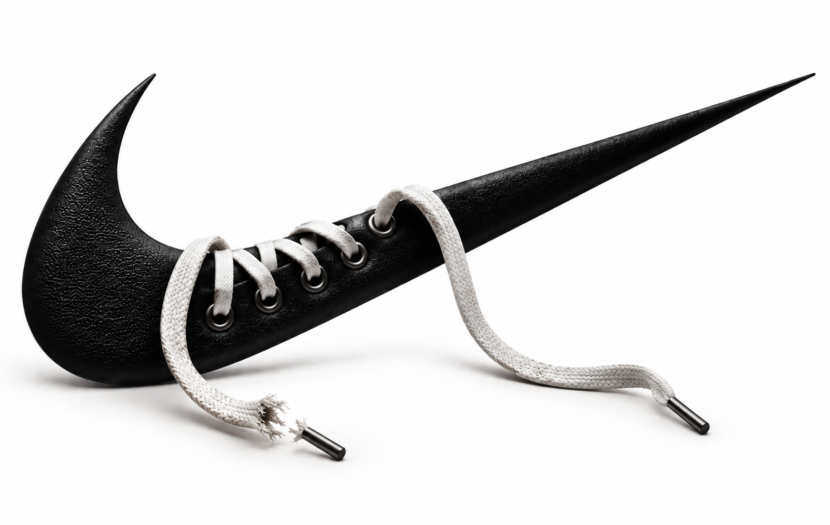
Belief Built Nike’s Story. The Company Stopped Governing It, Losing $220 Billion in Market Value.
After a keynote for a business association in Phoenix, the event producer handed me a copy of Shoe Dog, Phil Knight’s memoir, as a thank you.
Not a book I would have picked up myself.
I read it anyway. One of his thoughts persists with me: “People, sensing my belief, wanted some of that belief for themselves. Belief, I decided. Belief is irresistible.”
So taken by the Nike story and his central theme of belief, I invited Knight onto the Business of Story podcast. He declined — by handwritten letter.
That letter is the point. Not the refusal, but the precision of it. Knight still governed his own story down to the medium of a reply.
But in 2020, the company he built started believing in a new, ill-fated direct-to-consumer narrative.
Nike’s collapse is what happens when a brand’s belief has no governance infrastructure.
I call it narrative entropy: the slow structural dissolution of a brand’s story when no one in the enterprise is governing it through StoryOps™.
StoryOps™ is the operational discipline of governing a brand’s story with the same rigor a company applies to its code or its revenue — finding, crafting, operationalizing, governing, and guiding one narrative so every campaign, every channel, and every leader stays inside it. It’s the same category logic as DevOps for engineering or RevOps for revenue, just applied to story.
Nike is the most expensive case study I can imagine for the lack of StoryOps™.
What “Just Do It” Was Actually Doing
“Just Do It” was the best kind of marketing because it was story governance in disguise.
Nike’s Hero archetype was so clear that any decision inconsistent with it was obviously wrong to anyone who understood the brand — product calls, athlete partnerships, retail placement, cultural posture, all governed by one coherent idea.
That kind of clarity is rare. It’s also fragile without infrastructure.
Find the story. Craft the story. That’s what Knight did, better than almost anyone in the history of consumer brands.
What came next is where it recently broke: operationalize the story, govern the story, use the story as your guide. Nike stopped at two out of five.
Nobody Was Empowered to Say No
Magda Adamska, founder of the brand-strategy case-study library BrandStruck, calls what happened to Nike the Efficiency Trap — and laid it out in detail on this week’s Business of Story podcast.
What got me interested in this topic was Magda’s article, How Brands Shrink – Four Scenarios With Case Studies.
One case study is Nike. Magda writes, “Nike‘s commercial difficulties of recent years are often attributed to new brands such as On and Hoka entering the market and taking share. However, most business analysts point to a set of self-inflicted decisions, driven by the goal of improving profit margin without adequate assessment of the long-term effect on revenue and profit.”
Nike fell into the Efficiency Trap because they did not have an effective StoryOps™ discipline. And it all began with COVID.
Pandemic-era direct-to-consumer sales spiked. Nike’s leadership treated the spike as a new baseline instead of an anomaly, and extrapolated a permanent strategy from it: terminate wholesale relationships with Foot Locker and Macy’s, chase direct margins, control the whole channel.
That’s the diagnosis the market recognizes. But the deeper question is why nobody’s job was to ask whether that decision broke the story before it was approved.
The most structural move, and the least discussed, was organizational: Nike reorganized from sport-specific teams into gender categories — Men’s, Women’s, Kids’ — under a strategy it called Consumer Direct Acceleration.
Unfortunately, it dissolved the specialized product knowledge that made Nike’s story credible on the shelf.
Nike CEO Elliott Hill, reversing it two years later, put it plainly: “Organizing by sport gives us a much clearer point of view.” Between 2021 and 2025, Nike’s global sportswear market share fell from 29 percent to 26 percent.
This failure mode predates Nike by decades.
Brand builders have understood for the better part of a century that every decision is either a deposit into the story’s account or a withdrawal from it. A blurred brand image doesn’t inspire loyalty, it spends it. Nike stumbled out of the blocks big time.
The temptation was screenable, too. Before you chase a margin, there’s a question that should come first: does this decision make the story stronger, or does it just make the quarter look better? Fifty percent direct margins against thirty to thirty-five percent wholesale clears the second test easily. It fails the first one. Nobody ran it.
I have a fortune from a fortune cookie taped to my computer. It reads: “Do not mistake temptation for opportunity.”
When you reorganize around efficiency metrics instead of brand story, you haven’t solved a business problem. You’ve created a governance vacuum.
The Brand Story Grader Just Diagnosed Nike’s Story. The Grade Is D.
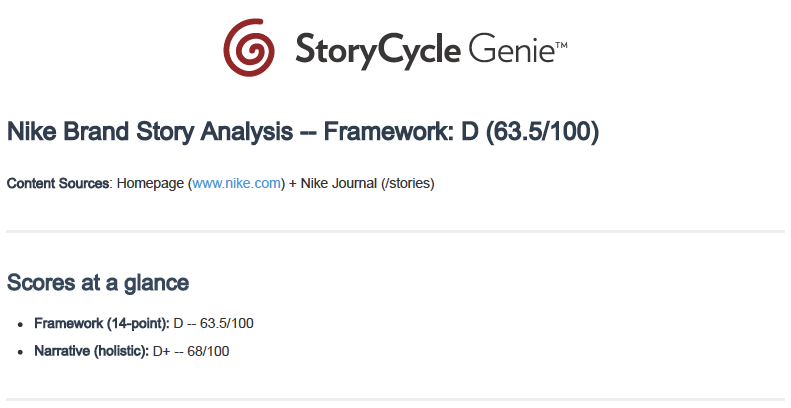
Click to see Nike’s complete brand story report
The financial data is a lagging indicator. I wanted a real-time one, so I ran Nike’s homepage and Journal content through the StoryCycle Genie™ Brand Story Grader myself.
Overall, Nike’s brand storytelling scored a D. This is 2026 — two years into a very real operational turnaround. The full findings are available to download here. Nike’s brand story score is also detailed at the end of this article.
The single lowest-scoring criterion, Customer Struggle Clarity, came in at 2.0 out of 5. The Grader’s own language: Nike “skips straight to aspiration.” There is no acknowledgment anywhere on the homepage of athletic struggle, doubt, injury, or barriers. The aspiration is assumed. It’s never earned.
Here’s what makes the score damning rather than just low: the execution-level criteria are excellent. Brand Archetype and Tone, Emotional Resonance, Simplicity of Language, Brand Differentiation — all scored 4.0 out of 5. The craft is there.
Nike hasn’t forgotten how to execute. It’s brand storytelling craft is some of the finest in the business. What’s missing is the layer that connects the execution to a single story: a brand narrative thread. Eight campaign threads run in parallel on the homepage — NBA, NikeSKIMS, NFL, Caitlin Clark, Jordan, ACG, NWSL, a trending shelf — each one internally coherent, none of them adding up to a single journey. Nike has the scenes. It needs the screenplay.
The market has already priced this in. Nike’s March 2025 quarterly results showed revenue down 11.5 percent to $11.01 billion, digital sales down 20 percent, gross margin compressed 190 basis points to 42.7 percent.
A class-action suit filed against then-CEO John Donahoe and CFO Matthew Friend alleges investors were misled about the Direct-to-Consumer strategy’s success throughout this period.
The athletes tell the same story from a different angle: Simone Biles left for Athleta in 2021, an early signal, before the deepest cuts even landed. Tiger Woods launched his own apparel brand, Sun Day Red, with TaylorMade in February 2024.
Stack the departures together, and they read as coherence signals — evidence the story stopped holding its own roster.
Elliott Hill Fixed the Business. Nobody Fixed the Story.
Hill’s moves since taking over are real, and directionally correct.
He rebuilt wholesale relationships with Dick’s Sporting Goods, Foot Locker, and JD Sports.
He restricted supply on classic Jordan retros to restore the scarcity that gives a premium brand its premium.
He poured resources into running specifically, the one category where Nike’s Hero archetype never fully broke down — five straight quarters of double-digit growth there.
He launched “Why Do It?” in 2025, a tonal shift from the competitive “So Win” toward self-belief and the courage to start.
And he reorganized the company back around sport. Governing a story is mostly the discipline of saying no to what doesn’t fit it, and that’s what the reorg actually is at operating-model scale — the same discipline Knight once carried personally, now being rebuilt as infrastructure.
Here’s what two years of that work hasn’t touched: the Grader score.
- Story Structure, 2.5 out of 5.
- ABT Messaging, 2.5.
- Clarity of Transformation, 2.5.
The parallel-lanes problem is still there, dated 2026, after the wholesale rebuild, after the reorg, after “Why Do It?” Hill has re-operationalized the business. He has re-governed a great deal of it. Nobody has yet used the story as the guide.
The market hasn’t fully bought the recovery either. As of this month, Nike stock has lost $220 billion in value since its November 2021 peak — a 78 percent decline, shares at twelve-year lows.
Market capitalization fell below $100 billion in March 2025. JPMorgan downgraded the stock to Underweight with a $40 target. In China, Nike has now lost share to Anta and Li Ning for eight straight quarters.
Analysts describe the turnaround as “a long, hard slog.” That’s the financial recovery they’re measuring. There’s a second, harder one they haven’t priced in yet, and it runs on a different clock.
You can fix distribution in a quarter. You can’t fix story architecture without first deciding it’s a governance problem, not a marketing problem.
Your Brand Doesn’t Have a Storytelling Problem. It Has a Governance Problem.
If Nike — with fifty years of brand equity, a turnaround CEO two years into the job, rebuilt wholesale relationships, and a category on fire — still scores a D on structural story criteria in 2026, the question for your brand isn’t whether this could happen to you. It’s whether it already is, and whether you’d see it before it shows up in the numbers. AI at scale without story governance accelerates narrative entropy.
I built the Brand Story Grader because Phil Knight’s belief can’t be yours. But the governance discipline his belief embodied — that can be. Run your own brand through it before your competitors see your score in your financials instead.
Knight didn’t decline that podcast invitation carelessly. He wrote by hand. He chose the medium. He controlled the message, two lines, no ambiguity, completely on-brand. That’s not nostalgia for a founder era. That’s what guiding a story looks like when one person is still doing it personally. The question for your organization: who’s doing it institutionally?
Nike didn’t lose its belief. It lost the infrastructure that belief requires at scale. That’s a different problem — and the Grader proves it’s still unsolved. Now you have a name for it. And a question: who in your organization is empowered to say “this breaks the story” before it ships?
One more governance test is coming in the next issue — how one of the world’s boldest entrepreneurs decides what’s allowed to carry his brand’s name, and what isn’t. That’s next.
The Full Nike Brand Story Assessment and Grade
Nike Brand Story Analysis — Framework: D (63.5/100)
Content Sources: Homepage (www.nike.com) + Nike Journal (/stories)
Scores at a glance
- Framework (14-point): D — 63.5/100
- Narrative (holistic): D+ — 68/100
- Homepage Content Analysis
Content Quality: Nike’s homepage is a sophisticated multi-campaign carousel operating at a global retail scale. Rich product navigation, campaign copy, and athlete storytelling exist — but the page functions primarily as a conversion engine, not a brand story vehicle.
Key Elements Identified: Athlete spotlights (Caitlin Clark, Cindy Ngamba), lifestyle campaign positioning (NikeSKIMS), sport-focused community signals (NBA, NFL, NWSL), inspirational Journal content, performance movement language (ACG, Jordan).
Missing Elements: A unified brand story arc; articulation of the customer’s struggle; explicit ABT narrative thread; clear transformation promise; future vision statement; direct audience identification beyond product categories.
Business Type: Athletic Brand
Content Completeness: Partial | Confidence Score: 8/10
14-Point Framework Scores
Criterion Score /5.0 Grade
- Story Structure 2.5/5.0 F
- ABT Messaging 2.5/5.0 F
- Customer’s Struggle Clarity 2.0/5.0 F
- Brand’s Role — Mentor vs. Hero 3.5/5.0 CPage
- Target Audience Identification 3.0/5.0 D-
- Brand Position, UVP, Emotional Promise 3.5/5.0 C-
- Brand Archetype/Tone 4.0/5.0 B-
- Consistency & Cohesion 3.5/5.0 C-
- Clarity of Transformation 2.5/5.0 F
- Emotional Resonance 4.0/5.0 B-
- Simplicity & Clarity of Language 4.0/5.0 B-
- Customer Centricity 3.0/5.0 D-
- Brand Differentiation 4.0/5.0 B-
- Future Vision 2.5/5.0 F
Framework average 3.18/5.0 D
Framework % 63.5% D
Narrative Quality Assessment
Authenticity: 18/25 — Cindy Ngamba story and Nike Journal provide genuine athlete-centered narratives
Completeness: 6/10 — Story elements distributed across campaigns rather than unified
Memorability: 12/15 — “BODY OBSESSED,” “NOTHING SPECIAL TO SEE HERE*” are exceptional
Story Cohesion: 16/25 — Multiple campaign threads fragment the homepage narrative
Emotional Journey: 16/25 — Peak emotional moments without continuous progression
Narrative Total: 68/100
14-Point Framework Analysis
1. Story Structure — 2.5/5.0 — F
Nike’s homepage offers multiple mini-narratives but presents no unified story arc. Each campaign is a well-crafted chapter with no overarching story structure tying them together. Opportunity: Create a homepage narrative layer establishing athletic human struggle, obstacle acknowledgment, and Nike’s role in resolution.
2. ABT Messaging — 2.5/5.0 — F
Nike has the ingredients of a powerful ABT but the structure never assembles on the homepage. The Caitlin Clark copy is the closest thing to an ABT — ordinary person, doubted, extraordinary results — but it’s one campaign, not the brand ABT. Opportunity: Surface Nike’s core brand ABT as a through-line.
3. Customer’s Struggle Clarity — 2.0/5.0 — F
Most significant homepage gap. Zero explicit acknowledgment of athletic struggle, performance anxiety, or barriers athletes face. Nike skips straight to aspiration. Opportunity: Name the specific struggles — this is the “BUT” that makes Nike’s resolution meaningful.
4. Brand Role — Mentor vs. Hero — 3.5/5.0 — C
Athlete stories position Nike correctly as enabler; product launch banners revert to hero language. Cindy Ngamba story: “she relentlessly pursues dreams” — Nike absent, athlete is hero. Versus: “Introducing the NBA Standard Issue Collection” — Nikecentric. Opportunity: Extend Journal’s mentor framing to all campaign banners.
5. Target Audience Identification — 3.0/5.0 — D
Product categories (Men, Women, Kids, Basketball) replace audience identity. NikeSKIMS “Unapologetically feminine, undeniably strong” is the model for audience-first messaging. Opportunity: Lead every section with audience identity truth, not category.
6. Brand Position, UVP — 3.5/5.0 — C
The unique value proposition (UVP) is globally known but absent from homepage copy. “Classic silhouettes and cutting-edge innovation” is the closest UVP statement. Opportunity: One declarative brand position statement: “You bring the will. We engineer the edge.”
7. Brand Archetype/Tone — 4.0/5.0 — B
Hero/Outlaw archetype executed with exceptional consistency. “BODY OBSESSED,” “FLIP THE SWITCH,” “WEAR YOUR ALLEGIANCE” all unmistakably Nike. Opportunity: Anchor archetype in evergreen brand voice, not only seasonal campaigns.
8. Consistency & Cohesion — 3.5/5.0 — C
Individual campaigns are internally cohesive; the homepage as a whole presents 8 simultaneous narratives. Opportunity: Sequence campaigns into a coherent homepage story: sport leads to culture leads to innovation leads to community.
9. Clarity of Transformation — 2.5/5.0 — F
No before-and-after transformation articulated. “Built for speed and standout style” is product spec, not transformation. Opportunity: Every product section should carry a transformation promise: “From overlooked to undeniable.”
10. Emotional Resonance — 4.0/5.0 — B
Nike focuses storytelling, emotional impact is genuine and powerful. Caitlin Clark humor + aspiration; Cindy Ngamba refugee depth; NikeSKIMS Olympian strength. Opportunity: Connect emotional peaks across campaigns into a continuous journey.
11. Language Simplicity — 4.0/5.0 — B
Page Campaign copy is masterclass simplicity. Three-to-four word declaratives, zero jargon. Opportunity: Extend this simplicity from campaigns to product descriptions, which revert to technical spec language.
12. Customer Centricity — 3.0/5.0 — D-
“We built our reputation,” “We’re ready to bring the heat” — Nike-centric launch copy. “You don’t need to say who you ride with” — customer-centric. Ratio tips toward Nike on commercial content. Opportunity: Reframe product launches from “We’re introducing” to “Your game just changed.”
13. Brand Differentiation — 4.0/5.0 — B
Nike differentiates through cultural curation — Olympian refugees, WNBA stars, NikeSKIMS Olympians. The athletes and moments chosen signal what the brand believes. Opportunity: Make the curation principle explicit: “We partner with athletes who prove sport is more than sport.”
14. Future Vision — 2.5/5.0 — F
Homepage is entirely present-tense. No articulation of where Nike sees sport or human performance going. Opportunity: “The next athlete to break a world record is training right now. We’re building the gear for a breakthrough that hasn’t happened yet.”
Summary Analysis
Nike presents a paradox that should fascinate any brand storyteller: one of the world’s most powerful brands, built on one of history’s greatest narratives — “Just Do It” — scores in the D band when its homepage is evaluated as a brand story vehicle.
This is not an indictment of Nike’s overall storytelling power; it is a precise diagnosis of a structural problem.
The brand’s strengths — archetype clarity, emotional resonance, language simplicity, differentiation — are execution-level qualities. Nike writes great copy, picks great athletes, creates great cultural moments. But the homepage lacks structural foundations: no articulated customer struggle, no coherent ABT arc, no transformation promise, no future vision.
The highest-leverage opportunity: build the story spine that world-class campaigns can hang on.
Priority Improvement Areas:
- Customer’s Struggle Clarity — Name the “BUT” in Nike’s brand ABT
- Story Structure — Build the narrative architecture connecting desire, obstacle, and resolution
- ABT Messaging — Deploy the brand ABT as a unifying through-line
Key Strengths:
- Brand Archetype/Tone (4.0) — Unmistakably Nike across every campaign
- Emotional Resonance (4.0) — Cindy Ngamba, Caitlin Clark, NikeSKIMS Olympians deliver genuine emotional power
- Brand Differentiation (4.0) — Cultural curation creates competitor-proof differentiation
- Transform Your Brand Story with StoryCycle Genie(TM)
How does your brand story grade?
Just Do It!