What Lincoln Knew About Narrative Structure That Most Business Leaders Have Never Been Taught
The Two-Minute Blueprint That Has Outlasted Every Speech Given That Day
What if every time you wrote an email, a presentation, or a pitch, your message connected deeply in those first moments, clutched your audience’s attention, and started compounding your influence with every word?
But when our communications crash, we blame the message — the wrong words, the wrong tone, the wrong angle — when in fact it is the narrative structure that is broken.
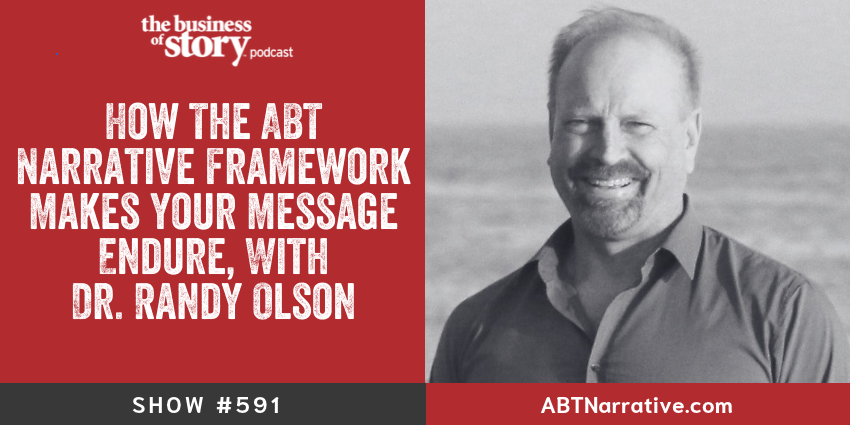
That is exactly what Dr. Randy Olson has spent 15 years proving. And he does it by pointing to the most enduring two-minute communication in American history: Abraham Lincoln’s Gettysburg Address — 272 words, flawlessly structured on the And, But, Therefore (ABT) framework — and showing you how to apply the same architecture to everything you say and write in business today.
Meet Dr. Randy Olson: The Harvard-Trained Scientist Who Decoded the Structure Behind Every Message That Endures
Dr. Randy Olson holds a PhD in evolutionary biology from Harvard University, left a tenured professorship to attend USC film school, and has spent the last 15 years developing the And, But, Therefore (ABT) framework with scientists, physicians, and communicators at NASA, the Gates Foundation, Pfizer, and medical schools across the country.
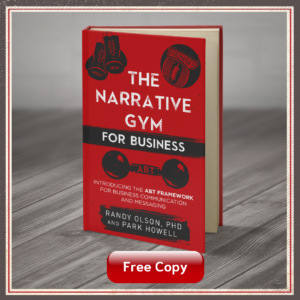
He is the author of Houston, We Have a Narrative, Narrative Is Everything, and the co-author of Narrative Gym for Business alongside Park Howell. This is his tenth appearance on the Business of Story — and arguably his most important.
The ABT framework is the three-part narrative structure at the core of every message that endures. AND establishes the agreement and dream. BUT drops the gut punch — the problem, the obstacle, the tension. THEREFORE delivers the resolution and the call to action. Lincoln used it without knowing its name. Randy has spent 15 years teaching it to every communicator willing to stop improvising their narrative and start installing it as a discipline.
What’s in it for You:
- Why Lincoln gave history’s first two-minute lightning talk — and what it teaches every business communicator today
- The six-element ABT framework and how to place your message in its most emphatic position for maximum impact
- The Lincoln-Douglas debate metric that reveals whether your brand message is built to endure or built to evaporate — and how you can measure it quantitatively in your own communications right now
- Why narrative entropy — the fragmentation of your brand story that renders it impotent — is accelerating at AI speed, and how the ABT stops it
- The “Liz moment”: the three things that happen when the ABT locks into your audience’s memory and they start repeating your message with perfect fidelity
- The team exercise that instantly exposes where your narrative entropy has already taken hold before it costs you
Listen and Watch:
Why Lincoln’s Gettysburg Address Is the Most Relevant Business Communication Case Study of Our Time
Randy’s breakthrough insight in this episode is both historically rigorous and immediately practical. Lincoln stood at Gettysburg and gave a two-minute talk. Edward Everett, the Harvard professor and gifted orator who preceded him, spoke for two hours. Everett’s speech is forgotten. Lincoln’s is memorized by schoolchildren 160 years later.
The difference was not eloquence. It was structure.
Lincoln’s first paragraph is pure AND — the dream, the agreement, the aspiration. Four score and seven years ago, our fathers brought forth a new nation conceived in liberty and dedicated to the proposition that all men are created equal. No drama. No conflict. Just the setup that gets every head nodding yes.
The second paragraph drops the BUT. Now we are engaged in a great civil war. Gut punch. The dream is threatened. Everyone in that field already knew it — they were standing on the graves of 51,000 casualties. But Lincoln named it as the structural contradiction, and by doing so, he gave the audience a problem their minds could hold.
The THEREFORE is the resolution — the call to endure, to finish what those who died there began, to ensure that government of the people, by the people, and for the people shall not perish from the earth. The dream, the disruption, the determination. Three paragraphs. 272 words. Two minutes.
The ABT Framework, Narrative Entropy, and the StoryCycle Genie®
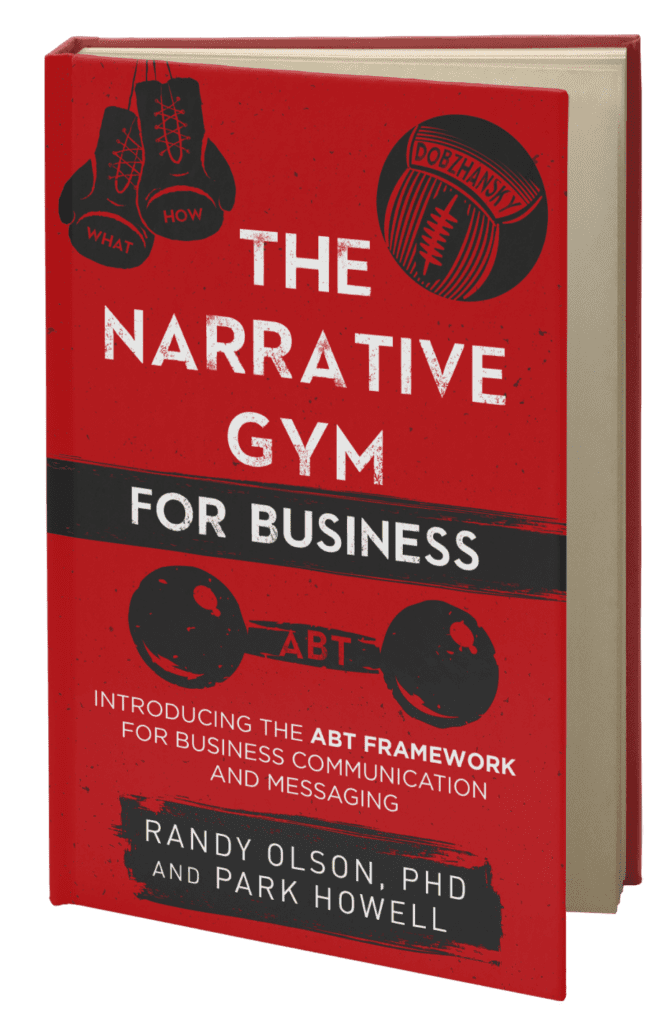 The And, But, Therefore framework is not just a presentation tool. It is the narrative engine at the core of the StoryCycle Genie® — the only narrative-native, Artful Intelligence™-driven platform built to help companies find their brand story, define it, and get every soul behind it.
Narrative entropy is the fragmentation of your brand story that renders it impotent. It is what happens when your message has no ABT backbone — when your team tells five different versions of the same story, when AI scrapes your content and amplifies the inconsistency at machine speed, when your brand starts to sound like everyone else in your category.
StoryOps™, coined by Park Howell and Sean Schroeder, is the governance discipline that stops it. The ABT is the structure that makes your story worth governing.
The Six-Element ABT: General to Specific, Three Times
One of the most actionable insights Randy delivers in this conversation is the six-element expansion of the ABT. The three-part structure — setup, problem, solution — is the skeleton. But inside each of those three elements, effective communication moves from general to specific. General gets the emotional punch. Specific delivers the intellectual proof.
Your AND opens with the general aspiration — the dream your audience already holds — and then narrows to the specific desire you can help them achieve. Your BUT opens with the general emotion — frustration, fear, pressure — and then names the specific problem causing it. Your THEREFORE opens with the general resolution — the transformation your audience can experience — and then specifies exactly how they will get there.
Randy and Park also share the single most powerful leadership diagnostic you can run in your organization: gather your senior team, give them five minutes, and ask each person to write one sentence — the ABT of your company. If they are aligned, every sentence will say the same thing in different words. If they are not, you will have five completely different narratives. That gap is your narrative entropy. That exercise is where you start fixing it.
More Information and Resources:
- Dr. Randy Olson’s website and ABT framework: abtnarrative.com
- Houston, We Have a Narrative by Dr. Randy Olson: Amazon
- Narrative Is Everything by Dr. Randy Olson: Amazon
- The StoryCycle Genie®: storycyclegenie.com
- The Story Cycle System™: businessofstory.com
Related Episodes:
- Why Brand Story Governance Is the Only Guardrail Standing Between You and Strategic Collapse with Magda Adamska — Magda Adamska’s 250-plus brand strategy case studies reveal exactly why the brands that endure are governed by a coherent narrative — and why the ones that collapse always lose their story first.
- When Every Person in Your Company Points the Same Direction, That’s Not Culture. That’s Story Governance. with Gavin McMahon — Gavin McMahon’s Arrow of Coherence framework shows you how to build the narrative spine that keeps your brand story intact across every department, every channel, and every AI tool running in your enterprise.
- Because If No One Is Governing It, AI Is Fragmenting It Faster Than You Can Fix It with Rain Bennett — Rain Bennett makes the case that brand story is not a marketing deliverable but an operating system — and that the Chief Storytelling Officer is the most urgently needed role in every organization navigating AI-accelerated narrative drift.
Randy Olson’s Conversation With Park Howell on the Business of Story Podcast
Park Howell: Randy, welcome back to the show.
Randy Olson: It is wonderful to be back, always. When did you start the show — about ten years ago?
Park Howell: Actually, twelve years ago. And I wasn’t even sure how many times you’d been on the show, so I had to ask the StoryCycle Genie® to look at the podcast and tell me. By God, I have endured nine of your appearances — so you’re back for number ten. Welcome back.
Randy: It’s great to be back. And I’ve got a feeling that this whole trait of endurance is really important in the business world.
Park: Yeah — endure, endure, endure. That’s what we always want our stories to do.
In brand and business development, you first have to find the story that is uniquely your own — the story only your brand can tell. Then you have to govern it. Make sure everyone is telling it, even from their own unique point of view, while staying consistent in the telling.
If that story is going to endure everything coming at it — from AI bots fragmenting it and spewing nonsense into the world, to your own people not really understanding what your story is — the only way to make it endure is, I think you probably guessed it, starting with the And, But, Therefore.
Randy: And wouldn’t it be nice if that And, But, Therefore structure were so powerful it could make your message still endure a hundred and sixty years later.
Park: I’ve got a hunch you’ve got an example of that for us.
Randy: Really? What gave you that idea?
Park: You know, you and I became fast friends back in 2013 when you were publishing your second book, Connection. That’s when I was first introduced to the And, But, Therefore framework.
When I saw it from a branding standpoint, I thought: is this thing really that powerful? Or am I just drinking the Dr. Randy Olson Kool-Aid at this point?
Over the years I’ve found that it is extraordinarily powerful. And by the way, it is at the core of the StoryCycle Genie® — the only narrative-native, Artful Intelligence™-driven platform out there for brand storytelling.
Randy: Nice. Therefore.
How Dr. Randy Olson Discovered the And, But, Therefore Framework from the Creators of South Park
Park: You have been training this stuff. I’ve been honored to be a part of many of your trainings with academics, scientists, and leaders in really big, complicated worlds very different from the business world. I’ve seen you in action so many times with the And, But, Therefore. How did you first find it?
Randy: I found it through a documentary on Comedy Central in the fall of 2011 — by the co-creators of the animated series South Park — in which they talked about a simple rule they called the rule of replacing.
I’d been through film school. I’d had at least five writing courses, lots of writers’ groups, learned all the complexity and nuance involved in writing a good screenplay and telling a good story.
But when these two guys talked about their simple rule, given my background in science, I know the value and importance of simplicity. I kind of fell out of my chair and started asking friends: why weren’t we told about this fifteen years earlier when I was in film school?
It turns out there was a great screenwriting instructor in the 1980s who first identified this three-part structure. In communication and in screenwriting and storytelling, the simplest three words are And, But, and Therefore. They embody the three forces that are absolutely fundamental — agreement, contradiction, and consequence.
They’re the three forces we use day in and day out. They underpin everything effective that we do.
I began to explore it, developed it into a template we call the ABT — And, But, Therefore — for short. We began to see it everywhere. It reaches back in time.
And then one day my good friend Park called me up and said, “Hey, that And, But, Therefore thing you’ve been talking about — have you ever looked closely at the Gettysburg Address?”
Lincoln’s Gettysburg Address Is a Three-Paragraph ABT — Agreement, Contradiction, and Consequence — That Explains Why 272 Words Have Outlasted 160 Years
Randy: It’s one of the five most important speeches in the history of this country on a lot of historians’ lists — number one on many of them.
There are only three paragraphs in that speech. Sure enough, they are basically agreement, contradiction, and consequence.
Agreement: we’ve got a great country. Contradiction: but now we’ve got a terrible Civil War tearing it apart. Consequence: therefore, we must continue what took place at Gettysburg — the struggle that saved this great nation.
It’s that simple. And that simplicity is just unbelievably powerful.
Park: Back in 2013 when I first came across it, I was reading your book and I thought: let me go find where else this has shown up.
I found it in nursery rhymes and thought that was interesting. But then I wanted something with a little more gravitas. Someone had mentioned the Gettysburg Address a few weeks earlier — mentioned it was only two minutes long, which surprised me. So I jumped over there and boom. It hit me right upside the head. There it is. The And, But, Therefore in two minutes in one of the most legendary speeches ever.
I’ve used that in all of my story training throughout the years. I never go without showing people the Gettysburg Address and demonstrating right where the ABT is.
Randy: And you know what? It kind of sat there hibernating for thirteen years. Then this past summer, everything changed.
My co-instructor and collaborator of the last eight years, Matthew, was invited to the University of Missouri to do training with their scientists in an agriculture and life science program. They were preparing people to give two-minute lightning talks.
Now, my colleague Mike Strauss loves to point out: if you take a twenty-minute talk and shrink it to two minutes, it’s still going to be boring. If it was boring at twenty minutes, it’s still boring at two. Just the fact it gets over quickly is not the right mindset. You need to make a two-minute presentation really, really good.
The way you do that is through structure. Structure is the big challenge. That’s what the ABT framework is all about.
At 272 Words in Two Minutes, Lincoln’s Gettysburg Address May Be History’s First Lightning Talk — Proving Narrative Brevity Permanently Outlasts Verbose Information Dumps
Randy: As I began working on a presentation for the Missouri event, and also after spending a week at Washington University in St. Louis for their medical school, I began thinking more and more about these two-minute lightning talks.
Then it finally hit me one day: wait a second — two minutes. That’s the length of the Gettysburg Address.
I began to dig in deeply on the specifics. What are the consequences of it? What did the praise for it consist of? And most importantly, why has it endured all these years?
I’m holding here a copy of Lincoln at Gettysburg by Garry Wills. Published in 1993 for the 130th anniversary of the Battle of Gettysburg — and it won the Pulitzer Prize that year. A hundred and thirty years after the speech was given.
The speech is only 272 words and lasted only two minutes. What did Lincoln manage to do there? Is it possible that Abraham Lincoln gave the very first two-minute lightning talk?
We started making a joke out of that. Well, it’s not a joke anymore. We’ve now made a five-minute video we’re releasing next week. And by golly, it really was a brilliantly structured two-minute talk.
A lot of it had to do with Lincoln’s gift — not just for oration, which is what you always see celebrated — but for narrative structure. We’ve learned in the last fifteen years, especially intensively in my narrative training, that some people have it and most people don’t.
It is super important. It is a defining characteristic of whether you communicate effectively.
Park: Let’s show the video to everyone watching. If you’re listening to the show, go to the show notes — I’ll have it there. Or find it on LinkedIn.
Lincoln didn’t know about the ABT because he wasn’t watching South Park at the time. He was just a very gifted natural storyteller.
And folks in the business world — nobody wants to be boring. We often think about B2B: business to business. What we mostly experience is boring to bored. Here is a way to overcome that.
It Was Not That Lincoln Was a Great Storyteller — It Was That He Had Deep Narrative Intuition Built on Setup, Problem, and Solution
Randy: I’m going to fine-tune what you’re saying there, because this really is a lot of our mission.
It’s not that Lincoln was a great storyteller. It’s that he had deep narrative intuition. And that gave him an incredible ability to think in terms of setup, problem, solution — the three elements of the ABT.
They’re the eternal elements that the great philosophers of the 1600s first identified.
Setup, problem, solution. The reason I point this out is because as I’ve studied Lincoln more and looked at not just his speeches, but especially the Lincoln-Douglas debates — seven debates in the summer of 1858 — you can analyze the transcripts of what they said.
Douglas was an “and, and, and” guy. He just spewed information and facts and statements. Lincoln, when you count the ands and buts, had a mind that was constantly crafting everything as a setup and problem-solution loop — over and over and over again.
Fascinating thing: the people who were present at those debates thought Douglas won because he was really animated and spoke twice as fast. That’s what you can do when you’re not crafting narratives — you’re just spewing information.
The people on the East Coast who read the transcripts in newspapers two to three days later all felt Lincoln won.
That’s the difference. Lincoln’s mind laid out everything as ABT. You can see it quantitatively simply by counting the ratio of buts to ands. That ratio was double for Lincoln what it was for Douglas.
And then it really comes to life in the Gettysburg Address.
Park: Well, and Randy — after producing this five-minute video, what did you learn or grow from?
Randy: One of the cool things happening already is that people commenting on the video are connecting to the moment at the end where Everett wrote to Lincoln the next day and said: “What it took me two hours to ramble through, you nailed in two minutes.”
A lot of people say that feels like the real synthesis moment of the whole video.
Back then, two-hour orations were the general form of entertainment of the day. Today, you can’t even do two minutes.
Park: Who’s got time for five minutes?
Randy: Some of the young people we work with will be watching that video at 2X speed.
Park: That underscores the importance of a singular narrative and the setup-problem-resolution dynamic that speaks to our problem-solution brain.
Randy: Yes. And the first thing I’d encourage your listeners to do with that video is watch it more than once. In repetition you pick up these patterns and begin to develop muscle memory with them.
There are five traits we run through in the video. They should ask themselves: have you touched on the dream? Have you incorporated time as a variable? Are you advancing the narrative?
But here’s our first real touching on our theme of endurance. Here’s your proof: 130 years after Lincoln gave that speech, here’s a whole book that Gary Wills wrote — and won the Pulitzer Prize for — in 1993.
Why did this speech endure? The title is The Words That Remade America. A lot of it is that the form lands right on this ideal shape — everything in the right place.
And then its shortness made it possible for people, over the years, to not just read it repeatedly but memorize it. You can’t do that for even a twenty-minute speech. Ken Burns did a whole documentary mostly about school kids memorizing the Gettysburg Address.
One of the patterns that emerged over time: lots of articles and books written about the Gettysburg Address — and yet none of those people had this knowledge of narrative structure. And if you don’t know narrative structure analytically, how can you fully understand why the speech works?
Charles Darwin and the ABT View of Life — Why Narrative Structure Changes How You See the World
Randy: Okay — you love the fact that I have a PhD from Harvard University in evolutionary biology, right?
Charles Darwin published in 1859 The Origin of Species — regarded as one of the ten most important books ever written by any human.
The last paragraph of that book — in fact the last sentence — he tells about what happened to him during the voyage of the Beagle. He was a young man in his 20s when he took that trip, stopped through the Galapagos Islands, and came to understand how evolution works by means of natural selection. It changed him.
It changed the way he looked at the world. He says: “There is grandeur in this view of life.” He had one view of life before that voyage. Afterward, he looked at the world completely differently.
This is what I’ve been through with the ABT — literally. There is an ABT view of life. When you begin to see this narrative structure, it changes how you look at the world. You start to see the structure everywhere. You realize how these things work.
That’s why deeper and deeper, the Gettysburg Address just becomes more and more extraordinary.
Park: And Randy, where I work with people in our line of work, business leaders will just jump right into the solution. Here’s what we’ve got to do, because of this and that, blah blah blah. No context whatsoever.
One time I was looking at Walmart Canada — they were going paperless with all their plastic bag lists in their stores. They’d provided a seventeen-page document on how they were going to launch it.
I took those 17 pages and boiled it down to one paragraph — setup, problem, resolution — and they could tell that story in under 20 seconds.
When they did it, everybody in the room said: “Well, why didn’t you just say that? Why did we have to wade through 17 pages?”
So for all of you listening: the next time you’ve got a presentation, a white paper, a blog, anything long-form — start it with an And, But, Therefore right up top so everybody is on board with setup, problem, and here’s how we’re going to solve it.
The Walmart Canada Case Study and James Carville Prove That One ABT Paragraph Wins More Boardrooms Than Thirty Volumes of Annual Reports
Randy: I’ve told you anecdotes about the work I did for a few months with James Carville back when Hillary Clinton was running for president.
He kind of understood the ABT. He told me he gets hired by big international corporations wanting to tell their story. They give him thirty volumes of annual reports and all this material and say, “Take it away.” He comes back and gives them one paragraph.
He said he’s been in boardrooms where they looked at him like: “We gave you all this money and all you’re giving us is one paragraph?”
And he says: “That’s what you need.”
It’s again the same thing that was said to Lincoln the day after: “What I rambled around for two hours on, you nailed in two minutes.”
That ability to boil it all down and achieve concision — you can’t say enough about how important that is in a world of too much information.
Trump’s MAGA Message Achieves a BUT/AND Ratio That Proves Narrative Architecture — Not Policy — Determines Which Messages Dominate Markets and Movements
Park: Let’s talk about story endurance, because right after Trump got elected the first time in 2016, I called you the very next day. You were down at NASA working with them.
I said, “Let’s get you on the show.” You said, “I’m too pissed off to talk about that.” I said, “Perfect — get on the show.” And you jumped on a couple of hours later.
You talked about Trump’s ability using an And, But, Therefore: we once had a great and mighty nation, but we no longer have a great and mighty nation, therefore I’m gonna make it a great and mighty nation.
That episode completely blew up. A lot of people talked about it, a lot of messages poured in.
And then, about a month ago, I was reading The Cult of Trump — trying to really understand MAGA and why people support him. In chapter three I read a quote that seemed very familiar. At the end of it: “According to Randy Olson.”
I took a picture of it. Sent it to you. Then jumped to the index and found they’d pulled it from my show — the Business of Story — referencing it from 2019. But again, it comes back to: how do you make your messages stick?
Randy: And by the way, you know what I was counting and measuring? Trump’s BUT/AND ratio was double what Hillary’s was. It’s the same thing as Lincoln versus Douglas. Trump versus Hillary. She didn’t have a message — she was “and, and, and.” He was out there ABT-ing.
I was counting and measuring that. That’s what eventually got me to Carville. I pitched it to a whole bunch of people — the New York Times, other places. Some of them wrote back and said, “That sounds too simple to me.” Carville was the one guy who understood at a gut level: yes, this is really what’s going on here.
Everybody was in shock the next day. I was sitting in a hotel room with my colleagues Rod Lamberts and Jade Lovell. We were there doing a thing with the American Association for the Advancement of Science.
We recorded that episode hot off the press — literally hours since the announcement. That episode is really good. I would encourage your listeners to go back to Episode 66.
Park: Episode 66 — I’ll have the link in the show notes.
Mark Twain’s Rule About Placing Crash Words in Emphatic Positions Reveals the Micro-Level Secret Behind Why ABT-Structured Messages Command Lasting Attention
Park: You sent me something that came out of the Garry Wills book. Let me read it.
“The proper words must be thrown into prominence, even if that meant inverting the normal order of a sentence. Twain said that even in swearing, you must study to put the crash words in emphatic places.”
So let’s talk about this idea of putting your words in emphatic places and how the ABT helps you do that.
Randy: Yeah — this is how universal what we’re talking about is. That quote is from Lincoln at Gettysburg. I should have read it thirteen years ago when you first put me onto it.
That phrase — “emphatic places” — hit me just the other day. Because that’s what we do day in and day out using the ABT. We’re trying to help you take all your pieces and put them in the right sequence for maximum impact.
Put them in the wrong sequence — as Twain said — and your “crash words,” your swear words, your most important points, land in the wrong place and have no impact.
You have to put the crash word in just the right place. Then you blow people away.
And what’s fascinating is that we began working a lot with environmental and climate people — they really don’t get it, there’s not enough urgency. We eventually got pulled toward public health, the World Bank, Pfizer. They get it better.
Now we’re working in medical schools. Physicians have urgency on a day-to-day basis and they get the power of this ABT tool. With them, we help them take all the different pieces of their project and put everything in the right emphatic places.
There’s a right place to put your hope. A right place to put your fear. A right place for the setup. And once you get it in your mind, you start listening to bad presentations and watching bad movies and you realize exactly what’s going wrong. They failed to put everything in the proper emphatic places.
Medical Schools Now Use the Collaborative ABT Build and the Billabong Leadership Exercise Proves That Narrative Misalignment Is the Organizational Rule, Not the Exception
Randy: When people hit these moments in the training, the whole room lights up. That’s why it’s so much fun.
The model we use now — we call it the ABT Build. It’s not critiquing. It draws on my background in evolutionary biology. It’s a two-step process: everybody in the room tosses out their suggestions, and then the one person whose narrative it is becomes the decider.
They start hearing other minds looking at their thing and thinking: wow, that’s a different way to look at it. It generates so much creativity.
A month ago we were at Washington University Medical School — one of the greatest moments in the fifteen years we’ve been developing this model. We had two groups of about fifteen medical students, postdocs, and faculty in two separate rooms.
They were doing ten to fifteen minutes on each person’s narrative. I was rotating between the two rooms watching this. You’ve got fifteen super-smart people focused on one sentence — the ABT — trying to figure out what the narrative is.
The rule we use: state the problem in five words or less. Everybody gives their shot. Then somebody nails it and the whole room lights up.
Park: And you did something similar right after Episode 66 — a call from a very large company. You brought all the leadership into the room, taught them how to write an ABT, and then asked everyone to write their version of the ABT for the company.
I am stunned when any two ABTs sound alike, because everybody’s coming from a different point of view.
Randy: In a perfect world, what would happen at that moment? Everybody would read theirs and they’d all be identical, right?
Park: Exactly. We call it narrative entropy when they’re not — and that’s the default state. You create a brand story and then you don’t do a good job of governing it through StoryOps™, and it completely falls apart very quickly.
Randy: And to be specific — it was Billabong Sportswear. Their international brand team came into the room. I gave them the usual talk and at the very end I said: “Why don’t all five of you write down the one-sentence ABT of this company?”
The first said they were about youth activity. The second, authenticity. The third, celebrities. The fourth, something else entirely. The head guy turned to me and said: “Do you think we have a problem here?” And I said: “I think so.”
That’s where the ABT becomes a really good assessment tool. If we’re all aligned, everybody quietly writes this thing and they should all be the same. If they aren’t — something’s going wrong.
Finding Your Organization’s Singular Narrative Theme Is the Hardest and Most Consequential Work in Brand Storytelling
Park: You and I, in building the Narrative Gym for Business together, we put our emphatic words in different places in the business world than you do in the science world.
The way we do it: I ask the brand to name their number one audience — and let’s introduce them right up top so they know we are talking to them — in the “And” statement of agreement. Who are you? What do you want relative to our offering? And why is that important to you? That’s our straight statement of agreement — all you want to do is get that audience nodding yes.
But — introduce a negative emotion. You’re frustrated, you’re annoyed, you’re fearful, you’re crazed — because of this problem that you have.
Therefore — introduce a positive emotion as contrast. Picture the excitement of your team when you accomplish this. And the second clause of that “Therefore” statement — at the very end — is where you introduce yourself and your solution. Nowhere before that.
You want to keep it all about your audience. That is where we emphatically place all of those points.
Randy: You’re really converging on what’s evolved for us with the model — it’s gone from a three-element model to a six-element model. You were nailing it right there.
Each of the three elements — And, But, Therefore — subdivides into general to specific, general to specific, general to specific. This is how communication works.
Effective communication begins with the general — we can all agree on this — and then gets specific. But there’s this one specific thing. And this is a major element of narrative intuition: beginning to get a feel for generality versus specificity.
Park: A general feeling — you feel generally frustrated, you feel generally annoyed — because of this specific problem.
Randy: That’s it — going from general to specific exactly. The general allows you to hit the emotional punch. The specific is the intellectual, the informational. You want to ratchet those two together.
The first element before you ever get to the “But” has two main things: the ordinary world — just what you work on — and the dream. If we could ever manage to measure this one little thing, we’d be able to solve this whole disease and all this suffering.
You crank the dream way, way up. Get everybody all excited. Then you drop the “But” bomb.
One of the mistakes people make is they say “but” and then take forever getting to the point. You need to land the “But” in five words or less. That gut punch. Everybody had their hopes way up — now you’ve aroused their interest with the emotional punch — and now you owe them the intellectual specifics.
Park: Yeah. And the last thing I want to really underscore is this idea about plot and theme.
You use the And, But, Therefore as your setup-problem-solution plot. But the theme — like today’s theme for this show — is: does your story endure? The stories that are fragmented, cluttered, and confusing are dead to the world.
The only way you will endure is to get super specific with that And, But, Therefore and find that singular theme. And coming from your evolutionary biology background — where did this idea of the singular theme come from and why is it so important?
Randy: Two weeks ago in the bookstore at LAX, there on the counter was The One Thing — still a popular book. The answer to that: read that book. It gives you a pretty good insight into the singularity of narrative. Narrative works at its best when it hits that single one thing.
The power of anecdotes. Science is the opposite of anecdotes — science is about big sample sizes. That’s a culture clash you see between narrative and the numerical.
The Liz Moment — When the ABT Locks In and Your Audience Begins Repeating Your Message With Perfect Fidelity
Randy: One thing I wanted to toss in as a clincher and validation of endurance: we have a thing we talk about in our training called the Liz Moment.
Liz Foot was one of the first members of our group, about twelve years ago. She wrote to me in 2014. She worked in ocean conservation, had given a talk, heard about the ABT, tried it out, and wanted me to know what happened.
It was the best talk she’d ever given. I ended up summarizing her email in my Houston, We Have a Narrative book.
What she said was: when she used this ABT tool, three things happened.
Number one, she found her talk easier to rehearse than ever before. It just naturally flowed and she could remember all the different parts. Didn’t have to look at her notes anymore.
Secondly, when she gave the talk, instead of people looking at their laptops and cell phones, they were all engaged, looking at her, answering questions as she posed them.
Thirdly, in the days after the talk, she saw people regurgitating what the talk was about — and getting it right. That was always one of her frustrations: you look at social media and they’ve mangled your whole talk.
All three of those things are about the emphatic places. The ABT helped her put all the information in the right, most emphatic places. Once she did, it locked into people’s minds. They propagated it with fidelity.
And there, once again, it circles back to the Gettysburg Address. He nailed it with the structure. And by nailing it, that enabled people over the years to memorize it — it feels good, you can rehearse it, it comes back out right.
Same with the Liz Moment. It’s a puzzle that’s there to be solved. When you solve it the right way, everybody feels good.
Narrative Entropy Is the Fragmentation of Your Brand Story That Renders It Impotent — and StoryOps™ Is the Governance Discipline Built to Stop It
Park: What I like about that one-word theme: if I’m writing an ABT and I’m losing myself — can’t get it dialed in — I ask, what is this about? And here’s how you can figure out what your theme is.
Boil it down. It’s so simple it’s almost vacuous. We call it the conversational ABT. Here it is: you want your story to endure. But it’s not enduring. Therefore, learn to make it endure with the ABT.
That’s it. That simple sentence tells you what the theme is. And then the last thing I’d tell everybody: now that you know about the ABT, go get your leadership in the room tomorrow. Tell them to write an ABT for your company and see where your narrative entropy has already taken place — and what you need to do to fix it.
Randy: And by the way — on LinkedIn, someone posted that the ABT was among the six most popular storytelling tools for CEOs. And the other five are all just derivations of the ABT. People take the simple and then tack on their own things and make it their own. But the ABT is the core of it all.
Park: And if you think the ABT is reductive and assaulting, you’re not alone — I’ve had someone yell at me about that. But it does reduce a very complex message down to a very simple, powerful setup, problem, resolution.
Randy: Once again, wait until this five-minute video gets unleashed on this community.
There’s some irreverence in that video on purpose — me basically thumbing my nose at a lot of the academic community. They have the best of intentions, but they bog stuff down. In a world of too much information, they end up doing damage they don’t want to acknowledge.
We’ve got a world of too much information. It has selected, over the last ten years, for a group of people who know how to communicate very simply — for better or worse. I saw it coming from miles away. Everything I feared in 2014 and tried to warn of — it all happened.
And talk about a simple one-word theme: once upon a time, this guy came out of the gates basically saying nothing in America today makes sense except in the light of one thing — and that one thing is greatness. That was a unifying theme that worked for ten years.
Park: You’ve got to be great to pull it off. You can say it, but if you can’t deliver on that promise, everything’s going to blow up in your face.
The ABT is extraordinarily powerful. Just be prepared to back it up. Back up your words and your storytelling by delivering on what you actually promise.
Randy: With great narrative power comes great narrative responsibility.
Park: Want to learn more about Randy’s world of ABT? ABTNarrative.com is the website.
Thank you very much for coming back for our tenth enduring episode.
Randy: Always a good time.
FAQs: The And, But, Therefore Framework, Narrative Structure, and Business Storytelling
Q: What is the ABT narrative framework and how does it work?
A: The ABT (And, But, Therefore) narrative framework is a three-part story structure that organizes any message into setup (AND), conflict (BUT), and resolution (THEREFORE) — the same sequence the human brain is neurologically wired to follow and retain. Developed and popularized by scientist-turned-storyteller Dr. Randy Olson, the ABT transforms rambling information into a message with a clear problem at its center and a compelling consequence at its close. The AND establishes shared context and agreement, the BUT introduces the tension or obstacle that demands attention, and the THEREFORE delivers the outcome or call to action. Business leaders apply the ABT to emails, investor pitches, brand stories, presentations, and strategic plans to produce communication that not only lands in the moment but endures over time. The framework is now taught in medical schools, used by Fortune 500 strategists, and embedded in the Story Cycle System™ as a foundational narrative tool.
Q: How does the Gettysburg Address use the ABT narrative framework?
A: Lincoln’s Gettysburg Address is a near-perfect three-paragraph ABT: the first paragraph establishes agreement (AND — the nation was founded on a principle of equality), the second introduces the contradiction (BUT — the Civil War tests whether that principle can survive), and the third delivers the consequence (THEREFORE — the living must dedicate themselves to a new birth of freedom). Dr. Randy Olson analyzed the Address and found that its narrative architecture — not its rhetorical flourish — explains why 272 words delivered in approximately two minutes have endured for more than 160 years. Lincoln’s superior BUT/AND ratio compared to Stephen Douglas’s information-heavy oratory demonstrates that the balance of narrative tension to context is what separates messages that last from messages that are immediately forgotten.
Q: What is the BUT/AND ratio in storytelling and why does it matter for business presentations?
A: The BUT/AND ratio is a diagnostic metric developed by Dr. Randy Olson to measure narrative tension in any piece of communication by comparing the frequency of “but” moments — conflict, problems, contradiction — to “and” moments — context, information, agreement. A high AND ratio signals an information dump: content that lists facts without a driving tension the audience is compelled to resolve. A high BUT ratio signals a story-shaped message the brain instinctively follows toward resolution. Lincoln’s Gettysburg Address achieves a dramatically stronger BUT/AND ratio than Stephen Douglas’s speeches, directly explaining its durability. For business leaders, auditing your BUT/AND ratio is a practical, immediate diagnostic for whether your pitch, proposal, or brand story functions as a narrative — or merely as a list.
Q: What is the six-element ABT model and how do I use it?
A: The six-element ABT model expands each of the three core narrative forces — AND, BUT, and THEREFORE — into two sub-elements that move from general to specific, giving communicators a precision tool for constructing messages at any level of complexity. The AND pair establishes broad context and then narrows to the specific agreement at stake; the BUT pair names the general category of problem and then specifies the exact obstacle or tension; the THEREFORE pair delivers the general consequence and then the specific resolution or call to action. This subdivision prevents the most common ABT failure — vague, interchangeable statements that could apply to any organization — by forcing communicators to move from principle to particularity at every stage. The six-element model is used in medical schools, corporate leadership training programs, and political communications to produce messages that carry both structural integrity and specific, actionable clarity.
Q: How can the ABT framework simplify complex business strategies and presentations?
A: The ABT framework simplifies complex business strategies by forcing communicators to identify the single most important tension — the BUT — driving the situation, then align all context and resolution around it rather than presenting information in parallel lists. The most powerful demonstration of this is the Walmart Canada case study, in which Park Howell compressed a 17-page strategic document into a single ABT paragraph without losing any of its critical decisions or directional clarity. Political strategist James Carville applied the same discipline — delivering one carefully constructed ABT paragraph to Fortune 500 boardrooms — and consistently won the room where dense slide decks had failed. Any business leader who can write a clean ABT for their strategy has already done the hardest cognitive work of communication.
Q: What is narrative entropy and how does it damage brand storytelling in the age of AI?
A: Narrative entropy — coined by Business of Story host Park Howell — is the fragmentation of your brand story by ungoverned AI content generation that renders it impotent across every marketing, sales, and communications channel it touches. As AI tools produce content at scale without a governing narrative framework, the coherence of a brand’s core message degrades: language becomes inconsistent, positioning dilutes, and the singular story that should drive recognition and trust dissolves into contradictory variations no one can repeat or remember. StoryOps™ — the governance discipline developed to counter narrative entropy — provides the organizational protocols, review structures, and AI guardrails necessary to ensure that AI amplifies rather than fragments the brand story.
Q: What is StoryOps™ and how does it protect a brand story from AI fragmentation?
A: StoryOps™ is the narrative governance discipline designed to stop narrative entropy — the fragmentation of brand story caused by ungoverned AI content generation that renders the brand’s core message impotent at scale. Coined by Park Howell and Sean Schroeder, StoryOps™ governs brand storytelling workflows to ensure every piece of content, at every channel and touchpoint, reinforces the singular narrative theme at the center of the brand. Just as DevOps governs software development workflows to maintain quality across distributed teams, StoryOps™ governs brand storytelling so AI tools operate as amplifiers of the brand story rather than sources of fragmentation. Any organization deploying AI in its communications at scale without a StoryOps™ framework is actively accelerating its own narrative entropy.
Q: What is the Billabong leadership exercise and what does it reveal about organizational brand alignment?
A: The Billabong leadership exercise involves five senior executives from the same company each writing their own independent ABT statement for the organization — and then comparing all five results side by side. In nearly every case, the five executives produce five meaningfully different ABTs, exposing that the leadership team lacks a shared singular narrative theme and is therefore communicating the brand’s story in five different directions simultaneously. This misalignment cascades through every investor pitch, customer conversation, employee onboarding experience, and marketing campaign the organization produces. The exercise is one of the most efficient diagnostics available to business leaders for determining whether their organization possesses a coherent brand story — or merely a collection of individual interpretations.
Q: What is the Liz Moment in the ABT storytelling framework?
A: The Liz Moment is the name Dr. Randy Olson and Park Howell give to the instant when an organization’s ABT finally locks in — and three things happen in rapid succession. First, there is an immediate emotional release: a collective sense of clarity that “this is exactly who we are and what we do.” Second, internal alignment follows almost instantly, as teams that previously described the brand in contradictory ways suddenly converge on shared language and shared story. Third, external communication sharpens across every channel: pitches become easier to write, presentations easier to deliver, brand content more consistent — and measurably more persuasive. The Liz Moment is the experiential proof that narrative structure is not a writing exercise — it is an organizational breakthrough with operational consequences that compound over time.
Q: What is StoryCycle Genie® and how does it use the ABT framework for brand storytelling?
A: StoryCycle Genie® is the only narrative-native, Artful Intelligence™-driven platform built on the Story Cycle System™ to help business leaders develop, govern, and deploy brand stories at scale without triggering narrative entropy. Unlike generic AI writing tools that generate content without a governing narrative framework, StoryCycle Genie® is engineered around the ABT and the full Story Cycle System™, so every output it produces reinforces rather than fragments the brand’s singular story. The platform embeds the StoryOps™ governance discipline into the content creation workflow itself, ensuring AI operates as a story amplifier rather than a story destroyer. For business leaders who need the speed and scale of AI without sacrificing the coherence and endurance of their brand’s core message, StoryCycle Genie® provides the only solution built from the narrative architecture up — not the technology architecture down.
 Listen To More Episodes