When Every Person in Your Company Points the Same Direction, That’s Not Culture. That’s Story Governance.
What a Recovering Engineer Discovered About the Hidden Force That Holds — or Destroys — Every Brand
You know your brand story matters. You’ve invested in it — the workshops, the messaging framework, the brand guide that lives on the shared drive. And you believe, because you’ve seen it work, that the right narrative can move people, align teams, and grow a business in ways no ad campaign ever could.
But walk into any company with more than fifty people and ask five leaders to tell the brand story. You’ll hear five different versions. Ask the frontline staff. You’ll hear five more. The story you built hasn’t traveled. It’s fragmented. And now with AI producing content at machine speed, every tool in your stack is scaling that fragmentation in real time, with confidence, in public.
Therefore, the most critical operating discipline in your organization is not your content strategy. It’s your narrative governance — the cause-and-effect logic that connects your purpose, your vision, your mission, and your strategy into a single coherent thread that governs every decision, every channel, and every AI output in the enterprise.
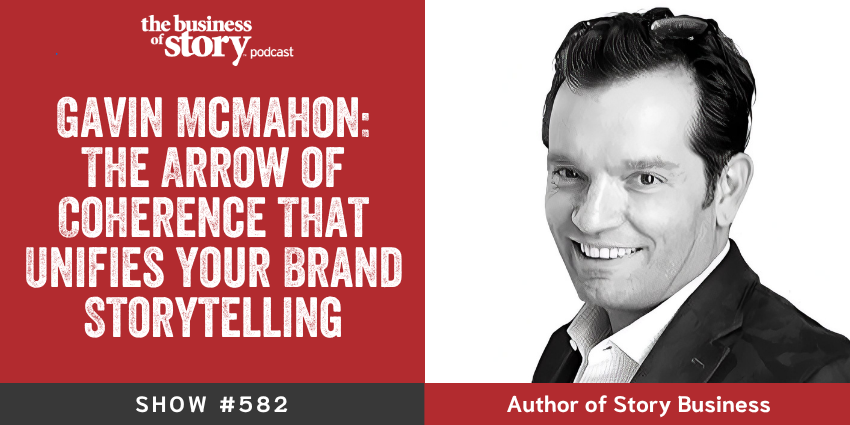
Gavin McMahon calls that thread the Arrow of Coherence.
Meet Gavin McMahon: The Engineer Who Discovered the World Is Made of Stories, Not Atoms
Gavin McMahon is the founder of a 25-year leadership and storytelling consultancy and author of Story Business: Why Stories Rule the World and How They Can Reinvent Your Business.
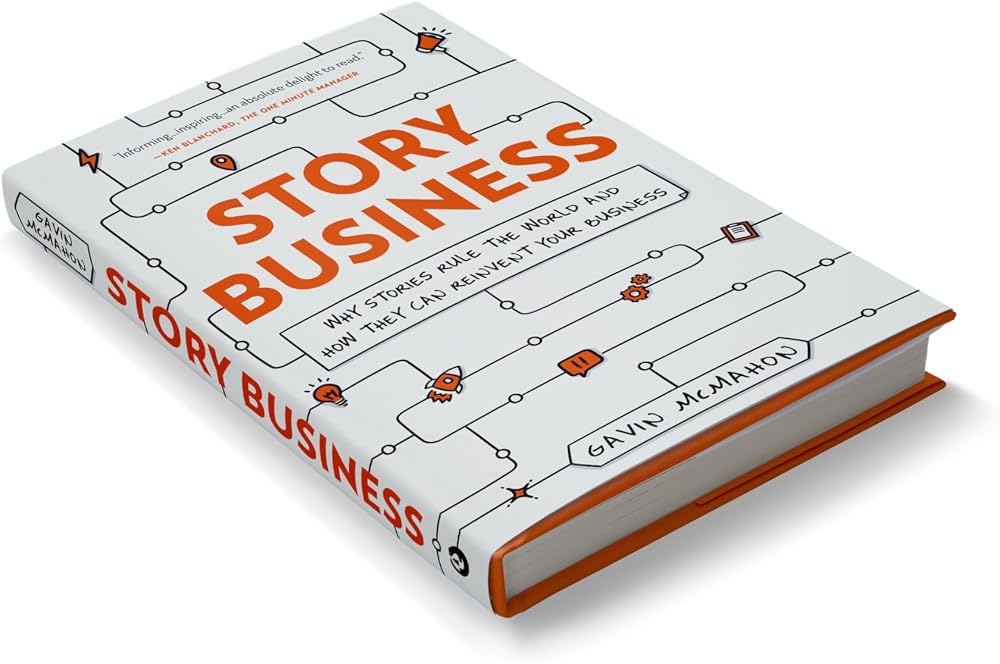
A recovering mechanical engineer who began his career working on nuclear submarines and manufacturing plants, Gavin transitioned into digital transformation at Gartner in the late 1990s — and failed spectacularly enough to learn something important.
His black-and-white engineering worldview collided with the messy human reality of organizational change, and what came out the other side was a framework for how companies actually create value: through story.
Story Business is the product of 25 years of testing that framework with real companies navigating real change, and it is one of the most practically useful books on organizational storytelling published in years.
What’s in it for You:
- What the Arrow of Coherence is and how to apply it to unify your brand story across every department, channel, and AI tool
- Why most companies suffer from a synonymous mess — purpose, vision, mission, and strategy all tangled together — and the one narrative move that untangles it
- Why brand storytelling is world building, and what that means for governance rather than just marketing
- Why the CEO is your most underutilized brand storyteller — and how to activate that power
- How show Bibles differ from brand guidelines, and why that distinction determines whether your story survives scale
- Why AI amplifies your narrative entropy at warp speed unless a governing Brand Brain is in place first
- The two things Gavin wishes he had known in the 1990s — and why they will change how you lead
- The Synonymous Mess That Is Quietly Destroying Your Brand
Here is the specific problem Gavin diagnoses that most companies refuse to name: the synonymous mess. Purpose. Vision. Mission. Strategy. In most organizations, these words are used interchangeably, stacked into the same slide, and nodded at in the same all-hands. Everyone agrees they’re important. No one can explain how they’re different or how they connect.
The consequence is not a communication problem. It is a decision problem. Every one of your people is making dozens of decisions every day — some of them small, some of them transformational — without a coherent narrative logic to guide them. In a pre-AI world, that drift was gradual. You had quarters to notice it. Today, it is exponential.
Gavin’s fix is surgical. Separate purpose — what propels you — from vision — where you want to go — from mission — how you get from here to there — from strategy — the path you’ll take. Once you tease those four things apart, you can build the framework for the internal strategic narrative that actually aligns people. And you can make the job of every marketer, every communicator, and every AI tool in your stack dramatically easier, because they know exactly where you’re going and why.
Why Brand Storytelling Is World Building — Not Marketing
Gavin draws a distinction that every brand leader needs to hear: the difference between a show Bible and a brand guideline. Brand guidelines tell you which Pantone to use. A show Bible creates the room in which you can invent an unlimited number of stories, because everyone who steps into that room understands the world.
Gene Roddenberry wrote the original show Bible for Star Trek in 1966. IKEA governs its product naming across every market on earth using the same logic. Apple created a world you believed in so completely that when the iPod launched, you already knew it was yours — because it could only have come from Apple. Dell launched an identical product the same year. Nobody bought it.
The companies that achieve this — IKEA, Patagonia, Harley-Davidson, Apple — are not doing better marketing. They are doing world building. They have an Arrow of Coherence so consistent, so cause-and-effect clear, that it shows up in product design, in hiring decisions, in the way a store employee explains a return policy. It is not in the marketing department. It is in the operating logic of the organization.
How the CEO Becomes the Owner of the Quiver
When Park asked Gavin who owns the Arrow of Coherence inside a company, his answer was direct: the CEO. Not marketing. Not the Chief Storytelling Officer. The CEO carries both the organizational authority and the storytelling power to point the cause-and-effect arrow in a consistent direction. What the CEO must build around that ownership is a coalition of the willing — the influencers at every level of the organization, regardless of title, who have the ears of the people around them.
That coalition is not a marketing function. It is a cultural one. And when it works, the story becomes so embedded in how people think and act that governance almost becomes invisible. The rules are not on a poster. They are in the decisions people make when no one is watching.
AI Will Amplify What You Have — Coherent or Not
Gavin and Park closed the conversation with the most urgent point of all. We are not yet in the AI age. We are in the interregnum — the gap between what was and what will be. And Jeff Bezos had the right instinct for moments like this: when everything is changing, look for what won’t change. Humans will still make decisions. Humans will still tell stories. Humans will still want to be led.
Underneath all of that is narrative. And the organizations that install a governing Brand Brain before they scale their AI outputs will compound coherence. The ones that don’t will compound drift. The Arrow of Coherence is not a nice-to-have for the AI age. It is the operating infrastructure that determines whether your story survives it.
Links and Resources
- Fass Forward
- Gavin McMahon on LinkedIn
- Gavin’s Book, Business Storytelling
- StoryCycle Genie®
- FREE Brand Story Grader
- Brand StoryOps™ for Agencies newsletter
Related Episodes from the Business of Story Podcast
- State of Storytelling 2026 Proves Brand Narrative Is Finally a Business Discipline with Elliott Rayner — Research from 25 C-suite job descriptions reveals that only 19% of employees can consistently articulate their company’s core story — and why that gap is now a measurable revenue problem.
- How One Simple Brand Theme Can Move Millions to Act with Ryan Kohn — The co-founder of PROPER Snacks reveals how compressing a complex brand idea into four words built a global movement without ever leading with the cause.
- What a Rock Star Manager Turned Global Keynote Speaker Reveals About Creativity, AI, and the One Competitive Advantage No Algorithm Can Touch with James Taylor — James Taylor makes the case that the human story — not the AI tool — is the only competitive advantage that cannot be replicated at scale.
Gavin McMahon’s Conversation With Park Howell on The Business of Story Podcast
How a LinkedIn Post About the Arrow of Coherence Connected Park Howell and Gavin McMahon
Park Howell: Hey Gavin, it’s great to see you again and welcome to the show.
Gavin McMahon: Thank you. Good to be here, Park.
Park: Yeah, you had written something on LinkedIn a couple months ago that really got my attention and drove me to your books. I didn’t realize that you had a book out. There are lots of books out there in the world. And when I started studying your approach, this arrow of coherence that you talk about, I thought was really fascinating.
We got on a quick call, chatted. It even led to an article that I wrote in my Brand StoryOps for agencies newsletter on LinkedIn. So thank you for that. You were inspiration for that. It’s just great to have you here so we can take a deeper dive into it.
Gavin: Yeah, it’s awesome. I feel like when you coined the term StoryOps, you put a word around something I’ve been trying to think. I knew it was there, but I couldn’t quite figure out how to describe it. And I think StoryOps is a great way of describing it.
Park: Thank you. You know, we in our lives have come across large enterprises, companies that have marketing ops and sales ops and HR ops and supply chain ops and financial ops. All of these silos really have their own governed system on how to operate. And hopefully you can tie all those silos together.
Well, per your book and your insights and what we have found too, is that what is the one guiding thing throughout all those silos? And that is the company’s narrative. We call it their brand story, the world making as you talk about — it’s the story making. So your book really takes an interesting look on how to activate StoryOps or what you call the Arrow of Coherence, which I want to talk about in just a second.
But first, you are a recovering engineer.
From Nuclear Submarines to Brand Storytelling: How a Mechanical Engineer Discovered the Power of Story
Park: You didn’t come at storytelling like I did through branding, advertising, marketing, which would be probably a more normal approach. You came to it from the engineering approach. And I can’t tell you how many engineers laughed at me and said, your storytelling stuff is woo woo. So how did you come about it?
Gavin: Well, I’ll make the story short. First of all, I have a black shirt, so I feel like I can pass for the people that are in marketing.
I’m originally an engineer. If you’re either drawn to that profession or you come out of that profession, I think you automatically want to pull things apart, figure out how they work and put things back together again. That’s the kind of MO for an engineer.
And the other thing that comes out of going to engineering school is a belief that there’s gotta be a way to figure this out. But you do have this very black and white rules of physics view of the universe.
I think over time, as I went from pure engineering — I was first working on nuclear submarines and then tanks and then into manufacturing — I was a mechanical engineer. So in the stack rank of engineering, that’s kind of towards the bottom because it just goes, you know, how good are you at math? You’ve got aeronautical engineering up at the top and then electrical engineering going down.
So yeah, I was a mechanical engineer and I think all engineers think that there’s got to be a way to figure this out. They usually have a very “this is the way it’s going to be done” kind of process, black and white view of the world.
Over time, as I worked more and more in business and outside of the core engineering function, you start to work with people. And people are going to make things great and they’re also going to mess things up.
So I kind of discovered this — well, there was a line in a poem by Muriel Rukeyser, which is “the world is made up of stories, not atoms.” That’s always stuck with me because it’s a great line, first of all, but it’s so counter to the worldview I grew up with.
But I think about people and I think about the way people process information, make decisions. I actually think, you know, she probably had it right. The world is made up of stories, especially the stories that stick in people’s heads, not so much atoms. So it’s a little bit of both.
The Box of Bolts Audit That Revealed the Hidden Link Between Decisions and Story
Park: Was there a defining moment in your engineering life? Was it just the reading of that quote or was something else that hit you — like, I’ve got to pay attention to the mechanics of storytelling for what it can do to actually move people.
Gavin: Yeah, it’s honestly a really boring story, but I can remember an instance where I was asked — I was running a factory in Africa. It was a proper management thing, not an engineering thing.
Coopers and Lybrand came around as auditors, and I always thought, well, if you’re an accountant, it’s in the name, you count stuff. I was taking them through the warehouse and we were looking at boxes of stuff. There was, I don’t know, a box of bolts and there were a thousand bolts on the label for this box.
So they were doing an audit and saying, do you have what you say you have in your assets and in your stock and in your inventory? They got to the box, I showed them the box, and they said, yeah, that looks good. And I was blown away because I didn’t understand why they didn’t want to open the box and count the thousand bolts that were in the box.
But it’s good enough. And so that was my kind of first exposure to — there’s actually a whole bunch of people that think differently from engineers. And then I got to marketers and that’s a whole different thing.
Park: Well, as you say, how did that — a thousand bolts in a box — lead to storytelling? What’s the aha moment?
Gavin: I think companies, all companies, the clients that we work with, they’re basically there to create value. The very simplistic view is they’re there to create value for their stockholders, their shareholders, their investors, their employees and all of that, but somehow you’re bringing people together to create value.
If you’ve got a thousand people in your company, you’ve got a thousand people making decisions every day, big and small. This is why StoryOps I think is so interesting as an idea, because those people are making decisions and those are good decisions, bad decisions. They’re either creating value or they’re destroying value.
That could be a small thing. Like, I’ve had a rough day, so I’m not going to answer the phone so nicely when I’m speaking to a customer. Or it could be choosing to have a direct conversation with an employee, whatever it is. You’re making those decisions. The cumulative effect of those decisions is creating value.
And the more you can get people lined up in the right direction — in a direction really, because honestly, I’m also coming to the opinion that it kind of doesn’t matter what strategy you have, just pick one and execute against it really well — the more you can line people up and get people motivated in that direction, making good decisions, that’s where it is. And to me, that’s where story comes in, because that’s how we make decisions. I don’t need to explain that to you.
How Failing at Digital Transformation at Gartner in the 1990s Led Gavin McMahon to Launch His Storytelling Consultancy
Park: And so when did you decide to make this major shift in your career to go from being very engineering-focused into storytelling?
Gavin: Well, I came across to the US from Paris via London with Gartner. And I came across in the mid to late 90s. I was then in my 30s. If you were basically 30 years old in the mid 90s, everyone thought you understood the World Wide Web. Some people still called it the information superhighway back then.
I was in charge of Gartner.com. So it was what would now be called a digital transformation, shifting the company’s business model from CD-ROM and paper onto — we consume this research by the internet.
And it was such a wrangling and herding of cats to get all these different departments onto what should be on the website, how do we service research, how do we provide this to our clients? And to be honest, I did a pretty terrible job because I had this engineering black and white view of the world and said, no, it’s this way, not that way. I held my hand up in front of a lot of people’s faces and said, no. And it didn’t work out so well for me.
So I ended up leaving Gartner and then we started this consultancy — fast forward 25 odd years ago, around about the year 2000, so nearly 26 years ago now.
And ever since then, we’ve been in the space of trying to help companies go through change, which to me involves two things. Leadership, because I need to lead people in a certain direction — or the company, people want to be led. They don’t like to be managed, but they want to be led.
And storytelling, because if leadership is about making a choice, storytelling is how do you amplify that choice? Which goes all the way back to here’s a decision that I want to create value around.
Park: So do I have this right? You’re at Gartner, big famous business consulting international consulting company. You’re 30 years old in the nineties and you’ve been tasked with doing this technological transformational change to the worldwide web, the interwebs if you will. And yet it sounds like you didn’t have a lot of success with it because you were still communicating from that very black and white engineering mind. And it sounds like maybe you pissed a bunch of people off. It didn’t go the way you wanted it to go.
And then in leaving there, you decided to create what is now a 25-year-old consultancy for change management. What did you learn from your own failures — that’s actually not how you do it, what we really need to do is embrace them or get them to embrace the story of change?
Gavin: Yeah. I mean, I think the first thing is — so first, that’s true. Good listening, good hearing between the lines.
I did piss off a lot of people on the way. I’m sure there are a lot of people that still remember me fondly, but there’s probably some that don’t. It was successful — we did transition — but there was a lot of friction in that.
And I think you do learn around how people change. Even before I get into Gartner, when I left business school in the early nineties, I sat next to someone from Seattle in my lectures. And he told me about this company called Mosaic and this thing called the internet or the World Wide Web.
I ended up through business school writing a series of papers and thoughts in strategy about what the internet could become. My professor submitted them to that company, Mosaic, which became Netscape — which for anyone that isn’t old enough listening to this podcast was probably one of the first big IPOs of the dot-com era. It was the publishing engine of the internet. And I ended up working with Netscape a little bit doing a case study.
I wrote the first interactive case study around that, which is taught at London Business School and Harvard in different places. My idea with the case study was not to write it like a regular case study where you can read page one, go all the way through to page ten and you’ve read the whole thing. I wrote it using hypertext. So there were lots of links and there was no index and you could get lost and you could end up wandering through IBM’s website or something else.
People back then couldn’t navigate the web as easily. And so the net effect was you got a lot of people in the room discussing this case study, each of whom, depending on the path they’d taken, had incomplete information and a different point of view.
So this case study always ended up in an argument about what you should do, not like any other case study at the time, because everyone had perfect information in those case studies. I’ve always been on this kick, I think, about how people make decisions. That was a really early one. And I really enjoyed the fact that they were all arguing and they didn’t have perfect information and they hadn’t read everything, because that is the way the world works.
The reason you’re arguing with your colleague or the reason that you’re disagreeing is you just have a different worldview and therefore a different point of view and you’re just advocating for your side.
Kurt Vonnegut, Pixar’s Emma Coats, and Stephen Pressfield: The Storytelling Influences That Shaped Story Business
Park: As you started getting into storytelling, who are some of your resources and inspirations? Mine, of course, as with a lot of people, is Joseph Campbell — the hero’s journey — that led to my Story Cycle System that I built for brand story development. Blake Snyder was Save the Cat and Christopher Vogler, the Writer’s Journey, a lot of them. Who impacted you as you grew as a company storyteller?
Gavin: Well, I’ll pick out three. One is Kurt Vonnegut. You can see this on the internet — he has this lecture, or he wrote a paper as well, but I think he lectured on it, around the shape of stories, which I thought was fascinating. Again, because I’m an engineer, I like people that put systems around things. So he was one of them.
I’m not a huge fan of Joseph Campbell. I mean, I love Star Wars and I get it. I think it’s a bit too complicated for business.
Park: Well, it is. You’re exactly right. It’s good for moviemaking and there is definitely a system to that. In fact, I’m just reading the Odyssey right now before I go and see it. But that’s one big Joseph Campbell hero’s journey, systematized storytelling. And I agree with you too, that I thought it would be way too complicated for business people to really appreciate. That’s why I boiled it down to the ten steps and show them exactly where it shows up in their business world.
Gavin: Yeah. So my second pick is Emma Coats, who was a storyboard artist at Pixar. And I don’t think these are originally hers, but you can see on the internet various versions of Pixar’s ten rules of storytelling. A lot of them talk about structure, a lot of them talk about character, and they really are a pastiche of all the rules that have gone before.
And then the last person I would say is — there’s a book called Gates of Fire by Stephen Pressfield, which I absolutely love. I read it every three or four years or so. It’s about the Spartan defense of Thermopylae.
What’s interesting about it, first of all, it’s a kind of treatise on leadership. It’s told from the point of view of a Spartan slave who was the body slave of the Spartan King Leonidas. And it was a little bit like Shahrazad in that he was telling the Persian King why the Spartans were like the Spartans — how they fought such a brave defense and what they did. So that was the point of view of the whole story.
I love the story because it’s about leadership, but I think Stephen Pressfield has also written a lot of stuff like Do the Work about how stories work.
Park: The War of Art is another good one of his. Yeah, well, those are great inspirations. And so you, after what, 20, almost 25 years, wrote your book. Did you write a book before this most recent one?
Gavin: No. I’ve been writing — I started writing a blog I think in about 2010. My blog was originally called Make a Powerful Point because I was upset with the way people just speak in PowerPoint to each other and then don’t understand what they were talking about.
So that was really me practicing as an engineer — thinking I had to practice writing. I got into this rhythm of writing every week, and then over the last seven or eight years, I’ve been writing a newsletter. That usually has an article — something to do with leadership, something to do with storytelling, something to do with the future of work. And that’s usually something that I’ve learned in dealing with our clients.
And then the book — honestly, that was boiling around in my head for years, seven or eight years. I just had to get it out of my head because I had all these ideas that were disconnected.
The act of writing, if anyone listening to this has stuff in their head that’s frustrating them, you just have to write it down because that is the way to calm your brain, I think.
The trigger was honestly — I woke up one morning, probably very, very early, and I had the title in my head and the first line of the book. Very similar to the Business of Story, but I dropped two words. I went with Story Business as the title. And then the first line was “the first stories were wild.”
Park: Yeah, and it is — the full title is Story Business: Why Stories Rule the World and How They Can Reinvent Your Business.
What Is the Arrow of Coherence? The Core Concept at the Heart of Gavin McMahon’s Book Story Business
Park: So in it, you introduce this idea of this arrow of coherence. And I have got another friend of mine who’s in the story branding speaking world, Brian Burkhart. He was on my show a couple weeks ago, he was reading one of the newsletters that I put out talking about you know, the article view and this idea of the arrow of coherence. And he loved it. He goes, that is like the best definition I’ve ever heard of. How did you come about it? And what do you mean by it?
Gavin: Well, Nicholas Taleb — I think as a storyteller, you’re a bit of a magpie, so you pick things up from everywhere. So I’m not even a hundred percent sure arrow of coherence is mine. I think it comes from Nicholas Taleb who wrote The Black Swan and other books like that.
He talked about the narrative fallacy, which is the idea that we take these disconnected events as human beings and we are constantly trying to make them make sense after the fact. So we kind of retrospectively apply why X happened because. And so he talks about a narrative fallacy and I think he also talks about an arrow of something.
And then I was just thinking that that arrow of coherence is a little bit about how do we connect the dots? Because storytelling is really just an editorialization of something to connect some dots for people so that you can put them — you can basically frame whatever it is in a new way.
Park: And so how do you use the arrow of coherence? How do you work with your customers to get them to understand it, to buy into it, and to actually implement?
Gavin: Well, for me, I talk more about how storytelling is used through different parts of the business.
So if you read Story Business — it’s not just about branding and marketing. It’s really about how story connects all different parts of the business, which is your term, StoryOps, right?
I think a lot of marketers are always a little bit frustrated. And the reason that they’re frustrated, I think, is they get left holding the bag for a lot of stuff. And then they’re asked to make a silk purse out of a sow’s ear.
How to Activate the Arrow of Coherence: Real-World Lessons from a 5G Telecom Brand Transformation
Gavin: I’ll give you an example. Everyone has a cell phone. We started with an iPhone. When you had your first iPhone, that was 1G and then you went to 2G and then went to 3G and the cell companies were constantly upgrading the quality of their network. And eventually you got from 3G to 4G to 5G.
Now somewhere inside of AT&T or Verizon, there is an engineer that can tell you the difference between 4G and 5G. That engineer, I can tell you for a fact, did not and could not explain the difference between 4G and 5G to a product manager. And that product manager did not and could not explain it to a marketer. And therefore marketers were left holding that bag.
All we know is that 5G is something we should have, and it’s probably better than 4G. And by the way, when 6G comes around, they’ll probably end up doing the same thing. I’ve seen lots of technical explanations about why it’s different, but it never gets translated. And I think that’s part of it.
Park: And you ask the question, who cares? What do I really care? Not what you make — that 5G — but what you make happen: that I’ve got fast, reliable, consistent connection no matter where I go in the world. So presumably 5G does that for you. How it does it? I have no idea.
Gavin: Yeah. I’ve remembered now — the Nicholas Taleb one is what he calls an arrow of relationship. So he’s talking about logical links. And I think I used arrow of coherence to really describe world building.
Because when I, in the book, when I talk about the different genres of storytelling — I talk about value storytelling, sales storytelling, product storytelling. When I come to brand storytelling, I really do think of it as world building. And that arrow of coherence, that cause and effect logic has to shine through, I think, in a brand.
Who Owns Brand Narrative Coherence? Why the CEO Must Be the Chief Storyteller — and What IKEA Gets Right
Park: So who owns that quiver for the arrow of coherence inside of a company? Who owns that story?
Gavin: I’m going to tell you an answer that will disappoint you. I’ve been thinking about this a lot and I’m thinking about it because I’m writing another book right now about change and how AI is driving change and how we react to it in business.
And I think the answer is the CEO. But I think the CEO has to build a coalition of the willing and get people on board. And I think most CEOs do things by fiat and tell people, and then they leave that disconnection.
CEOs in companies carry enormous power. They carry organizational power from their position in the hierarchy, but they carry storytelling power. And they should be the ones — even in really large companies — who are pointing out this cause and effect.
In the book, I use IKEA as an example. The founder of IKEA, Ingvar Kamprad, originally ran it as a mail order catalog. It was not just furniture; it was all sorts of bits and pieces, pens and stationery and other things. But as he moved into furniture, he had this vision about a better furnished world for the common man. There was a Swedish expression that went with that.
And that really causes this arrow of relationship, this arrow of coherence, this cause and effect, which I think is fundamental to world building.
One of the things — Park, I didn’t give you kind of three very classy answers to who are my influences, but I’m a massive science fiction nerd and I read all sorts of junk fiction as well.
Park: Mm-hmm.
Gavin: And I think science fiction writers do a brilliant job of building worlds that you kind of want to be transported into. And the worlds are realistic because they make sense, even though they’re fantastical and there’s no way all of that is real. But they make sense because they have that cause and effect. They have that inherent logic. They have that relationship.
And really good science fiction writers do this world building really well. And what I noticed is that really good brands — the ones that we could tick off, IKEA, Apple, Patagonia, Harley Davidson — those kind of companies all do world building really, really well.
I don’t think they intentionally necessarily do it, but once you start to look inside them at companies, and outside of marketing or functions outside of marketing, those rules of cause and effect are in place. Story on.
Show Bibles vs. Brand Guidelines: What Gene Roddenberry and Star Trek Teach Us About Brand Story Governance
Park: Yeah, and that’s going back to what we were talking about, where you introduced me to this idea of story Bible that Gene Roddenberry did for Star Trek. And he was the owner of that story. Here’s how you write these stories. And he did it for Star Trek: The Next Generation. He owned it. He had the Bible that everyone could work from. But that had a certain amount of governance as long as he was around.
Once he disappeared, then that governance went out the window and things started going a bit haywire. So there’s a little bit of difference between who owns the story, the narrative, and who owns the governance of that narrative. To make sure — la Arrow of Coherence and or story ops — that it is being woven or shot through the organization, that everybody has a certain amount of ownership, but it has to be with the same narrative.
Otherwise you get this fragmentation. And we all know now that artificial intelligence doesn’t care if you’ve got a fragmented story or not. It’s going to grab whatever it can and — like the Klingons — it’s going to spread that fragmented story to the world and you’re really going to be in trouble.
So I go back to that idea of story governance versus the actual story itself. Who owns it and what is the best way to embed it consistently and coherently throughout an organization?
Gavin: Well, think — let me ask you a question. You’ve worked with lots of different marketing organizations in your time. On the political pecking order inside an organization, where do you think marketing usually ranks politically, like as in it’s got a lot of clout?
Park: All right, I think it ranks way down the food chain and probably indicated by the fact that your average marketing director in any one organization barely lasts four years until you’re tossed and the new person comes in.
When we would do brand development, roll up our sleeves and get involved — I was thinking of one organization down in Yuma, Arizona, the largest community health center down there called Sunset Health. They brought me in a couple of years ago to help them refine, revise their brand story.
When we got it there and we worked with the leadership there, we worked with the board members and we got it, over the course of a couple of months, really dialed in. And then they asked me — they said, we want to now embed this in the organization. They wanted me to do a next round of training, both story training and introduce them to the brand story.
And I said, I actually don’t want to categorize them by leaders of departments. I want to get your influencers in here. Who are the people, regardless of rank, that have the ears of your other colleagues there? I said, it could be you, Mr. CEO, right down to the janitor. It could be a night nurse. It could be whomever, as long as they’ve got the influence and the ear of the people around them.
I want to have those people first in the room, train them on storytelling, show them the new story for Sunset Health, and then give them the tools to go out and share it with everyone else. So it wasn’t a marketing function, it wasn’t a sales function, it wasn’t an administration function — it was truly an influence function.
Gavin: Yeah, I like that. I think I almost feel — maybe it gets back to that Muriel Rukeyser quote.
The universe is made up of atoms, or the universe is made up of stories, not atoms, because when it comes to storytelling and then we try and put this governance around it and we try and put these rules around it — which I think the rules are helpful and the governance is a little bit helpful — but to me, that’s the difference between a show Bible and a brand guideline.
A show Bible creates the room in which you can invent stories. So you can invent stories and narrative about IKEA or you can invent stories and narrative around Dune because you understand what the world of Dune is like. Or you can invent stories and narrative around Harley Davidson because you understand that. And then a set of brand guidelines tells you you must always use this color, this Pantone, and you must never use that one.
I think this whole idea of storytelling — which naturally creates fandom — starts to collapse when you put too many rules and regulations around it. And your idea about let’s build this coalition of the willing, let’s build a group of people, because what you’re saying then is it becomes very cultural. And I actually want this to be a cultural outpouring of what we do and how we behave as a company. And then you get something like a Patagonia or an IKEA.
In IKEA, the rules of naming the products — the fact that it’s always a quirky Swedish-sounding name for a bookcase or a chair, and it’s never a place name and it’s always got some strange Swedish letter in it — those are actually hard and fast rules that they go by, but they’re not in marketing. They’re in product development.
It’s kind of like Simon Sinek. So his very famous TED talk opens up the Start With Why thing. And he asked that question — why was Apple able to create an MP3 player called an iPod? And Dell basically built the same thing the same time or a year earlier, and no one bought it from Dell and everyone bought it from Apple.
Because Apple had created a world that you believed that they were going to do something new and different. It was in their marketing. It was in their product. It was in everything they did.
Dell was like, want to buy a computer from Dell? And so I think when you get overly rigorous, this is why I’m a big fan of show Bibles. And I’m not a big fan of brand guidelines. I actually think you need brand guidelines because you need patterns and you need to be able to repeat those patterns.
Park: Well, I understand too, you want to use the same color red and the same color gray and the same font and all that stuff because you have to have the consistency. But what we’re talking about there is the expression of a brand narrative or message.
What you and I are talking about is the creation, the world building of those stories that get told through that font and through that color and through that imagery and so forth. But it’s the first — without governance of that story, it can really start getting fragmented.
So like we’ve done with our Story Cycle Genie, you can now use AI in a very artful way. I call it artful intelligence because it becomes the brand brain for your story. Everyone stays consistent, but you can then bring your own voice and your own storytelling to the brand. It locks in that governance across the board.
Why AI Amplifies Whatever Brand Story You Have — Coherent or Fragmented — and How Artful Intelligence Changes the Stakes
Gavin: Yeah, I 100% agree. I think you want to ask, is this coherent? Is this something we would do? And I think that’s the same question that Gene Roddenberry asked and told his writers when he brought them first into Star Trek.
It’s why — we’re going through a golden age of television. It’s why you pay the showrunner so much money, because the showrunner is that kind of voice of internal consistency in saying what it’s doing.
And you can absolutely use AI for that. You can, but it’s got to be very intentional and it’s got to be done in an artful way because otherwise AI will just say you’re using the wrong color or you’re using the wrong brand. You just have to use it to help you think, not think for you.
Park: Right. You have to collaborate with it. You’re not just going to offload everything to it and hope that it comes up with something, but it’s truly a collaboration tool in that process.
Brands Winning with Narrative Coherence: What Nvidia’s Value Storytelling and Wyld Market Get Right
Park: Who is a surprising brand that you’ve seen out there that is doing — using the arrow of coherence or StoryOps well — that maybe a lot of people don’t know about?
Gavin: So this is a brand I — full disclosure, I know the CEO and I’m invested in the company as well. But there’s something we didn’t talk about, which I have to explain first.
In Story Business, I talk about this idea of value storytelling. And value storytelling, you could think about this as the answer to the eternal question, is it worth it?
You ask that question before you get out of bed every day. Maybe it’s a flash and maybe it’s completely subconscious, but is it worth it? You ask that question before you buy something. And so is it worth it? Is this magnifying effect that stories can have, a value story can have around a brand.
You can look at something like Nvidia, which is a trillion dollar brand. And there’s a value story around it. And the value story is essentially AI is a gold rush.
As you think through that story, you know that in a gold rush, the people that make the money are not the miners mining the gold. It’s the people selling the picks and shovels to the miners, which in this story is Nvidia.
So no wonder Nvidia is a trillion dollar brand. So what I look at a lot is in a particular space, what is what Robert Shiller called the narrative constellation? In other words, where are all the stories going? Because Nvidia did not create the AI as a gold rush story. It clamped onto it.
So I’m a big fan of a brand in the UK called Wylde Market. And Wylde Market is part of a constellation of stories about there has to be a better way to eat, there has to be a better food cycling system. We’re putting too much bad stuff on our crops. I want to eat healthier. I’d like to live longer.
And essentially what Wylde Market is, is an Amazon for farm-to-table food direct to a consumer. It’s a great little brand, but I think what’s really clever about it is it’s part of a zeitgeist. And I think brands that pay attention to the zeitgeist and kind of follow that are in good shape. So yeah, that’s my answer.
Park: That’s great. You gave me two brands to go and take a look at because I’ve heard of Nvidia, but I did not know their story. And then Wylde Market — W-Y-L-D-E — that’ll be really interesting.
Gavin: Yeah, W-Y-L-D-E.
The Interregnum: Why Human Story Is the One Constant as We Move Between Ages
Park: You had said something earlier. It occurred to me as you were talking just now that one author quoted — the world is made of stories, not atoms.
Gavin: Muriel Rukeyser. She was a poet. I think it’s a line from one of her poems: “the universe is made up of stories, not atoms.”
Park: What I love about that is let’s do the inverse. So the universe is made up of atoms — we all know that everything is a vibrating atom. We are all just energy, right? Even when we pass away, our atoms are still vibrating, as weird as that is, and our soul does something else.
But story does have an energy all its own, does it not? When someone tells a story, you cannot help but have the atoms in your brain fire up to picture and actually live to be a part of that story. You cannot help your body from saying, no, that story isn’t right, or yes, that story is true and I want to be a part of it. It has this insatiable pull of energy because it’s simply the meaning-making tool that all of us homo sapiens use to make meaning out of the madness of being alive.
So there’s a lot of truth to that statement. The universe is made up of stories, not just atoms, and there is absolute energy in the story. And if in this modern day, companies are not embracing it through your arrow of coherence or through the StoryOps mechanism using a tool like the StoryCycle Genie — the energy of artificial intelligence is going to disperse your energy of fragmented stories everywhere. And you are going to lose momentum.
Even your story may become impotent at that point because you don’t have that core solid nucleus of it that you need in order to be able to succeed in the amount of noise we all compete in today.
Gavin: Yeah, I think that’s so true. I was thinking about the age we’re going through now, entering into with AI.
We’ve gone from an atomic age to an information age. And before that, we went from an industrial age to an atomic age. And over history — the bronze age, the iron age, the Renaissance, whichever — there’s something in the middle of that called an interregnum, which means, I guess, between reigns if you look at the Latin.
And I think we’re actually not in an AI age right now. We’re in the interregnum, the gap between what was and what will be. And I think there’s a ton of change.
Jeff Bezos said this really — I think this is a kind of strategy that he uses all the time. When there’s a lot of stuff changing, look for the things that won’t change. And what won’t change is humans will still talk to other humans. Humans will still want to make sense of the world. Humans will still want to buy things. Humans will still want to have relationships. And underneath all of that is story.
Park: That’s brilliant. Hadn’t thought about that. You’re right. We do say we’re in the age of AI, but you’re right — it hasn’t really arrived. We don’t even know when it’s going to be completely here. It’s changing so quickly.
And I see a lot of people are caught flat-footed. It seems like they don’t know what to do, who to believe, where to go. I see others that just swear off AI. I’ll never ever use it. It has no place in my writing. It has no place in my researching.
And then I have others, and I fall into this camp, of thinking if you use it right, it could be really artful. You know, it doesn’t need to be artificial. It has helped me become a better writer, a way better, faster researcher. It spurs ideas in me over and over and over again — by the thousands it seems like — of things that I could do and talk about that would have otherwise taken me years to get to, that now I can sort of test and proof them out using artful intelligence, and then find the ones I really want and bring my own experience to that writing, to that story.
Like that issue in my LinkedIn newsletter that you inspired in me, because I did not know of this story Bible of the Star Trek world. And I thought that was really fascinating comparing what it used to be way back in the sixties to where we are today.
So yeah, we are right in the thick of it right now, aren’t we?
Gavin: Yeah. And if you think about it — StoryOps, the Story Cycle Genie — you could kind of roll your own with AI, probably wouldn’t be as good, but you’re what you’re really looking for is — when you’re creating something, a marketing campaign, there are so many moving parts, it’s difficult to keep it straight in your head.
So I’m writing a book and I’m using AI to help me write the book. So I want to be really clear about what that means. AI is not writing any words for me. I’m writing the words. And the reason I’m writing the words is I like writing the words. But what AI is doing is — I have this cast of characters in the book, six storytellers in fact, and each character has a motivation, each character has a flaw. And it’s really difficult to keep those things straight in my head.
Each character has an arc that they go through. But I’m using AI as I write it and I basically load that into AI and say, have I broken any of my rules? Have I broken my arrow of coherence that I set out at the beginning of this? And it’s saying, yeah, this person would never say that. And I’m like, yeah, you’re right. It would never say that.
And then sometimes I’m writing a scene and I’m having a person say something or do something and it would say, it would never do that. So I go in and I say, well, I like that person doing that and it makes sense to me, and actually this makes it a more fully formed character. So I’m going to go back and change the guidelines that you’re using — I’m going to change the canon.
So I think it’s a useful tool if you let it help you.
Park: Mm-hmm. If you are collaborating with it, not just giving all of your agency to it in hopes it’s going to create something worthwhile. It’s not — it’s going to create slop and you don’t want to be associated with it.
Two Timeless Story Lessons Every Business Leader Needs: Own Your Hero Frame and the Truth You Tell Yourself
Park: So as we wrap up here, Gavin, what are the two or three things a listener or viewer could do today to start bringing this arrow of coherence, this idea around StoryOps, to govern, to protect, to install a narrative that really is going to work hard for everybody?
Because it’s going to avoid the narrative entropy and the fragmentation that happens when you are not paying attention to it.
Gavin: Well, I’d say I’ll give people a starting point. And Park, you have a system with StoryOps that’s an equally valid way of doing it.
I would say to anyone that hasn’t read Story Business, give Story Business a try. I think it lays out a lot of the stuff. But I think if you’re in a company, what companies tend to do is they use a lot of words that create what I would call a synonymous mess — goals, mission, vision, strategy — and it’s all the same words in one big model.
I think where you have to start, and this creates this arrow of coherence, is you have to separate out things like purpose — which is what propels you, what gets you up in the morning — from vision, which is where you want to go, from mission, which is how do we get from where we are to where we want to go, from strategy, which is the path that we’re going to take.
Once you start to tease apart all these things, then you can start to build the framework for the internal narrative, strategic narrative that you tell people and how you want people to line up against your resources.
It makes the job of the marketer that’s in your organization so much easier because they completely get where you want to go rather than just trying to create a little campaign that attaches to the end of some big elephant that you’ve already got going.
So I think starting there, and I don’t think there are many companies that really do that. I think a lot of companies live with the pain of that synonymous mess where everything is a little bit tangled.
And it’s always a, I would say, a kind of career-limiting conversation to have that with your CEO, because there’s no CEO in the world that likes to hear, nobody understands your strategy. But there’s a good chance it’s true.
Park: So true. So final question. What do you know today in the world of storytelling that you wished you had known back in the mid-1990s when you were that young Gartner professional trying to institute change management in the world of the World Wide Web?
Gavin: That is a good one. So I have two things that spring to mind.
The first is everyone is the hero of their own story. And so it’s okay — you need to accept that how people are behaving is because their world is revolving around them. They are the hero of their story.
The second I would say is that the truth is not driven by facts. And I’ve only recently come to believe this to be true. The truth is driven by the story you tell yourself.
So it doesn’t matter how old you are, how heavy you are, whatever you think about yourself. These are kind of objective facts — you were born at a certain age and you’re now this. It’s the story you tell yourself. Now, obviously there are some limits of physics in all of that, but I think people are so driven by the story they tell themselves.
And your job as a leader, your job as a friend, is I think to give people grace because everyone’s the hero of their own story. And also to help them, because the truth is the story they tell themselves.
Park: So as what you’re saying is back then in the 1990s, you were telling them a story from your point of view and, damn it, they have to embrace it. Versus taking a deep breath, pumping the brakes a little bit and saying, wait a minute. Let me really first understand and appreciate where they’re coming from and how I can connect their world with the world that I want them to embrace.
Gavin: You should have been a psychologist. Or a psychiatrist — I’m never sure which.
Park: Well, I’ve been doing this story thing a long time too, and that’s one of the main things. Everything you said there — I’m like, yep, yep, yep, agree.
Stories have an energy that is beyond anything. And we’re really the only creature we know that thinks, plans, organizes, and acts in story. Every change management story is fiction that you need to get people to buy into to make it fact. In order to do that, you’ve got to trigger the energy going on between their ears — literally synapses that are firing that might have been firing with, no, that’ll never work, to, hmm, that’s a possibility. I want to be a part of that. That is truly change and energy management.
Can’t think of a more powerful tool than Story to do that. And thank you for your great book. I highly recommend it to anyone out there in business storytelling, business story — and you cover so many great points in there. Thank you for writing it and making it available. And thank you for being here with me today, Gavin. I’m so happy to have met your acquaintance this year.
Gavin: Likewise, Park, thank you for reading Story Business. Thank you for talking about it. It’s been a pleasure to meet you.
Q: What Is the Arrow of Coherence and Why Does It Matter for Brand Storytelling?
A: The Arrow of Coherence is a concept introduced by Gavin McMahon in his book Story Business to describe the cause-and-effect narrative logic that must run consistently through every layer of an organization. Borrowed and adapted from Nassim Nicholas Taleb’s idea of an “arrow of relationship,” the Arrow of Coherence is the connective thread that links a brand’s purpose, vision, mission, and strategy into a single, governing story world. When it’s present, every decision — from product naming to customer service to marketing — points in the same direction. When it’s absent, brands fragment. In the age of AI, that fragmentation gets amplified at machine speed.
Q: What Is “Synonymous Mess” — and How Does Fragmented Language Erode Your Brand’s Credibility?
A: The synonymous mess is Gavin McMahon’s term for the confusion that arises when companies use purpose, vision, mission, and strategy interchangeably — stacking them into the same all-hands slide and treating them as equivalent. The result is that thousands of employees making daily decisions have no coherent narrative logic to guide them. Some decisions create value; others destroy it. The cumulative effect of that confusion is brand fragmentation. McMahon’s prescription is surgical: separate each term clearly, define what each one means in your organization, and build a strategic narrative around those distinctions so your people always know where you’re going and why.
Q: What Is the Difference Between a Show Bible and Brand Guidelines — and Which One Builds a Stronger Brand Story?
A: A brand guideline tells you which Pantone color to use, which font is approved, and which phrases are prohibited. A show Bible — like the one Gene Roddenberry wrote for Star Trek — creates the world inside which any number of stories can be invented, because everyone working inside that world understands its internal logic. Gavin McMahon argues that the best brands operate like show Bibles, not brand guidelines. They create rooms in which stories can be invented consistently, because the cause-and-effect logic of the brand world is clear to everyone — not just marketing. IKEA’s product naming conventions, for instance, live in product development, not in a brand guide.
Q: What Is Narrative Entropy and How Do Business Leaders Stop It from Destroying Brand Coherence?
A: Narrative entropy is the predictable degradation of brand story coherence in any organization without governing infrastructure. As companies grow, teams expand, and AI generates content at scale, the brand story fragments — department by department, channel by channel, AI output by AI output. The result is a brand that sounds like its industry rather than itself. Park Howell and Gavin McMahon agree that the solution is not better creative direction; it is structural governance — installing what Park calls a Brand Brain through the Story Cycle System™ and StoryCycle Genie®, and what Gavin calls the Arrow of Coherence. With a governing narrative in place, AI amplifies coherence rather than entropy.
Q: Why Should the CEO Be the Chief Storyteller — and How Does Narrative Coherence Start at the Leadership Level?
A: According to Gavin McMahon, the CEO owns the arrow of coherence — not marketing, not the CMO. The CEO carries both the organizational authority and the storytelling power to point the cause-and-effect logic of the brand in a consistent direction. But the CEO cannot govern the narrative alone. McMahon recommends building a coalition of the willing — identifying the influencers at every level of the organization, regardless of title or department, who have the ears of the people around them. Park Howell calls this an influence function, not a marketing function. When the right people carry the story, governance becomes cultural rather than mandated.
Q: How Does AI Amplify Brand Fragmentation — and How Can the Arrow of Coherence Make AI Your Brand’s Storytelling Superpower?
A: AI tools do not discriminate between a coherent brand story and a fragmented one. They amplify whatever narrative exists in the organization’s content, tone, and messaging — at scale, in public, in real time. Without a governing Brand Brain, every AI-generated blog post, social caption, and campaign brief pulls the narrative in a slightly different direction. McMahon uses AI himself as a collaborator while writing his new book, loading his cast of characters and their motivations into AI and asking it to flag when he breaks his own narrative rules. The key insight he and Park Howell share: AI should help you think, not think for you. Collaboration with artful intelligence — not delegation to it — is the only way to keep the Arrow of Coherence intact at scale.
Q: What Is the Jobs-to-Be-Done of Story in Business — and How Do You Apply It to Brand Strategy?
A: Gavin McMahon frames value storytelling around the fundamental question every buyer, employee, and stakeholder asks: is it worth it? This is the jobs-to-be-done of story — not to inform, but to answer that question in a way that is so clear and compelling that the decision to engage, buy, or align becomes obvious. The Arrow of Coherence is the architecture that makes the “is it worth it” answer consistent across every touchpoint. From the Nvidia value story — AI is a gold rush and Nvidia sells the picks and shovels — to the Wylde Market farm-to-table narrative, the brands that win are the ones whose cause-and-effect story answers that question before the customer even asks it.
Q: What Is Brand World Building and How Does It Apply to B2B Companies and Complex Organizations?
A: Brand world building is the practice of creating a governing narrative universe — complete with internal logic, cause-and-effect relationships, and consistent rules — that allows any number of stories to be invented inside it. Gavin McMahon argues that the best brands — IKEA, Apple, Patagonia, Harley-Davidson — are not doing better marketing. They are doing world building. For B2B companies and complex organizations, world building means defining the Arrow of Coherence so clearly that product teams, HR, customer service, and marketing all operate from the same story logic — without requiring a governance memo for every decision. It’s what makes the iPod feel inevitable when Apple launches it, and what made Dell’s identical product feel like a misfire.
Q: How Do You Build a Coalition of the Willing Around Brand Narrative Coherence Inside a Large Organization?
A: Park Howell pioneered the coalition of the willing approach during a brand story rollout for Sunset Health, a large community health center in Yuma, Arizona. Rather than training leaders by department, Park identified the influencers — the people, regardless of title, who had the ears of the people around them. A night nurse. A senior administrator. The CEO. Anyone with earned influence rather than positional authority. These are the people who carry the story first, receive storytelling training, and then become the internal ambassadors who spread narrative coherence organically through the organization. Gavin McMahon validates this approach: the most durable brand stories become cultural, not mandated. They live in the decisions people make when no one is watching.
Q: How Can Business Leaders Practically Activate the Arrow of Coherence Across Their Teams, Marketing, and Culture?
A: Gavin McMahon offers a clear starting point: untangle the synonymous mess. Separate purpose — what propels you — from vision — where you want to go — from mission — how you get from here to there — from strategy — the path you’ll take. Once those four elements are clearly distinct, you can build the strategic narrative that aligns your people, informs your marketers, and governs your AI tools. Park Howell’s Story Cycle System™ and the StoryCycle Genie® operationalize this architecture as a permanent Brand Brain — a governing source of narrative truth that every person, team, and AI output checks against before anything ships. The Arrow of Coherence is not a creative brief. It is the operating infrastructure of a story-governed organization.
 Listen To More Episodes