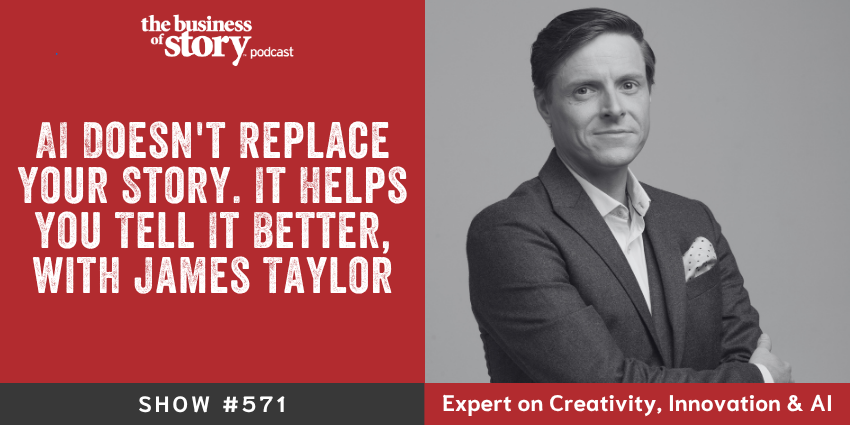
What a Rock Star Manager Turned Global Keynote Speaker Reveals About Creativity, AI, and the One Competitive Advantage No Algorithm Can Touch
You want to stay relevant, credible, and compelling in a world where AI is writing emails, building decks, and generating content at industrial scale — and if you’re willing to lean into it with the right mindset, you will unlock creative capabilities you never knew you had.
But most professionals are either paralyzed by AI anxiety or chasing shiny tools with no strategic story behind them, leaving their most powerful human advantage — creativity — completely untapped.
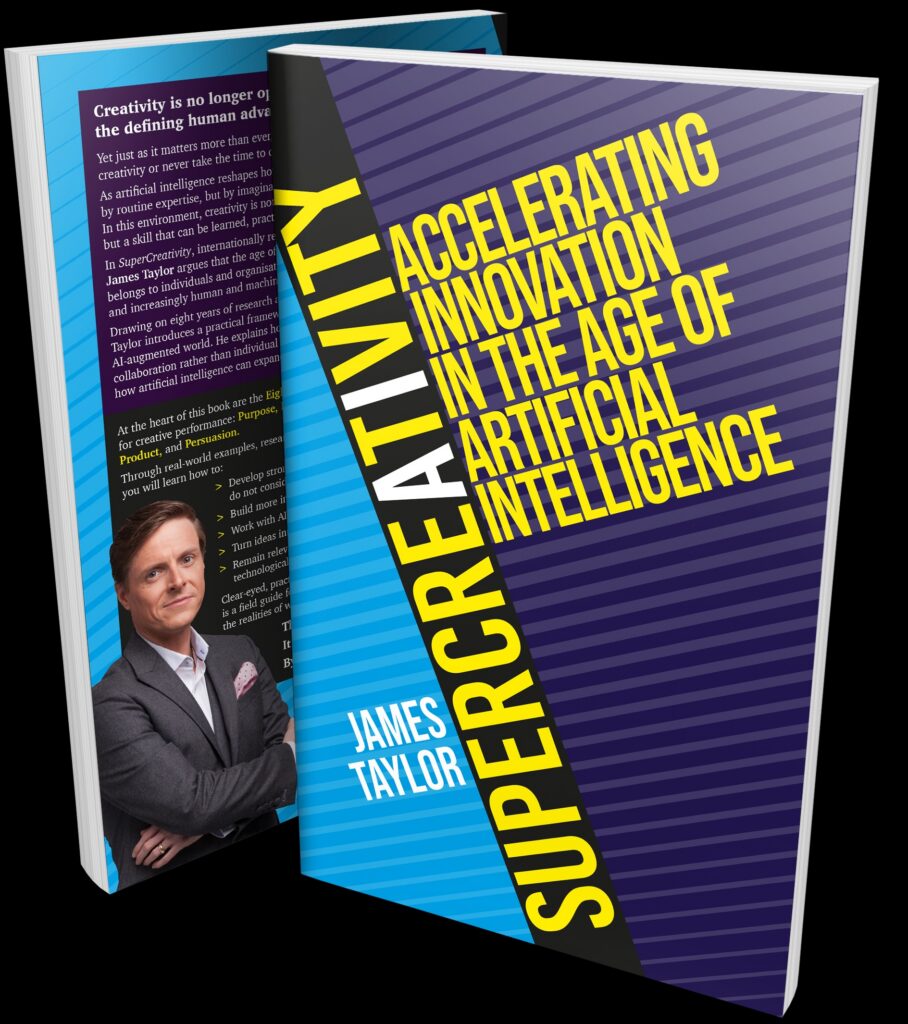 That’s the urgent, timely, and deeply practical argument at the heart of SuperCreativity: Augmenting Human Creativity in the Age of Artificial Intelligence, the new book by James Taylor — and the conversation we dig into on this episode of the Business of Story.
James Taylor, M.B.A., F.R.S.A., started his career managing rock stars — Bill Wyman of the Rolling Stones, Jeff Beck, and Deacon Blue, whose six million albums sold proved that brand discipline and creative instinct aren’t opposites.
He moved from the Royal Albert Hall to Silicon Valley, built an executive MBA on top of his music industry instincts, and has spent the last decade speaking 50 to 100 keynotes a year in 25-plus countries for Apple, Cisco, L’Oreal, PwC, Deloitte, EY, and over 500 Fortune Global companies.
James was recently the subject of a 30-minute BBC documentary. He is a Fellow of the Royal Society of Arts — alongside Benjamin Franklin, Bob Dylan, and Nelson Mandela. His new book is the capstone of everything he’s learned about what makes humans irreplaceable in the age of machines.
The short answer: your story.
What’s in it for You
- Why James calls the AI-powered 2020s the New Roaring Twenties — and what that means for entrepreneurs and creative business leaders right now
- How James uses psychometric AI analysis to profile every audience before he steps on a call or a stage
- The 250-story story bank system that powers his hyper-personalized keynotes for Fortune 500 audiences
- Why your emotional promise matters even to the most analytical, data-driven audiences — and the standing ovation story from a billionaires’ bank in the UAE that proves it
- What a live StoryCycle Genie® brand analysis revealed about James’s Visionary Magician archetype and his emotional promise of “possibility”
- The brand discipline lessons James learned managing rock stars — and why he built a brand guide before most speakers knew what one was
How the World’s Best Communicators Are Actually Using AI
James doesn’t use AI to replace his thinking. He uses it to sharpen it.
Before he steps on a call with a prospective client, he runs psychometric analysis on the decision-makers in the room — understanding how they think, how they buy, and what emotional triggers will make them lean in. He interviews two or three audience members in advance to gather texture and texture alone. He feeds all of it into AI, which holds his 250-story story bank and helps him build the overall structure for the keynote. Then, about a week before the event, he runs the client through the full presentation and makes final adjustments.
The AI hasn’t written the presentation. It’s made James a better communicator of his own ideas.
That’s the distinction that matters. As James puts it, quoting Steve Jobs: at its highest, technology should disappear. AI at its best should disappear — and what should remain is the message, the audience, and the outcome.
Why Emotional Storytelling Works Even on Analytical Audiences
James speaks primarily to finance, technology, engineering, and manufacturing audiences — the people who are most likely to flinch at emotional language on a speaker’s website. He’s built a career on the assumption that they want data, frameworks, and global perspective.
Then he told the El Cielo story.
At a keynote in Ras Al-Khaimah for a private bank whose clients are billionaires, James opened with a cold story about a restaurant in Bogota, Colombia, where a chef named Juan Manuel Barrientos trained former soldiers and guerrillas to cook together after the country’s civil war. He called it “cooking peace.” Within four minutes, James received a standing ovation. He later learned that 40% of the audience was Lebanese — a country that had lived its own civil war. They didn’t hear a story about Colombia. They heard their own story.
We buy with emotion and justify with logic. Every time.
When Park ran James’s brand through the StoryCycle Genie®, it identified his primary archetype as the Visionary Magician — a brand whose entire narrative engine is transformation, converting AI anxiety into creative confidence. It surfaced his emotional promise as a single word: possibility. James called it bang on.
Links
- JamesTaylor.me
- James Taylor on LinkedIn
- James on Instagram
- SuperCreativity Podcast
- SuperCreativity on Amazon
- StoryCycle Genie®
- Free Brand Story Grader
Deepen Your Storytelling Mastery: Three Related Episodes
- The Machines Can Code. They Can Calculate. But They Cannot Connect., with Joe Lazauskas — Joe’s research on why storytelling becomes more valuable as AI scales is the perfect philosophical foundation beneath everything James and Park discuss here.
- Your Best Ideas Are Not Going to Come From a Chatbot, with Sara Connell — Sara’s neuroscience-backed case for protecting your creative genius in the age of AI is the ideal companion to James’s SuperCreativity framework.
- Using Artful Intelligence to Tell Your Sustainability Story, with Bruno Sarda — Bruno’s work on using AI as a force multiplier for human storytelling — not a replacement for it — echoes the core argument of this episode across a completely different industry context.
James Taylor’s Conversation With Park Howell on The Business of Story Podcast
What Is Super Creativity? How AI Augments Human Creativity Without Replacing It
Park Howell: Hello James, welcome to the show.
James Taylor: Well, it’s my absolute pleasure being with you today. I’m looking forward to our conversation.
Park: And where you’re coming to us from.
James: Today I’m coming to you from a very sunny Scotland in the UK, at the highlands of Scotland today.
Park: Must be beautiful.
James: Yeah, it’s beautiful. I’ve just had about two and a half weeks on the road. I was in New York and then California and then Mexico City. And then last week, I was in Las Vegas, Amsterdam and Stockholm in Sweden. So I’m glad to be home for 24 hours.
Park: What were you doing? Running from the law or what?
James: Maybe that’s what my wife thinks I’m doing. No, I was giving keynotes for various different organizations. The one in New York was for L’Oreal, all their marketers, 500 marketers from L’Oreal. And then the one in Las Vegas was for all the business offices for the big universities across the United States.
Mexico City was a technology conference. Sweden was the biggest bank, one of the biggest banks in Sweden, for all their AI and technology folks. And then the one I was finishing up finally was in Amsterdam, and that was for PwC, the big accounting firm, but the strategy part. This was basically the 500 partners for Strategy, who do a lot of strategy consulting for some of the big global Fortune 500 companies. So a real mixed bag.
Why AI Is Fueling a New Roaring Twenties for Entrepreneurs and Creative Business Leaders
Park: And do you have a through line, a main theme that you’re speaking on these days to all of them?
James: Yeah, so primarily it’s really about the ideas in the latest book, which is Super Creativity. It’s really about this idea of how as individuals, we can augment the creativity that we’re all born with by collaborating both with other people, but also with artificial intelligence.
Because of the AI side, which is what I speak a lot on, there’s a lot of interest in that topic just now. Companies are trying to figure out how to do it. Individuals are trying to understand, should they be fearful of it? Should they be leaning into it?
So it’s a good time to be a speaker on the topic.
Park: Yeah, and I was just up in Denver last week working on some story training for a large tech company. We talked a bit about AI too. They’re all scrambling to get into it, trying to build their own custom GPTs. And I see a lot of people on LinkedIn just whining about AI. I mean, just downright whining. And I want to slap them upside the head and say, hey, it’s here. It’s really cool when you use it right and well. Is that what you’re experiencing out there? Is that where your book takes us?
James: Yeah, I’m generally an optimist about how these technologies will improve the lives of people. There are obviously guardrails we need to have, AI governance, the ethics of it. But I think on the whole, this is a great time.
If I was an entrepreneur today, this is one of the best times to be a builder of a business because you have this suite of tools that have never been known before.
I speak a lot in the US, and you had the roaring 1920s, that great period when cities like Chicago and New York boomed. That was driven by the combustion engine and electrification. But now we have this new roaring 20s, which is primarily driven by artificial intelligence. And so I’m very excited about this.
From Managing Rock Stars to Global Stage: James Taylor’s Origin Story and Brand Discipline Lessons
Park: So why did you write the book? What was the big impetus there?
James: I start the book talking about my origin story. I used to manage the careers of high-profile rock stars. I worked with members of the Rolling Stones, multiple Grammy award winners.
There’s a story I start with where I was standing at the side of the stage at the Royal Albert Hall in London. I had one of my artists performing. I could see the artists and the band on stage with a spotlight on them. If I looked to my left, I could see tens of thousands of people in the audience enjoying the show. But if I looked to my right, I could see backstage — 100 to 200 people who are just as much a part of making a creative, successful, and innovative show as the person with the spotlight on them.
So I decided I’m going to move out from just being the person that builds the brands of high-profile rock stars. I want to focus on all those backstage heroes from corporates, from all kinds of different areas, about how they could really augment their creativity and increase it with technologies like AI.
That started me on the journey, moving to Silicon Valley. And now what I do today is I speak 50 to 100 keynotes a year, in 25-plus countries, for many of the Fortune 500 companies who are intrigued, excited, and fearful about how they can augment their people with creativity and AI.
Park: So what do you tell them? How can they do just that?
James: It depends on the industry I’m speaking to and where they are on that journey. I just spoke a few months ago in Singapore for Micron, which is a great American company in the silicon chip industry. 95% of their entire procurement process for those chips now has been run by agentic AI.
So companies like that are really leaning into it and they’re further ahead. But many of the organizations I speak to are a little bit further behind. Many of them are using AI for email writing, doc review, some of the basics.
What I’m very interested in is how AI can elevate the things that we as humans are uniquely capable of — creativity, and actually communication as well. On the storytelling side.
I think about it in my own work as a speaker. I intertwine everything I do with artificial intelligence now. It helps me understand the audiences I’m going to speak to, what their challenges are, what’s keeping them awake at night. It helps me understand how I need to tailor my message for a particular audience so it’s going to resonate with them and connect with them.
There are clients who come to me and say, “James, I want you to come in and tell us how we can lay off 30% of our people with artificial intelligence.” That is one approach. But that’s not really going to be a competitive advantage in the long term.
We have to assume that in the next two years, everyone will have a pretty similar tech stack. So that is not going to give you the competitive advantage. It’s going to come back to those things like creating the kind of experiences, products, or services that excite customers — and telling those stories that connect with audiences.
How Top Keynote Speakers Use AI: Psychometrics, Audience Analysis, and Story Banks Explained
Park: So do you have a client example, a story of where you’ve seen them use AI in creativity, in their brand storytelling, in their sales and marketing to really hit it out of the park?
James: I’ll give you a good example. I was just speaking in Austin a few weeks ago for the electronics industry in America, one of the big associations there. These are all sales professionals selling electronics for robotics, satellites, all kinds of things. When they get in that room with a client, they have to really connect with that client.
An example I shared is from my own work. Let’s say before I give a sales pitch, someone’s interested in booking me to come and speak at their event. Before I ever step on a call with that executive, I use AI to analyze the psychometrics of that individual or the decision makers who are going to be on that call. Because we want to understand how they think, how they feel, how do they buy, what’s going to get them excited.
I use that information to think about how to nuance my message to connect with each of these different people, because they may have different objectives — especially if there’s a committee deciding on a group of speakers.
Then once I’m chosen, I do the human things we have to do. If I’m giving a presentation, I’m having conversations with the client and trying to understand what success looks like for them. I take them, future-pace them a little bit. There’s that Maya Angelou quote: people forget what you say, but they should never forget how you make them feel. What is the emotion you want people to feel?
In addition to that, I usually like to speak to two or three audience members in advance because what I’m listening for is a little bit more texture. Often they’re telling me things about what’s going on in the industry, their challenges at the moment, that I can weave into what I’m doing.
Then this next bit is probably the part that most keynote speakers don’t do, which is I feed all this into different forms of AI and then I help it understand this audience. Together, working with AI, we basically craft the overall structure for the keynote.
It has my story bank, essentially, of all the 250 stories that I’ve told, examples, case studies. And then we start to fill in the blanks. I’m using AI to help me fill in the gaps. Maybe there’s a bit of research I want to have. Then about a week before the event, I run the client through the entire presentation. We make some final adjustments.
And then when I go on stage — and this is an important point — the AI hasn’t written my presentation for me, but hopefully it has made me a better communicator and a better presenter of my ideas. And I think that’s where I see people using this technology well.
James: It’s almost like — I see you have a beautiful Rhodes piano behind you there as well. It’s like that musician, the instrument becomes part of who they are. It’s an extension of themselves.
There’s a Steve Jobs quote: at its highest, when technology is best, it should disappear. AI at its best should disappear. And it should focus on what is the message I’m trying to get across, who are those people I need to persuade or convince, and what is the outcome I want to have at the end of that.
What Brand Archetype Should a Keynote Speaker Choose? The Visionary Magician Explained
Park: What have you learned from your days in the music industry? How long did you do that? Why did you move out of it? And what did you learn that you are applying today?
James: I did that really from leaving school. My father was a musician, my grandfather was a musician, my wife is a jazz singer. So I was brought up around that world. I really did that from the age of 17, 18 until probably I was 30.
Park: And who are some of the artists you worked with?
James: I worked with members of the Rolling Stones, like Bill Wyman. I worked with Jeff Beck. I managed a band for many years called Deacon Blue. We sold about six million albums. A lot of classical artists, jazz artists as well.
I really enjoyed that job. I loved working with teams of very talented people, both on the stage and off the stage. But after a while, sometimes you get people whose egos become a little bit too big. And it sometimes becomes less fun if you’re dealing with people all the time who have got very big egos.
I also have a fascination for technology and the future. And so it made sense to move towards that Silicon Valley world. That’s how the transition happened.
A lot of people I think would have previously gone into something like the music industry or even the games industry a few years ago. Those people are now working in technology. They’re working in artificial intelligence. They’re building startups. They’re not building record labels anymore.
Park: And so how long have you been in the business world?
James: When I had the music company, we decided to bring in private equity. Business was doing very well. We had record labels, music publishing. And then I realized, I started it pretty much straight from school, and I’m in meetings with lawyers and accountants and financiers, and I’m going to have to upskill myself. So I went back and did an executive MBA.
You learn a lot of the theory side of things, but there’s nothing more dangerous than a new MBA with theory if you put them into a business. So I really wanted to combine some of that theory with understanding how business really works.
Moving into California, working in the startup world, that’s very interesting. It’s very different from a corporate setting — that idea of move fast and break things. I was living there at the time and Twitter, Coursera, Masterclass were all coming up. There was a lot of optimism, especially within Silicon Valley at that point.
Then one day I was speaking in San Francisco, someone asked me to speak at a conference. At the end of it, a professional speaker came up to me and said, “You know, you can do this for a living.” Really? I didn’t know anyone that was a professional keynote speaker. I saw people like Tony Robbins, but I didn’t really think that was a job.
So he explained to me a little bit more about how it worked. And then my curiosity took me to deciding to interview 150 of the world’s best professional keynote speakers. I learned from them that the job of a keynote speaker is not just giving a speech, it’s getting the gig. And that really comes back to the business.
Since really 2017, this is what I do. I travel around the world speaking usually as an opening or closing keynote speaker for big conferences. My clients are many of the Fortune 500, big tech companies, big finance, big banks, insurance companies, engineering companies, all kinds of different businesses.
One thing I did, which I learned from my music industry background, is around this idea of building a brand and message discipline. Don’t overcomplicate things.
My name is James Taylor. Everyone in America thinks it’s going to be the singer-songwriter James Taylor. So I decided, well, I’m going to flip this. Everyone’s going to remember James Taylor. But the way I create my keynotes is very tailor-made, very customized, like getting a handmade or tailor-made suit. So I use that Britishness — which is why when you see me on stages, I’m usually wearing a very well-made tailor-made suit. It’s part of the branding.
Park: Yeah, that would make sense where image is everything. And I mean, in the branding world, image is also everything, but I don’t know that business people put as much emphasis on it as they need to.
James: Yeah, the very first thing we ever did was create a brand guide for my brand. And most speakers won’t have a brand guide. It’s a very useful activity, and it’s obviously much easier to do now with different tools. But in terms of brand voice, typography, colors, logos, everything like that, it just made things so much simpler when we wanted to speed up and scale.
What made it great now with AI is you can feed all of this to different tools and they very quickly understand: this is your ideal type of client, this is how your brand resonates, these are the pillars your brand stands around.
I remember very early on, we launched our first website for my speaking brand. I had a good friend of mine, a wonderful speaker from the US called Rob Waldman. He’s an ex-F16 fighter pilot. And I said, Waldo, can you have a look at my website? And he took it down like a New York cab driver. He went straight through and he was blunt and he was brutal, and it’s exactly what was required. Then we made some changes and got it more in alignment with what we were trying to do.
What a StoryCycle Genie® Brand Analysis Reveals About a Speaker’s Archetypes, Voice, and Emotional Promise
Park: Yeah, we did that for you as well. In preparation for this interview, we took your website and put it through the StoryCycle Genie®. It gave us an assessment in about two minutes — it’s like, you know, James, mirror mirror on the wall, how’s my brand showing up for all? And then from that assessment, it created your overall brand narrative strategy. That took another five to six minutes.
This is something that would have taken months before. But now using our process, the Story Cycle System process, we’ve got it built into the Genie and we use AI. It’s built on our proprietary Brightsy platform. So it’s not gen AI. We have APIs of AI coming in, but we’re using all the brilliant power of artificial intelligence and making it artful intelligence inside the Genie using our brand story development process.
So with all that said, what did you think of what I sent over?
James: I loved it. I sent it to my team after you sent it through as well, to see their reflections on it. In terms of primary audiences identified, some of the key brand things, some of the key ways we were trying to communicate the business and the brand and the segmentation — perfect, great.
It was also nice to see some of the differentiators there. One thing that was interesting was it picked up on something on the website, which was we have lots and lots of landing pages that are highly optimized for individual cities. So if you type in “keynote speaker on artificial intelligence in Tampa, Florida,” it’s probably likely to be me that shows up.
And this is actually a constant conversation I have with my team: how do you get that blend right between stuff that works from an SEO standpoint and stuff that also doesn’t go against the brand and what you’re trying to get? It’s hard. I think that document brought in a useful and interesting tension that exists there, which we haven’t necessarily resolved yet.
Park: Yeah, it does really three things. It validates what you’re doing well, reveals gaps that you can quickly fix, and inspires you with new ways to think about your brand. What were some of the areas where it actually validated what you’re doing well?
James: I think it very much validated the audiences. It had these three types of audiences and I thought those were great and exactly in alignment with what we do. And their emotional triggers — how you talk to each of those three groupings about what it is and the value you deliver. I really liked that.
And one of the challenges I was reflecting on is, I’ve got a podcast show and I created it a long time ago, even before I got into speaking. And it’s kind of evolved over time. Reading your report, one of the things I was reflecting on is: how well is this podcast in alignment with these audiences now? Is this podcast even serving any of these audiences particularly well?
Maybe the content piece of what we’re doing around the podcast isn’t quite in alignment with the brand or the audience we’re trying to serve.
Park: Well, you could actually ask the Genie that. You go into the Brand Intelligence Genie. And once it gets to know your brand, like it does now, you can say, okay, now I want you to look at my podcast and the brand, and I want you to tell me where they are married together and where are the voids. What do I need to strengthen? Where is the white space? What could I do to make it speak even more resonantly to my main audiences?
And the Genie will collaborate with you to do that. Sometimes you’ll go, yeah, no, I don’t want to do that. That’s way too out there. But what about this? And it’ll come back and it’ll be brutally honest. It’s such a collaboration tool, and that’s why I call it Artful Intelligence — because it’s playing off of you, off of your knowledge, your wisdom, your experience, and it’s not replacing any of that, it’s just augmenting it.
James: Yeah, I think one of the gaps — and this is also a cultural thing — is that in the US, many of the great motivational speakers came from the churches. There is a certain style when you present in that way. It has a certain feel to it. There’s a lot of call and response.
One of the interesting things was about the brand personality archetypes. For me, like magician, sage, hero. And one of the challenges sometimes is as a speaker, you go on stage, but you don’t want to be the hero of the story. You want your client to be the hero. I’m trying to be the Yoda, the sage as well.
One thing I was reflecting on: the sage works very, very well, especially if I speak in the Middle East or Europe, where they want you to be a little bit more low key, a little bit subservient to the audience. Where in America, you generally like a little bit more hero, a little bit more forward.
I never really tell my own personal origin stories on stage. I rarely tell a personal story on stage because it usually doesn’t feel like it serves me. And also it has a little bit of a cultural ick factor for me being British, where we tend to downplay. That sometimes becomes a bit of a problem because I’ve noticed recently, especially for American audiences, they really like to understand the person on that stage a little bit behind the scenes.
Park: Without a doubt, yeah. We want to know what have you been through and where did you fall on your face and how did you recover and how can I keep from that happening to me through your story?
And one thing I’d like to point out: the hero archetype, as you pull out Swiss psychologist Carl Jung, is not a chest-pounding archetype at all. The hero archetype is about being in service to people. You are a hero, not a Superman. It’s not a cape type thing. You are there in service to the people you are trying to help.
James: Yeah. And I was reading this document after having just been in Las Vegas and going to see the Wizard of Oz at the Sphere with my wife. And I mean, I haven’t seen the Wizard of Oz in a long, long time. And you kind of watch that and think, what a brilliant example of storytelling and structure. All the things you mentioned — the hero’s journey, the allies and the enemies, the new normal, villains, fog and crevasses.
And Dorothy, she’s a hero and she’s a hero for many people in different ways, but she isn’t a chest-thumping type of hero. You’re with her on that journey because many of those same things — wanting to return home, family, comradeship, having friends, achieving your dreams — that is universal.
How to Use Emotional Storytelling to Win Over Analytical Audiences With the Promise of Possibility
Park: Now, these archetypes — remember, this is the Genie reading how you are currently showing up in the world from your website. It said your primary archetype is the Magician. And by the way, that’s a category of archetype. Inside that, you are the Visionary Magician.
It reads here: “The Magician archetype emerges as James Taylor’s dominant psychological pattern because the brand’s entire narrative engine is transformation — converting AI anxiety into creative confidence through proprietary frameworks that fundamentally alter how organizations operate and compete.”
Does that sound like you? Is that what you are about?
James: Yeah, but I think what is also interesting is that any website is created by multiple hands. There’s my team, I have a team in the Philippines, I have a team in the UK, we have brand people, photographers in New York, a stylist in London. And so it’s interesting that looking at the website has come out pretty in alignment with what I’m about.
I’ve always felt my role as a speaker is just to take the audience on a journey. I’m a little bit in the future from where you are just now, but come on, follow me along. Let me show you this amazing stuff that’s happening over here. So there is a little bit of the magician, I guess. I’ve never used that term — visionary — but I think for a lot of clients, that’s what they want.
They want someone that has a sense of vision. Where are we going? Because for many of my clients, they’re scared, they’re worried about how technology is going to transform their industry or their own business. The pace of change is so fast now. They want someone with good pattern recognition and also a global perspective.
That was one of the other things you picked up absolutely correctly. It was very conscious in my brand and the way my storytelling is — global in nature. I don’t tell stories of just European companies or American companies. The faces I represent on the screen, on the stage, on PowerPoint and presentations are global faces and global stories.
I had a discovery call with a client today, and this is the International Association, and they have people traveling from 50 different countries around the world. That’s my ideal audience. And having global perspectives is really useful for me.
Park: So it said here your brand purpose statement is: James Taylor exists to inspire people to unlock their creative genius so they can build a more innovative, collaborative, and human future.
James: Bang on, bang on. The only word I might change is instead of using the word genius, I might use the word potential. So “creative potential” instead of “creative genius.” A lot of people are resistant to this idea of genius. That word is quite a loaded term. You think it’s just Nobel Prize winners.
So probably I would go with “creative potential” because that would be a softer way into talking to them about it.
Park: Well, and what you would do then, if you were working inside the Genie and it gave this to you, you would just iterate with the Genie. Say, I love it, but I don’t like the genius. I want potential and here’s why. So you don’t have to worry about prompting at all. You just talk to it like you’re talking to a consultant. And every time you do that iteration in there, James, it learns that much more about you and it retains that context.
So with what I said to you, did you find some gaps reading through it? Like, hmm, it’s missing something here?
James: Yeah, there was one section in particular. You said the emotional promise is implied but not explicitly articulated. And the first thing that led me to wonder is that a lot of my clients are from more analytical industries — data-orientated industries. Finance, technology, engineering, manufacturing.
I don’t get booked so much by what you would class as the cooler brands that lead very heavily on emotion as a term. My audience in general tends to be a little bit more on the side of technology, scientific, engineering, or financial background — something where they might be a little bit cautious about contacting a speaker who is overly gushy around using emotional language on their website.
So that was just something immediately I kind of noticed.
Park: Mm-hmm. So you’re telling me that you’re working with more logic- and reason-driven audiences. And I’ve been there too, the finance world, the tech world. And you think that emotion doesn’t play into it, and yet it does.
I will quite often argue that B2B means business to business, right? Well, in communication, it typically means boring to boring because people haven’t tapped into, even in a slight way, the emotion around that audience, even if they’re a really hard-charging, logic-driven audience.
So the Genie did come up with an emotional promise, and you can throw it out. I’m just really now very eager to hear what you think of it. And it said “possibility” — that your emotional promise is possibility.
James: Exactly. I think this also comes to maybe a confidence bit. Once you’ve achieved a level of success, I think you can open up a little bit more emotionally in terms of what you do.
I’ll give you an example. I was recently giving a keynote in Ras Al-Khaimah, which is in the United Arab Emirates. It was for a very well-known private bank — the bank that billionaires would bank with. I’m thinking, this is a numbers-orientated audience, very shrewd type of people. And I made a decision to tell a particular story about a place called El Cielo, which means “the sky” in Spanish. It’s a restaurant in Bogota, Colombia, created by this amazing chef called Juan Manuel Barrientos.
He wanted to use food as a way to bring people together. There was a civil war in Colombia, and when the country first signed its peace deal, he traveled into the former conflict zones and trained former soldiers, but also former guerrillas, former paramilitaries. He took these former combatants — people that were trying to kill each other up until relatively recently — and put them together in a training kitchen. They would learn to cook together. He calls it his “cooking peace.”
So I told this story really as a way to get across the idea of collaboration, even with people you don’t necessarily see eye to eye with, and the power that can come from that. I told it at the very start of the keynote as a cold open story. And within that first four or five minutes, I got a standing ovation.
I was like, wow, this is unusual. Normally you don’t get a standing ovation at the start of a keynote. I spoke to people afterwards and said, what was it in particular about the story that touched you? And I found out that 40% of the people in the audience were from Lebanon, from the country of Lebanon, which had also gone through its own civil war. So many people in the audience, hearing that story about Colombia, about collaboration, people coming together after many years of war — they saw themselves in that story. And it resonated on an emotional, not a rational level.
So that kind of made me think, maybe I should weave a little bit more of the emotional side into what I’m doing.
Park: Yeah, I think it would be interesting because we do buy with our emotion and then we justify that purchase with our heads. And so I was really interested about that emotional promise being possibility.
It says because it is the single word that most authentically captures the emotional transformation his brand delivers. Possibility.
James: Yeah. And it’s fascinating because I have a good friend of mine, we speak on the same topic, and he really leads with emotion. That’s his brand, that’s who he is as a person, that’s his style. And he said, I would love for me and you to do an event together at some point, because we’re talking about the same stuff, the same topic, but we come at it from very different perspectives and very different tonally.
And I think this is what makes things interesting. People have this imposter syndrome about writing a book. And this is obviously, I’ve just written my book here. And there was that thing in the back of your mind when you’re writing a book, like, who am I to say this? Who am I to write this book?
But someone said to me, you know, when you look at your bookcase and you might have 50 books on the same topic, this book and this author may appeal to you, but this other one might appeal to your friend or your wife. They’re talking about similar things, but they’re coming at it from a different perspective. They’re maybe saying it in a slightly different way, using different terminology, connecting emotionally in a different way.
So that gave me a little bit of hope that there’s space for everyone.
The Standing Ovation Story That Proves Human Creativity and AI Collaboration Can Bridge Global Divides
Park: So with that in mind, was there any part of it that inspired you with a new way to think about telling your story?
James: Yeah, so the story actually mentioned right at the start, the rock star manager thing. I don’t normally tell that story on stage. Normally whoever’s introducing me will mention I used to be a rock star manager, but I never mention it on stage myself. It’s almost like in storytelling, opening and closing a loop. The person announces me on, they open that loop, people go, rock star manager — they instantly want to ask. And usually what would happen is I wouldn’t mention it on stage, but afterwards over coffee or in Q&As, people would ask me the story.
So from this, what I might do is figure a way of artfully incorporating it — but it’s not about me, it’s about how can I do it in a way that’s going to be in service to the audience, that’s going to be useful for the audience, either a takeaway or something I learned from that profession.
Park: Yeah, well, I’ll really be eager to hear what your team thinks of the Genie and the input. Let me know. Please let me know how that goes.
Where can people find your book and learn more about you?
James: They can go to my website, jamestaylor.me. And obviously you can get the hard copy or the paperback copy on Amazon or your local independent bookstore. But also we just released the audio book version. So if you’re more of an audio book person, you like to listen in the gym and travel to work, then just go to Spotify, Apple Music, wherever you get your audio books from and enjoy it there.
Park: Well, James, thank you so much for being here, man. You have been all over the world, so I appreciate you taking the time and having the energy to be on the show today.
James: Well, thank you, Park, it’s been a great pleasure speaking with you today.
Park: And good luck with your new book.
Frequently Asked Questions About This Conversation
Q: What Is Super Creativity and How Does It Differ From Traditional Creativity?
A: Super Creativity, as defined by keynote speaker and author James Taylor, is the amplified form of human creativity unlocked through intentional AI collaboration. Unlike traditional creativity, which relies solely on individual imagination, Super Creativity pairs human intuition, emotional intelligence, and contextual wisdom with AI’s pattern recognition and data-processing power. The result is creative output neither humans nor AI could achieve independently, expanding what’s possible for entrepreneurs, business leaders, and creative professionals navigating the modern innovation economy.
Q: How Do Top Keynote Speakers Use AI to Prepare for High-Stakes Presentations?
A: Leading keynote speakers like James Taylor use AI throughout their preparation workflow to deliver hyper-personalized presentations. This includes psychometric analysis to understand audience personality profiles, AI-powered research to surface relevant industry insights, and story bank systems to match the right narrative to each audience’s emotional triggers. AI also analyzes pre-event audience data so speakers can tailor content, language, and examples to specific stakeholder groups, transforming generic talks into precision-targeted keynote experiences that consistently earn standing ovations.
Q: What Is Artful Intelligence and Why Does It Matter for Business Leaders?
A: Artful Intelligence is the philosophy and practice of combining human artistic sensibility, emotional depth, and creative judgment with AI capabilities. Championed by keynote speaker James Taylor and podcast host Park Howell, the concept describes a critical new professional competency: using AI tools not as replacements for human creativity, but as amplifiers of it. For business leaders, mastering artful intelligence means remaining competitive and creatively agile as AI transforms every industry, turning technological disruption from a threat into a compounding strategic advantage.
Q: How Does AI Augment Human Creativity Without Replacing It?
A: AI augments human creativity by handling analytical, repetitive, and data-intensive aspects of creative work, freeing humans to focus on meaning-making, emotional connection, and original insight. AI can surface patterns, generate variations, and accelerate research, but it cannot replicate lived experience, moral judgment, or authentic storytelling. The most powerful creative outcomes emerge when humans direct AI with clear intention, using it as a collaborator rather than a substitute — the core principle behind James Taylor’s Super Creativity framework and his artful intelligence philosophy.
Q: What Brand Archetype Should a Keynote Speaker Choose to Stand Out and Get Booked?
A: For keynote speakers, brand archetypes form the psychological foundation of stage presence, messaging, and audience connection. James Taylor’s StoryCycle Genie® analysis identified the Visionary Magician as his primary archetype, combining a future-forward perspective with the ability to transform audiences through insight and demonstration. Speakers with Magician or Sage archetypes typically resonate with analytical, professional audiences. Choosing the right archetype creates consistency across all content, proposals, and delivery, making every touchpoint immediately recognizable and emotionally compelling.
Q: How Can Psychometrics Improve Sales Conversations and Keynote Speaker Preparation?
A: Psychometrics — tools that measure personality traits, communication styles, and behavioral tendencies — give speakers and sales professionals a strategic edge by enabling tailored approaches before a conversation begins. James Taylor uses psychometric data as part of his AI keynote workflow to understand an audience’s dominant personality profile and adapt stories, language, and pacing accordingly. In sales contexts, psychometric insights help professionals mirror communication preferences, reduce resistance, and accelerate trust, turning data about people into more meaningful human connection and higher conversion.
Q: Why Are the 2020s Called the New Roaring Twenties for Creative Entrepreneurs?
A: James Taylor describes the AI-powered 2020s as a “New Roaring Twenties” because, like the original cultural and economic explosion of the 1920s, today’s era features rapid technological disruption, unprecedented creative opportunity, and a reshaping of business norms at speed. AI tools are lowering barriers to entry, accelerating innovation cycles, and enabling small teams to produce outputs previously requiring entire organizations. For entrepreneurs who embrace AI collaboration, this decade offers a once-in-a-generation window for exponential creative and business impact.
Q: How Do You Use Emotional Storytelling to Connect With Analytical Audiences?
A: Analytical audiences — engineers, scientists, data-driven executives — are often assumed to prefer facts over feelings. But even the most quantitative minds make decisions emotionally and justify them rationally. The key is anchoring emotional stories to measurable outcomes. James Taylor’s approach pairs powerful human narratives, like his peace-bridge story from Ras Al-Khaimah, with clear business implications. Leading with an emotional promise like “possibility” and following with evidence creates a bridge that moves analytical audiences from skepticism to conviction, and standing ovations.
Q: How Should a Keynote Speaker Build a Personal Brand That Consistently Attracts Bookings?
A: Building a sustainable speaker brand requires the same discipline James Taylor observed managing rock stars: consistency, clarity, and audience-centric storytelling. Begin by defining your brand archetype and emotional promise — the singular feeling you reliably create for audiences. Develop brand guidelines covering visual identity, language style, and core message pillars. Use AI tools to audit your existing brand presence against your intended positioning. Then create content that demonstrates expertise consistently, allowing your unique origin story to differentiate you in a crowded market.
Q: What Is the StoryCycle Genie® and How Does It Help Speakers Clarify Their Brand Story?
A: The StoryCycle Genie® is an AI-powered brand story development tool built on Park Howell’s Story Cycle System, a proven narrative framework used by global brands, entrepreneurs, and keynote speakers. It analyzes existing brand communications, website content, and messaging to surface brand archetypes, emotional promises, and story gaps. When Park ran a live StoryCycle Genie® analysis on James Taylor’s brand during their podcast conversation, it identified his primary Visionary Magician archetype and an emotional promise of “possibility,” delivering immediate, actionable brand clarity.
 Listen To More Episodes