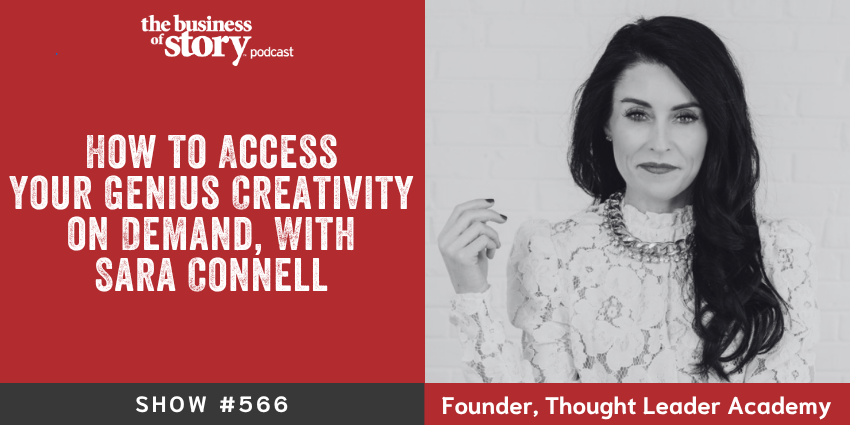
Your Best Ideas Are Not Going to Come From a Chatbot
The Brain State That Separates Original Thinkers From Everyone Else
You are a coach, an entrepreneur, a marketer, a thought leader with ideas that could change lives. And you know your best thinking doesn’t happen at your desk. It arrives in the shower, on a walk, in that half-awake moment before the alarm goes off.
But in the age of artificial intelligence, you’re being quietly pressured to outsource that genius. To let the machine think for you. And every time you do, your creative muscle weakens.
That’s the urgent, timely, and deeply human argument at the heart of Sara Connell’s new book, The Download — and it’s exactly what she unpacks in this episode of the Business of Story.
Meet Sara Connell: The Author Who Downloaded a Book About Downloads
Sara Conn ell is a 5x bestselling author, the founder of Thought Leader Academy, and one of the most compelling voices in the thought leadership space today. She helps coaches, experts, and entrepreneurs scale their impact and create six to seven figures by becoming bestselling authors and in-demand TEDx speakers. She has been featured on Oprah, The New York Times, Good Morning America, TODAY, Forbes, and Entrepreneur.
Her upcoming book, The Download, explores one of the most important questions of our time: what if we could train our brains to access genius, creative, original thinking on demand — even in the age of AI?
The meta irony? The book itself came to Sara as a download. She was walking, wondering what to write next, when the idea arrived fully formed. That’s not a coincidence. That’s the method.
What’s in it for You
- The neuroscience and quantum physics behind creative downloads — and why your best ideas feel like they come from somewhere beyond your rational mind
- The Gamma Walk: Sara’s step-by-step daily practice for inducing the brain state associated with flow, channeling, and breakthrough insight
- Why AI slop is a beta-state problem — and what MIT brain scans reveal about what happens to your creativity when you outsource your thinking to a machine
- How the reticular activating system works — and how to train your brain to filter for creative breakthroughs throughout your day
- The coincidence journal and the Download app: two practical tools for capturing ideas before they vanish
- The SWOO framework (Science Meets Woo) — how neuroscience validates what artists and mystics have always known about inspiration
The Science Behind the Shower Moment
Most of us have experienced a download. That moment in the shower, on a walk, in the space between sleep and waking, when a complete idea arrives. A book. A business decision. A solution you’d been grinding on for weeks.
Sara has spent years studying where those moments come from — and more importantly, how to make them happen on purpose.
Her research draws on neuroscience, quantum physics, and the work of scientists at Stanford, Harvard, and the Noetics Institute. The result is her SWOO framework: Science Meets Woo. It’s the bridge between the measurable and the mysterious. Between the peer-reviewed and the profound.
The key insight: your brain operates in different wave states. Beta is where most of us live — analytical, task-focused, and largely closed to creative downloads. Alpha and theta open the door. But gamma — the channeling state studied in Tibetan monks at the University of Wisconsin — is where the real magic happens. It’s the state athletes call flow. It’s what musicians mean when they say the music played through them. It’s what writers mean when the book writes itself.
And it’s trainable.
The Gamma Walk: How to Do It
Sara’s signature practice is simple enough to start today.
Set an intention. Identify what you want to download — a decision, a creative idea, a solution. Feel the desire in your body. Then think of someone or something you love and send them a beam of warmth. This activates gamma wave production in the brain.
Then walk. Five to ten minutes. No podcast, no voicemail, no music. Stay present to your sensory surroundings. Let your attention rest gently on what’s around you — birds, wind, passing cars. This is what Stanford researchers call soft fascination. It’s the state that increased creative output by 60% in their walking studies.
Capture what arrives. During the walk or after. In your phone, your journal, or the Download app Sara built specifically for this purpose.
Repeat daily. Watch for themes. Act on even a fragment of what arrives. Because action invites the next download.
AI Slop Is a Beta-State Problem
Here’s the line from this episode that stopped me cold.
“Gamma state doesn’t lead to slop. Beta state leads to slop.”
An MIT study cited in this conversation found that people who outsourced their writing entirely to AI showed measurably reduced brain activity. A dead zone in the prefrontal cortex. The people who actively created — or co-created — showed the brain fully lit up.
Sara’s point is not anti-AI. It’s pro-human. AI can only generate from what humans have already created. If we stop generating original thought, we stop feeding the creative ecosystem that AI draws from. The human who brings a lived anecdote, a genuine insight, and a distinct voice to an AI collaboration produces something the machine alone never could.
That’s what I call artful intelligence. And it starts with protecting and developing your own gamma-state creativity first.
Links and Resources
- SaraConnell.com
- Sara Connell on Instagram
- Download: Train Your Brain. Unlock Your Genius. Create Miracles book
- StoryCycle Genie®
- FREE Brand Story Grader
Deepen Your Storytelling Mastery
- The Machines Can Code. They Can Calculate. But They Cannot Connect., with Joe Lazauskas
- Using Artful Intelligence to Tell Your Sustainability Story, with Bruno Sarda
- The Agencies That Thrive With AI Will Project the Most Flexible Identity, with Marcus Sheridan
Sara Connell’s Conversation With Park Howell on The Business of Story Podcast
How to Train Your Brain for Creative Downloads in the Age of AI with Sara Connell
Park: Hello, Sara, welcome to the show. Coming to me from Chi town, I guess, Chicago.
Sara: So happy to be here.
Park: And whereabouts of the East Coast did you grow up?
Sara: My parents are in DC, so I grew up right outside in Alexandria, Virginia, and I have a sister in New York and a sister in Philly, and then we have cousins and everyone in Boston. So I’m the outlier.
Park: What brought you to Chicago?
Sara: I came out here to go to school. I went to Northwestern University and then moved to London for a while. I got to live abroad and then, you know, it’s funny — it kind of got to me at first. I thought, so flat. I don’t like the Midwest. Why is there no… you’re out in the mountains, right? It’s so beautiful and I missed it. But it’s such a — the people are great. There’s great food, great nature. So I figured I’m gonna stay.
Park: Awesome. And you are coming to us today to help our audiences download their next big creative idea. What do you mean by that exactly?
What Is a Creative Download? How to Access Genius Ideas from a Higher Source
Sara: So I have a book coming out later this year called The Download, and it is intentionally a little bit of a play on the era that we’re in. We are in an era where we download everything from the cloud, from different software, or from AI. And I really wanted to explore the way that — and I’m sure everyone listening has had a moment — where you were either in the shower or you were walking or you kind of woke up in that in-between sleep and waking, and you suddenly had some kind of idea come to you. Whether it was clarity about a decision or a book you were going to write or a business idea.
If that was a download, have you had one of those, Park?
Park: Yeah. Yeah, I think you’re exactly right. And it’s the muse out there. Some people say it’s a saint looking over your shoulder and guiding you. When you’re writing your book — and you probably experienced this too — I’ve written a couple of books where you get in this flow and it’s like you are the vessel for another intelligence that is feeding through you to the page.
Now that I mentioned that, I was just driving up from Phoenix the other day and I was listening to filmmaker Robert Rodriguez. He’s amazing — a guy who learned how to make films for like $7,000 and they became huge hits. He was talking about this very thing on the Joe Rogan show, April 15th, 2025, in and around that area. It is a fabulous show on this very subject. He talks about letting that muse come through, just start writing and it’s gonna work for you. Start painting. And he goes, as soon as we start having imposter syndrome, we are shutting off that gift, that muse coming through. So I think maybe that’s what you’re talking about.
Sara: It’s so similar. I’m going to absolutely listen to that episode later today because I know I’ll love it. That’s it. So we’ve all had these downloads, right? And I got really curious about where they come from, what’s really at play, and what if we could train our brain for them.
I love neuroscience. I love physics. I love, even though I’m a creative and a writer, that world — and it’s been very important to me in my own personal development, my own business development. We weave brain science-based strategies into helping people write books and talks and TED talks and the things that we do at our thought leader programs.
And so I thought, what if I just… it came to me, right? The book actually downloaded, which is very meta. I was sort of walking like, I’m downloading a book about downloads. So there was a little joke there.
These things — whether we think of it as the muse, God, the universe, consciousness, or our subconscious mind — we could think of it as… I know writers who are materialists. They don’t have a worldview that includes something beyond the brain and the matter of physical reality. And yet they’ll still say, I get these ideas from my subconscious or from the imaginal mind.
The reason I’m so fascinated right now is one, that we know so much more with science. We can actually put electrodes on our brains and we can watch things happen when we read and create and ideate. Stanford and Harvard and all these great places have studied this stuff. So you can really nerd out.
The neuroscience has proven what a lot of us have experienced as intuition and strokes of insight and downloads. But also because we’re in an era where it is very, very tempting — and we are encouraged, if not maybe subtly bullied — to really outsource our creative thinking and our imaginal thinking and our innovation because we do have this explosion of artificial intelligence.
I found myself even thinking, I could just have AI write this article. And I was like, no, wait a minute. I’m going to back it up because I know that the AI can only generate from what we’ve all created so far. And so I want to be responsible in myself and the people that I get to work with, making sure we’re continuing to fill it with original creative thinking. There’s an urgency around making sure that we don’t lose that muscle.
The Science of Creative Downloads: Neuroscience, Quantum Physics, and the SWOO Framework Explained
Park: Let’s talk a little bit about your backstory. What did you study in college to lead you to your career now? And I would imagine it’s probably some program that’s very logic and reason-driven, like all of us. And yet now you’re jumping over into the woo woo world, which a lot of people would call it. Give us a little bit of that backstory.
Sara: I call it SWOO, which is like science meets woo, because I feel like some of us might like the woo, but our left brain does need to be satisfied with research. We want the data and the research, and then our whole brain can embrace these ideas.
I grew up in a very traditional household, was raised Catholic. There was no woo. Then I went to college. I was a liberal arts major, studied English and communications. I did have to take a science credit and I was not happy about it. There was one class that fit in my schedule and it was on neuroscience. And I thought, well, I have no idea what that is.
It was one of my favorite classes I took in the entire four years. An ex-Navy pilot taught this class. He was fabulous, interesting, and I was riveted because I learned about things like neuroplasticity — which means we can change what we believe and therefore what’s possible for us in our lives. I learned about visualization, I learned about all kinds of things. And this was a hard Northwestern University science class. It was nothing woo. This was science.
However, it was a science I’d never been exposed to and it definitely planted seeds as I began to pursue a career in writing and coaching and all the things. I just love the woo, right? But I wanted to understand the why behind that woo.
What is happening in our own brains as we have to become the people capable of getting the muse to talk to us? And also, what could we embed in the work that we create that could make it transformational, not just informational or inspirational? That’s where the neuroscience and the SWOO really comes in.
Our brains are wired for story. You’re an expert in story and brand and these incredible ways that we get to share our message. And so there’s neuroscience behind that, right?
It’s so fascinating to me that people say visualizing is helpful, you know, to manifest. There’s all the woo words. But why? And what happens in the brain when we’re visualizing? Now because of peer-reviewed studies, we can see the brain matter reorganizing itself around a visualization as opposed to only a physical action, like learning to play the piano, for example. And so it’s really incredible. It’s a little bit like sci-fi comes into our real life.
Alpha, Theta, Beta, and Gamma Brain Waves: Which State Unlocks Your Most Creative Ideas?
Park: Well, you know, speaking of playing the piano, I play the piano and I was just up in Seattle visiting our 101-year-old mother who’s hanging in there. She asked me if I could play for her. And I came down and I played four or five songs that I just knew — a lot of music I wrote because I was doing a lot of music writing back in the day. And then I would try to play some other songs that I knew, but I was logically like, okay, how does this go? My muscle memory around those was gone. If I had had five minutes to plow through it, it all would have come back. And that experience always feels to me like something else is being channeled. I am just a musician and it flows through me and it plays.
And I think that is true in writing and a lot of things that you are talking about here. Have you read Dan Brown’s most recent book, The Secret of Secrets?
Sara: I sure did because it’s fiction. Dan Brown wrote the fictional version of the download, like in a way, right? It’s so much.
Park: Yeah, and he talks about noetics in there, which I was unfamiliar with. I listened to it and then have been doing a lot of study in noetics. And one of the metaphors he uses — and apparently science has proved this out to some respect — is our brain is like an antenna and there are all these different transmitting radio stations in the universe around us. And it depends on how you tune your antenna. Are you going to listen to the horror story channel about your life or positivity or creativity or worry?
Sara: Yes, it’s so true. Isn’t it fascinating? And if anyone hasn’t read it, Dan Brown always writes a good story. He brings a lot of the noetics in. In researching this book, I talked to a lot of quantum physicists and neuroscientists and surgeons and doctors and also regular people who just are creatives and get downloads and want to know where did that come from.
There’s things that feel miraculous to us, right? To me, when something downloads that I know I didn’t think of with my rational intellect, I find that absolutely extraordinary that we have the capacity to dial into something. And often it’s by chance. I don’t know how I got on that station. I just know I got something really good. But we don’t know how to get back to it.
And so in the book, what I was aiming to do is give us a method that we can more consistently, more frequently, more on demand, get on that station that’s giving us those yummy things — whether it’s the big idea or the affirmation or the clarity, whatever it is.
The noetics piece is fascinating because Dr. Dean Radin and Dr. Julia Mossbridge are, I believe, still co-founders of the Noetics Institute in California. And I got to know Dr. Julia really well and Dean Radin a bit through the book.
It is just so fun to meet the scientists who have been studying things that have been previously relegated more to the spiritual realm or the woo world. This is not a new marriage, people. We’ve been talking about this even in this kind of era since Einstein and Max Planck. Tesla. There’s people who have been talking about this constantly. But it is exciting to see how available it is and how much we can train our brains to get the downloads.
The Gamma Walk Method: A Step-by-Step Practice for Triggering Peak Creative Brain States
Park: So there’s a lot of people listening right now going, OK, Park, here we go. What is the method? What is the method that you talk about that people could use right away?
Sara: Yeah. So I’m going to give a tool that there is in the book. There’s like a four-part method. I think if I was listening to this, I’d want someone to tell me something I could do today, right now.
So there’s a thing I call the Gamma Walk and it’s named after the Gamma Brain State. Just to give a little bit of context — the last couple of decades, scientists felt that the genius zone was when our brain was in a combination of alpha and theta waves. Those of you listening will recognize alpha theta by a time when you feel deeply relaxed. You weren’t asleep, but maybe this is a state if anyone meditates or does breathing or yoga — when you’re in Shavasana, laying there at the end. You’re in an alpha. Yoga Nidra. I go to sleep to Yoga Nidra recordings every night.
So that is the alpha theta. Where we’re usually as humans when we’re awake, we’re in beta. Getting stuff done, we’re thinking, rational left brain, like I can think my way through this.
And then the Dalai Lama agreed to a study with a number of his monks at the University of Wisconsin. And these monks were cycling — their brains were going up into a state that’s now identified as gamma. And they didn’t think the human brain was capable of this. And these monks were like, think those are interesting? Here you go. Let me show you something really interesting.
I’m sure we’ll find more brain states. People are predicting epsilon and lambda. There’s always going to be new frontiers in what we can discover about our world and ourselves.
Why I call it the Gamma Walk is because gamma is called the channeling state. So when you were talking about getting into the flow with your music and it’s kind of channeling through you — or people who experience that shower download, or sometimes people say, it felt like this book was just kind of coming through me, or this music was coming through me, or athletes will talk about the ball was playing through me — it’s the flow state. So I named it the Gamma Walk.
What produces gamma, even if we’re not a monk who’s meditated for 15 hours a day, fascinatingly is love. It’s one of the key energies and frequencies that produces it, that gets us on that radio dial.
So to do this Gamma Walk, what you would do is think of something you want to download. Do you want clarity on a decision you’re making? Do you want that next big idea for a creative project? Do you want a solution in your business? Whatever it might be, on any given day, we have a desire, right? And desire is a form of love.
Then I have people just think of someone or something you love and almost as if you could send a beam of energy to that person. Somehow this starts producing gamma waves in the brain.
And then you just go on a walk. If you have to walk inside, if your body doesn’t let you walk, you can gamma glide or gamma gaze out the window. It’s not limited to ability level. And the point is you’re at that point just focused on being present and you’re going to allow the distance.
We get on the right channel through that intention setting and love. And then we listen. You might just listen — if you’re walking outside, birds are chirping, cars driving by. Just notice anything that kind of drops in.
Sometimes I’ll get a download on the walk. And lots of times I don’t get a download on the walk. I feel happy to have gone on a walk. And then it comes later that day, again, in the shower, in a dream, in a conversation. But you’re honing your antenna through this practice.
And what it really is about is creating white space, which we’re very bad at doing. On this walk, you could do it for five, ten minutes. You’re not inputting anything. You’re not putting on a podcast or answering a voicemail. You’re doing your best to just stay present to your sensorial surroundings.
At Stanford, they researched this and people’s creativity and innovative ideas went up by 60% when they went just on a walk instead of trying to think at their desk or come up with something or stay on the computer. We kind of get it, right? It creates a little break. We get in a different state. But I wanted to know what the brain is doing. And then I added in some of the gamma stimulators to this idea. And the Stanford researchers said we get into a state of what’s called soft fascination. And that’s their term for when we get the dial tuned to get the downloads.
Real Download Moments: How a Poverty Study Sparked a Bestseller and Creative Inspiration Changed a Family Forever
Park: So give us an example that has happened to you, where you purposely did this practice of getting in a gamma state flow and you had that aha moment of channeling something almost otherworldly that maybe surprised you and maybe even scared you or freaked you out a little bit.
Sara: Yes. I’ve had a lot because now I do a Gamma Walk every day. I’ll say one — I’m going to give two kind of short examples, one more professional and one personal.
So I was wondering, you know, what am I going to write about next? I’ve written — you know, like you, Park — many books. Yeah, I’ve got number seven coming out this fall because I snuck another one in there. So I didn’t know what I was writing about and I took a walk.
A text flashed across — kind of breaking the rules of the walk, I kind of saw my phone. It was like a news story alert. It was in 2021, I believe. And it was a study out of Oxfam that was published in The Guardian that said women had lost $800 billion in the pandemic. That was like the collective economic hit at that point for women during the pandemic because of all the things that happened in the world.
And that number really horrified me because I thought, wow, that’s already — like there’s already a pay gap and all the stuff that we hear about. I thought, yikes, that’s really a problem. And suddenly I was thinking about how all these people I knew had always recommended this book, The Science of Getting Rich by Wallace Wattles. And I thought, I want the science of getting rich for women.
I suddenly just knew. The way I can recognize a download is like it has that otherworldly feeling — there’s sort of a resonance or a vibration around it. And I thought, someone had to have written this book. So I look it up — there’s nothing. I call my friends in publishing — nothing. And I said, I’m gonna write that book.
And that was the next book I wrote. It was really just to be of service, to be part of an economic comeback for women post-pandemic. I had 25 other self-made women millionaires weigh in on this topic. That’s an example of just walking along, that was not on my radar, it wasn’t anything, and suddenly through this news story, the book just showed up. I knew I had to write it.
That’s the other marker of a download. I don’t know if you feel this way, Park — it’s like there’s a feeling of almost like I’m compelled to do something with this. It’s like, this came for me. This came for me, right?
And then the other one was really wild. My husband and I went through seven years of fertility treatments to have our son. And it was — anyone who’s walked that kind of a walk, right? It’s hard, it’s long, it’s expensive. Very emotionally crushing. And I started taking these walks just out of desperation because every time the phone rang, it was like a friend of mine saying they were pregnant. And I was very happy for my friends, but it was really hard.
My husband and I ended up getting pregnant. And then unfortunately, I went into premature labor and we lost our twin boys. They were stillborn.
Park: I’m sorry.
Sara: And walking was like the one thing I could just go — I don’t know what to do with all this pain. So I’m just gonna walk. And my mother was doing the same thing around something completely different. She was walking because she was turning 59 and she felt like she had no role model for what she was going to do. She’s like, I don’t want to retire. I’m not done. I feel like I’m youthful. I feel like I’m healthy. I just don’t want to move to Florida. I don’t play golf. I don’t know what I’m supposed to do.
And long story short, we would take these walks and we would talk to each other afterwards. And I got nothing. I don’t know how I’m going to have a child. I don’t know what I’m supposed to do next.
And a very wild thing happened when she was on one of these walks months later — she had this vision come through her, this download, to offer to be the surrogate for our child. Now, this is a woman almost turning 60, okay?
When she suggested or offered this, we thought, our doctor’s going to call it the psych ward. I mean, like, this is just crazy. This is insane.
Park: Yeah.
Sara: And that is how my son came into the world 15 years ago from that download on those walks. It turns out — obviously it was my egg, my husband’s sperm, my mother’s womb. My mother joked, “He’s in your old room.” You know, that was like the twisted jokes that we made in our family during this miracle.
To us, it could feel very… some people might hear this and think, that’s horrifying. To us, it was a miracle. A way that we never talked about, never imagined, nothing we could have come up with on our own. We were looking at adoption and all kinds of other options. And this just through these walks, getting in that soft fascination state, somehow this idea just swooped in and it ended up being the way we had our child.
How to Capture Creative Downloads Before They Vanish: The Coincidence Journal and Download App
Park: That is wild. Okay. Wow. We’ve covered a lot of amazing ground here. So here’s what I want you to do right now for us. Any listener out there that is wrestling with an idea, maybe they’ve got a challenge they cannot figure out how to overcome, or they’re kind of starting to picture this beautiful painting they want to make or this commercial they want to write or whatever. Just take us through the exact steps you would coach a new person trying to go on a Gamma Walk.
Sara: Yeah. So start with just what I know so far, right? You might say, I have an idea for this commercial I want to do, or I have this idea for the song I want to write. You would use that same process I described. You’d feel that desire in your body — just actually feel it. Like, I want to have clarity on this project or I want this to be a success. You think of someone or something you love, a pet, a child, a friend, whatever it is — beam some love. And then you would go on that walk, just like I described. Not inputting sound or music. You just try to be present, listen in.
And then you’re going to pay attention both during the walk and afterwards for anything like I just described that swoops in through a news story, an idea. And you’re going to capture it. I keep it — we have an app for it now for our clients, but in the phone, wherever. Because sometimes we get the downloads and then we forget.
Park: Like a radio wave, goes right through us. Yeah.
Sara: Right. Exactly. So you want to capture that download and then you want to watch for themes. So maybe you take another walk the next day and you either feel that same idea comes to you and it’s stronger, or something brings another puzzle piece swooping in. So you’re really going to let this call and response with the universe happen.
You’re going to watch for the signs. And you’re going to capture them because the capturing part is really important — because sometimes we miss the fact that, my gosh, this is coming up eight times in a row. We just think it was a fleeting one-off. And it kind of creates buy-in to us to believe it and to trust it.
And then you want to take whatever action you can take on the download you’ve received so far. So again, if it’s, I don’t really know what the whole song is, but I hear this one chord — go play the chord. It’s like what you talked about, it sounds like in that episode on Joe Rogan. It’s like, we’ve got to start the brush moving on the canvas. We want to get the fingers typing on the screen. We want to get the arms around the instrument and start making — even if it’s not the whole picture, there’s something about the action that will bring in the next download.
So we want to be actioning it, listening for it, and we’re putting together a puzzle.
And then I think it’s really important to find ways to case-build for trusting this muscle. What I mean by that is really looking at — are there times in our past that we’ve had those creative inspirations and flashes that did work out? Because a lot of times we question: should I spend the time, the money? I don’t know. We get imposter syndrome.
I think it was Einstein who said we’re supposed to have imagination as our source and logic as its servant. And we’ve created a society where we’ve essentially switched those. We’ve made logic the master and completely forgotten imagination. And so this practice of Gamma Walking — or some people like to free write or meditate or swim, whatever people want to do to get in that soft fascination state — capture them, act on them. And then what happens is we’re building something that does come into 3D form that we can touch, taste, smell, hear, and we believe in it more.
Park: I’m glad you clarified that, because I was going to ask you, does it have to be walking? You know, if I’m a swimmer, can I go swimming? If I’m a sailboat person, can I go sailing?
Sara: And just do whatever is natural to you. Going back to this idea of capturing it — you had a guest on a couple of years ago talking about a coincidence journal, which I started keeping.
Park: And I was not into noetics. I was not into what you’re talking about at all. I was just starting to learn about this stuff. And I’ll tell you, Sara, the first two months, I started keeping that coincidence journal and then paying attention to a coincidence that happens more than three times — they typically happen in threes, if not more. Then I say, okay, the universe, woo woo is trying to tell me something. What is it trying to tell me? And I would go on a walk, or I would even park it over the side and come back to it the next day with a fresh mind and go, this is the through line, maybe I need to follow this.
What Is the Reticular Activating System and How Does It Train Your Brain to Filter for Creative Breakthroughs?
Sara: Yeah, and I love that you kept that journal because it’s exciting, right? And what you’re doing for the brain science is the reticular activating system. If you’ve read about that or anyone listening — it’s a part of our brain that essentially filters information for us because we’re exposed to some obscene number like 11 billion bits of information every second. I mean, it’s horrifying if we think of it. So our brain has to filter out almost everything. So we think we’re seeing reality, but we’re seeing reality through the filters of what we’ve trained our brain to go look for.
And most of us just do that unconsciously, because who’s thinking about training your brain for something? However, what you did is you started to train your brain to look for coincidences. They’re there, but you were able to actually notice them and then say, if this is a message, what is the message?
And that’s a meta question that’s based in neuroscience. So for anyone that’s not woo, you might find it easier if you like this idea but think it’s weird — you could use a meta question. Just means the way that the question is phrased works on different parts of your brain. And you could say, instead of thinking, what is the sign the universe is telling me, which might feel a little out there, you could say, if there was a message here, what would it be? Or what could it be? Or if I was getting a download that I tried, what would my most recent one have been?
And then it doesn’t threaten the brain’s mammalian parts that say, that’s weird, I don’t know what that is, that’s unfamiliar — which means danger to our primal brain. And we start to allow a space for curiosity and inquiry, which it sounds like the coincidence journal gave you.
Park: Yeah, definitely did. And I’ve always had kind of this sense of something else out there. I’ve never pursued it until just really within the last few years. And I think it probably has come through my own experience and really learning story, studying it. How does it work on our brain? And Joseph Campbell would say, you know, when you follow your bliss, doors will open where there were only walls before. And I absolutely experienced that when I started learning about the hero’s journey.
Back in 2006, our son was going to film school at Chapman University and said, send me your books and record lectures since I’m paying for them because I want to know what Hollywood knows about this stuff. And I started reading and doing a deep dive into the hero’s journey and how it’s almost like an incantation when you really look at a story or you even think of your life as in a story, then things do start happening.
I mean, I completely closed down my ad agency, which had run for 20 years, and followed just — what is this story thing and how am I supposed to bring this to the world? And I’ll tell you, we’re talking about where doors open where there are only walls before. I went to Robert McKee’s famed three-day story session with our son Parker, who is the filmmaker. A month later, I was sitting in Robert McKee’s living room in Connecticut, recording a podcast. I didn’t even have a podcast. I knew I wanted to start. It wasn’t this show. I just said, I’ve got a podcast, and I spent three hours asking him about story structure and so forth. And I left there going, okay, this is what Campbell’s talking about. Because how else did I show up there?
Sara: It sure is. How else? And this is what that all falls under — I call it the download constellation, right? There’s the intuitive nudges, the ideas that drop in, also those signs. You couldn’t have made that happen if you tried, right? If you’d efforted that, you could not have concocted a reason to be… McKee was someone who, in my understanding, didn’t often do those kinds of interviews. That’s not an everyday easy thing. You weren’t someone that had a friendship with him for 20 years. That is extraordinary. And yet the doors open where there were no doors. Absolutely.
AI vs. Human Creativity: What MIT Brain Scans Reveal About Original Thinking That AI Can Never Replicate
Park: Yeah. And I just see it happen over and over again. When is your book coming out?
Sara: So it comes out in October and it just went up for pre-order. It’s called The Download, obviously, as I said. It just went up for pre-order starting today. So what a fun day. But it comes out October 6th and we will be doing all kinds of fun stuff during the pre-order period and giving people access to the app for free.
I just want people to have — you kept that coincidence journal and we have built in the app and it’s free for anyone even if you don’t buy the book or anything. And it has a download diary. So you know how some people are like, I lose things and I have notebooks everywhere? This is all in the cloud and it’s private. No one else on the app will see your own downloads. But then you can feed it. What I’m loving is then I’ll say, show me the last month of downloads. And then I can see the themes and the patterns like you’re talking about.
And it doesn’t get lost because, like your coincidence journal, you think, whoa, I’m getting a lot of these. There’s a lot. I am getting talked to and guided and these things are happening for me. Whereas, again, we move on to other things. Our attention span is 2.9 seconds right now is the average stat. So we’re very distracted quickly. This keeps them all somewhere so that we can really understand if we do think we’re being guided or we do believe in coincidences, we can see them happening and get those reflected back to us.
Park: Yeah. Well, didn’t you talk about the timing being so perfect too with our inundation of technology and artificial intelligence? I think it’s artful intelligence because you are bringing your lived experience and your intuition to it. And it can really actually augment your intelligence just by working with it as a confidant.
Sara: For sure. There’s so much good. And I’m speaking at an event in two weeks in San Francisco called Human Plus Tech. And the whole purpose — it’s such an exciting event because it’s not just people talking about things. They actually have software developers and venture capitalists and thought leaders coming together in real time. But the whole premise is to work on projects that promote human flourishing with the AI and with technology. We’re not anti, but we’re also not going to default to not showing up and working our own brains and being creative because that’s needed for the future of our species too.
Park: Yeah, well, in the development of our StoryCycle Genie, which I want to talk about just a second with you — I came to channel through me and it was kind of an aha moment when I was writing a blog post thought leadership piece about it. And I said, I realize that what we’re talking about is emotional intelligence — EI plus AI, artificial intelligence, equals a whole new kind of ROI. And that is return on your intelligence.
And I want to underscore, italicize, underline, and make bold your bringing yourself to it. And then what it can do is amazing.
So for instance, you’ve obviously put together a very, very thoughtful brand and a website, and I gave it to the StoryCycle Genie. I do this with all of our guests. And then I sent you yesterday the 13-page output that says, essentially, mirror mirror on the wall, how is my brand showing up for all? What did you think of what you received?
Sara: Well, if anyone hasn’t gotten to do this yet, it’s extraordinary, right? Because I didn’t know that was a surprise, Park — that I didn’t know that you were gonna send that. And there is something about, my gosh, how am I being perceived? Because we all know what we intend our brand to be. And that does not mean it’s how it’s perceived, right?
So there were so many — I mean, it’s very comprehensive. I think especially for anyone that doesn’t know about some of your frameworks. Understanding your unique selling proposition is different than your emotional promise. So I think that you’re giving someone an insanely comprehensive look at their brand, but not just what the brand is doing, but how it could be improved and how we could strengthen the brand messaging.
And to have that — you and I had never met, we’d never talked — but the fact that you put that through your proprietary bot, your AI, it’s incredibly accurate and also showed the opportunities. It’s like, well, this is under-leveraging. It showed me two things I was under-leveraging.
One, that we have the 100% success rate, which we really do in our Thought Leader programs. If people do the things, their book will be finished, it will be published, it will be a bestseller on Amazon or above. And everyone who’s done our TEDx process has spoken at TEDx. That’s pretty cool.
Also, the fact that we are passionate about books that start movements, thought leadership that is a movement — something more transformational. And so it really keyed in on that, which is exciting because I’ve been sharing about that more on Substack and we have an event every year called Women Starting Movements. And my son has said, it has to be Leaders Starting Movements because why are you being exclusionary? And every, you know, men and women come to it. So he’s correcting me to be more inclusive and egalitarian there.
But the bot found that, right? Like the AI found — you’re not, this is a differentiator. Other people in the space — there’s tons of people who do books, tons of people who teach speaking, lots of people in the thought leadership space. But we really do specialize in having your thought leadership lead, start, and lead a movement. And they pulled that out. And I got excited that it sort of identified that as like, make this front and center.
Park: Yeah. And it identified your three primary audiences, the expert in the gap, it called it, which I thought was a really — is that a term you use or was that something it came up with to identify that?
Sara: So the AI came up with that. We don’t call it the expert in the gap. We’ve done things like invisible thought leader or emerging, or whatever. But the thought leader in the gap is a whole different way of phrasing that, right? And that’s gonna spark things in people’s minds. So that was all the AI.
Park: Did you like that? Yeah, well, what we found it does — it validates what you’re already doing well. It reveals gaps that you can then fix in your own brand storytelling. And it also inspires you with new ways to think about it. And that’s where that expert in the gap moniker for your number one audience surprised me because I’ve never seen it come up with that.
And again, this isn’t just like turning everything over to AI. This is literally artful intelligence because Sara, I’ve spent 20 years building and working my Story Cycle System and we’ve grown brands by as much as 400%. And so everything that Genie is working off is coming from our human intelligence and experience first. And then it took us two years to build it. So we prompted and then we reprompted, then we reprompted again, then we’re like, hey, we’re getting closer, we’re getting closer. Till it got to the point of, this is now augmenting my own intelligence.
Sara: And Park, I want to thank you as someone who just appreciates great thought leadership because so many people are just whipping off a bot in five minutes and then saying, I’ve got a genie that will write your copy, your sales page or whatever. That is very different than someone who artfully, mindfully iterates and makes sure that that AI genie is really doing a version of your intelligence back to what you said a few minutes ago. And that is very, very different than when people are just dumping all their stuff into Claude and then saying, okay, you’ve now read my last eight sessions with my clients, make a bot that does this.
Artful Intelligence vs. AI Slop: Why Human-Led Brand Storytelling Still Wins in the Age of Generative AI
Park: Gamma state doesn’t lead to slop. Beta state leads to slop. You’re overwhelmed and I’m not blaming anybody — you’ve got to get that next thought leadership piece up, but you also got to do nine other things. Here, ChatGPT, crank this stuff out for me. That looks pretty good. Let’s get it up there. Check and move on. And yet you’re doing no good for yourself. You’re doing no good for the world with that.
Sara: Right. In the MIT study, they did brain scans on people using the AI to create writing, and then people that didn’t. And what’s sobering is the brain scans are dead. Like it’s a dead zone on the people that used the AI when they didn’t participate — they just let the AI write the essay. And they just have a dead brain versus the people that had to co-create or create. Of course, the prefrontal cortex is lighting up and they’re creative. You see the whole thing happening.
And so I always think of that. I can’t unsee that, right? And what you’re talking about is you let yourself get lit up. You participate in it. You’re contributing to it. And then you make something really magical.
How to Collaborate with AI Without Killing Your Creative Voice: The Human-First Framework for Thought Leaders
Park: Yeah, well, thank you for going through that. I mean, I know it was kind of last minute because I was traveling, but I ran your brand through it yesterday and it took the Genie about two minutes to give that assessment. That’s page one. So it says here’s who she is.
If you were using it as a paid customer, a collaborator with it, you would look at that assessment and go, yeah, it’s 70% accurate, but I think it’s missing this, this, and this. You just tell it that. Get it to like 90% accurate, and then you’d say, okay, now run the Story Cycle. And in the next five minutes, it took that assessment, looked at your competition, looked at the industry, and then wrote and provided you with the next 11 pages of your whole brand narrative strategy.
And then you could go, okay, this is great, I need to tweak this, this isn’t the right audience, this is the audience I want you to look at — because again, it’s polling from how you’re currently showing up. And you go, boy, I like the UVP, the unique value proposition, but I would like three versions of it based on this primary takeaway. And then get one that you get close, then you would go in and you would wordsmith it maybe a little bit more.
The idea — what we’re hearing back from people — is it’s about 90% to 95% accurate when it’s all said and done. And then they go in and tweak it. And then, of course, you update the brain with every iteration whenever you’re creating content from it, strategy. It learns you. It becomes your cohort, your co-pilot, if you will, in building, managing, and telling your brand story.
Sara: Park, do people then have it write — like you say, okay, now write a sales page for this thing, or is it going to be able to be your copywriter because it knows you?
Park: Totally is. It knows you. And like Sara, it would not only know your brand and how your enterprise is going in the market — it has a voice author’s genie in it. You would just give it your five bestselling books, the new book coming out, anything you’ve written, and it starts writing like you. And then you coach it, you just say, okay, ooh, I see a little bit of AI slop. I never say it like this. That’s obvious. An AI tell. Sorry about that. Because we are working with large language models. It’ll pull it out and hopefully never do that again.
But we get to the point that I can write with it. And here’s an example of how I use it. Say your book comes out, right? And I love it. I read your book and I go, man, I really love this. I want you, Genie, to digest your book. Not stealing from it. Just like, here’s what she wrote, and I want you to celebrate this particular part that I really liked, and I want you to relate it over to yourself, the Genie, and how people can collaborate with you after doing that Gamma Walk to even augment that inspiration. Write a thought leadership post, completely search-optimizable for AEO, GEO, SEO, whatever.
It will then maybe give me a 1,200 to 1,600 word post. And then I’ll read it like, okay, this is really good. Let’s take this section out. I like this. I wouldn’t say it like this. But then here’s the real secret, Sara — I go, oh, this reminds me of an anecdote in my life. And then I would write that anecdote and I would say, I now want you to start this article with this anecdote and I want you to weave the theme throughout. And I end up with a really solid thought leadership piece that maybe took me two hours collaborating with the Genie — would have taken me eight to ten hours had I tried to do it on my own and it wouldn’t have been as good.
Sara: This is what I love. This is warming my heart. It’s warming my heart because so many people are just doing the slop or they feel like I can’t even let it touch my work, right? And you’re showing us through this Genie that you’ve taken time to build — and through your collaborative process because you still did put in the two hours, right, to create something quality. We didn’t have to put in ten. And I think if anyone asked us, we’d love those eight hours back, right? Like we’d all be very grateful.
Park: Well, you’ve got to bring the idea to it. You can’t just tell some custom ChatGPT, hey, take Sara’s book, compare it to this, write me an article, boom, go. You gotta go, no, here’s what I’m really interested in — this one through line she talks about here, how it applies over here, help me pull that together in a first draft. And then let me become the chief copy editor and come in and provide you an anecdote to set that up and then work with the rest of it to make sure. And then, by the way, when it’s all said and done, I said, please record this to Park’s voice profile, because you’re going to find more insights on how Park likes to write. Thank you. Got it. Boom. It just now got smarter about how to write for me.
Sara: Thank you. Thank you for doing something quality in this space, Park.
Park: Well, I’ve got two partners, Sean Trotter and Matt Levine, that I have to thank for them. Clients of mine who came to me and said, we love your process. We want to use AI to make it accessible to everybody. So hats off to them.
Connect with Sara Connell: Get The Download, Join Thought Leader Academy, and Start Your Creative Practice Today
Park: So anyway, Sara, thank you so much. Where can people learn more about you and even put some of your tools to work right now?
Sara: Absolutely. I would say Substack is really the place where I’m bringing this work. If you like today’s conversation and want all the fun stuff that you can do to try more techniques like the Gamma Walk or just be in community, I would say that would be the best place to come — just join me. It’s free on Substack. I have all kinds of neat things. We’ll go live. I’ll have different things happening there.
And that’s just become the hub. Instead of YouTube, I would say — before YouTube or certainly anyone can DM me on Instagram. I’ll spell my name because I don’t have an H on Sara. So it’s S-A-R-A. It’s at Sara Connell — @saraconnell — at Sara Connell on Instagram. And you can always DM me if people have questions. But Substack is where you get all the goodies. Just search on Substack “The Download with Sara Connell” and you’ll find it.
Park: I’m going to go do that right now, Sara. Thank you so much.
Sara: Thanks, Park.
FAQs
Q: What Is a Creative Download and How Can It Transform Your Business Ideas and Creative Output?
A: A creative download is the experience of receiving a complete, fully-formed idea that feels sourced from beyond your conscious, rational mind. Sara Connell defines it as those moments — in the shower, on a walk, in the space between sleep and waking — when clarity, a book concept, a business solution, or a creative breakthrough simply arrives. In her book The Download, Sara argues that these aren’t random accidents. They are trainable, repeatable experiences rooted in neuroscience and quantum physics. For entrepreneurs, coaches, and thought leaders, learning to access downloads on demand is the difference between grinding for ideas and receiving them. The key: intentional brain state management, not more hustle.
Q: What Is the Gamma Walk and How Do You Do It Step by Step?
A: The Gamma Walk is Sara Connell’s signature practice for inducing the gamma brain state — the “channeling state” associated with peak creativity, insight, and flow. Here’s how to do it:
- Set your intention. Identify what you want to download — a decision, a creative idea, a solution to a business challenge.
- Stimulate love energy. Think of someone or something you love and send them a mental beam of warmth. This activates gamma wave production in the brain.
- Walk without input. Go for a 5–10 minute walk with no podcast, no voicemail, no music. Stay present to your sensory surroundings.
- Enter soft fascination. Let your attention rest gently on what’s around you — birds, wind, passing cars. Don’t force anything.
- Capture what arrives. During or after the walk, note any ideas, images, or nudges in your phone, journal, or the Download app.
- Watch for themes. Repeat daily and look for patterns across multiple walks.
Stanford research shows that walking alone increases creative output by 60%. The Gamma Walk adds targeted brain state activation to amplify that effect.
Q: Which Brain Wave State Produces the Most Creative and Innovative Ideas?
A: While alpha and theta waves have long been associated with creativity and relaxed insight, the gamma brain state is now considered the peak creative and integrative state. Gamma waves — studied in Tibetan monks at the University of Wisconsin — represent a level of cross-hemisphere brain connectivity that produces what Sara Connell calls “the channeling state.” This is the state athletes describe as flow, musicians describe as music playing through them, and writers describe as the book writing itself. Beta waves, by contrast, are where most of us spend our working hours — analytical, task-focused, and largely closed to creative downloads. The goal isn’t to eliminate beta, but to intentionally access gamma through practices like the Gamma Walk.
Q: How Does Neuroscience Explain Creative Inspiration, Intuition, and Breakthrough Ideas?
A: Neuroscience now validates what artists, mystics, and innovators have long described as intuition or inspiration. When the brain enters lower-frequency states — alpha, theta, and especially gamma — the default mode network activates, allowing the brain to make novel connections between previously unrelated ideas. Peer-reviewed studies show that visualization alone can reorganize brain matter similarly to physical practice. Sara Connell’s SWOO framework (Science Meets Woo) bridges this gap: the “woo” experiences of downloads, intuitive flashes, and creative breakthroughs are measurable neurological events, not mystical accidents. The MIT brain scan study referenced in this episode shows that people who outsource creative thinking to AI show significantly reduced prefrontal cortex activity — while those who actively create show the brain fully lit up.
Q: How Can You Train Your Brain to Receive More Creative Downloads and Original Ideas?
A: Training your brain for creative downloads is a repeatable practice, not a personality trait. Sara Connell’s approach includes:
- Daily Gamma Walks to induce the channeling brain state through intention, love energy, and soft fascination
- Capture habits — a coincidence journal, voice memos, or the Download app — to record ideas before they fade
- Reticular activating system priming — setting intentions before sleep or walks so your brain filters for relevant insights throughout the day
- Case-building — reviewing past creative breakthroughs to build trust in the process and overcome imposter syndrome
- Acting on partial downloads — taking action on even a fragment of an idea, because action invites the next download
The key principle: downloads are not waiting for you to be ready. They’re waiting for you to create the conditions.
Q: What Is the Difference Between Alpha, Theta, Beta, and Gamma Brain Waves for Creativity?
A: Each brain wave state serves a different creative function:
- Beta (13–30 Hz): Alert, analytical, task-focused. The state most of us default to during work. Useful for execution, but largely blocks creative downloads.
- Alpha (8–12 Hz): Relaxed, open awareness. The creative on-ramp. Accessible through meditation, walking, or yoga. Where ideas begin to surface.
- Theta (4–8 Hz): Deep relaxation, hypnagogia, the edge of sleep. Where intuitive leaps and dream-state insights emerge. Yoga Nidra is a reliable theta access point.
- Gamma (30+ Hz): Peak cognitive integration, cross-hemisphere binding, the “aha” state. Associated with flow, channeling, and breakthrough insight. The target state of the Gamma Walk.
Creative mastery involves moving fluidly between these states — using beta to execute, alpha to open, theta to dream, and gamma to channel.
Q: How Does Using AI Tools Affect Human Creativity and Brain Activity?
A: An MIT study cited in this episode found that people who outsourced their writing entirely to AI showed measurably reduced brain activity — a “dead zone” in the prefrontal cortex compared to those who actively created or co-created. Sara Connell frames this as the central urgency of our moment: AI can only generate from what humans have already created. If we stop generating original thought, we stop feeding the creative ecosystem that AI draws from. The solution isn’t to avoid AI — it’s to remain the creative originator. As Park Howell puts it, “Gamma state doesn’t lead to slop. Beta state leads to slop.” The human who brings a lived anecdote, a genuine insight, and a distinct voice to an AI collaboration produces something the AI alone never could.
Q: What Is the Reticular Activating System and How Does It Help You Generate More Creative Ideas?
A: The reticular activating system (RAS) is the brain’s relevance filter — the neural network that determines what you consciously notice out of the approximately 11 billion bits of information hitting your senses every second. Most of us let the RAS operate on autopilot, filtering for threats, tasks, and familiar patterns. But when you deliberately prime it — through journaling, intention-setting, or asking yourself a creative question before sleep — you train it to surface relevant insights, coincidences, and connections throughout your day. Park Howell’s coincidence journal is a perfect example: once he started tracking coincidences, his RAS began flagging them constantly. The journal didn’t create the coincidences. It trained his brain to see them.
Q: What Is “Soft Fascination” and Why Does It Dramatically Boost Creative Thinking?
A: Soft fascination is a term from Stanford research describing the effortless, low-demand attention we experience in nature or during gentle movement — watching clouds, listening to birdsong, walking through a park. Unlike “hard fascination” (screens, urgent tasks, active problem-solving), soft fascination doesn’t consume cognitive bandwidth. It allows the default mode network to activate, which is where the brain makes its most creative and integrative connections. Stanford researchers found that walking — even on a treadmill — increased creative output by 60%. Sara Connell’s Gamma Walk is built on this foundation, adding intentional love-energy activation and gamma stimulators to amplify the effect. Soft fascination is not zoning out. It is the optimal state for receiving downloads.
Q: How Do You Capture Creative Downloads Before They Disappear?
A: Creative downloads are fragile. They arrive in brain states — gamma, theta, alpha — that are neurologically distant from the beta state we use to work, analyze, and remember. The moment you shift back to beta, the download can vanish like a dream. Capture strategies that work:
- Immediate voice memo — speak the idea the moment it arrives, even mid-walk
- Coincidence journal — a dedicated notebook for tracking recurring ideas, signs, and patterns
- The Download app — Sara Connell’s purpose-built tool for capturing, organizing, and reviewing downloads over time, with a private download diary and pattern-recognition features (free, even without the book)
- No-judgment capture rule — record first, evaluate never in the moment. The critical brain (beta) kills downloads on contact.
Review your captures weekly to spot themes. What looks like a one-off idea is often the third or fourth signal of something your brain is trying to tell you.
Q: What Is Sara Connell’s Thought Leader Academy and Who Is It For?
A: Thought Leader Academy is Sara Connell’s flagship program for coaches, experts, and entrepreneurs who want to scale their impact and income by becoming bestselling authors and in-demand speakers — including TEDx. Sara brings a 100% success rate to her programs: every client who completes the process finishes and publishes their book, achieves bestseller status, and — for those in the TEDx track — speaks at a TEDx event. The Academy specializes in thought leadership that doesn’t just inform or inspire, but starts movements. Sara has been featured on Oprah, The New York Times, Good Morning America, TODAY, Forbes, and Entrepreneur. Her approach blends neuroscience-based strategies with deep narrative craft to help thought leaders build authority that lasts.
Q: What Is the Download App and How Does It Help You Capture and Develop Creative Ideas?
A: The Download app is Sara Connell’s free mobile tool designed specifically for capturing, organizing, and developing creative downloads. Unlike generic note-taking apps, it’s built around the download methodology — with a private download diary, prompts for reflection, and pattern-recognition features that let you review a month of downloads and spot recurring themes. The app is free for anyone, even without purchasing The Download book. It’s available now as part of the book’s pre-order launch. To access it, visit Sara’s Substack at “The Download with Sara Connell” or DM her on Instagram at @saraconnell.
 Listen To More Episodes