You Built It for Freedom. So Why Does It Feel Like a Prison?
What Every Agency Founder Gets Wrong About Growth — and the 5-Stage Evolution That Sets You Free
You started your agency because you wanted more control over your time, your work, and your life. You were good at something — maybe great at it — someone offered you money, and you were off to the races.
But somewhere between the thrill of landing your first big client and the exhaustion of your eighty-seventh consecutive 60-hour week, something went sideways. You have a team now. You have clients who trust you. You have revenue. And somehow, you have less freedom than the day you started.
That’s not a coincidence. That’s a trap. And it has a name.
Your business owns you.
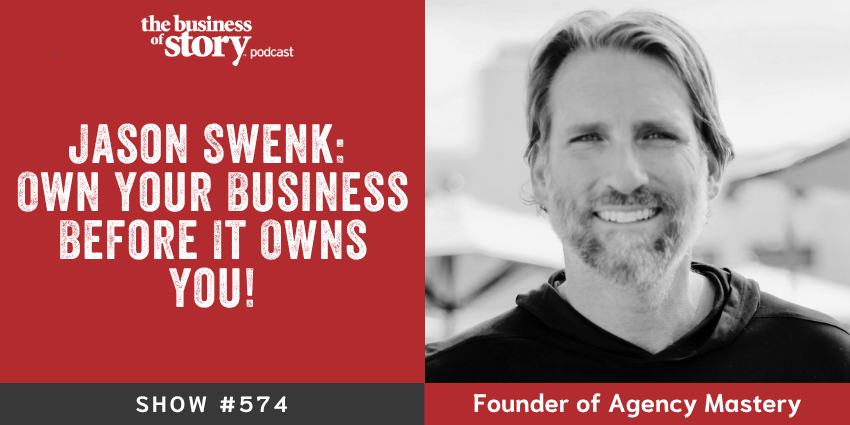
Jason Swenk has been in that trap, fought his way out, sold his agency to prove it, and spent the last decade teaching other founders how to follow that same path — at every stage of the climb. He joins me on this episode of the Business of Story to share the exact framework that changed everything.
What You Will Learn from Jason Swenk on the Business of Story
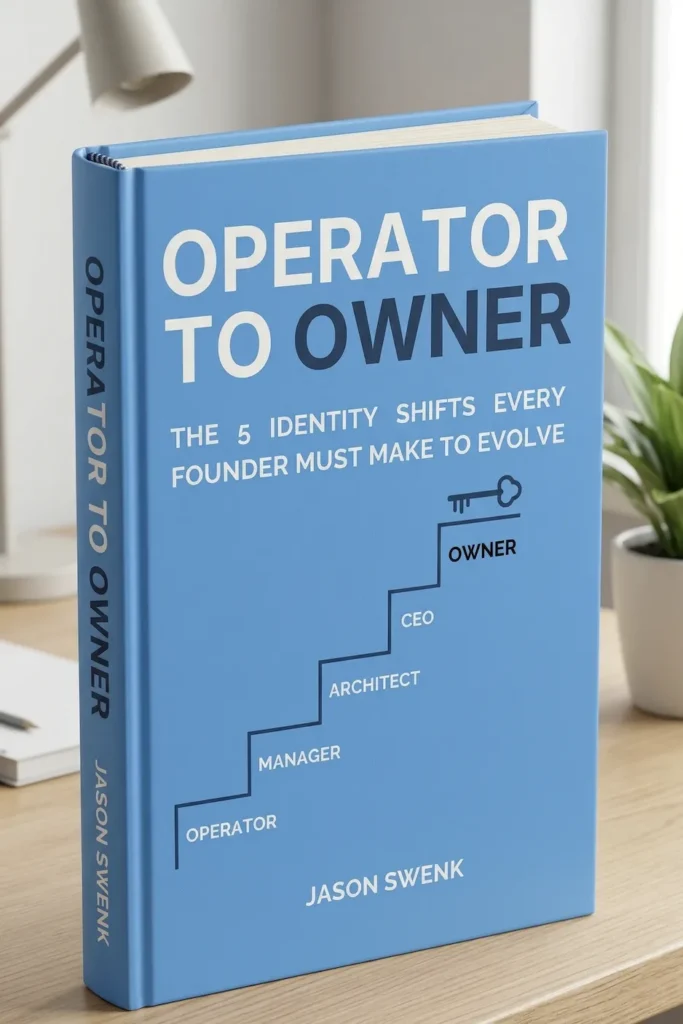 Jason Swenk is the founder of Agency Mastery 360, host of the Smart Agency Masterclass podcast, and author of Operator to Owner — the no-fluff manual for agency founders who are ready to stop working for their businesses and start owning them.
He built a digital agency that grew to over 100 people, surpassed eight figures in revenue, and landed clients including AT&T, Hitachi, and LegalZoom — all before he sold it and realized his entire identity had been the business itself.
Now he coaches 7- and 8-figure agency founders at Agency Mastery to make the identity shifts that most growth advice completely ignores.
What’s in it for You
- The 5-Stage Founder Evolution Framework — Operator, Manager, Architect, CEO, Owner — and which stage your identity is actually at right now
- Why chasing revenue milestones without evolving your leadership identity keeps you trapped, even at $10 million in revenue
- The 1-3-1 system that teaches your team to make decisions without you — and how to stop being the bottleneck in your own business
- The fist-on-paper circle exercise for identifying who you need to hire and what you need to let go of forever
- Why hesitation — not artificial intelligence — is the actual existential threat to your agency’s survival
Why Identity — Not Revenue — Is the Only Growth Metric That Matters
Most agency growth advice is built around revenue milestones: hit a million, hire your first team, hit five million, build a department structure, hit ten million, celebrate.
Jason Swenk has watched that model fail founders at every revenue level. He’s sat across from $10 million agency owners who are completely miserable — unprofitable, working every hour, living inside their own business with no exit in sight.
His framework is built around something entirely different: identity.
Every founder passes through five distinct stages, and each one requires you to let go of who you were in order to become who the business needs next. There is no shortcut, no cheat code, and no way to skip ahead. The boomerang will pull you back every time you try.
Stage one — Operator — is where almost every founder starts. You are the business. You do the sales, the creative, the operations, the client management. You created this thing because you wanted freedom, and instead it owns you completely. The advantage of this stage, Jason points out, is ignorance. You don’t know what you can’t do yet, which makes you dangerous.
Stage two — Manager — is where founders first taste real pain. You hire people to take work off your plate and discover you are now working a hundred hours a week instead of eighty. Managing people while still doing their jobs, second-guessing every delegation, watching tasks boomerang right back. This is where most founders think: maybe I should just do it myself. The secret Jason wishes he’d known? You have to hire people who can manage themselves.
Stage three — Architect — is the turning point. This is where you stop managing tasks and start designing systems. Jason’s 1-3-1 framework is the centerpiece: every employee who brings you a problem must also bring three possible solutions and one recommendation. Run that system consistently and your team stops bringing you problems altogether. They start bringing you decisions. Give them outcomes, not instructions. Point them toward London and let them steer.
Stage four — CEO — is the most psychologically brutal phase of the entire journey. You have done everything right. You have a leadership team. You walk into a marketing meeting and they say, “We’re good, Jason.” Creative? “We’re good.” And then it hits: the agency doesn’t need you. Founders who have tied their entire identity to being the hardest worker in the room will self-sabotage here. They will throw wrenches where there are no problems to solve, just to feel needed again. Everyone goes through it. The only variable is how long you stay.
Stage five — Owner — is where the business runs without you as an operational necessity. You’re accessible, not indispensable. Think Tony Robbins with a thousand companies. This is the destination.
The AI Evolution Every Agency Owner Cannot Afford to Miss
One of the most urgent conversations in this episode centers on artificial intelligence — and Jason’s take is as clarifying as his founder framework.
The internet didn’t kill traditional agencies in the early 2000s. Hesitation did. The agencies that thrived were the ones with nothing to protect and everything to gain from the new landscape.
AI is the same inflection point.
Jason identifies two specific unlocks that separate the agencies poised to win from those already falling behind: give AI outcomes, not tasks — and teach your team to create AI agents rather than simply handing them AI-generated output. The first unlock makes AI exponentially more useful. The second makes your team exponentially more capable. Stop giving fish. Teach your team to fish — with AI.
His bottom line: AI is no longer a competitive advantage. It’s a baseline requirement. If you’re not building it into your operations today, you’re not running in place. You’re falling behind.
Resources from This Episode
- Jason Swenk — jasonswenk.com — Agency coaching, the mastermind, and everything Jason
- Agency Mastery 360 — Jason’s community for 7- and 8-figure agency owners
- Operator to Owner — the book — Available on Audible (Jason’s voice, not AI’s) and in hardcover
- Founder Stage Assessment — operatortoowner-evolution.com — Free assessment to identify exactly which of the five stages your identity is at
- StoryCycle Genie — storycyclegenie.ai — Free Brand Story Grade to see what your brand narrative is costing you
Related Business of Story Episodes
- The Companies Winning the War for Talent Aren’t Telling Better Stories — They’re Telling Truer Ones, with Bryan Adams — Bryan Adams of HappyDance reveals why sanitized brand stories fail and his TRUTH Framework for employer storytelling that actually converts.
- What Happens When a Brand Decides to Make Its Own Business Model Obsolete? with Shawn David Nelson — Lovesac founder Shawn David Nelson shares how he built one of America’s fastest-growing furniture brands on a radical forever philosophy and a refusal to quit.
- The Agencies That Thrive With AI Will Project the Most Flexible Identity, with Marcus Sheridan — Marcus Sheridan, author of They Ask, You Answer, explains why identity fluidity is the single most powerful quality an agency can develop right now — and what it looks like in practice.
Jason Swenk’s Conversation With Park Howell on the Business of Story Podcast
How Jason’s “Epic Fridays” Rule Tests Whether You Own Your Business—or It Owns You
Park: Hello Jason, welcome to the show.
Jason: Hey, thanks for having me, Park.
Park: Nice having you here. You are just down the road from me, down I-40 out in beautiful Colorado.
Jason: Yeah, in Durango, so not too far. Kind of similar topography too.
Park: What’s your elevation there?
Jason: I’m at 8,000.
Park: Is the town itself at 8,000?
Jason: The town’s at 6,500.
Park: Okay, that’s where we’re at — 6,600 — but you must be up in the mountains a little bit.
Jason: Yeah, we’re away from people.
Park: I was watching one of your podcasts the other day and you were up on a mountain with a buddy. I think you call these your Epic Fridays — where you don’t work, you just go and do something epic.
Jason: Yep. It really started off as a test: did I really own this business, or does the business own me? Can I actually take Fridays off?
Then a buddy and I were like, let’s go do something epic. Let’s go climb a big mountain, jump off a cliff, go mountain bike down 13,000 feet — bucket list items. Because too many people just work their whole life, and when they get to a point where they can actually enjoy it, they’re not able to. We wanted to hit that thing early.
Park: I thought it was a fun place to have an interview. And the fact that you admitted you didn’t go all the way to the top — because it was a little questionable in one area and you both said you wanted to live to hike another day — that was very smart.
Jason: Yeah. Sometimes you can’t reach the mountain that particular time, but maybe in a month or two we’ll be able to go back and reach that peak.
The “Fighting Weight” Work Week: Jason Swenk’s 3-Day Schedule for Peak Business Productivity
Park: In another show I watched, you said you really got your work week truncated down — working Tuesday, Wednesday, Thursday. You keep Monday open for yourself, and then Friday of course for your Epic Fridays. How did you get there?
Jason: It took me a while to figure out, and I think everybody’s different. I relate it to a story about Charles Barkley when he got to the NBA. He wasn’t playing, and he went to a teammate who told him, “You’re fat and lazy.” So Charles started losing weight — 10 pounds, then another 10, repeat. He lost 50 pounds and played really well.
Then he did it one more time, lost too much weight, didn’t play as well. His teammate said, “Okay, you found your fighting weight.”
That’s how I look at my week: what is my fighting weight for my work schedule? If I work more or have more meetings outside those times, I’m overwhelmed and burned out. If I work less, I’m bored. Working Tuesdays through Thursdays for meetings keeps my mind on business — and that’s the curse of being an entrepreneur.
I look at my friends who work for airlines. They shut off the plane, they’re checked out. We don’t have that luxury.
Park: I know that feeling. I ran my agency for 20 years up to 2016, then pivoted to the Business of Story. We built our home up here in Northern Arizona, and the first year was still crazy — burning the midnight oil, making Starlink work, doing virtual training, still building the business.
Then I had an aha moment that first summer. I thought, let me try not working Monday mornings — just get my feet underneath me, do some work Monday afternoon, then work hard Tuesday through Thursday. Fridays I’d work a little in the morning and take the afternoon off for golf, hiking, whatever. It’s worked pretty well, although it’s really hard to make that shift. How did you do it?
Jason: Just gradually over time. Everything big — big shifts — take little movements over time. I maybe started with half a Friday off, then a full Friday, then half a Monday, then a full Monday.
The key is creating it as a rule — like a rule like gravity that you don’t break. Too many people set out a goal and don’t follow the rules, or their goals are set based on revenue rather than time. If you set a goal on revenue, you’ll break your time goal every time.
But if you set a goal based on “I only want to work Tuesdays through Thursdays,” you won’t break it.
Jason Swenk’s 5-Stage Founder Evolution Framework: Why Identity Shifts Matter More Than Revenue Milestones
Park: Today we’re going to explore this idea you’ve written a lot about and teach in the Agency Mastery 360 program: the five-stage evolution of every founder. And for all you listeners out there, you don’t have to be an ad agency for this to apply. If you’re a founder, you’ve built something great — and as Jason says, it may own you rather than you owning it.
So where do we start? How did you first come up with this whole evolution theory?
Jason: I had to look back at my career — how I started in the nineties designing websites and kind of falling into being a business owner with a team. I’ve always had side jobs: mowing yards, working on a bait boat, selling golf balls back to golfers who couldn’t find them because they should quit golf. I’ve always done those things, but I never had a true business until this point.
I started thinking about all the different identities I went through — because that’s what they are. And this applies to people who just work for a business too, because every one of us wants to evolve to something better, something more — significance, growth, contribution.
When I started, I was an accidental agency owner. I knew how to do something cool. Someone offered me money. I was off to the races.
Stage 1—Operator: How Jason Swenk Accidentally Built an 8-Figure Agency Serving AT&T, LegalZoom, and Hitachi
Park: Let’s talk about that for a second. You’re not just a web designer — there are a lot of web designers, that’s a commodity. Tell our audience about that first website you designed and how it launched you into becoming an accidental agency owner.
Jason: I owe all my success to Justin Timberlake — but I don’t know Justin Timberlake. One of my best friends looked like Justin, so we would get into bars and everyone thought he was him.
I took it up a notch. I created a fake band, fake website called InShit — making fun of NSYNC — with him as the feature and my three other friends. It was on a GeoCities web address, started getting shared, and people started asking me to design websites.
I started selling $500 websites to real estate agents, lawyers, boat marinas. I was off to the races.
Park: And then how did your agency grow from there?
Jason: I had it for 12 years. We grew to over eight figures, over 100 people, and were fortunate enough to sell it.
After I sold it, I was kind of depressed — my whole identity had been being the owner of the agency. Then my old competitors started reaching out: “How did you beat us for LegalZoom? How’d you land AT&T?” I started helping them out for free, and my wife said, “That should be your new career. You’re miserable right now — you’re just bored.” So we did that.
Park: So you’re this accidental agency owner, you grew from a funny website into a quite large and impressive agency over 12 years. How did you do it without a clear focus?
Jason: This is how little I knew: my first client asked me to send them an invoice. I didn’t know what an invoice was. And there was no Google, so I just had to figure it out.
When I started, I had ignorance on my side. Resourcefulness, creativeness — I didn’t have anything to protect. That made me a very dangerous person. I wasn’t afraid of failing.
I’d been fired from every single job I’d ever had. I wasn’t a quitter — I had to have people fire me. So I burned all my boats. All I could do was take the island.
For many years I was the operator — doing everything, all by myself. Sales, operations, creative, development. I created the business because I wanted more freedom, but it was actually the opposite. The business owned me.
I got to a point where I thought, I can’t operate this by myself anymore. I need to hire people.
Stage 2—Manager: Why Agency Owners Fall Into the 100-Hour Work Week Trap (and the Boomerang Hiring Effect)
Right before I started hiring people, I was working 80 hours a week and burning the midnight oil. So I thought, I’m going to evolve to Stage 2 — the manager. And then I was working 100 hours a week: doing my job, managing people, and doing their job.
Then I didn’t have to manage anybody. But what I realized is, in each of these stages, you have to go through all of them. There’s no cheat code.
The secret — if I could go back and tell myself — was that I had to have clarity of where I was actually going. I didn’t know who I wanted my clients to be. I didn’t know what services we should actually do. I was doing anything and everything coming at me.
The other thing I realized: I’m a really shitty manager. I’m still a shitty manager. And I think all of you listening who went through this, you’re shitty managers too. That doesn’t mean you don’t hire people — it means you have to hire people who can manage themselves.
Park: When I would bring in people to my agency at first, it was great — some extra muscle to help me through it. And then I’d wake up and go, “God, now I’ve got to spend time figuring out how to manage this person.” And then they’d just flail around going, “Dude, what do you want me to do? Throw me a bone.”
Jason: Yep. And it’s the cycle too. There’s a boomerang effect at every evolution through these identity shifts — it pulls you back. At the manager stage I’d think, “It was just more fun to do it by myself.” But really, I wasn’t the right manager for them. I didn’t give them direction. If I gave them direction, I’m the idiot. I look back at people I got rid of or that quit because I just wasn’t ready to lead them.
Stage 3—Architect: The 1-3-1 Framework for Building a Team That Makes Decisions Without You
Park: What’s the next stage?
Jason: Architect. This is where you really start designing systems and processes for your team to make decisions without you.
When you’re the manager, all decisions are coming through you. You’re the bottleneck, it gets overwhelming, and your team just waits.
The architect starts designing systems. One example: when an employee would come to me with a problem, I implemented a 1-3-1. What’s the problem? What are the three possible things you’re thinking about doing? What’s the one thing you recommend?
Do that enough and they’ll think, “He’s just going to do that anyway — I need to go make my own decision.” Then they start making decisions.
Another example: instead of telling a new salesperson “just go out and sell,” you give them a system. Here’s the revenue range of the agency owners to go after. You’re not selling everything we do — I want you to position and get meetings for a clarity call. It’s a free 30-minute call. Shadow me on that call, then I’ll shadow you. Once you pass that, move to the agency blueprint call — that’s a paid call — and do the same thing.
That’s a system they can follow.
The bigger shift is giving your team outcomes, not tasks. A manager says “go do these tasks.” An architect says “here’s the result I want.” Same thing with AI right now — a lot of people go to AI with tasks. Try giving it an outcome and see what comes back.
Stage 4—CEO: How to Navigate the Founder Identity Crisis When Your Business No Longer Needs You
Park: And what follows architect?
Jason: CEO. Even though a lot of people have this title, they’re not the CEO yet.
A true CEO is building the leadership team. You’re setting the vision and communicating it to the team often so they can make decisions. You’re coaching and mentoring your leadership team — your architects — so they can build systems for people to follow. And you’re only coaching them, not the whole team.
A lot of agency owners come to me with 10 to 20 people — that’s no man’s land. If you’re there, you’re still a manager, not an architect. People think they can never get to 50-plus people because there are only 24 hours in a day.
When I sold my agency, I was at the CEO level. The other CEO roles: being the face of the organization, allocating capital, steering the ship, and understanding the key financials.
When you get to the CEO stage, you’re working about 20 hours a week. And that’s where it really hits you in the mind.
I’d walk into a marketing meeting — “Nah, we’re good, Jason.” I’d walk into a creative meeting — “We’re good.” Then it hit me: the agency doesn’t need me anymore.
I actually started self-sabotaging — throwing wrenches in where they didn’t need to be, so I felt needed. Then I was depressed.
Everyone will go through that. Everyone listening who isn’t at that level yet is thinking, “I won’t be depressed.” Yes, you will. It just matters how long you stay there. You’ve built your whole career being the hardest worker, working around the clock. And the truth is: the business doesn’t need you for that.
Stage 5—Owner: What True Business Freedom Looks Like—Lessons from the Tony Robbins Model
Park: So I’ve got operator, manager, architect, CEO. Which one did I miss?
Jason: Owner is the last one.
This is where you’re basically on a board of advisors — maybe you’re the chairman. The business can operate without you. You’re not needed, but you have to be accessible.
Think about Tony Robbins. He has a thousand companies. You can only be an owner of several companies. You cannot be a CEO of a bunch of companies. I’ve only seen it done well once: Elon Musk. I don’t think he’s human. Tesla, Starlink, SpaceX — crazy.
The Fist-on-Paper Circle Exercise: A Proven Delegation Tool for Agency Owners Ready to Scale
Park: So say you’re an agency owner right now — or an owner of any company, because this applies to every industry. You’re that operator, working your ass off. You hire a few people, you’re managing them, learning by the seat of your pants. What do you recommend people find themselves in the operator-manager-architect range do to guide themselves forward?
Jason: The first part is understanding which stage your identity is actually at. A lot of people think their title tells them. They’ll say, “My title is CEO, so I’m at that stage.” Then they implement strategies for that stage, but they’re not there yet, so it’s irrelevant.
We have an assessment for this at operatortoowner-evolution.com. It’s free.
One exercise I share in the book: get a sheet of paper — 8.5 by 11 — put your fist on it, draw a circle around it just for the size. Spend 30 minutes writing down everything you never want to do again outside that circle — things you don’t like, things you’re not good at.
For me, that was project management, account management, sales — pretty much everything in an agency.
After 30 minutes, figure out what gives you energy. That list is a lot smaller and won’t take as long, because you just did the process of elimination.
Then figure out who you need to hire based on your weaknesses. Make sure they can manage themselves.
And give them a direction. One of the examples I use in the book: you’re sailing from New York to London over the Atlantic. You’ve been at the helm for 10 hours. You’re tired. You tell your team — except you haven’t told them where you’re going.
“If the boat changes course, come get me.” Then you go take a nap. They’re waking you up every second.
If you’d just said, “We’re going to London — that’s 240 degrees. If it drifts to 242, turn it back to 240” — that’s it. Very simple stuff we skip.
Park: How often did you find yourself assuming your people knew what you were thinking and where you were headed?
Jason: All the time. We have a thousand things going on in our heads at any moment.
In our mastermind we have some really big agencies, but they forget the basics. I played college tennis. I remember losing a match to a guy who had no business being on the court with me. My coach said: “Just go back to the basics. Watch the ball. Take your racket back early. Watch the ball. That’s it. Don’t worry about topspin or slicing. Watch the ball.”
Park: The basic blocking and tackling of tennis. Same thing on the golf course — start blowing up in the middle, and you go, “Oh, just go back to the basics. Slow everything down, shorten everything up, and relax.”
You’re in the fog of war when you’re running an agency or any company, and you lose sight of shore very quickly.
Jason: And sometimes I’ll give advice to a mastermind member and then think — am I still doing that? I’ll call my team: “Hey, that idea I told a member about? We need to start doing that again.”
Park: Do as I say, not as I do.
Jason: Yeah. We’re always chasing the new thing. That’s an issue.
Why Hesitation—Not AI—Is the Real Threat to Agency Survival (and How to Treat AI as a Requirement)
Park: What do you see happening with agencies and artificial intelligence? Writers feel like AI is identity theft — “I’m a writer, no bot can outwrite me.” Designers feel the same. Even strategists fear their identity being stolen by AI. Where do you come down on that?
Jason: I look at it as evolution. When I was 22 and started my agency in ’99, there were traditional agencies and print. There was no such thing as a digital strategist or web developer.
When digital marketing started really happening, the internet didn’t kill those traditional agencies. Hesitation did. They had something to protect. I had nothing to protect — so I was excited.
Right now 20% of agency owners are really excited about AI. The other 80% are scared. But hesitation will kill you, not AI.
I was on top of a mountain with my buddy about six months ago when I started really seeing what AI could do. I’ve built websites for Agency Mastery — event sites, the book website — in about 10 minutes. Sites I would have charged $40,000 and up for. But there still had to be a director.
The roles are changing and you have to evolve your role. Roles we’ve never even thought of are going to appear. But if you’re just a web design agency designing websites and you don’t evolve — you’re toast.
There will always be someone in the middle. That’s what agencies are — middlemen. Someone needed to sell ads, so they went to an ad agency. Car dealers are the middlemen between manufacturers and buyers. You have to keep evolving and getting better.
If you don’t, you’re replaceable.
Park: AI is a tool — a remarkable one. When I hear writers complaining they’ll never touch AI because it robs us of our soul — what about Photoshop? Photoshop made excellent photographers out of most of us, if you can show up with an eye, frame an image, and capture it. Maybe it’s a little overexposed, slightly out of focus, cropped wrong. You go into Photoshop and clean it up — beautiful picture.
Now you can take that same photo to ChatGPT. I’ve been doing it with old photos of my parents. I’ll say, “This one’s really out of focus — clean it up, give it a 1950s 35mm effect, add a little depth of field.” It does it. That’s incredible. But it couldn’t do it on its own. It needed me, my picture, my instruction. And I could never have cleaned that photo as well in Photoshop.
Jason: Yeah. You need a director.
I remember taking pictures with a disposable camera and having to drop the film off — you never knew how good the shot was.
Park: I went through 120 Kodak carousels of my father’s 35mm slides, from 1951 through about 2015 when he got Alzheimer’s. He catalogued everything — he did all the heavy lifting. Maybe 5% are worth keeping because they’re out of focus or weird. But some are amazing shots that were just slightly soft. I put them into AI, cleaned them up — now I’ve got these memories I could never have recovered on my own.
Jason: Since the dawn of time, people with better technology win. That’s all this is. From the ice age to the stone age to the bronze age to now.
Here are the two real unlocks to AI. First: tell AI the outcome you want, not the task.
Second: stop giving fish to your team. You’re out fishing, you keep giving them the fish — they’re never going to learn. They’ll just eat the fish. If you teach them how to create the AI agent themselves, that’s the real unlock. Show them they are not going to be replaced. This will enhance their job.
Start with your biggest bottleneck — for your role and your team’s roles. Start using AI for that first. And look — AI is not a competitive advantage anymore. It’s a requirement. If you’re not using it, you’re losing.
It changes every week. It probably just changed five minutes ago.
How Park Howell’s StoryCycle Genie Helps Agencies Score and Strengthen Their Brand Narrative
Park: I don’t know if you’ve had a chance to look at it — I sent you the brand assessment and narrative strategy we created using our StoryCycle Genie. Did you get a chance to look at it?
Jason: Briefly. I thought it was pretty spot on.
Park: The idea is it’s built by agency principles for agency professionals — plug it in immediately.
Three dozen experts working for you. You could apply it to your brand immediately. Apply it to that next pitch. Run their brand through it. Show up and say, “Here’s a baseline we can start on tomorrow if you hire us today.”
You don’t have to mess with generic AI at all.
Jason: Exactly.
Connect with Jason Swenk: The Operator to Owner Book, Agency Coaching Resources, and the Swank Day Mindset
Park: Well, thank you for being here. Where can people learn more about you?
Jason: You can go to jasonswenk.com — S-W-E-N-K — or just swenk.com. That’ll have links to the mastermind and the book. The book is out now on Audible — I recorded it myself, not some AI — and in hardcover. No fluff. Here’s where you’re at. Here’s what you need to go do. Go do it.
Park: You always close your show by saying “Have a swank day.” What do you mean by that?
Jason: Have a great day. I try to live every day to the max.
I heard something many years ago from an old timer: “Yesterday is history, today is a gift, tomorrow is a mystery.” I always try to do as best I can. And if I slack off at all, at the end of the day I think — I could have put a little more effort into that.
Park: Well then I’m going to go out and have a swank afternoon. Thank you so much for being here, man.
Jason: Thanks.
Frequently Asked Questions From This Business of Story Podcast Episode
Q: What is Jason Swenk’s Operator to Owner 5-Stage Founder Evolution Framework?
A: Jason Swenk’s 5-Stage Founder Evolution Framework tracks the identity shifts founders must make as they scale — not the revenue milestones they hit. The five stages are Operator, Manager, Architect, CEO, and Owner, and each requires the founder to consciously let go of a previous identity before the next stage is possible. Swenk introduced this model in his book Operator to Owner and discussed it in depth on Business of Story podcast episode #574. Unlike conventional business growth frameworks, this model treats psychological self-awareness — not headcount or annual revenue — as the engine of sustainable scaling.
Q: Does Your Business Own You, or Do You Own Your Business?
A: According to Jason Swenk, most founders are owned by their businesses — meaning the company cannot function for more than a few days without the founder’s direct involvement. The defining test is whether your business could operate for 30 days without you. Swenk’s “Epic Fridays” concept — structurally removing himself from work every Friday — was his first deliberate step toward reclaiming ownership and proving that the business could run on systems rather than his constant presence.
Q: What Is the “Fighting Weight” Work Week Jason Swenk Recommends for Founders?
A: Jason Swenk advocates for a “fighting weight” work week in which founders work only Tuesday, Wednesday, and Thursday — three focused, high-leverage days instead of filling every available hour. The concept is borrowed from athletics: a fighter performs best at optimal fighting weight, not maximum weight. Swenk argues that compressing your work week forces ruthless prioritization, stronger delegation systems, and a business structure capable of functioning without the founder on Mondays and Fridays — which is precisely the point.
Q: What Is the Operator Stage in Business, and How Do You Know You’re Stuck in It?
A: In Jason Swenk’s framework, Stage 1 — the Operator — is the accidental founder phase where the business runs entirely on the founder’s personal production. You’re trapped in the Operator stage when your business stops the moment you stop. Swenk notes that ignorance is actually a structural advantage in this stage: founders don’t yet know the risks they’re taking, which gives them the courage to burn the boats and launch. The danger is staying in Operator mode after the business outgrows it, which is where most founders stall permanently.
Q: What Is the Boomerang Effect in Business, and How Do You Break Out of It?
A: The boomerang effect, identified by Jason Swenk as the defining trap of Stage 2 (Manager), is when a founder delegates a task to a team member only to have it bounce straight back because the employee can’t complete it without the founder’s input. This forces founders into 100-hour work weeks — they’re managing people, not doing the work themselves, but they’re still the default decision-maker for everything. Swenk’s solution is to hire people who self-manage and to shift from assigning tasks to assigning outcomes, so team members own the result, not just the activity.
Q: What Is Jason Swenk’s 1-3-1 System, and How Does It Reduce Founder Dependency?
A: The 1-3-1 system is Jason Swenk’s delegation framework for Stage 3 Architects: team members must bring 1 problem, 3 possible solutions, and their 1 recommended solution before escalating to the founder. This structure eliminates the founder as the default problem-solver and trains the team to think critically before seeking approval. The 1-3-1 system is the operational backbone of Swenk’s “outcomes not tasks” philosophy — and consistent application of it is the primary prerequisite for a founder advancing to Stage 4 CEO.
Q: Why Do Entrepreneurs Experience an Identity Crisis When They Become CEO?
A: Jason Swenk explains that the Stage 4 CEO transition triggers the deepest identity crisis in a founder’s evolution because it demands they stop being the most capable person in the room and become the leader of people who are. Founders who have built their self-worth around being the best operator, best coder, or best account manager face profound psychological resistance to stepping back — and many self-sabotage by reverting to execution mode. Swenk describes the CEO stage as a 20-hour work week built around developing a leadership team that makes the founder structurally optional for daily decisions.
Q: How Do You Build a Business That Runs Without You as the Owner?
A: Stage 5 of Jason Swenk’s Operator to Owner framework — the Owner stage — is when the business generates revenue and growth independent of the founder’s daily involvement. Swenk cites Tony Robbins as a model: a business ecosystem so well systematized that it scales without requiring any single person’s presence. Reaching the Owner stage is the cumulative result of completing all five identity evolutions, building durable systems and leadership teams, and developing processes that replicate founder-level decision-making without the founder in the room. Founders can assess where they are in this evolution at operatortoowner-evolution.com.
Q: Is AI a Competitive Advantage or a Baseline Requirement for Digital Agencies Today?
A: According to Jason Swenk, AI is no longer a competitive advantage for digital agencies — it is now a baseline operational requirement, and hesitation about adopting it is an existential threat. Swenk identifies two critical AI unlocks for agency leaders: giving teams outcomes rather than tasks, and actively teaching team members to use AI tools rather than using AI to replace the team. His philosophy is “teach your team to fish with AI” — agencies that build AI-literate, AI-enabled teams will compound their capabilities, while those that wait will fall irreversibly behind.
Q: What Is the Fist-on-Paper Circle Exercise, and What Does It Reveal About Your Business?
A: The fist-on-paper circle exercise is a diagnostic tool Jason Swenk uses to help founders identify the single biggest constraint on their business’s growth. The founder traces their fist on paper to draw a circle, then spends 30 minutes listing everything outside the circle they never want to do again — revealing what drains them and what they need to hire out. This tool pairs with Swenk’s “sailing to London” analogy, which illustrates that most founders are working extraordinarily hard but have never set a clear destination. Together, these exercises surface the core distinction between effort and direction — two entirely different problems that demand entirely different solutions.
 Listen To More Episodes