Your Agency’s Most Valuable Asset Is the One You Keep Giving Away for Free
Why the Smartest Agency Owners Are Finally Treating Legal as a Growth Strategy
You want your agency to command premium fees, build lasting enterprise value, and stop competing on execution alone. The thinking and strategy you deliver every day is worth far more than the work you produce.
But most agency owners are unknowingly giving their most valuable intellectual property away in spec pitches. In vague client contracts. In freelancer agreements that hand over rights they never intended to transfer. And AI has quietly turned that costly habit into a legal emergency.
If you want to protect what you’ve built, profit from how you think, and walk away from your agency on your terms someday, this conversation with Sharon Toerek, you can’t afford to skip this conversation.
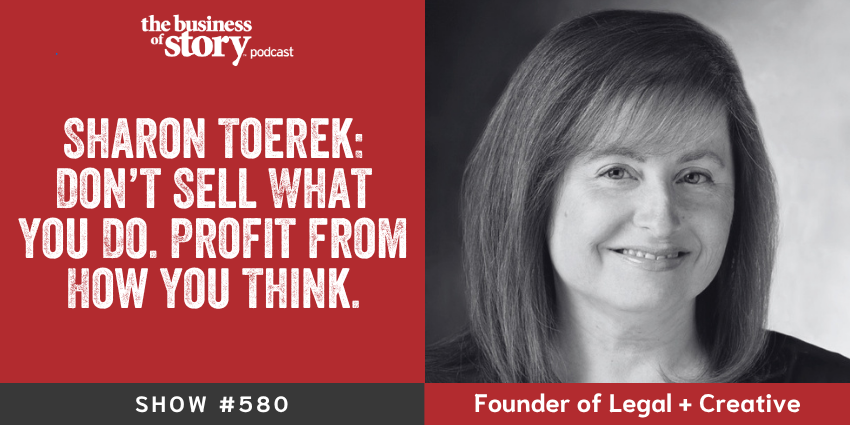
Sharon Toerek is the founder of Legal+Creative, a law firm dedicated exclusively to serving independent marketing agencies across the US, and host of The Innovative Agency podcast.
With a career built on intellectual property, trademark, and copyright law, she has spent over a decade helping agency owners see legal not as a cost center but as a competitive advantage.
Most agency owners think about legal the same way they think about insurance: necessary, boring, and only relevant when something breaks.
Sharon has spent over a decade proving that’s exactly backwards. She works exclusively with independent agencies, helping owners protect their IP, negotiate stronger contracts, and treat legal as a profit lever. This conversation will change how you think about your agency’s most overlooked growth driver.
What’s in it for You
- Why generic AI-generated content may legally belong to no one — not your agency, not your client, not anyone — and what that means for every deliverable you’re producing right now
- How feeding client data into generic AI tools is a hidden data privacy violation waiting to happen, and why most agencies are doing it without realizing it
- The single biggest mistake agencies make during new business pitches — and how to protect your IP before a prospect ever becomes a client
- Why your agency’s underlying methodologies, processes, and frameworks are protectable assets most owners are accidentally giving away in their client service agreements
- The five moves every agency must make now — from internal AI policies to errors and omissions insurance — to govern AI use, protect IP, and build an agency worth far more when it’s time to sell
The IP Problem Most Agency Owners Don’t See Until It’s Too Late
Here’s the painful irony Sharon surfaces early in our conversation: the agencies most at risk are often the most creative. They’re generating original thinking, proprietary frameworks, and breakthrough ideas every day — and handing them over without a second thought.
Spec work is the most visible version of this problem. Sharon isn’t arguing you should never do it. She’s arguing you need to be intentional about who owns it while you’re doing it. An NDA, a clear copyright position, a simple written understanding before the work begins — these aren’t bureaucratic hurdles. They’re the difference between owning your ideas and watching someone else build a business on them.
The same logic applies inside client agreements. Most agency contracts either blanket transfer everything as work for hire or fail to carve out the underlying methodologies and processes that actually belong to the agency. Your frameworks. Your proven approaches. Your proprietary way of solving problems. Those are yours. If your contract doesn’t say so, a client can reasonably claim otherwise.
What AI Has Changed — and Why Agencies Are Exposed
The Copyright Bombshell No One Is Talking About
The legal landscape around AI-generated content has shifted faster than most agency owners realize, and Sharon delivers one of the most clarifying explanations you’ll hear anywhere.
Under current copyright law and Copyright Office guidance, nothing completely generated out of generative AI is ownable. Not by the agency. Not by the freelancer. Not by the client. To the extent you can separate and document the human-created elements from the machine-generated ones, you can own the human contribution — but there is no magic percentage, no threshold that automatically protects you, and no shortcut around documentation.
For agencies producing AI-assisted work at scale, this changes the conversation with clients entirely. What are you actually transferring when you deliver a final asset? Who owns it? Can your client trademark it? These are questions your contracts need to answer before a project begins, not after a dispute arises.
The Data Privacy Risk Hiding in Plain Sight
The second major exposure Sharon identifies is one almost no agency is discussing with clients: data privacy.
Every time an agency feeds proprietary client information — customer data, campaign strategy, targeting lists, competitive intelligence — into a generic AI platform, they may be breaching their confidentiality obligations and potentially violating the data privacy rights of third parties. Not intentionally. Not maliciously. Simply because the policy conversation never happened.
Sharon’s point is direct: agencies need both an internal AI policy that governs which tools are approved and how data can be used, and an external-facing policy they share with clients that surfaces these questions before they become liabilities. Most agencies have neither.
The Five Moves That Protect and Grow Your Agency
Sharon closes the conversation with a practical framework any agency can begin implementing now:
- Internal AI policy: Document approved tools, use cases, and data input rules
- External AI policy: Share your AI governance stance with clients and build it into your MSA
- Read the terms: Know what the major AI platforms actually say about IP ownership and indemnification
- Train your team: Make AI risk a recurring internal conversation, not a one-time memo
- Review your insurance stack: General liability, errors and omissions, and cyber coverage together form your best risk management architecture
The Bigger Shift — From Doing to Thinking
What ties all of this together is a fundamental shift in how agencies need to think about their business model. The agencies that will thrive are the ones that stop competing on execution — where AI is rapidly commoditizing the output — and start commanding premium fees for the thinking, the strategy, the governance, and the proprietary methodology that no tool can replicate.
Recent industry research cited in our conversation shows that 52% of brands want agency help not just with strategy but with AI governance across their organizations. That’s not a threat to agencies. That’s a new line of revenue for the ones paying attention.
As Sharon puts it: AI is calling the question on what agencies should have been selling all along.
Because what goes on between your ears is your most valuable and protectable asset.
Links
- legalandcreative.com
- The Innovative Agency Podcast
- Sharon Toerek on LinkedIn
- Craft your vibrant brand story with the StoryCycle Genie®
Deepen Your Agency Storytelling Mastery: Three Essential Episodes
To amplify your transformation from today’s conversation, these carefully selected past episodes provide complementary wisdom for agency owners navigating growth, AI, and business model evolution.
You Built It for Freedom. So Why Does It Feel Like a Prison? With Jason Swenk — Jason Swenk’s five-stage founder evolution framework reveals exactly why so many agency owners feel trapped by the business they built — and the identity shifts required to own it instead of being owned by it.
State of Storytelling 2026 Proves Brand Narrative Is Finally a Business Discipline with Elliott Rayner — Elliott Rayner’s landmark research shows that 81% of brand touchpoints are delivered without a shared story underneath them, making the case for why agencies that govern narrative will command the fees Sharon describes.
Stop Pushing. Start Finding the Buyers Who Are Already Sold on You. With Rob Snyder — Rob Snyder’s PULL framework shows how agencies can stop chasing the wrong clients and start attracting the ones already ready to pay for strategic thinking — the exact shift Sharon argues is the future of the agency business model.
Sharon Toerek’s Conversation With Park Howell on The Business of Story Podcast
Sharon Toerek Transcript — Don’t Sell What You Do. Profit from How You Think
Sharon Toerek’s Origin Story: How She Built the Go-To Law Firm for Marketing Agencies
Park: Hello Sharon, welcome to the show.
Sharon: Hey Park, thanks for having me. I’m looking forward to it.
Park: Great to have you here. We just had a chat about a week ago on your podcast, so thanks for having me over there. Can’t wait to be sharing both of these shows with our respective audiences.
Today we’re going to dive in and talk about the AI world in agencies — because you do a lot of work with ad agencies and marketing consulting firms around the world, and what you are seeing with the legal ramifications of it.
We’re also going to talk about some opportunities that agencies have to use your services around thinking IP, protecting that IP, and what it could mean to them for additional lines of revenue.
Let me ask you — why don’t you give us a quick backstory about how you found yourself in this niche of working with agencies in the IP and legal world.
Sharon: Yeah. I never expected to have a law firm focused on serving marketing agencies, but I started my career and got a lot of high-quality and deep training in intellectual property law — a lot of trademark and copyright work.
That eventually led me into doing a lot of work directly with marketers who had a lot of IP-related issues, and who still do on a day-to-day basis.
Over time I built a silo within a more general practice law firm, serving marketing services firms because they had a lot of IP issues, a lot of contract issues, and regulatory issues. And I really fell in love with the industry — having a front row seat to the creativity and the imagination and the business problems they were solving.
About a dozen years ago I founded my current firm, Legal and Creative, to serve independent marketing agencies across the US. That’s the fast story about how I got from law school to where I am today.
Why IP Protection Is Not a Set-It-and-Forget-It Strategy — and What Ongoing Vigilance Really Costs You
Park: I ran my own ad agency, Park and Co, for 20 years. I learned a lot about the IP world working with some really smart IP attorneys. That helped not only protect our agency but also helped us create products we could then license — campaigns we could then license out throughout the world.
One of the things that really woke me up: it’s one thing to protect IP, maybe a trademark or a logo. But you have to then vigorously protect it. If someone goes out and takes your mark and you do nothing about it, or they take something you’ve copyrighted and you do nothing, then you actually lose the ability to protect that IP. Can you talk a little about that?
Sharon: Yeah. It’s not a set-and-forget strategy. The beauty of IP is what it can do on the top side of your business. The dues you pay along the way are not only vetting it before you adopt it — making sure you’re not conflicting with anybody else’s IP — but then taking the measures to protect it and monetizing it appropriately.
That maintains the legal integrity of it while also giving you marketability and revenue-earning potential. It’s an exercise that never really ends, because you have to remain vigilant.
If you’re not vigilant about protecting your intellectual property and you don’t monetize it the correct way, you can eventually lose your rights over time — which sort of defeats the purpose of investing in developing it.
Park: I’ve heard people that have spent $10,000 on patents and then told me: the real expense wasn’t getting the patent, it was protecting it.
Sharon: Yes, and another scenario agencies frequently find themselves in is new business development. The table stakes are frequently displaying some of your ideation in tangible form — storyboards, now videos, software programs, whatever it might be.
Not having a written understanding in place with your potential new client before they’re actually a client puts the use of that IP at risk. And discovering infringements along the way and not taking prompt action — or treating one person differently than another — those are real vulnerabilities. You’ve got to be consistent and stalwart about protecting.
The Biggest IP Mistakes Marketing Agencies Make with Spec Work, Client Agreements, and Freelancer Contracts
Park: What are some of the big mistakes agencies are making right now by either not protecting their IP or not leveraging it for business growth?
Sharon: I love this question. The number one mistake I see is around new business. There’s this ongoing, raging debate that’s never going to get resolved about whether agencies should ever do spec work or create sample assets in the business development process.
I think it’s the wrong question. The real question is one of intentionality — are you protecting and preserving your ownership stake in the work you’re creating while you go through that gauntlet?
You do that with written NDAs, with copyright, and other mechanisms. But not doing that is the number one mistake.
The second mistake is not adequately addressing IP rights in their agency services agreements with clients. They’re either blanket giving away work as work for hire, or they’re failing to exclude from the IP transfer the work that should remain the agency’s.
A lot of agencies have underlying methodologies or processes that get reflected in deliverables but belong to the agency. They don’t protect those things in their agreement. They don’t carve out a portfolio display right — the ability to display examples of the work for future business development. And they don’t protect themselves in independent contractor relationships.
Every agency works with freelancers at some stage. You don’t own the rights to the work those people do for you unless you have a properly prepared agreement that puts those rights in your hands.
On the missed monetization side: agencies fail to take a holistic approach to packaging their IP in a way that might present an opportunity to earn an additional stream of revenue.
If you’ve developed a methodology around brand development or PR strategy, you could develop a course. You could develop an online learning academy. You could develop assets and workbooks. I’ve had agencies develop entire training divisions.
Failing to protect it along the way also means that when you go to sell the agency you have fewer options. You might be able to peel the IP off and keep it while selling the rest. You might be able to sell it all together for a higher multiple. Or you might want to keep the agency and sell the IP. Failure to protect limits your options and shortchanges you on what your business is worth as a whole.
The Spec Work Debate Resolved: Why Showing Up with Spec Strategy — Not Spec Creative — Wins the Client and Protects Your IP
Park: In the 20 years I ran Park and Co, I hated spec work. We don’t know enough about the business. We’re showing up with a dog-and-pony show of creativity — isn’t this clever? — and it’s ridiculous for a prospect to ask that. It’s costly, takes a lot of time, and doesn’t demonstrate anything more than what the portfolio already shows.
Sharon: I have an obvious opinion from a pure IP point of view, but this debate has been raging for years. At a very prominent business development conference there was an actual panel on pro and anti-spec work, and there were as many arguments for doing it as against. I think it’s a personal choice for each agency — but it’s never going to go away for the industry.
Park: Here’s what I would do instead. I’m going to take a page out of my dad’s playbook. My dad was a civil engineer who ran a heavy construction company out of Seattle — Constructors PANCO. They specialized in tunneling, repairing and building dams.
One year, circa 1980, they were bidding on a flume — a canal that ran alongside a hillside in Eastern Washington that took irrigation water to the apple, peach, and cherry orchards of the Cashmere Valley. The problem was avalanches and rock slides kept wiping out sections of the flume.
The bid was to rebuild it in concrete. But my dad looked at one long section and thought: why build a concrete flume that could still get washed out? Let’s bore a tunnel through the mountainside. You’ll never have to worry about it again.
It did cost more. But they said, you will never ever have to replace this again. They got the business, and it was highly profitable simply because he saw a different solution.
So the next time you’re asked for spec work — instead of showing up with spec creative, take your StoryCycle Genie, run the prospect’s brand through everything you know from their website and any other intel, and show up with a spec narrative strategy that outlines everything they need to do in the next two years to own and dominate their market.
Instead of spec creative — stories about a brand you don’t know enough about — show up with spec strategy that is way more on-brand, way more useful, and blows the minds of your competition who spent a fortune on boards.
Sharon: I think strategy has been so undervalued. And the way AI is slamming into agency business models now means we’re rethinking that — rethinking the entire monetization model of an agency, from being compensated for the doing and the producing to being compensated for the thinking and the strategy.
I hope we’re making a healthy move in that direction. I’m encouraged. As an IP nerd, I’m here for it — because I think this is what agencies should have been doing all along. And now AI is calling the question.
How AI Is Forcing Marketing Agencies to Shift from Doing to Strategic Thinking — and Why That’s the More Profitable Model
Park: That leads us to a whole new opportunity for agencies: brand story governance, or what we call story ops. An agency has to be strategic — figure out where the brand sits, what’s the future vision, how to attack the problem. Then creativity. Then governance.
The agency could come in and say, let’s make sure everybody across the enterprise understands and embraces the story and how to tell it from their own unique point of view. That could be an enormous opportunity for agencies.
Sharon: A lot, yes. There’s new research from Agency Audit and Agency Management Institute — and the number that came back was 52%. That’s the percentage of brands who said they wanted assistance not only with strategy, but with governance around AI and how it fits into the organization.
That was a huge surprise to me — that as many brands as that admitted that need and, really, handed it to agencies with a bow around it as an opportunity. They want this.
Park: And agencies aren’t moving on it. Drew’s research shows everybody knows what they need to do, but only 20% of agencies are actually doing it. The rest seem paralyzed in this AI funk.
Sharon: Some of it is fear. Some of it is that a lot of transformational change came simultaneously — economic, geopolitical, technological. I think that’s driving the M&A market to be as volatile as it is right now for small agencies. Five years ago I didn’t see as much deal volume for agencies getting ready to transition and sell. Some owners just aren’t interested in version 3.5 of whatever this is.
Park: But the value of that agency is going down by the day if they haven’t embraced AI and demonstrated to a buyer they are on the cutting, bleeding edge.
Sharon: I’m hoping we’re getting past the point of panic to the point of acceptance — operationalizing these tools and figuring out how to use them strategically and proactively to distinguish yourself, either through product development or through optimization of work you already do really well.
The only way through a fire is through it. These agencies just have to continue to walk as quickly as they can through the fire of change.
Who Legally Owns AI-Generated Content? Why Work Created Entirely by AI Has No Copyright Protection
Park: What do agencies have to worry about relative to AI and potentially trampling on someone else’s IP? If they’re using generic AI and pulling from something already protected — what kind of exposure is there?
Sharon: That’s one of the two primary areas of legal jeopardy for agencies. The second is data privacy, which we’ll get to.
When it comes to AI, there are a couple of IP issues. First — who owns the end product? And is it even ownable?
If content is strictly generated out of AI, it’s not ownable by anybody. Not by the agency. Not by the freelancer. Not by the brand. That is sometimes uncomfortable for brands.
Park: Let’s stop there, because that’s news to me. Say I’m hired to write a video script. I use ChatGPT or Claude to do some research and write a draft. Then I come in as the chief copy editor, tweak it, make sure it’s in the client’s voice, and present it. They can’t own it. I can’t own it. Is that what I’m hearing?
Sharon: What I mean is that anything entirely generated out of AI is not ownable. The ownability depends on the extent to which humans actually added to it, edited it, changed it.
Park: And the only way to prove that is to copy the chat you used and say: AI created the first draft after I gave it my input, but then I revised it by 50%.
Sharon: Yes. And there’s no magic percentage number — I get that question a lot. What’s the percentage we have to change it? There is no number.
What the Copyright Office says and what current copyright case law says is that nothing completely generated out of generative AI is ownable. Nothing machine-created is ownable.
To the extent you can separate out the human-created aspects from the machine-generated portions, you can own the human-created portion. So if the illustrations were human-created but the script was generated out of AI — or vice versa — to the extent you can trace a part of the works exclusively to human creation, you can own that.
But most agencies are mashing the two together on the regular. All you can do is document the iteration process, document the before and after, and be in a position to know where the human contributions to the final product lie.
The Hidden Data Privacy Risk Agencies Face When Feeding Client Information into Generic AI Tools
Park: Wow. So that leads me to a question about our StoryCycle Genie — built on our IP, the Story Cycle System guides it, it uses API calls out to Claude and others, but it only works if you as the human being are working with it. And it sits on our Brightsy platform — not in the general AI world. Everything is built within this fortress. We call it story sovereignty.
Everything you create there is sovereign to you. You own it. You always have access to it. Would that overcome these copyright issues that don’t hold up well when you’re using general AI?
Sharon: It’s a closed system. As between you and the client using it — if you’re in agreement about who owns it — you own your underlying technology, the client owns the deliverable output. As between the two of you and the rest of the world: if you haven’t used an open system, if you haven’t duplicated the intellectual property of any third party, there’s probably very low to no risk of any third party having a claim.
The tighter and more closed the system, the tighter the inputs, the more targeted the output, the lower the risk. I’m never going to say no risk, because every lawyer will tell you it depends. But yes — that is a very tight, low-risk scenario.
Park: And that would go back to traditional agency-client relationships — work for hire, the client owns everything the agency produces, as long as they’ve been paid.
Sharon: Typically, if that’s what they agree. And remember — the way copyright law works, if you use any third parties to create the deliverable, you’ve got to have alignment in your contracts with those parties on IP rights. You can’t convey to the client what you didn’t own in the first place.
Park: So let’s talk about that other side — data privacy.
Sharon: I think this is under-discussed, and it’s the number two area of legal risk for agencies when using AI.
When you are using an AI platform and feeding into it any information that is proprietary to a client — and especially any information that might constitute data of a third party, like customers, prospects, targeted customers — you are not only in jeopardy of breaching your confidentiality obligations to the client, but potentially violating the data privacy rights of third parties.
This is always unintentional. It comes up when we’re using the wrong version of the tool — a version that allows training. Or letting freelancers work on the project and they’re using the free versions of the tools at home, and we don’t even realize it because we didn’t ask the question.
It gets down to having insufficient policies and practices in place. It gets down to having relevant language in the agency-client agreement: we use these tools, client acknowledge that. You abide by confidentiality provisions, but also have crucial conversations with clients: what are your AI policies? What tools do you prohibit us from using? What use cases do you not want us using AI for? Which information that you’ve provided are we allowed to feed into AI?
And by the way — which data you’re giving to us was AI-generated in the first place? We’re not thinking about that. But it’s using information in a way that could cause agencies to breach their privacy promises and their confidentiality obligations. I don’t think agencies are thinking about that often enough.
Park: It sounds like AI has opened a whole new can of worms. You get an assignment, the client gives you the intel you need, you’re working with Claude or whatever, you give it that intel to help create a strategy — and you have just inadvertently exposed yourself by giving away a client’s information to the world.
Sharon: Exactly. And it’s always unintentional — the result of inadequate training, inadequate policy-making, and not socializing those policies within the agency. Some agencies don’t want to have the conversation because they don’t want to create alarm, or they don’t want to answer too many questions about time savings or the originality of the work product.
But they’re avoiding a huge opportunity to educate their clients. Because a lot of times the counterparts at the brand aren’t thinking these issues through either — it’s not their day-to-day job. So they’re not having the conversations. And I think that’s one of the primary risk areas agencies face.
What Is a Closed AI System — and Why Purpose-Built Platforms Protect Your Agency’s IP Sovereignty Better Than Generic Tools
Park: I had a Genie user reach out to me just the other day — an agency that does a lot of work with large associations. He asked: if I put in a customer list inside the Genie, is it protected?
I told him: yes, you’re the only one who can see it. The only other person who can see it is me if you gave me permission to look at your account because you’re having a challenge with something. It’s locked down.
He then asked: if I provide the Genie with the intel my customer gave me about a direct mail campaign, can anybody else access it?
I said no. It resides in your account. Gen AI can’t get to it. Nobody else can see it but you.
Sharon: I’m gratified and fortified to hear that the agency owner was asking those questions. Because not everybody would — or if he had delegated that to someone on his team who wasn’t thinking at the big picture level, that might have been an opportunity missed.
Five IP Protection Moves Every Marketing Agency Must Make Right Now — Policies, Contracts, Training, and Insurance
Park: What have we not covered that an agency principal really needs to pay attention to, especially in this age of AI?
Sharon: I have five basic things that every agency can get along the pathway to making.
First — policy development. Have an internal AI policy about approved use cases, the tools you’re using, who approves adding new tools, who troubleshoots, what information can be input into these things. The human guardrails. Assign a responsibility for discussing AI with the client. And have an external-facing policy you’d share with clients and third-party vendors: what are your AI policies we need to be aware of? What information are you providing that is AI-generated? What use cases do you absolutely not want us using AI for?
Item one: internal AI policy and external-facing AI policy.
Park: Where does an agency get guidance on what makes the best internal and external-facing AI policy?
Sharon: They can contact us — we have an AI agency legal toolkit that has all of this in it. But you don’t need to get it from us. You can start on your own. Make a checklist of the things you think need to be in your AI policy and start drafting.
Number two: relevant contract provisions in your master service agreement with clients and in your independent contractor agreements around AI usage. The biggest thing you want to extract from your client is their acknowledgment that you are using AI. And if you want to really add one plus one and equal five, take your external policy and make it an attachment or addendum to your MSA.
Number three: read the terms and conditions of the major AI platforms you regularly use. Understand what they say about liability, IP ownership, indemnification. Spoiler: they’re not going to indemnify you for anything. But you should know who’s responsible for what.
Number four: internal training. Regularly convene as a team to talk about the tools you’re using, real-life use cases and issues that have arisen, legal or news updates. This is a fast-moving target. Things that are true now may not be true nine months from now.
Number five: look at your insurance stack. In addition to all the practical and legal things, risk management comes in many forms. Good general liability insurance, good errors and omissions insurance, and good cyber insurance. There’s no AI-specific coverage right now, but having these three knit together is the best belt-and-suspenders approach you can take for limiting your liability exposure when you’re using AI to do your agency’s work.
Park: If I were still running Park and Co today, would I have to look at my errors and omissions anew through the lens of AI?
Sharon: I think it could work to the extent it’s the kind of claim traditional ENO would cover — like unintentional copyright infringement or accidental trademark infringement. But it’s not going to cover anything specifically hinged on using AI. Expect carriers to fight back hard on it. The best you can do is stack the coverage reasonably: general liability, errors and omissions, and cyber liability together form your best web — along with good contract language and the other things we talked about.
Park: It really has opened up a whole new can of worms for agency principals to get their head around — this evolution that is really a revolution, changing the dance floor on how agencies work with clients and how to protect themselves from inadvertent copyright damage.
Sharon: I always talk about the balance of opportunity with risk whenever I talk about AI to agencies. I see a tremendous amount of opportunity. I think the changes it’s going to bring to agency business models are a net positive for most of the agency community.
But you have to balance it against these real-life risks. And the problem is the technology is always going to move faster than business, and both of those things are always going to move faster than the law. So there are always going to be some unknowns from a legal perspective.
Park: I am optimistic. I’ve been in the advertising and agency world for 40-plus years. The very first technological evolution I saw was the fax machine. What? We can send this through telephone lines? And I see nothing but upside for what an agency can do with AI when they use it as artful intelligence, not artificial intelligence.
I think it creates all new lines of business for agencies through story governance. If you are out pitching business, you have like a 20 to 24% chance of getting it — about one in four. But I think you could double, if not triple, your win rate if you use AI right. Don’t go in with spec creative. Go in with spec strategy.
If I were still running Park and Co, that would be a dream come true.
Sharon: There has to be discernment and taste in the mix — which has always been a hallmark of a good, successful agency. And there has to be openness to the abundance. That takes an abundance mindset — and that’s what’s between the ears of the individual running the agency.
You cannot manufacture that with an LLM. That’s got to be your belief, verified with the numbers and the technology. I see a lot of opportunity here. I’m here for the change that this is going to force on agencies to think more critically about the value of the thinking they do.
It moves economies. It moves cultures. It creates social change. And you should be building your business models with that mindset.
Park: Think outside the bot. I had a boss when I was a young copywriter — also an account guy, also a strategy guy, as you do at small agencies — and one time we were coming back from a client meeting and apparently I wasn’t listening very well. I was eager to jump in and share my ideas without really hearing the whole customer input. He called me on it.
I felt horrible. He said the best line: you always have to remember, Park, that our clients pay for what’s going on between our ears. So we have to use them.
Sharon: A hundred percent. He was right. I love it. That’s very wise advice.
Park: Sharon, this has been awesome. Where can people learn more about you and your services?
Sharon: Thank you for having me — I’m excited about our crossover episodes. We are legalandcreative.com. You can reach out there and learn more about our agency toolkit on AI. You can come to The Innovative Agency podcast. And I’m very active on LinkedIn — Sharon Toerek, T-O-E-R-E-K.
Park: Awesome, and we’ll have all those links in the show notes. Sharon, thanks again. I really appreciate your time and your insights. I learned a lot today.
Sharon: Thank you, Park. It was a pleasure to be here.
Q: How Do Marketing Agencies Build a Legal Strategy That Actually Protects Their Most Valuable Assets?
A: Most agencies treat legal as a reactive expense rather than a proactive growth strategy. According to IP attorney Sharon Toerek, founder of Legal+Creative, the most effective approach involves three layers: vetting your IP before you put it into the world to ensure you’re not conflicting with existing marks, actively protecting it through written agreements and consistent enforcement, and monetizing it in ways that maintain its legal integrity. Agencies that treat IP protection as an ongoing discipline — rather than a one-time filing — are the ones that command higher valuations at exit and create additional revenue streams through licensing, courses, and training programs.
Q: Is IP Protection a One-Time Thing or Does My Agency Need to Actively Manage It?
A: IP protection is emphatically not a set-it-and-forget-it strategy. Filing a trademark or registering a copyright is only the beginning. Agencies must remain vigilant about enforcing their rights consistently — treating all infringers the same way — and monetizing their IP through proper channels. Inconsistent enforcement, failure to have written agreements in place before sharing ideas with prospective clients, and not carving out proprietary methodologies in client service agreements are among the most common ways agencies unknowingly lose the rights they thought they had secured.
Q: What Are the Most Common Ways Marketing Agencies Unknowingly Give Away Their Intellectual Property?
A: Sharon Toerek identifies three primary ways agencies inadvertently surrender their IP. First, sharing speculative creative work during the new business process without a written NDA or copyright protection in place. Second, using agency-client service agreements that either blanket-transfer all work as work for hire or fail to carve out the agency’s underlying methodologies, processes, and portfolio display rights. Third, working with freelancers without properly prepared independent contractor agreements that transfer IP ownership to the agency — meaning the agency cannot legally convey those rights to the client, even after being paid.
Q: Can a Marketing Agency Make Passive Income from Its Intellectual Property Without Taking On More Client Work?
A: Yes — and it’s one of the most underutilized revenue opportunities in the agency industry. Agencies that have developed proprietary methodologies, frameworks, or strategic processes can package those assets into online courses, workbooks, learning academies, or full training divisions. Sharon Toerek has worked with agencies that have built entire training businesses around their core intellectual property. Beyond passive income, properly protected and packaged IP also increases agency valuation at exit, giving owners the option to sell the IP separately, bundle it for a higher multiple, or retain it while selling the agency operations.
Q: Should My Agency Do Spec Work to Win New Business, or Is There a Better Way?
A: The spec work debate may never be fully resolved, but there is a more strategic alternative. Rather than showing up with speculative creative — work created for a brand you don’t yet know well enough — consider showing up with speculative strategy instead. Using tools like the StoryCycle Genie to run a prospect’s brand through a narrative analysis, you can present a strategic roadmap for how they could own and dominate their market over the next two years. This approach is more on-brand, more useful to the prospect, and far more differentiating than a creative presentation that looks similar to every other agency in the pitch.
Q: How Is Artificial Intelligence Changing the Way Marketing Agencies Make Money and Stay Competitive?
A: AI is forcing a fundamental shift in the agency business model — from being compensated for execution and production to being compensated for thinking and strategy. Research from Agency Audit and the Agency Management Institute shows that 52% of brands want agency help not just with strategy but with AI governance across their organizations. Agencies that embrace this shift and position themselves as strategic and governance partners — rather than purely executional vendors — are opening entirely new revenue lines. Those that remain paralyzed are watching their enterprise value decline as AI commoditizes the execution work that once justified their fees.
Q: If AI Wrote My Content, Do I Own the Copyright?
A: No — not if AI generated it entirely. Under current U.S. Copyright Office guidance and copyright case law, nothing completely generated by generative AI is legally ownable by anyone. Not the agency, not the freelancer, not the client. However, to the extent that human creative contribution can be separated from the machine-generated output and documented, the human-created portions can be owned. There is no minimum percentage threshold that triggers ownership — the key is being able to identify and document where human creative contribution begins and ends. Agencies producing AI-assisted work should document their iteration process carefully to establish and protect their human contribution.
Q: What Are the Legal Risks of Using ChatGPT or Other AI Tools with Confidential Client Data?
A: Feeding proprietary client information — including customer data, targeting lists, campaign strategy, or competitive intelligence — into a generic AI platform creates two categories of risk. First, it may breach the confidentiality obligations the agency owes to the client under their service agreement. Second, if the data includes information about third parties such as customers or prospects, using it in an AI platform may violate those individuals’ data privacy rights. These violations are almost always unintentional, often resulting from using a version of an AI tool that allows model training, or from freelancers using free versions of tools on their own devices without agency oversight.
Q: What Is the Difference Between a Closed AI System and a General AI Tool, and Why Does It Matter for My Agency?
A: A closed AI system is a purpose-built platform where data entered by users stays within the system — it cannot be accessed by outside parties, does not contribute to general AI model training, and remains sovereign to the user. A general AI tool like the publicly available versions of ChatGPT or Claude may use inputs to inform model training and does not provide the same data isolation. For agencies, this distinction matters enormously: using a closed system like the StoryCycle Genie to work with client data significantly reduces the risk of data privacy violations and confidentiality breaches. The tighter and more closed the system, and the more targeted the inputs and outputs, the lower the legal risk to the agency.
Q: What Are the Most Important Legal and IP Steps a Marketing Agency Should Take Before Selling or Exiting the Business?
A: Sharon Toerek identifies protecting and packaging intellectual property as one of the most commonly overlooked steps in agency exit planning. Agencies that have identified, documented, and legally protected their proprietary methodologies, frameworks, and processes before going to market have significantly more options at exit: they can sell the IP bundled with the agency for a higher valuation multiple, peel the IP off and retain it while selling the agency operations, or sell the IP independently. Agencies that have not taken these steps limit their options and frequently undervalue their business. The time to build your IP portfolio is long before you plan to sell — making ongoing IP protection an investment in future exit value as much as a current legal safeguard.
 Listen To More Episodes