Stop Pushing. Start Finding the Buyers Who Are Already Sold on You.
The One Shift That Separates Struggling Founders From Founders Who Scale
You’ve built something genuinely great. You’ve done the research, built the pitch, run the demos, and followed every best practice in the playbook.
But prospects keep disappearing. Sales cycles drag. You’re pouring energy into conversations that go nowhere — and you can’t figure out why.
Here’s the hard truth: the problem isn’t your product. It’s that you’re pushing it onto people who aren’t ready to pull.
The moment you stop trying to convince the wrong people and start finding the ones who are already sold — everything changes. Sales cycles shrink. Deals close without a fight. And the product practically sells itself.
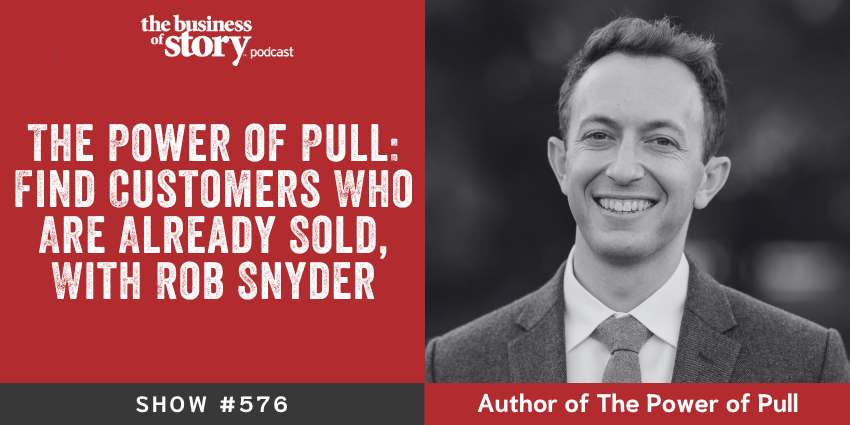
That’s the transformative power of the PULL framework. And in episode 576 of the Business of Story podcast, the man who built it is here to show you exactly how it works.
Who Is Rob Snyder? The Harvard MBA and McKinsey Veteran Rewriting the Sales Playbook
Rob Snyder arrived at Harvard Business School with a McKinsey pedigree, a million dollars in startup funding, and a business that looked brilliant on paper. Two years later, he was deep in what he calls “the pain cave” — doing everything right and going nowhere.
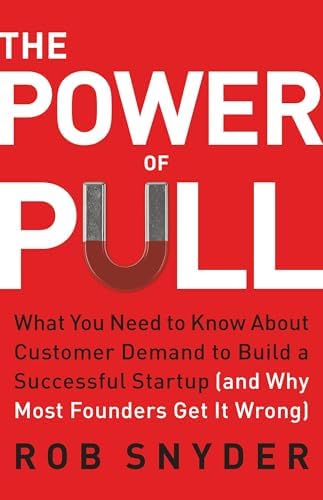
Then one unexpected phone call changed everything.
A restaurant owner he’d once tried to sell to called out of the blue — not to buy Rob’s product, but to ask if Rob could help solve a completely different problem. That pivot led to a new company that went from zero to $4 million in annual recurring revenue in two years.
That experience sent Rob on a decade-long quest to figure out why some products take off while others stall — even when the founders are smart, well-funded, and working hard. The result is his book, The Power of Pull, a battle-tested framework for finding the customers who are already sold before you ever say a word.
What’s in It for You
Listen to this conversation with Rob and you will discover:
- What “the pain cave” is and why even the smartest, best-resourced founders get trapped there
- The four-part PULL framework — Project, Unavoidable, List of options, Limitations — and how to use it to identify buyers who are already in motion
- Why your product description is probably convincing people not to buy — and the simpler language that creates instant pull
- How to turn a single customer success story into a repeatable sales engine that closes deals without pitching
- Three concrete action steps you can take this week to find your pull customers and accelerate growth
Why Doing Everything Right Still Leads to Lost Deals (And What’s Really Going Wrong)
Most founders assume that if they do enough research, build the right MVP, run enough demos, and get enough sales coaching, the market will eventually respond.
Rob did all of that. And it didn’t work.
“When it didn’t work,” Rob says, “it felt like there were a million possible reasons why it wasn’t taking off. It just was never clear what we were doing wrong.”
That’s the pain cave — a stage where you’re executing correctly by every measurable standard, yet the results refuse to follow. It’s disorienting precisely because it could be a million different things. You don’t know if you’re totally backwards or an inch away from breakthrough.
The answer, Rob discovered, isn’t to try harder or pivot faster. It’s to stop asking “how do I sell this?” and start asking “who has already decided they need this?”
What Is the PULL Framework? A Four-Part System for Finding Customers Who Are Already Sold
PULL is an acronym. Each letter describes a condition that must already be present in a customer before they ever hear about your product.
P — Project. They have a specific project on their to-do list related to what you solve.
U — Unavoidable. That project cannot be delayed. It has to happen now.
L — List of options. They are already evaluating solutions. They’re in motion.
L — Limitations. Every option on that list has a problem that’s preventing them from moving forward.
When all four conditions are present, Rob says, “it would be weird if they didn’t buy.” And when they’re absent? “It’d be kind of weird if they bought.”
This isn’t a theory. It’s the pattern behind every startup that appears to find product-market fit “overnight.” They didn’t get lucky. They found the people who were already pulled toward a solution — and showed up at the right moment.
How to Describe Your Product Using Pull Signals Instead of Push Tactics
Here’s where most founders make the critical mistake: they describe their product in terms of what it does instead of what it resolves.
Rob coached Park live on this exact problem with the Story Cycle Genie. After hearing Park’s full explanation — an enterprise-grade story ops platform that aligns brand narrative across every department and channel — Rob distilled it to a single sentence:
“We offer a way to make sure your story is used by default — fits in everywhere — on autopilot, without employees even having to think about it.”
That’s it. No features. No architecture. No vision statement.
“That description alone should release the tension in the air,” Rob says. “It should cause them to lean in.”
The reason it works is that it auto-completes the thought already running in the prospect’s mind: here’s where I’m stuck, here’s what I’ve tried, here’s why it’s not good enough. You’re not selling. You’re resolving.
The Repeatable Customer Success Story: How to Recognize Your Best Buyers Before You Ever Pitch
Once you understand pull, your best sales asset isn’t a polished deck. It’s a repeatable customer success story — a narrative about a specific person who had your customer’s exact problem and got your customer’s exact result.
Rob describes this as the core engine of every startup that scales quickly. “A startup doesn’t produce a bunch of different case studies,” he says. “It’s producing one case study that repeats a lot of times.”
Park takes it further: drop the word “study” entirely and replace it with “story.” Anchor it with a timestamp — last June, September of 2023, a Tuesday afternoon. Give it a location. Put a real person at the center — someone the reader can see themselves in. Make it specific enough to create instant recognition.
When the right prospect hears that story, they don’t need to be persuaded. They see themselves in it. And they lean forward.
Three Action Steps to Find Your Pull Customers Starting This Week
Rob closes the conversation with three steps that any founder, agency, or sales team can act on immediately.
One: Audit your current customers and identify who bought weirdly fast and used the product as if it were addictive. Those are your pull archetypes. Study them. Understand what made them different.
Two: Describe your product in the smallest possible terms — specifically through the lens of what that pull customer needed. Not the big vision. The one specific thing that made them say yes.
Three: Go find more people who match that profile. Talk to them. Show them that tiny, specific description. Lean back and watch what happens. If they pull — do more of that. If they don’t — iterate until you find who does.
The goal is never to convince the market to want what you’ve built. It’s to find the people who already do.
More From Rob Snyder and the Business of Story
- The Power of Pull by Rob Snyder — available on Amazon
- https://robsnyder.org/
- Rob Snyder on LinkedIn
- Startup Hustle Podcast
- Story Cycle Genie™ — the AI brand storytelling platform discussed in the episode
Related Episodes From the Business of Story
Stop Scaling Too Early — or Too Late: The Framework That Changes Everything, With Mark Roberge — HubSpot’s former CRO reveals the product-market fit threshold that tells founders whether they’ve actually earned the right to scale their go-to-market motion.
How to Effectively Position Your B2B Brand, With April Dunford — The world’s foremost expert on positioning shows how finding the exact right customer context — not just a better pitch — is what makes a product suddenly, unmistakably click.
What a Hit Song Has in Common With Every Great Business Pitch, With Rob D. Willis — Strategic story producer Rob D. Willis unpacks why the smartest people in the room most often lose it, and how to transform deep expertise into a narrative that actually drives decisions.
Rob Snyder’s Conversation With Park Howell on The Business of Story Podcast
Why a Harvard and McKinsey Pedigree Doesn’t Prevent Startup Failure
Park Howell: Hello, Rob. Welcome to the show.
Rob Snyder: Thanks so much for having me.
Park: Yeah, man. I’ve had a lot of you Harvard boys through here lately, it seems like. Always nice to go right to the top of the echelon in innovation and business development and so forth. I am so happy you’re here. Would you give our audience a little bit of a backstory — your backstory — as to why you’re here and the new book you’ve got out?
Rob: Totally. So I, as you mentioned, came from Harvard where I thought I was really smart. And it turns out, as I went to build my first startup, I wasn’t as smart as I thought I was. I got punched in the face for two years where the startup wouldn’t take off no matter which of my plans felt right or sounded like they were going to work.
And then the business took off and went zero to four million ARR — annual recurring revenue — in two years.
And when it did, you’d think, wow, you figured it out. No. It made no sense to me why it took off when it did take off. And so I’ve been trying to figure it out since then.
Park: All right, so let’s level set. What did you go to Harvard to study?
Rob: Business. I went for my MBA there, but I had worked at McKinsey beforehand. So I’d been a consultant, and I knew from consulting that I did not want to work in a big company.
And so I said, all right, what’s the exact opposite side of the spectrum? Startups. Being a tech billionaire wouldn’t be bad. Why not start a company out of business school?
So I spent the entire time in business school in what’s called the Harvard Innovation Lab — a place where all sorts of Harvard students come together to try to launch companies — and took every entrepreneurship class I could.
Park: And what kind of company did you have in mind to launch?
Rob: I went through many ideas in school, but we wound up with a B2B software company that did workforce management and scheduling for hourly workplaces.
Park: Okay. And you ended up there because you saw a decided hole in the market — a major problem that you had the perfect innovation to solve.
Rob: Exactly. What would I be doing if not doing a bunch of market research, doing a bunch of customer interviews, planning out the future, mapping out what the ideal solution would be, and even recruiting design partners who were using our minimum viable product. I did all of the things to build what on paper seemed like it was going to take off.
Park: And you’re coming from Harvard. You’ve got the best teachers, the best innovators and professors around you. How could you miss? Didn’t they even provide you with a million dollars cash to get it rolling?
Rob: We did raise over a million to get started. And it seemed — I was actually talking with one of my professors from back then a couple weeks ago. He said, I remember your business. He explained it back to me. He said, that was brilliant. How did that go?
And I said: horrible. It sounded totally right, but it did not work.
Inside the Pain Cave: Two Years of Doing Everything Right and Still Failing
Park: Tell us the story. What was your pitch and why did it not work? How did you fix it?
Rob: So in retrospect, it’s going to sound a lot cleaner than it was. The pitch was basically: we can save you a bunch of money on scheduling. A lot of workplaces spent a lot of time and money on scheduling. They lost money when employees didn’t show up for their shifts.
We had a scheduling system that would automatically check in and call people to fill open shifts. It made a lot of sense. People would nod when we told them about it. Our design partners used it every single day. And then we tried to sell it to people — and they just disappeared.
We were like, I have no idea what’s going on. Everything else about this makes sense. So we tried different versions of that for about a year. We got sales coaches. We pivoted to a smaller version of the product — just a shift swapping tool. We did a variety of different things for basically the next year. None of it worked.
Park: So we were essentially hunting and guessing at what the market wanted.
Rob: Basically. And doing it in a way that seemed like it made sense. We would interview potential customers. We would try to follow all the ways to keep interviews unbiased. We would ask about willingness to pay. We would show demos, show mock-ups, do co-design.
All of that stuff that in theory should have led to them buying. And it didn’t.
When it didn’t work, it felt like there were a million possible reasons why it wasn’t taking off. It was never clear what we were doing wrong. Were we totally backwards? Were we an inch away from it taking off? I had no idea.
I call this stage the pain cave — where nothing works, it’s not really taking off, and it’s not obvious why.
Park: You’re in the pain cave — in the dark, dank, messy pain cave. Take us to the moment when everything changed.
The Inbound Phone Call That Revealed a $4M Business Hiding in Plain Sight
Rob: This is embarrassing. The moment it all changed, I got a phone call from somebody I had tried to sell to weeks earlier. He said, essentially: Hey, you’re a tech guy, right?
I said yes.
He said, I know you tried to sell me something. That’s not what we need. I need help hiring employees for my restaurant. You’re a tech guy, right? You can help us with that.
And I was like: Yeah, sure. I don’t know — why not? I’ll try to figure it out.
Park: So he wasn’t buying your initial product offering, but he did buy into your expertise as the tech guy — thinking, well, if Rob can build this, he can probably build this to really answer my need.
Rob: Yeah. I think it was more of a hey, I thought of this guy who tried to sell me something and might be able to help here. I don’t know that he thought very highly of me, but he said: Listen, I’ve probably made four other calls before this and everyone told me to pound sand. Let’s try this guy.
Park: So what’d you do?
Rob: I said sure, let me try. I have nothing better going on. Why not? This is the first time anybody’s actually seemed interested.
So I called around to a couple people to try to figure out what I should do. I talked to one of his managers, and the manager said: You know, if you’re trying to help us with hiring, we have this massive database of people who’ve applied to us in the past and people who’ve worked for us in the past. Maybe start there.
So I got access to that list and I just started texting them. I tracked it all in a spreadsheet. I would send emails whenever anybody was interested. That spreadsheet became our first product.
We said, hey, I wonder — do you think other people might want this? So we started talking about it to a couple other restaurants, and they said: My gosh, you can do that? Yeah, totally.
And that’s how the business started.
Park: So did your initial product completely iterate out of what its initial mission was and evolve into this new product, or is this a complete standalone enterprise?
Rob: There was zero lines of code carried over from product one to product two.
From Zero to $4M ARR: How Listening to Pull Customers Unlocked Rapid Growth
Park: Okay. So you’ve got a whole new business model, a whole new product. Whatever happened to your first one — did it ever take off or did you just bench it?
Rob: No. And I’ve seen a ton of cases like this since then. I’ve been asking a bunch of people to try to figure out: is this a normal thing or was I just uniquely incompetent?
And there’s been a lot of cases where people say, yeah, of course. We did the exact same thing. We’ve used zero lines of code from the first four products we built. It’s a total rewrite.
Park: All right. So really, where this has all led is to your new book, The Power of Pull — which I have found really fascinating because we are experiencing some of the same things you experienced in the launch of yours with the launch of our Story Cycle Genie.
You talk to people about it, beta testers love it. Some of them will buy it, some fall off, others will never actually pull the trigger on it — and yet others have ongoing use cases for it. And we are still trying to understand. We’re into it ten months now, and I think I’m in the same position you were early on.
We do have early adopters and they are liking it and using it — just not adopting it as fast as I thought they would.
So, PULL. The Power of Pull. Would you walk us through your four-letter acronym — what it means, how you arrived at those meanings — and then can we dissect the Story Cycle Genie and you coach me on what I’m doing wrong?
Rob: Let’s do it.
The PULL Framework Explained: How to Find Customers Who Are Already Sold
Rob: Starting from just the concept — the idea of pull — and then I’ll get into the framework.
When our startup took off, it felt like this: I got a call from a number I had never seen before. It was from like Kansas City or something. I answered it, and on the other line was a restaurant owner who said: Hey, I found your phone number. I need to sign up for your product. How do I do that? And how do I pay you? And also, what does it do?
That was a weird ordering of things.
And that’s what a lot of startups actually wind up feeling — you’re not pushing a product onto a market. You’re not doing any convincing at all. The market is pulling the product out of you. They are showing up. They are buying way more than you are selling.
We know what this looks like. We call it product-market fit. I think of it as pull. The question has always been: what happens before that? How do you get there?
The pull framework is an acronym: P-U-L-L.
When those four things are present in a customer before they hear about your product, they are in a state where it would be weird not to rip it out of your hands. They will buy, or it would be weird if they didn’t.
P is for Project. U is for Unavoidable. L is for List of options. And the second L is Limitations.
They have a project on their to-do list that’s unavoidable right now — not something they can delay. But they have a list of options they’ve considered to get that project done. And those options all have limitations that prevent them from getting it done.
You can almost think of it as: I’m trying to do something right now, I have to do it right now, but I kind of can’t do it with the options I have available to me.
If that’s present, they will rip a product out of your hands. If it’s not present, it’d be kind of weird if they bought.
Park: How did you come about this?
Rob: Mostly by working. After that company wound up exiting, I started getting pulled into a bunch of friends’ startups.
I didn’t quite understand why my startup had worked when it worked. So I’d say, let me try to apply some of what I learned to your situation. I knew there was something about the fact that customers didn’t really want the product — they had some project on their to-do list they were trying to get to. A job to be done.
So I would start applying this, and it would kind of work, and then it kind of wouldn’t. I kept iterating with the framework until I figured it out. They say they have a project, but then they’re not buying. Why? Because their existing options are good enough. Or they don’t have good enough options and they’re not buying — why? Because it turns out they could delay the project. So they just did.
They all kind of came together as one thing through a process of trying to implement it and having it not quite work the way I thought it would.
Park: So in story parlance — I think of it as the inciting incident in a story, where the protagonist has something they absolutely have to do. It’s unavoidable. They’ve got a project. It’s unavoidable. They absolutely have to do it. They already have a list of options — they know they’ve got to move on one of them. But in every one of those options, there’s enough of a limitation that’s making them second-guess what to do.
You, as the product founder, need to show up and understand what that general project category is — why it’s unavoidable right now — and have a pretty good sense of what lists of options they’ve considered and their limitations. And then you deliver how you can overcome each one of those limitations and are the best decision to be made right now.
Am I accurate on that?
Rob: That is great. Well said.
Live PULL Framework Coaching: Applying the Pull Method to a B2B AI Product
Park: So sometimes as founders, we show up and we’re trying to tackle more of an existential problem. In my world — brand storytelling. It’s fragmented, it’s doing more harm than good, even if you’ve got it dialed in right. And so what we need to do is recreate this brand story using our Story Cycle Genie.
My sense after reading The Power of Pull is that I’m thinking too large. Too existential. I need to get down and find an exact project somebody’s on that’s unavoidable — where what they’re doing isn’t working, they don’t have a lot of options they’re happy with, and we’re the way forward.
Rob: I would a hundred percent agree. Maybe give a little context on how you’re currently describing the Story Cycle Genie and how you’re currently framing it. Then we could dig into that. That’d be fun.
Park: That’d be awesome. And for all you listeners out there — what Rob is going to run me through here, we have not rehearsed this. So this is live. I’m showing all my cards because I thought I was pretty smart until I launched this thing.
So, we are a story ops platform. From the business world, everyone has marketing ops, rev ops, HR ops, supply chain ops — ops across the enterprise, all governed by their own operating systems. The one op they have never really pulled together and optimized is their story. Their brand narrative op.
So that every department, every channel, every internal and external communication medium is sharing the same coherent, consistent story.
How many times have you seen it — sales saying one thing, marketing saying something else, HR telling recruiting something completely different, and the CEO is doing a keynote about something everyone else doesn’t even know about?
This is an existential problem. And trying to simplify it to that project needed right now is: how do we get coherent and consistent so that our story is as strong as possible across every medium, every department, every team?
Rob: I love it. Okay. Do you mind if I get to work?
Let’s start. There have been people who have used it and love it. I don’t want to hear about the company — I want to hear about the person. Is this a head of brand? A CEO? A CMO? Who is the person?
Park: Let me tell you about Brian Burkhardt. Brian is a solopreneur — a brilliant marketing, storytelling, and leadership coach. He does a lot of work in big healthcare cases, helping them define their stories for everything from selling products to defending themselves in court. He is a story shaper. He’s been using the Story Cycle Genie and it has been blowing his mind.
This is a guy who’s been in the business world thirty years. And he goes: the amount of information it provides me that is so on brand — that listens to me and my input — is just mind boggling.
He’s been using it for a couple months, and he just keeps using it. He says: I just keep creating this amazing content way faster than I ever did before.
Rob: Okay. So pull is always a thing that exists at the individual level. It is a person. It is never a thing that exists at the company level, because companies can’t buy things. They are not real entities.
It always has to be a person with a project on their to-do list.
What it sounds like Brian is saying is: I am trying to produce brand story assets faster without sacrificing quality. That could be what he’s trying to do with it. That’s one example.
It’s because I’m a consultant — very sought after — and this is the kind of constraint on my business: my ability to develop assets that are actually on brand. That’s one example.
I could imagine there are other examples, like brand leaders inside companies.
Park: Let me give you one. Let’s go from the solopreneur to the very large enterprise. It’s a global electronics firm. There’s a gentleman inside it who handles one of their divisions on high-definition screens for corporate and entertainment settings.
He said: Our problem is we are completely fragmented. What product is giving me the intel is not the same thing that marketing is telling that is giving to our sales team. And then the sales team is out there completely stymied in the presentation. Will your platform be able to pull all of that together for me so that I’ve got one single source of truth about this particular product line — that I can spread throughout a team of eighty people, from product developers to marketers to sales — and that I can actually measure the outcome of this narrative?
We call it narrative entropy when you don’t have a story ops system in place. And that is what he’s feeling.
Rob: And is this person in marketing or is this the division leader?
Park: It was the division leader.
Rob: Interesting. I wasn’t expecting that. So for that person — I don’t know why this is urgent or unavoidable for him at this very moment.
Park: He’s got aggressive sales targets he has to hit now.
Rob: Okay. So I’ve got aggressive sales targets. And what I am seeing out of my different departments is a bunch of fragmented messaging. That’s the unavoidable now. I’m not going to be able to hit my sales targets unless we get on the same page — unless eighty people get on the same page about our story.
Therefore, I want — on the project side — I want to make sure that by default, all of our stories, all the things we do, all the things we say, all the things we show, fit our story without me personally overseeing every single message.
And I have looked into mandates, edicts, story guidelines. But I would assume the limitation is they don’t guarantee this by default.
Park: Nobody follows them.
Rob: Nobody follows them.
This is really interesting. There’s somebody in an organization who is the person who cares about the story — or is responsible for the story — or has ruled out all other options and is seeing that their narrative isn’t clear.
That person is trying to make sure the story carries through everything they are doing. And all of the existing options do not get followed because they’re not plugged in to where the employees are actually doing their work.
That is what pull looks like. That is a person who is stuck before you exist.
Now the question is: if you show up to that person, how do you need to describe your product?
Park: I would always default to the individual — the hero at the center of this journey. What’s keeping them up at night? What’s the angst? And how can we help them overcome it and get them to say, as you say in your book: Hell yes, let’s go.
So I would talk about the frustration and the energy suck that goes into trying to herd cats around a brand story about a particular product line that may not even be really dialed in yet.
Maybe that’s job number one — really get that story codified so it becomes a single source of truth for that product line. And then show them how you then indoctrinate, embed it in a consistent, coherent way that gets your sales and marketing team to first believe: yes, I believe this story. I believe this story is going to work. I believe we can deliver on this story.
And then get them consistent in telling that story so they can see the final outcome of real revenue being developed — simply because they have pulled that narrative, stopped their narrative entropy, and created a core story ops that everybody lives by.
Rob: I like it. Here’s what I’ve seen in cases like this. The first hard thing — which you’ve done way better than most — is you’ve given me the context to write what a pull framework really is. You’ve actually found somebody who is stuck and should rip this out of your hands. And the goal is just to find more of them, then not convince them not to buy.
However, the way we tend to describe our products as entrepreneurs — as people who like products, AI, and building things — convinces people not to buy.
So if I’m in a situation where I have these revenue targets, or I’m responsible for making sure all our brand assets and stories are coherent across sales and marketing — if I’ve done all the work and I can’t show my boss that people are actually using the story I just spent a bunch of money and time on — I’m in a bad situation.
In that situation, all you need to do is show up and say something very simple:
We offer a way to make sure your story fits in everywhere, on autopilot, with no extra work from you.
And then: here’s how that works, with a couple of bullet points underneath.
Park: Say that again. Your story fits in everywhere.
Rob: We offer a way to make sure that your story is used by default — fits in everywhere — on autopilot, without employees even having to think about it.
And then you pause there. That description alone should release the tension in the room. It should cause them to lean in.
Because it’s not about your product description. It’s about pull — which was there before you. You’re basically auto-completing the thing that’s in their brain: here’s where I’m stuck, here’s what I’ve tried, here’s why it’s not good enough.
Our goal is to say the fewest possible words that help them realize they can get unstuck.
Park: And it plays to the old saw we always talk about: your product story is not about what you make, but what you make happen.
And even I — who knows this inside and out — get so trapped in the curse of the expert. Inside the genie walls of what we’ve built, two years of amazing programming and prompting and working with Gen AI — it’s hard for the founder to shake off those shackles of expertise and say it as simply as you just did.
Rob: And to be clear — I can barely do this for my own stuff. This is normal. You do want somebody else to help you with this.
But let me double-click here, because I just gave you the highest-level description. Based on what you said, there are a couple of important follow-on points likely to be very relevant to your potential customer.
The first: some way — on autopilot — it plugs into where your team is already doing their work. Maybe it’s available by MCP and it plugs in, so whenever they ask to create an asset, it refers to the story first.
Park: We’ve got an MCP server — and yes, in an enterprise, they can literally plug the Story Cycle Genie anywhere within their systems with complete and utter security.
Rob: Which means this can plug into the tools your team is already using. So by default, your story will be integrated and used — on autopilot — without long employee trainings, without added friction. That’s piece one.
Piece two is the implication: not just that your team is using the story, but that you get visibility on how often it’s being used and in what ways — so that you can report upwards on how much the story is being used, and potentially even track some analytics on the revenue uplift as a result.
Park: Absolutely.
Rob: Those would be the two points I would double-click into.
What Is a Repeatable Customer Success Story and Why It’s Your Best Sales Asset
Park: Now, you also talk in your book about a repeatable customer success story. I want to go back quickly — you come in very high-level, thinking very large, because you have to as a founder. But everything you are talking about is really down in what I would call the fog of war. I got a project, it’s unavoidable, I’ve got a list of options, none of them great. Therefore, I need you.
You get this purely through talking with your customers — talking with the people that bought and then went away, people that didn’t buy at all. You literally have to do the nitty-gritty interviewing.
Rob: That’s so important. You come out of business school, or you spend enough time on LinkedIn, and you think at the macro level. Here’s the trends changing the world. Here’s the architecture of this thing. You feel really smart.
But the challenge is people have to buy it. Startups that take off have pull. They’ve found people who rip the product out of their hands. That doesn’t happen at scale. That always happens as an individual decision, one customer at a time.
So you have to understand this in what customers are saying. There is no other level of understanding. And if you try to zoom out from there, you’ll miss it.
Where I often see this — and what I do a lot — is I’ll literally just review recorded sales calls. And in those calls, you can fill out the pull framework just listening to the customer talk. It’s just not what we typically look for in a sales call.
They will come and tell you what their pull is. And then because we’re not looking for it, we’ll hear things about pain points or complaints, and we’ll wind up pitching whatever we want to pitch. And they won’t understand it, and we won’t understand why they didn’t understand it.
In these little conversations, in these little sales calls — that’s where the answers are.
Park: So let’s lead into the idea of repeatable customer success stories. You are getting these stories — and as obvious as this sounds — you’re simply sharing a testimonial of a customer who was successful with your product to a prospect that is like that customer and could have equal success.
Rob: The repeatable customer success story — or the repeatable case study — is one of the most powerful concepts I have.
The idea is simple: a startup produces case studies. A customer came to us trying to solve something, we helped them solve it. Done. Case study.
Well, what a startup really is producing is not a bunch of different case studies — it’s producing one case study that repeats a lot of times.
And when you show a case study to a potential customer, they tend to say: Yeah, that’s just like me. That’s what I want too. They understand what you do, who you’re for, the story — and it’s what they want. They don’t really want the product. They want the kind of completion of a case study.
So in sales, you can listen to the customer and say: You remind me of this other person. And you show them a case study that they understand, and they buy based on it.
Park: You started by saying you didn’t really know how best to articulate that. Can I offer you a little training from my end, since you’ve been so kind in training me?
Here’s something that has worked really well for me throughout my forty-year career in branding and marketing: rethinking a case study. I like to take “study” out and say “story” — because I want to reframe it.
The idea of telling this as a truly human impact story plays right off of what you said from the very beginning. The pull strategy is about finding an individual with a project that’s unavoidable, limited options they don’t like, and you’re going to solve that.
So in a case story, take me to a moment — put a timestamp on it. Was this last June? September of twenty twenty three? Tuesday? And give me a location. Where did this happen? In Boston? Phoenix, Arizona? Even something as specific as the sixth floor of the IBM Center in Manhattan.
That timestamp says: I’m being told a story. Stories are temporal. Something must have happened. I better pay attention so that I learn what to do in case whatever happens in this story ever happens to me.
The location stamp fires up the theater of the mind.
Then introduce an individual — the person who by proxy represents the larger organization. You can name them if they allow you to, or say: We’ll call her Jill.
And then you get in: Jill was trying to do this. She had this unavoidable thing she had to do. But she was limited here. She didn’t even know our solution was available. We showed it to her. Within the first three weeks, she had a measurable impact.
Jill couldn’t be happier. Are you like Jill?
What you’re doing is taking the organization out of the center of that case story and making it about the person. Because the Homo sapien storytelling ape you are communicating to can relate to the person. He or she cannot relate to the organization.
Rob: Yeah. And I love that. The person is the main character in this story. They represent you.
And you know what else it’s not about? Our product. Our product plays a supporting role in the case story here. It really is about this person getting their project done.
Park: Yeah. Again — getting their needs met, both emotional and physical. Let’s take the exhaustion out of it. Let’s take the fear out of it. Let’s bring the success in. Let’s set them up as the victor in this thing — moving them from victimhood to victory in the process.
Rob: Yeah — which actually reminds me of a story of a startup with a similar journey to mine. Really smart Stanford founders who had spent a year and a half, two years getting punched in the face by the market, staring down customer indifference.
And then a financial advisor — the next-door neighbor to one of the founders — reached out and said: Hey, I heard about your technology. Could we give it a try?
They started using it. They loved it. And the startup said: Okay, well, we don’t know anything about financial advisors. Do you mind if we just tell your story to a couple others?
They wrote a quick case study, and they sold to thirty thousand financial advisors in the next two years. They went from zero to raising eighty million dollars in two years. One of the faster growing startups of that period.
And it was all because they were just showing the story of a financial advisor. A couple slides in a sales deck. That was basically it.
How Agencies Can Use the PULL Framework to Win More New Business Pitches
Park: Yeah. So let me ask you — bounce one more audience off you. And here’s my vulnerable question: am I pushing or am I pulling?
Because that’s really what your book is about: stop pushing. People don’t like to have anything pushed on them. Pull them into your story so that they pull the product out of you. Hell yes, I want to be a part of this.
We’ve talked about Brian, in the solopreneur and SMB world. We’ve talked about the large electronics company. Now let’s talk about the ad agency world.
My principals who helped create the Story Cycle Genie all come from running ad agencies. So we say: this is built by ad principles for ad professionals.
The idea is agencies can white-label this. They can do way more work, way faster — and in some cases, way better — because of the intellect of the genie working on it.
One of the ways I talk to them is this: if you are pitching a new prospect, you have about a twenty-four percent chance of winning. You may put ten grand into the pitch, you may put a hundred and fifty grand in, and yet your odds are one out of four — because everyone shows up the same way, showing capabilities.
So instead, turn that into a pull strategy. Take your prospect, run their brand through the Story Cycle Genie, get an initial brand evaluation: validating what they’re doing well, revealing gaps the agency could fix, inspiring new ways to launch.
Instead of pitching your capabilities, you pull them in by demonstrating your ability to act the moment they hire you — because you’ve already got the intel in place.
Rob: Hmm. What I find is that when you find pull, you don’t do any pitching. It is you’re finding people who are stuck.
What I’m hearing from your story is there are kind of three directions: an SMB direction, an ad agency direction, and a corporate direction.
What I have tended to see is that for startups that take off, they find one direction where there is really pull. And that one is the customer that comes in maybe inbound. Maybe they look a little different than you were expecting. But as you’re pitching, as you’re explaining and educating — they’re impatient. Because they were already sold when they showed up and they don’t need to hear this.
So what I’ve seen is that’s where startups that take off always wind up optimizing.
And you realize: you know what, I always go and pitch ad agencies and they nod and sometimes get back to me, but a lot of times they don’t. It always feels like a good conversation. Okay, that’s not what pull feels like.
If you feel like you’re doing any sort of education, persuasion, telling them about the vision or the theory of your product — that’s pushing. That’s convincing.
But then a big corporate comes inbound — hadn’t been following you for a long time — and just says: Listen, I’m under the gun for this. This is the thing I’m struggling with, and you can solve it. And it was a weirdly fast sales cycle.
That’s an indication that there is pull there. And your education in those sales calls is almost certainly counterproductive. You can have much shorter sales calls that are way more effective.
And it’s like: if we just focus on those and find more of those, we can grow really fast. Why not do that?
I did that a lot too — I’d have people calling me and buying really fast. And I was always like, well, I don’t understand that. But I want those other people to buy from me, so why don’t I go try to sell to them?
The answer was always: no. Just focus on the people who pull the product out of your hands. Design for them. And you’ll realize the product gets simpler, the pitch gets simpler, sales gets easier — and like everything else downstream gets easier.
Park: Yeah. And there’s got to be a point, especially in the founder stage, where you realize: for me, your book isn’t just about founders and startups. Any company that is selling anything can benefit from it.
I don’t know of any operation that is a hundred percent revenue-optimized. There’s always room to grow. And I think your whole pull strategy plays across the spectrum. That’s my humble opinion.
Rob: That means a lot. I really appreciate that.
Park: So let’s go back to the startup, the founder. You launch something, you have to push information. You have to let people know what it is. And in some cases — and maybe I’m doing it wrong — I’ve been reaching out to my warmest market. My colleagues, my friends, the people who have done it.
I needed to push the genie on them, not so much to sell them, but to get clear on how to communicate this story that’s actually going to resonate. But the problem is: we get so busy pushing and trying to get clear on our own story, we don’t take enough time to stop and listen to their reaction — to how they might tell us our story is landing.
Rob: Totally. So every startup starts out trying to push. And you start out pushing, trying to persuade, and you find it doesn’t quite land.
The book lays out a way to sell to figure out what they will pull. Yeah — as you try to push, as you try to persuade, some people will buy, others won’t. You have to have a way to interpret who buys, who doesn’t, why they buy, why they don’t.
Some people bought kind of weirdly fast. And it wasn’t because of you — it was because they were being selfish about it in a good way. They needed it. And so that’s what we have to figure out as quickly as possible and build our business around that.
Because I’m sure you know — pushing is exhausting.
Park: It is. And it tears down your ego. You’re like: God, I got another no.
Rob: Yeah. Mine’s been bludgeoned out here. But it’s good.
What I try to do early on is I go out and say: Hey, I want you to tell me why this isn’t a good fit for you. That would be the most helpful thing for me — so that I’m not persuading them or hearing what I want to hear, and then they disappear and I never learn anything.
I view a sales call as a see-if-they-try-to-buy call. Not as much as a me-convince-them-to-buy call.
Three Actionable Steps to Identify Your Pull Customers and Accelerate Growth
Park: I love that. So in closing — what are the three things that I should do next? And by proxy, all of our listeners who are like, I really like this pull strategy. What do we need to do to land a few more pieces of business?
Rob: For you specifically, I would look across your current customers and say: who bought weirdly fast and used it as if it were addictive?
Compare and contrast those to the people who didn’t, to figure out: what is pull really? Who has pull, and what is it? Can we narrow down to one kind of person we’re focused on — one pull framework we’re trying to repeat? That’s thing one.
Thing two: once you figure that out, figure out what the smallest possible way to describe your product is in the context of that pull.
So it’s no longer this big thing — it’s this small thing that just plugs in, gives you visibility into how your story is being used and whether it’s being used, that you can measure, that you can report up. And that’s all it is. Period.
Third: go find people who you think fit that profile — people who have pull. Have them talk to you, see if they do in fact have pull, show them that really tiny thing we just talked about, and see what happens.
Lean back. See what happens. Do they try to buy? If they lean in, if they pull — it’s like, all right, cool. Let’s do more of that. Let’s find more of them.
And if they don’t — iterate, until you figure out who does.
Park: That’s awesome. So what are you doing these days?
Rob: I am bootstrapping a couple of software things and advising a bunch of startups and involved in venture. So I do a bunch of things that are all related to how do you make things take off? And I just find it to be super fascinating. A lot of startups will bring me in to review their sales calls and help them figure this stuff out.
Park: And what did you think — although I pushed it on you, you didn’t pull it in — when I sent you the write-up that the Genie did for your brand? Based on your book, because it could not read your website — it’s made of JavaScript, something you might consider for searchability.
Rob: When you sent that, I was thinking: I don’t feel like I have a good way to position or communicate what it is that I do. And you sent that across and I was like, wow — these are things I’ve been chatting with AI about and have not been getting as good answers as this.
I was like, this is really nice.
Park: Good. Well, I’m glad you liked it. You can always — I’ll pull you in, you can pull it out of my hands — you can start using the Genie to build your brand story and all of your customers’ brand stories.
And that’s all the pushing I’m going to do right now.
Rob, thank you so much for being here. This has been just a marvelous conversation and you’ve really made my day.
Rob: Thank you so much. This was great.
Park: Where can people learn more about you?
Rob: I am at robsnyder.org and on LinkedIn.
Park: Rob Snyder dot org. Are you a nonprofit?
Rob: A lot of my tech businesses are, unfortunately.
Park: All right. Robsnyder.org, on LinkedIn, and go to Amazon to get your book. Highly, highly recommend it, folks. You’re going to love it. Thank you, Rob.
Rob: Thanks so much.
FAQs from Rob Snyder’s Book, The Power of Pull
Q: What Is the PULL Framework for Finding Ready-to-Buy Customers?
A: The PULL framework, developed by Rob Snyder, is a four-part methodology for identifying customers who are already primed to buy before you pitch them. PULL stands for Project, Unavoidable, List of options, and Limitations. Instead of pushing a product onto unqualified prospects, founders and sales teams use these four criteria to pinpoint buyers who are in an active project, face an unavoidable problem, are already evaluating vendors, and are constrained by time, budget, or resources. The result is shorter sales cycles, higher close rates, and far less wasted effort.
Q: What Is the Startup “Pain Cave” and How Do Founders Escape It?
A: The pain cave is a grinding period in a startup’s life where founders execute nearly every recommended growth tactic — customer research, outbound sales, product iteration — yet still fail to gain meaningful traction. The term captures the psychological and financial toll of doing everything “right” without seeing results. Escaping the pain cave typically requires a fundamental reexamination of who the customer actually is, not just how to reach them. Rob Snyder spent nearly two years in his own pain cave before a single inbound phone call revealed the pivot that led to $4M ARR.
Q: How Do You Find Customers Who Are Already Sold Before You Pitch Them?
A: To find customers who are already sold, apply the PULL framework: target buyers who are actively working on a Project related to your solution, face a problem that is Unavoidable right now, are already building a List of options, and operate under Limitations such as tight deadlines, constrained budgets, or limited internal capacity. These four conditions signal a buyer who is already in motion. Founders who design their marketing and outreach around these signals stop chasing the market and start attracting the prospects most likely to close quickly.
Q: What Does True Product-Market Fit Actually Feel Like for a Founder?
A: True product-market fit feels less like a strategic milestone and more like fielding inbound demand you didn’t fully engineer. As Rob Snyder describes it, the signal is customers calling you — not the other way around — because your solution directly addresses a problem they are already motivated to solve. Sales conversations become shorter, objections fewer, and customers begin referring others before you ask. The contrast with the pre-fit experience — constant pushing, slow cycles, and high churn — makes the shift unmistakable when it finally arrives.
Q: What Is a Repeatable Customer Success Story and Why Does It Matter for Sales?
A: A repeatable customer success story is a documented narrative featuring a customer profile your best prospects can immediately see themselves in — same industry, same problem, same constraints, same desired outcome. Unlike generic testimonials, a repeatable success story functions as a mirror, helping prospects self-identify as the right fit before a sales conversation begins. Rob Snyder argues these stories are your most powerful pull asset because they attract qualified buyers while simultaneously disqualifying poor fits, reducing wasted sales effort on both sides.
Q: How Should You Describe Your Product to Create Pull Instead of Push?
A: To create pull instead of push, frame your product around the customer’s active problem — not your feature set. Lead with the specific situation a buyer must already be in: the project they’re working on, the urgency they’re facing, and the decision they’re trying to make — before introducing your solution. This positions your product as the answer to a question the buyer is already asking, rather than a new question they haven’t considered. The language shift is from “here’s what we do” to “here’s exactly who we help and precisely when they need us.”
Q: How Can Agencies Apply the PULL Framework to Win More New Business Pitches?
A: Agencies can use the PULL framework to stop pursuing every prospect and start targeting only those already in a buying motion. That means identifying prospective clients who have an active project underway, a business problem that cannot be ignored, are already evaluating agency options, and face hard constraints like an upcoming product launch or an under-resourced internal team. Outreach built around these signals — supported by repeatable client success stories from similar industries — resonates immediately because it speaks to where the prospect already is, not where you want them to go.
Q: What Are the Three Steps to Find Pull Customers and Grow Faster?
A: Rob Snyder’s three action steps for finding pull customers are: first, audit your existing customer base to identify the clients who required the least selling, closed fastest, and extracted the most value — these are your pull customer archetypes. Second, document a repeatable success story from one of these clients with enough specificity around the problem, constraints, and outcome that a new prospect can see themselves in it immediately. Third, redesign your outreach and content to speak directly to buyers who match those conditions, so you consistently surface at the moment they are already in motion and ready to act.
 Listen To More Episodes