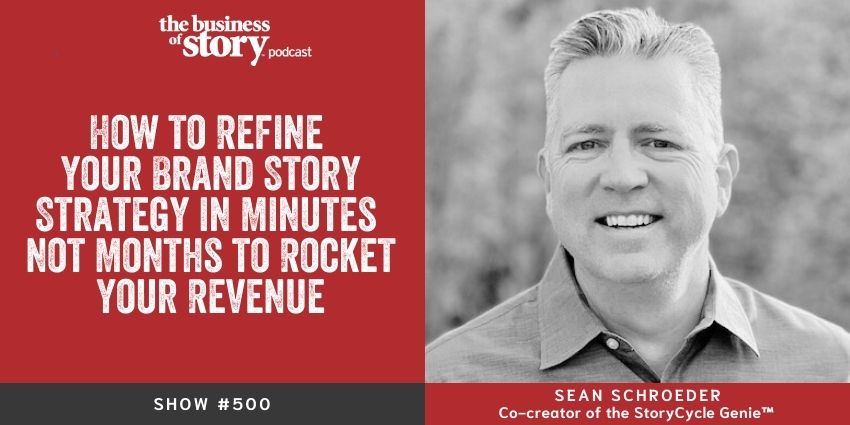
How to Refine Your Brand Story Strategy in Minutes, Not Months, to Rocket Your Revenue With Sean Schroeder
As a business owner or content creator, you probably want to create the same impact with your brand story as…
- Avein Saaty-Tafoya grew Arizona’s Adelante Healthcare by 600 percent.
- André Martin Hobbs has made Prêt Auto Partez one of the fastest growing auto dealerships in Canada.
- Sean Schroeder and his partners at Sacramento digital agency blueriver™, creators of the MURA content management platform, had a profitable exit in 2019.
They all have one thing in common: They each refined their brand story using the Story Cycle System™.
Ours is a proven process to create compelling clarity that aligns your people, engages customers, and accelerates your revenue growth (many of their stories are in the links below).
But like all approaches to branding, the Story Cycle System™ – as effective as it is – can take months of research, discovery, brainstorming meetings, and creative content development before you can start implementing your brand narrative.
What if you can accomplish the same thing in under an hour?
Sean Schroeder joins me today to show you how you can now refine your brand story strategy quickly using our StoryCycle Genie™.
Sean and his business partner, Matt Levine, helped me take my nearly 40 years of branding experience (20+ years using the Story Cycle System™) and bottle it in an AI Agent = The StoryCycle Genie™.
Now you can let your brand genius out of the bottle in minutes not months, at a fraction of the cost of the old traditional way of branding, with an even more powerful brand story strategy that you can activate immediately.
Think of it as going from being overwhelmed with developing your brand story to being overjoyed in under an hour.
I like to think of it as turning minutiae into inertia so you can immediately operationalize your brand story strategy and start reaping the rewards.
We’ll show you how in this episode.
What’s In It For You:
- How to craft your brand story strategy in under an hour.
- The 10 essential elements of a potent brand narrative spun from the StoryCycle Genie™.
- How you can activate your refined brand story immediately.
- Why general AI misses many critical aspects of your brand story.
- How the StoryCycle Genie™ focuses AI on your unique and authentic story.
Chapters:
- 00:00 Introduction and Background of Happy Ladders
- 02:24 The Evolution of the Story Cycle System™
- 07:18 Success Stories and Brand Story Importance
- 12:36 AI in Brand Story Development
- 18:35 Refining Brand Stories with AI Tools
- 21:26 Final Beta Cohort Announcement
- 23:21 Harnessing AI for Brand Storytelling
- 24:46 The Evolution of AI in Brand Development
- 25:33 Understanding Your Audience Through AI
- 27:15 Crafting Compelling Brand Narratives
- 29:09 The Power of Clarity in Messaging
- 30:35 Streamlining Brand Development Processes
- 31:34 The OOOh Exercise: Defining Your Brand Story Elements
- 33:01 Transforming Stories into Marketing Assets
- 34:43 Operationalizing Your Brand Story
- 37:07 Identifying Your Brand Archetype
- 39:52 Creating Emotional Connections Through Story
- 41:23 The Living Brand Narrative
- 43:41 The Future of AI in Brand Storytelling
Links:
- Join the StoryCycle Genie™ beta cohort
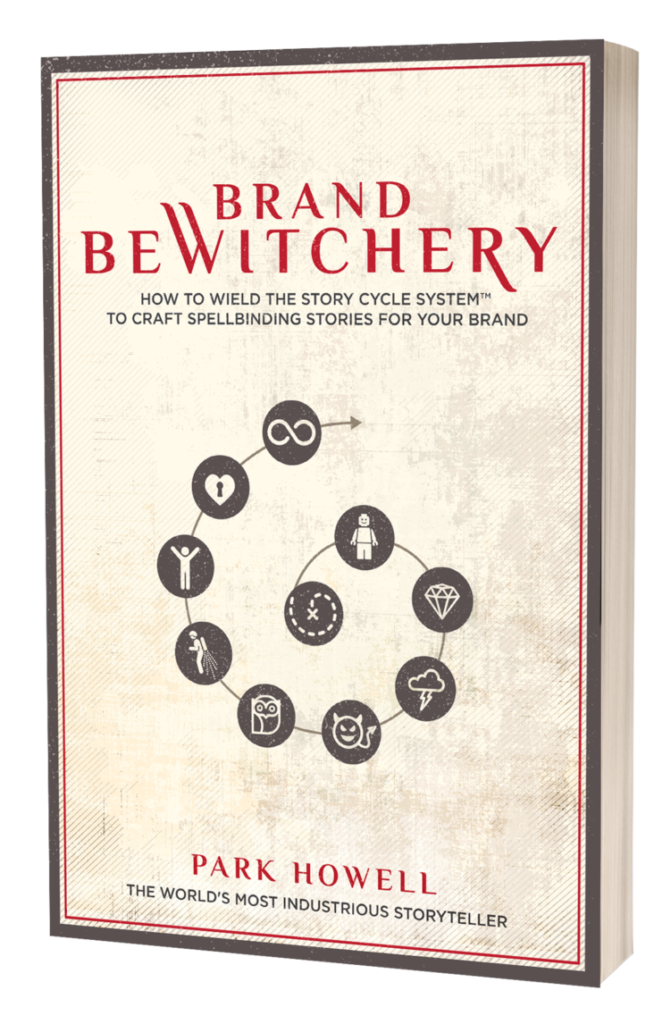
- Brand Bewitchery: How to Wield the Story Cycle System™ to Craft Spellbinding Stories for Your Brand
- The Narrative Gym for Business: Introducing the ABT Framework for Business Communication and Messaging
- Listen to Brand Bewitchery
- Sean Schroeder on LinkedIn
- Sean on Instagram
Popular Related Episodes You’ll Love:
- #121: How blueriver™ Found the Flow in Their Brand Story with Sean Schroeder
- #160: How a Purpose-Driven Brand Story Will Increase the Health of Your Organization with Avein Saaty-Tafoya, former CEO of Adelante Healthcare
- #237: How to Share a Healthy Brand Origin Story with Dr. Shyam Shridharani and Avni Shridharani
- #499: How to Create an Enduring Business Based on Your Timeless Brand Story with André-Martin Hobbs, founder of Prêt Auto Partez
- #151: How to Use the Story Cycle System™ to Become an Activist Brand with Luis Miguel of Avantpage
- Case Stories of Brands using the Story Cycle System™
Sean Schroeder’s Conversation With Park Howell on The Business of Story Podcast
What Two Years of Building the StoryCycle Genie™ Taught Us About Brand Development
Park: Hello, Sean, welcome to the show.
Sean: Hey Park, great to see you again.
Park: Well, I see you almost every single day, I think, as the co-creator of the StoryCycle Genie. We have just been on a journey — almost a two-year journey of creating this systematic approach to branding that was really your brainchild to get going in the first place.
Sean: Yeah, it’s crazy. We kind of started out with just a very small idea to see — would it actually work? And then here we are two years later in the thick of it, meeting with customers on the fly and helping people get into the Genie and do all the things that we want them to do.
Park: And what I love so much about it, just personally, from my own background — I’ve been using the StoryCycle System for brand development for the past 20 years. I’ll be honest with you, I kind of stopped taking on branding customers the last five years because it’s a long, exhaustive process. It works extraordinarily well, as you have experienced, but even myself — as the creator and the implementer of the Story Cycle System — I got to the point of, I don’t know if I’ve got three or four or five months to invest in this and take my clients and their team through that much time and effort to get them to that end result.
Sean: Yeah, I mean, it is great. Obviously a big fan, have been for many, many years, but it does take some intestinal fortitude to get to the finish line, and it does involve a lot of different brands.
From Vibe Coding to Vibe Marketing to Vibe Branding — The Natural Progression
Park: You came to me a couple of weeks ago and you said, Park, what we’re really talking about — as we are using the StoryCycle Genie and we have more and more users on it and they are able to develop their brand strategy and their content and their campaigns literally in minutes — you said, what we’re really talking about is Vibe Branding. So what is Vibe Branding?
Sean: Well, you’re familiar with Vibe Coding. That was the first one out of the gate. I’ve been doing Vibe Coding myself for a while now. And then shortly thereafter came Vibe Marketing, and there’s a whole movement behind it. I joined the Slack group and I’ve been following along on X and the different conversations people were having. And so it just seemed like a natural progression to talk about what we’re doing in that context.
Park: What do you mean by Vibe Coding? Because you’ve been a coder for a long, long time. How is Vibe Coding different than regular coding?
Sean: Well, regular coding is very, very manual. Vibe Coding uses AI to get a lot done in a short amount of time — which can be great, you can get some very cool stuff done. It can also go horribly wrong. So it’s a double-edged sword for sure. And it’s the same thing with Vibe Marketing, and I would say the same with Vibe Branding. It’s always a double-edged sword because you have to have that human element in there guiding things — using your own knowledge that you’ve won and fought for over the years — in order to make sure things don’t go south. Unless you can add that level of specificity, it’s not good.
Park: So for a guy like me who is not a coder, the way I picture it — correct me if I’ve got this wrong, Sean. To me, coding is a very analog deal. You sit down, you type in your code, you make sure it’s clean. It’s very analog in the digital world. But Vibe Coding is you’ve got some of that, and yet you are now talking to AI. You are giving AI both logic and emotional prompts in order to get the code you want. Am I clear on that?
Sean: Yeah, that’s exactly right.
The Vibe Is Not a Feeling — It’s Accelerated Pattern Recognition
Park: And so by marketing — the same way — you bring logic and reason. Here’s the audience we want, here’s what I think we want to say. And it’s kind of analog processing through your brain to get that emotion down on paper and then online. But now you can use AI and share those prompts and ideas with AI, and it comes back to you with fairly decent content. Sometimes it hallucinates, sometimes it just totally makes stuff up. But it feels much more emotional, and that’s where the vibe comes from.
Sean: I don’t define it that way. Some people might think of it that way, but I think of it more as — the vibe is not how it makes you feel. It’s more like how do you feel about what it’s creating for you. It’s where you’re leaning into your intuition, that hard-fought knowledge that you’ve gained over the years as a professional. So when it comes back to you — how does that feel? Does that feel right? Because there have been many times, even creating the prompts for the Genie — it comes back and I’m like, that doesn’t feel right. And then I have to think about it for a second, identify why it doesn’t feel right, so I can add that specificity in order to get back on track. Because otherwise you let it run amok, and boy, you could end up in a very, very dark rabbit hole.
Park: Yeah. So it’s interesting. You start with logic and reason to get you what you want, but you ultimately fall back on — does it feel right?
Sean: Well, yeah. And then not only does it feel right, but is it right at the end of the day? I was working on an article last night using the Genie — a new LinkedIn post talking about some prompt tactics using some code conventions. And I looked at it and based on my work with the Genie, I was like, that doesn’t feel right. I’m not buying that. And so I went and ran some tests, did some studies to see how this concept held up. And it turned out my intuition was right. It doesn’t actually hold up — it’s not wrong, but it doesn’t fulfill the promise that people are talking about it in the way they’re talking about it.
Park: Yeah, so it’s giving you the ideas — a lot of it great inspiration, a lot of it dead on — but some of it just doesn’t feel quite right. So you have to go and test it.
Sean: Yeah. And it’s not so much that it’s giving you ideas, right? You have to start somewhere. You have a goal, something you’re trying to accomplish. You’re pushing it in a certain direction for a specific purpose. That’s why it’s really important to get that specificity in there as you’re starting — and that’s the value of having these specialized agents that we have in the Genie. It already has that. You don’t have to teach it how to think about that specific problem you’re solving. We’ve already done that for you. So it basically says, here’s a base of knowledge, here’s how we want it executed, and here’s what good outcomes look like. And then when it comes back, you can evaluate and say, yeah, I like that, I don’t like that, that doesn’t feel right. And to me, that’s where the vibe comes in. It’s not necessarily that, woo, it makes me feel great. It’s leaning into your intuition.
Brand Excavation: Pulling Out What You Already Know
Park: So the next natural step after Vibe Coding and Vibe Marketing is Vibe Branding. How do you define it?
Sean: Yeah, it seems like a logical extension to me for the same exact reasons. As an entrepreneur, having gone through the Story Cycle process multiple times in the analog world — sometimes you need things to help draw out what you already innately know and maybe have forgotten that you knew. That was sort of the value of the Story Cycle System — working with you was pulling those things out. In a way, you were like the analog Genie back in the day. We had that six-hour meeting in your office, I gave you this big dump and shared all the things with you, and then you came back after some time and said, I got it — this is what you do. And I was like, yes, that is what we do.
It took a long time to get there, and it was quite a laborious process. There was some travel involved, some deep thinking involved. But we got there, and it had value because it gives you that North Star. Suddenly you’re like, OK, I know how to frame everything I’m doing — which I’ve been doing anyways. I just didn’t know how to articulate it, how to lean into it from a messaging standpoint, from a brand story standpoint, or operationalizing all the things — how do I explain things to our employees, how do I write this documentation? It literally informs everything. So it seemed like a natural progression to say, OK, well, that’s essentially what we’re doing. We’re trying to shorten that deep think and tap into your intuition as a professional, as an entrepreneur, as a business leader — in order to tell that true, authentic story about what you are. You already know these things. We know you know these things. You know you know these things. We’re just trying to pull it out of you so that now you can lean into it and take the ball and run.
Park: Yeah. And so in all of my experience — when doing it the old analog way and what I’m now experiencing and seeing the Genie do — it’s really brand excavation. You know what the story is. You’re just so close to it, you don’t see it. It’s hiding in plain sight. The job of the Genie — and the job of any great branding — is to work off the business owner’s own business intuition, their own marketing trend instincts, because they’ve been living and breathing their business and their brand quite often for years and years and years.
And yet a lot of agencies, a lot of other consultants might show up and say, OK, that’s all well and good, but let’s take you through our proprietary process. And it quite often ignores everything that that founder, that owner, that CMO has experienced — or doesn’t give it the credence it needs to really unearth the authentic brand story that’s there. They just don’t know how to tell it yet.
Sean: Yeah. And if you think about it — some of these things that you already know, these components, like we do things this way, we think about things this way, we handle things — it’s kind of this big formula of: if this, then that, based on your business DNA, who you are. And so yeah, we do think of it as a feeling, right? Because it’s your intuition. But we also know that intuition is based on rapidly identifying patterns. In fact, there was that whole Marines study many years ago — they got into that and talked about how quickly the Marines respond using their intuition and their knowledge that they’ve gained over the years, and how they also learn how to teach it. So while we can think of it as just a feeling, it’s really not a feeling. It’s really logic and reason that we just identify so quickly and process so quickly that it just feels like something to us.
The Five Principles of Vibe Branding
Park: Well, let’s walk through the five principles of Vibe Branding that you have helped identify — that gives structure around what this is. I’m sure I still have some listeners right now going, come on, Park, Vibe Branding, really? So let’s go through all five of these principles.
Principle #1 — Developed Intuition Over Discovery Sessions
Park: Principle number one: developed intuition over discovery sessions. I call that intuition versus interrogation. Dive into that a little bit. What’s your experience with this principle?
Sean: Well, before we worked with you, we had worked with a couple different branding agencies and went through the process of figuring out what car we were, what news anchor or news network we were — were we CNN, were we Piers Morgan, whatever the personality is. And yeah, part of that is you’re being interrogated to talk through all these things about why — then you have to justify why you are essentially someone else’s brand, and why you are that brand. And so you try to come up with your own thing, which you can then try to operationalize from there.
Park: And so how is it different now with Vibe Branding?
Sean: With the Genie, it’s different because your first input doesn’t have to be an interrogation. You can just give it your website, or your marketing materials, or whatever. So you already have a starting point — and everyone has these things. At some point you’ve created something as a professional, as an entrepreneur, as a business leader. Your thinking already exists in some form somewhere. So we don’t have to go through the interrogation process. We just go, cool, give us your stuff, and let’s take a look at it and see what’s there.
From there, you can do an assessment — well, yeah, I wrote that three years ago, or our website was created 10 years ago and we haven’t updated it in two years. Are there some core things that are still relevant? Is it all still relevant? Or are we thinking about things differently? And if so, then you say, yeah, that’s great, but it doesn’t feel right — it’s off because of X, Y, Z. And then you explain what it is. And think about how much time that saves just by giving it something to infer from — things you already know and have already created in some form.
Park: Yeah, so like you and I would sit down for a six-hour interrogation and I would ask you about this and that and you would have to dig deep and justify it. That was the old way of doing it. And now with the Genie, when you say give it to us — actually you do it yourself as a user. You go in and just feed it your website, feed it some of your marketing plan documents, feed it a PowerPoint presentation as long as it can read the content in there. And it will then excavate for you and reveal how you’re showing up in the world. You don’t need a consultant or an agency involved at all.
Sean: Almost like a — I think I may have stolen this term from you — it becomes a brand anthropologist.
Park: A brand anthropologist. I’m not sure I made that up either. It’s kind of like mirror, mirror on the wall — how’s my brand showing up for all? And then the three things we see it does: it validates what you’re already doing well, it reveals gaps and missed opportunities, and it gives you inspiration — new ways to think about it.
I had one guy just the other day go through the Genie, and he goes, oh my God, I do all kinds of work with law firms — he was an LA agency — and yet none of that showed up in any of my content. That’s a gap I need to fill. And then of course it gives you inspiration. The same gentleman, Rand Vick with the Vick Agency, said it gave him the most marvelous unique value proposition — creating brands that haunt. And he goes, that’s what I do. I had never thought of that before, but that’s what I do.
So that’s what the Genie can do for you. You can operate it yourself, feed it yourself, and get all that feedback. Or if you have an agency or consultant, don’t fire them — get them involved in it. Have them be a part of it, because it’s always great to have an outside voice, outside people looking in. They can see the forest for the trees.
Principle #2 — Systematic Amplification Over Creative Translation
Park: Principle number two: systematic amplification over creative translation. I boil it down to disconnected exercises versus your developed business instincts — meaning tapping into those instincts.
Sean: Yeah, that’s right. Systemizing all of those instincts that you have and creating your business framework — how you do business, how you think about solving the problems that you solve, all those things that are related. It’s great taking these things that are just sort of hanging around — things that you know — if someone were to ask you a question, you go, oh yeah, and you could take a left turn and share even more detail that you probably shouldn’t share, like I do sometimes when you’re excited about something. But it’s all there. So it’s taking that, systemizing it, and locking it down. Like, OK, cool. Now we’ve got a map, so to speak, of all the things that we think about in terms of how we do business, what problems we solve, and who we are. What are we trying to do?
Park: And the way I look at that from my experience in brand development — we are now taking that conference room of whiteboards filled with thoughts and yellow Post-it notes all over the place, and everybody’s written notes that somebody has to pull together and try to make sense of to create a unified document that will actually take you someplace. That all basically happens instantaneously within the Genie as you’re building out your brand brain.
Sean: Yeah, one thing that I found — and I think a lot of people think this way too — when I really want to think about something, I step away from the computer and I go to the whiteboard. Because I can write quickly, I can sketch things out. And to me, Vibe Branding is kind of the same thing, because it eliminates some of that friction. It’s like a truth discovery tool. It allows the technology to get out of the way and create those conditions where you can just get to where you’re trying to get to without all the distractions.
Park: I remember that whole flow concept — that was really the core brand story for Blue River, your digital agency, and then the Mira content platform. Chick Csikszentmihalyi was the guy that created flow. And I remember the first time I rolled that out to you, you kind of looked at me sideways like, is this really a thing? And I go, there’s all kinds of studies on it. Here are the books. Go knock yourself out. And we realized it today — that’s kind of what we’re creating with the Genie as well. Take the friction out of it so you can have traction and have this flow as your story materializes before your very eyes.
And our emotional promise with the Genie is to enthrall you — to have you go, holy cow, look at that, that’s right on. Or, oh my God, it missed this. What it’s really doing is taking the energy and the exhaustion and the overwhelm out of all of that discovery. And it’s just showing you — truthfully — here’s how you are currently showing up in the world, whether you like it or not. And then it’s your job to go and refine and define that truth so that you can really carve out your brand position.
Sean: Yeah, that’s exactly right.
Principle #3 — Market Experience Over Theoretical Frameworks
Park: Principle number three: market experience over theoretical frameworks. I kind of sum that up as abstract positionings — I think I’ve got this right — versus absolute resonance. Let’s run with it.
Sean: Yeah, it kind of goes back to that identifying-your-car exercise as your brand personality, right? I understand the motivation behind that, I understand the thinking and how it could be helpful. But at the same time, it’s kind of a misappropriation of someone else’s brand. You’re trying to live into their brand now. And so you don’t really get at the truth of who you are as a brand.
Park: Yeah. I suppose we used that sort of stuff in the past as inspiration, but it does just cloud up what you are trying to do to find your own authentic brand. And the Genie doesn’t do any of that on you. It does it for you — it says, here are your archetypes, here’s the way you are currently showing up. Do you like these brand personality archetypes? Do they fit the way you want to move forward with your brand?
Sean: Yeah, exactly. And it allows you to capture a lot more nuance. In fact, using our Vibe Branding methodology, you can’t even get to someone else’s brand. It’s not even possible, because that’s just not the way it works. It starts with a kernel of truth and then we build from there. It’s like a funnel that gets rid of all the noise as you go. And then eventually you end up with — hopefully — the truth at the end. And you feel excited and empowered to do something with that.
Park: By the way, I love your squeaky chair there. No, it’s all good — because it’s like, OK, this is humans working in an AI world. And I think the squeaky chair just underscores — we are not taking the humanity out of brand building. In fact, we are amplifying your business intuition and business instincts and everything that you have learned along the way. And the Genie just sort of magically goes, I get you. And here’s the way forward.
Sean: Yeah, so I have a piece that I’m working on right now that kind of talks about that — going back to that Marines study. Our goal is to create that cognitive amplification. Get you into flow so that you can just get started and keep going, and one thing leads to the next. Because that’s all the kind of work that I think most people like to do. You like to get into that flow state where you’re just crushing it — that sense of time getting lost, all those things. That’s a great place to be, whether it’s gardening or Vibe Branding.
What I thought was interesting about the Marines study was it started out trying to figure out — what is intuition? Is it just feelings or is it data? And of course, we now know that it’s 100% data. But the analog between how they were able to leverage that intuition has everything to do with getting into flow. And those are some things I want to be talking about going forward in some of the pieces I’m working on right now. It really does help you create that cognitive amplification.
Park: Yeah, it’s cool. I experienced flow last week. I was up in the Pacific Northwest with some good old buddies of mine that literally date back to third grade — we all got together for some goofy wiffle ball and horseshoe tournaments. And we played two rounds of golf. They always beat me at golf. And I’ve been working on my golf game — taking lessons, got my new Ping set — and I thought, I just want to beat these guys because they always beat me as a younger man.
And I had two really great rounds of golf because I stopped thinking and I just started taking dead aim and let the body take over. Let that intuition take over. Let the muscle memory take over. As soon as I start thinking and rationalizing and reasoning with what I’m doing, then I start hitting it right, hitting it left, coming up short, choking.
And it’s kind of the same sort of thing in brand development. You have to have the logic and reason to get the ball moving, to get you going — and then let the Genie sort through that with you. And all of this intuition, this instinct, starts appearing. And it’s coming from you. It’s not coming from another Homo sapien consultant trying to psychoanalyze you and figure it out and then go off and try to brainstorm ways to tell it — which is the old traditional way of branding, because we didn’t have the power of AI and what we’re doing. Didn’t have the power of the Genie.
But to me, it’s just so revolutionary to be able to take all that discovery, feed it into the Genie, simply using the materials you already have. You answer no questions. And then as it starts coming up, you start prodding the Genie — well, what about this, what about that? The beautiful thing too is you don’t need to know any prompt engineering, because you and our amazing developer Matt Levine have done the prompt engineering, have trained all the Genies embedded in it — so that you just talk to it like you’re talking to me or talking to you or talking to your agency.
Sean: Right. Or you just click a button. One of the things that helps create flow — I’ve been creating what I’m calling the cognitive mesh architecture. This is a way that the agents work with each other and also how they work with you. So having contextually relevant options made available to you — instead of making you think of what the next step is — is basically how I designed it. It already gives you those things. So you don’t even have to think, you don’t even have to type. Because I’m a horrible typer. I’m a great speller, horrible typer. And I feel compelled to fix my typing when I type to AI, even though I know I don’t have to — it’s hard to resist. And so that creates a lot of friction for me. My solution to that was, let’s create some buttons where I don’t have to think. I can just read it, click it, and go. You move on to the next step. You don’t have to think about what you’re typing, you don’t have to go back and fix anything.
But it goes back to helping create those conditions so that you can just keep going as quickly as possible, not lose that train of thought — like I did a couple minutes ago.
Principle #4 — Integrated Execution Over Strategy Implementation Gaps
Park: All right. Principle number four: integrated execution over strategy implementation gaps. What I boil it down to is the three-headed brand monster versus a singular brand brain.
The three-headed monster — when you go through the branding development process, as you and I experienced when working with Blue River and Mira — head number one: we’ve gotta create the brand story strategy. What is our narrative strategy in the 10 steps of the Story Cycle System? OK, great, we got that done. Head number two: strategy. All right, now I’ve gotta roll this thing out. How do I do that? Do I talk to my internal people first and then my customers? How do I bring all that together? That could be another several-month process developing that strategy. OK, great, I’ve got my two heads. Now I’ve got to create content and campaign. That’s head number three. That can be another two to three month process before, you know, you’re nine or ten months into redoing your brand before it ever sees the light of day in the old way of doing it.
But now with the StoryCycle Genie, you’ve got one brand brain that everything is built upon.
Sean: Yeah, I mean, that’s literally the point. It’s really hard to look at a lot of the other marketing tools out there that use AI — I’ve played around with them — and very few of them, actually none of them that I’ve used, transcend that high-level way of talking about things. They’re not necessarily connected to anything. They’re just saying words and you’re like, I guess that’s right. I don’t know. It’s not wrong. Not the way I’d say it. Not necessarily the way our brand should say it. But not necessarily wrong, right?
Versus starting with a brand story as your primary asset. To me, that is the keystone of everything — everything has to come off that. If you have that, you could do a lot. You’ve got this great foundation to build from. And from there, you go, OK, well, cool — because part of that process is identifying your core audiences. So now you know what your value proposition is, you know what audiences you should be connecting with because you’re solving a problem specifically for them.
And then you peel back that next layer and say, well, who are those audiences? What do they care about? What are their challenges, fears, and frustrations? And then what is your value proposition to that specific audience? And how should you say that from a brand perspective? And that’s where I really love the nuance of having the 12 archetypes plus the additional 60 sub-archetypes that help you delve into the nuance. Because it really is nuanced. That’s not something that most people will do. It comes back to the car analogy — that embodies a lot of things, and we can probably lean into that, but the nuance is not there.
Now we go to that next layer where we’re talking about our audiences in a more detailed manner. And again, this is a process. If you were to do that manually, it would take you months and months — audience research, customer interviews, which you should do anyways. You’re never going to say that what any AI gives you is going to replace that, because it’s not. But it gives you an amazing starting point that if you were to augment and refine those audience stories down the road, as you do customer interviews and pull things in from customer support — now you’re starting to add some real depth to these stories.
Now, once you have that, you know who you’re talking to. You know their pain points, challenges, fears, frustrations, and aspirations. You know what your value proposition is. You know how to talk to them because you’ve identified the archetypes, the sub-archetypes, and how much of each one you want to lean into for that specific audience. We break them down into percentages.
Now you’ve got these audience stories. OK, well, cool. Now you need a content strategy in order to operationalize these things and actually start creating things. And so now you’ve unlocked the content playbook. Now you have a way to get into some very robust content strategy in not a lot of time. And once you have that, you’ve just unlocked the keys of the kingdom. You can literally do anything from there.
Park: Well, and that’s the one thing — of the many things that you have brought with your background and Matt’s background in development, coding, and so forth — that has made the Story Cycle System way stronger than when it was in its analog phase. And it was pretty powerful in its own analog phase. But clients would rarely, if ever, take the time after they built their initial overarching brand narrative to now break it down by audience. They would get eager. They’re like, no, let’s just get this to market. I don’t have time. I don’t want to spend any more time or money on that.
But what you’ve done in building that brand brain — you really end up with five major assets. And you could do this in about two hours. Ninety minutes to two hours is the average it takes, running about 80 brands through it so far — and that’s with your input really getting it dialed in.
Asset number one is the brand story — where this all began. It first does the brand assessment and then creates an overarching brand narrative, which is the foundation for everything. Then what you brought to it, Sean, which I love — now that we’ve got the foundational brand narrative, we know what each one of those audiences are. Create a brand narrative strategy nuanced to each one of those audiences based off of our foundational brand story. So you have compelling consistency telling that foundational brand story from your specific audience’s point of view. Which is enormous.
So now you’ve got four assets — the foundational brand narrative and the three specific audience brand narrative strategies. And then you brought to this, Sean, the content playbook. You say, OK, that’s all well and good, but now we have to organize it in the cognitive mesh architecture. The content playbook then says, OK, great. Now I understand your foundational brand story and your nuanced specific narrative strategies for each audience. I’m bringing that all together in one unit, in one asset. So all of your campaign strategy is going to be based on that, depending on which audience you’re going to be speaking to. And then all of your content is written based off of that content playbook. So it’s like an Uber story style guide on AI steroids. And it is all locked down — you can go in and revise it and refine it and update it anytime you like. But everything that comes out of that now is totally on brand.
Sean: Yeah, exactly right. In fact, I was using it this morning, working on a piece I’m about to publish. Part of the cognitive mesh architecture is having your collective intelligence ecosystem — all the things that you’re creating along the way, they’re all pieces that get added to create more of a story, more depth to your brand story and what you’re doing.
One of the ways that we do that is — we have what we call user content preferences. That’s sort of the object in the system. As you’re going through it, I want this, not that. Don’t ever say this. I don’t think about it that way. That’s a horrible way to do that. In my case, don’t make me try to sound like an expert — I’m not. I’m just stubborn and I like to learn. Combining this stuff in there, that becomes part of that collective intelligence that then gets added to that content playbook over time. So it’s evolving as it goes. And man, over time you add in AI memories, plus our content preferences storage within the system, and updating the content playbook for easy access to that information. Off to the races.
How the StoryCycle Genie™ Saves You 98% of Your Time and 99% of Your Cost
Park: One of my customers, Aaron Godby with Green Irony out of Tampa — they are an AI company that works directly with Salesforce and MuleSoft and brings AI implementation for Salesforce MuleSoft customers so that they can activate it even faster. He’s been using the Genie now all year. He was a part of our beta test, and they have now completely brought it into their company.
He’s a really, really AI-astute guy. He’s been working with it since the very beginning. He goes, you know, I was using ChatGPT to kind of do all of this stuff. And he went through the Story Cycle System on the analog basis with me 18 months ago. And he goes, I fed what you gave me there — and I really loved that — but we have changed so much as AI has changed. We need to update that. And he said ChatGPT actually did a decent job with it. But the biggest problem is I couldn’t share that with anybody. I couldn’t share it with my team — I could share them the printout, the PDFs, but they couldn’t get into my sessions with ChatGPT and now work in it.
And what he said he loves so much about the StoryCycle Genie is it’s now everybody’s involved. We’ve got a team, we’re all working from the same brand brain. We’re creating content, we’re creating videos, we’re creating everything we need, and we’re all in lockstep because of the Genie. And that’s one of the big advantages of the StoryCycle Genie — we have it in the self-contained brain on the Brightsy platform. Doesn’t hallucinate, not very often anyways. It’s all locked down, and your team can use it to continue to build out the brand brain, your strategies, and your content — all from one place.
Sean: Yeah, first of all, Aaron’s a super smart guy. I was listening to his episode on SaasFuel podcast a couple of weeks ago. And yeah, he’s a super smart dude. So when he said, it’s like having a CMO that studied your brand for six months and operationalized everything it gathered in a matter of minutes — I was like, this is awesome. This guy gets it. This is exactly what we’re trying to do.
Park: Yeah. And you know, we’re not trying to put agencies or consultants out of business. In fact, that’s a big question people get. You’re going to get all of your agency buddies fired and out of business. I go, no, no — the smart ones are going to use this themselves to help make their clients even better, take them to market faster, reduce the workload within their own agencies, probably even reduce the price for doing that while increasing their margins because they’re doing it so much faster and so much more effectively. And they can do it hand in hand with a customer. So this is not meant to be a tool that’s going to eradicate the advertising industry. If anything, it might save it.
Sean: Yeah, a couple points that I like to make about that. One, there was a Drew McClelland that did that study with all of his agency partners, asking their customers what they cared about — was it price, was it time to market, was it quality? And his learnings were that price and cost had nothing to do with it. It was all about quality and time to market. And so that’s what we’re aiming to solve for.
But at the same time, while AI can speed us up a lot — there’s the whole solving the blank page problem, getting that first 90% done — there’s still that last 10%. And you know the saying about that, Park — the last 10% takes as long as the first 90%. That’s always been true in the work I’ve done in development, building applications, doing design, all kinds of different things. It’s always that last 10% that is the heavy lifting. But if you can speed that first 90% up, then essentially you’re not taking it down to 10% of what it was — you’re really probably taking it down to 30%, 40%, 50% of the total time. But the important thing is that you have the quality.
Principle #5 — Intuition-Guided Systems Over Manual Creative Development
Park: Yeah, you’ve got to have the quality. Which leads me to the final principle — principle number five: intuition-guided systems over manual creative development. Systematizing intuition so it rapidly gets you the intel you need so that you can spend 100% of your energy on that last 10% of the output.
Sean: 100%. Yeah, I mean, going back to that Marines study — they found that you can access 50,000 stored patterns in two to five seconds. Think about that. So if you can create a system that takes advantage of that and keeps you in flow, keeps those ideas coming, allows your brain to fire at that rate without getting bogged down — and systematizes stuff — then think how good that last 10% could be if you’re allowed to do that.
The stuff that I’ve been using the Genie for, working on some of the pieces that I’m going to publish — man, it is crazy. That’s why sometimes you get this stream of consciousness from me where I’m like, hey Park, I just unlocked this new idea, it’s blowing my mind right now, what do you think about this? And there it is. It’s like, I’ve kind of been on that weird stream of consciousness high over the last week since I started working on this stuff. Because once you get going, you can’t stop. At least I can’t. My brain just goes — and it’s like, this. And then that begs this question. Really? What’s that question? OK, cool. And next thing you know, oh my gosh.
The thing is, this little small idea that we started with — OK, well, I’m not convinced that AI is solving all the problems. That last 10% matters deeply. It started there. And then a few days later, I’m talking about how I architected the system — which again, I didn’t deliberately do, I just kind of took it piece by piece, pulling from my experience and things I’ve done in the past building applications and how I use tools. And next thing you know, I’m calling it a cognitive mesh architecture. Those are the kinds of things that it unlocks for you. It’s just been creating that pathway, which is super exciting to me because I love to work that way.
Park: Well, I love the fact that the Genie does those three things that we did not anticipate, but we heard from the many, many users now. It validates what I’m doing well. It reveals the gaps and missed opportunities that I can easily fill working with the Genie. And it inspires you — with fresh ways to think about another approach to come at it. And you’re like, I never thought about it that way before. That’s really cool. Let me dive into that and see if there’s something there.
Sean: Yeah, for sure. And sometimes it’s wrong, right? It’s the wrong idea. But you challenge it. And you say, that ain’t right. I’m not buying that. This is how we should actually be thinking about this problem. And it goes — and of course, it validates your brilliant insight — and then goes on. But it also allows you to go down that path a little bit more. Something you already know, something you’re already thinking in. And because it even gave you something that wasn’t quite right and you identified it, now you can lock it using your ability to unlock 50,000 patterns in two to five seconds.
The Real ROI of Vibe Branding: 98% Time Savings, 99% Cost Savings
Park: Now here’s the part I’m always hesitant to talk about — the ROI, the time savings and the money savings using the Genie — because it just sounds way too good to be true. So again, based on my background for many, many years doing that, and your experience, because you’ve not only taken your own brands through it but you’ve helped other brands go through it — we decided, all right, let’s take a look at the use of the Genie versus the old way of doing it.
Let’s use a really conservative rate of $150 an hour. This is for the business owner or founder or whomever — their opportunity sunk costs into the old way of doing it and the new way of doing it. And that’s really cheap, because people’s time is probably worth more like $250 to $350 an hour. It doesn’t account for any colleagues working with you on this, and it doesn’t account for any outside expenses if you do have an agency or a consultant working with you. It’s just simply your time.
So taking the average of what we were experiencing in the Genie, here are the six things, the six assets it created in one session:
- Foundational brand story — would typically take you maybe 60 hours of your own sunk time at $150/hour = $9,000
- Audience strategies — three narrative-specific strategies to your audiences — 15 hours
- Content style guide — 8 hours
- Social media plan — 16 hours = $2,400
- Homepage content — 8 hours = $1,200
- Email campaign — four emails to promote a new landing page — 12 hours = $1,800
We add all that up — it’s about 119 hours of sunk costs to do it the old-fashioned way, and about $17,850 of your time. Again, not your colleagues and not any outside help — just your time.
So then we get into the Genie:
- Foundational brand story — about 60 minutes
- Audience strategies — 20 minutes for all three
- Content style guide — about 20 minutes
- Social media plan — about 20 minutes
- Homepage content — 10 minutes
- Email campaign — 10 minutes
It all comes down to about two hours of your time, roughly about $203 investment for the cost of running the Genie. And again, this is on a very conservative note of only charging $150 an hour for your time to do it. So it saves you about 98% of your time to develop a very powerful brand story strategy and some of the content from that. And it saves you about 99% of the cost of doing it the old-fashioned way.
And again, I hesitate to even throw that out because it sounds too good to be true. But this is the disruption and the revolution of the StoryCycle Genie — based on these really powerful agents you’ve built out, 24 and all currently inside the Genie — to make your life as a user extraordinarily easy, to find that flow, and to save you a boatload of money so that you can use those funds to invest in actual campaign content and connecting with your customers.
Sean: Yeah, and beyond that — just think about the opportunity cost, the time it frees your brain to go work on other parts of the business. Once that’s off your plate, you know, that whole thing’s working. That was the big unlock for me working with you, Park — cool, now I’ve got this North Star that I can work against. And now I don’t have to second-guess every single thing that I do, because it’s all been methodically put together and it follows patterns and there’s a system in place.
Even in the old way, it was an unlock in that way. Yes, you save tons of your own time and tons of money by doing this — which is, again, uncomfortable to say out loud because it does sound too good to be true. But it is what it is. We live in a new world. And it’s a good thing.
But as a business owner, as an entrepreneur, as a business leader — everyone’s time is completely compressed. Everyone has too much on their plate. And so if you can find a way to regain some of that and regain some mind share — to unlock your brain to work on some other things — then man, what’s that worth? To me, it’s worth a lot.
Park: Yeah, it’s invaluable.
So the three things that it ultimately does — it takes that three-headed monster into one thing. It creates that vibrant brand story, brilliant strategy based off of your brand story, and then compelling content that converts in your own authentic, authoritative voice that the Genie helps write for you, but you have complete control over.
And finally, I guess the most wonderful part of it is — it doesn’t limit you to three wishes. You can give the Genie as many brand wishes as you want, and in minutes it will fulfill your wishes.
Sean: That’s right. And if you run out of wishes, you can always buy more.
Park: That’s true. Well, Sean, thank you so much for being here and just kind of talking through this whole Vibe Branding thing. Any final thoughts for our listeners?
Sean: Yeah, I just really want to make the point that the whole Vibe Branding thing — yeah, it’s very timely. Other people are using the term, we stole it straight up. But it’s not about feelings. It’s not this woo-woo concept. It’s really about tapping into that accelerated pattern recognition that we’re able to do as humans. So that’s the vibe.
Park: That’s the vibe. Well, I love it. Vibe Branding is here. And you know, it’s gonna probably be called something a little bit different next year, but for right now we are on that trend. And you guys have pulled together and put together an amazing tool that just expedites the entire process. And as I love to say, it turns overwhelm into overjoy. And again, I stopped doing the StoryCycle System because it overwhelmed me — even though I know it worked, it was overwhelming. But now I’m overjoyed to be able to provide it to folks through the StoryCycle Genie.
Sean: Yeah, likewise, Park. I feel exactly the same way. And especially as a gift to myself — someone who is a big fan of the Story Cycle System.
Park: Well, I appreciate it, Sean. Thanks so much for being here and have a great day.
Sean: Awesome, thank you, Park.
Frequently Asked Questions
What Is Vibe Branding?
What is Vibe Branding?
Vibe Branding is the next evolution in brand development — following Vibe Coding and Vibe Marketing — that uses AI-powered tools to rapidly excavate and articulate a brand’s authentic story. Rather than putting business owners through lengthy discovery sessions or abstract exercises, Vibe Branding taps into the intuition, instincts, and hard-won knowledge they already possess. The result is a complete brand brain — built in hours, not months.
How is Vibe Branding different from traditional branding?
Traditional branding typically involves months of consultant-led discovery sessions, abstract positioning exercises (like identifying which car or news anchor your brand resembles), and a multi-phase process that can take 9–12 months before anything reaches the market. Vibe Branding collapses that timeline to hours by starting with what the business owner already knows — their existing website, marketing materials, or documents — and using AI to excavate the authentic brand story hiding in plain sight.
Is Vibe Branding just a trendy buzzword?
No. While the term borrows from the Vibe Coding and Vibe Marketing movements, Vibe Branding is grounded in cognitive science. Specifically, research on Marine Corps decision-making shows that humans can access up to 50,000 stored patterns in two to five seconds. Vibe Branding creates the conditions — through AI-powered flow states — for business leaders to leverage that accelerated pattern recognition rather than getting bogged down in manual processes.
Does Vibe Branding replace human intuition with AI?
Absolutely not. Vibe Branding amplifies human intuition — it doesn’t replace it. The AI provides a starting point and reflects back what it finds, but the business owner’s judgment, expertise, and gut check are essential throughout. As Sean Schroeder explains, when the output doesn’t feel right, that’s the signal to dig deeper and add specificity. The human remains the final authority.
How the StoryCycle Genie™ Powers Vibe Branding
What is the StoryCycle Genie™?
The StoryCycle Genie™ is an AI-powered brand development platform built on Park Howell’s 20-year-old Story Cycle System™. It uses specialized AI agents — currently 24 — to guide business owners through brand story creation, audience strategy development, content playbook generation, and content creation. The entire process is self-contained on the Brightsy platform, meaning teams can collaborate from a shared brand brain rather than siloed ChatGPT sessions.
How does the StoryCycle Genie™ work?
You start by feeding the Genie your existing materials — your website, marketing documents, a PowerPoint presentation. The Genie analyzes what’s there and excavates your brand story, revealing how you’re currently showing up in the world. From there, you refine and define that truth through a guided process that produces five core strategic assets: a foundational brand story, three audience-specific narrative strategies, and a comprehensive content playbook.
What is a brand brain?
A brand brain is the unified, AI-powered strategic foundation that houses your brand story, audience strategies, and content playbook in one place. Unlike a static PDF brand guide, the brand brain is a living system that evolves as you add customer insights, update preferences, and create new content. Every piece of content your team creates draws from the same brand brain, ensuring consistency across all channels.
What is the cognitive mesh architecture?
The cognitive mesh architecture is the framework Sean Schroeder designed to govern how the AI agents within the StoryCycle Genie™ work with each other and with the user. Rather than forcing users to figure out the next step or type complex prompts, the cognitive mesh presents contextually relevant options — often as simple clickable buttons — that keep users in a creative flow state and moving forward without friction.
Can I use the StoryCycle Genie™ without knowing how to write AI prompts?
Yes. The prompt engineering has already been done for you by Sean Schroeder and developer Matt Levine. You simply talk to the Genie the way you’d talk to a consultant or colleague — or in many cases, just click a button. The specialized agents already know how to think about your specific branding challenge, so you don’t have to teach them.
The Five Principles of Vibe Branding
What are the five principles of Vibe Branding?
The five principles are:
- Developed intuition over discovery sessions — Start with what you already know, not an interrogation
- Systematic amplification over creative translation — Systemize your instincts into a reusable brand framework
- Market experience over theoretical frameworks — Build from your authentic truth, not someone else’s brand
- Integrated execution over strategy implementation gaps — One brand brain replaces the three-headed monster of strategy, rollout, and content
- Intuition-guided systems over manual creative development — Let AI handle the first 90% so you can pour your energy into the last 10%
What does “developed intuition over discovery sessions” mean in practice?
It means you don’t have to sit through a six-hour interrogation session with a consultant before you can start building your brand. Instead, you feed the Genie your existing materials — website, marketing docs, presentations — and it infers your brand story from what you’ve already created. Your thinking already exists somewhere. The Genie finds it.
What is the three-headed brand monster?
The three-headed brand monster refers to the three separate, sequential phases of traditional branding: (1) brand story strategy development, (2) rollout strategy planning, and (3) content and campaign creation. Each phase can take months, meaning a brand refresh can take 9–12 months before it reaches the market. The StoryCycle Genie™ collapses all three into a single, integrated brand brain.
What does “the last 10%” mean in Vibe Branding?
In any creative or strategic project, the final 10% — the refinement, the judgment calls, the human touch — often takes as long as the first 90%. Vibe Branding accelerates the first 90% (research, structuring, drafting, organizing) so that business owners and their teams can invest 100% of their creative energy into that critical last 10% where quality is made.
Brand Excavation and Authentic Story Discovery
What is brand excavation?
Brand excavation is the process of uncovering the authentic brand story that already exists within a business — but that the founder or team is often too close to see. Park Howell describes it as a story hiding in plain sight. The StoryCycle Genie™ acts as a brand anthropologist, analyzing your existing materials and reflecting back how you’re truly showing up in the world.
What three things does the StoryCycle Genie™ reveal about your brand?
The Genie consistently delivers three insights:
- Validation — It confirms what you’re already doing well and articulating effectively
- Gaps and missed opportunities — It surfaces areas where your story isn’t showing up (like a law firm specialist whose website never mentioned law firms)
- Inspiration — It generates fresh perspectives and language you may never have considered, like the unique value proposition creating brands that haunt for Rand Vick of the Vick Agency
Why do traditional branding exercises like “what car is your brand?” fall short?
These exercises ask you to appropriate someone else’s brand identity and map it onto yours. The problem is you end up trying to justify why you are someone else’s brand, rather than discovering the truth of your own. Vibe Branding starts with a kernel of your own truth and builds from there — making it impossible to end up with someone else’s brand story.
How does the StoryCycle Genie™ handle audience strategy?
After establishing the foundational brand story, the Genie creates separate, nuanced narrative strategies for each of your primary audiences. These audience stories identify each segment’s specific challenges, fears, frustrations, and aspirations, and then determine the right archetype blend — from 12 primary archetypes and 60 sub-archetypes — to communicate your value proposition in the way that resonates most with each audience.
ROI, Time Savings, and Business Impact
How much time does Vibe Branding save compared to traditional branding?
Based on running approximately 80 brands through the StoryCycle Genie™, the average time to complete six major brand assets — foundational brand story, three audience strategies, content style guide, social media plan, homepage content, and an email campaign — is approximately two hours. The same work done traditionally would require an estimated 119 hours of the business owner’s time. That’s a 98% reduction in time investment.
How much money does Vibe Branding save?
Using a conservative rate of $150 per hour for the business owner’s time (not including colleagues or outside agency costs), the traditional approach to those same six assets would cost approximately $17,850 in sunk opportunity cost. The StoryCycle Genie™ delivers the same output for approximately $203 in platform cost — a 99% reduction in cost. At more realistic rates of $250–$350 per hour, the savings are even more dramatic.
Does the StoryCycle Genie™ replace marketing agencies and consultants?
No — and it’s not designed to. The smart agencies and consultants are using it to serve more clients with higher quality results in less time, while increasing their margins. Research by Drew McClelland found that agency clients don’t primarily care about price — they care about quality and time to market. The Genie solves for both. It’s a tool that makes great strategists even better, not a replacement for human expertise.
What is the opportunity cost benefit of Vibe Branding?
Beyond the direct time and cost savings, Vibe Branding frees the business owner’s mental bandwidth. Once the brand brain is established and the North Star is clear, leaders no longer have to second-guess every content decision, messaging choice, or campaign direction. That cognitive freedom — to focus on other parts of the business — may be the most valuable benefit of all.
Flow States, Intuition, and the Science Behind Vibe Branding
What does “flow” have to do with Vibe Branding?
Flow — the state of effortless, focused creativity described by psychologist Chick Csikszentmihalyi — is central to the Vibe Branding experience. The StoryCycle Genie™ is designed to eliminate friction (confusing prompts, blank pages, complex forms) so that users can enter and maintain a flow state throughout the brand development process. The cognitive mesh architecture, with its contextually relevant button options, is specifically engineered to keep users moving forward without breaking that flow.
Is intuition really data, or just a feeling?
It’s data. Research on Marine Corps decision-making demonstrates that what we experience as intuition is actually the brain’s ability to rapidly identify patterns — accessing up to 50,000 stored patterns in two to five seconds. Vibe Branding is designed to leverage this capability. When something the Genie produces doesn’t feel right, that’s your pattern-recognition system flagging an inconsistency — not a vague emotional response.
How does Vibe Branding create cognitive amplification?
By handling the structural, organizational, and first-draft work through AI, Vibe Branding frees the human brain to operate at its highest level — evaluation, refinement, and creative judgment. Rather than spending cognitive energy on logistics, business owners can focus entirely on the quality of their brand story and the nuance of their messaging. The AI handles the scaffolding; the human builds the masterpiece.
What is the collective intelligence ecosystem?
The collective intelligence ecosystem is the accumulating body of brand knowledge stored within the StoryCycle Genie™ over time. As users create content, set preferences, provide feedback, and update their brand story, all of that information is added to the brand brain. AI memories, user content preferences, and an evolving content playbook work together to make the Genie smarter and more personalized with every interaction.
Your Storytelling Resources:
Connect with me:
Instagram: https://www.instagram.com/parkhowell/
Facebook: https://www.facebook.com/groups/BusinessOfStory
YouTube: https://www.youtube.com/channel/UC0ssjBuBiQjG9PHRgq4Fu6A
Twitter: https://twitter.com/ParkHowell
LinkedIn: https://www.linkedin.com/in/parkhowell/
Website: https://businessofstory.com/abt/
#StoryOn
 Listen To More Episodes