When Joe Namath Put on Pantyhose and Vampired Her Brand, Lynn Harper Learned the Lesson That Changes Everything
You want your campaigns to build your brand, drive real awareness, and create lasting demand for everything you sell.
And if you nail the big idea — the celebrity, the spectacle, the moment the whole world talks about — you believe it will.
But most marketers never ask the one question that separates brand-building campaigns from brand-consuming ones: if someone describes this ad at a dinner party tomorrow, which company do they name?
When Lynn Harper ran that focus group after the Joe Namath Beauty Miss pantyhose campaign became a cultural sensation, every woman in the room gave the same answer.
Haynes.
Not Beauty Miss. Not her brand. Joe Namath.
“It was vampire video,” Lynn told me on a recent episode of the Business of Story. “Joe vampired my brand. People remembered Joe. Nobody remembered Beauty Miss.”
That lesson — and the 70 years of survival-forged marketing wisdom surrounding it — is the brand story operating system no marketing class ever taught.
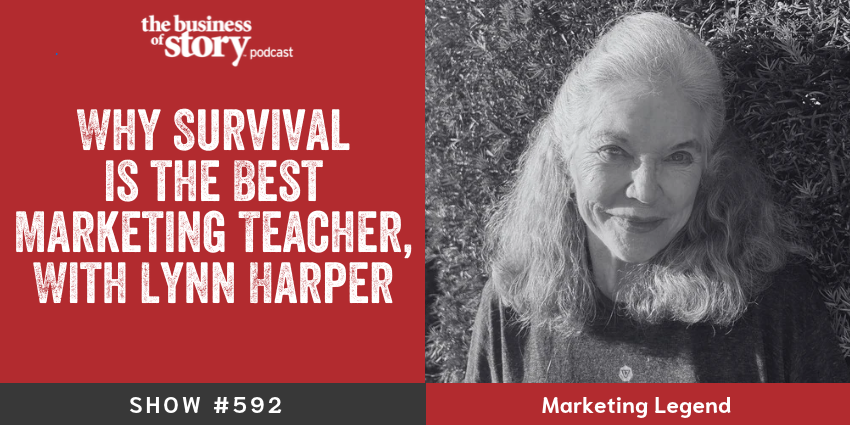
Meet Lynn Harper: From a Berkeley Dumpster to the Pinnacle of American Marketing
Lynn Harper’s credentials are not listed on a diploma.
They are written in experience that most marketers will never accumulate in ten lifetimes.
Discarded as an infant in a Berkeley dumpster and rescued, she was raised by a showbiz family with roots in vaudeville — her uncle David married Carmen Miranda, and her uncle Maury co-founded Gulf and Western, which bought Paramount Studios. She made her performing debut on the radio at age three, went on to TV roles including My Three Sons, appeared in films at Paramount, and recorded country music before buying and running her own nightclub featuring Merle Haggard’s band, The Strangers.
She was present at a Charles Manson recording session at Vox Studios before any of the world knew who he was. She once drove a member of the Manson Family in her car.
And then, because she ran out of money with a baby and no résumé, she walked into Max Factor with nothing and talked her way from shipping department assistant to the president’s right hand — and from there into a decades-long marketing career at Gillette, Miles Laboratories, Haynes Hosiery, and ultimately EVP of Marketing & Sales at Quorum International.
She built her entire marketing education not from case studies.
She lived them.
What’s in It for You
- The Look Below Principle — the one diagnostic question every marketer must ask before any major campaign launches
- Why vampire video is a documented brand-killer — and how Mary Wells Lawrence made the exact same mistake on the Alka-Seltzer campaign
- Matrix Marketing — Lynn’s cross-functional team model invented at Miles Laboratories that stops brand fragmentation before it starts
- Why no campaign in history has ever rescued a product that does not deliver on its promise
- How verbal judo — the disarmament discipline Lynn mastered as an Oceanside Police volunteer and San Diego County Deputy Sheriff — applies directly to brand trust and customer communication
Watch and Listen
The Look Below Principle: The Brand Story Question Nobody Teaches
Mary Wells Lawrence made the same mistake.
Her famous Alka-Seltzer spot — the Italian mama standing over her son while he eats spaghetti, the son sighing “Mamma mia, that’s a spicy meatball” — was loved by everyone who saw it. When audiences were asked which brand the spot was for, they answered Ragu.
Two of the most gifted marketers of their era. Two campaigns audiences adored. Two brands the audience never remembered.
The failure mode has a name. Lynn calls it vampire video. The execution is so entertaining, so memorable, so complete unto itself that it drains your brand identity dry before the media buy is even over.
The diagnostic: before any major campaign, ask whether your audience will walk away knowing who they just saw. If your celebrity, your stunt, or your concept can stand alone without your brand — it will.
Matrix Marketing: The Cross-Functional Antidote to Brand Fragmentation
Lynn invented Matrix Marketing during her time at Miles Laboratories, where her role required coordinating R&D scientists, medical doctors, and sales teams simultaneously.
The model is straightforward: every discipline that touches a product — research, science, sales, marketing — meets regularly, talks regularly, and shares everything.
“If you don’t,” she said, “you’re gonna be messed up like you wouldn’t believe.”
Most brands fragment their message before the market ever hears it. Marketing runs one direction. Sales runs another. R&D builds something nobody has language for. Matrix Marketing stops that fragmentation at the source — and it is one of the earliest practical descriptions of what StoryOps™ delivers inside a modern organization.
The Product Has to Work. Full Stop.
No campaign saves a product that fails.
Lynn watched this truth destroy Quorum International. Her CEO promised a product — live, on a satellite broadcast to fifteen thousand distributors — that wasn’t ready. Not close. Within six months the company collapsed. She had resigned in thirty days.
The promise must match the product. Value-based. Effective. Necessary. One disappointment and the customer is gone — and now they take twelve others with them.
The Survival Curriculum
Lynn Harper did not study marketing. She survived it.
The child actress making her radio debut at three, bribed with paper dolls. The country singer who killed a nightclub in two years. The EVP who created the most memorable campaign of her era and watched a celebrity drink her brand dry. The police volunteer who spent fourteen years learning that lowering your stance and softening your voice is more powerful than anything in your holster.
Park Howell says it best at the close of their conversation: “You’ve had verbal judo your entire life.”
Every experience left a principle. Every failure produced a framework.
That is a brand story operating system.
Built not in a classroom. In survival.
Links
- Joe Namath Beauty Miss Pantyhose Commercial
- Craft your brand story with the StoryCycle Genie™
- What users are saying about the StoryCycle Genie™
Added Storytelling Resources You’ll Love
How to Effectively Position Your B2B Brand With April Dunford — When your campaign spectacle outshines your brand, the root problem is positioning: April Dunford shows you exactly how to own the category where you actually win.
Why Brand Story Governance Is the Only Guardrail Standing Between You and Strategic Collapse With Magda Adamska — Lynn’s Quorum story is a case study in strategic brand collapse; Magda Adamska has catalogued 250-plus of them and shows you the four traps to avoid.
When Every Person in Your Company Points the Same Direction, That’s Not Culture. That’s Story Governance. With Gavin McMahon — Matrix Marketing is Lynn’s version of Gavin McMahon’s Arrow of Coherence — this episode installs the cross-functional framework into your organization.
Each recommendation selected to deepen your mastery through The Business of Story’s archive of storytelling wisdom enhanced by modern application.
Lynn Harper’s Conversation With Park Howell on the Business of Story Podcast
Park Howell: Well good afternoon, Lynn. Welcome to the show.
Lynn Harper: Well, thank you, Park. It’s a pleasure, believe me.
Park: You know, just for a little bit of a backstory for all of our listeners and viewers here, Lynn Harper was my boss. You were what, senior VP of marketing at Quorum International way back in…
Lynn: Well, actually we fight a lot over our titles, as you know from Prince Harry and Megan. I was executive vice president of marketing and sales.
Park: That’s right. Well, you were heading up the whole thing. And it was a very, very fast-growing electronics company. This was back in 1993, when we worked together. I spent about two years there. We had so much fun working together and I learned so much from you.
I thought, man, it would be great to have you on the show to talk about your extraordinary life and how so much of these things that happened to you worked into you being this international marketing guru in the day.
Lynn: Well, I also like to make sure that we tell everybody listening and watching — without you, we would not have had the largest independent video speed in the United States of America. So I want to make sure that you get the credit for that.
Park: Thank you. Quorum. Yeah. We had a satellite network, and it was before live streaming video back then. So we would shoot and produce these shows for all of our distributors and every week run them over to a satellite uplink truck in Phoenix, and then they would broadcast it live. People would be all around the country watching this Quorum show come in. It was really quite something.
Lynn: It sure was, and it really had a lot to do with the gigantic surge in sales. The satellite was your idea.
Park: Well, I wish I could claim that. It was kind of up and running when you hired me, but then you and I really built it out. And then I did go on to my next client when I was able to start Park Company. It was Forever Living Products, and they wanted to do a similar satellite network. So everything I learned at Quorum we applied out there and got it up and running. And then thank God the internet came along and made life way easier than trying to do KU band satellite broadcasts.
Lynn: But it’s not bad being first with the best, so no problem.
Lynn Harper’s Childhood: Abandoned as an Infant, Adopted, and Raised in a Hollywood Showbiz Family
Park: So Lynn, tell us a little bit about your entry into this world, because it’s really quite amazing. Then how you found yourself in Hollywood as a very young lady on a lot of different TV shows and in movies before your illustrious marketing career.
Lynn: All I can say is I did not know that I was adopted until I was an adult. I did not know that whoever gave birth to me tossed me in a dumpster in Berkeley, California. If I hadn’t been found, you and I wouldn’t be here talking.
However, I was adopted by the most amazing mom and dad. Unfortunately, when I was two and a half, my dad passed away of cancer, and mama raised me and a baby sister alone.
She comes from a showbiz family back in the day — vaudeville, all that exciting stuff. Apparently her dad, my grandfather, was with Hall Road Studios. My uncles were all cameramen. My uncle David, the baby of the family, married Carmen Miranda. That didn’t hurt, you know.
So mama raised me to be a showbiz Broadway baby, but not Broadway. It was California. And that’s how I got into it.
How Lynn Harper Started a Hollywood Career at Age Three in Radio and Television
Park: What was one of your first TV roles?
Lynn: The first role I ever got was when I was around three or four, after my father had passed away. For some reason my mother wanted me to memorize a scene from The Secret Garden. And if I did and said it on the radio, she would give me these paper dolls that I had my eyes on.
I memorized it perfectly and I got the paper dolls. They were called the Happy Family, I think I remember. So I have to be bribed for everything that I do.
Park: So you were three years old and then on the radio?
Lynn: I was. My dad died when I was around two and a half, so we moved from San Francisco to live with my mom’s oldest aunt in California. The show business never stopped from that moment on, because the whole family was that. That’s all we knew, or all she knew.
And Park, you don’t know this, because I just found this out recently. My uncle Maury Coke had a company called H. Coke and Sons with a government contract doing amazingly. He had a partner by the name of Charlie Bloodhorn. So Charlie and my uncle got together and they developed a company called Gulf and Western.
Gulf and Western bought, among many other things — they had that giant building in New York, which by now was the Trump Tower, believe it or not. My uncle Maury and Charlie Bloodhorn decided they want to get into show business through acquisitions. And my uncle Maury and Charlie Bloodhorn bought Paramount Studios.
I found that out just a couple of years ago. I didn’t have any idea. I never connected Charlie Bloodhorn, my uncle Maury, Gulf and Western. When it said Gulf and Western owned Paramount, I quickly looked at the dates. Oh my God.
And that explains why uncle Maury got me a meeting with Bob Evans when I was a teenager. Bob Evans was the president of Paramount Studios. And his friend Roman Polanski was at the door telling him it was time to go to lunch.
Park: Bob Evans was a famous director, studio head.
Lynn: Time, you know, get rid of the kid, we’re going to lunch. And this is before the terrible Sharon Tate stuff. So this’ll tell you it was before 1968.
Lynn Harper’s Family Connection to Carmen Miranda and Growing Up Around Old Hollywood Royalty
Park: I remember one time when you and I were just getting acquainted at Quorum, and you told me that you had a bit role on My Three Sons as Robbie Douglas’ girlfriend.
Lynn: Yes, and you may see it anytime you want. Just Google My Three Sons. The one that I know is on the internet — my daughter found it — it’s called The Ballad of Lysistrata.
You remember Lysistrata from the Greek mythology where she withheld sex from the men unless they did whatever they were supposed to do? So she appeared and told all the boys that they wouldn’t go out with them until they won the football game.
He said something to the effect that I was the other girlfriend, the adjunct girlfriend, the side piece. Betty’ll do it. And the scene you will see shows Betty coming down the hallway in school. Robbie tells all the boys, here’s Betty, she’ll do it. And my answer was something like, she said it would happen just like this. No, Robbie, I don’t think so.
Park: Now, what were some of the movies that you were in?
Lynn: All the films that I did at Paramount had nothing to do with my uncle because I didn’t know back then. I don’t think my mother even knew.
The first one I ever did that I saw on television is called Stars Are Singing. I was eight, and it was with Anna Maria Albergetti, who was a young sixteen-year-old opera singer who came over and was the new hot thing. She was wonderful. And Rosemary Clooney was in it.
Another one of interest was 1970. It was called Christine — but not the car — the story of Christine Jorgensen.
Park: I don’t remember the story.
Lynn: I do, because we lived in a hotel for a short time. I was watching television. It was black and white. My mother and my Aunt Violet were watching television when the news came on. A plane landed in Burbank and a lovely lady came out of the plane wearing furs. She was blonde. And my Aunt Violet leaped up and shut the television off.
Years later, I was cast as the sister of the real Christine Jorgensen for the movie Christine. And believe it or not, Christine and I became very good friends.
She said, I was 21 years as a man. When I was 21, I had the very first sex change operation on the planet, as far as they knew. And she turned into a very beautiful woman and lived a really interesting life. She remained my friend until she passed away. I miss her even now. She told me that her body was much better than mine.
Park: Ha!
Lynn: Well, she was right, Park.
Park: Tell us about Carmen Miranda — your aunt Carmen Miranda.
Lynn: She was actually wonderful. I was raised in a really loving family. My mom had seven brothers and sisters. Every single one of my aunts and uncles ended up with their own businesses. They were just amazing.
When my uncle David married Carmen in 1947, I never knew which ones were coming into the family and which ones were my mom’s aunts and uncles. Everybody was related.
When I got to be about eight or nine, all of a sudden I realized Carmen, my aunt Carmen, was Carmen Miranda. Oh my God.
And this is my idea, nobody said it — Dolly Parton was the latter-day Carmen Miranda. Think about it. A unique individual, nobody like her, talented beyond belief, wonderful people. I always thought of Dolly only as my aunt.
My aunt died in August 1955, at 46 years old. A heart attack. She was wonderful. I used to swim in her pool every week because she lived five minutes from us.
The last time I ever saw my aunt — I can never forget it. I’m in the pool all by myself, and I look up at the balcony of the master bedroom. She drifts out from the balcony. I see her looking over the pool. She didn’t wave, she didn’t do anything. She just looked. Maybe a minute. And then she drifted back in.
I never saw her again. She died soon after that. To this day I can still see her.
What Happened When Lynn Harper Crossed Paths With Charles Manson at a Recording Session
Park: Still quite amazing. Now, I remember you telling me about your run-in with Charles Manson.
Lynn: Yep. I had a friend named Randy Keith. I met him when I was twenty-one and he was twenty-two. We were at RCA Studios. We had a theme song for the movie Lila. I sang, he was the musical director, played guitar.
He was a producer all his life. And he asked me, did I want copies of his recordings? Of course, I love your work, Randy.
So one day he calls me up and he said, listen, I’m driving down Laurel Canyon. I pick up this hitchhiker. He had this aura about him. And this is what he said — dig on his name. Okay? What’s his name? It’s Manson. His name is Charlie. M-A-N-S-O-N. Isn’t that heavy?
So he says, I’m recording Charlie. Wanna come see the session? Sure. So can I bring my friend Margie? Yes, you can.
So Margie and I dressed up — we look clean and neat, little high heels, little pretty outfits on — and we go into Vox Studios in the San Fernando Valley. And in the booth, on the floor in the studio with a microphone pulled down, was this dirty-looking guy, barefooted, dirty feet, long hair. He’s got this guitar and he’s wranging away on it.
I remember one lyric from the whole thing, which was pretty horrible, but the lyric was brilliant. I thought, you know, the only thing was: I like you. Do you like you? And I thought, well, it’s heavy. One good thing.
Roger and I said, we gotta go, Randy. We gotta go. And so we cut out of there because there were these girls in there also — bare feet, long hair.
Randy told me later that Charlie said Margie and I ruined his session because we had bad vibes. And I thought, my God, we pissed off —
Park: You don’t want to get on his bad side.
Lynn: I wondered if we’re in danger.
And then another time, Randy’s car broke down and he needed to go to the Spahn Ranch where Charlie and his group were living. He wanted to pick up a girl whose name was Gypsy. Her real name, if you want to look her up — because she’s still alive, I think — is Catherine Share.
So I drove him out there and then this girl gets in my car. I said, my car wash coming up, you know. I dropped him off at a recording studio. I found out the next day she couldn’t play worth anything on the violin. But her name is Gypsy, why not.
And that’s all I ever heard of that until all this happened, because they closed Vox Studios. The Charlie Manson thing came out that he was involved, it was the Manson gang, and I remember — oh my gosh, it’s the guy with the dirty feet.
I called Randy, Randy, we can get money for this. So he said, no. I said, Randy, you’re so lazy. I will find the tape.
So I called, and Vox Studios had given all the tapes to a storage unit. Got the number of the storage unit. I called up and a guy said, wait, let me look. Producer Randy Keith. Okay. There’s a lot of names on this. Here’s a name. Says Charles Manson.
And he says, you’ll have to come pick it up. So I called Randy, I said, you gotta go pick it up. Anyway, the guy said he’d charge fifty dollars a day for all those months he kept it. And Randy just turned around and left, because everybody was selling Charlie Manson recordings. He was recording all over the city. So it didn’t really matter.
I said, that’s marketing, baby.
Park: So wild. And that brought Sharon Tate full circle for you, didn’t it?
Lynn: Unfortunately it was not just Sharon Tate, but it was Abigail Folger, her girlfriend, Jay Sebring, a gentleman who used to date Sharon but was still a friend, and the young gardener, and some guy who drove up there by accident and never made it back.
Park: Your skin must have just crawled when you heard about all that.
Lynn: Yeah. And then his group murdered a man and a woman on Los Feliz Boulevard as well. It’s beyond belief how these things happen. But Charlie’s gone now. At least I certainly hope so.
How Lynn Harper Built a Country Music Career and Owned a Nightclub Before Entering Marketing
Park: Let’s move on to something a little brighter. You also had a bit of a career as a country western music singer, correct?
Lynn: Yep. As a matter of fact, I did so well that I was able to buy a country western nightclub. Did you know that?
There were two nightclubs that were huge in California. The Palomino was number one. I used to sing there a lot, it was wonderful. All the superstars were there. The Aces Club was number two — not quite as big as the Palomino, but really big.
I remember when I first started country, I sang at the Aces Club and the Palomino and one called the Nashville West. It was a circuit where all the California superstars and others, like me, would sing for Christmas and push our records.
I had just had my first record out and it had just started playing on the radio. And I remember the band leader. His name was Gene Davis. He sees a girl, she just had a record, big deal, they come, they go, whatever. So I tried to tell him what chords were in my song. He kind of shoved me away — yeah, yeah, yeah, get out of my face, kid.
And I never forgot it. Time goes on, more records, and the Aces Club was for sale. And Gene Davis was still there. And I thought, you know, it’s been a couple of years, but I’ll buy the Aces Club. Now see what he says.
Park: You became his boss.
Lynn: Well, actually, yes. I had a lot of faith in his abilities as a band leader. He was very good. But they moved on and I needed another band. You’ll never believe it — I hired Merle Haggard’s band. He had just fired the Strangers. That’s the name of the band.
The lawyer for Merle Haggard immediately got back to me with no. Strangers belongs to Merle. You, on the other hand, either cough up the money to buy it or get another band.
So I got another band and I called them Southern Comfort, and we toured the world many times and had a good time. So the Aces Club — when it closed it became a church, and then it became all Hispanic. So if I want to learn my Spanish, I’ll go down and listen to the sermons. Dios mío.
Park: So had this pretty much all happened up until you’re about thirty? When do you make your transition into marketing?
Lynn: I was forced to make a transition when I ran out of money. Who wouldn’t? I was the breadwinner and I had just had my son, Joey, and the club — you have to understand, when did you ever know that I could run a nightclub? I can’t run a nightclub. I killed it in two years. Dead as a doornail, gone.
And I had a baby, and my husband Bill came with me from Europe. He had a wonderful booking agency, but it doesn’t travel. So he said, I’ll watch the children, you sing or whatever, but if you don’t have a record, it’s pretty hard to get those jobs.
So here’s the baby and I had to get a job. I had never worked a job in my life. I did the singing or the acting or whatever it was, but I never worked a job. I couldn’t type, I couldn’t do shorthand. But I had to make a living.
How Lynn Harper Got Into Marketing at Max Factor Without a Resume or Any Marketing Experience
Park: How did the job search go?
Lynn: I went to an agency and filled out the forms and they sent me to a bunch of jobs. I would interview and interview, and the answer was no, no, thank you, no, uh-uh, no.
I finally decided being honest about what you can’t do is not gonna work. So they sent me to another job. They said, this is in the City of Industry, and it’s shipping — which is far from the home office — and it’s Max Factor shipping. They don’t need a secretary. They just need a low little minion who can help the man who is the head of distribution. A man called Don Ferrell.
Park: Max Factor being the big cosmetic company.
Lynn: In the city, Max Factor was gigantic. It was huge. The big building was in Hollywood, a twelve-story building across from Groman’s Chinese, next door to the Hollywood Roosevelt.
But Mr. Farrell in shipping was way out in the boonies. And I thought, well, okay. So I decided not to tell him I could take shorthand, because he didn’t need a secretary. I used to call my shorthand the Palmer method — Palmer method is how you just write regular writing. So I just made it up.
Turns out he didn’t need anybody to lie. He just wanted somebody to straighten his office up and keep him straight when he came in from a hard night, if you know what I mean.
I just loved this man and he loved me because I took care of him. I cleaned his office when the bigwigs came to visit. We became very close.
So then, three months after, I was working there — I joined Max Factor when Joey was almost one month old. And I started working when he was a month old. Bill is home, so that’s good.
I figured, I’ve never worked before. Mr. Farrell is somebody very different. I can’t do this nine-to-five thing. I gotta get out of this. I told Bill, I can’t do this, is it me?
So Bill says, well, you know, the children gotta eat.
And then I talked to Hollywood a lot. They wanted to know where their shipment was going. And one young lady said, hey, I’m the secretary for one of the three salesmen. I’m leaving because I’m gonna have a baby. I said, oh my gosh. Her name was Judy.
Judy, do you think I could get your job?
And she said to me — we’d never met, she was in Hollywood, I was in industry as the lowest person on the totem pole — she said to me, honey, you can’t do my job.
I will tell you that I had her job in sixty days.
How Lynn Harper Rose From Entry Level to the President’s Office at Max Factor
Park: How did you rise through the ranks?
Lynn: The man that I worked for — of the three salesmen — was a handsome man, lazy man, never wanted to do anything. All his salesmen would call and tell him the numbers and he’d write them down and have me try and type them as best I could.
But he didn’t want to talk to them, so I said, I’ll talk to your salesmen. I can write numbers down, who can’t? So I took all the calls from all the salesmen because I loved those guys. They were fun.
Here I am as a secretary for the first time in my life.
And the president of Max Factor came to the sales floor and he said, his assistant of twenty-five years is in the hospital, not expected to come back. I need one of you three secretaries to fill her position until I can do something about it.
Two of the other secretaries put their heads down, looked around, coughed. And I said, I’ll do it. I’ll do it. Because he was on the twelfth floor and that was as high as you could go.
So he said, okay, you come on upstairs. So I went upstairs and I situated right outside President Herm Schnitz’s door.
The guy that I worked for called me and he said, hey, you can’t work for two people. I said, yes, I can. He said, no, you can’t. You have to pick. I said, I’m so glad you said that, Ron. Bye-bye.
And I stayed working for the president.
I’m working for the president, I loved him, wonderful guy, but I’m still somebody’s minion. I don’t care if I’m the secretary to the president. And so I said, I’ve got to get a better job, a more meaningful job. Since I’ve been here, I know the marketing is where it’s at. I didn’t even know what marketing was before, but that’s what I want to do.
So I came to him, Herm, and I said, Herm, listen, I love working with you. But I need a good job. He said, you got the best job in the world. I said, no, you got the best job in the world. I’m your assistant.
He said, I’ll tell you what I’m gonna do. I’m gonna give you six months in marketing under the vice president of marketing, Dennis Clark. I haven’t told him this yet, and he won’t be happy, but I’ll do that. And if you fail, you can’t come back, you can’t sweep the sidewalk in front of this building.
I said, I’ll take it.
And so that’s how I got into marketing. I was assigned to the first lady vice president of Max Factor, Janet Myers. She was my idol. She still is. She’s ninety-five and still my idol.
I worked for the Geminis brand. So I went from there to Gillette to American Home Products to Mars, working directly for Forest Mars. And I never looked back.
What the Joe Namath Beauty Miss Pantyhose Campaign Teaches About Brand Identity and Celebrity Advertising
Park: You had a very illustrious career for many decades in marketing. Give us an idea of maybe a campaign or two that some of us older folks would remember.
Lynn: I could tell you about the three products of mine for three different companies that are still on the shelves. I’m not going to. I’m going to tell you about the product that was all my idea that died a horrible, bloody death.
When I was hired from Jaffra of Gillette to Haynes Hosiery in North Carolina — first time I ever left California — I called the president of Max Factor, Herm Schnitz. I said, Herm, what should I do? And this is what he said that made me accept North Carolina: what the hell? Take it.
Because of that, I did it.
So I went to Haynes in North Carolina. They’re the biggest in the world. Huge. I worked with a North Carolina agency called Long Haymes Carr. And they told me, we need to find a model who has ugly, ugly legs. Then we’ll put the Beauty Miss on her and she’ll be beautiful.
The guy said, well, you’re not gonna find a model who’s gonna say she’s got ugly legs. Anyway, it turned out from that meeting — wasn’t my idea, but I jumped all over it — Joe Namath has ugly legs.
They said, he’s got the ugliest legs of any human being, male, female, or frog. He’s awful. I said, yes, that’s it. Yes.
We are going to have Joe Namath. I bet he’ll put those pantyhose on. So he was contacted and he loved the idea. Because there were gonna be pretty models in there too, right? Yes, there are gonna be beautiful models.
So if you want to Google the commercial, just put in Joe Namath pantyhose. And you will see these toes in pantyhose, nice looking, panning slowly, slowly, slowly up. To beautiful legs, up, up, up, until you get a grinning face of Joe Namath who says, if they look good on me, they’ll look good on you.
And I’m thinking, oh my God, I’m a marketing star. Oh my God, I’m gonna be rich. Everybody’s gonna wanna hire me.
And by God, Beauty Miss died.
Park: I remember the commercial. I don’t remember the brand at all, but I absolutely remember Joe Namath wearing those.
Lynn: You would remember. Most people have never heard of Beauty Miss. If they heard it, they don’t care.
Nobody knew the brand. After they came on, my God, do you know what your numbers are? I said, well, we’re gonna do a little focus group and find out who remembers. The question to the ladies was, do you remember a certain brand that Joe Namath wore? Oh God, yes, my husband’s jealous. What’s the name of the brand? Well, it’s Haynes, of course.
You’re lucky you get to keep the job.
Park: What would you do differently?
Lynn: I would look below. Look below. The top idea, great, fantastic, exciting — old boy Joe Namath in pantyhose. Below. Joe Namath in pantyhose. Do you think that they’re gonna remember the brand? They’re gonna remember Joe.
And I know this because the greatest woman in advertising — Mary Wells Lawrence — she made a huge mistake, the same thing I did when she was starting out. Do you remember a commercial that had spaghetti sauce? A kind of fat young guy eating the spaghetti sauce and an Italian lady who’s standing above him like mama. And he’s eating, eating, eating. He says, mamma mia, that’s a spicy meatball.
Everybody said it’s for Ragu. No, it wasn’t for Ragu. It was for Alka-Seltzer. She got handed Alka-Seltzer and blew it the same way I did. And everybody said he was eating Ragu. No, he had a stomach issue.
Park: The spot was just such a spectacle in and of itself that it actually took away from the punchline of the brand.
Lynn: But everybody loved the commercial. Even an actor friend of mine — he couldn’t get enough of it. He used to entertain Bill and me by saying, mamma mia, that’s a spicy meatball. I said, stop it, I don’t want to hear anymore. Yeah, but it happens, it happens. But I made sure it didn’t happen again. I couldn’t afford it. I had kids. I had food to buy.
Three Marketing Principles That Never Go Out of Style: Product Quality, Sales Alignment, and Matrix Marketing
Park: What do you believe are two or three truths about marketing — no matter when you’re doing it, be it back in the 1970s or today in 2026 — what are the Bible truths about marketing that every marketer should consider?
Lynn: That’s probably the best question you could ask any marketer. The most important thing about marketing is that you make money and you don’t die.
If you have no product, you’ve got nothing. How do you have a successful marketing launch or career? The product has to be, first of all, necessary to the person who might purchase it. Whether it’s necessary to save their lives like pharmaceuticals, whether it’s necessary to make them beautiful, or if it has staying power.
Because another thing is you have a great launch, big opening, and all of a sudden it doesn’t last because the product has to work. It has to work, it has to be effective, it has to be value-based. Otherwise, they’re gonna know. And if you mess up with somebody one time, they’re never gonna come to you again.
The best thing about marketing is if they purchase your product and it performs, it makes you feel wonderful too. That’s my product and they’re happy with it.
The other thing about marketing is marketing is not a standalone at all. The most important group that you can deal with in marketing is sales. Sometimes you’ll have a sales and marketing person, but basically sales is sales, marketing is marketing, and they must, must, must talk to one another and get along.
I had this situation at Miles Laboratories with the new products that we developed. Not only is sales very important and marketing very important, but we had R&D, we had research, we had doctors on the staff.
And if you do your thing and you don’t consult the people that really know — the doctors, the scientists — you spin your wheels. What you have to do — and this is what I did — I called it Matrix Marketing, because I didn’t know what else to call it. So I started it at Miles Laboratories.
Matrix Marketing is when the marketer, who should be running the show, makes every other team member a part of you. R&D has to send somebody. The doctors have to send somebody. The color people need to send somebody. And you have a team of maybe six to seven people who meet regularly, talk regularly, and share everything.
Because if you don’t, you’re gonna be messed up like you wouldn’t believe. I would never try and market something all by myself and leave all of the partners out. You’re asking for trouble.
So the most important third thing is teamwork. Teamwork, teamwork, and teamwork. Getting together and trying not to fight — because there will be some fights.
How One Lie Destroyed a Company: The Quorum International Satellite Network Story
Park: Let’s get everybody up to speed on what happened at Quorum. Let me take you back to when I came in for the interview.
Lynn: I remember distinctly, I led you into my gorgeous office — which the other president had been asked to vacate — and you followed me in. I said, please have a seat.
And I thought, Jesus, high school, what the heck? Who is this person? He’s eighteen years old. But I don’t want to ask him about that. I have to figure out how old he is. But does it matter? Frankmont’s pretty good as a headhunter.
He looks eighteen years old. This is what’s going through my head. So I sat down. So your name is Park. That’s a very cool name.
The more you talked, the more I said, I think he is the person I’m looking for. I don’t care about Raymond, you know, because what does he know? But I think you’re the one. Why? Because you were creative, wonderful to get along with, smart. And I figured, I don’t know how long he’s gonna be looking eighteen because he’s making me look like a grandmother.
Park: I remember I was thirty at the time.
Lynn: You were. Because I finally figured out — you have two children and one on the way. So I think I said, so you have a wife, her name is Michelle. How old will you be when your baby is born? Some trick question stupid.
And for the first week or two you were there, people were going, what is she doing? And by the time you had done your thing, they were doing, look at this.
Because I hired you as the creative head of Quorum. And I wasn’t looking for a creative head, I was looking for a creative person to run it. Head means the whole package. Everything. And the only person you had to answer to would be me.
Park: I said, yes, this looks great, but I need to go home and talk to my wife before I accept any offer.
And at that time, you’d already walked me down and showed me my office. And I remember, I was sitting there and you were sitting there and you said, what are you waiting for? And I said, well, I need to talk to my wife. And you go, well, yes, you’ll talk to your wife, but what are you waiting for? This is happening right now.
Lynn: Basically what I said was — not these words, because that would be terrible — I said, you will take the job. Period. Because I’m telling Raymond that I hired you. So if you want to make me look like an ass, tell me no.
Park: That was funny because then I called Michelle and I said, well, I’m sitting in my new office. And Michelle said, whatever happened with you coming home and talking to me about it? And she laughed.
I was making now triple what I was making at the agency. And we had a really great creative team there. And we had six weeks to pull off five product launches at a gigantic convention in downtown Phoenix at America West Arena.
Lynn: Two days in America West Arena, hired people like the Oak Ridge Boys, Sergeant Shriver came and gave away a car, a huge talent show involving very talented people.
My daughter was twelve or thirteen at the time and they needed another little girl to sing. And I remember hitting whoever’s lap — I think it was you in the audience with Michelle and Bill. And they put on the flashlights when she finished the song. She sang Wind Beneath My Wings. She doesn’t do that anymore, but it was a family thing.
It was the largest MLM of electronics in the world. In the world. There was never one bigger, even close to how Quorum was then. Unfortunately the major owner made a very bad mistake.
You do not tell an untruth to a television audience of hundreds of thousands of people. And he didn’t remember that every one of our distributors had purchased the dish that brought Quorum — the one that you designed.
Park: QSN — the Quorum Satellite Network.
Lynn: When people would invite someone over to look at the company, all they had to do was say, seven o’clock, turn on the TV, Quorum International is on the air. And that was thanks to you — we got all these new people because they were able to sign up.
Unfortunately, the head of the company did not tell the truth. We had a really gigantic product called the Home Master. Today it’s no big deal, everybody has one, but way back then this little thing — you could run your house from somewhere else. It wasn’t ready. It was still being tested.
But when I was asked at the big convention to tell people it’s gonna be for sale in a month, the answer is no because it’s not even on the boat.
And then I’m gonna say what Raymond told me, because I later had a radio show in San Diego and I told everything.
Raymond said to me, I said, I’m not — he said, you have to say that it’s gonna be ready to sell. That’s not true. He said, you stupid American girl. Say certain sounds, you get money. Don’t make those sounds, you do not.
I said, well, I’m not doing it. So I introduce him to the audience, and Park, I hear him say it. Everybody heard him lie.
They all waited. The next month it wasn’t gonna come. The month after it wasn’t gonna come. They were going out — I don’t want to say rats on a sinking ship because I don’t blame them. I left in thirty days. I gave him my thirty-day notice because I don’t stiff anybody.
And they offered me a lot of stuff. Finally I said, look, I have children, husband, I have to move everybody. I said, you have to give me a house. And it has to be in Scottsdale.
They didn’t even give me paperwork. They gave me a piece of paper and I scrolled on it that if I leave or if you fire me, I’d give the house back.
When I left, I told the company, you need to send me something because I have to give you back the house. And I signed the house away, not a problem.
Time passed, and some people we knew told me I was crazy. That the house was in my name legally and I didn’t have to give it back. And I thought, you don’t understand what it’s like not to be able to sleep because you cheated somebody. I would way rather be able to sleep. I’ll get another house. And I did.
What Lynn Harper Did After Marketing: Volunteer Police Officer, Armed Security, and Back to College at 60
Park: The thing that has always amazed me about you is you are a bit of a shapeshifter. You know where your strengths are and you’re really great with people and marketing. And then you became a volunteer sheriff. How did you become a volunteer sheriff?
Lynn: When I was successful, it’s no secret that you make money. And I wanted to give back a little because I wasn’t doing anything for my community.
I saw a letter in the paper that said the Oceanside Police are looking for volunteer officers because they don’t have any money and they’re in real trouble. I thought, wow. I tore the letter out and I put it away. I kept coming back to it. Finally I said, you know, I saw this letter for a reason. I’m gonna see what’s what.
Long story short, I joined the Oceanside Police. I was a volunteer for eight years.
During that time I also joined the San Diego County sheriff as a deputy, because there’s only one sheriff and all the rest of us are deputies. I wanted different places to call on and to work with. So I became a sheriff for six years.
And there’s a time in your life when you time out. I knew I couldn’t work for Oceanside or the county as a sheriff for my whole life.
If you are a security professional, you can work until you’re a thousand years old. It doesn’t matter, as long as you can do the work and do it properly. So I actually went to the Nanpur Academy for Officers and went through all of that, and then weapons training.
I have a Glock, which is a semi-automatic, and then I have my favorite which is a 1951 Smith and Wesson. My favorite, you know.
So I joined Allied Universal and Securitas — the two companies I work with — and they book you. So I was booked through these companies for a week, a job for three months, whatever it was, all armed security.
One day they tell us that Homeland Security has applied for ten of their best armed officers. We’re looking at each other, nine guys and me, and we’re saying, finally we’re gonna get some decent money.
What did I tell you I was earning? Twenty-five dollars an hour.
Park: Yeah, twenty-five bucks an hour.
Lynn: The government was paying twenty-one. That’s four dollars less an hour. Three guys walked off. I said to myself, I’m gonna get another job and then I’ll walk off, because I’d like to say adios properly.
And then my cat bit me. It went septic. I went to the hospital. I survived it, they didn’t think so, but I did.
Park: And the last thing I want to ask you, Lynn — you’re using your student email right now at Miracosta College. What are you studying?
Lynn: Miracosta College is a big college with two satellites. I decided to take some courses there. I take a radio course — it started with the good old times of radio, and now the students write their own scripts and perform them.
And then improv. Improv is one of the hardest things you can do.
And I’ll say this about armed security. When we signed up, they said, you have to sign — you can’t, you don’t get a second shot. And the reason you don’t is because somebody in class said, well, I can just shoot to wound. I can’t kill anybody.
And they said, excuse me. No. You will shoot to kill. You get one shot. You will shoot to kill. If you don’t kill, they can kill you. And you’ve got a client you have to protect because you promised that you give your life for your client and also protect yourself. Either you’re willing to do that or take a walk.
In my case, I don’t care. At this point I’ve lived long enough. That’s fine, you know.
And I’ve never, ever drawn my gun in all these years. Never shot it. Never even touched the holster.
Because we also — and you’ll love this part — they taught us verbal judo. All it is, is talking with the right look, the right sound. For instance, I lower myself down to almost a little bit over five foot four. I sink down in myself and I lower my chin a little bit and I kind of talk in a little kind of voice like this.
Hi, my name is Lynn. Is there something that I can do for you?
Something like that to disarm them. Because if you walk up like this, the next thing you know, you won’t know anything.
So the verbal judo has really been wonderful. You can get that in certain academies online.
Park: Well, you think about it — you’ve had verbal judo your entire life. From that little girl that was left in a dumpster to your acting career to singing to marketing to where you are today. Lynn, it’s just been an absolute pleasure having you. Thanks so much for coming on the show and sharing your extraordinary life with our people.
Lynn: Well, it’s my pleasure, Park. Say hello to Michelle and the kids. I really appreciate talking to you.
Park: It’s been great, and I will. Thank you, Lynn.
Lynn: You’re welcome.
Q: What Is the Vampire Video Marketing Lesson and How Does It Apply to Brand Advertising?
A: Vampire video is a brand recall failure where the creative execution — a celebrity, a character, or a spectacle — is so memorable that it outperforms the brand in audience recall. Audiences remember the entertainment but forget the product. The Joe Namath Beauty Miss pantyhose campaign is the defining example: focus groups remembered Namath but credited the brand to competitor Haynes. The diagnostic fix is simple — ask whether audiences can name your brand after seeing the ad without audio or logo.
Q: What Is Matrix Marketing and Why Does It Prevent Brand Fragmentation?
A: Matrix Marketing is a cross-functional alignment strategy invented by Lynn Harper at Miles Laboratories that brings every department touching a product — R&D, science, sales, and marketing — into regular shared meetings before any campaign launches. It prevents the common failure where marketing builds campaigns without input from the teams responsible for delivering the product or closing the sale. When departments operate in silos, marketing messages frequently contradict the customer experience, eroding trust and wasting media spend. Organizations using Matrix Marketing produce more coherent campaigns and stronger customer relationships.
Q: What Marketing Lesson Does the Joe Namath Pantyhose Commercial Teach About Brand Identity?
A: The Joe Namath Beauty Miss pantyhose campaign is a textbook example of celebrity advertising undermining brand recall — Namath was so entertaining that audiences remembered him but forgot the product entirely. This illustrates a foundational marketing principle: a spokesperson or creative hook must amplify brand recognition, not replace it. Entertainment value and persuasion are worthless if the audience cannot connect the emotion to the correct brand. Marketers still reference this campaign when training teams to subordinate creative novelty to consistent brand identity.
Q: How Did Lynn Harper Get Into Marketing With No Experience or Resume?
A: Lynn Harper entered marketing at Max Factor without formal credentials, landing her first role through persistence and interpersonal instinct after a career spanning Hollywood acting, country music, and nightclub ownership. Her early life — marked by abandonment, adoption, and repeated reinvention — gave her survival-sharpened communication skills that proved more transferable to marketing than classroom training. She rose from a shipping department position to the president’s right hand, then leveraged that access to negotiate a six-month trial in the marketing department. She went on to build a decades-long career at Gillette, Miles Laboratories, Haynes Hosiery, and Quorum International.
Q: What Is the Look Below Principle in Marketing Campaign Strategy?
A: The Look Below Principle is a pre-launch diagnostic discipline that directs marketers to examine every layer beneath the surface appeal of a big idea before committing budget to execution. The core question: if someone describes this ad at a dinner party tomorrow, which company do they name? If the celebrity, the stunt, or the concept can stand alone without the brand, it will — and the campaign will build recognition for the execution, not the product. The principle is a direct lesson from the Joe Namath pantyhose campaign, where the spectacle consumed the brand entirely.
Q: What Survival Experiences Teach the Best Marketing Lessons?
A: The best marketing lessons from survival experience center on clarity, resourcefulness, and deep audience empathy — the same instincts required to navigate genuine hardship. When resources are scarce and stakes are real, people who have faced adversity learn to strip away everything that does not directly serve the customer or close the gap between problem and solution. Lynn Harper’s career demonstrates that people who have survived abandonment, career collapse, and institutional failure often become more effective marketers because they understand human motivation at a visceral, not theoretical, level. Survival forces the same question every great marketer must answer: what does this person actually need, and how do I earn their trust?
Q: How Do You Prevent Brand Fragmentation Across Marketing Campaigns?
A: Brand fragmentation occurs when different campaigns, channels, or team members communicate inconsistent messages, leaving audiences unable to form a clear, stable impression of the brand. To prevent it, organizations need a single documented brand story that every team references, combined with a cross-functional review process — like Matrix Marketing — that audits every customer touchpoint for message consistency before launch. Practical diagnostic tools like the vampire video test help teams catch fragmentation early. Consistent visual identity, tone, and value proposition across all executions are the structural safeguards that protect long-term brand equity.
Q: What Is Verbal Judo and How Does It Apply to Marketing and Brand Communication?
A: Verbal judo is a communication discipline originally developed for law enforcement that uses precise, empathetic language to redirect resistance and build cooperation without escalating tension. In marketing, its principles apply to sales conversations, customer service scripting, and persuasive brand messaging — using a customer’s own language and expressed concerns to guide them toward a decision rather than arguing against their objections. The core insight is that persuasion comes from alignment with the audience’s existing worldview, not from overpowering it. Lynn Harper applied verbal judo principles throughout her marketing career long before she formalized the skill as a police volunteer.
Q: Why Do Most Marketing Campaigns Fail to Build Lasting Brand Awareness?
A: Most marketing campaigns fail to build lasting brand awareness because they optimize for short-term engagement — views, clicks, or cultural moments — rather than sustained, consistent exposure to a recognizable brand identity. When creative execution prioritizes entertainment or novelty over brand reinforcement, audiences remember the campaign element but cannot connect it to the brand — the failure mode the Joe Namath pantyhose example illustrates definitively. Lasting brand awareness requires that every campaign element — visuals, tone, spokesperson, and messaging — repeatedly reinforces the same core brand associations across time and channels. Without that consistency, marketing spend builds recognition for the execution, not the brand.
Q: How Do Cross-Functional Teams Improve Marketing Campaign Results?
A: Cross-functional teams improve marketing results by ensuring that every department responsible for delivering on a product’s promise — sales, operations, customer service, and product development — is aligned with the marketing message before a campaign launches. When marketing operates in isolation, campaigns frequently overpromise or misrepresent what sales teams are actually equipped to deliver, creating a credibility gap that undermines both initial conversion and long-term retention. Matrix Marketing formalizes this alignment by requiring all functions to contribute to and ratify the core value proposition before any external communication goes out. The result is campaigns that hold up under customer scrutiny because every team behind the product is telling the same story.
 Listen To More Episodes