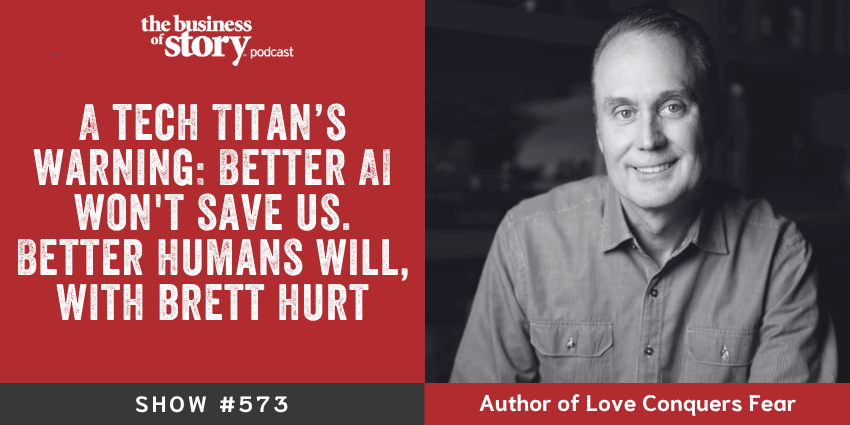
The Most Urgent Upgrade of the AI Age Is Personal, Not Technological
What Happens When the Man Who Built Five Companies and Backed 12 Unicorns Tells You the Real Problem Isn’t AI — It’s Us?
You believe in the future of artificial intelligence. You’ve watched the tools evolve in real time, you understand the leverage they offer, and you’re leaning in — because that’s what serious leaders do.
But something underneath the optimism keeps nagging at you. If the technology is this powerful, and the people wielding it haven’t fundamentally changed how they think, how they lead, or what they’re building toward, then we’re just amplifying the same fears, the same scarcity thinking, and the same blind spots that got us here.
I’m your host, Park Howell, the world’s most industrious storyteller. Today’s guest built his career at the edge of that exact tension — and came back with a warning and a framework that every leader navigating the AI age needs to hear.
Meet Brett Alexander Hurt: Serial Entrepreneur, Investor in 151 Startups, and Author of Love Conquers Fear
Brett Alexander Hurt is one of the most accomplished technologists of his generation. He co-founded data.world, acquired by ServiceNow on July 7, 2025. He co-founded Bazaarvoice, which achieved a unicorn IPO.
 He sold Coremetrics to IBM. He has invested in 151 startups, backed 12 unicorns, participated in 52 VC funds — including SpaceX — and was named Austin’s Best CEO with the Legacy Award. He is an Aspen Institute Henry Crown Fellow and the host of the Love Conquers Fear podcast, 62+ episodes strong and publishing every Tuesday.
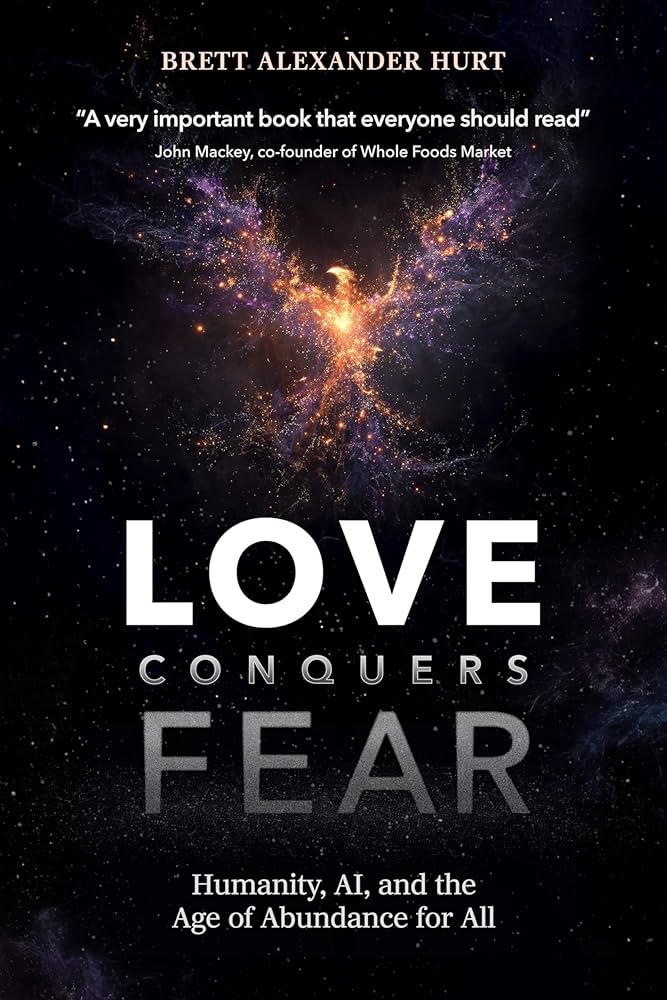
His new book is Love Conquers Fear: Humanity, AI, and the Age of Abundance for All, published June 23 by Do More Good.
Brett Hurt is not a philosopher guessing about AI from the outside. He is a builder who got everything capitalism promised — the Lamborghini, the exits, the recognition — and discovered it wasn’t enough. That discovery changed everything about how he thinks, leads, and writes.
What’s in It for You:
- How leading with love — not fear — is the only strategy that actually works in the age of AI
- Brett’s wild arc from chasing Lamborghinis to a psychedelic awakening that changed everything
- Why AI isn’t here to replace you — it’s here to make you more human
From Programmer at Age 7 to Psychedelic Awakening: The Transformation Arc That Changes This Conversation
Brett started writing code at age 7. By the time most people are still figuring out what they want, he had already found his mission — and spent decades executing it with a ferocity that built empires. He chased the milestones that signal success: the exits, the valuations, the Lamborghini. And when he arrived at all of it, he found something unexpected waiting for him there.
Emptiness.
The question that surfaced — why am I actually doing this? — led Brett to psychedelic-assisted therapy, Vedantic philosophy, and a fundamental reorientation of his entire operating system from fear and scarcity to love and abundance. His conviction is not that this shift is personally enriching. His conviction is that this is the upgrade humanity must make to survive the AI age with its soul intact.
Why Nuclear Weapons Are a More Urgent Existential Threat Than Artificial Intelligence
One of the most arresting moments in our conversation is Brett’s redirection of the AI existential risk narrative toward the danger we’ve collectively decided to stop thinking about: nuclear weapons.
Humanity has built more than fifty times the nuclear arsenal needed to effectively end civilization. Just two percent of that arsenal deployed would trigger a near-extinction event. The most urgent existential threat to human survival right now is not artificial intelligence. It is a technology we built, normalized, and then forgot to be afraid of — while redirecting all of our fear toward a newer, shinier threat.
That willingness to name the uncomfortable truth without flinching is the hallmark of Brett’s reasoning throughout Love Conquers Fear. He is not interested in the threat that’s trending. He is interested in the one that’s real.
AlphaFold, Psychedelic Therapy, and the Signals That a Better Future Is Actually Possible
Brett is also one of the most genuinely optimistic voices I have had on this show. Not because he’s ignoring the dangers — because the potential he sees is that extraordinary.
DeepMind’s AlphaFold project, which won the Nobel Prize, has decoded protein folding in ways that could enable what Brett calls unlimited medicine — treatments for diseases that have defied human biology for centuries, now unlocked in months. The Trump administration’s executive order fast-tracking psychedelic-assisted therapy for veterans — more of whom have been lost to suicide since 9/11 than to combat — is another signal that the culture is moving, even haltingly, toward the kinds of inner transformation Brett believes are essential.
He describes the “superfecta” — the simultaneous convergence of AI, quantum computing, robotics, and brain-computer interfaces — as an exponential forcing function unlike anything in human history. And he points to the rise of Public Benefit Corporations like OpenAI and Anthropic as meaningful evidence that at least some of the builders most responsible for shaping this era are thinking about governance, accountability, and purpose, not just growth.
The question, he says, is whether the humans guiding that convergence are operating from love or from fear.
When a 7-Minute Brand Story Analysis Outperformed Months of High-Priced Marketing Consulting
Near the close of our conversation, Brett experienced a live demo of the StoryCycle Genie® — an AI-powered brand narrative tool built on my Story Cycle System. In under seven minutes, it produced an analysis of his brand story that he said surpassed what top marketing firms had charged him hundreds of thousands of dollars to deliver over months of engagement.
His reaction wasn’t just complimentary. It was a real-time demonstration of his central argument: the extraordinary leverage available right now is not in the technology alone. It emerges when proven human frameworks and AI capability combine — when artful intelligence replaces the illusion that the machine can do it without you.
Better AI will not save us. Better humans, armed with better tools and operating from love instead of fear, just might.
More Information About Brett Hurt and Love Conquers Fear
- Love Conquers Fear: Humanity, AI, and the Age of Abundance for All — Brett’s new book, available now
- loveconquersfear.org — Brett’s platform, holding company, and community hub
- Love Conquers Fear Podcast — 62+ episodes, published every Tuesday on Apple, Spotify, and all major platforms
- Brett Hurt on LinkedIn — Connect with Brett directly
Three Business of Story Episodes to Deepen This Conversation
- Your Best Ideas Are Not Going to Come From a Chatbot, with Sara Connell — Sara Connell reveals the neuroscience behind creative downloads and why training your brain to access original thinking will always outperform outsourcing it to a machine.
- The Agencies That Thrive With AI Will Project the Most Flexible Identity, with Marcus Sheridan — Marcus Sheridan makes the case that the organizations winning in the AI era are not the ones with the best models — they are the ones willing to fundamentally redefine who they are.
- Using Artful Intelligence to Tell Your Sustainability Story, with Bruno Sarda — Bruno Sarda of EY explores how purpose-driven leaders use AI as a force multiplier for values-led communication, proving that technology and conscience are not opposites.
Brett Hurt’s Conversation With Park Howell on the Business of Story Podcast
What Made Brett Hurt a Serial Tech Entrepreneur? From Programming at Age 7 to 12 Unicorn Investments
Park Howell: Hi Brett, welcome to the show.
Brett Alexander Hurt: Thank you so much. It’s a pleasure to be here, all the way from Ireland too.
Park: I know it, and you are carving out time from your thirtieth anniversary trip with your wife Deborah to be with us today. So we appreciate that.
Brett: Yes. Thank you. Yeah, I got that decision right.
Park: Smart man, smart man. It’s great to have you here. You’ve got this book that is just launching, and the timing couldn’t be better considering all the fear and anxiety wrapped around AI — that you are taking head on through your experience as a tech entrepreneur, as an investor, and your own experience of turning fear into love, or overcoming fear with love.
So give us a little bit of backstory. How do you find yourself at this intersection?
Brett: Yeah, so I’ve been a longtime technologist. I’ve started six different companies as an entrepreneur. Fortunately, I’ve had great success.
It’s a real product of a mom putting a tremendous amount of love in me, learning my passion when I was age seven. That’s when I started programming. My mom learned how to program with me.
Growing up in Texas, she kept everybody out of my way. There are a lot of people that told her she was ruining me — that all I knew how to do was program and there was going to be no future in this. Why wasn’t I playing football and doing the things other Texas kids were doing?
I was obsessive about it. I programmed over 40 hours a week from age seven to twenty-one. That led to me being at the right place at the right time with the right passion, and becoming a successful entrepreneur.
I started to really think about how do I give back. And initially, that started with investing in startups. My wife, Deborah, and I are investors in 151 startups now, as well as 52 VC funds. And 12 of those companies that we seed backed are now unicorns.
We’re also investors in SpaceX — so that’s going to be a big IPO. Historically the largest IPO in history, a 75 billion dollar raise, if they pull that off.
I’ve heard the demand for the IPO is very strong.
And it really got me thinking a lot more about how do I give back. And this moment that we’re in with AI — I felt the ground quake when Chat GPT launched on November 30th of 2022.
I grew up, like many tech entrepreneurs, reading a lot of science fiction. Most science fiction tends to be pretty dystopian. I was a big fan of Isaac Asimov, which tends to not be as dystopian as much of it.
Reading sci-fi growing up, I was one of those kids that was like, I want to create a better world than they’re depicting here. I thought the tech was really interesting.
The medium that I decided to do that with was capitalism. And I would say that I’m a conscious capitalist.
Is AI Humanity’s Greatest Hope? Why Public Benefit Corporations and Protein Folding Breakthroughs Matter
You’ve read my book now, and chapter nine is on capitalism. I find it very interesting that OpenAI has converted to a public benefit corporation and filed to go public.
Anthropic started their life in 2021 as a public benefit corporation. These are the fastest growing companies in history. Anthropic is now around a $47 billion ARR company. And OpenAI just surpassed a billion active monthly users.
So you have the two fastest growing companies in history that are going to go public probably this year. They’ve both been quietly filing to do so with the SEC. And they’re both public benefit corporations, which is a really good sign.
I run a public benefit corporation. My last company was a PBC. It was called data.world.
Park: How do you define a public benefit corporation?
Brett: Some of the more famous ones are companies like Patagonia. It essentially means that you have a charter that is a protected charter for the company, and that shareholders invest in the company knowing that’s the deal.
It means that you are beholden to a public good. Nobody should invest in your company if they’re not willing to sign on to that public good. So it gives legal protection for the public good that you’re striving to serve as a company.
You’re still a for-profit company. But it puts you in a position where you can try to do more good for the world.
I find it very heartening that the two biggest AI companies — and the two biggest companies of any type in history, in terms of their growth rates — are PBCs. That’s a really good sign.
Park: Now, the cynic might argue, Brett, that these companies are doing that just to mask the scariness of AI in a lot of people’s minds. Do you feel like they are legitimately pursuing the public benefit corporation position?
Brett: I do. I don’t think I’m being naive on that.
They’re putting out extremely thoughtful pieces. Dario Amodei recently put out a piece called “The Adolescence of Technology,” which is a deeply thoughtful piece. He doesn’t have to do that. He’s doing it because he really cares about humanity meeting this moment.
You have Sam Altman now putting out similar pieces. You also have people like Mustafa Suleyman, who’s in charge of everything AI at Microsoft — he’s the co-founder of DeepMind, which Google acquired.
They were most famous for creating AlphaGo, which beat the best Go player in the world by recursively training against itself and coming up with novel moves the world had never seen.
Then Demis Hassabis, the other co-founder of DeepMind, is the head of everything AI at Google now. He recently won the Nobel Prize for AlphaFold, which decodes protein folding.
That means we’re going to get to a world of an unlimited number of medicines that’ll help us cure disease. Once you understand proteins — the building blocks of life — you can understand how to create medicines to solve every disease that’s known, or diseases to come.
And then Henry Kissinger’s dying work is a book called Genesis. He finished writing it about a week or two before he passed away. He was a hundred years old. He co-wrote it with Eric Schmidt and Craig Mundy.
The last chapter is his dying prayer for humanity to meet this moment.
So I think we’re having a consciousness awakening. People are waking up to really meet this moment.
Why Nuclear Weapons Are a Bigger Existential Threat to Humanity Than Artificial Intelligence
That doesn’t mean there’s not risk. One of the longest chapters in my book is chapter 11 on the risk that we face.
The biggest risk being nuclear weapons.
We’ve created real weapons. These are not toy guns. A lot of people are shocked to know how few of those it would take to destroy almost all of humanity and send the world into a nuclear winter for a decade.
Think about that moment in The Matrix where they busted through the dark skies and cloud to see the sun again for the first time in a long time. Well, that’s what would happen. The world would be covered in darkness. We would shiver and freeze to death if we didn’t die from the nuclear weapons.
The shocking statistic is that just 2% of today’s world nuclear arsenal would do that. It would destroy almost all of humanity and kill untold numbers of animals and plants.
It means that humanity has produced 50 times more of these weapons than it would take to have a near-extinction event — if not an extinction event.
There’s an acronym for this: MAD. Mutually Assured Destruction.
So we have this disease that we need to overcome. It’s the fear-based center of our brain. We’ve only had electricity as Homo sapiens for 0.1% of our evolutionary time.
And that doesn’t mean that all Homo sapiens alive today have electricity. In the country of Chad — 21 million people in Africa — only one in eight has electricity.
For us to create a future for people in Chad as well as everyone on the planet, it really requires us getting this moment right and having a consciousness upgrade.
That’s why the book is called Love Conquers Fear — because that message is in all of the spiritual texts. Whether it’s the Bhagavad Gita, the Dao De Ching, the Bible, the Torah, Kabbalah, Buddhism, Hinduism — all have this common spiritual root.
We’re 99.9% genetically identical across this beautiful jewel of a planet.
From Lamborghini Goals to Love-Based Consciousness: How Psychedelics and Vedantic Philosophy Changed Brett Hurt
Park: So was this your crossing of the threshold? You went on this trip and then came out the other side and built the platform Love Conquers Fear. Before that, you were a very, very successful tech entrepreneur. Were you operating from fear even while you were building that great legacy?
Brett: Yeah, there were definitely moments where I was operating from fear, without a doubt. I’m the best version of myself now that I’ve ever been.
I face the same kind of programming we all get in America. I was taught to crave a bunch of things that I didn’t need.
I had a poster of a Lamborghini on my wall as a kid, and I ultimately got the Lamborghini. It was fun, but it was not nearly as much fun as knowing that you’re doing exactly what you’re supposed to do in this lifetime.
I’m just having so much fun right now doing what I’m doing — even though what I’m doing is daunting. I’m trying to help humanity have a consciousness upgrade.
And I’m not alone. This is not a world savior complex. There are many people with the same calling in much more powerful positions than I’m in.
I ultimately got every material thing that I wanted and went to the top of the capitalist mountaintop. And I found out that the thing that mattered the most — I started to learn this through Vedanta, but psychedelics really hammered this home — was the beautiful journey I’ve been on as a human being to try to create a better world through technology.
I wish I could say I got there earlier. I didn’t.
That doesn’t mean I didn’t lead with a lot of love. My prior companies were rated among the best places to work in Austin. The company I took public over a billion dollar valuation was rated the number one company in Austin when it was small, then medium, and then large.
But my internal clock was running quite often on fear, on scarcity, thinking, wow, now I’m gonna have this billion dollar IPO, and that ultimately will be the thing that makes me happy forever.
And you realize that so much of life is about the journey. It’s about the journey and the relationships and the way that you led with love and the love that you received.
Park: So how can we get out of the fear of artificial intelligence and embrace what I call artful intelligence — and really have it amplify our authentic, human-centered voice through our stories?
Brett: I think AI can actually help you become more human, not less.
What If Race, Religion, and Gender Are Just Illusions? Brett Hurt’s Case for a Spiritual Renaissance
The love conquers fear journey actually came through a psychedelic journey. I know your listeners may want to shut the computer right now if they have a certain construct in their mind about psychedelics.
The Nixon administration is where the war on drugs began. Psychedelics have been around for a long time. Plant-based medicine has been used for thousands of years.
There’s a great book your listeners should read called The Immortality Key by Brian Muraresku. He traces back that the original wisdom schools were places where you had to gain entry after a certain amount of wisdom was accumulated. And people like Aristotle went there and drank from a magical chalice. We know now that psychedelics were part of that brew.
For me, psychedelics were an awakening to actually meet God.
And God is also a trigger word for people. I think God and consciousness are synonymous. I think God and the intelligence of the universe are synonymous. I don’t think we can understand the nature of God. God is ineffable, nameless, formless.
But that’s what I’ve met in my journeys — this force where you’re surrounded by radiant light and unconditional love.
People get there all different types of ways. They can get there via meditation. I have lots of friends who’ve had near-death experiences where they felt that unconditional love. People can get there through active prayer, or through a spontaneous spiritual awakening.
Now President Trump has fast-tracked, through an executive order, psychedelic-assisted therapy. Primarily to help suffering veterans.
Deborah and I are involved in Americans for Ibogaine. We’ve lost four times as many veterans since 9/11 to suicide as to combat. Four times as many.
There’s lots of ways that people are being hurt — chronically addicted to opioids, chronic alcoholism — where psychedelics can be the catalyst. And we’re starting to rediscover what indigenous people knew that Western society largely demonized.
We’re suffering in a country where our GDP is $86,000 per person versus Chad at $660 per person. And we’re suffering from depression and loneliness in a country with more abundance than any other on Earth.
Why? Because we have this system where it’s profit over people. The social media algorithms are constantly trying to hijack us to be afraid and to fear each other. The media keeps us click, click, clicking like a mouse in a maze looking for the cheese.
That’s not a critique of the free press. It’s a critique of the business model.
A lazy form of capitalism is to study the base nature of the brain and then try to scare the hell out of people.
There are so many constructs dividing us — man versus woman, my race versus your race, my religion versus your religion, my generation versus your generation, my political party versus your political party, my country versus your country. All of these are illusions of separation.
We are one humanity on one planet.
Why AI Makes Us More Human, Not Less: Consciousness, Creativity, and the Coming Age of Abundance
Park: So how can AI amplify our authentic human storytelling?
Brett: I think AI can actually help you become more human, not less.
I was at TED this year. The past couple of years had been a little dystopian on the AI front — people very fearful of the Terminator and Matrix scenario. This year felt different.
This year felt like: hey, we’re getting our footing. Humanity’s creating something new and learning how to work with it.
There was a woman on stage showing artwork that was absolutely stunning — that everybody agreed was not possible to create prior to AI. It is something genuinely new.
She was creating art pieces derivative of nature. The unfolding of flowers. Nature is the best teacher — nature’s had billions of years to evolve and perfect itself.
Then she shared that she’s coming out with her first album. This was a woman in her late 50s or early 60s. And she said, I never thought that would happen in my lifetime.
And it was beautiful music. It was a partnership — human and AI. AI is going to allow us, if we use it wisely, to become more human.
Just like when we discovered fire. We could use it to do really horrible things, or we could use it — as most of us did — to cook our food, create bigger brains, warm our caves.
I actually think we do not understand the nature of our own consciousness. Anil Seth this year gave his second consciousness talk at TED on why AI will not become conscious — and how intelligence and consciousness are two different things.
Think about the smell of a rose. Or the experience I had today in Ireland of one of the most beautiful hikes I’ve ever been on in the Mourne Mountains. There was a part where I saw the valley and the lakes and it just looked like the most beautiful painting I’d ever been in.
I can’t even believe I’m here witnessing this absolute majesty of nature.
We need robots and unlimited energy and AI to become more efficient so we can get back to being more human.
On the other side of this curve is abundance and community that is hard for us to imagine today.
Can AI Out-Brand a $100,000 Marketing Agency? A 7-Minute Live Demo That Changed Brett Hurt’s Mind
Park: We ran your brand through our Story Cycle Genie AI — just to give you an example of what we’re talking about in your book, Love Conquers Fear. I make the argument that “artificial intelligence” is the worst brand name ever. That’s scary. But when you use it properly, with human intelligence, it becomes artful intelligence.
In a very short amount of time, what did you think when it ran your brand narrative strategy?
Brett: It was very effective. It is something I could use. The way it separated out three different personas for the audience I’m reaching was really masterfully done. I learned quite a bit from reading that.
I get asked often — who is your audience? And through that brand story, you really intelligently showed the different personas, how I should be focused on them, and how to create the audience as the hero.
It is true that the book is trying to give every single human being the courage to lead with the agency they have. We all have free will to create the world that we want.
Park: And that took about seven minutes. That would have taken me easily three weeks of research and due diligence. So that just freed me up to go hiking, play golf, be with my family, see our grandkids.
Brett: Which is amazing. I’ve had marketing firms produce a brand assessment. I’ve started six companies and run companies for thirty years. And I’ve had marketing firms produce a brand assessment — they would call it that — and it was not as good as what you produced.
I mean that very sincerely.
And they spent months on it. It cost a lot more. Hundreds of thousands of dollars for those at prior companies.
Most people are afraid. The recent Pew report is that only around 25% of Americans think AI is going to lead to good outcomes.
We have the Matrix and the Terminator grafted in our collective human psyche. And those stories, by the way, are thousands of years old. We’ve been talking about creating machines that destroy us for a long, long time.
That is an illusion. We have amazing agency with these tools.
What’s going to matter in the future are things that are the most human. We’re going to automate so much of manual labor and cognitive labor that the things that will be most valuable are the things that are most human.
I think that’s going to lead to a very beautiful world.
Where to Find Brett Hurt and Love Conquers Fear: The Book on AI, Humanity, and the Age of Abundance
Park: Where can people find your book and learn more about you, Brett?
Brett: Love Conquers Fear publishes on June 23rd, in honor of the solstice — where the light overcomes the dark.
It’s available at all major retailers. You can buy it on Amazon. If you buy the Audible version, it is me reading it.
That was the hardest public speaking I’ve ever done, by the way. I’ve spoken to many audiences over 30 years. Actually doing your own book on Audible — you have to hit the emotional chords right, you have to pronounce everything perfectly. It required a lot of retakes. I spent over 20 hours in a studio.
But it’s worth it because it’s 100% human. There is no AI involved in me reading the book to you.
The hardcover is absolutely beautiful. It’s a really gorgeous hardcover — the highest quality print.
My purpose with this is honestly to help humanity have a heart shift.
If you think this guy’s way too optimistic, I will say: the risks are laid out very clearly in the book. It’s just that I love humanity. I believe in humanity. I believe that we can do very hard things.
If you haven’t seen the documentary Unknown: Cosmic Time Machine on Netflix — it’s about the making of the James Webb telescope. Over 10,000 people coordinated globally to create it. And we can see back literally 13.5 billion years.
There’s just so much at stake.
The image I love from the James Webb telescope is called the Pillars of Creation. If the earth is 8,000 miles in diameter, each of those fingers is three billion earths long. That’s just one tiny, tiny part of this infinite universe.
We have to survive first. We’re not going to get there if we’re so landlocked. We’ve never reconciled quantum science and classical science. We’ve never created a world of unlimited energy. We’ve never created a world of abundance where humanity doesn’t have to suffer like people in Chad.
We’ve progressed a lot in the last 250 years. But there’s so much farther we can go.
We don’t get access to the rest of the universe if we allow fear to conquer love. Love has to conquer fear. That force — whatever you want to call it — is not going to allow us to propagate the universe with destruction and death.
It’s just not.
Park: With that, I am going to let you get back to Deborah, your thirtieth anniversary trip, and more hiking. Where can people learn more about you, Brett?
Brett: loveconquersfear.org is really the best place. My podcast now has 62 episodes live as of this recording, and it comes out every week on Tuesdays.
I’ve had amazing entrepreneurs, investors, spiritual teachers, and scientists on there — hitting this from all different types of angles. Including people that are more optimistic than me, if you can believe that, and people a lot less optimistic.
I would encourage you to listen to both. It really takes all types, hitting this from all angles, for humanity to wake up and realize the moment we’re in and realize the stakes.
The major AI model leaders in the United States, in my opinion, are waking up. Not just to the potential of AI, but to the promise of a world of abundance for all — and the stakes of this moment.
Park: Well, thank you, Brett, for being here with us. Thank you for your great new book. It’ll be interesting to circle back with you in a year or two and see what’s developed.
Brett: I would love that. The next ten years are going to be the most exciting, daunting years for humanity that we’ve ever had.
And I think we will choose well.
There will be things that scare people. There will be terrorists that use AI to do something destructive. But most people are wired for good. And the same tools that can be used for destruction can be used to fight against those who try to create harmful outcomes.
There are many more — I’ll say humans of the light — that will defeat the darkness. And they’ll have the superpower to do so because of AI, quantum computing, robotics, and brain computer interfaces. What I call the superfecta.
Park: Thank you, Brett. Great to have you here.
Brett: Thank you.
Frequently Asked Questions of Brett Hurt and His Book, Love Conquers Fear
Q: Who is Brett Hurt and why should I care what he thinks about AI?
A: Brett Hurt is a serial entrepreneur who started programming at age 7 and has since founded six companies and invested in 151 startups — including SpaceX and 12 that became unicorns. That track record gives him a rare vantage point: he’s not a philosopher speculating about AI, he’s an operator who has built and funded technology at the highest levels. His core argument is that the most important variable in the AI era isn’t the technology itself — it’s the character, consciousness, and ethics of the humans wielding it.
Q: What is a Public Benefit Corporation and why does it matter for AI safety?
A: A Public Benefit Corporation (PBC) is a legal business structure that requires a company to balance profit with a stated public benefit — legally binding its leadership to consider societal impact, not just shareholder returns. Both OpenAI and Anthropic are structured as PBCs, which Brett Hurt views as a genuinely hopeful sign that the most powerful AI labs have built ethical accountability into their governance. Unlike a traditional corporation, a PBC can’t simply abandon its public mission in pursuit of profit without legal consequence.
Q: What is AlphaFold and why could it cure virtually every disease?
A: AlphaFold is an AI system developed by DeepMind that solved one of biology’s most stubborn problems: predicting how proteins fold into their three-dimensional shapes. Because virtually every disease — cancer, Alzheimer’s, rare genetic disorders — is rooted in protein malfunction, understanding protein structures with this precision opens the door to designing targeted treatments for conditions that have resisted medicine for generations. Brett Hurt points to AlphaFold as one of the clearest examples of AI delivering civilization-level upside, not just incremental productivity gains.
Q: Is nuclear war a bigger threat than AI right now?
A: Brett Hurt argues yes — and the math is sobering. Just 2% of the world’s nuclear arsenal, if deployed, would trigger enough atmospheric disruption to cause a near-extinction event. While AI safety dominates headlines, the Mutually Assured Destruction (MAD) doctrine that kept nuclear weapons in check during the Cold War was never dismantled — it just faded from public consciousness. Hurt believes our collective failure to treat nuclear weapons as the ongoing existential threat they are represents a dangerous gap in humanity’s risk awareness.
Q: How did Brett Hurt go from wanting a Lamborghini to writing a book about love?
A: Brett Hurt spent much of his early career driven by scarcity thinking — measuring success in status symbols like a Lamborghini and operating from a competitive, fear-based mindset. A series of experiences with psychedelics and deep engagement with Vedanta philosophy fundamentally rewired his relationship to success, self, and others. The result was a shift from fear-based consciousness to what he calls love-based consciousness — a framework he argues is not just personally liberating but essential to building companies and wielding technology responsibly in the age of AI.
Q: What does psychedelic-assisted therapy have to do with AI and the future of humanity?
A: Psychedelic-assisted therapy — using plant medicines like psilocybin and ibogaine in guided therapeutic contexts — has thousands of years of documented human use and is now being validated by clinical research for treating PTSD, depression, and addiction. Brett Hurt highlights a Trump executive order that signaled federal openness to these therapies, particularly for veterans: the U.S. loses approximately 22 veterans to suicide every single day, and conventional treatments have largely failed this population. Organizations like Americans for Ibogaine are working at the intersection of policy and medicine to scale access, and Hurt sees psychedelic therapy as a critical tool for healing the human consciousness that must guide AI’s development.
Q: How does AI make us more human rather than less?
A: The fear that AI replaces human creativity misses what’s actually happening at the frontier. Brett Hurt points to a TED artist who uses AI to generate large-scale nature art — work that wouldn’t exist without the technology but that is deeply, aesthetically human in its expression. Drawing on Anil Seth’s TED talk on consciousness, Hurt distinguishes between intelligence (pattern recognition and prediction) and consciousness (subjective experience, meaning-making, and love) — arguing that AI can replicate the former but not the latter. That gap is precisely where human value expands in an AI-abundant world.
Q: Can AI really create a brand story better than a marketing firm?
A: In a live demo on the podcast, Brett Hurt used the Story Cycle Genie — an AI tool built on Park Howell’s Business of Story framework — to generate a complete brand narrative in approximately seven minutes. The output, he said, outperformed brand work that had cost hundreds of thousands of dollars from traditional marketing firms. The demo illustrates a broader point Hurt makes throughout the episode: AI doesn’t eliminate the need for human wisdom, story, and strategy — it dramatically compresses the time and cost required to express them with precision.
Q: What is the “superfecta” of technologies Brett Hurt says will change everything?
A: Brett Hurt’s “superfecta” is four converging technological forces he believes will create an exponential civilizational shift: AI, quantum computing, robotics, and brain-computer interfaces. Each is powerful independently, but their convergence creates compounding effects that no single technology could produce alone — from quantum-accelerated drug discovery to robotic labor abundance to direct neural interfaces that may one day allow humans to interface with AI systems at the speed of thought. Hurt argues that understanding this convergence, not just AI in isolation, is essential to preparing for the world ahead.
Q: Where can I find Brett Hurt’s book and podcast about AI and humanity?
A: Brett Hurt’s book, Love Conquers Fear: Humanity, AI, and the Age of Abundance for All, is available starting June 23 on Amazon in hardcover, Kindle, and Audible formats — and Brett reads the audiobook himself. His podcast of the same name publishes new episodes every Tuesday and has released more than 62 episodes exploring the intersection of consciousness, technology, and human flourishing. You can explore all of it at loveconquersfear.org.
 Listen To More Episodes